Category Archives: Ordinary Seaman

Able Seaman Thomas Jago

Able Seaman Thomas Jago

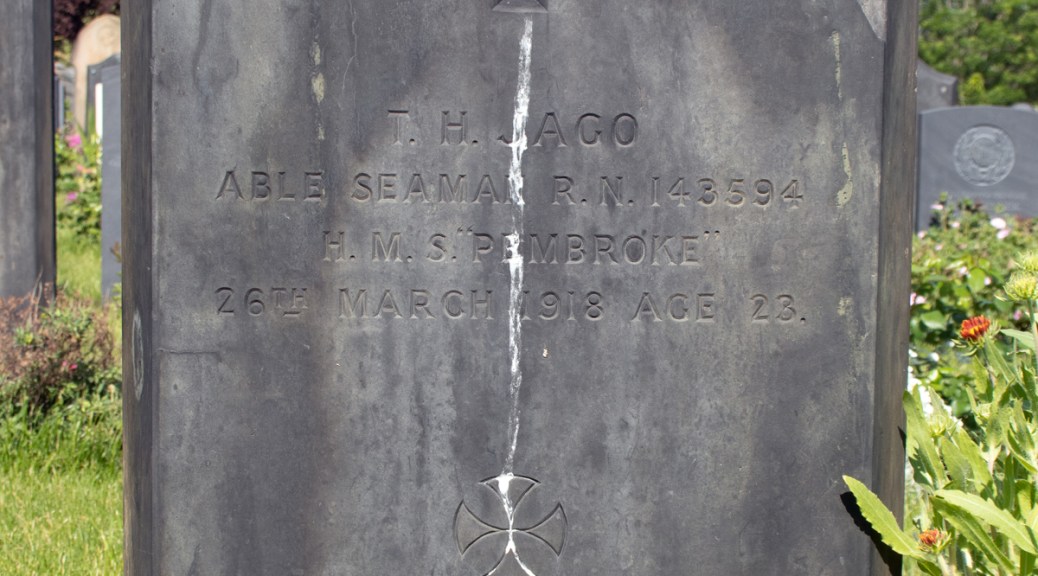
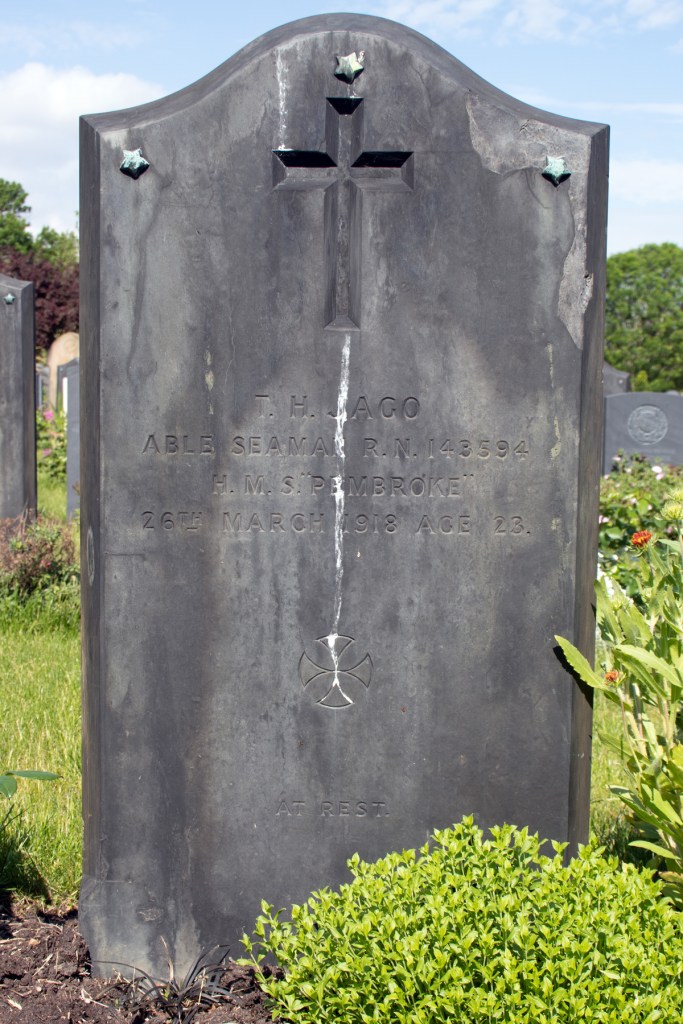
Thomas Henry Jago was born on 3rd June 1872 in Romney Marsh, Kent. The second of ten children, his parents were James and Elizabeth. James was a coastguardman, and his son was destined to be connected to the sea.

Thomas joined the Royal Navy on 19th December 1887. Given the rank of Boy 2nd Class, his records show that he was just 5ft (1.52m) tall, with dark brown hair, grey eyes and a fresh complexion. He was sent to HMS St Vincent, the training ship based in Haslar, Hampshire, and would remain there until June 1889. During this time, he was promoted and given the new rank of Boy 1st Class.

Thomas’ first ocean assignment was on board the corvette HMS Active. She would be his home for the next three years. In June 1890 he came of age, and was formally inducted into the Royal Navy as an Ordinary Seaman. By November 1890, he had proved his worth again, and was promoted to Able Seaman.

Over the next seventeen years, Thomas would serve on 21 ships. Frustratingly, the dates on his service records become a little muddled as time goes on, but it was while he was on board the RMS Empress of India in the late 1890s that he was promoted to Leading Seaman, then Petty Officer 2nd Class and Petty Officer 1st Class, all within a matter of three years.

In March 1903 he was demoted to Petty Officer 2nd Class, but the higher rank was reinstated eighteen months later. In September 1907, while serving on HMS Magnificent, Thomas seems to have been in some sort of trouble. This resulted in the removal of his ranking, and he was downgraded to Able Seaman once more, a rank that he would then hold until the end of his naval career.

In between voyages, Able Seaman Jago would have a shore base to return back to. His most common port seems to have been Chatham, and HMS Pembroke, the town’s Royal Naval Dockyard, features on his records more and more as time goes by.

In June 1912, after 22 years of service, Thomas was stood down to reserve status. Over the next few years his trail goes cold, although a later document suggests that he had moved to Sandgate, Kent, where he was renting rooms at 18 High Street.

War was soon raging across the world, and Able Seaman Jago was called upon to serve again. Assigned to London’s HMS President in December 1915, he quickly returned to Chatham Dockyard again. Over the next couple of years, Thomas serves on two further ships – HMS Diligence and HMS Mars – but HMS Pembroke definitely became a home from home.

In February 1918, Able Seaman Jago returned to the Royal Naval Dockyard in Chatham one last time. He was unwell by this point, and was admitted to the the town’s Royal Naval Hospital for an operation on his mouth. Thomas was suffering from carcinoma of the tongue, and the condition was to prove fatal. He passed away on 26th March 1918, at the age of 45 years old.

Thomas Henry Jago was laid to rest in the naval section of Woodlands Cemetery in Gillingham, Kent, not far from the base he had called home for so many years.


Able Seaman William Comley

Able Seaman William Comley

Charles William Comley was born on 10th May 1882 in the Somerset city of Bath. One of sixteen siblings – only seven of whom survived childhood – his parents were Charles and Mary. Charles Sr was a stonemason, and to avoid any confusions with their names, his son quickly became known by his middle name, William.

When he completed his schooling, young William found work with a baker. However he had his sights on bigger and better things, and on 1st August 1899 he enlisted in the Royal Navy. Being too young to formally enlist, he was given the rank of Boy 2nd Class, and was sent to HMS Northampton, a training ship, to start learning the skills he would later rely on.

After jut a couple of months Boy Comley was given his first assignment, on board HMS Curacoa, a cruiser which served as a training ship. He would spend the next six months on board, visiting the Atlantic coastal ports in Madeira, Las Palmas and Cape Verde. By the time William completed his time on Curacoa, he had been promoted to Boy 1st Class.

Returning to Britain, William was sent to HMS Vivid, the Royal Naval Dockyard in Devonport, Devon. He would only be based there for a matter of weeks, but during that time he turned 18, and was now of an age to be inducted into the navy proper. Now given the rank of Ordinary Seaman, his service records show that he was 5ft 3ins (1.6m) tall, with light brown hair, hazel eyes and a dark complexion. He was also noted as having a scar on the first finger of his left hand.

In June 1900, Ordinary Seaman Comley was assigned to the battleship HMS Magnificent, and from this point on, his naval career was set. Over the next sixteen years, he would serve on a total of seven ships, with HMS Vivid remaining his home base in between voyages. His service records continually note his very good character, and, from September 1903, he held the rank of Able Seaman.

When William’s initial twelve-year contract came to an end in the spring of 1912, he immediately re-enlisted. He had grown to 5ft 7.5ins (1.71cm) in height, and his records show that, while retaining his light brown hair and eyes, he now had a light complexion.

War broke out in the summer of 1914, and Able Seaman Comley was assigned to the newly launched HMS Tiger. He would remain part of the battleship’s crew for close to two years, and was involved in the Battle of Dogger Bank in January 1915.

On 3rd April 1916, William was medically disembarked in Scotland, suffering from pneumonia. He was admitted to the Royal Naval Hospital in Queensferry, but his condition turned septic. He passed away on 12th April 1916, a month short of this 34th birthday.

The body of William Charles Comley was taken back to Somerset for burial. He was laid to rest in the city’s majestic Locksbrook Cemetery.


Able Seaman William Comley
(from ancestry.co.uk)

Petty Officer William Feldon

Petty Officer William Feldon

William Feldon was born on 16th October 1878, the middle of three children – and the only son – to William and Jessie Feldon. William Sr was a carpenter from Highgate, Middlesex, but it was south of the Thames, in Lambeth, Surrey, that the family were raised.

When he finished his schooling, William Jr found work as a general labourer. He was drawn to bigger and better things, however, and a life at sea was to catch his eye. In June 1894, he enlisted in the Royal Navy as a Boy 2nd Class. His service records noted that he was 5ft 2ins (1.57m) tall, with brown hair, brown eyes and a fresh complexion.

By the time William had completed his initial training, he had been promoted to Boy 1st Class. He was then moved to HMS Pembroke, the Royal Naval Dockyard in Chatham, Kent.

By October 1895, he was given his first posting, on board the torpedo cruiser HMS Archer, and he would remain assigned to her for the next two years. During this time, William came of age and was formally inducted into the Royal Navy, and was given the rank of Ordinary Seaman. His commitment to the service was pretty clear, and, within seven months he had been promoted again, to Able Seaman.

After a short spell back at Pembroke, William was assigned to HMS Wildfire, another shore establishment just along the coast in Sheerness. He remained there for nine months, during which time he was promoted again, to the rank of Leading Seaman.

In May 1899, William was moved to another posting, on board the gunboat HMS Partridge. This assignment provide him with the route to further promotion: he remained on board until July 1901, having risen to Petty Office 2nd Class on 1st July 1899 and Petty Officer 1st Class on 23rd September 1900.

Over the remainder of his initial term of service, William served on six further vessels. The sea was in his blood by this point, and when his contracted ended on 15th October 1908, he re-enlisted without any hesitation.

Away from the Navy, William fell in love. On 23rd October 1909, he married Ada Plumpton, who was 25 years old, and who lived in Battersea, Surrey. The couple exchanged vows at St Faith’s Church in Southwark, but settled down in the village of Dovercourt, Essex. They went on to have two children, Doris, who was born in 1910, and Elsie, who came along the following year.

Back at sea, Petty Officer Feldon was assigned to the cruiser HMS Boadicea. He spent two years on board, before moving to another cruiser, HMS Blonde, for another two years. In between voyages, William returned to the Royal Naval Dockyard in Chatham.

On 13th January 1914, Petty Officer Feldon was posted to the battleship HMS Formidable, part of the Channel Fleet patrolling the seas of the southern coast of Britain.

Early on the morning of 1st January 1915, while off the Dorset coast, she was torpedoed by the German submarine U-24. Other ships in her convoy came to help, but after a couple of hours – and another torpedo strike – the damage was too great and she sank. 120 members of the crew were saved, but more than 540 officer and crew – including Petty Officer Feldon – were lost. He was 36 years of age.

William Feldon’s body was one of those recovered and identified. He was laid to rest in a communal grave in Lyme Regis Cemetery, in the hills above the Dorset town where he had been brought ashore.


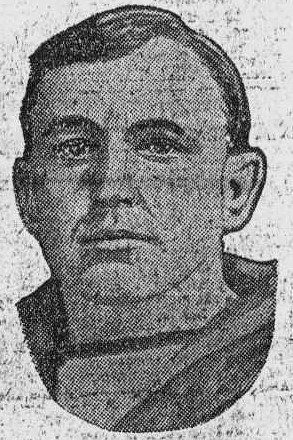
Leading Seaman Sidney Crabb

Leading Seaman Sidney Crabb

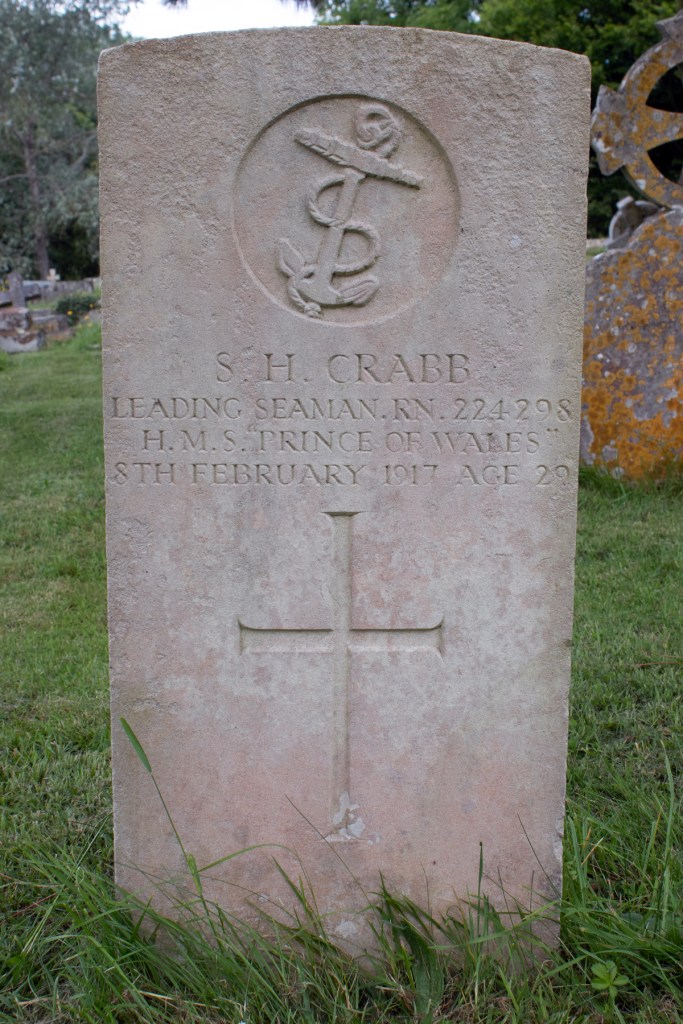
Sidney Harry Crabb was born in the seaside town of Lyme Regis, Dorset on 6th September 1888. One of nine children, his parents were Albert and Mary Crabb. Albert was a Trinity pilot, working on ships, and his son was destined to follow in his stead.

On 16th January 1903, Sidney enlisted in the Royal Navy. He lied about his age to be taken in, adding two years to his date of birth. That was still below the full enlistment age for the military, and he was taken on with the rank of Boy 2nd Class.

Sidney was sent to HMS Boscawen, a training ship, for his initial instruction. He remained there until mid-November 1903, by which time he had been promoted to Boy 1st Class. He then moved to the training battleship HMS Minotaur (which became HMS Boscawen II shortly afterwards), and remained on board for the next nine months.

On 7th September 1904, Sidney “came of age” (albeit he was two years younger than he had said), and was formally inducted into the Royal Navy. He was given the rank of Ordinary Seaman and, within a matter of days, was assigned to his first vessel, the tender HMS Fire Queen.

On 19th November 1904, Ordinary Seaman Crabb was reassigned, to the armoured cruiser HMS Sutlej. She was to remain his home for the next eighteen months, during which time Sidney was promoted again, to the rank of Able Seaman.

Over the next nine years, Sidney was to serve on six more vessels. On 9th December 1912, while back in Dorset, he married Lily Froom in the parish church of their home town, Lyme Regis. The couple would go on to have a son, Stanley, who was born in September 1914.

By this point, Able Seaman Crabb’s health was faltering. He was serving on board the battleship HMS Prince of Wales when war was declared, and had been promoted again, to Leading Seaman. By early October 1914, however, he was medically dismissed from service, having contracted pulmonary tuberculosis.

At this point, Sidney’s trail goes cold. He seems to have returned home, but it is unclear how much his failing health impacted on his daily life. The lung condition was ultimately to get the better of him: he passed away in Axminster, Devon, on 8th February 1917, at the age of 28 years of age.

Sidney Harry Crabb was taken the short distance back to Lyme Regis for burial. He was laid to rest in the town’s cemetery, overlooking the sea to which he and he late father had dedicated much of their lives.


Petty Officer 1st Class Albert Hodder

Petty Officer 1st Class Albert Hodder

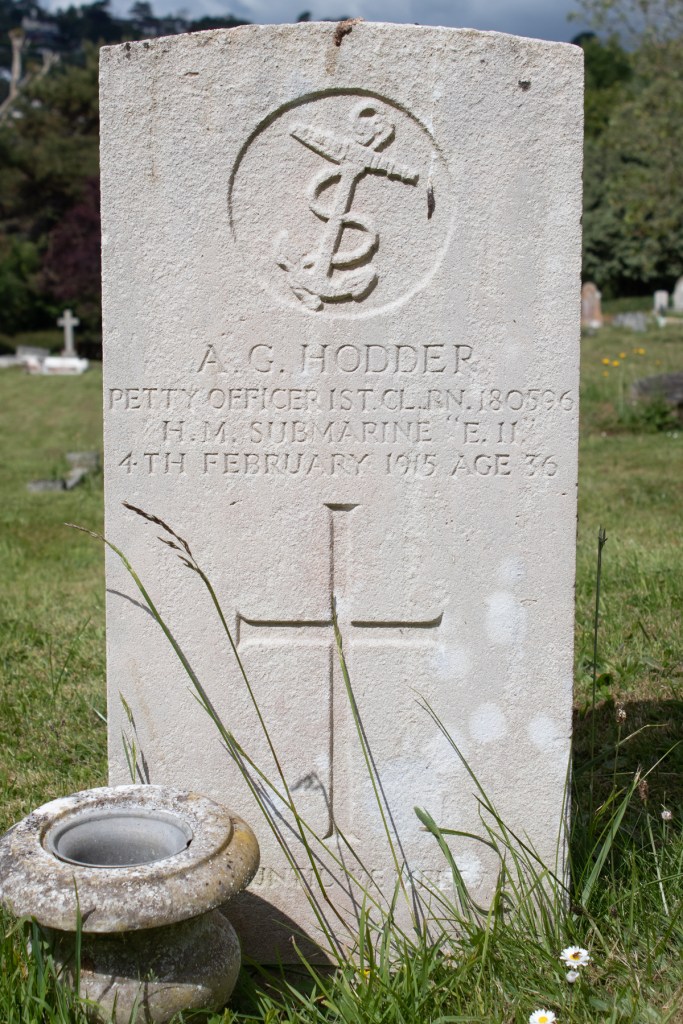
Albert George Hodder was born on 27th December 1878 in Lyme Regis, Dorset. The oldest of three children, his parents were Samuel and Ellen Hodder. Samuel was a general labourer who died in 1886, when he was 35 years of age. By the time of the 1891 census, Albert had given up school, and was working as a live-in cowboy in the nearby Devon village of Uplyme, bringing in what would be the only wage for him, his mother and his two younger brothers.

Working on a dairy farm would not bring in the money the his family would need. So, on 7th August 1894, Albert sought out more of a career and enlisted in the Royal Navy. His service records confirm that he was 5ft 4ins (1.62m) tall with brown hair, grey eyes and a ruddy complexion.

Albert was under the age to formally enlist, and so was given the rank of Boy 2nd Class. He was sent to the training ship HMS Boscawen, and, over the next eighteen months he received a basic education and naval induction. By the end of July 1895, he had been promoted to the rank of Boy 1st Class.

On 12th November 1895, Boy Hodder was assigned to the ironclad ship HMS Alexandra, and his naval career began. Over the next nearly two decades, he would serve on twelve separate ships, rising through the ranks as he did so.

When Albert came of age, on 27th December 1896, he was serving on board HMS Gibraltar. Formally inducted into naval service, he was given the rank of Ordinary Seaman. He spent more than three years on board Gibraltar, and rose to Able Seaman on 1st January 1899.

From here his career continued: He was promoted to Leading Seaman on 18th May 1903, Petty Officer 2nd Class on 1st April 1905 and Petty Officer 1st Class just two years later.

In the autumn of 1912, Albert’s career changed course. He was assigned to HMS Maidstone, a submarine depot ship, and a life under the ocean waves started to appeal. On 28th March 1914, Petty Officer Hodder was sent to HMS Dolphin, home of the Royal Navy Submarine Service, where he was trained up for new duties. By October that year he was to be found serving on board the newly-commissioned submarine E11.

Over the next few months he served in the North Sea, Baltic Sea, and the E11 was involved in a minor way in the defence of Scarborough in December 1914 and the Cuxhaven Raid ending on Christmas Day that year.

At this point, Petty Officer Hodder’s trail goes cold. He remained on the E11 until early February, by this time she was based off the Norfolk coast.

An inquest was held on Friday on the body of Albert George Hodder… of Lyme Regis, Dorset, a member of the crew of one of HM vessels, who died from the effect of immersion.

Evidence showed that at 9.20 on the previous Thursday night a petty officer heart the shout of “Man overboard.” He got on to a collier moored in the river and saw a black object float past. Unable to reach it, he jumped ashore and got into the ferry boat. He was then able to reach the object, which he found was the deceased. He held his head above the water while the ferryman pulled the boat to the quay. The deceased was got out in an insensible condition, a doctor sent for, and artificial respiration tired. Efforts were persisted till breathing was established, and he was then wrapped in blankets, with hot water bottle; but he succumbed to the effects of immersion and shock shortly after eleven. No one saw how the deceased fell overboard.

A verdict of “Accidental death” was returned.

[Diss Express: Friday 12th February 1915]

Petty Officer 1st Class Albert George Hodder was just 35 years of age when he died on 4th February 1915. His body was taken back to Dorset for burial, and he was laid in Lyme Regis Cemetery.


Able Seaman William Real

Able Seaman William Real

William Thomas Bradley Real was born in Lyme Regis, Dorset, on 31st December 1875. His parents were coastguard William Real and his wife, Sarah. William Jr seems to have lived with his maternal grandparents for most of his life, even though he went on to have seven younger siblings.

Sarah died in the spring of 1891, just weeks after the birth of her and William Sr’s youngest child, and William Jr took this as an opportunity to seek a career for himself. Living next to the sea, and with a coastguard for a father, a role in the Royal Navy seemed an apposite choice. He joined up on 26th May 1891, just 20 days after his mother’s funeral.

William was under age when he joined up, and so was given the rank of Boy 2nd Class. His service records show that he was 5ft 8ins tall, with brown hair, blue eyes and a fresh complexion. He was initially sent to HMS Boscawen, the training ship moored in Portland, Dorset, and remained there until January 1893. By this point his training had paid off, and he had been promoted to the rank of Boy 1st Class.

William’s first posting was on board the ironclad HMS Alexandra. Over the next year he was posted to two further vessels, and, when he came of age on 31st December 1893, he was formally inducted into the Royal Navy, and given the rank of Ordinary Seaman. Over the next 25 years, he would serve on a total of sixteen more ships, returning to HMS Vivid, the Royal Naval Dockyard in Devonport, Devon, between some of his voyages.

William’s career saw promotion – to the rank of Able Seaman on 4th February 1896. He also spent three days in the cells in August 1898, although the nature of his misdemeanour is unclear.

Away from his career William’s family life took hold. On 15th April 1911, he married Louisa French. Her parents owned and ran the George Hotel in Charmouth, Dorset. The couple went on to have a daughter, Maud, who was born in the spring of 1915.

When war was declared, Able Seaman Real was assigned to HMS Tiger. The most heavily armoured battlecruiser in the British Navy, She would go on to fight in the Battles of Dogger Bank, Jutland and Heligoland Bight, action William would have seen first hand.

By the spring of 1918, Able Seaman Real had become unwell. He was posted back to HMS Vivid on 1st May, and was admitted to the Royal Naval Hospital in Plymouth. His admission was not to be a long one: he died of heart failure just five days later, at the age of 42 years old.

The body of William Thomas Bradley Real was taken back to Dorset for burial. He was laid to rest in Lyme Regis Cemetery, overlooking the town in which he had been born.


Ship’s Corporal Thomas Berry

Ship’s Corporal Thomas Berry

Details of the civilian life of Thomas Joseph Berry are a challenge to piece together. He is not recognisable in any census returns, and baptism records don’t tally either.

The main resource for building a picture of Thomas’ life is the service record for his time in the Royal Navy. This provides his date of birth – 6th May 1882 – and suggests that he was born in Hornsey, Middlesex. He was working as a cabinet maker when he enlisted, the document also confirming that he was 5ft 4ins (1.62m) tall, with brown hair, brown eyes and a fresh complexion.

Thomas began his naval career on 29th July 1898. Below the age to formally enlist, he was given the rank of Boy 2nd Class. Over the next eighteen months, his time was split between two training ships based in Devonport, Devon, HMS Impregnable and HMS Lion. In April 1899 he was promoted to Boy 1st Class.

In February 1900, Thomas moved to HMS Vivid, the Royal Naval Dockyard in Devonport. On 6th May he came of age, and was formally enrolled in the navy, receiving the rank of Ordinary Seaman. From this point his career took off and, over the next sixteen years, he would go on to serve on board fifteen ships, seeing the world.

At his annual reports, Thomas’ conduct was regularly identified as Very Good, and his commitment was reflected in the progress he made through the ranks. By June 1901, he had been promoted to Able Seaman Berry. The summer of 1907 saw him move up to Leading Seaman, and three years later, Thomas was a Petty Officer. In November 1911 he was made Ship’s Corporal 2nd Class, and by the following spring he had been promoted again, this time to Ship’s Corporal 1st Class.

Away from the Royal Navy, Thomas’ personal life was developing. Again there is little documentation to provide any specifics, but he married a woman called Albertine Elizabeth in the early 1910s. The couple went on to have a son, Bernard, who was born on 15th January 1913, and the family seemed to settle down in Paignton, Devon – a later record giving Albertine’s address as 3 Alma Terrace, Well Street.

When war broke out in the summer of 1914, Ship’s Corporal Berry was serving on board the protected cruiser HMS Blake. In February 1916, he was assigned to the battleship HMS Revenge which served in the English Channel.

By this point, Thomas’ health seemed to be taking a downturn. He was posted back to HMS Vivid on 7th March, but was then transferred to Devon County Asylum in Exminster, suffering from “general paralysis of the insane“. His condition worsened and he passed away on 29th April 1916: he was days away from his 34th birthday.

Thomas Joseph Berry’s body was brought back to Paignton for burial. He was laid to rest in the town’s cemetery.


Ordinary Seaman John Diaper

Ordinary Seaman John Diaper

John Dolby Diaper was born in Stowupland, Suffolk, on 1st June 1898. He was the second youngest of ten children to George and Martha, and the older of two sons. George was a cattleman turned gardener, and it seems that John went into farm work when he completed his schooling.

When war broke out, John was called upon to play his part. He enlisted in the Royal Navy on 6th June 1917, joining as an Ordinary Seaman. His service records show that he was 5ft 4.5ins (1.63m) tall, with brown hair, grey eyes and a fair complexion.

Ordinary Seaman Diaper was sent to HMS Pembroke, the Royal Naval Dockyard in Chatham, Kent, for his training. The summer of 1917 was a particularly busy for the base, and temporary accommodation was set up in the Drill Hall; this is where John was billeted.

On the night of 3rd September 1917, Chatham suddenly found itself in the firing line as a wave of German aircraft bombed the town. The Drill Hall received a direct hit, and Ordinary Seaman Diaper was badly injured. He was admitted to the Royal Naval Hospital in the town, and would remain there for some time.

John’s injuries were severe and, although his treatment was ongoing, the impact on his overall health was detrimental. Ultimately, the air raid weakened his system, and his heart gave out. He died on 18th April 1918, more than seven months after the bombing: he was 19 years of age.

John Dolby Diaper was laid to rest in Woodlands Cemetery, Gillingham, alongside those who had given their lives on 3rd September.


Able Seaman Russell Engleback

Able Seaman Russell Engleback

The life of Russell Engleback seems destined to remain lost in the mists of time and the only concrete information for him relate to his military service.

Ordinary Seaman Engleback joined the Royal Naval Volunteer Service on 3rd July 1914, just weeks before the declaration of war. His records confirm his date of birth – 11th August 1896 – and his occupation, which was a printer. He was 5ft 5ins (1.64m) tall, and had dark brown hair, brown eyes and a dark complexion.

Russell was sent to HMS Victory – the Royal Naval Dockyard in Portsmouth, Hampshire – for training, before being assigned to the battleship HMS Commonwealth in October. He remained on board for the next two years, rising to the rank of Able Seaman during this time.

Able Seaman Engleback returned to HMS Victory in August 1916, but may have moved to another naval base, HMS Pembroke in Chatham soon afterwards. Certainly he was at the Kent dockyard when he fell ill in November, as he was admitted to the Royal Naval Hospital around this time.

Russell was suffering from nephritis – kidney disease – by this point, and it was a condition that was to ultimately kill him. He passed away on 23rd November 1916, while still admitted in hospital: he was just 20 years of age.

Russell Engleback was laid to rest in Woodlands Cemetery, Gillingham, not far from the Chatham dockyard. His pension records give Fred and Amelia Tiffin – Russell’s Sussex-based mother and stepfather – as his next-of-kin.


Petty Officer Ellis Sayer

Petty Officer Ellis Sayer

Much of the life of Ellis Edward Sayer seems destined to remained shrouded in the mists of time. Born in Attleborough, Norfolk on 31st January 1888, the only census return he appears on dates from 1891. This records him as living with his grandmother, Maria Simons, who was noted as being married and working as a laundress. Ellis’ 16-year-old uncle, William, was also living there and employed as a groom.

Jumping forward a few years and, on 31st December 1907, Ellis enlisted in the Royal Navy. His service records note that he had previously been employed as a messenger, and there seems to have been some previous marine connection. The document shows that he was 5ft 8ins (1.72m), with dark brown hair, blue eyes and a fresh complexion. He was also noted as having tattoos of a dragon, a rose and the word ‘unity’ on his left forearm.

As an Ordinary Seaman, Ellis was initially sent to HMS Pembroke, the Royal Naval Dockyard in Chatham, Kent, for his training. He was only there for a matter of weeks before being assigned to the HMS Cochrane then HMS Natal.

On 7th April 1908, Ordinary Seaman Sayer was attached to the cruiser HMS Lancaster, and he was to remain with her for close to two years. Promoted to Able Seaman on 26th November 1909, his time on board came to a close in May 1910.

Over the next few years, Ellis continued his progress in his naval career. After a year on shore in Chatham, he was assigned to HMS Blonde, and was promoted to Leading Seaman in August 1912. He returned to HMS Pembroke the next month, and remained attached to the dockyard for the next year and a half: his experience likely being used to support newer recruits.

On 6th March 1914, Leading Seaman Sayer was assigned to the battleship HMS Commonwealth. Over the next three years she patrolled the North Sea, from the Norwegian coast and Shetland in the north to Dogger Bank in the south. On 1st August 1915, Ellis receive a further promotion, holding the rank of Petty Officer for the remainder of his time on board Commonwealth.

On 18th February 1917, Ellis’ life came to an abrupt end. There is little information available about his passing, one record stating that he died from an injury to his kidney which was as a result of an accident, while another states ‘rupture of kidney caused through [a] fall’. HMS Commonwealth seems to have been moored in Chatham, however, as he passed away in the town’s Royal Naval Hospital. He was 29 years of age.

Petty Officer Sayer’s next-of-kins were noted as his sister, Mrs J Andrews, who lived in Norwich, and a friend, Mrs Ethel Hampton, who lived in Gillingham, Kent.

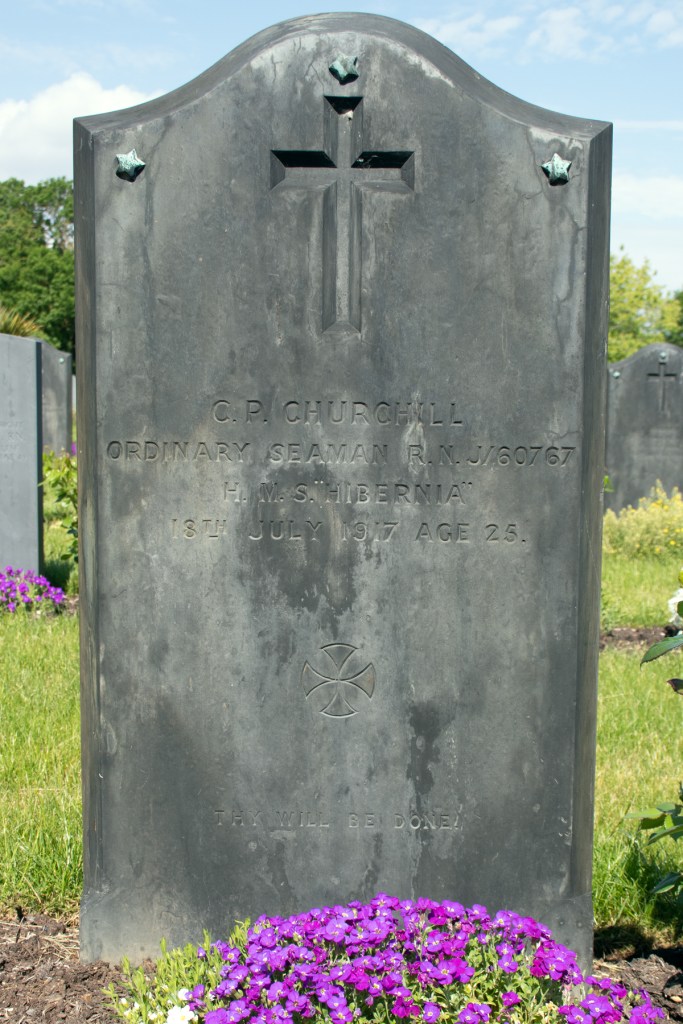
Ellis Edward Sayer’s body was laid to rest in the Woodlands Cemetery, Gillingham, not far from the dockyard he had called home for so long.