Category Archives: Role

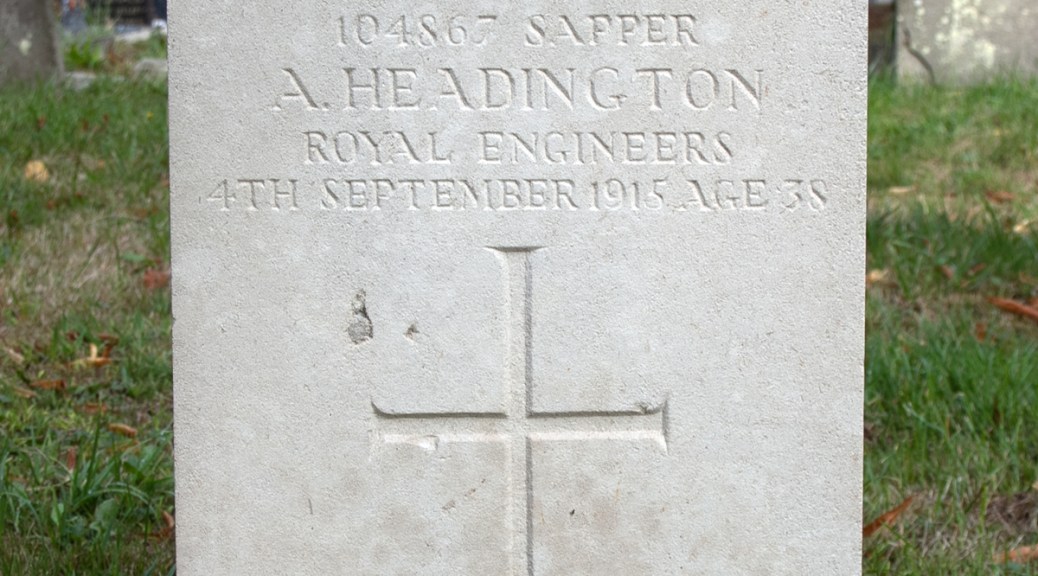
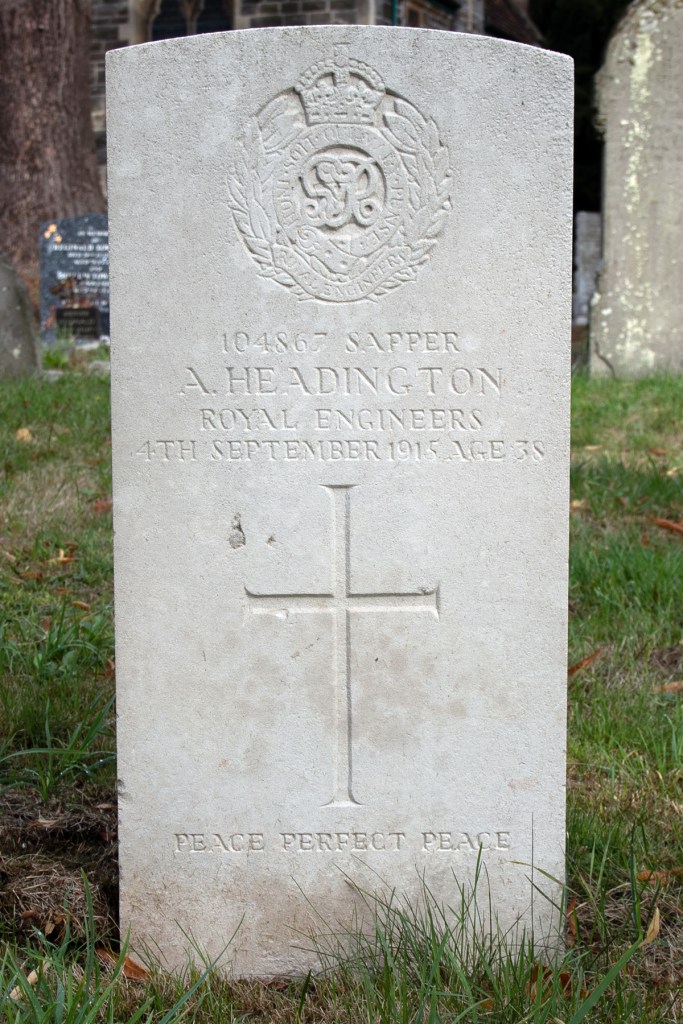
Sapper Albert Headington

Sapper Albert Headington

Albert Edward Headington was born on 5th December 1876 in Keynsham, near Bristol, in Somerset. The ninth of eleven children, his parents were Joseph and Jemima Headington. Joseph was a stonemason and, while he seems not to have had his father’s talents, Albert worked with the same material, becoming a bricklayer’s labourer when he left school.

On 29th May 1899, Albert married Ellen Gray. She was a mason’s daughter from Semley in Wiltshire, and it seems that he was either working there or had some connection with the family through his father’s work. The couple settled down in Keynsham, and went on to have two children, Harold, who was born in 1900, and Edith, who was born in 1912.

By the time of the 1911 census, the family had settled in a small house in the middle of Keynsham. Albert had, by this point, found other employment, and was working for Great Western Railways as a packer.

When war broke out, Albert stepped up to play his part. He enlisted on 22nd June 1915, joining the Royal Engineers as a Sapper. Sent for initial training in Chatham, Kent, he returned home on leave at the end of August. Tragically, he had fallen ill by this point, and died at home on 4th September 1915, having contracted cerebrospinal meningitis. He was 38 years of age.

Albert Edward Headington was laid to rest in the quiet cemetery of his home town of Keynsham.


Ellen went on to live a full life. She and Edith emigrated to Canada in 1921, following Harold, who had made the same move a year earlier. They all settled in the town of Welland, Ontario, not far from Niagara Falls.

Both of Albert and Ellen’s children married and had children of their own. Ellen never remarried, and passed away on 4th November 1956, at the age of 80 years old. She was laid to rest in the Holy Trinity Anglican Cemetery in Welland.

Private George Garrett

Private George Garrett

George Garrett was born in early 1895 in Abbotskerswell, Devon. He was the oldest of five children to George and Annie Garrett. George Sr was a labourer and the family seemed to travel with his work: his and Annie’s younger children were born in Aldershot, Plymouth and London.

When he left school, George Jr found work as an errand boy – the family were back in Devon by this point. War was on the horizon, however, and he would feel compelled to play his part. Full details of his service are not available, but it is known that he enlisted in the Devonshire Regiment, and was assigned to the 2nd Battalion.

Private Garrett arrived in France in December 1915, and was soon entrenched on the Western Front. Hi battalion was caught up in the Battle of the Somme and George was badly injured, having received a gunshot wound to his spine.

Medically evacuated to Britain, his wounds proved too severe for him to return to duty, and he was discharged from the army on 28th December 1916. It is not clear whether he returned home, but it seems likely that he remained in hospital in Exeter. He would never recover from his injuries. He passed away at the hospital on 18th April 1917, at the age of 22 years old.

George Garrett was laid to rest in the graveyard of St Andrew’s Church in Ipplepen, Devon, where his family were, at that point, living.


Private Leonard Luscombe

Private Leonard Luscombe

Leonard Luscombe was born in the spring of 1894 in the Devon village of Ipplepen. He was the fourth of five children to William and Bertha Luscombe, bakers and grocers in the village.

When he left school, Leonard found work as a clerk in a bank, but it is clear he was after bigger and better things. On 27th August 1912 he enlisted in the Royal 1st Devon Yeomanry as a Private. His service records show that he was 5ft 5ins (1.65m) tall, had good vision and was of good physical development.

Private Luscombe was sent to Salisbury Plain in Wiltshire for his training, but then returned to Devon at a base near Bovey Tracey, where he remained when war broke out in 1914. That autumn, he contracted tuberculosis, and it was to prove severe enough for him to be medically discharged from the army in February 1915.

Leonard returned to his life in Ipplepen, but his lung complaint was to dog him for the next few years. He finally succumbed to the condition on 26th October 1918, at the age of just 24 years old.

Leonard Luscombe, whose “cheerful hopefulness and intelligence gained him much popular sympathy” [Western Times: Saturday 2nd November 1918], was laid to rest in the family grave in St Andrew’s Churchyard in his home village.


Private Clarence Emmett

Private Clarence Emmett

Clarence Southwood Emmett was born in September 1899 in the Devon village of Ipplepen. The middle of five children, his parents were village butcher Thomas Emmett and his wife, Annie.

There is little information about Clarence’s early life, but when war broke out in 1914, he is evident that he wanted to play his part. He enlisted in the army as soon as he turned 18, and joined the 4th Battalion of the Wiltshire Regiment.

Sadly, full details of his time in the army, although a local contemporary newspaper sheds a little more light onto his health:

He soon contracted measles, and took a chill before he recovered. Since then he has been dangerously ill at different times, and has undergone various operations. He was recently removed to a hospital at Devonport where, until a few weeks ago, it was hoped he might recover.

Western Times: Friday 14th February 1919

Private Clarence Southwood Emmett died in the hospital on 8th February 1919. He was just 19 years of age. His body was brought back to Ipplepen, and he was laid to rest in the graveyard of St Andrew’s Church there.


Private Clarence Emmett

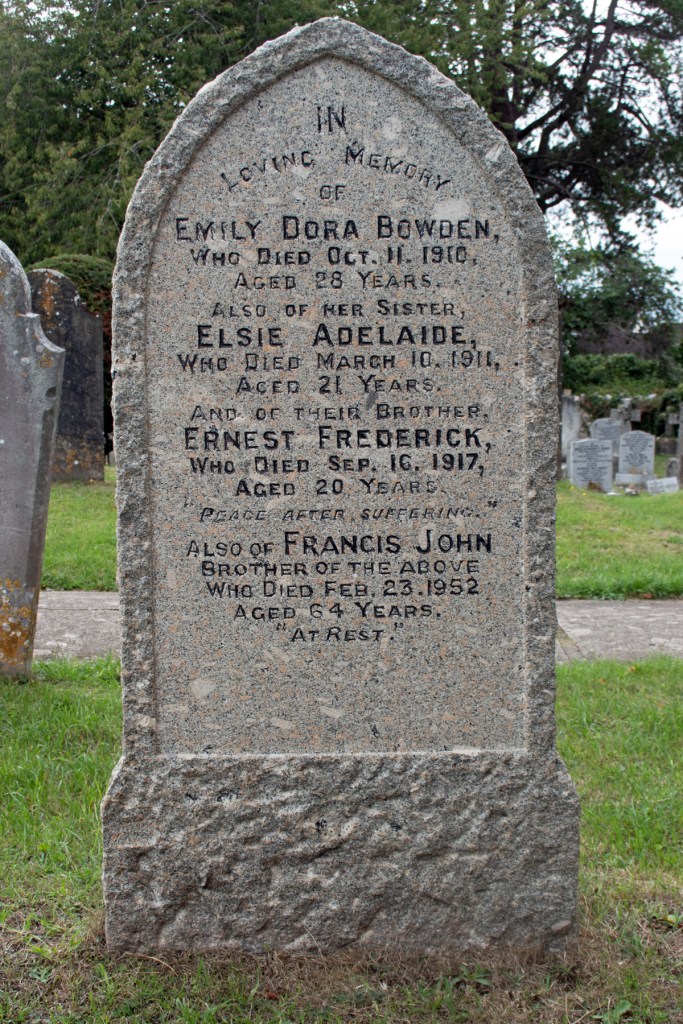
Private Ernest Bowden

Private Ernest Bowden

Ernest Frederick Bowden was born on 2nd November 1896 in Ipplepen, Devon. He was one of eleven children – and one of twins – to Frederick and Dora Bowden. Tragically, Dora died when Ernest was just over a year old, leaving Frederick and his older sisters to raise the family as best they could.

When he left school, Ernest found work as a page for a surgeon living in Paignton, before finding other employment as a chauffeur in Bovey Tracey. In his spare time, he was an avid bellringer at his local church.

War was coming to Europe, however, and in November 1915, he enlisted in the Gloucestershire Regiment. His service records noted that he was 19 years of age, and stood just 5ft 1.5ins (1.56m) tall. Assigned to the 14th Battalion, Private Bowden soon found himself on the front line. Arriving in France in July 1916, he spent four months there, during which he contracted tuberculosis and trench foot.

Medically evacuated to Britain for treatment, his conditions proved too severe for him to continue in the army. He was discharged from active service in December 1916.

For some months he had been at the Ivybank Dispensary, Exeter. Complications set in, and he rapidly sank just before reaching his 21st year.

Western Times: Friday 28th September 1917

Ernest Frederick Bowden had passed away on 16th September 1917, aged just 20 years old. He was laid to rest in the family grave at St Andrew’s Church, Ipplepen.


Private Alfred Bishop

Private Alfred Bishop

Alfred John Bishop was born on 25th April 1896 in the Devon village of Kingswear. The older of two children, his parents were John and Susanna Bishop. John was a farm worker, and his expertise with horses was not lost on Alfred, who became a delivery driver for a baker in Marldon, to the north of Paignton, when he left school.

On 3rd September 1917, Alfred married road contractor’s daughter Bessie Webber. Originally from Staverton, her family had settled in Ipplepen, and this is where the newlyweds made their home.

War had come to Europe by this point, and Alfred had enlisted in the Royal Army Service Corps (RASC). His background with horses came in useful, as he was assigned to the Yeomanry Remount Depot. Details of Private Bishop’s military service are lost to time, so it is unclear if he was attached to one of the RASC depots in the UK, or if he served abroad.

Alfred survived the war and, by 1919, was back home. He and Bessie had a son, Leslie, who was born on 23rd October 2020. Time with his son was to be tragically brief, however, as Alfred passed away on 14th April 1921. The cause of his death is not known, but he was just 25 years of age.

Alfred John Bishop was laid to rest in the graveyard of St Andrew’s Church in Ipplepen.


Bessie went on to marry again, to James Joint in the autumn of 1932. She passed away in Newton Abbot in 1980, at the age of 85.


Alfred’s brother James’ life was also cut short. He married Ethel Warren in 1925, and is recorded has having passed away in London in the autumn of 1935, when he was only 35 years old. Ethel was left with two young children to raise, and John and Susanna were to outlive both of their sons.


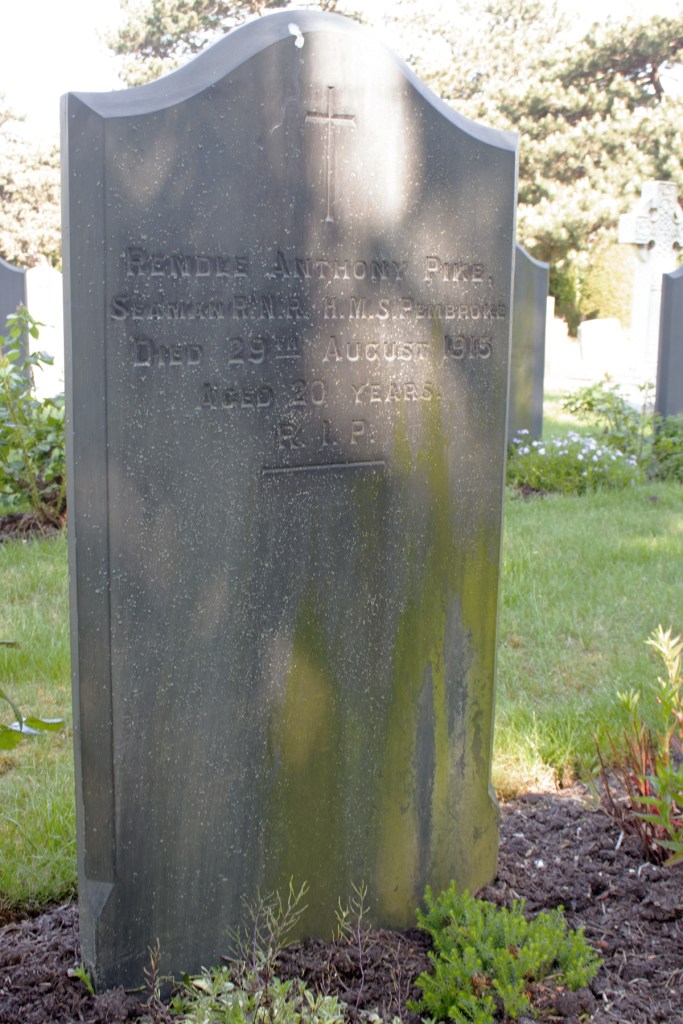
Seaman Rendle Pike

Seaman Rendle Pike

Rendle Anthony Pike was born on 9th May 1895 in Newfoundland. He was one of nine children to Lewis and Mary Pike, but there is little additional information about his early life.

Lewis was a fisherman, and it seems likely that Rendle would have had experience of seafaring when he was growing up. When war broke out, therefore, it made sense that he enlisted in the Royal Naval Reserve.

Again, full details of his service was unavailable, but Seaman Pike joined up within the first year of the war and, by the summer of 1915, he was based at HMS Pembroke, the Royal Naval Dockyard in Chatham, Kent.

Tragically, Rendle’s time in the navy was to be a short one. The next record available for him is that of his passing. According to his service documents, he died ‘of disease‘ on 29th August 1915. He was just 20 years of age.

Rendle Anthony Pike was laid to rest in Woodlands Cemetery in Gillingham, Kent, not far from the dockyard at which he had been based.


Stoker John Campbell, AKA John Connolly

Stoker John Campbell, AKA John Connolly

John Connolly was born on 7th April 1887 in Liverpool, Lancashire. There is little information available about his early life, although his parents were Thomas and Marianne Connolly. A Roman Catholic, he was baptised at St James Church and went on to marry a woman called Bridget, although details for the wedding are lost to time.

John must have had a level of proficiency when it came to ships and sea-faring as, when war had broke out, he was call up for service with the Royal Naval Reserve (RNR). He enlisted as a Stoker on 1st October 1915, using the surname Campbell. His records show that he was 5ft 6ins (1.68m) tall, had blue eyes and a fair complexion.

Stoker Campbell was based at HMS Pembroke, the Royal Naval Dockyard in Chatham, Kent. His time in service, however, does not seem to have been a happy one. In fact, within a few months of being conscripted, John had absconded and made his way back to Liverpool.

John was caught and was being brought back to Kent under escort, when the unimaginable happened.

John Connolly, a stoker of the RNR, attached to the Royal Naval Barracks, Chatham, was found dead on the railway near Warren House Crossing, between Sole Street and Cuxton, on Wednesday, with terrible injuries to his head.

Connolly, who is known also as Campbell, had been arrested as a deserter at Liverpool, and was returning to Chatham under escort on Tuesday… The train was very full, and deceased, with his escort, stood in the corridor, where several soldiers were also standing.

Some time after the train had left Herne Hill the escort, Leading Stoker John Edward Craig, left his prisoner to proceed to the lavatory, and when he returned one of the soldiers shouted “Jack, your prisoner had gone out the window.” The train was stopped, but the guard suggested that Craig had better proceed to Rochester instead of searching for the deceased, as the night was very dark. At Rochester Bridge the matter was reported to the military authorities, and a search along the line, then ordered, resulted in the discovery of the body of deceased…

A Lance Corporal of the 2/5th King’s Liverpool Regiment, one of the soldiers in the corridor, gave evidence at the inquest… He said he was standing close by deceased, but did not see him go out of the window, which was open at the time.

It was stated that is was usual in the Navy for one man only to act as escort, as all expenses connected with desertions had to be paid by the prisoners.

The jury found the death resulted from injuries received by deceased in a fall from the train, but that there was not sufficient evidence to prove whether the fall was intentional or otherwise.

South Eastern Gazette: Tuesday 8th February 1916

Whether John had intended to throw himself from the train will never be known. All that can be confirmed is that he died of his injuries on 1st February 1916, aged just 28 years old.

John Connolly was laid to rest in Woodlands Cemetery, Gillingham, not far from the dockyard at which he had been based. His epitaph mentioned both of the names he chose to go by, and the inscription: “Beloved husband of Brigid, her one and only love. Re-united RIP. Jesus mercy Mary help.


Stoker Alexander Maguire

Stoker Alexander Maguire

Alexander Maguire was born on 28th March 1880 in Glenarm, County Antrim, Northern Ireland. Little is known about his early life, apart from his parents’ names – James and Ellen.

Glenarm is a coastal village, and it is likely that Alexander would have had experience of seafaring from an early age. This seems to have spurred him into building a career and, on 16th December 1903, he enlisted in the Royal Naval Reserve as a Stoker.

With war getting closer, Stoker Maguire was called into formal service, and was assigned to the steamer SS Rathlin Head. He sailed the Atlantic in March 1914, and disembarked an New Orleans. It seems, however, that he missed his passage back home, although at this point, his whereabouts become a bit hazy.

Alexander was back in Britain by 13th January 1915, as his service papers record him in Liverpool. He then travelled to HMS Pembroke, the Royal Naval Dockyard in Chatham, Kent. This looks to have been his last move, however, as he passed away just two days later. The cause of death is simply recorded as ‘disease’: he was 34 years of age.

Alexander Maguire was laid to rest in the Roman Catholic section of Woodlands Cemetery in Gillingham, Kent, not far from the dockyard to which he had been assigned.


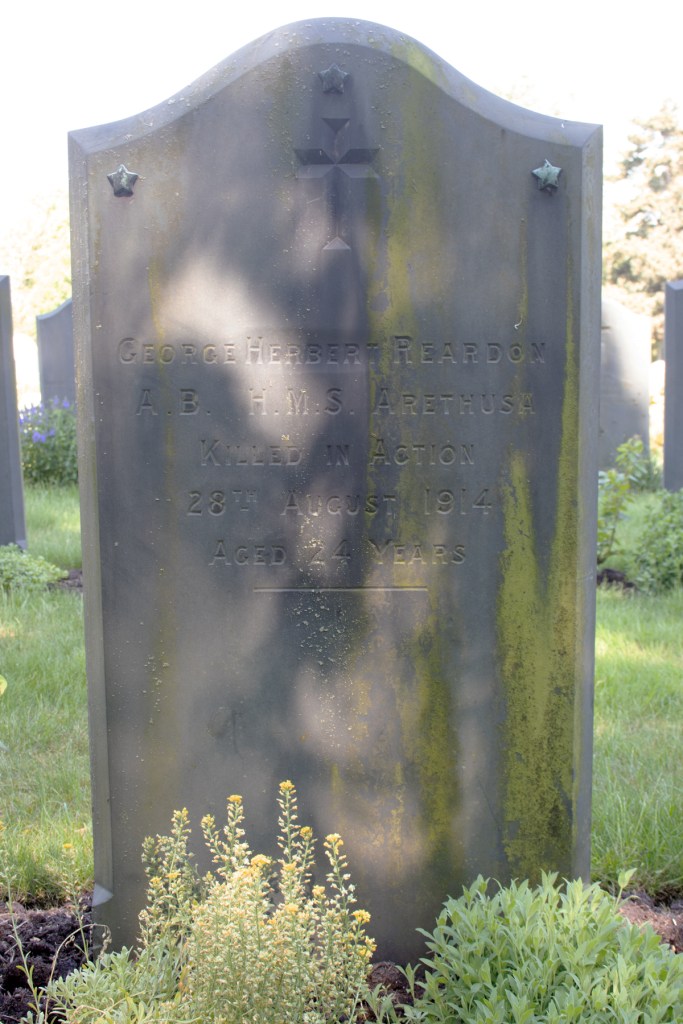
Able Seaman George Reardon

Able Seaman George Reardon

George Herbert Reardon was born on 29th March 1890 in St Pancras, Middlesex. The second of four children, his parents were tailor Thomas Reardon and his dressmaker wife, Mabel.

When he left school, George worked as an errand boy, presumably for his parents’ business. However, he wanted bigger and better things and, on 6th April 1906, he enlisted in the Royal Navy.

Initially underage, George was given the rank of Boy 2nd Class, and was sent to the training ship HMS Impregnable. After nearly a year there, he was promoted to Boy 1st Class and, on 5th March 1907, was given his first sea-going assignment. Over the following nine months, Boy 2nd Class Reardon served on five ships, the last being the battleship HMS Venerable.

It was while he was assigned to this ship that George came of age, and was formally inducted into the Royal Navy, on a twelve year contract. His service records show that he stood 5ft 5.5ins (1.66m) tall, had brown hair, brown eyes and a fresh complexion. He was also noted to have two moles, one on his right upper arm and another on the third finger of his left hand.

The now Ordinary Seaman Reardon remained on HMS Venerable until 1st February 1909, when he was transferred to another battleship, HMS Implacable. He was to spend the next eighteen months on board, and, while there, was promoted again, to Able Seaman.

In September 1910, George came on shore, and was assigned to HMS Pembroke, the Royal Naval Dockyard at Chatham, Kent. This was to be his base for the next few years, and he would return there in between voyages.

Over the next four years, he served on four more vessels – HMS St George, Vindictive, Forte and Ganges. Able Seaman Reardon’s last trip, however, was to be on HMS Arethusa, which he boarded on 11th August 1914, just a week after war had been declared.

The Arethusa was a light cruiser built at HMS Pembroke, and was the lead vessel of the Harwich Force, whose aim was to patrol the North Sea. On 28 August 1914, a fortnight after leaving port, she fought at the Battle of Heligoland Bight, and was seriously damaged by two German cruisers, SMS Frauenlob and Stettin.

Eleven souls were lost in the incident, Able Seaman Reardon among them. He was just 24 years of age.

The extent of the damage to HMS Arethusa meant she had to be towed back to England. Once on dry land, George Herbert Reardon was laid to rest in Woodlands Cemetery, Gillingham, not far from the dockyard at which he had been based.