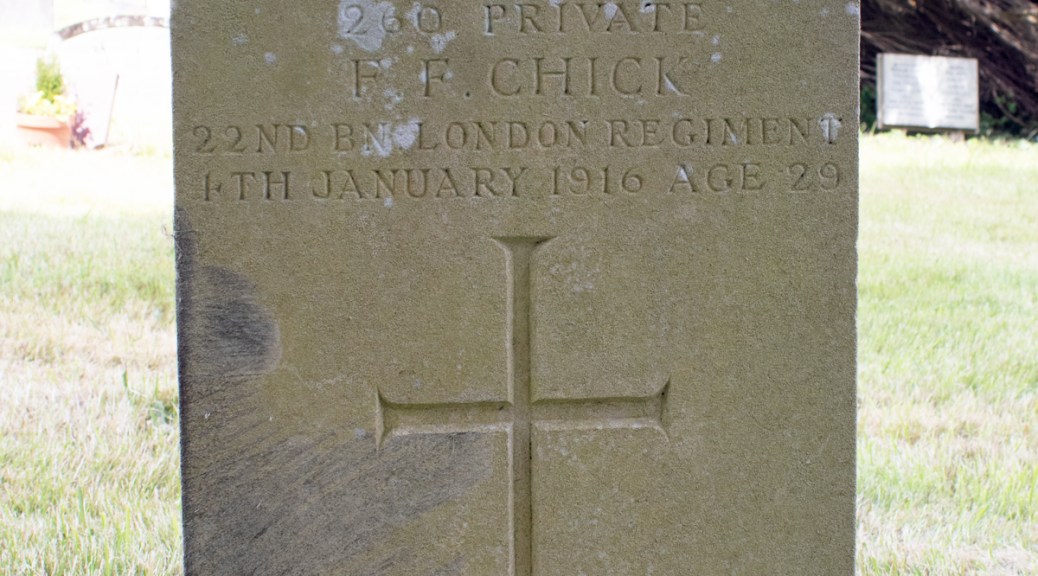
Francis Frederick Chick was born in the spring of 1886 in Axminster, Devon. One of eight children, his parents were brickmaker Edwin (or Edward) Chick and his wife, Elizabeth.
When he completed his schooling, Francis found work as a sawyer’s apprentice. However, he wanted bigger and better things and, on 19th November 1900, he enlisted in the army. At 14 years of age, he was just short of 5ft (1.52m) in height, and had fair hair, blue eyes and a fresh complexion.
Initially enlisting in the Royal Marine Light Infantry, Boy Chick was to serve three years in the naval division. The 1901 census found him based at the East Stonehouse Barracks in Devonport, Devon, where he was a Bugler.
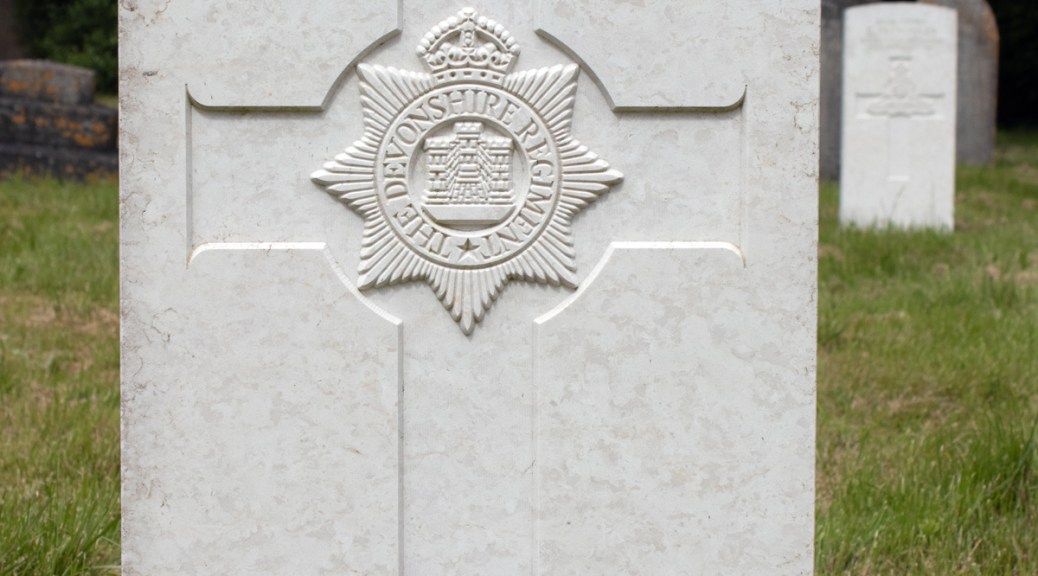
In September 1903, Francis transferred across to the Devonshire Regiment, remaining within the band structure. He came of age in March 1904, and, as a Private, he took on the role of Drummer. By the start of 1909, his unit had moved overseas, and the next census, taken in 1911, found Private Chick billeted in St George’s Barracks in Malta.
Francis remained in Malta for three years, and moved to Egypt with his unit in January 1912. By this point, having completed nearly twelve years’ service, he elected to stay on and renewed his contract. While serving in North Africa, he completed his induction into the Camel Corps, although by the end of the year, he was back on home soil after nearly four years abroad.
At this point, Francis seems to fall off the radar. It is unclear whether his move back to Britain was because he had been placed on reserve status, or due to medical reasons. To add to the mystery, when war broke out, he did not re-join the Devonshire Regiment, but enlisted in the London Regiment instead. He was assigned to the 22nd (County of London) Battalion, but later records note a connection to the 22nd (Wessex and Welsh) Battalion of the Rifle Brigade.
Private Chick was in Buckinghamshire by the winter of 1915/16, and it was here that he became unwell. Admitted to hospital in Aylesbury, he died of pneumonia on 4th January 1916: he was 29 years of age.
The body of Francis Frederick Chick was taken back to Devon for burial. He was laid to rest in the cemetery of his home town, Axminster.
Ralph William Page was born in the autumn of 1889, and was the second of five children to William and Elizabeth. William was a brush maker from London, but the family were initially born and brought up in Ottery St Mary, Devon.
By the time of the 1901 census, the family had upped sticks and relocated to Kilmington, near Axminster. Three of the family – William, Elizabeth and Ralph’s older sister Ethel – were all working in bone brush making, William as a maker, and his wife and daughter as drawers.
Ralph initially followed in the family trade, but this was not to be enough for him. He was already volunteering for the Devonshire Regiment, and he took the opportunity to join full-time. He enlisted on 11th September 1907. His service records show that he was exactly 18 years of age, and that he had black hair, brown eyes and a fresh complexion. Ralph stood 5ft 4ins (1.62m) tall and weighed 10st 9lbs (67.6kg).
Private Page initially enlisted for five years on active service. During that time he remained on home soil and, by the autumn of 1911, he was promoted to Lance Corporal. The following spring, he extended his term of service, in advance of being placed on reserve status later in 1912.
Away from army life, romance had also blossomed. On 2nd September 1912, he married Beatrice White at St Mary’s Church in Axminster. She was the daughter of a carpenter, who had also follower her widowed mother into lacemaking. The couple would go on to have three children: Florence, Ralph and Frederick. A fourth child, Peggy, passed away when she was just a matter of weeks old.
When war was declared in the summer of 1914, Ralph was sent with his unit – the 1st Battalion – to France. He saw action at Mons, Messines and Armentières in the next few months alone. In October, Ralph was promoted to Acting Corporal, and just two months later he was made Acting Serjeant.
In March 1915, things seem to have changed for Ralph. He was transferred to a Depot unit on home soil, and reduced in rank to Private. Nothing in his service records suggests any misdemeanour leading to his transfer.
Private Page remined on home soil until the end of 1916. Attached to the 3rd (Reserve) Battalion, he made his way back up through the ranks again, and was a Corporal by the time he was reassigned to the 2nd Battalion and sent off to France once again that December.
Ralph was to be firmly entrenched on the Western Front over the next five months. It was during the German retreat back to the Hindenburg Line in the spring of 1917 that he received the injury that would remove him from the war. On 23rd April, the now Lance Serjeant Page was shot in the abdomen. He was medically evacuated to Britain for treatment, and did slowly recover. Ralph’s need for an abdominal belt meant that he was no longer fit to serve and he was ultimately discharged from the army on 29th November 1917.
Ralph returned home to Devon, but the war had taken its toll on his health. When pandemic spread around the world as the conflict drew to a close, he was to succumb. He passed away from a combination of the influenza and pneumonia on 5th November 1918, at the age of 29 years old.
Ralph William Page was laid to rest in Axminster Cemetery, Devon, not far from where his widow and children lived.
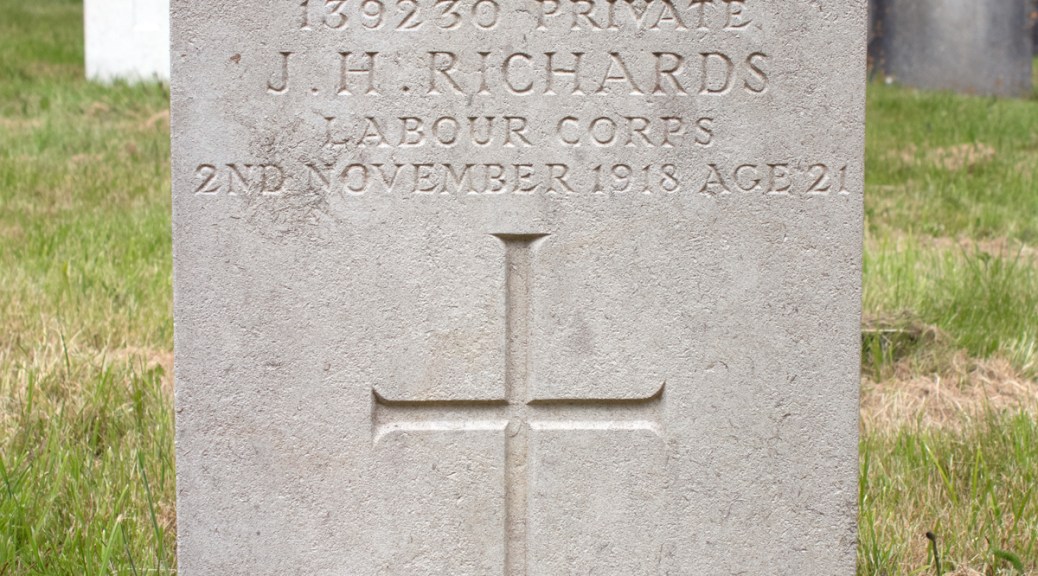
John Henry Richards was born in Sutton, Surrey, on 3rd June 1896. The third of four children, his parents were John and Harriet Richards. John Sr was an engine driver and stoker, while his son found employment as a greengrocer’s assistant when he finished his schooling.
When war came to Europe, John Jr stepped up to serve his King. Full details of his military service have been lost to the annals of time, but he had certainly enlisted by the end of 1917. Initially joining the Devonshire Regiment, he subsequently transferred to the Labour Corps, and was assigned to the 385th Coy.
Private Richards seems to have been based in Kennington near Lambeth, Surrey. He married Dorothy Ford on 23rd December 1917, at which point, both bride and groom were living at 47 Hartington Road.
The family’s geographical locations become a bit confused at this point: Dorothy had been born in Bristol, Gloucestershire, but the 1911 census found her living in Ottery St Mary, Devon, with her paternal grandparents. John seems to have served some time in Devon as well, but it is unclear whether the couple met in the South West or London.
By the autumn of 1918, Private Richards’ unit was certainly in Devon: it was here that he contracted pneumonia, and he was admitted to the No. 1 Section Hospital in Devonport for treatment. This was to prove ineffectual, however, and he passed away on 2nd November 1918. He was 22 years of age.
Dorothy’s family appears to have been living in Axminster by this point, and it is certainly somewhere he would return to in later years. The town’s cemetery is where she would bury her late husband: John Henry Richards at peace again.
John Samuel Channing was born in Axminster, Devon, in 1884, the oldest of four children to John and Elizabeth. John Sr was a bricklayer’s labourer, and, when Elizabeth died in the late 1890s, he struggled to look after the whole family.
The 1901 census found John Sr and his two youngest children living with his widowed mother, while John Jr and his sister Sarah were sent to live with their maternal grandmother, widow Mary Telford. Both were of age to leave school, and both were employed: Sarah as a lace mender, John Jr as a nail brush finisher.
John Jr married a woman called Elizabeth in 1910. There is little additional information available about her, but by the time of the following year’s census, the young couple were boarding with an Eliza Banks in Silver Street, close to the centre of the town. John was employed as a toilet brush maker, adding that they were bone nailbrushes. Within the year, Elizabeth gave birth to their only child, son Leslie.
In addition to his brushwork, John had also enlisted in the local militia. He joined the Devonshire Regiment on 1st April 1908, although his service details are lost to time. Private Channing’s unit – the 4th Battalion – were based around Exeter, but, when war was declared, they moved to India. There is no evidence, however, that John went with them: promoted to the rank of Lance Corporal, it is likely that his experience was better used on the Home Front, training new recruits.
John’s wartime experience was not to be a lengthy one, however. By 1st April 1915, he had been medically discharged from service, having contracted tuberculosis. At this point, Lance Corporal Channing’s trail goes cold, but it is likely that he returned home to Elizabeth and Leslie.
The next record for John is that of his passing. He died from tuberculosis at home on 29th December 1918: he was 34 years of age.
John Samuel Channing was laid to rest in Axminster Cemetery, a short walk from where his widow and son still lived.
Alfred Edward Wallis was born on 7th February 1876, the youngest of five children to Charles and Mary. Charles was a carpenter and joined from Bruton in Somerset, but the family were born and raised in the Walcot area of Bath.
By the time of the 1901 census, Alfred was the only one of the Wallis siblings to remain living with his parents. They were living at 14 Belgrave Crescent, to the north of the city, and, at 25 years of age, Alfred had taken on work as a printer’s compositor.
On Christmas Day 1907, Alfred married Caroline Little. She was a farmer’s daughter from Cheltenham, Gloucestershire, and, at the time of their nuptials, the young couple were living at 8 Seymour Road, the next road over from his parents.
Alfred and Caroline would go on to have three children: Harold, Winifred and Lilian. The 1911 census found that they had moved again, and were now settled in a small terrace at 22 Cork Street, in the Weston area of Bath.
War broke out across Europe in the summer of 1914, and, in on 19th December 1915, Alfred enlisted in the Army Service Corps. His records noting that he was 39 years and 10 months old, stood 5ft 5ins (1.65m) tall, and weighed 128lbs (58kg).
Private Wallis was not formally mobilised until the August 1916. Attached to the 19th Company, he was sent for duty to the Queen Mary’s Military Hospital in Whalley, Cheshire. Full details of his duties are unclear, although he would remain in the area for the next couple of years.
As the war progressed, it is likely that Alfred was exposed to the illness with which the patients were being admitted. In October 1918, he became unwell, and was admitted to hospital with a combination of influenza and pneumonia. The hospital he was sent to was the King’s Lancashire Military Convalescent Hospital in Blackpool, Lancashire, so it is likely that he had left Whalley by this point.
Private Wallis’ illness was to prove too much for his body to bear. He passed away while still admitted, on 29th October 1918. He was 42 years of age.
The body of Alfred Edward Wallis was brought back to Somerset for burial. He was laid to rest in the majestic setting of Bath’s Locksbrook Cemetery.
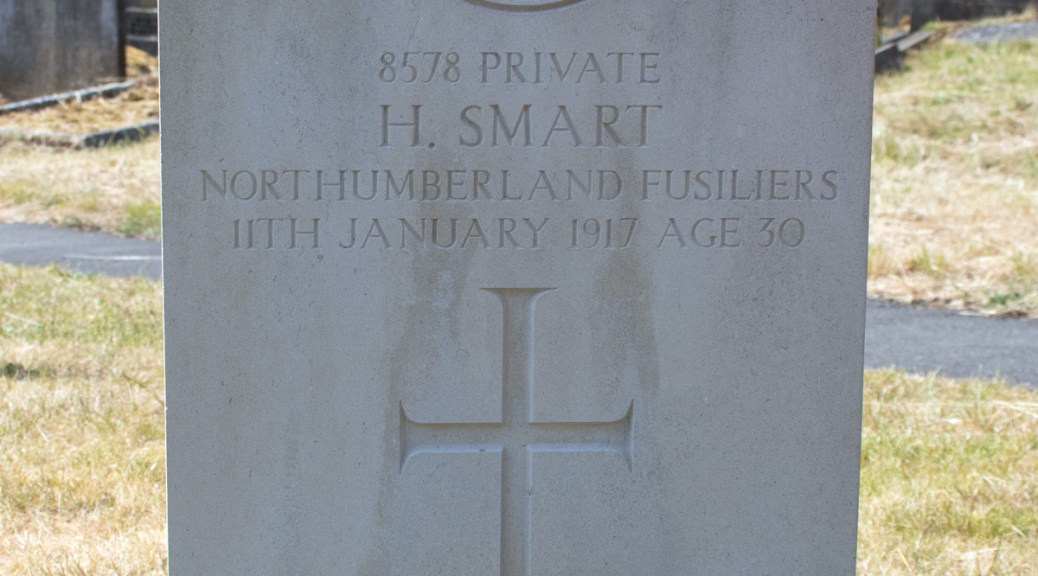
Herbert – or Bertie – Smart was born on 9th February 1885, and was the middle of five children to John and Lucy. John worked as a gardener and the family were raised in the Kent town of Sidcup.
By the early 1900s, Bertie had moved to London, and had settled in Islington, Middlesex. He was working as a fruiterer and, on 19th May 1907, he married Lucy Purton, a policeman’s daughter from the east of the capital.
The couple set up home in Kensington, and went on to have four children: Frank, Herbert, Kathleen and Frederick. The 1911 census found the family renting three rooms in a tenement at 36 Netherwood Road. They were sharing their home with Lucy’s younger brother, Frederick.
When war broke out across Europe, Bertie was called upon to play his part. Full service details have been lost to time, but it is clear that he enlisted in the second half of 1916, and was assigned to the Northumberland Fusiliers. Attached to the 2nd/4th Battalion, it seems that he may have been sent to the South West for training.
Private Smart’s time in the army was not to be a lengthy one. He came down with cerebrospinal meningitis, and was admitted to the War Hospital in Bath, Somerset. The condition was to get the better of him: he passed away was still admitted, on 11th January 1917. He was 31 years of age.
Herbert Smart was laid to rest in the sweeping grounds of Bath’s Locksbrook Cemetery.
These were tragic times for the Smart family. Lucy’s brother died just four months after her husband, and Lucy herself passed away in February 1918. In just over a year, the four children – Frank, Herbert, Kathleen and Frederick – had become orphans.
John Adams Boura was born in the spring of 1868 in Kensington, Middlesex. The middle of three children, his parents were Julien and Esther Boura. Julien was the son of a French immigrant, who had built up two businesses as a dyer and cleaner (the first business having failed).
John followed in his father’s line of employment, and, by the time of the 1891 census, he was living with business partner Isabel Knight, at 3 St Mark’s Place in Wimbledon, Surrey. Work and pleasure were obviously mixing, though, and, on 3rd October that year, the couple married in the nearby Queen’s Road Chapel.
The newlyweds would go on to have a son, also called John, in March 1895. By the start of the new century, the family has moved out of the capital, relocating to Aldershot, Hampshire, where they set up a new business at 111 Victoria Road, in the town centre.
Within the next decade, however, the Bouras had moved back to the London suburbs, setting up home and business in Merton, Surrey. A new alliance was forged at 106 Kingston Road, with the three sharing their home with Henry and Adelaide Shelley. All four adults were involved in the business, while the now 16-year-old John Jr was employed as a dentistry improver.
Julien – who was also known by his middle name, Aimé – and Esther had moved to Maidenhead in Berkshire by this point, and in September 1910, it seems that their son visited them. An argument seems to have erupted, and John was arrested. Taken before the Maidenhead Petty Sessions, he was tried for unlawfully and maliciously damaging the glass of certain windows, exceeding he amount of £5 to wit £8 6s., the property of Aimé Boura. John was find a total of £10 for the damage.
When war broke out, John stepped up to serve his country. While his service documents are long since lost, other records suggest that he had enlisted by the summer of 1916, and likely volunteered, give he was in mid-40s by this point. Private Boura was assigned to the Royal Army Service Corps, and was to be based at the Supply Depot in Bath, Somerset.
It is probable that John’s dying and cleaning background meant that he was involved in uniforms in some way, although nothing concrete remains to document his time in the army. During the early part of 1917, he fell ill, coming down with bronchitis. He was admitted to Bath War Hospital, but the condition was to get the better of him. Private Boura passed away on 9th February 1917, at the age of 48.
The body of John Adams Boura was laid to rest in Bath’s majestic Locksbrook Cemetery, not far from the hospital in which he had passed.
Robert Jenkins Kelway was born in the autumn of 1897 in the Devon town of Torquay. The oldest of four children, his parents were Robert and Rosina Kelway. Robert Sr had been born in Paignton and, when a job working as a carter for Hollicombe Gas Works came up in around 1900, he moved the family back down the coast.
By the time of the 1911 census, the Kelways were living at 3 Hollicombe Terrace, on Torquay Road: their home was one of a row of terraced houses build specifically for the gas works employees, and all of their neighbours were employed there in one form or another.
Robert Jr was 13 years old at this point, and seemed to have completed his schooling: his entry on the census confirms he was employed as a telegraph messenger for the Post Office.
Everything was to change when war was declared and, on 22nd April 1915, Robert Jr voluntarily stepped up to play his part. Lying about his age – he said he was 19, when he was, in fact, two years younger – he was nonetheless taken on his word. His service records show that he was 5ft 5ins (1.65m) tall and weighed 141lbs (64kg). He was noted as having brown hair, blue eyes and a fresh complexion.
Assigned to the Devonshire Regiment, Private Kelway was initially attached to the 3rd Battalion. At the end of October 1915, however, he was transferred to the 8th (Service) Battalion, and dispatched to France. His unit was caught up in the Battle of Loos, but it was at the Somme the following year that Robert would really have cut his teeth in fighting.
Private Kelway saw out the Somme relatively unscathed, but, on 27th December 1916 his luck was to run out. He was shot in the back, damaging one of his lower vertebra, and was medically evacuated to Britain for treatment.
Robert was admitted to King George’s Hospital in South London, and it was quickly ascertained that the damage to his spine was permanent. Paralysed from the waist down, he was, not surprisingly, no longer able to continue in the army in any capacity. His discharge papers noted that he was a ‘steady, sober and honest’ person.
From this point, details of Robert’s life are sketchy. It is unclear whether he was able to return home, although he was definitely back in Devon by the spring of 1919, as this is where he died. Admitted to the Royal Devon & Exeter Hospital, he passed away from pneumonia on 18th April, aged just 21 years old.
Robert Jenkins Kelway was laid to rest in Paignton Cemetery, a short distance from where his family lived, in the Preston area of the town.
Melbourne Linas Mumford was born on 13th June 1898, and was one of seven children to William and Fanny. William was a Gunner in the Royal Artillery, and while Melbourne and his siblings were born in the Kent village of Cliffe, the family soon moved to rented rooms in Stafford Street, not far from his new barracks in Gillingham, Kent.
It seems that William’s term of service came to an end, and he moved the family to Devon, where he had been born. Fanny died in 1909, at the age of just 33, and he was suddenly left to raise the family alone. The1911 census found William and his three sons – including Melbourne – living in a cottage in Paignton. William was by now working as a nurseryman, while Melbourne’s older brother, also called William, was bringing in some money as a paperboy for Smith & Sons.
When war came to European shores, Melbourne stepped up to play his part. Full service details have been lost to time, but later documents confirm that he had enlisted in the Devonshire Regiment on 9th August 1915. Attached to the 9th (Service) Battalion, papers confirm that he was 5ft 3.5ins (1.61m) tall, and weighed 99lbs (44.9kg).
Private Mumford’s unit fought as Loos in 1915, and at the Somme in 1916, but it was at Ypres, on 7th October 1917, that he was badly injured. Melbourne was shot in the left thigh, which caused a compound fracture in his femur. Medically evacuated to Britain for treatment, he spent time hospitalised in Manchester.
Recuperation was ongoing, but was not to prove successful, and Private Mumford was eventually discharged from the army on 22nd January 1919.
Melbourne’s treatment would continue, however, and he had a further operation on his leg that summer. Tragically, however, his body had been weakened, and he passed away following the procedure, on 27th August 1919. He was just 21 years of age.
The body of Melbourne Linus Mumford was laid to rest in Paignton Cemetery, not far from the family home in Corsham Road.
Private Mumford’s Dependant’s Pension was assigned to Mrs Kate Mumford, who was recorded as his mother. This would suggest that William had remarried after the 1911 census, although there are no records to confirm this.
Thomas Fidler was born on 15th May 1881 in Newbury, Berkshire and was the fourth of eight children to Charles and Sarah. Charles was a groom, who travelled where the work was, and, by the time of the 1901, the family has relocated to Whitchurch in Hampshire.
When he finished his schooling, Thomas found work as a dairyman. However, he had always had his sights on bigger and better things, and, having been a volunteer for the local militia, he was keen to become a full soldier. Things did not go immediately to plan though, and he was initially turned down because he was under height – he was just 5ft 3ins (1.6m) tall when he turned 18.
But Thomas was persistent, and, on 27th June 1898, he was formally enrolled in the Hampshire Regiment. Along with his height, his service records confirm other details about the young man he had become. The document show that he weighed 124lbs (56.2kg), and that he had brown hair, brown eyes and a fresh complexion. The records advise that he was considered fit for duty, but also note that he was given special authority to enlist, presumably to bypass the concerns about his height.
Private Thomas Fidler would go on to build up quite a military career for himself. He spent nearly two years on home soil, before his unit was shipped out to South Africa. During his time in the colony, he served in a number of the campaigns, and was awarded with the Queen’s South Africa medal, including clasps for Cape Colony, Orange Free State and Transvaal, and the King’s South Africa Medal 1901-1902.
After more than two years spent overseas, Thomas’ unit returned to Britain. He would remain on home soil until 1903, extending his service beyond the five compulsory years, and choosing to remain on active duty, rather than being stepped down to reserve status. In September of that year, his unit was on the move again, and he was transferred to Malta.
It would not be until September 1905 that Private Fidler saw home soil again. He was formally stood down from duty the following June and assigned to the Army Reserve. Interestingly, his transfer papers recorded that his conduct was indifferent, disobedient… inclined to drink.
Thomas’ attitude over the years was evidenced by his entries in the Regimental Defaulter Book. He was disciplined no fewer than twelve times during his military career. His offences included being absent from parade and using insubordinate language. While stationed in Malta, he was punished for being drunk four times. Over the years, Private Fidler spent 125 days confined to barracks, and was fined a total of £1 2s 6d for his crimes.
When he was not confined to barracks, Private Fidler would likely be found in a sick bay. Between January 1901 and September 1905, he spent 342 days in hospital with conditions ranging from fevers, psoriasis, scabies and gonorrhoea.
On 22nd March 1905, while serving in Malta, Thomas was admitted to hospital having suffered a fractured jaw following a scuffle. The cause of the injury is recorded in detail in an eleven-page report, which outlined that Private Fidler had been out in Valetta, and ended up quite drunk. He was approached by a couple of military police officers, and became abusive towards them. While trying to take off his boots, a private from another regiment, who was also drunk, came along and punched him in the face, fracturing his jaw. Both men were arrested and taken back to barracks. The investigation in to the incident found that, while Private Fidler was off duty at the time, he was to blame for the altercation.
In June 1906, Thomas returned to civvy street, and to his former job as a dairyman. On 5th February 1907, he married Tryphena Snook, who was the daughter of his employer. The couple had had a son the previous year, and would go on to have three more children in the next few years.
The 1911 census found the young family living in Sparsholt, Hampshire, the household being made up of Thomas, Tryphena and their older two children, Tryphena’s parents, William and Emma, and a boarder, William Clark, who was a carter on the farm.
By the summer of 1914, Thomas had been formally stood down from the army, his contract coming to an end on 26th June. A storm was brewing over the Channel, however, and he would soon be called upon to play his part once more.
Details of Thomas’ re-enlistment into the army have been lost to time. It is likely that he was called upon quite quickly. He was assigned to the South Wales Borderers, and, with the experience he had under his belt, was given the rank of Lance Corporal.
Thomas’ unit – the 4th (Service) Battalion – was initially sent to France, and he arrived there early in July 1915. Within a matter of weeks, however, the battalion moved on to the Eastern Mediterranean, ending up at Gallipoli.
Lance Corporal Fidler’s time in on the peninsula would have been fraught with danger. In the autumn of 1915, he was badly injured and was medically evacuated to Britain for treatment. Admitted to hospital in Devon, his wounds were to prove too severe, and he passed away on 5th November, at the age of 34.
The funeral rook place at Paignton… of Lance-Corpl. Thos. Fidler, of the 4th South Wales Borderers, who died at Oldway Hospital on Friday as a result of wounds sustained at Gallipoli. The widow and other mourners followed, and the Matron of the Hospital (Miss Blackmore) was among those present. Wounded convalescents from Oldway and a Company of the 7th Devons, under Capt. Brearley, attended, and the Devons provided a firing party.
[Exeter and Plymouth Gazette – Tuesday 09 November 1915]
Thomas Fidler was laid to rest in Paignton Cemetery.










 Death and Service