Category Archives: Private

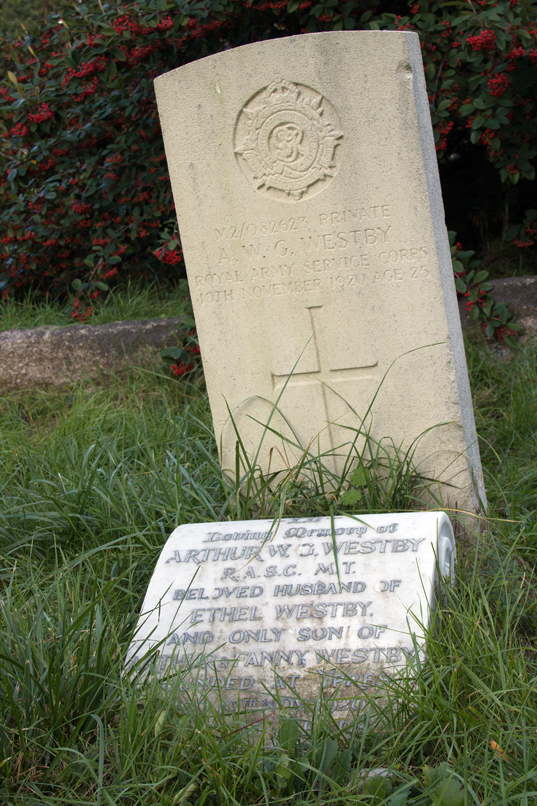
Private Arthur Westby

Private Arthur Westby

Arthur William George Westby was born in the spring of 1895, the only child to Arthur Henry Westby and his wife, Emma. Arthur Sr was a Corporal in the Scots Guards, but, beyond the fact that his son was born in Clapham, South London, there is little further information about Arthur Jr’s early life.

His father’s military career must have taken him across the country – the 1901 census lists Emma and Arthur Jr living in Bolton, Lancashire, even though there seem to be no connections with the county for them.

The records for Arthur Jr go quiet until 1920. At this point, documents hint at his military service during the Great War.

The death notices in the Sussex newspapers confirm his passing:

On November 19th 1920, at The Cedars, 13 Browning Road, Worthing, Arthur WG Westby (late MT, RASC), beloved husband of Ethel Westby, and only son of Ex-RQM Sergeant and Mrs Westby, 34 Wenban Road, Worthing. Patiently suffered to the end, result of Active Service.

Worthing Gazette: Wednesday 24th November 1920

There is no further information available about Ethel, and no marriage records to confirm a date for their wedding.

From a military perspective, Arthur enlisted in the Royal Army Service Corps, and was attached to the Motor Transport division. Again, there is nothing to evidence when he enlisted or for how long he served. It seems that Private Westby was injured in the line of duty, and was medically discharged in April 1918. The injury appears to have been life-changing, and it affected him until the end of his life.

Arthur William George Westby passed away in Worthing on 19th November 1920, aged just 25 years old. The specific cause of his death is unknown. He was laid to rest in the Broadwater Cemetery in the town, close to his parents and widow.


Private Frederick Willmer

Private Frederick Wilmer

Frederick Ernest Potter Willmer was born in Worthing in 1878 and was the oldest of five children to Eliza Emma Willmer. She married Charles William Sparks Green in December 1880, and the couple went on to have four children – Frederick’s half-siblings.

Frederick falls off the radar for a number of years, only reappearing in 1898 when, on 26th October, he married Gertrude Boote. The couple would go on to have two children, Maude and Leslie.

By 1901, the young family were living near Tunbridge Wells in Kent, where Frederick was working as a coachman and groom. Sussex was calling, however, and, by the time of the census ten years later, the family had returned to Worthing. Frederick was now working as a gardener, and the family were living in two rooms in a house near the centre of the town.

With war calling, Frederick signed up to do his bit. His full service records no longer exist, but it is clear that he joined the Royal Sussex Regiment, and, as a Private, was assigned to the 72nd Provisional Battalion.

It seems that Private Willmer was part of the territorial force, serving instead on home soil, rather than overseas. The next record available for him – his pension record – confirms that he died on 12th December 1915 as a result of a cerebral haemorrhage following an illness. He was just 37 years old.

Brought home to Worthing, Frederick Ernest Potter Willmer was laid to rest in the Broadwater Cemetery in the town.


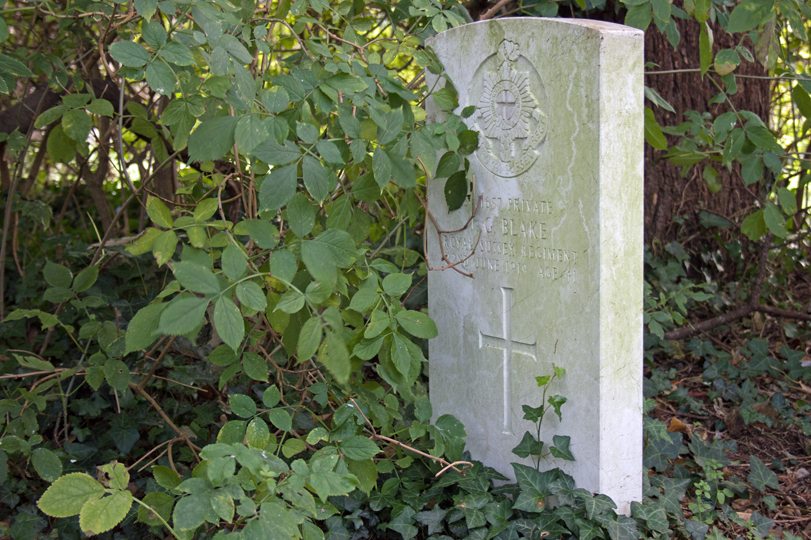
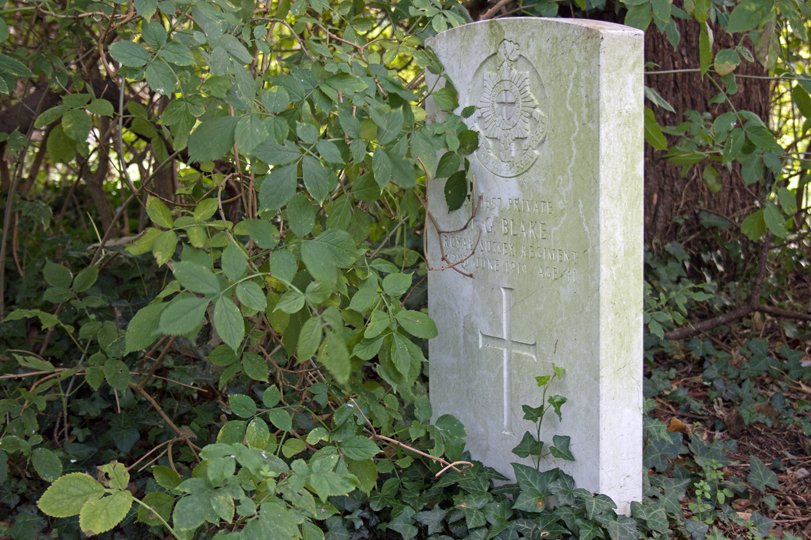
Private John Blake

Private John Blake

John George Blake was born early in 1878, and was the oldest of seven children. His father, Job, was a general labourer, and, with Eliza, John’s mother, brought the young family up in the West Sussex town of Worthing.

Job died in 1898, ages just 36 years old; Eliza found work as a housekeeper, while John was employed as a carter for the railway. By the 1901 census, the family were living in a terraced house near the centre of town, Eliza living there with her three sons, two daughters, son-in-law and granddaughter.

In October 1904, John married Alice Attwater, a labourer’s daughter from mid-Sussex. The couple moved into a house close to the station and went on to have four children; John Jr, Ernest, Bertha and Dorothy. John was by now working as a porter for the railway, a role he continued through to the outbreak of war.

John enlisted in November 1914; he joined the Royal Sussex Regiment, working as a member of the depot staff. Private Blake was shipped overseas, arriving in France in March 1916.

Almost exactly a year after landing in France, John was injured in the line of duty. The medical report confirmed that a “scald on the left arm and neck [had] occurred while on duty on March 1st 1917, in France. He was preparing hot soup for his company in the front line at midnight. He was not to blame. Injury caused by enemy shelling the company kitchen“.

Private Blake was shipped back to England for treatment, and admitted to Netley Hospital near Southampton. While there, he contracted phthisis (tuberculosis), which left his totally incapacitated. He was medically discharged from military service in August 1917.

Further details of John’s life are scarce. He returned home to his family, although whether he took up his job again is unknown. He passed away on 22nd June 1919 at the age of 41. The cause of his death is unknown, although it seems likely to have been related to the tuberculosis.

John George Blake lies at rest in the Broadwater Cemetery of his home town, Worthing.


Private Raymond Champ

Private Raymond Champ

Raymond Champ was born on 30th March 1880, one of eight children to coachman William Champ and his wife Eliza. While Raymond was born in the West Sussex village of Cowfold, within a year, the family had moved to Worthing, settling in the Broadwater area of the town.

The 1901 census gives more of an insight into Champ family life. William by now is listed as unable to work and gives his infirmity as paralysed. There are no newspaper records evident to highlight an accident of any sort, so the cause of his paralysis, and his inability to work, are destined to remain a mystery. The document does show, however, that the other members of the family stepped up to fill in the shortfall of money; Eliza was working as a laundress, Raymond was a bricklayer’s labourer, and his younger brother Francis (or Frank) was employed as a milk boy.

Fast forward ten years, and the next census give further information. It confirms that William was paralysed when he was 45 years old (in around 1894/1895). Raymond, now aged 30, was still working as a bricklayer, Frank was an iron founder, and the youngest brother, George, was a baker.

Raymond was a keen footballer, and went on to captain the Silverdale Football Club. By the time war broke out, he had found work at Wenban Smith, a renowned timber supplier in the town. The call to arms came, however, and, in September 1914, he enlisted.

Private Champ joined the Royal Sussex Regiment, and was assigned to the 2nd Battalion. Shipped overseas in February 1915, he served on the Western Front, but his time there was not to be a lengthy one. A local newspaper report picked up Raymond’s story:

The wretched conditions which our Troops had to contend with during February and March proved too much for his constitution, and having the misfortune to contract bronchitis, he was invalided home in April, being taken to one of the Military Hospitals in Manchester.

His recovery was regarded as hopeless from the first, but the careful nursing and attention which he received there brought about a temporary improvement, and he was eventually discharged in order that he might return to his home, where his death occurred on Sunday week.

The funeral on Thursday afternoon was of a very impressive character, and despite a heavy deluge of rain, there was a large number of sympathising friends at the Cemetery to pay the last tribute of respect.

Worthing Gazette: Wednesday 14th July 1915

Private Raymond Champ passed away on 4th July 1915 and just 35 years old. His body was laid to rest in Broadwater Cemetery, Worthing, not far from where his family were living.


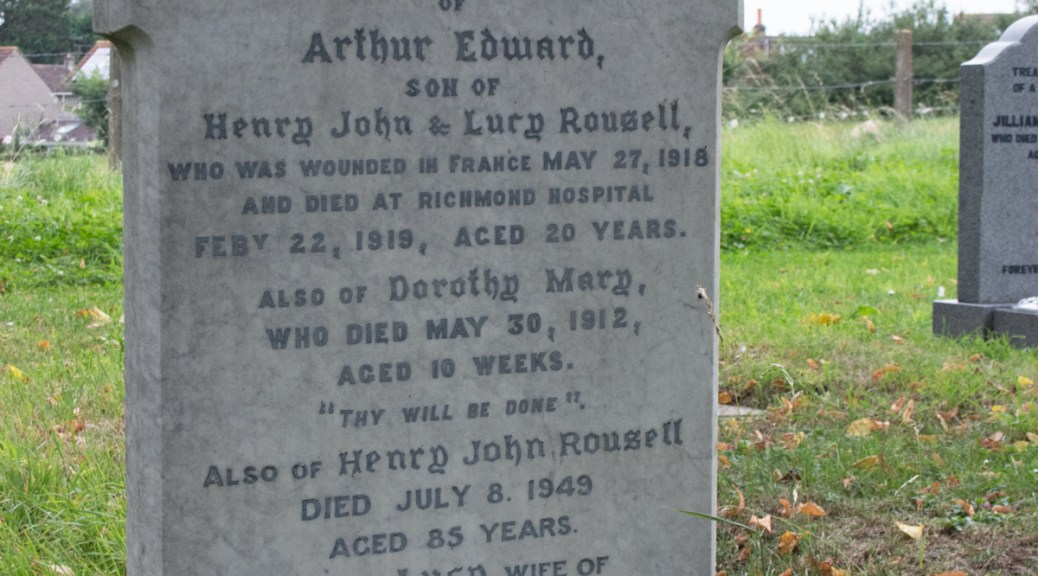
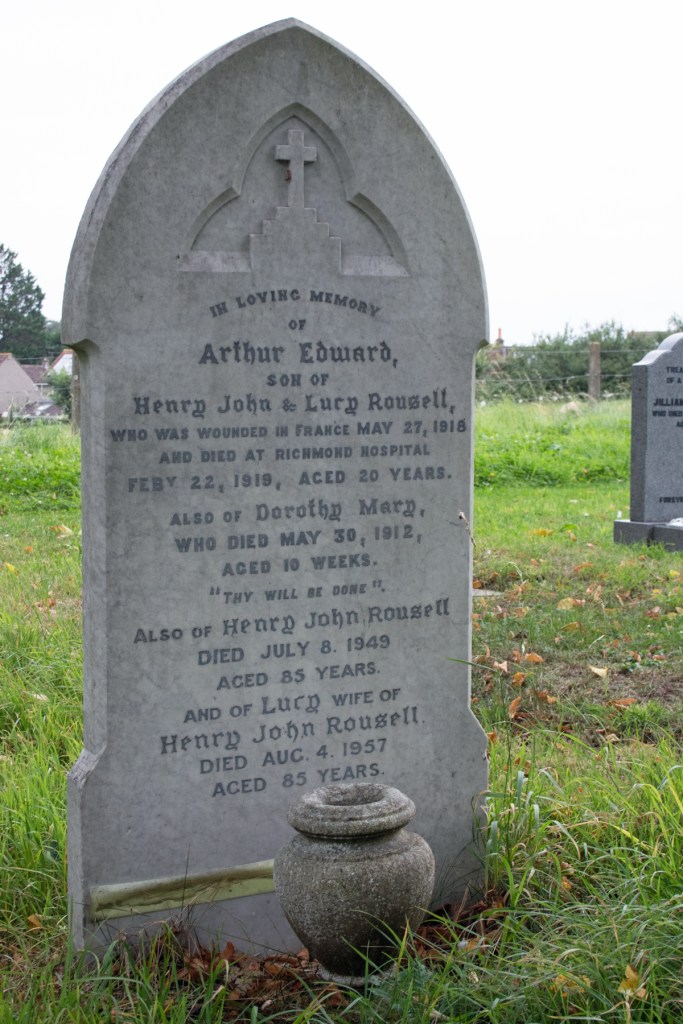
Private Arthur Rousell

Private Arthur Rousell

Arthur Edward Rousell was born in the summer of 1898, one of five children to Henry and Lucy Rousell. Henry was a police constable in Worle, near Weston-super-Mare, and this is where he initially raised his family. By the time of the 1911 census – when Arthur was a schoolboy of 12 years old – the family had moved to the village of Huish Episcopi, on the outskirts of Langport.

Details of Arthur’s military career are sketchy. Initially enlisting with the Royal Lancashire Regiment, he was soon transferred over to the 1st Battalion of the Lincolnshire Regiment. He certainly saw action abroad, and was caught up on the Western Front.

Private Rousell was injured on 27th May 1918, this the first day of the Battle of Aisne. His battalion was certainly involved in the battle, but whether this was where he was injured, and what his injuries actually were, cannot be confirmed.

Evacuated back to England for treatment, Private Rousell was admitted to the South African Hospital in Richmond. Whether he was there for a long time, is not recorded, but he was certainly there in nine months after he was wounded.

It seems that his injuries left him susceptible; his pension record confirms that he died of sickness, and it seems likely that this was one of the lung conditions – pneumonia, influenza – that was prevalent following the cessation of hostilities.

Private Arthur Edward Rousell died on 22nd February 1919, at the age of 20 years old. His body was brought back to Huish Episcopi, and he lies at rest in the family grave in the graveyard of St Mary’s Church.


UPDATE : 19th April 2022

An article on Arthur’s passing sheds more light onto his life:

We regret to record the death of Pte. AE Rousell, of the 1st Lancs. Regt., eldest son of PC and Mrs HJ Rousell of Newtown, which occurred at Richmond Hospital on Saturday morning. Deceased, who was 20 years of age, had been seriously ill a week with influenza, death being due to septic pneumonia, which followed.

The late Pte. Rousell, was a member of the staff of “The Langport and Somerton Herald” where he served his apprenticeship, when war broke out, and joined up early in 1917, his regiment being the King’s Own Yorkshire Light Infantry. After a period of training he proceeded to the front and took part in several engagements. He was gassed, and in the winter of that year was invalided home with trench feet. On recovery he was transferred to the Lancs. Regt., and again proceeded to the front.

On May 27th last he was severely wounded in the right leg by shrapnel, the bones being badly splintered. He was sent to a military hospital in this country and had been in hospital ever since. He had made a fairly good recovery and his parents were expecting him home shortly, when on Thursday last week a wire was received, informing them of his serious illness. Mrs Rousell at once proceeded to Richmond and was able to see her son before he passed away.

Deep sympathy is extended to the relations in their sad bereavement.

Langport & Somerton Herald: Saturday 1st March 1919

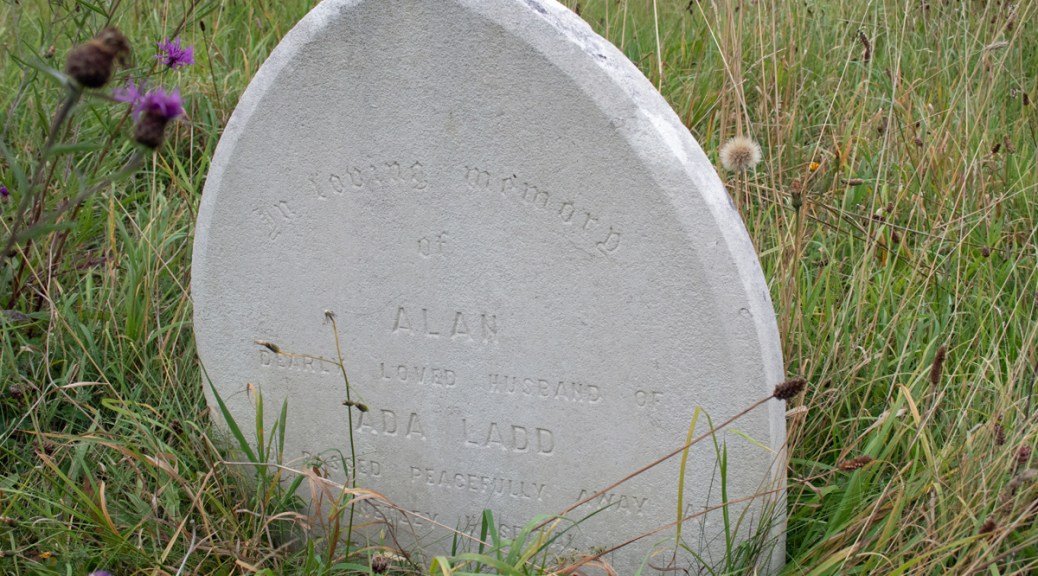
Private Alan Ladd

Private Alan Ladd

Alan Ladd was born in the summer of 1893, and was one of twins. His parents were plumber and gas fitter George Ladd and his wife Mary Ann, who was a midwife. The couple had eight children altogether, of whom Alan and his twin Arthur were the youngest.

George had been born in Exeter, Devon, and Mary Ann in Somerset, which is where they initially based their family. By 1887, however, they had moved to Berkshire, and were living in Knowl Hill, near Maidenhead, when their youngest four children were born.

The 1911 census found the family living in Dunster, Somerset, where everyone seemed to be bringing in a wage. George and Mary Ann had four of their children living with them, who were employed as an engine driver, grocer, baker’s apprentice and, in Alan’s case, a tailor’s apprentice.

War broke out in 1914, and, in November 1915, Alan enlisted. He joined the Royal Army Service Corps as a Private, and his enlistment papers showed he stood 5ft 5ins (1.65m) tall, and weighed in at 130lbs (59kg). He was stationed at the Corps’ Remount Department in Swaythling, Southampton and thus his military service was completed on the Home Front.

Shortly after enlisting, on 16th April 1916, Alan married Ada Westlake. She lived in the village of Long Sutton, near Langport in Somerset, and the couple married at the Wesleyan Methodist Chapel in Somerton. They do not appear to have gone on to have any children.

Further details of Private Ladd’s life are scant. What can be determined is that he was admitted to Netley Hospital in Southampton on 11th October 1918, having had symptoms of pneumonia for a few days. Sadly, his condition worsened, and Alan passed away just three days later, on 14th October 1918. He was just 25 years of age.

Alan Ladd was brought back to Long Sutton for burial. The war may have led him and Ada to adopt more of a Quaker way of life, as he lies at rest in the Friends Burial Ground on the outskirts of the town.


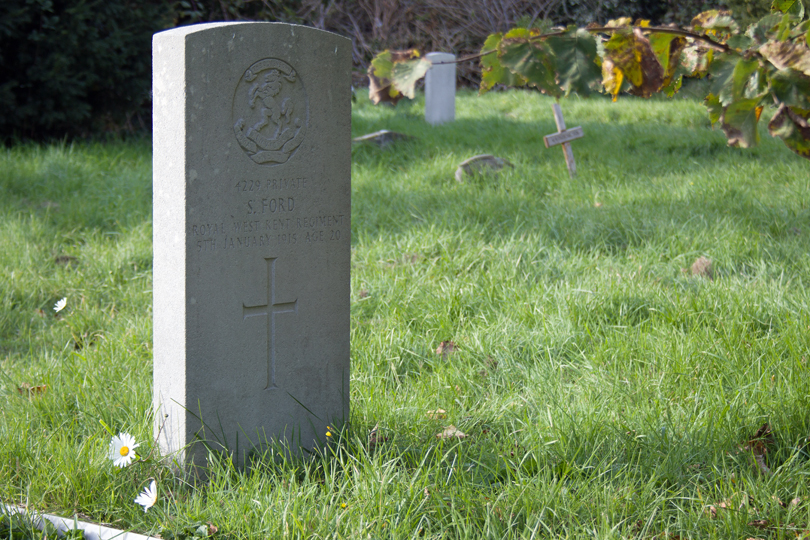
Private Sidney Ford

Private Sidney Ford

Sidney Ford was born in Kent in 1896, the son of Stephen John Ford and his second wife, Elizabeth Ann (née Underdown). The couple had four children – Frederick, Sidney, Ethel and Alice – although it seems that Elizabeth brought them up almost singlehandedly. Sidney’s military records gives his father’s name, although simply notes that he was an imbecile, in the stark way that only Edwardian officials could.

Sadly, little of Sidney’s early life remains documented. By the time war broke out, he was working as a farm labourer in Yalding, close to where he was born. He enlisted at the end of October 1914, joining the Queen’s Own (Royal West Kent Regiment), and was assigned to the 8th (Service) Battalion as a Private.

Joining up in Maidstone, by the end of the year, Private Ford’s battalion was soon billeted in Worthing, West Sussex. Tragically, his service was destined to be a short one, and he passed away after only a month in the town.

The first death from the Red Cross Hospital, Cecil’s, at West Worthing, had to be recorded. Since it has been opened there have been a large number of cases, and many of them have been of a serious nature, but happily all except the one under notice have made progress, thanks to the skill of the Medical Officers and Nursing Staff of the institution.

The deceased in this instance was a Private of the Eighth Battalion of the West Kent Regiment, now stationed locally. His name was Sidney Ford, and he was twenty-five years of age. He died on Friday, and at the funeral, which took place on Monday, full Military honours were accorded him.

Colonel Vansittart (who commands the Eighth Battalion) and Major Bock-Hollinshead attended, as also did other members of the Staff of the Hospital. A large number of the public were also at the Cemetery to witness the last rites, the progress of so long and so imposing a procession through the streets attracting considerable attention.

Worthing Gazette: Wednesday 20th January 1915

Private Ford has died on 15th January 1915, and was actually just 20 years of age, not 25, as had been reported. The Worthing Gazette does not give no mention to Sidney’s family, so it can only be assumed that they were unable to make the journey from Kent to the funeral. I have been unable to uncover details of the cause of his death, but, given that there is no mention of the cause in the newspaper, it is likely to have been following an illness than anything more sensational or unusual.

Sidney Ford lies at rest in the Broadwater Cemetery in Worthing, one of the first in the town to have passed because of the Great War.


Sidney’s older brother, Frederick, was also involved in the Great War. While there is little specific information about his service, it is evident that he was a Private in the Duke of Wellington’s (West Riding Regiment).

Unlike his younger brother, Frederick did see military action, but list his life on the Western Front on 4th November 1915, ten months after Sidney had passed in Worthing.

Frederick lies at rest in the Royal Irish Rifles Graveyard in Laventie, in Northern France.


Private Sidney Alner

Private Sidney Alner

Sidney William Alner was born in Shaftesbury, Dorset, in March 1899, one of eleven children to Sidney and Ellen Alner. Sidney Sr was a grocer’s porter, and the family lived on the celebrated Gold Hill in the town.

War was to come when Sidney Jr was only young – he had just turned 15 when it broke out. He saw his older brothers go off to war and was obviously keen to do his bit as well. Until he was old enough, however, he worked as an errand boy for his father’s employers, Stratton Sons and Mead.

His time would come, of course, although dates for Sidney’s enlistment are not clear. A contemporary newspaper record confirms that he arrived in France in January 1918, so it is likely that Private Alner joined up at some point during the previous year.

He joined the Hampshire Regiment, and was assigned to the 1st Battalion. Heavily involved during most of the conflict, the battalion was seen as key to the Final Advance of the autumn of 1918. Private Alner was caught up in the fight to break the Hindenburg Line, fighting on the River Selle and capturing the town of Monchaux.

It was while his battalion was advancing on the village of Préseau on 2nd November, that Private Alner was injured. Shot in the arm, he was evacuated back to England, and admitted to the Cambridge Military Hospital in Aldershot. He would have survived his injuries, had pneumonia not set in, and it was to this that he would succumb on 19th November. He was just 19 years old.

Sidney William Alner’s body was brought back to Dorset. He lies at rest in the Holy Trinity Churchyard in Somerset, within walking distance of his family’s home.


Sidney was the second member of the Alner family to die as a result of the Great War.

His older brother Harry, who had become a chauffeur and went to live in London, joined the Royal Army Service Corps in 1915. Private H Alner had served three years in France when he was killed on the front line just three weeks before his brother. He was 32 years old, and left a widow and two children.


When researching Sidney Alner in newspaper articles, an interesting report surfaced.

An unfortunate accident has happened to a little girl, not quite four years old, the daughter of Sidney Alner, who resides in Gold Hill. Heals’ steam hobby horses visited the town on Friday and Saturday in last week, and on the evening of the former day, Alner took his little girl for a ride on the horses.

Whilst they were in motion, the bolt that kept the horse on which Alner sat with his child attached to the connecting rod came out, and he and the little girl were precipitated to the ground.

Alner escaped without injury, but his daughter had one of her legs fractured above the knee. She was taken home, and Dr Evans set the injured limb. Later in the evening she was removed to the Westminster Cottage Hospital.

Salisbury and Winchester Journal: Saturday 31st October 1891

This Sidney Alner was Private Alner’s father, and the daughter would have been his older sister Sarah. Nothing more is reported of the incident, and Sarah went on to live until 1945, when she was 57 years old.


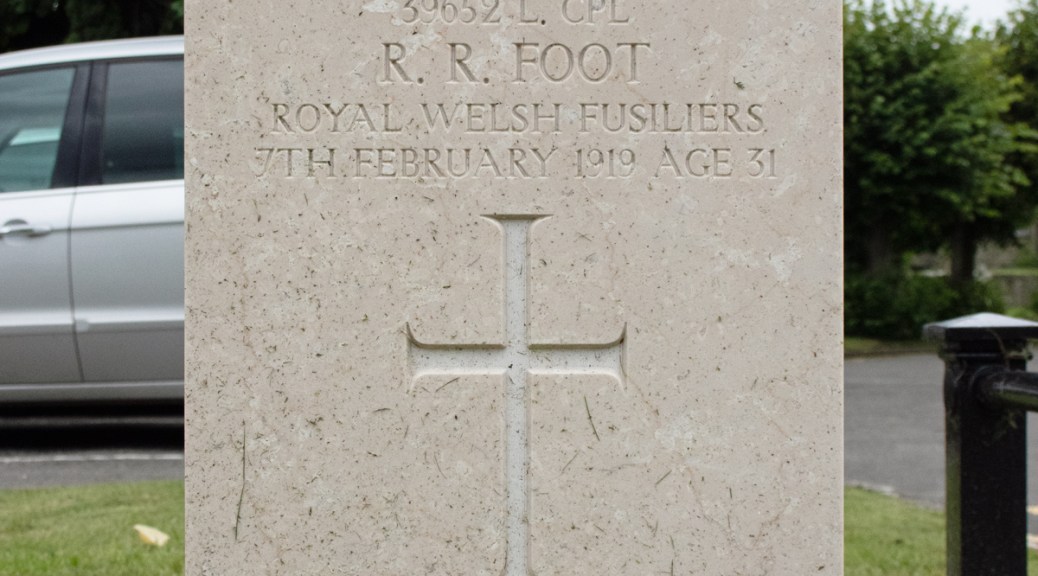
Lance Corporal Reginald Foot

Lance Corporal Reginald Foot

Reginald Robert Foot was born at the beginning of 1888 in Shaftesbury, Dorset, the oldest of three children to Robert and Annie Foot. Robert was a tailor from the town, who brought up his young family in the comfort of well-known surroundings.

When he left school, Reginald found work as a carpenter and joiner. He was a keen, if over-eager, sportsman, and played for Shaftesbury FC. In May 1906, he was reported for ‘cheeky’ behaviour towards the referee in one match.

In the lead up to the Great War, he also spent some of his his spare time in the Territorial Army and, when war broke out, he was keen to continue doing his bit. He joined the Royal Welch Fusiliers as a Private in December 1915 and, by the time he was shipped out to France in January 1917, he had been promoted to the rank of Lance Corporal.

After a year on the Western Front, Reginald returned to the United Kingdom and, once the Armistice had been declared, his unit was shipped to Ireland. He fell ill while he was out there, and, in January 1919 was admitted to a military hospital in Ireland.

Sadly, the lung conditions he had contracted – influenza and pneumonia – were to get the better of him, and he passed away on 7th February 1919. Lance Corporal Foot was 31 years old.

The body of Reginald Robert Foot was brought back to Dorset; he lies at rest in the Holy Trinity Churchyard in the town of his birth, Shaftesbury.


Private John Dyer

Private John Dyer

John Frederick Dyer was born in Crediton, Devon, on 3rd July 1864. He was one of twelve children to William Dyer, a shoemaker, and his wife Sarah.

When he left school, John initially found work as a tanner – presumably helping with his father’s business. He soon moved on from this, however, and worked as a labourer and then a stone mason.

In 1888, aged 24, he married a woman called Emily; they went on to have four children. By the time of the 1901 census, John was a fully fledged mason, and the family had moved to Weston-super-Mare in Somerset.

From this point in, there is little information available relating to John’s life. The 1911 census records him as living in the centre of Weston-super-Mare, in a six-room house with his wife, two of his children and his niece.

Storm clouds were on the horizon in Europe, but not much documentation records his military service. He was 50 years old when war was declared, and he was old enough to be exempt from volunteering or conscription. However, he did put his name forward, and enlisted at some point at the beginning of 1915.

Private Dyer joined the 4th Battalion of the Somerset Light Infantry. This was a primarily territorial force, that served in India and the Middle East, although there is no confirmation that he was anywhere outside of the UK during his time in the army.

In fact, Private Dyer’s service was not destined to be a long one; the next available record shows that he died on 9th July 1915 at the 2nd Southern General Hospital in Bristol. He had just turned 51 years old. Sadly, no details of the cause of death exist.

John Frederick Dyer’s body was brought back to Somerset for burial. He lies at rest in the Milton Road Cemetery in his adopted home town of Weston-super-Mare.