Tom Mounter was born on 24th March 1890 in the quiet Somerset village of Kingsbury Episcopi. He was one of ten children to Robert and Ellen Mounter. Robert was a farm labourer, while Ellen earned a little more money for the family by stripping withy – or willow – branches for use in a variety of ways, such as basket weaving.
When Tom left school, he followed his father into agricultural work, employed to grow and manage the withy fields. In April 1911, he married Ellen Talbot, a farm labourer’s daughter from the village. The couple went on to have three children, Frederick, Martha and Horatio.
When war came to Europe, Tom stepped up to play his part. On 14th December 1916, he joined the Royal Navy, along with four others from the village.
Tom’s service records show that he was 5ft 6ins (1.68m) tall, with brown hair, blue eyes and a fresh complexion. Stoker 2nd Class Mounter was initially sent to HMS Vivid, the Royal Naval Dockyard in Devonport, for training, before being assigned to the cruiser HMS Ariadne on 31st March 1917.
The Ariadne had been converted into a minelayer that year, and worked in the English Channel. On 26th July 1917, she was torpedoed by the German submarine UC-65, and sunk, with the loss of all 38 hands, including Stoker Mounter. He was just 27 years of age.
Tom Mounter’s body was brought back to Somerset for burial. He was laid to rest in the peaceful Kingsbury Episcopi Cemetery, next to George Bonning, who had enlisted on the same day as him, and who had died six months before.
The local newspaper, when reporting on Stoker Mounter’s funeral, noted that he was “the seventeenth Kingsbury Episcopi man who has died for his King and country. It is stated that he had a strong presentiment that he would be killed.” [Langport & Somerton Herald: Saturday 4th August 1917]
Stoker 2nd Class Tom Mounter (from findagrave.com)
George Thomas Bonning – whose forenames seem to have been interchangeable – was born on 9th August 1887 in the Somerset village of Kingsbury Episcopi. His parents were farm workers James and Elizabeth Bonning, and George also entered farm work when he finished school.
In 1909, George marred Olive Harvey, the daughter of another agricultural labourer from the village. The couple set up home together in the village, and went on to have a daughter, Lilian, the following year. It was around the time of their daughter’s birth that George’s mother passed away, happiness and sadness in a short space of time for the young family.
By 1911, George was employed as a carter in a factory, presumably a financial step up from his previous employment on the farm. The money was still not a great deal, however, and Olive was also working, machining gloves at home for the local factory.
War came to Europe, and on 14th December 1916, George enlisted in the Royal Navy, along with four other men from the village, including friend and neighbour Tom Mounter. His service records show that he was 5th 11.5ins (1.82m) tall, with black hair, hazel eyes and a fresh complexion.
Stoker 2nd Class Bonning was sent to HMS Vivid, the Royal Naval Dockyard in Devonport, for training, and it was here that he contracted a chill. Tragically, this developed into pneumonia, and he died in the barracks on 20th January 1917. He was 29 years of age, and had been in service for just 37 days.
George Thomas Bonning’s body was brought back to Somerset for burial. He was laid to rest in the peaceful Kingsbury Episcopi Cemetery.
Olive never remarried after losing her husband. She remained in the village, raising Lilian and finding occasional employment to help pay the bills. She passed away on 26th March 1968, at the age of 79, and was laid to rest with George, husband and wife reunited after more than fifty years.
Daniel Johnson was born in Dingle, County Kerry, Ireland, on Christmas Day 1883, one of nine children to John and Ellen Johnson. John was a general labourer in the town, but while he initially followed suit, his son was destined to see the world.
On 3rd April 1903, Daniel joined the Royal Navy as a Stoker 2nd Class. His service records show that he was 5ft 7ins (1.70m) tall, with auburn hair, grey eyes and a sallow complexion.
Stoker Johnson was initially sent to HMS Vivid – the Royal Naval Dockyard in Devonport – for training. He was given his first posting in December, and was assigned to the battleship HMS Empress of India. She was to be his home for the next fifteen months.
In February 1905, Daniel was moved to another battleship, HMS Hannibal. Over the next eight years, he would go on to serve on six further vessels. His conduct was noted as Very Good throughout his time in the Royal Navy, and this was matched with the promotions he received. In July 1906, while on board HMS Suffolk, he was given the rank of Stoker 1st Class, and four year later, while serving on HMS Commonwealth, he was promoted to Leading Stoker.
In between voyages, Daniel’s base was HMS Vivid, but in February 1913, he was assigned to HMS Victory – the Royal Naval Dockyard in Portsmouth, Hampshire. He had been serving for ten years by this point, and his records hint at the man he had become. His height was now 5ft 10ins (1.78m), his hair recorded as dark brown and his complexion was noted as being fresh.
On 16th April 1913, Daniel seems to have been assigned to the Northern Irish Inniscrone Battalion, remaining with them for some fifteen months. Based at Inniscrone (now Enniscrone, Co. Sligo), this posting seems to have been with the Coastguard, patrolling the western coast of Ireland.
August 1914 saw Leading Stoker Johnson return to the Royal Navy. He was assigned to the battleship HMS Bulwark, which patrolled the English Channel when he first came on board. By that autumn, however, she had moved to North Kent, guarding the waters around the Isle of Sheppey against potential German invasion.
Daniel was on board Bulwark when, on the morning of 26th November 1914, an explosion ripped through the ship, tearing it apart and sinking it. In all 741 souls were lost, Leading Stoker Johnson among them. He was just 30 years of age.
The majority of those who died in the explosion aboard HMS Bulwark were buried in a mass grave in Woodland Cemetery, Gillingham, Kent. Daniel’s body, however, was not recovered until 24th January 1915, some two months after the explosion.
The sixteenth inquest on the victims of the Bulwark disaster was held at Chatham Naval Hospital on Monday. A body clothed in the dress of a patty officer was identified as that of Thomas Henry Treacher, who was a gun-layer. Two stokers were identified by marks on their clothing as Daniel Johnson, of Blackfields, Co. Kerry. and Edward Henry Buckingham of Nunhead, London, and an able seaman’s body proved to be that of John Griffin, of Kilrush, Co. Clare. The jury returned a verdict of accidental death in each case. Twenty-five bodies have now been recovered.
Westerham Herald: Saturday 30th January 1915
Daniel Johnson was laid to rest in a marked grave in Woodlands Cemetery, not far from his fellow servicemen.
Interestingly, the Coastguard station at Enniscrone would feature in history again a few years after Daniel’s death. Based next to the town’s pier, it was manned by up to five guards and was home to them and their families.
The coastguard station at Enniscrone, County Sligo, was raided on Thursday night, and arms and ammunition taken. The streets of Enniscrone were cleared by the Volunteers prior to the raid. One coastguard is stated to have fired several shots at the attackers, but he was eventually overpowered, and the garrison were then marched out. The arms and ammunition were removed to a waiting motor car, and the furniture and personal belongings of the coastguards taken from the building, which was then set fire to and destroyed.
Anthony Eames was born on 29th October 1876 in the village of Newhall, Derbyshire. He was one of four children to James and Mary Eames, although Mary passed away in 1880, not long after Anthony’s younger brother was born. James remarried, and he and his new wife (and possibly his late wife’s sister), Theresa Barlow went on to have twelve children of their own.
James was a coal miner, and while Anthony initially followed in his father’s footsteps, he sought bigger and better things. In September 1896, just short of his twentieth birthday, he joined the Royal Navy as a Stoker 2nd Class. His service records show that he was 5ft 3.5ins (1.61m) tall, had brown hair, grey eyes and a fresh complexion. The document also noted that he had tattoos on both of his arms.
Stoker Eames’ initial posting was at HMS Victory, the Royal Naval Dockyard in Portsmouth, Hampshire. He spend a year there, honing his skill, before being assigned to HMS Powerful in September 1897. Three months later, he was transferred to the cruiser HMS Alacrity and, over the remainder of his twelve years’ service, he worked on eight further vessels, rising to the rank of Stoker 1st Class in the process.
It was during this time that Anthony met and married Frances Pelley, a young woman from Portsmouth. The couple went on to have three children and, when Stoker Eames was stood down from active service at the end of his contract in 1908, the family moved to Sheffield. Anthony found employment in the mines again and the family settled in to a small terraced house in the then village of Darnall.
The sea continued to call to Anthony, though, and, on 8th March 1912, he re-enlisted. For the next couple of years he was based at HMS Victory, but when war broke out he was transferred to the battleship HMS Bulwark.
Stoker Eames was on board Bulwark when, on the morning of 26th November 1914, an explosion ripped through the ship, tearing it apart and sinking it. In all 741 souls were lost, Anthony amongst them. He was 38 years of age.
The majority of those who died in the explosion aboard HMS Bulwark were buried in a mass grave in Woodland Cemetery, Gillingham, Kent. Anthony Eames’s body, however, had been identified, and so he was laid to rest in a marked grave in the cemetery.
Ernest William Brown was born on 5th April 1889 in Halstead, Essex. One of twelve children, his parents were carpenter Edward and silk weaver Elizabeth Brown.
Ernest initially found work as an errand boy, then as a house painter. He wanted bigger and better things, however, and the Royal Navy offered him that opportunity. He enlisted as a Stoker 2nd Class on 12th March 1908 for a period of twelve years’ service.
Ernest’s early service records are lost to time, but he received a promotion to Stoker 1st Class on 12th March 1909, exactly a year after a joined up. At this point he was assigned to the dreadnought battleship HMS Russell, on board which he served until August 1912.
After a short period at HMS Pembroke, the Royal Naval Dockyard in Chatham, Kent, Stoker 1st Class Brown was transferred to the Apollo-class cruiser HMS Iphigenia. She was to be his home for the next two-and-a-half years, during which time he was promoted again, this time to Leading Stoker.
Returning to HMS Pembroke in March 1915, this was to be his shore base for the next couple of months. On 27th May, Leading Stoker Brown was helping out on the steamer Princess Irene. Tragically, while on board an explosion ripped through the ship, while moored off Sheerness, Kent and he was one of the 352 souls killed. He was just 26 years of age.
Ernest William Brown was laid to rest in the Woodlands Cemetery in Gillingham, Kent. His body having been identified, he was given his own grave, unlike those who were buried in a mass grave nearby.
Thomas Daniel Woodman was born on 17th March 1892 in the village of Oldland, Gloucestershire. One of sixteen children, his parents were Daniel and Ruth Woodman. Daniel was a fireman, stoking furnaces at a local paper mill, but Thomas wanted bigger and better things.
On 20th April 1910, not long after he turned 18, Thomas enlisted in the Royal Navy. His service records show that, when he joined up, he was 5ft 6ins (1.67m) tall, had brown hair, brown eyes and a fresh complexion. It was also noted that he had a long scar on his left wrist, and a tattoo of a cross on the same spot.
Stoker 2nd Class Woodman was to be based at HMS Vivid, the Royal Naval Dockyard in Devonport. From here he undertook his training, and it was from the Devon port that he began and ended his seafaring. In June 1911, while on board HMS Caesar, he was promoted to Stoker 1st Class.
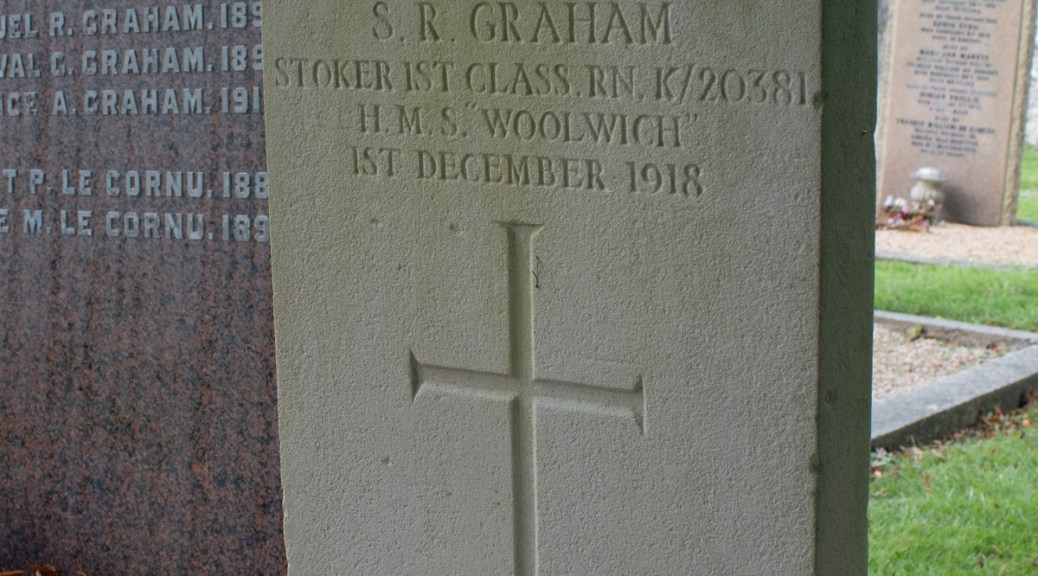
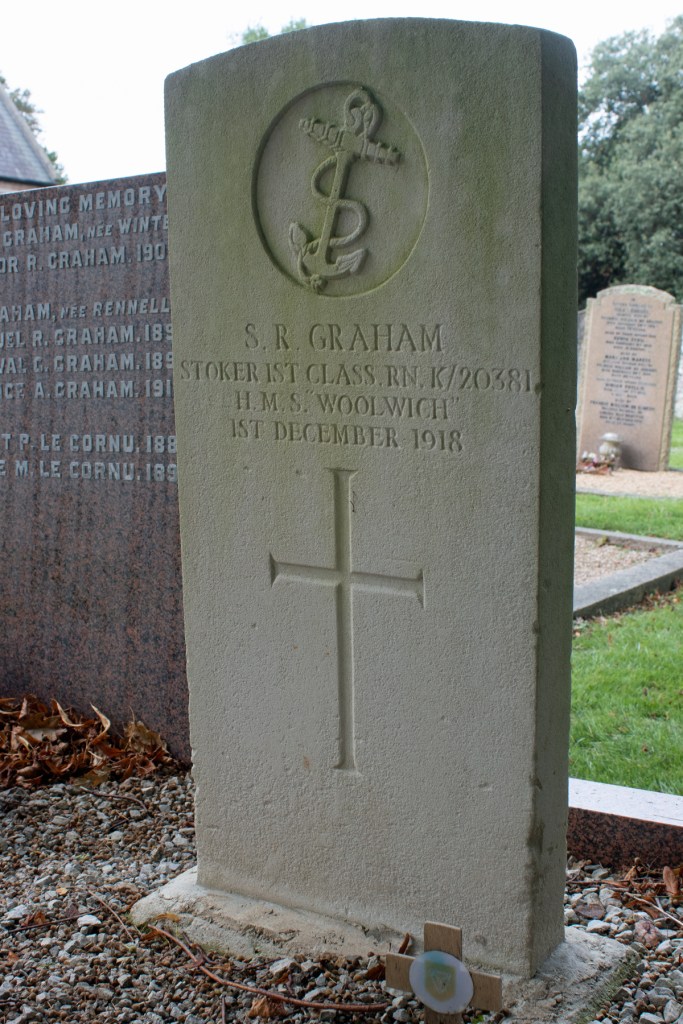
When war broke out, Thomas continued his naval service. During the course of the conflict, he served on three vessels – HMS Blake, HMS Diligence and HMS Woolwich – returning to Devonport in February 1919.
On 8th March 1919, while on leave, Thomas married Eva Paget at St Barnabas’ Church in Warmley. She was the same age as Thomas and daughter of a sexton. Tragedy was to strike the couple, however as, within a matter of weeks, the young groom contracted meningitis. He passed away at the Royal Naval Hospital in Plymouth on 21st April 1919. He was just 27 years of age.
Brought back to Gloucestershire for burial, Thomas Daniel Woodman was laid to rest in the graveyard of St Barnabas Church, where, just 44 days earlier, he had married his beloved Eva.
Eva herself went on to lead a remarkable life. After the loss of Thomas, she never remarried, and, by the 1930s, was living with her sister, and doing unpaid domestic duties.
On 2nd May 1998, at the age of 105, she became the oldest person in the world to go supersonic, by flying on Concorde on a 90-minute flight around the Bay of Biscay. This was the first time she had ever left Britain, and only the second time she had ever left Bristol.
Eva Woodman passed away in her Bristol nursing home on 17th October 1999. She was 107 years old.
She was buried with her late husband, finally reunited after 80 years apart.
John Connolly was born on 7th April 1887 in Liverpool, Lancashire. There is little information available about his early life, although his parents were Thomas and Marianne Connolly. A Roman Catholic, he was baptised at St James Church and went on to marry a woman called Bridget, although details for the wedding are lost to time.
John must have had a level of proficiency when it came to ships and sea-faring as, when war had broke out, he was call up for service with the Royal Naval Reserve (RNR). He enlisted as a Stoker on 1st October 1915, using the surname Campbell. His records show that he was 5ft 6ins (1.68m) tall, had blue eyes and a fair complexion.
Stoker Campbell was based at HMS Pembroke, the Royal Naval Dockyard in Chatham, Kent. His time in service, however, does not seem to have been a happy one. In fact, within a few months of being conscripted, John had absconded and made his way back to Liverpool.
John was caught and was being brought back to Kent under escort, when the unimaginable happened.
John Connolly, a stoker of the RNR, attached to the Royal Naval Barracks, Chatham, was found dead on the railway near Warren House Crossing, between Sole Street and Cuxton, on Wednesday, with terrible injuries to his head.
Connolly, who is known also as Campbell, had been arrested as a deserter at Liverpool, and was returning to Chatham under escort on Tuesday… The train was very full, and deceased, with his escort, stood in the corridor, where several soldiers were also standing.
Some time after the train had left Herne Hill the escort, Leading Stoker John Edward Craig, left his prisoner to proceed to the lavatory, and when he returned one of the soldiers shouted “Jack, your prisoner had gone out the window.” The train was stopped, but the guard suggested that Craig had better proceed to Rochester instead of searching for the deceased, as the night was very dark. At Rochester Bridge the matter was reported to the military authorities, and a search along the line, then ordered, resulted in the discovery of the body of deceased…
A Lance Corporal of the 2/5th King’s Liverpool Regiment, one of the soldiers in the corridor, gave evidence at the inquest… He said he was standing close by deceased, but did not see him go out of the window, which was open at the time.
It was stated that is was usual in the Navy for one man only to act as escort, as all expenses connected with desertions had to be paid by the prisoners.
The jury found the death resulted from injuries received by deceased in a fall from the train, but that there was not sufficient evidence to prove whether the fall was intentional or otherwise.
South Eastern Gazette: Tuesday 8th February 1916
Whether John had intended to throw himself from the train will never be known. All that can be confirmed is that he died of his injuries on 1st February 1916, aged just 28 years old.
John Connolly was laid to rest in Woodlands Cemetery, Gillingham, not far from the dockyard at which he had been based. His epitaph mentioned both of the names he chose to go by, and the inscription: “Beloved husband of Brigid, her one and only love. Re-united RIP. Jesus mercy Mary help.“
Alexander Maguire was born on 28th March 1880 in Glenarm, County Antrim, Northern Ireland. Little is known about his early life, apart from his parents’ names – James and Ellen.
Glenarm is a coastal village, and it is likely that Alexander would have had experience of seafaring from an early age. This seems to have spurred him into building a career and, on 16th December 1903, he enlisted in the Royal Naval Reserve as a Stoker.
With war getting closer, Stoker Maguire was called into formal service, and was assigned to the steamer SS Rathlin Head. He sailed the Atlantic in March 1914, and disembarked an New Orleans. It seems, however, that he missed his passage back home, although at this point, his whereabouts become a bit hazy.
Alexander was back in Britain by 13th January 1915, as his service papers record him in Liverpool. He then travelled to HMS Pembroke, the Royal Naval Dockyard in Chatham, Kent. This looks to have been his last move, however, as he passed away just two days later. The cause of death is simply recorded as ‘disease’: he was 34 years of age.
Alexander Maguire was laid to rest in the Roman Catholic section of Woodlands Cemetery in Gillingham, Kent, not far from the dockyard to which he had been assigned.
Peter Higgins was born in Thornaby, North Yorkshire, on 23rd January 1887. His parents were William and Catherine (Kate) Higgins, but of them there is very little information.
What seems likely that Peter would have had some experience with boats as, on 26th May 1909, he enlisted in the Royal Naval Reserve. His service records show that he was 5ft 7ins (1.70m) tall and was described as having blue eyes and a pale complexion. He was also noted as having a scar over his left eye and another on his left thigh.
When war broke out, Peter was officially called for duty and, over the next couple of years, he served as a Stoker on the battleship HMS St Vincent. The ship patrolled the North Sea, and would later be involved in the Battle of Jutland.
Stoker Higgins, however, was back on dry land by that point, having been assigned to HMS Pembroke, the Royal Naval Dockyard in Chatham, Kent. Peter had fallen ill with a gastric ulcer, and tragically, this was to prove fatal. He passed away on 16th February 1916, at the age of just 29 years old.
Peter Higgins was laid to rest in the naval section of Woodlands Cemetery in Gillingham, Kent, not far from the dockyard that was to prove his last posting.
Wilson John Woodbury was born on 8th December 1888, and was the third of seven children to Daniel and Elizabeth Woodbury. Daniel was a chair maker from Wellington, Somerset, and this is where the family – including six boys and one girl – were raised.
By the time of the 1901 census, Daniel had had a change of career – he was now working as an oil presser. His and Elizabeth’s oldest three boys, Wilson included, had also found work, and were employed as wool spinners.
Elizabeth passed away in 1906, when Wilson was just seventeen years old. This may have pushed him to bigger and better things, and a career. On 13th August 1908, at the age of 19, he enlisted in the Royal Navy as a Stoker 2nd Class. His service record shows that he was 5ft 7.5ins (1.71m) tall, had light brown hair, blue eyes and a fresh complexion. It also noted that he had a tattoo of a cross on his right forearm.
Stoker Woodbury was initially trained at HMS Vivid – the naval dockyard at Devonport. On 9th February 1909, however, he was given his first posting, on board HMS Defence. He spent two years on board the armoured cruiser, and, gained a promotion to Stoker 1st Class.
During the remainder of his initial service, Wilson served on two further ships – HMS Sentinel and HMS Bellona – returning to Devonport between each posting. When he completed his five-year contract, Wilson voluntarily signed up for a further seven years with the Royal Navy.
As war came to Europe, Stoker Woodbury was given a number of assignments, on the battleships HMS Caesar and Lord Nelson, the cruisers HMS Blake and Apollo, and the depot ship HMS Blenheim. Further promotions followed – Leading Stoker in 1915 and Stoker Petty Officer two years later.
Wilson’s oldest brother, James, was serving in the Labour Corps during the conflict. Based in Northern France, he was assigned to the 720th Company, although further details are unclear. He almost survived the war unscathed, but contracted an illness of some description and died on 3rd November 1918, aged 34 years old. He was laid to rest in the Terlincthun British Cemetery in Wimille, France.
Stoker Petty Officer Woodbury returned home on leave in July 1919. The plan was to meet up with his fiancée who lived in Rockwell Green, near Wellington, but he instead turned up unexpectedly at his brother Fred’s home instead. Wilson said he had returned to Somerset because his girlfriend had broken off the engagement the previous week: the couple had been due to marry when he next came home on leave.
Fred told Wilson that she was not worth it, and they had gone drinking with a friend. Fred later said that on his previous leaves his brother had taken to drinking more than was good for him, but on that evening – Saturday 2nd August 1919 – he did not get drunk.
The following Monday, Stoker Petty Office Woodbury had taken himself down to the railway at Wellington, and been hit by a train. The action was deliberate, as, about his person were three letters. The first was to Daniel.
To My Dear Father,
Sorry to cause you any inconvenience or trouble, and please don’t worry about me, as I’m not fit to worry about. I have had this in mind for about a week. I can’t sleep and can’t eat, as I am broken-hearted, but not insane. This is through love. Now I must exit myself, and I am in great pain. Written at 4:15pm Sunday afternoon…
This is all I have to say in this world. Hoping you and my dear sister will soon forget their broken-hearted
Wilson John Woodbury.
Wilson’s second letter was to his only sister, Ivy. This included details of a parcel left on board his ship, in which was the ring he had given to his fiancée, which he asked that Ivy wear as a memory of him.
Knowing the implications of what he was doing, the third letter was addressed to the jury of the inquest.
My leave expires at 1pm, and my life expires just before by my own hand. I wait to get the chance to put a stop to my life. This would not have happened to bring disgrace on my relations. I am quite sane. Written at 2pm.
On the afternoon of Monday 4th August 1919, Wilson made his way to the Woodford crossing, a short distance from Wellington Railway Station.
…he waited by the side of the line at the crossing for a train, and as the Northern express approached he laid down with his head on the metals, being practically decapitated.
Taunton Courier and Western Advertiser: Wednesday 13th August 1919
The fiancée in question did attend Wilson’s inquest, although the Coroner did not think it was necessary to call her. The newspaper report referred to her, but not by name. She will remain a mystery.
Despite the evidence of his own hand, the inquest found that Stoker Petty Officer Woodbury had committed suicide while temporarily insane. He was just 30 years of age.
Wilson John Woodbury was laid to rest in the cemetery of his home town, Wellington.