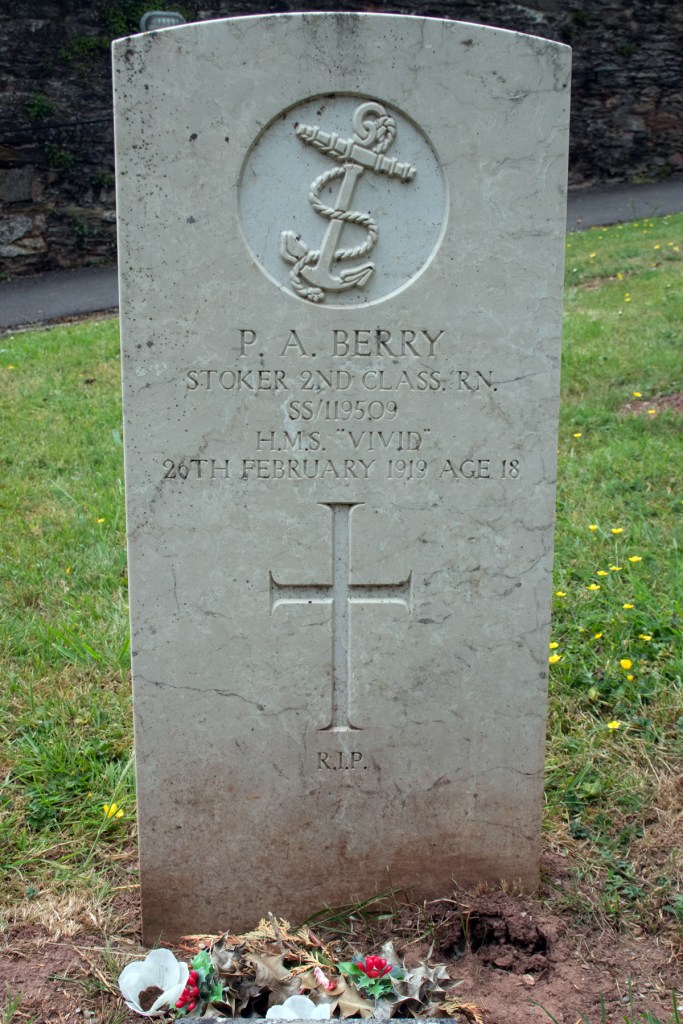
Percival Arthur Berry was born in January 1902, one of five children to Henry and Elizabeth Berry. Henry was a bricklayer from West Monkton in Somerset, and this is where the family were born and raised.
Percival seems to have had a roaming soul, or itchy feet. When he finished his schooling, he worked as a farm labourer, but in January 1918, he found employment as an engine cleaner for Great Western Railways in Taunton. This was not to last, however, and hi employment ended on 15th March, his work records stating that he just left.
Percival went back to farm labouring, but still sought a way out of that life. In January 1919, he enlisted in the Royal Navy. So keen was he to escape Somerset, he added a year to his age, to ensure that they allowed him to enlist. His records show that he was 5ft 6ins (1.68m) tall, with brown hair, blue eyes and a fresh complexion.
Assigned the rank of Stoker 2nd Class, Percival was sent to HMS Vivid, the Royal Naval Dockyard in Devonport. Within a matter of weeks, however, Stoker Berry had fallen ill. The details are a little confusing at this point – he was stationed at HMS Vivid, but admitted to the Dreadnought Seaman’s Hospital in Greenwich, Kent, his admission records stating that he had come from HMS Harlech. It is likely, therefore, that he was on a voyage from Devon, on board the converted trawler Harlech, when he fell ill. Docking in London, he was then admitted to the Greenwich hospital.
Stoker 2nd Class Berry had contracted influenza, and this was to take his life. He died on 26th February 1919, aged just 17 years old. He had served in the Royal Navy for just 47 days.
Percival Arthur Berry was brought back to Somerset for burial. He was laid to rest in the peaceful graveyard of St Mary’s Church in Kingston St Mary, a few miles from his old family home.
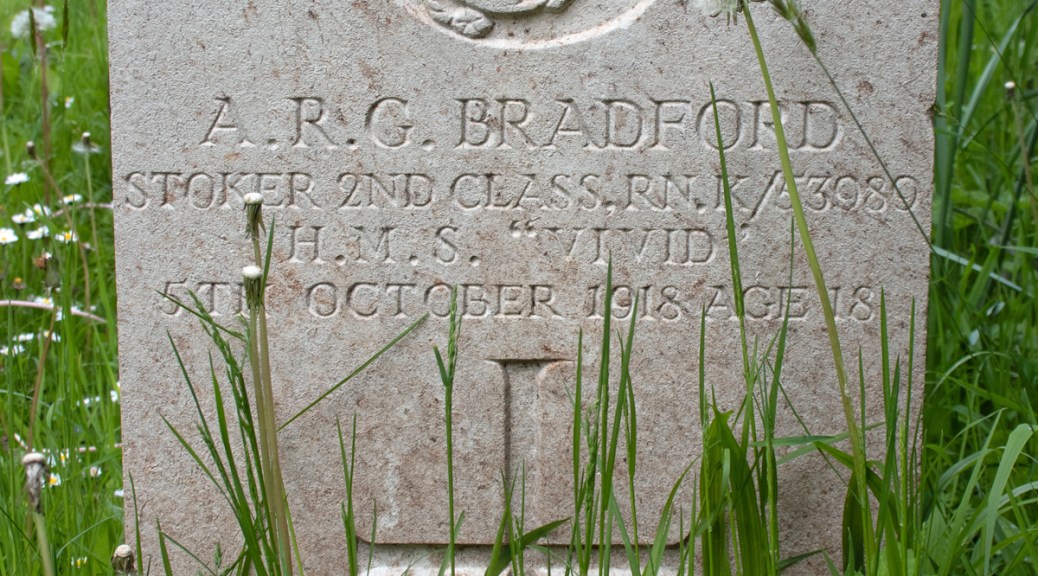
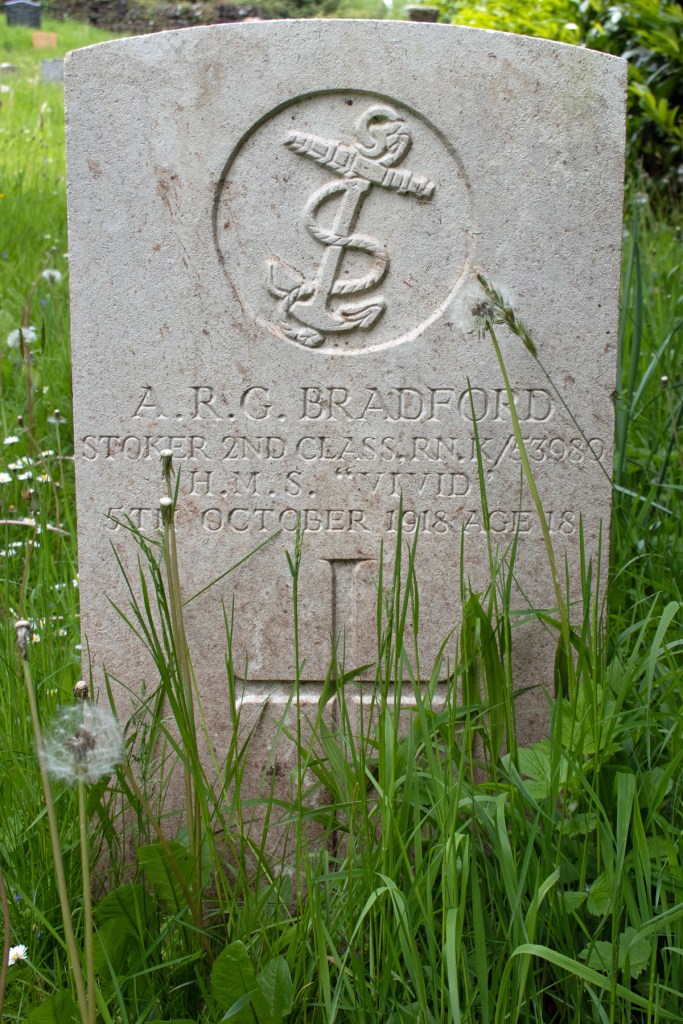
Arthur Redvers George Bradford was born in the Somerset village of Winscombe on 16th September 1900. He was second of six children to George Bradford, who was a postman, and his wife, Louisa.
When he finished his schooling, Arthur found work as a carter. War was raging across Europe by this point, however, and he was evidently keen not to miss out on the excitement. On 18th September 1918, just two days after his 18th birthday, he enlisted in the Royal Navy.
Stoker 2nd Class Bradford was noted as being 5ft 3.5ins (1.61m) tall, with brown hair, grey eyes and a fresh complexion. He was sent to HMS Vivid, the Royal Naval Dockyard in Devonport, for training, but his time there was to be tragically short.
Cramped barracks prove to be the perfect breeding ground for illness, and in early October 1918, influenza and pneumonia were rife. Around a dozen of Stoker Bradford’s colleagues died from the diseases in the time he was at the base, and, on 5th October 1918, he too was to succumb to them. He was just eighteen years old, and had been in the Royal Navy for just 17 days.
The body of Arthur Redvers George Bradford was brought back to Somerset for burial. He was laid to rest in the quiet graveyard of St James the Great Church in his home village of Winscombe.
Phillip George Clemett was born on 5th December 1891, one of eight children to Albert and Mary Jane Clemett. Albert was a carpenter from Devon, Mary Jane came from Somerset, but by the time Phillip was born, the family had moved to Fulham in Middlesex.
The 1911 census records the family as having moved back to Somerset. Mary Jane had been born in the village of Huntspill, and it was here that the Clemetts returned. Albert was now working as a farmer, so it is possible that they had moved to work on the family farm.
Labouring was not a job to satisfy Phillip, though, and he sought a career on the high seas. On 3rd February 1913, he enlisted in the Royal Navy as a Stoker 2nd Class. His service records show that he was 5ft 4ins (1.63m) tall, with brown hair, brown eyes and a fresh complexion.
Stoker Clemett’s was initially sent to HMS Vivid, the Royal Naval Dockyard in Plymouth, Devon. Here he received a few months’ training, before being given his first posting, on board the battleship HMS Indefatigable. He remained on board for the next fifteen months, gaining a promotion to Stoker 1st Class in the process.
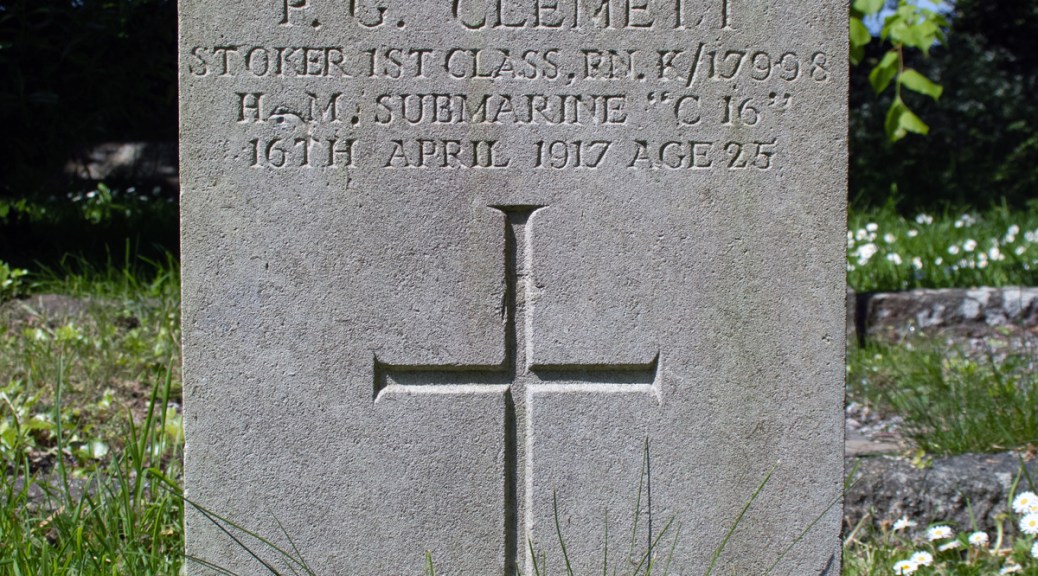
Over the next couple of years, Phillip served on a couple more vessels, but on 11th February 1917 he was assigned to the submarine HMS C16. Stoker Clemetts was on board for a couple of months, as she was patrolling off the Essex coast. On 16th April 1917, the C16 was accidentally rammed by the destroyer HMS Melampus. She sank to the bottom and a couple of attempts were made for the crew to escape, but they became trapped and all perished, including Stoker 1st Class Clemetts. He was 25 years of age.
Contemporary newspaper reports give little detail about the accident – stating simply that Phillip ‘perished at sea’ [Western Daily Press – Tuesday 01 May 1917] His service documents are equally cagy about the incident, confirming jus that he ‘lost his life on duty.’ The records, however, show that on each of his five annual reviews, his character was noted as ‘very good’, while his ability was ‘superior’.
When the submarine was salvaged, Phillip George Clemett’s body was brought back to Somerset for burial. He was laid to rest in the peaceful graveyard of St Peter’s Church in Huntspill.
Sidney Goddard was born on 2nd January 1889 in the village of Oldland Common, near Bristol. The youngest of three children, his parents were Albert and Frances Goddard. Albert was a shoemaker, but by the time of the 1911 census, he and Frances had set up home in Saltford, between Bristol and Bath, where he was recorded as being a bootmaker and innkeeper at the village’s Jolly Sailor.
Sidney, by this time, had gone his own way. On 17th January 1917, he enlisted in the Royal Navy as a Stoker 2nd Class. His service records note that he had been working as a collier when he joined up, so it seemed that coal ran through him. The same records note that Sidney had dark brown hair, brown eyes and a fresh complexion. He was also recorded as being was 5ft 5.5ins (1.66m) tall, and having a number of tattoos: a true lovers’ knot on his left wrist, several dots on his left arm. He had three dots on his right arm, a scar on his back and another on the inside of his left shin.
Stoker Goddard was initially sent to HMS Vivid, the Royal Naval Dockyard in Devonport, for training. After a couple of months he was assigned to the cruiser HMS Amphitrite. It is evident that Sidney showed promise, because he was promoted to Stoker 1st Class on 22nd April, just three months after he enlisted. He returned to Devonport in May, but this was only to change assignments: he boarded HMS Blake, another cruiser, a few days later.
Over the next eight years, Stoker 1st Class Goddard served on five further vessels, returning to HMS Vivid in between assignments. On 1st July 1915, he was assigned to the newly commissioned minesweeper HMS Larkspur. In November that year, she came into Merklands Wharf in Glasgow.
[Sidney] met his death while assisting in docking his ship at Glasgow on the afternoon of Wednesday, November 3rd. By some mischance he was thrown into the dock, and in falling his head struck either on the boat’s side or on the dock. It is believed that he was rendered unconscious by the blow, as otherwise, being a good swimmer, he would have been able to keep afloat till help came.
Bath Chronicle and Weekly Gazette: Saturday 13th November 1915
Stoker 1st Class Sidney Goddard was just 26 years of age when he died. His body was brought back to Somerset for burial. He was laid to rest in the peaceful graveyard of St Mary’s Church, Saltford, within walking distance from the Jolly Sailor, where his parents still lived.
Sidney has the dubious honour of being the only member of HMS Larkspur’s crew to die during the First World War. His two older brothers also served in the conflict, Maurice in the Royal Marines and William, who was a Leading Seaman on board HMS Spitfire when he was killed during the Battle of Jutland.
Stoker 1st Class Sidney Goddard (from britishnewspaperarchive.co.uk)
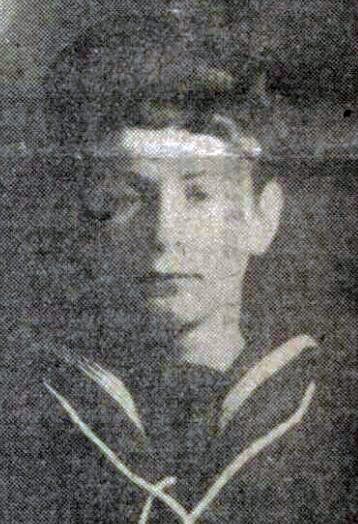
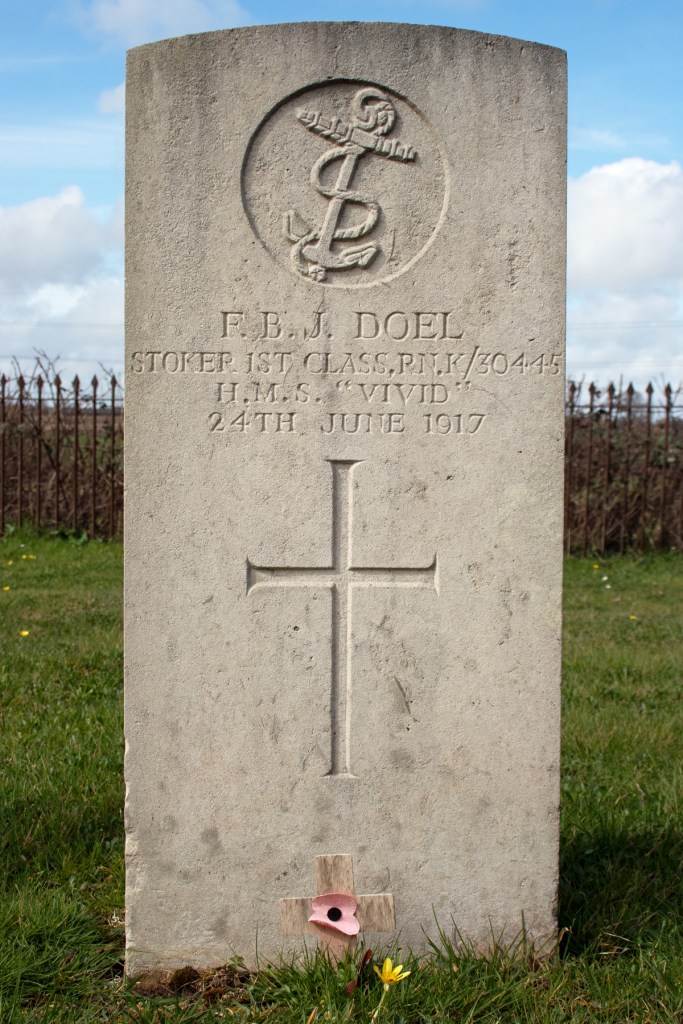
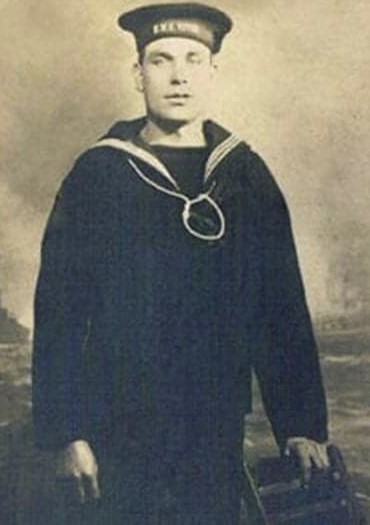
Francis Benjamin John Doel was born in Glastonbury, Somerset, on 26th August 1897. The oldest of five children, his parents were Frederick and Alice Doel. Frederick was a mason’s labourer and, by the time of the 1911 census, the family had set up home in the village of Berkley, on the outskirts of Frome. Intriguingly, the census clearly gives Francis’ middle name as Crossman, although no other record confirms this.
When war broke out, Francis had left school, and was employed as a labourer in a brass foundry. By the start of 1916, however, he stepped up to serve his King and Country, and enlisted in the Royal Navy. His service records give his height as 5ft 3.5ins (1.61m) and note that he had brown hair, grey eyes and a fresh complexion.
Francis was assigned the role of Stoker 2nd Class, and was sent to HMS Vivid – the Royal Naval Dockyard in Devonport – for training. Within a matter of weeks, he was given his first posting, on board the cruiser HMS Dublin, although he only remained there for a month.
After having returned to HMS Vivid for a few weeks, Francis was assigned to another cruiser, HMS Essex. He appears to have been good at his job, and in November 1916 was promoted to Stoker 1st Class.
Stoker Doel returned to HMS Vivid in May 1917, preparing for his Leading Stoker exams. They were not to be, however, as on 24th June, he died, having ‘accidentally drowned’. No further information is available on his death, and the newspaper report of his funeral only notes that he “…met his death on Sunday week. His body was landed from his vessel, and was brought home for burial…” [Somerset Standard: Friday 6th July 1917]. He was just 19 years of age.
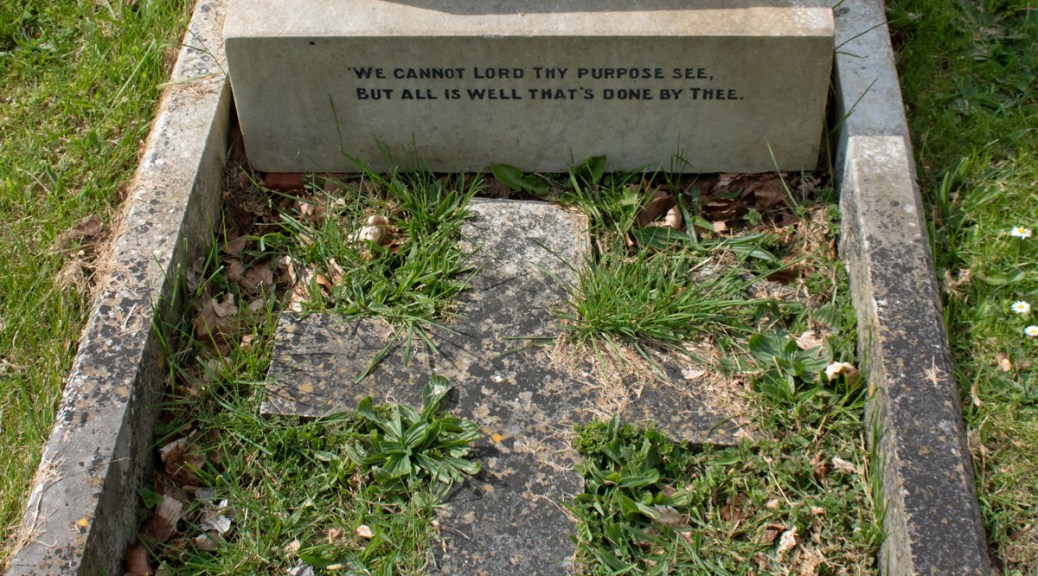
Francis Benjamin John Doel was brought back to Berkley for burial. He was laid to rest in the village’s church cemetery.
Albert Aven was born on 18th December 1896 in the Somerset hamlet of Rodden. One of eleven children, his parents were Alfred and Elizabeth Aven. Alfred was a farm labourer, and farming was certainly something that his sons went into when they finished school.
When war came to Europe’s shores, however, Albert was keen to play his part. On 29th November 1915, he enlisted in the Royal Navy as a Stoker 2nd Class. His service records show that he was 5ft 5.5ins (1.66m) tall, with brown hair, blue eyes and a fresh complexion.
The record also suggests that he lied about his age, giving his year of birth as 1895. It is likely that Albert would have done this because there was a minimum age requirement, although, as he was already over that minimum age, it wouldn’t have made that much difference anyway.
Stoker 2nd Class Aven’s first posting was to HMS Pembroke, the Royal Naval Dockyard in Chatham, Kent, where he spent a couple of months undergoing training. At the end of January 1916, he was moved to HMS Gibraltar, an old cruiser, which patrolled the waters around the Shetland Isles.
After six months on board, and following a further month in Chatham Dockyard, Stoker Aven was assigned to HMS Test. She was a destroyer that patrolled the waters of the Humber Estuary, and Albert spent the next sixteen month with her. During this time, he was promoted to Stoker 1st Class, but the Test was also to be the last ship he served on.
On 8th November 1918, Stoker 1st Class Aven was ashore at the naval base in Hull, when he fell into a dry dock, dying instantly. Little additional information is available – and indeed contemporary newspapers are silent on the matter – but his service records report “Death caused by accidental fall into dry dock at Hull. Verdict of accidental death returned at inquest.” He was just 21 years of age.
Albert Aven’s body was brought home to Somerset for burial. He was laid to rest in the tranquil graveyard of All Saints’ Church in Rodden.
William Henry Dyer was born on 26th March 1895, in Bath, Somerset. He was the only child of William and Elizabeth Dyer. Elizabeth had had a son prior to her marriage to William Sr, and so William Jr had a half-brother, Sidney.
Elizabeth tragically passed away in December when her youngest was only a toddler. William Sr went on to marry again, to a Sarah Chivers. The couple went on to have a family of their own, giving William Jr and Sidney a further five half-siblings.
William Sr was a carman and, when his son left school, he also found carting work, the 1911 census recording him as being a milk carrier. He wanted bigger and better things, however, and, on 8th April 1913, a fortnight after his eighteenth birthday, he joined the Royal Navy.
William’s service records show that he was working as a van guard on the railway at the time of his enlistment. He was 5ft 7ins (1.7m) tall, with light hair, grey eyes and a fresh complexion. He joined as a Stoker 2nd Class, and was initially assigned to HMS Vivid, the Royal Naval Dockyard in Devonport.
After six months’ training, William was assigned to the dreadnought battleship HMS Ajax. She became his home for the next four years, patrolling the North Sea during the conflict and, in June 1916, was involved in the Battle of Jutland. During his time on board, William rose through the ranks, becoming Stoker 1st Class in August 1914, Leading Stoker in August 1916 and Petty Officer Stoker in October 1917.
In January 1918, William returned to HMS Vivid for a few weeks He was then given a new posting, on board HMS Sandhurst, based at Scapa Flow in the Orkneys. Petty Officer Stoker Dyer was to spend the next ten months here, albeit with a short break that autumn.
It was during this period of leave that William married Lily Sarah Bethia Durbin. She was the daughter of a miner, and the couple married in Clutton, Somerset. Their time together was to be brief, however, as William soon returned to Scotland.
It was while Petty Officer Stoker Dyer was back at HMS Sandhurst that he developed pneumonia. Sadly, the condition was to get the better of him. He passed away on board on 27th November 1918, at the age of just 23 years old.
William Henry Dyer’s body was brought back to Somerset for burial. He was laid to rest in St James’ Cemetery in Bath.
Lily had been a wife for just a matter of weeks, and was now left a widow. In 1926 she remarried, to baker and confectioner Albert Farmer. The couple lived a long and happy life, celebrating their 59th wedding anniversary before Albert died in 1985. Lily lived on, passing away in January 1997, at the ripe of age of 98 years old.
Tom Mounter was born on 24th March 1890 in the quiet Somerset village of Kingsbury Episcopi. He was one of ten children to Robert and Ellen Mounter. Robert was a farm labourer, while Ellen earned a little more money for the family by stripping withy – or willow – branches for use in a variety of ways, such as basket weaving.
When Tom left school, he followed his father into agricultural work, employed to grow and manage the withy fields. In April 1911, he married Ellen Talbot, a farm labourer’s daughter from the village. The couple went on to have three children, Frederick, Martha and Horatio.
When war came to Europe, Tom stepped up to play his part. On 14th December 1916, he joined the Royal Navy, along with four others from the village.
Tom’s service records show that he was 5ft 6ins (1.68m) tall, with brown hair, blue eyes and a fresh complexion. Stoker 2nd Class Mounter was initially sent to HMS Vivid, the Royal Naval Dockyard in Devonport, for training, before being assigned to the cruiser HMS Ariadne on 31st March 1917.
The Ariadne had been converted into a minelayer that year, and worked in the English Channel. On 26th July 1917, she was torpedoed by the German submarine UC-65, and sunk, with the loss of all 38 hands, including Stoker Mounter. He was just 27 years of age.
Tom Mounter’s body was brought back to Somerset for burial. He was laid to rest in the peaceful Kingsbury Episcopi Cemetery, next to George Bonning, who had enlisted on the same day as him, and who had died six months before.
The local newspaper, when reporting on Stoker Mounter’s funeral, noted that he was “the seventeenth Kingsbury Episcopi man who has died for his King and country. It is stated that he had a strong presentiment that he would be killed.” [Langport & Somerton Herald: Saturday 4th August 1917]
Stoker 2nd Class Tom Mounter (from findagrave.com)
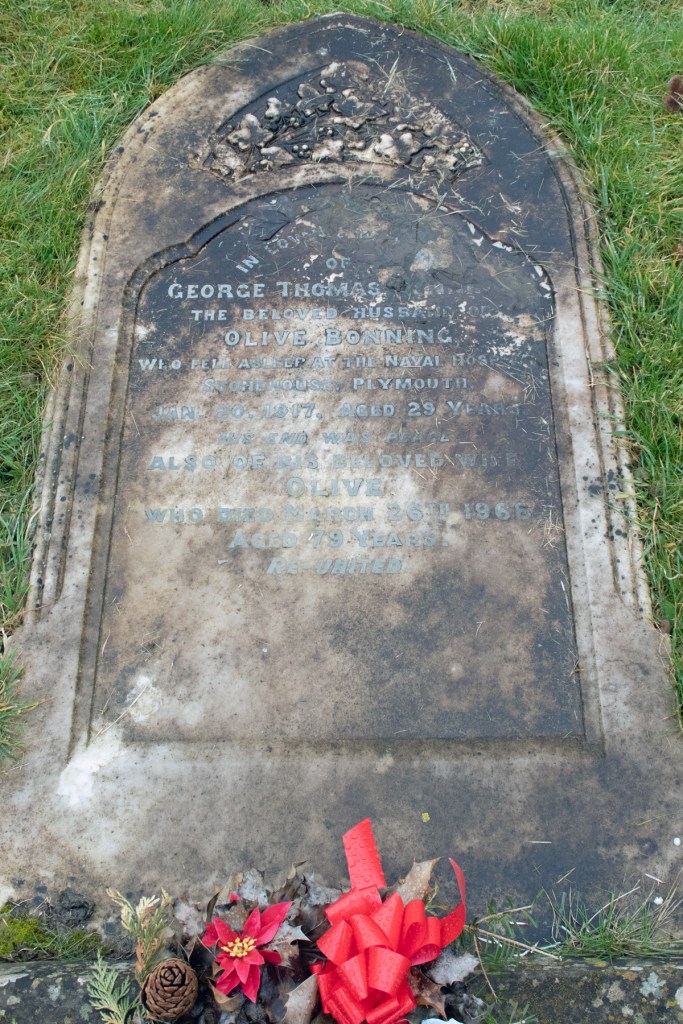
George Thomas Bonning – whose forenames seem to have been interchangeable – was born on 9th August 1887 in the Somerset village of Kingsbury Episcopi. His parents were farm workers James and Elizabeth Bonning, and George also entered farm work when he finished school.
In 1909, George marred Olive Harvey, the daughter of another agricultural labourer from the village. The couple set up home together in the village, and went on to have a daughter, Lilian, the following year. It was around the time of their daughter’s birth that George’s mother passed away, happiness and sadness in a short space of time for the young family.
By 1911, George was employed as a carter in a factory, presumably a financial step up from his previous employment on the farm. The money was still not a great deal, however, and Olive was also working, machining gloves at home for the local factory.
War came to Europe, and on 14th December 1916, George enlisted in the Royal Navy, along with four other men from the village, including friend and neighbour Tom Mounter. His service records show that he was 5th 11.5ins (1.82m) tall, with black hair, hazel eyes and a fresh complexion.
Stoker 2nd Class Bonning was sent to HMS Vivid, the Royal Naval Dockyard in Devonport, for training, and it was here that he contracted a chill. Tragically, this developed into pneumonia, and he died in the barracks on 20th January 1917. He was 29 years of age, and had been in service for just 37 days.
George Thomas Bonning’s body was brought back to Somerset for burial. He was laid to rest in the peaceful Kingsbury Episcopi Cemetery.
Olive never remarried after losing her husband. She remained in the village, raising Lilian and finding occasional employment to help pay the bills. She passed away on 26th March 1968, at the age of 79, and was laid to rest with George, husband and wife reunited after more than fifty years.
Daniel Johnson was born in Dingle, County Kerry, Ireland, on Christmas Day 1883, one of nine children to John and Ellen Johnson. John was a general labourer in the town, but while he initially followed suit, his son was destined to see the world.
On 3rd April 1903, Daniel joined the Royal Navy as a Stoker 2nd Class. His service records show that he was 5ft 7ins (1.70m) tall, with auburn hair, grey eyes and a sallow complexion.
Stoker Johnson was initially sent to HMS Vivid – the Royal Naval Dockyard in Devonport – for training. He was given his first posting in December, and was assigned to the battleship HMS Empress of India. She was to be his home for the next fifteen months.
In February 1905, Daniel was moved to another battleship, HMS Hannibal. Over the next eight years, he would go on to serve on six further vessels. His conduct was noted as Very Good throughout his time in the Royal Navy, and this was matched with the promotions he received. In July 1906, while on board HMS Suffolk, he was given the rank of Stoker 1st Class, and four year later, while serving on HMS Commonwealth, he was promoted to Leading Stoker.
In between voyages, Daniel’s base was HMS Vivid, but in February 1913, he was assigned to HMS Victory – the Royal Naval Dockyard in Portsmouth, Hampshire. He had been serving for ten years by this point, and his records hint at the man he had become. His height was now 5ft 10ins (1.78m), his hair recorded as dark brown and his complexion was noted as being fresh.
On 16th April 1913, Daniel seems to have been assigned to the Northern Irish Inniscrone Battalion, remaining with them for some fifteen months. Based at Inniscrone (now Enniscrone, Co. Sligo), this posting seems to have been with the Coastguard, patrolling the western coast of Ireland.
August 1914 saw Leading Stoker Johnson return to the Royal Navy. He was assigned to the battleship HMS Bulwark, which patrolled the English Channel when he first came on board. By that autumn, however, she had moved to North Kent, guarding the waters around the Isle of Sheppey against potential German invasion.
Daniel was on board Bulwark when, on the morning of 26th November 1914, an explosion ripped through the ship, tearing it apart and sinking it. In all 741 souls were lost, Leading Stoker Johnson among them. He was just 30 years of age.
The majority of those who died in the explosion aboard HMS Bulwark were buried in a mass grave in Woodland Cemetery, Gillingham, Kent. Daniel’s body, however, was not recovered until 24th January 1915, some two months after the explosion.
The sixteenth inquest on the victims of the Bulwark disaster was held at Chatham Naval Hospital on Monday. A body clothed in the dress of a patty officer was identified as that of Thomas Henry Treacher, who was a gun-layer. Two stokers were identified by marks on their clothing as Daniel Johnson, of Blackfields, Co. Kerry. and Edward Henry Buckingham of Nunhead, London, and an able seaman’s body proved to be that of John Griffin, of Kilrush, Co. Clare. The jury returned a verdict of accidental death in each case. Twenty-five bodies have now been recovered.
Westerham Herald: Saturday 30th January 1915
Daniel Johnson was laid to rest in a marked grave in Woodlands Cemetery, not far from his fellow servicemen.
Interestingly, the Coastguard station at Enniscrone would feature in history again a few years after Daniel’s death. Based next to the town’s pier, it was manned by up to five guards and was home to them and their families.
The coastguard station at Enniscrone, County Sligo, was raided on Thursday night, and arms and ammunition taken. The streets of Enniscrone were cleared by the Volunteers prior to the raid. One coastguard is stated to have fired several shots at the attackers, but he was eventually overpowered, and the garrison were then marched out. The arms and ammunition were removed to a waiting motor car, and the furniture and personal belongings of the coastguards taken from the building, which was then set fire to and destroyed.