Tag Archives: 1915

Private Philip Langlois

Private Philip Langlois

Philip John Langlois was born 21st September 1886 in St Lawrence, Jersey. One of fourteen children, he was the eldest son to carpenter Philip Langlois and his wife, Mary.

When he finished his schooling, Philip Jr was apprenticed to his father, but, by the time of the 1911 census, the Langlois family had taken on Mayfield Farm. Most of the family we included in running it.

When war came to Europe, Philip left his father’s farm and stepped up to play his part. Sadly, full details of his service are lost to time, but it is clear that he enlisted in the Royal Jersey Militia. Attached to the 1st, or West, Battalion, he served his time on the island.

The funeral took place yesterday afternoon with full military honours of Pte. Philip Langlois, of D (St Lawrence) Co… The deceased, who was 28 years of age, was very popular with his comrades, and was on duty a fortnight ago. Though suffering with a slight cold, he then seemed otherwise to be in good health. A few days ago, however, he was engaged ploughing, when he was taken ill, and returning to his father’s residence… was obliged to take to his bed. Unfortunately he never rallied, but passed away on Tuesday last.

It is very many years since a military funeral took place at St Lawrence, and this coupled with the sad circumstances surrounding the death was responsible for the large number of sympathetic spectators who lined the roads and assembled at St Lawrence Churchyard, where the internment took place.

[Jersey Evening Post: Saturday 6th February 1915]

Philip John Langlois had passed away on 2nd February 1915. His family headstone notes the other members of his family who are buried with him.


Philip’s younger brother, George, enlisted in the Hampshire Regiment, and was attached to the 1st Battalion as a Private. He was caught up in the Third Battle of Ypres and killed on 4th October 1917. George was 21 years of age, and is commemorated on the Tyne Cot Memorial.

Sadness was to strike again on 21st December 1917, when Philip’s sister, Elsie, passed away: she was 28 years old. Another sister, Florence, passed away on 3rd March 1918, aged 29. Both were laid to rest with their brother.

Philip’s parents were also interred in the family grave: Philip Sr when he died in 1936 at the age of 76; and Mary when she passed away in 1955 aged 92.


Rifleman Conrad Bedford

Rifleman Conrad Bedford

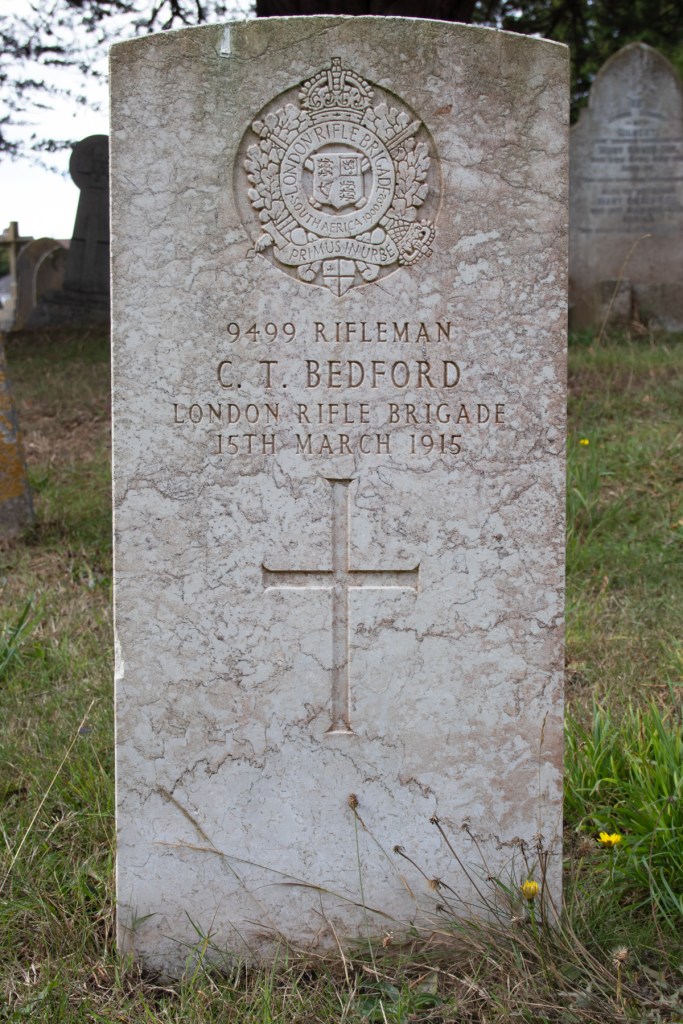
Conrad Thomas Bedford was born on 8th August 1891 in Bowes Park, Middlesex. The younger of two children, his parents were Thomas and Clara Bedford. Thomas was a bank clerk, who had a strong focus on education and, after his untimely death in 1899, aged just 40, Clara was keen to ensure that her only son received the best.

Conrad was educated at Seaford College in Sussex, and was boarding there at the time of the 1901 census. Whilst there, he served in the College Cadet Corps, which was attached to the Royal Sussex Engineers, and by the time he left, in 1909, he had taken the rank of Corporal.

When he completed his schooling, Conrad found work as a clerk in the London Joint Stock Bank, and soon volunteered for the London Rifle Brigade. When war broke out, he willingly stepped up to serve his country, and became attached to the regiment’s 5th Battalion.

The 1/5th (City of London) Battalion (London Rifle Brigade), to give the London Regiment’s unit it’s full title, fought on the Western Front, and Rifleman Bedford arrived in the Wallonia region of Belgium on 4th November 1914.

Early in 1915, Conrad was based near Ploegsteert, when, at around 2am on 27th February, he was shot in the right shoulder. He was medically evacuated to Britain, and admitted to the American Women’s War Hospital, in Paignton, Devon. While his injury was treated, sepsis set in, and Rifleman Bedford succumbed to it: he passed away on 15th March 1915, at the age of 23 years old.

Surprisingly, Clara did not bring her son back to London, where she was living. Instead, Conrad Thomas Bedford was laid to rest in Paignton Cemetery, not far from where he had breathed his last.


Riflemen Conrad Bedford
(from ancestry.co.uk)

Stoker Petty Officer Albert Symes

Stoker Petty Officer Albert Symes

Albert Symes was born in Dorset on 6th March 1887. Details of his early life are a challenge to piece together, as his was not an uncommon name in the county – the 1891 census has at least two potential matches, and the 1901 record at least three.

The first concrete information for Albert is that of his military service. Having been working as a general labourer, he enlisted on the 22nd September 1906, joining the Royal Navy as a Stoker 2nd Class. His service records show that he was 5ft 5ins (1.65m) tall, with brown hair, blue eyes and a fresh complexion. He was also noted as having the letters BS (presumably for Bert Symes) tattooed on his right forearm.

The service document gives his place of birth as Yeovil, Dorset, although the town is actually in Somerset. The next census, taken in 1911, suggests he was born in the village of Bradford Abbas, three miles south east and over the Dorset border.

Stoker 2nd Class Symes was first sent to the training ship HMS Nelson. Based in Portsmouth, Hampshire, this is where Albert spent three months, before being assigned to the cruiser HMS Eclipse. Over the next nine years, Albert served on eight ships, returning to a land base – HMS Victory in Portsmouth – in between voyages.

Albert’s commitment to the job is evident – his character was continually noted as being Very Good, while his ability was Superior as each of his annual reviews. In May 1907 he was promoted to Stoker 1st Class; five years later he made Acting Leading Stoker, with a full promotion to the rank in June 1913; on 1st June 1915, while serving on board HMS Hampshire, Albert was promoted again, to Stoker Petty Officer.

Things would change rapidly for Albert, however. Within a matter of weeks, he had contracted pneumonia. He was transferred to the hospital ship Garth Castle, but the condition was to prove too severe. Stoker Petty Officer Symes passed away from the condition on 3rd October 1915: he was 28 years of age.

Albert Symes’ body was brought back to Dorset for burial. He was laid to rest in the peaceful graveyard of St Mary’s Church in the village of Bradford Abbas.


Serjeant William Dutch

Serjeant William Dutch

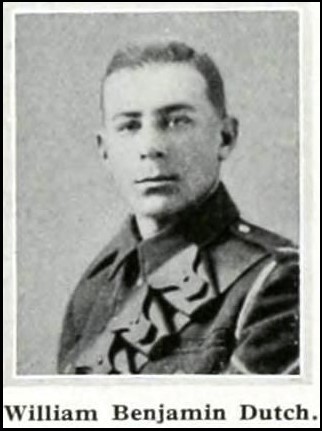
DUTCH, WILLIAM BENJAMIN, Sergt., No. 83812, 47th Brigade, Royal Field Artillery, [son] of William Dutch, of Bladud House, Bath, Accountant, by his wife, Alice, [daughter] of Alderman Alfred Taylor, of The Red House, Bath; b. Lower Weston, Bath, 21 April 1894; educ. Bathforum, and Bath City Secondary School 93 years’ Scholarship), and was employed in the engineering works of Stothert and Pitt Ltd., of Bath. He joined the Army, 17th Aug. 1914; was made Bombardier, 1 November 1914; Corpl., 14 November 1914; and Sergt., 1 January 1915; and died at the Thornhill Isolation Hospital, Aldershot, 11 April 1915, of septic scarlet fever; [unmarried]. He was buried at Locksbrook Cemetery, Bath, will full military honours. His Capt. wrote: “I cannot exaggerate the loss he is to me personally and to the whole battery, had picked up a wonderful knowledge of gunnery and his work in general was out and out the best sergeant I had, and would have gone far in the service.” He was a keen sportsman and a popular football player.

[De Ruvigny’s Roll of Honour, 1914-1919]

William Benjamin Dutch was the second of five children to William and Alice. His father initially worked as a grocer and wine and spirit shopkeeper, and the 1901 census found the family living above the shop on the corner of Chelsea Road and Park Road, Bath.

By the time of the 1911 census, however, things had changed. The Dutches had moved to Walcot, nearer the centre of Bath, and William was working as a tramway clerk. Alice was running the family home – 3 Bladud Buildings – as a boarding house, and employed a housemaid and kitchen maid to help look after the lodgings.

William’s dedication to his army role – and his rapid rise through the ranks – is outlined in the article above. He seems, however, to have spent his time on home soil, remaining at his Hampshire base from his enlistment to his passing. His service records give an insight into his physical nature: he stood 5ft 6.5ins (1.69m) tall, and weighed 153lbs (69.4kg). He had light brown hair, grey eyes and a fresh complexion.

Serjeant Dutch’s illness seems to have come on him quickly:

On Sunday a telegram reached [his parents] saying that their son… was seriously ill in hospital at Aldershot. Mr Dutch went thither at once, only to find that his son had passed away. He was attacked last week with bronchial pneumonia, and tracheotomy was performed in the hope of saving his life, but in vain. The deceased was… a young soldier of rare promise and fine physique.

[Bath Chronicle and Weekly Gazette – Saturday 17 April 1915]

William Benjamin Dutch was just 20 years old when he passed away. His body was taken back to Somerset for burial. He was laid to rest in the family plot in Bath’s sweeping Locksbrook Cemetery, within sight of William Sr’s former shop on Chelsea Road.


Serjeant William Dutch
(from findagrave.com)

Boy 1st Class Ernest Hewett

Boy 1st Class Ernest Hewett

Ernest Roye Hewett was born on 18th April 1898 and was the third of twelve children to Alfred and Ada. Alfred was a coachman and groom and, while both he and Ada were born in Cornwall, it was in Budleigh Salterton, Devon, that the family were born and raised.

When he finished his schooling, Ernest found work as a butcher’s boy, but when sought bigger and better things. His oldest brother, Ralph, had enlisted in the army by the time of the 1911 census and, by that October, his next oldest brother, Leslie, had enlisted in the Royal Navy. Ernest felt a career in the military was his destiny and, on 12th September 1913, he also joined the navy.

As he was under age at this point, he was given the rank of Boy 2nd Class, and sent to HMS Impregnable, the training establishment in Devonport, for his induction. His service records show that he was 5ft 2.5ins (1.59m) tall, with brown hair, hazel eyes and a fresh complexion.

Ernest spent nine months training, moving from Impregnable to HMS Powerful, and gaining a promotion to Boy 1st Class in the process. In June 1914, he was assigned to the cruiser HMS Edgar, remaining on board for six months, by which point war had broken out.

On 18th December 1914, Lance Corporal Ralph Hewett was killed in action, aged just 20 years old. Attached to the 2nd Battalion of the Devonshire Regiment, he was caught in fighting in Northern France, and is commemorated on the Le Touret Memorial.

Ernest, by this point, had been assigned to another ship, the armed merchant cruiser HMS Viknor. Patrolling the seas off Scotland, towards the end of the month, she was tasked with locating and detaining the Norwegian ship Bergensfjord, on board which was a suspected German spy.

The vessel was located and escorted to Kirkwall in the Orkneys, and the suspect and a number of other prisoners, were taken on board the Viknor to be transported to Liverpool. The ship and crew were never to reach their destination. On 13th January 1915, she sank in heavy seas off the Irish Coast: no distress signal was made and all hands were lost.

BODY WASHED ASHORE – Another body has been washed ashore at Pallntoy Port, about six miles from Ballycastle. The body was that of a man of about 5ft 10in. in height. He was dressed in a blue jacket, and wore a service blue webbed belt, on which was the name E. F. Hewett. In the pocket of the trousers was a boatswain’s whistle.

Freeman’s Journal: 24th February 1915

Already in mourning for Ralph, Alfred and Ada were unable to bring 16-year-old Ernest Roye Hewett back home. Instead, he was laid to rest in Ballintoy parish church, County Antrim.


The heartbreak was to continue for the Hewett family. Leslie’s career had gone from strength to strength and, by the time of his older brother’s death, he had been promoted to Able Seaman. In the summer of 1915, he was assigned to the cruiser HMS Europa, remaining aboard for the next year as it patrolled the Mediterranean. In July 1916 he fell ill, having contracted malaria. This was to prove his undoing: he passed away from the condition on 21st July, at 20 years old.

Able Seaman Leslie Hewett was laid to rest in the Mikra British Cemetery in Greece. His parents had now lost their three oldest sons, and had no way to reach their final resting places.


Lance Corporal John Bowden

Lance Corporal John Bowden

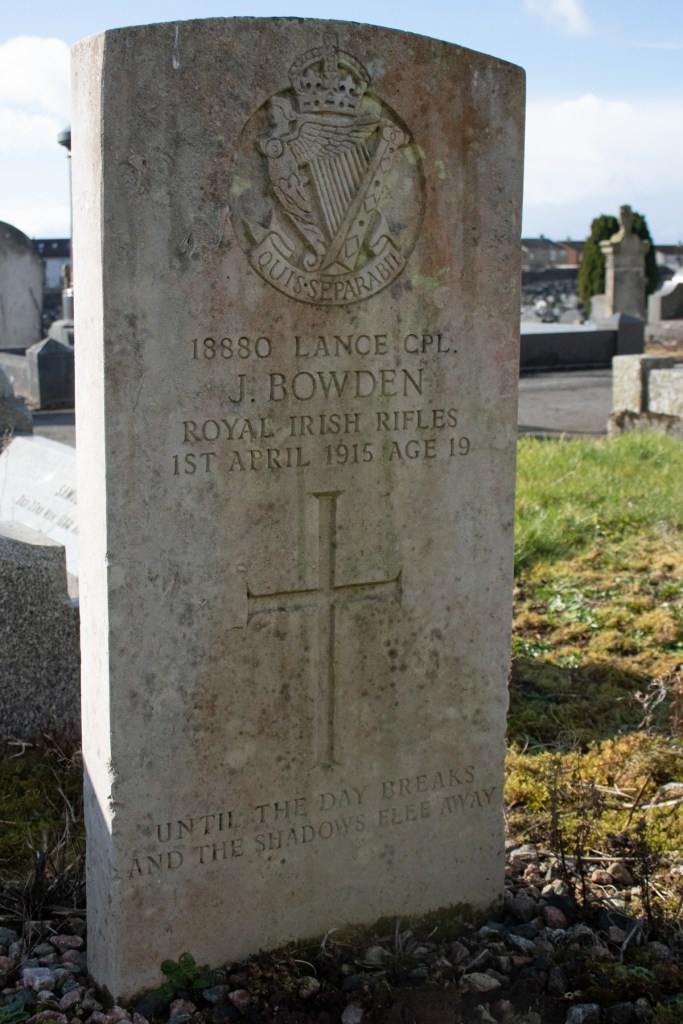
John Bowden was born in Slaght, Ballymena, County Antrim, in 1896. The third of four children, he was one of three sons to David and Margaret. David was a railway labourer, and by the time of the 1911 census, the family had four wages coming in. John, at 15, was working as a solicitor’s clerk, while his older brothers were both employed, one as a baker, the other as an engine cleaner.

On Saturday afternoon last there were laid to rest in the Ballymena New Cemetery the mortal remains of Lance-Corporal John Bowden, of the Royal Irish Rifles, whose lamented demise from scarlet fever took place at Newtownards Camp… to the intense regret of his commanding officers and comrades, with all of whom he was on the most intimate and friendly terms.

The deceased was a bright, intelligent young man, of a rather retiring disposition but by his unassuming personality, combined with a cheery and lovable disposition, he gained for himself hosts of friends wherever he went.

He served his apprenticeship to the law in the office of Mr John Owens, solicitor… where he was held in the very highest esteem by his employer and fellow clerks. Indeed he was on happy relations with all the law clerks and young men in the town, all of whom deeply deplore his demise.

He was for a considerable length of time a staunch and loyal member of Slatt LOL No. 475, and… [at] Ballymena District Orange Lodge very sympathetic allusions were made to his untimely death, and the District Secretary (Br. Hugh Ballentine) was instructed to forward a letter of sympathy and condolence to the bereaved parents and other relatives in this season of their affliction.

The deceased was a most enthusiastic member of the No. C Company Ulster Volunteers (Harryville Branch) and here is may be remarked that out of a hundred of a membership there at the present time thirty-nine members in Lord Kitchener’s army, together with eight reserve men at the front, which educed the company by almost fifty per cent…

Shortly after the outbreak of hostilities the deceased very gallantly volunteered for active service and was accepted, being attached to the 12th Battalion Royal Irish Rifles… He was most attentive to his drill instructions, courteous and obliging to his officers, and a true comrade in every sense of the term.

Ballymena Observer: Friday 9th April 1915

Much of John’s service records are lost to time. His commitment to duty was underlined by his promotion to the role of Lance Corporal within months of enlisting.

John Bowden passed away from scarlet fever at Newtownards Camp on 1st April 1915. He was just 19 years of age. He was laid to rest in Ballymena New Cemetery, the newspaper report going on to outline the outpouring of grief at what would have been one of the town’s first military funerals of the war:

The tremendous crowds which formed in the funeral procession at the several squares and crossings en route to the cemetery testified to the respect in which the deceased was held by all who knew him.

The footpaths were lined and thronged with people all along the entire way, and as the funeral passed through the town business was suspended for the time being…

On arriving at the Cemetery the place was absolutely packed with spectators, all anxious to witness the carrying out of the obsequies… the scene was truly most pathetic, whilst to add to the sorrow and sympathy manifested on the face of everyone, the wailing and sobbing of deceased’s little sister as the remains were lowered into the grave were heartrending.

Ballymena Observer: Friday 9th April 1915

Lance Corporal John Bowden
(from findagrave.com)

Private Rondaine Cary

Private Rondaine Cary

Rondaine Tristram Cary was born in Lancashire in the autumn of 1896 and was the oldest of two children to Henry and Wilhelmina. Henry was an insurance agent, and, by the time of the 1901 census, the family had moved to the parish of Linsfort in County Donegal, Ireland. This is near where Wilhelmina had been born, so it seems likely that the draw of family had been partially responsible.

The 1911 census found the Carys living a few miles down the road, in Buncrana. Rondaine was listed as being a scholar, while his younger brother, five year old John, completed the family setup. John was employed as a commission agent, and all four members of the household were listed as being Episcopalian.

When war came to Europe in 1914, Rondaine was keen to play his part. He seems to have enlisted almost at once, joining the Royal Inniskilling Fusiliers. Assigned to the 11th (Service) Battalion (Donegal and Fermanagh), Private Cary was sent to Ballymena, County Antrim, for training.

Rondaine had only been in the camp for a matter of weeks, when he contracted measles. He was admitted to a hospital in Ballymena on 17th February 1915, but his condition worsened, and his father came to visit. Private Cary passed away on 27th February 1915, aged just 18 years of age.

The Cary family seemed unable to afford the cost of bringing their son’s body back to Buncrana. Instead, the local authority paid for Rondaine Tristram Cary’s coffin and funeral at Ballymena Cemetery, while his army colleague funded his headstone.


Driver Charles Millson

Driver Charles Millson

Charles Millson was born in Scullcoates, Yorkshire, in the summer of 1897. One of nine children, his parents were called Charles and Eliza. Charles Sr was a general labourer and while still at school, his son found work as a newsboy, hawking papers for a local newsagent.

Sadly, there is little more concrete information about young Charles’ life. When war broke out, he stepped up to enlist, although the exact dates of his service are lost to time. He joined the Royal Field Artillery and, as Driver, was assigned to the 107th Brigade.

By the summer of 1915, Driver Millson was based on Salisbury Plain, near Amesbury, Wiltshire. This is where he was to breathe his last. Charles died on 7th June 1915, through causes unknown: he was just 18 years of age.

It would seem that the Millsons were unable to bring their son back to Yorkshire for burial. Instead Charles was laid to rest in Amesbury Cemetery, not far from where he had passed away.


Serjeant John Chambers

Serjeant John Chambers

John Dwelly Chambers was born on 21st August 1846, in Holborn, Middlesex. The second of four children, his parents were John and Sarah Chambers. John Sr was a tailor, and this was a trade into which his oldest son followed.

Unusually, John Jr travelled widely with his work and, by the late 1860s, he was based in Devon. It was here that he met and, on 5th March 1870, married Isabella Smith. She was born in Exeter, and couple initially made a life for themselves there.

The 1881 census return shows just how far the family moved in the coming years. John and Isabella were to have nine children: their first, Louise, was born in Exeter a hear after their marriage. The second child, son John, was born in Armagh, Ireland, though; their third, Emily, was born in Glasgow; while their fourth, George, was born in Surrey. It was only by the time their fifth and sixth children, Thomas and Charles, were born that they family returned to Devon. Their youngest three children – Percy, Victoria and Ivor, were all born in Somerset, when the family had settled in Taunton.

The reason for these moves seem to have been because his tailoring work was for the army. The 1891 census found the family living in army barracks, where John was listed as being a soldier. Ten years on, and John was recorded as being a Lance Sergeant in the Somerset Light Infantry, the Chambers’ still being billeted in barrack accommodation in Taunton.

By this point, Percy, now 17 years of age, was employed as a gunsmith, and a later photo suggests that all six of John’s sons went into the army.

Isabella died in 1906, at the age of 58: the following year, John married Elizabeth Dunning, a widow with her own children to raise. The 1911 census found the extended family living in the barracks: John, Elizabeth, Ivor and Elizabeth’s two daughters, Kate and Beatrice. John, by now, was listed as being a master tailor (military), Ivor was now a gunsmith, and the two girls were employed as a book binder and dressmaker respectively.

John had officially been discharged from the army by this point, but it seems likely that the outbreak of war brought him back into service. His life over the next few years is largely undocumented, but it is fair to assume that Serjeant Chambers was called back to the army, possibly to train newer recruits in the trade he had been working in for decades.

John Dwelly Chambers died of a heart attack on 2nd August 1915: he was just short of his 69th birthday. John was laid to rest in the sprawling St Mary’s Cemetery in Taunton, not far from the barracks to which he had devoted his life.


Serjeant John Chambers (seated middle, with his sons)
(from ancestry.co.uk)

Private Edwin Hawkins

Private Edwin Hawkins

Another sudden death has occurred… when Edwin Giles Hawkins, Divisional Reserve company, 8th Divisional Train, BEF, passed away at the age of 38 years. Deceased… was called up with the National Reserves, and for some time he had been in France. On December 2nd he was granted eight days leave from the Front and arrived at home the same evening. He retired to rest at 10pm, apparently in his proper health. At 5am next morning he called his mother and complained of pains in the stomach. Hot water was applied and a doctor sent for but before the latter arrived he passed away.

Western Chronicle: Friday 10th December 1915

Edwin Giles Hawkins was bornin the autumn of 1877, the oldest of six children to Giles and Elizabeth. Giles had been born in West Coker, Somerset, and the family grew up in the Anchor Inn, Yeovil, where he was the innkeeper and glover.

By the time of the 1891 census, Giles had stepped down as landlord, and the growing family were living in a cottage next to the pub. He was working as a leather dresser and glover, working to feed his wife and five children.

Little information about Edwin’s time in the army before the First World War is available. However, his details are missing from the 1901 census, which would suggest that he was serving overseas at that point.

Edwin was called upon to due his duty once more when war was declared. Joining the Somerset Light Infantry, he was assigned to the 1st Battalion, and, by December 1914, he was in France. Private Hawkins was caught up at Ypres the following spring and returned home on leave in December 1915.

The cause of Private Hawkins’ death was recorded as being heart failure. As the newspaper report noted, he was 38 years of age.

Edwin Giles Hawkins was laid to rest in Yeovil Cemetery, a short walk from where his parents still lived.