Tag Archives: 1916

Private William Talbot

Private William Talbot

William Talbot’s early life is destined to remain a mystery. He was born in Street, Somerset, in around 1869, although there is no concrete information about his family. When he left school, he found work in the local shoe factory – as did the majority of Street residents – and he appears to have married at some point in the late 1890s.

By the time of the 1911 census – the first that can be directly connected to him – William had moved to Frome. He was widowed by this point, and was living in a small cottage with his two sons – Edward, who was sixteen, was labouring in the local flour mill; Albert, who was a year younger, was working as a hairdresser.

William seems to have married again, this time to a widow called Alice; she had four children, and the two of them went on to have another child together.

When war broke out, William joined the National Reserves. He subsequently transferred to the Somerset Light Infantry, and was assigned to the 4th (Reserve) Battalion as a Private. He served on guard duty on the Kent coast, although specific details are not available.

Reporting on Private Talbot’s passing, the Somerset Standard stated that he “did not enjoy good health, and had been several times in hospital[Friday 29th September 1916]. He had been admitted to the military hospital in Herne Bay, but passed away from ‘disease‘ on 21st September 1916. He was 47 years of age.

William Talbot’s body was brought back to Frome for burial. He lies at rest in the graveyard of the town’s Holy Trinity Church.


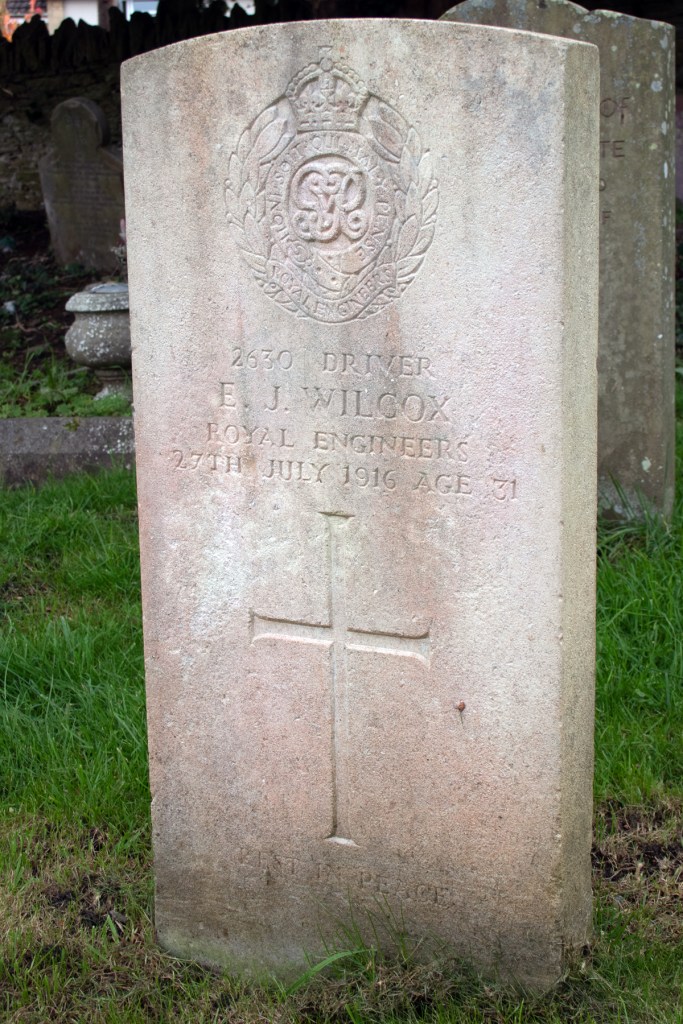
Driver Edgar Wilcox

Driver Edgar Wilcox

Edgar James Wilcox was born in Frome, Somerset, on 2nd February 1885, and was the third of six children to Robert and Louisa Wilcox. Robert was a coal dealer and he and Louisa raised their family in the town of their own birth.

When he left school, Edgar found work on a local farm, tending to, and milking the cows. He met a woman called Ellen Snelgrove and, on 31st October 1908, the couple married at the parish church in Ellen’s home village of Corsley, just over the border in Wiltshire.

By the time of their wedding, Edgar had found employment as a carman for the local railways. The young couple set up home in Frome, and went on to have four children, Edward, Phyllis, Gladys and Cecil.

War was coming to Europe, and, when the conflict broke out, Edgar initially enlisted in the National Reserves in Frome. From there, he joined the Royal Engineers and was assigned as a Driver in the Wessex Regiment Field Company. In his new regiment, he was first based in Taunton, but soon moved to the East Coast.

It was while Driver Wilcox was here that Germany carried out a number of Zeppelin raids on the east of the country. One of these raids, in the spring of 1916, proved too much for Edgar and he suffered a nervous breakdown. He was brought back to Somerset for treatment and admitted to a hospital in Bath.

A contemporary newspaper picked up his story:

On Thursday last week Mrs Wilcox paid her husband one of her periodical visits. They spent several happy hours together, and in the afternoon he went to see her off by train. She then wishes him good-bye, when he seemed as usual, and Mrs Wilcox went to catch a train. It now seems that deceased did not return to the hospital, and after being missing for three days his body was found in the river at Bath.

Somerset Standard: Friday 4th August 1916

Driver Wilcox had taken his own life on 27th July 1916. He was just 31 years of age. An inquest was held and the verdict of ‘drowned’ was reached.

Edgar James Wilcox’s body was brought back to Frome: he was laid to rest in the graveyard of the Holy Trinity Church in the town.


Driver Edgar Wilcox

Serjeant Charles Flower

Serjeant Charles Flower

Charles Franklin Flower was born in Walcot, Bath, at the end of 1879. The middle of five children, his parents were stonemason John Flower and his dressmaker wife, Elizabeth.

John died when his son was only eleven years old, and Elizabeth passed away just two years later, leaving Charles an orphan at just 13 years of age.

He disappears off the radar for a time, only reappearing again when, in the summer of 1895, he enlisted in the 13th Battalion of the Somerset Light Infantry. Charles’ service records show that he stood 5ft 7ins (1.69m) tall, weighed 121lbs (55kg) and had grey eyes, light brown hair and a fair complexion. He was also noted as having a tattooed ring on his left ring finger.

After eighteen months on home soil, Private Flower was sent out to the East Indies, where, apart from a short stint back in England, he spent the next twelve years. He was promoted to Lance Corporal in May 1898, but though his own volition, reverted to the rank of Private seven months later. Charles was destined for bigger things, though, and was again promoted to Lance Corporal in September 1900. Over the next few years, he received further promotions – to Corporal in September 1905 and Lance Serjeant eighteen months later.

In the autumn of 1908, Charles returned to home soil, but his military service continued. On 12th April 1909, he married Elizabeth Ann Wills, a gamekeeper’s daughter from Cannington, Somerset. They set up home in Portland, Dorset, where Charles was based, and went on to have a son, Herbert, a year after they married.

By 1910, Charles had again been promoted, and was now a Serjeant. In the next couple of years, the family moved from the Dorset coast to the Somerset town of Frome. Serjeant Flower’s service continued, but he remained on home soil, even when war broke out.

All was not well with Charles’ health, however, and by the summer of 1915, he was admitted to hospital. He was thin and anaemic, with an enlarged liver and an ‘enormously swollen’ spleen. This was discovered to be a malignant growth, and Serjeant Flower was discharged from military service on medical grounds on 20th December 1915. He had been in the Somerset Light Infantry for more than two decades.

Charles Franklin Flower was not to recover from his illness. He passed away at home on 27th February 1916, at the age of just 37 years old. He was laid to rest in the graveyard of Holy Trinity Church in Frome.


Serjeant Charles Flower
(from ancestry.co.uk)

Private Frederick Down

Private Frederick Down

Frederick Francis Down is one of those servicemen whose life is destined to remain lost to time. Born in Chudleigh, Devon, most of the information available about his life comes from one document – his naval service record.

The document gives his date of birth as 15th November 1897 and confirms that he enlisted on 23rd November 1914. Frederick was 5ft 2ins (1.57m) tall, had a fresh complexion, brown eyes and dark brown hair.

Frederick signed up as a Private in the Royal Marine Light Infantry, and, at the time of joining up, had been working as a butcher’s boy, living in Fore Street in the village of his birth.

Private Down served at the regiment’s depot in Deal, Kent. But he was only there for a short time: he was invalided out of the service – for reasons unrecorded – on 9th June 1915.

At this point, Frederick Francis Down’s trail goes cold once again. His gravestone confirms that he died on 11th April 1916, at the age of just 18 years old. He was laid to rest in Chudleigh Cemetery.


Sergeant Archibald Mills

Sergeant Archibald Mills

Archibald Henry Mills was born in the summer of 1895, the oldest of six children to John and Edith. John was a commercial traveller, selling veterinary wares around the country; he was born in Derby, Edith was from Leicester and, for the for the first seven years of their married life they lived in Edith’s home town – this is where Archibald was born. By the turn of the century, however, they had relocated to Somerset, and set up home in Weston-super-Mare.

When he left school, Archibald found work as an errand boy for a local tailor, but change was on the horizon. By the summer of 1914, he had based himself in Nottingham – the reason is lost to time – and this is where he was when he volunteered for military service.

Archibald enlisted as a Private in the Notts and Derby Regiment – the Sherwood Foresters – and was assigned to the 7th Battalion. He was sent to France as part of the 46th Division and, over the next couple of years, he evidently served his regiment well.

In August 1915, Private Mills was promoted to Lance Corporal; three months later he was again promoted, to Corporal. By May the following year, he received another rise, this time to Serjeant. These promotions were against the backdrop of some fierce fighting – the Sherwood Foresters were involved at Hooge, Hohenzollern and Gommecourt, and were briefly sent to Egypt.

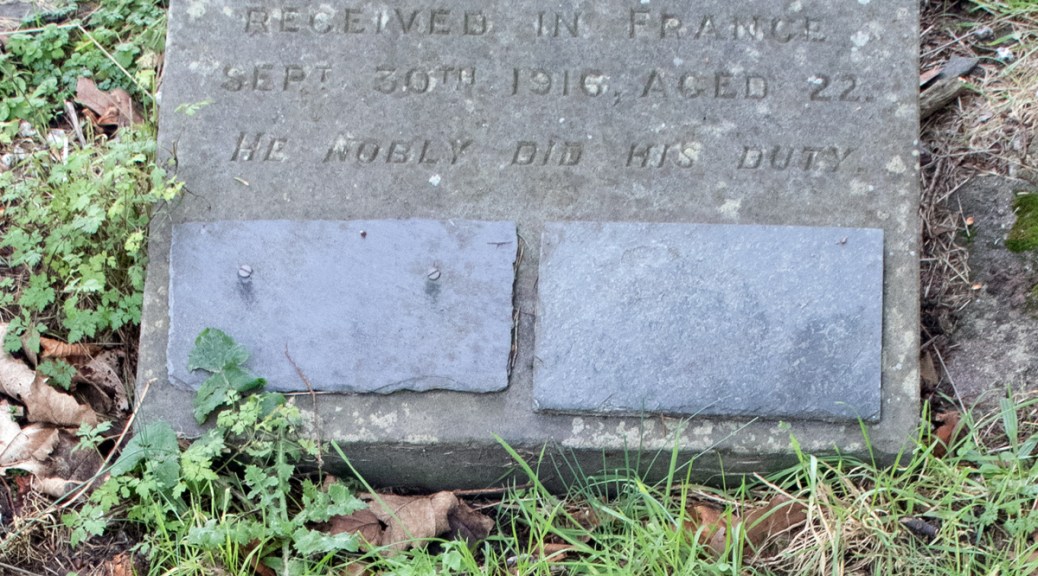
At some point during the summer of 1916 – possible at Gommecourt – Archibald was injured, and medically evacuated to the No.2 Western General Hospital in Manchester. Sadly, however, his wounds were to prove too much: Serjeant Mills passed away on the night of 30th September 1916. He was just 21 years old.

The body of Archibald Henry Mills was brought back to Somerset; he was laid to rest in the Milton Road Cemetery of his adopted home town of Weston-super-Mare.


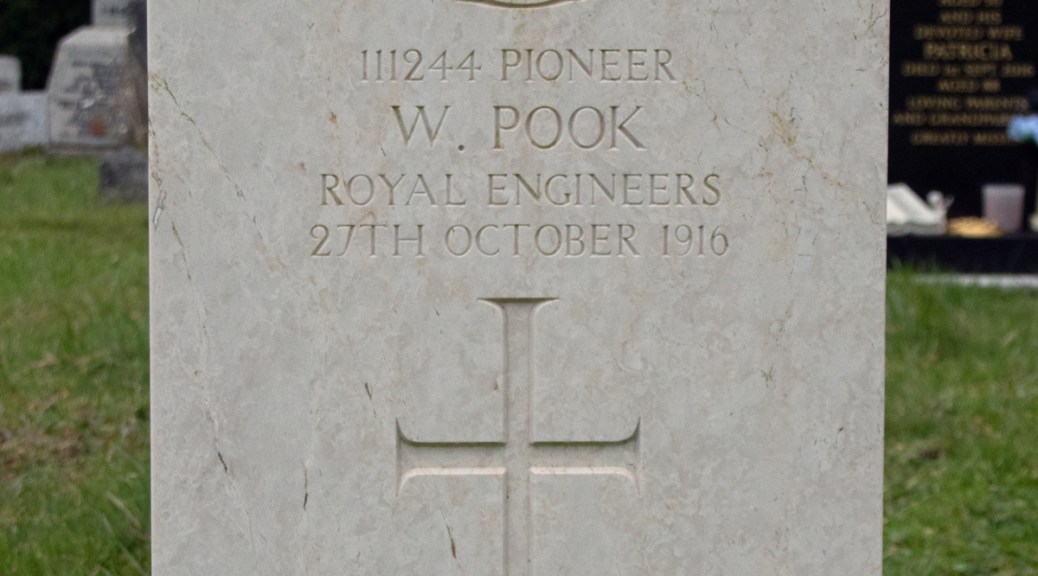
Pioneer William Pook

Pioneer William Pook

William Pook was born in 1869. There is little specific evidence available about his early life, but his service records confirm that he married Jessie Elizabeth Moxey on 25th January 1890: they went on to have four children.

The 1891 census records the young family living in the village of Highweek, near Newton Abbot in Devon, where William was working as a fellmonger, dealing in hides and sheepskins. This was a trade he continued through the years, and is confirmed as his line of work by the time of the 1911 census. At that point, the expanding family had moved from Highweek to nearby Wolborough.

War was coming to Europe and, in August 1915, at the age of 46, William joined up. His age suggests that this was something he did voluntarily – compulsory enlistment was only introduced the following year – and he joined the Royal Engineers as a Pioneer. The role was designed to relieve the infantry from some of the duties that kept them from the front line, effectively acting as a labour force to free up those who were fighting.

Pioneer Pook was sent to France in August 1915, remaining there for nine months. Health issues started to intervene, and, in June 1916, he was dismissed from military service as being medically unfit because of his asthma.

At this point, William’s trail goes cold. The next record confirms that he died on 27th October 1916, in Newton Abbot. No cause of death is evident, but it seems likely to have been related to his lung condition. He was about 47 years old.

William Pook was laid to rest in Newton Abbot Cemetery.


Private Graham Grant

Private Graham Grant

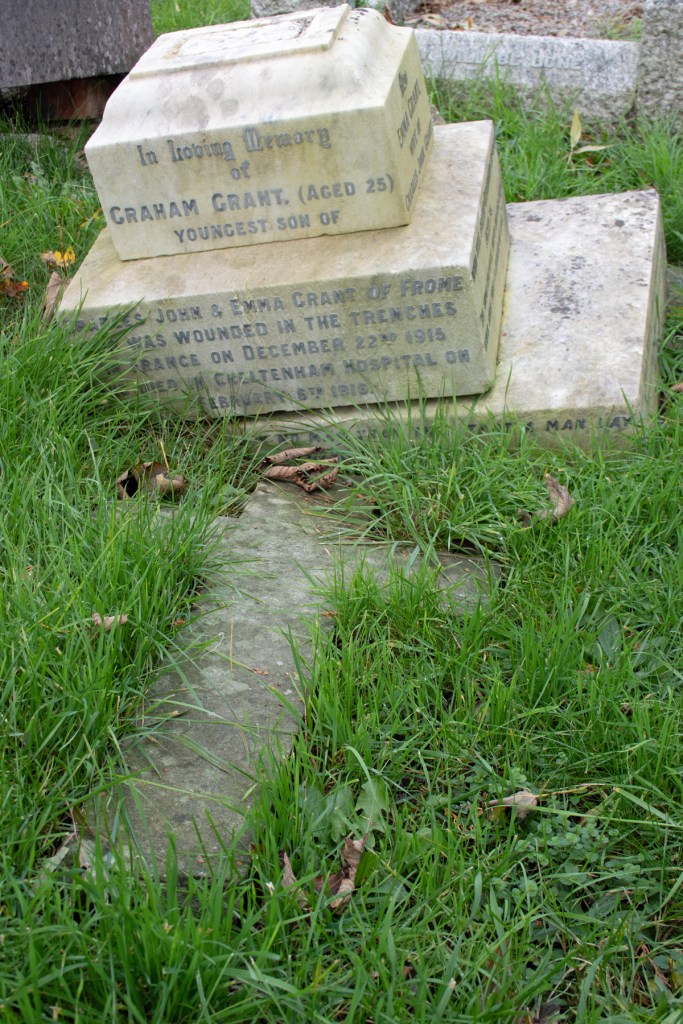
Graham Grant was born in early 1891, one of ten children to Charles and Emma Grant. Charles was a sign painter and both he and his wife were from Wiltshire, but it was in Frome, Somerset, that they chose to settle and raise their family.

When he left school Graham found work as an assistant in a jeweller’s shop, but when war came to England’s shores, he was keen to do all that he could for King and Country.

While full details of his military service are not available, it is noticeable that the local newspaper – the Somerset Standard – dedicated a full column to news of his death in 1916, and then a further full column to his funeral a week later. The newspaper reported that:

Private Graham Grant, who was just 25 years of age, was living in Bristol when the war broke out, and in September 1914, he joined the 4th Gloucesters along with his eldest brother, Private Charles Grant, and being in the same platoon they were inseparable companions both in training and in the trenches… They went out to the Front just over 12 months ago – January 1915 – and for practically a year they escaped injury…

Private Grant had not been home since he landed in France, but he and his brother were expecting to have leave at Christmas to visit their family and friends at Frome. On the 23rd December… [he] was with his platoon in a trench, the top of which was some three feet above the heads of the men. At 8:30 in the evening they were about to be relieved… when a German machine-gun opened fire on the trench.

Somerset Standard: Friday 11th February 1916

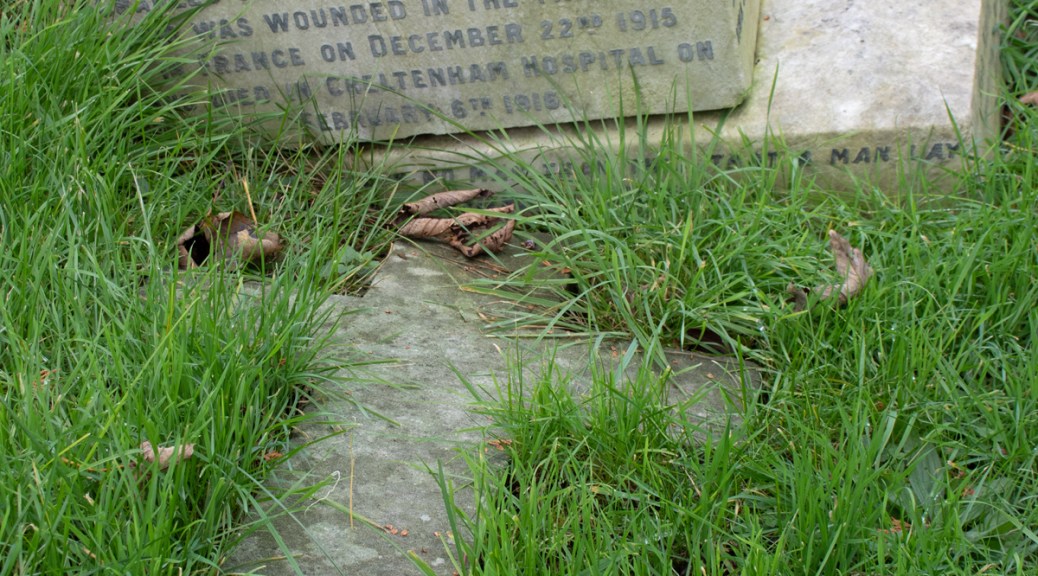
A bullet hit Graham in the back and he was taken first to a hospital in Rouen, then medically evacuated back to England. Admitted to the Racecourse Hospital in Cheltenham, x-rays showed that his spine had been shattered by the bullet, and he was paralysed from the waist down. “[His] case was regarded as hopeless from the first” and as many friends and family went to see him as possible. Private Grant passed away on 6th February 1916, Emma and his three sisters at his bedside. He was just 25 years of age.

Graham Grant’s body was brought back to Frome, and laid to rest in the graveyard of Christ Church in the town. The funeral, at the family’s request, was devoid of any military fanfare or involvement.


While there was a lot of reporting on both the death and funeral, the vicar of St John’s Church in the town noted in his sermon that Graham had been a member of the choir there, both as a boy and a man. He was also the first chorister of the church to give his life for his country. Reverend Randolph went on to say that:

…there were things connected with Graham Grant’s death for which [he was] thankful… he did not die on the battlefield, maybe after hours of suffering unattended and without succour… he did not die in the hands of the enemy or in the enemy’ country… he died surrounded by his relatives and friends, those who were near and dear to him, and that he had the most skilful medical treatment and tender nursing.

Somerset Standard: Friday 11th February 1916

Leading Stoker Joseph Craven

Leading Stoker Joseph Craven

Joseph Craven was born in Liverpool on 6th January 1870. There is little information available about his early life, but by the time of the 1891 census, he was boarding with a blacksmith and his family in Bootle, Lancashire. By this point he was working as a fireman – probably a stoker-type role, rather than for the fire service.

The following year, Joseph found an opportunity to broaden his horizons and, on 21st October 1892, he enlisted in the Royal Navy as a Stoker 2nd Class. His papers show that, at the time of joining up, he was 5ft 4ins (1.62m) in height, had dark brown hair, blue eyes and a fresh complexion. No distinguishing marks were noted.

Joseph’s previous employment seemed to have stood him in good stead. After initial assessments at HMS Pembroke – the shore-based establishment at the Royal Naval Dockyard in Chatham, Kent – he was quickly moved on to HMS Wildfire, based in Sheerness. His first sea posting was aboard the battlecruiser HMS Howe, and, within a couple of months, he had been promoted to Stoker 1st Class.

By the time Joseph’s initial twelve-year contract came to an end, he had served on board nine ships and travelled the world. When the time came, he voluntarily renewed his contract and continued his life at sea.

When back in port, he developed a private life. He met a young widow called Sarah Baker in Portsmouth, and the couple married in 1908. The census three years later found Joseph as the head of the household, living in a seven-room house with Sarah, her 13-year-old daughter, 80-year-old widowed mother and two boarders.

Stoker Craven’s naval service was, by this point, continuing apace. By the time hostilities were declared in August 1914, he had served on twelve further ships, and been promoted again, this time to the role of Leading Stoker. In between his voyages, he was based primarily at HMS Victory, Portsmouth Dockyard’s shore-base.

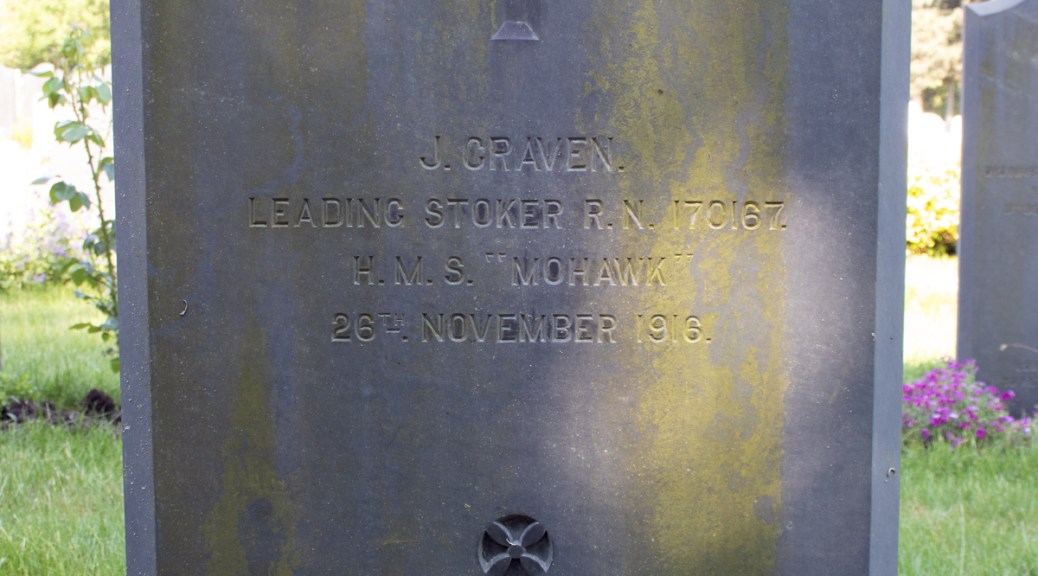
By the end of the following year, Joseph was almost entirely shore-based, moving from HMS Victory in Portsmouth to HMS Pembroke in Chatham and HMS Attentive in Dover. On 26th November 1916, he was serving in Chatham. A local newspaper picks up on what happened to him next:

Joseph Craven… belonging to Portsmouth, met his death under shocking circumstances at Chatham Dockyard on Sunday. When walking by the side of his ship, which was in dry dock, he tripped over some hose and fell headlong into the dock, turning two or three somersaults in his descent, and falling upon his head at the bottom, 80ft [24.3m] below. He was killed instantly.

Kent Messenger and Gravesend Telegraph: 2nd December 1916

An inquest on the 46-year-old’s death was held, and a result of accidental death was returned.

Joseph Craven was laid to rest in the Woodlands Cemetery, Gillingham, walking distance from the dockyard in which he lost his life.


Lance Corporal Henry Preece

Lance Corporal Henry Preece

Henry Thomas Preece was born in the summer of 1884, one of seven children to agricultural labourer Tom Preece and his wife, Sarah. Thomas had been born in the Somerset village of Nunney, and it was here that he raised his family.

When Henry left school, he chose not to follow in his father’s agricultural footsteps. By the time of the 1911 census, he was recorded as a baker and, as such, would have been at the heart of village life in Nunney.

Henry married local woman Ellen Stone in 1909, who was a dressmaker with her own account. The couple would go on to have four children between 1909 and 1916.

With war looming, Henry felt the need to play his part. He joined the King’s Royal Rifle Corps in January 1916 and, after training, was sent to France a couple of months later.

He was wounded on July 25th, when out with a wiring party erecting barbed wire obstacles. He received a gun-shot wound in the abdomen, which also injured the spinal cord and his back. He was first taken to the South African Hospital at the base, and after being there for several days he was removed to England and take to the Netley Hospital where he died…

Somerset Standard: Friday 8th September 1916

Lance Corporal Preece died on 3rd September 1916, at the age of 32 years old. His body was brought back to Nunney, where he was laid to rest in the family grave at All Saints’ Church.


Lance Corporal Henry Preece
(from britishnewspaperarchive.com)

Lieutenant Basil Scott-Holmes

Lieutenant Basil Scott-Holmes

Basil Scott-Holmes was born on 2nd February 1884 in the Somerset village of Wookey. The oldest of two children, his father was Liverpool-born Thomas Scott-Holmes and his wife, Katherine. When Basil was born, Thomas was the vicar of St Matthew’s Church, Wookey, but by 1901, he had risen to the role of clergyman – and subsequently Chancellor – at Wells Cathedral.

Basil’s pedigree stood him in good stead. Initially educated in Llandaff, South Wales, he subsequently attended Sherborne School in Dorset. Sent up to Cambridge, he studied history at Sidney Sussex College.

After leaving university, Basil spent time in Europe learning German and French. He was then assigned the role of Assistant Commissioner in North Nigeria but, after a year there he was invalided home taking up a teaching role at the Bristol Grammar School in 1912.

In July 1913, Basil married Barbara Willey, a surgeon’s daughter from Reigate, Surrey. The marriage record shows that Basil was registrar for an architectural association by this point; the couple went on to have two children, daughters Annette and Prudence.

When the war broke out, he was obviously keen to do his bit. In September 1914 he enlisted in the Royal Army Service Corps, before gaining a commission in the King’s Royal Rifle Corps a couple of months later. In the spring of 1916, Lieutenant Scott-Holmes had been seconded to the Machine Gun Corps, although it is unclear whether he served abroad during any of his time in the army.

On the evening of 24th October 1916, Lieutenant Scott-Holmes was riding in a motorcycle sidecar through central London, on the way back to camp. A local newspaper picked up the story:

…they stopped when going through Wandsworth to re-light the near light, and in the dark a motor omnibus ran into them, and Lieutenant [Scott-Holmes], who was strapped in the side-car, was, with the car, flung across the road. He died as he was being taken to Wandsworth Hospital. At the subsequent inquest, a verdict of “accidental death” was returned.

Central Somerset Gazette: Friday 3rd November 1916

Basil Scott-Holmes was just 32 years old. His body was brought back to Somerset; he was laid to rest in the cemetery at Wells Cathedral.


Larger memorial image loading...
Basil Scott-Holmes
(from ancestry.co.uk)