Tag Archives: 1916

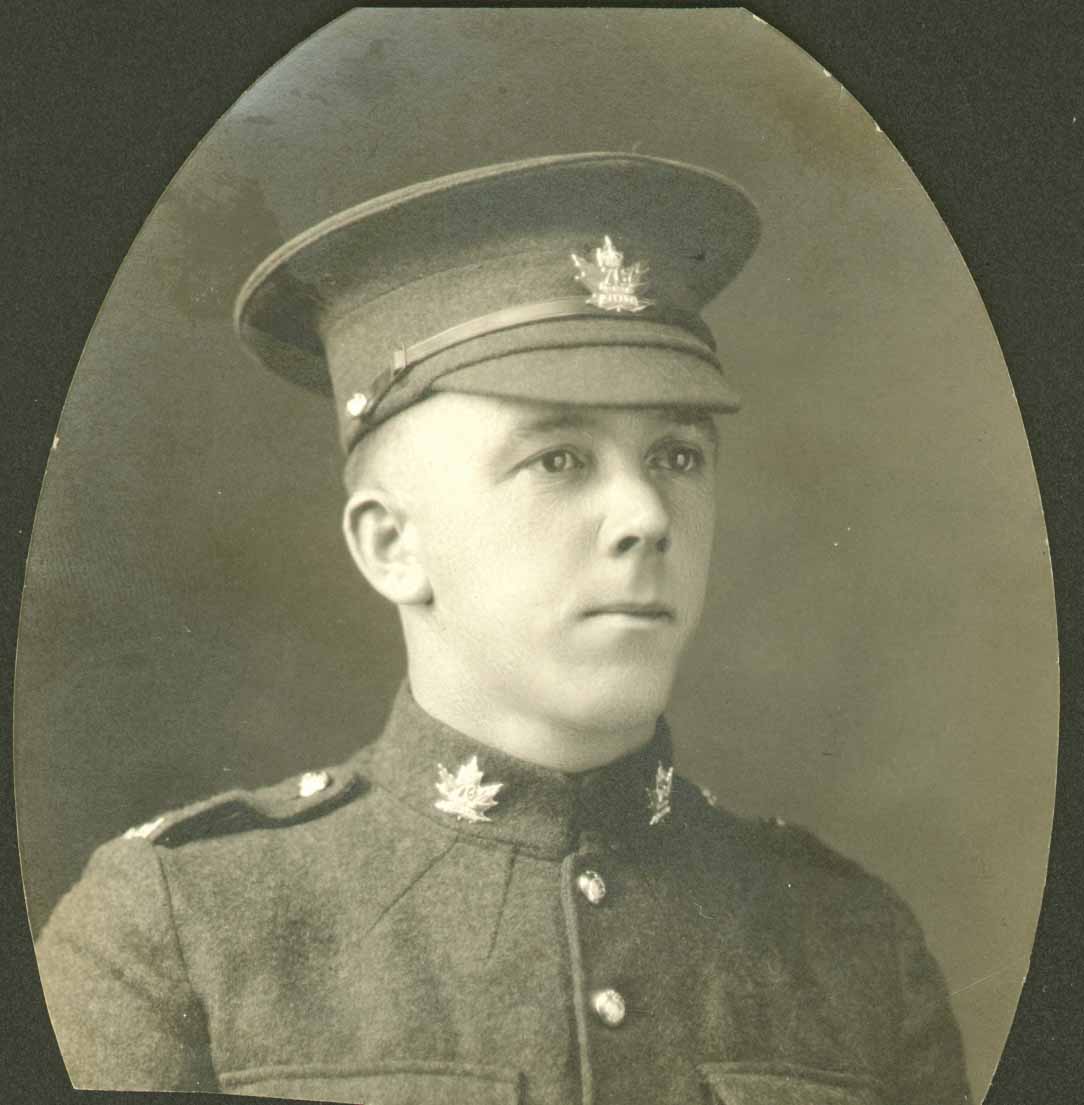
Lance Corporal Henry Preece

Lance Corporal Henry Preece

Henry Thomas Preece was born in the summer of 1884, one of seven children to agricultural labourer Tom Preece and his wife, Sarah. Thomas had been born in the Somerset village of Nunney, and it was here that he raised his family.

When Henry left school, he chose not to follow in his father’s agricultural footsteps. By the time of the 1911 census, he was recorded as a baker and, as such, would have been at the heart of village life in Nunney.

Henry married local woman Ellen Stone in 1909, who was a dressmaker with her own account. The couple would go on to have four children between 1909 and 1916.

With war looming, Henry felt the need to play his part. He joined the King’s Royal Rifle Corps in January 1916 and, after training, was sent to France a couple of months later.

He was wounded on July 25th, when out with a wiring party erecting barbed wire obstacles. He received a gun-shot wound in the abdomen, which also injured the spinal cord and his back. He was first taken to the South African Hospital at the base, and after being there for several days he was removed to England and take to the Netley Hospital where he died…

Somerset Standard: Friday 8th September 1916

Lance Corporal Preece died on 3rd September 1916, at the age of 32 years old. His body was brought back to Nunney, where he was laid to rest in the family grave at All Saints’ Church.
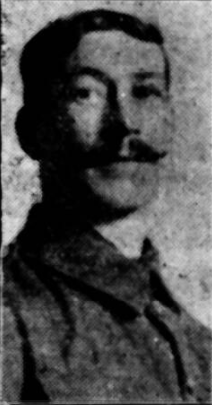

Lance Corporal Henry Preece
(from britishnewspaperarchive.com)

Lieutenant Basil Scott-Holmes

Lieutenant Basil Scott-Holmes

Basil Scott-Holmes was born on 2nd February 1884 in the Somerset village of Wookey. The oldest of two children, his father was Liverpool-born Thomas Scott-Holmes and his wife, Katherine. When Basil was born, Thomas was the vicar of St Matthew’s Church, Wookey, but by 1901, he had risen to the role of clergyman – and subsequently Chancellor – at Wells Cathedral.

Basil’s pedigree stood him in good stead. Initially educated in Llandaff, South Wales, he subsequently attended Sherborne School in Dorset. Sent up to Cambridge, he studied history at Sidney Sussex College.

After leaving university, Basil spent time in Europe learning German and French. He was then assigned the role of Assistant Commissioner in North Nigeria but, after a year there he was invalided home taking up a teaching role at the Bristol Grammar School in 1912.

In July 1913, Basil married Barbara Willey, a surgeon’s daughter from Reigate, Surrey. The marriage record shows that Basil was registrar for an architectural association by this point; the couple went on to have two children, daughters Annette and Prudence.

When the war broke out, he was obviously keen to do his bit. In September 1914 he enlisted in the Royal Army Service Corps, before gaining a commission in the King’s Royal Rifle Corps a couple of months later. In the spring of 1916, Lieutenant Scott-Holmes had been seconded to the Machine Gun Corps, although it is unclear whether he served abroad during any of his time in the army.

On the evening of 24th October 1916, Lieutenant Scott-Holmes was riding in a motorcycle sidecar through central London, on the way back to camp. A local newspaper picked up the story:

…they stopped when going through Wandsworth to re-light the near light, and in the dark a motor omnibus ran into them, and Lieutenant [Scott-Holmes], who was strapped in the side-car, was, with the car, flung across the road. He died as he was being taken to Wandsworth Hospital. At the subsequent inquest, a verdict of “accidental death” was returned.

Central Somerset Gazette: Friday 3rd November 1916

Basil Scott-Holmes was just 32 years old. His body was brought back to Somerset; he was laid to rest in the cemetery at Wells Cathedral.


Larger memorial image loading...
Basil Scott-Holmes
(from ancestry.co.uk)

Private Edward Rendell

Private Edward Rendell

Edward Rendell was born in the Dorset town of Corfe Castle in 1894. His parents were Edward and Sophie Rendell, and he had two siblings, William and Agnes.

Sadly, little information on Edward Jr’s early life is available. His father was a farmer – or at least an agricultural labourer – and this is the line of work his son went into.

When war broke out, Edward Jr was quick to play a part, enlisting within a fortnight of hostilities being declared. He joined the 1st Battalion of the Dorsetshire Regiment as a Private and, after initial training, was sent out to the Western Front by March 1915.

Private Rendell’s battalion was involved in the fighting at Ypres and, on 19th April 1915, he was injured, receiving a gun shot wound to his left arm. Initially treated in the field, he was later transferred to a hospital in Boulogne, before being evacuated back to England to recover.

Reunited with his regiment, Edward was then shipped out to Gallipoli, arriving there in September 1915. While he is likely to have been involved in the fighting in Turkey, he did end up in hospital, but was suffering from influenza.

A couple of weeks later, he is recorded as being admitted to a hospital in Malta, although whether this was also because of the lung condition is not clear. Either way, Private Rendell was back in England by mid-December 1915, remaining in the country for six months.

In March 1916, he again returned to the fray and was posted back to the Western Front. Private Rendell spent a couple of months in battle until, on 21st June 1916, he received a gunshot and shrapnel wound to his thigh. The injury was serious enough for him to be medically evacuated back to England, and he was admitted to the Voluntary Aid Detachment Hospital at Norton-sub-Hamdon in Somerset.

Sadly, while his treatment may have bought Private Rendell some time, it seems that his wounds were too severe; he passed away on 30th July 1916 at the age of just 22 years old.

By this time both of Edward’s parents were dead; his next of kin was his sister, Agnes. While she was still living in Dorset, Edward was laid to rest in St Mary’s Churchyard in Norton-sub-Hamdon.


Private Daniel Norman

Private Daniel Norman

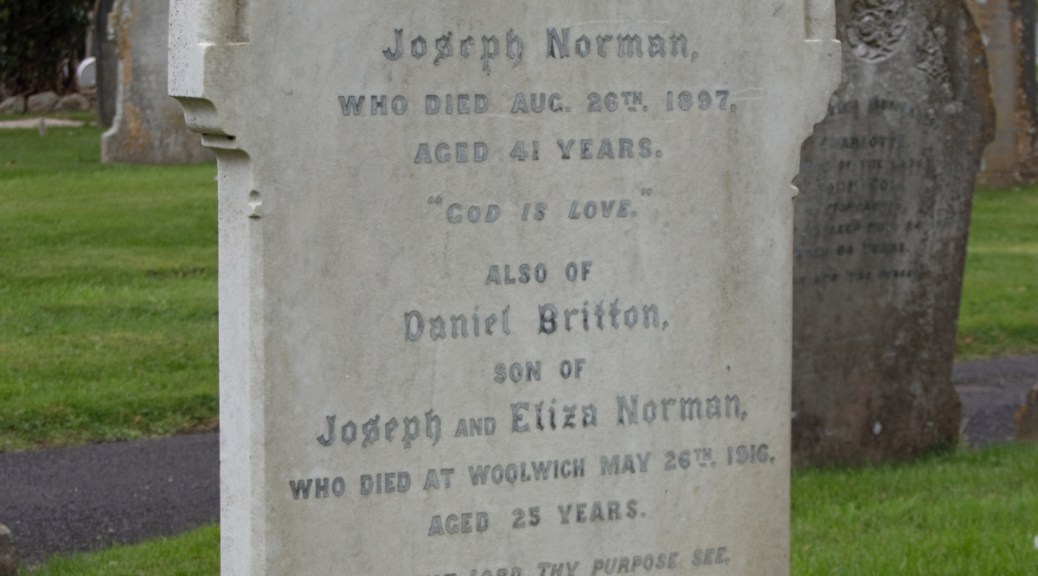
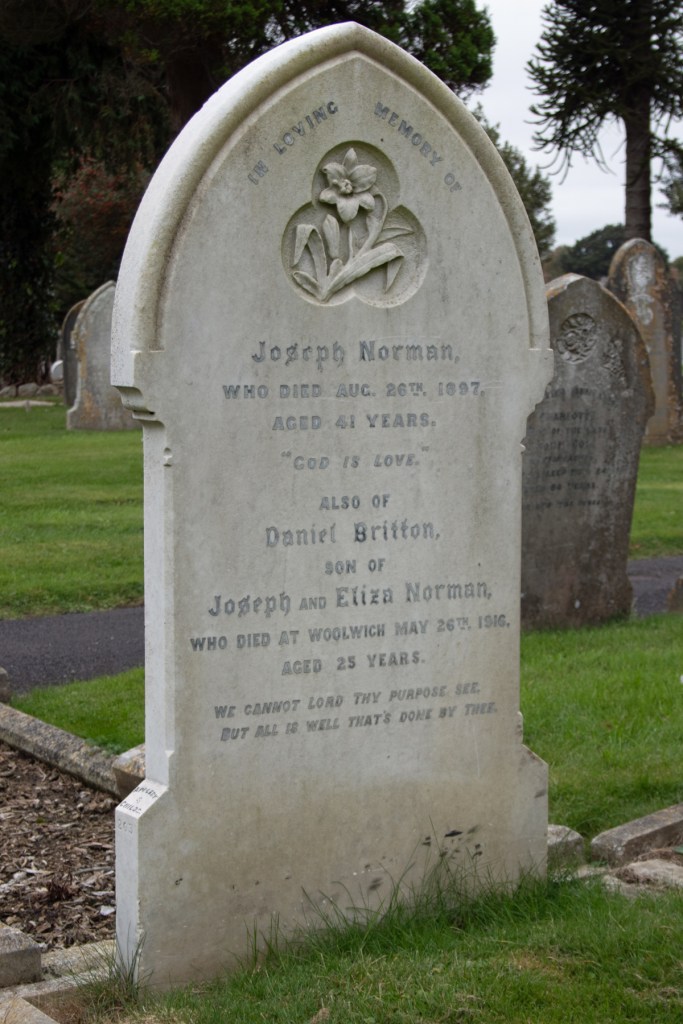
Daniel Britton Norman was born in Yeovil, Somerset, in early 1891, the youngest of four children. Joseph and Eliza Norman, Daniel’s parents, ran the Blue Ball Inn in the town centre, something Eliza took over when her husband died.

There is little information on Joseph’s passing, but a report in the local newspaper may allude to what led to his death:

On Friday [16th January 1891], Mr J Norman, of the Blue Ball Inn, was riding in a waggon through the Borough when he was jerked off onto the road. One of the wheels passed over his right leg, breaking a vein.

Western Chronicle: Friday 23rd January 1891

By the time of the 1911 census, Eliza too had given up the reins of the Blue Ball Inn. At the age of 59, she was living with her two sons in a house on the outskirts of the town; Daniel was listed as a motor mechanic, while his older brother Rowland was a cabinet maker.

War broke out and Daniel enlisted in April 1916. He joined the Royal Army Service Corps and was assigned to the Motor Transport Division. Based in London, Private Norman had received three weeks’ training, when he was taken ill.

Admitted to the Royal Herbert Hospital in Woolwich with cerebro-spinal meningitis, Private Norman quickly went downhill. He died in the hospital on 26th May 1916, aged just 26 years old.

Brought back to Yeovil, Daniel Britton Norman was buried in Yeovil Cemetery, alongside his father.


Private James Plympton

Private James Plympton

James Plympton was born in the spring of 1875, one of four children to Richard and Mary Plympton from Yeovil, Somerset. They raised the family in a cottage to the south of the town centre, where Richard was a labourer and Mary a glover. When they left school, James and his two brothers followed in their father’s footsteps, finding labouring work in the local area.

In the summer of 1899, when James was 24, he married Elizabeth Maria Holt, an agricultural labourer’s daughter from the village of Misterton, near Crewkerne. The couple would go on to have six children, but, according to the 1901 census, they had set up home near the centre of Yeovil, with their first born, Dorothy, and James’ recently widowed mother.

Mary, at 69, was no longer working, and so Elizabeth found employment as a cloth ripper – presumably for the local glove industry – earning a little extra money to support James’ labouring work. This was a job that he continued to do: the 1911 census found James and Elizabeth living in a five-roomed cottage in Yeovil; Mary had by this time passed away, as had young Dorothy, but the couple were surrounded by their other five children, Elizabeth looking after them and James working as a jobbing mason.

By now war was imminent, and James enlisted to play his part. While full details of his service are no longer available, it is evident that he had joined up by the summer of 1915. He was a Private in the Somerset Light Infantry and was assigned to the 7th (Service) Battalion. He was shipped to France on 24th July 1915, and, for his service, was awarded the 1915 Star and the British and Victory Medals.

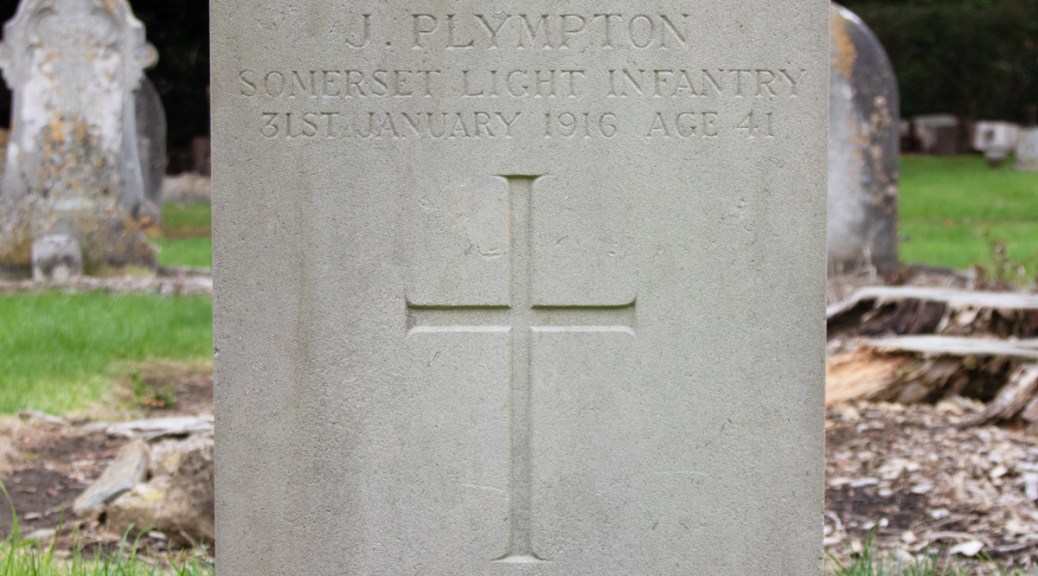
Private Plympton returned from France at the start of 1916; he was suffering from nephritis – inflamed kidneys – and was admitted to St Bartholomew’s Hospital in London. Sadly, it seems that his treatment came too late; he passed away on 31st January 1916, at the age of 41.

James’ body was brought back to his home town; he was laid to rest in Yeovil Cemetery.


A local newspaper, the Western Chronicle, reported on James’ funeral; interestingly it gave his rank as Sergeant, although none of the official military documentation corroborates this.


Private William Ridley

Private William Ridley

William Frederick Ridley was born on 7th April 1887 in the New Brompton area of Chatham/Gillingham, Kent, one of eight children to John and Elizabeth Ridley. John was an engine fitter in the nearby naval dockyard and, as the key employer in the area, William followed in his father’s footsteps.

Sadly, John died in 1904, and this seems to have been what spurred his son on to a better life. In 1907 William emigrated to Canada, settling in the town of Wentworth, on the banks of Lake Ontario.

It was in Ontario that William met his future wife. Edith Wass was the daughter of a local labourer; the young couple married on 5th June 1909, and went on to have two children, John, born in 1910, and Wilfred, who was born five years later.

During this time, William was putting his engineering skills to the test; his marriage banns confirm he was a machinist. While there is nothing to confirm any specific trade, given his proximity to the coast, dockyard employment seems probable.

On the other side of the Atlantic, war was breaking out; keen to do his part for King and Country, William enlisted in the Canadian Expeditionary Force on 28th July 1915. Initially enlisting in the 76th Overseas Battalion of the Canadian Infantry, he was shipped to England a year later and transferred across to the 4th Battalion.

Once on the Western Front, Private Ridley was thrown right into the thick of things. His battalion fought at the Battle of Flers-Courcelette – part of the Battle of the Somme – and it was here, on 18th September 1916, that he was wounded.

William received shrapnel wounds to his head, hand and right leg. Initially treated on site, he was quickly evacuated back to England, and admitted to the 2nd London General Hospital in Chelsea. Sadly, however, his wounds appeared to have been too severe; Private Ridley passed away from them on 30th November 1916, aged just 29 years old.

With his widow and children still in Canada, William’s body was taken back to Kent. He lies at rest in the Woodlands Cemetery in Gillingham, close to where his mother was still living.


Larger memorial image loading...
Private William Ridley
(from findagrave.com)

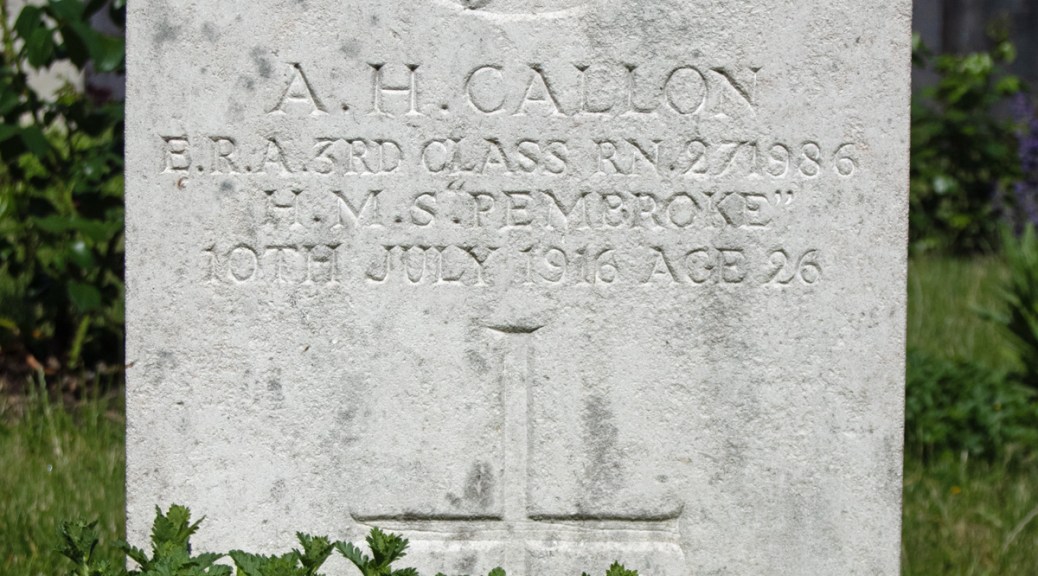
Engine Room Artificer Archibald Callon

Engine Room Artificer Archibald Callon

Archibald Hubert Callon – also known as Archie – was born on 2nd January 1890 in Pembroke Dock, South Wales. One of eight children, his parents were shipwright Michael Callon and his wife, Mary. Soon after Archie was born, Michael moved the family to Gillingham, Kent, presumably as work at the nearby Naval Dockyard was plentiful.

The sea was clearly in his blood as, in 1905, Archie joined the Royal Navy, initially as a Boy Artificer, before taking on full employment there once he reached the age of 18. The 1911 census found him working as an Engine Room Artificer 4th Class, one of a crew of 57 aboard the torpedo destroyer HMS Swale, moored in Grimsby.

Archie slowly rose through the ranks and, by 1913, had become Engine Room Artificer 3rd Class, while serving on HMS Clio. He remained on this vessel through to April 1916, before returning to HMS Pembroke, the shore-based naval establishment in Chatham, Kent.

Sadly, Archie’s time back home was short. The next record for him is stark; it is noted that on 10th July 1916, he committed suicide, during temporary insanity. I have been unable to uncover anything further about his passing. He was just 26 years old.

Archibald Hubert Callon was laid to rest in the Woodlands Cemetery in Gillingham, Kent, not far from where his family lived.


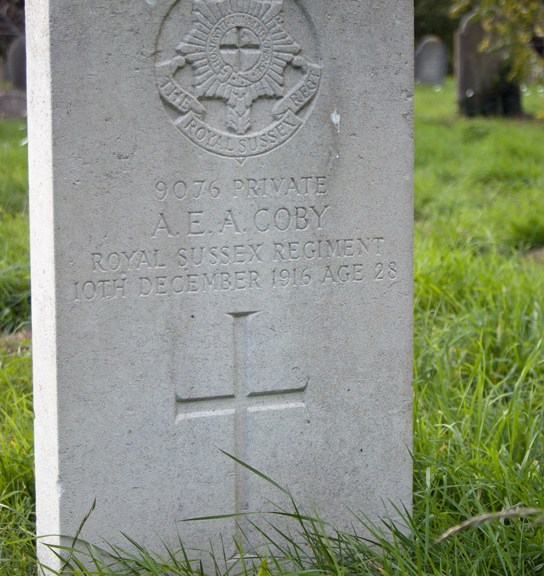
Private Albert Cobby

Private Albert Cobby

There are some mysteries that are just destined not to be solved, no matter how much digging you do. One gravestone in Worthing’s Broadwater Cemetery, dated 10th December 1916, proved to be one of those.

Research across the standard platforms revealed very little. There was no AEA Coby on Ancestry, the service number 9076 did not reveal anything on the Fold3 website. The name Coby did not feature in any contemporary newspaper article in December 1916 or January 1917.

One lead suggested that Private Coby’s first names are Albert Ernest, but again, this drew a blank. Another gave the surname with the spelling Cobby, and this seemed to fit better.

The birth of an Albert Ernest Cobby was registered in Sussex at the start of 1888, but the parents’ names are missing. The Commonwealth War Graves Commission website gives these as Alfred and Ellen Coby, but there is no concrete documentation to back this up.

The combination of Cobby and the service number did identify a military record on Fold3, but even here the information was limited. The document confirmed that Albert was nearly 29 when he enlisted in the Royal Sussex Regiment on 3rd December 1915, and that he was a motor cleaner in Worthing by trade. It gave his mother as Mrs A Cobby, but this does not fit with the Ellen suggested elsewhere.

Crucially, it confirmed that Private Cobby served on the home front for a matter of weeks – from 29th February 1916 to 4th May 1916. No reason is given for the end of his service.

Sadly, much of Private AEA Cobby’s life is destined to remain a mystery, with no definite links between the various pieces of evidence.


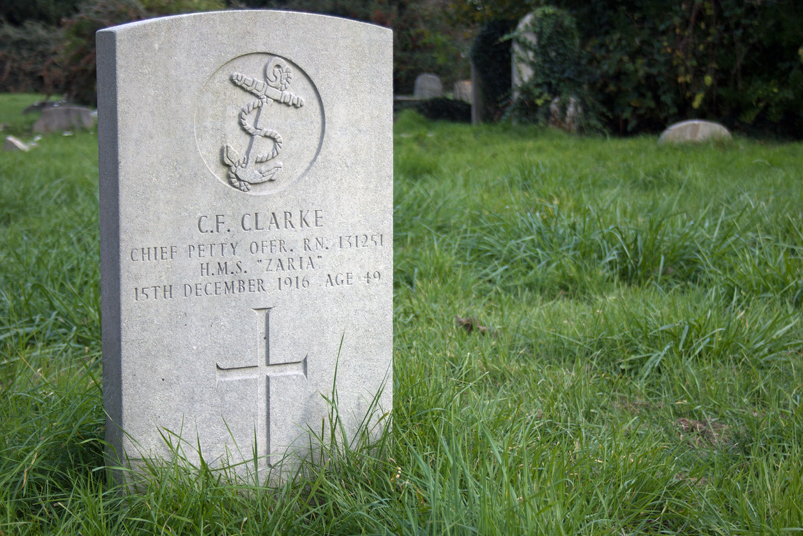
Chief Petty Officer Charles Clarke

Chief Petty Officer Charles Clarke

Charles Frederick Clarke was born on the 14th April 1869 to James and Jane Clarke. James was born in Suffolk, but moved to London, where he found work as a watchman (guarding the city streets at night). Jane was from Essex, and the couple went on to have five children, of whom Charles was the middle child.

Charles was set on a life of adventure, joining the Royal Navy in 1887, for a period of twelve years. During this time, he served on eleven vessels, working his way up through the ranks from Boy to Ordinary Seaman to Able Seaman, Leading Seaman and eventually Petty Officer.

In October 1895, he married Lydia Rogers, a sailor’s daughter from Portsmouth. The couple would go on to have nine children, eventually settling in Sussex.

When his naval service ended in 1899, Charles enlisted again. Within six years, he had achieved the rank of Chief Petty Officer, and in March 1909, after 22 years’ service, retired from active duty. He was obviously well respected, however, and was selected to serve on the staff of the Royal Naval Recruiting Office in Portsmouth. His service records suggest that he resigned from this role on 14th April 1914.

It seems that Chief Petty Office Clarke took on a role on the vessel HMS Zaria. This was a ship that was requisitioned by the Royal Navy, which acted as a patrol ship, guarding the coastal waters around the UK. While details are scant, Charles certainly served on board for a couple of years, and he died on board, from causes undisclosed, on 16th December 1916, at the age of 47 years old.

Brought back to West Sussex, Charles Frederick Clarke was laid to rest in the Broadwater Cemetery in Worthing. This was where Lydia was now living; she was buried in the same grave, when she passed away eight years after her husband.


Second Lieutenant Wallis Rochfort-Davies

Second Lieutenant Wallis Rochfort-Davies

Wallis Rowland Henry Rochfort-Davies was born August 1895, the youngest of two children to Reverend Charles Rochfort-Davies and his wife, Ethel. Charles was, for some time, the vicar at St Leonard’s Church in Shipham, Somerset, and both Wallis and his older sister Agnes, were both at school until at least their late teens.

Details of Wallis’ military service are scant. He enlisted in the Somerset Light Infantry, and was assigned to the 3rd (Reserve) Battalion, which was based initially in Taunton and then Devonport, near Plymouth.

Sadly, the next information available for Wallis relates to his death. A contemporary local newspaper initially.

It is reported that Sec.-Lieut. Wallis Rowland Henry Rochfort-Davies, 3rd (Reserve) Batt. Somerset LI, died on March 8th. He was the only son of Rev. CH Rochfort-Davies, of Shipham Rectory, Weston-super-Mare. Aged 20, he obtained his commission in Somerset LI in August 1914.

Western Morning News: Thursday 16 March 1916

No details of the cause of Wallis’ death were announced, but a post mortem and inquest were held, and the findings came out later that month.

At the Coroner’s Court yesterday afternoon, Mr AE Baker resumed the inquiry into the circumstances surrounding the death of Wallis Roland [sic] Henry Rochfort-Davies, aged 20, a Second Lieutenant in the Somerset Light Infantry. The inquest was opened on the 9th when evidence was given to the effect that deceased was found dead at the Royal Hotel on March 8. The adjournment was rendered necessary in order that the contents of the stomach might be analysed.

Mr Russell, the City Analyst, gave evidence as to the examination of the contents of the stomach. This showed the presence of morphia.

Dr PW White said he was called to the Royal Hotel about 3:30 in the afternoon of March 8. He found the deceased lying in bed, life being extinct. Death had take place probably 8 or 9 hours previously. There were no external marks of violence. The post mortem examination showed some congestion of the internal organs, but nothing to account for death. He had no hesitation in saying that the cause of death was morphia poisoning, probably hypodermically administered.

Charles Greenslade, a plain clothes officer, said he was called to the Royal Hotel on Wednesday 8 March about 4:30pm. Witness made an examination of the room. He found on the dressing table a case containing two small bottles: one was filled with morphia tablets and the other empty. There was also a blue bottle found, which contained a lotion. Needles and a hypodermic syringe were also found…

Reginald Francis Cheese, a friend of the deceased, said he had shown him some drugs on two occasions. He identified a case of drugs produced as having been shown him by the deceased.

The jury returned a verdict of “Death from an overdose of morphia, self-administered”. The expressed sympathy with the father of the deceased and desired to severely censure the witness Cheese.

The Coroner spoke of the increased habit of drug taking among officers, and of the amount of drugs which the case that had been produced contained. Deceased, he said, could not have purchased from any chemist such a quantity of drugs, and it must have got into his hands through the medium of a friend. It was a grossly wicked act that such a large quantity of drugs was ever allowed to get into the hands of this unfortunate young man.

Western Daily Press: Friday 31st March 1916

Wallis Rowland Henry Rochfort-Davies was just 20 years old when he died. He was laid to rest in the Milton Cemetery in Weston-super-Mare, in his home county of Somerset.