Tag Archives: 1916

Private Henry Boon

Private Henry Boon

Henry Boon was born in May 1880, the youngest of ten children to Edwin and Fanny Boon. Edwin worked in service – consecutive census records list him as a manservant, coachman and gardener – and the family lived in the Somerset town of Taunton.

Henry was working as a packer in a factory when he met Alice Mockridge. The couple married in June 1902, and went on to have three children – Henry, Dorothy and Vera.

By the time of the 1911 census, Henry had put the factory behind him and was working as a labourer in the local sewage works. Employed by the town council, it is likely that the job paid more, particularly with a young family to support. Alice was also working, doing ironing and sewing to help them make ends meet.

Storm clouds were gathering over Europe, however, and soon Henry was needed to do his duty. Full details of his military service are not readily available, but he joined the Devonshire Regiment early on in the conflict, and was assigned as a Private to the 13th (Works) Battalion.

Private Boon seems to have been based in England for the duration, although full details of his movements are not clear. He was certainly living in Taunton by December 1916, and it was here that he fell ill.

Admitted to hospital with apoplexy, it seems that it was this haemorrhage or stroke that killed him. Private Boon passed away on 23rd December 1916. He was just 36 years of age.

Henry Boon lies at rest in St Mary’s Cemetery in his home town of Taunton in Somerset.

Serjeant Major Charles Cassidy

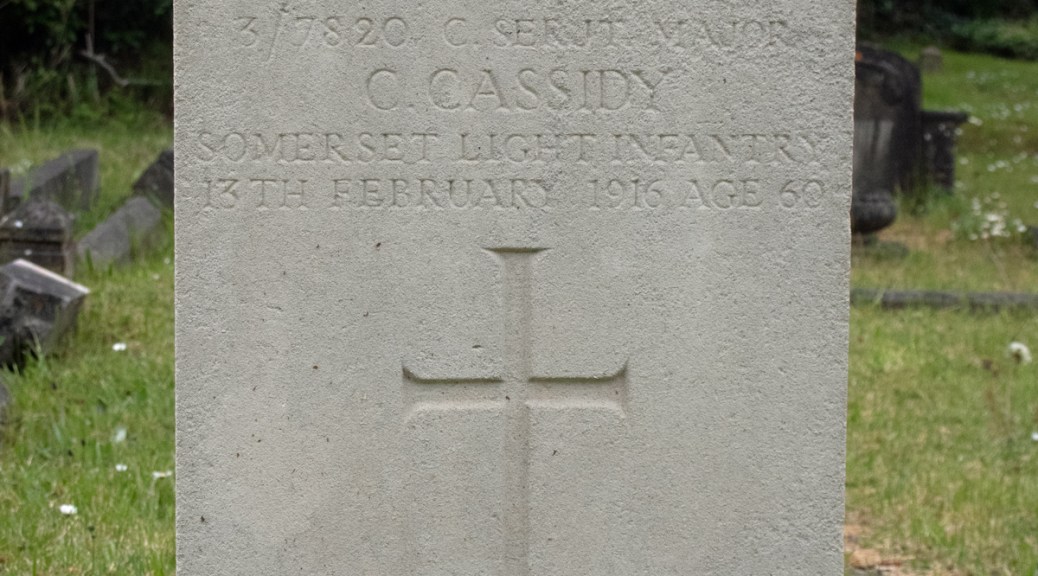
Company Serjeant Major Charles Cassidy

Charles Cassidy’s early life is a bit of a challenge to uncover. He was born in County Antrim, Ireland in around 1856, but there is little concrete information to identify his parentage or his movements before the late 1870s.

A newspaper report of his passing confirms that his military career began early. He joined the Somerset Light Infantry, and “saw active service in the Zulu campaign in 1879, and in Burmah 1885-1887.” [Western Times: Tuesday 15th February 1916]

In around 1890, he married a woman called Annie; she came from Wareham in Dorset, and the couple went on to have three children – Daisy, Charles and Margaret.

After completing his military service, Charles continued to work as a messenger for the regiment. However, when war came, he was called up again, acting as Company Serjeant Major in the Taunton Barracks.

Charles’ military service was not to be prolonged, however. On 13th February 1916, he was in the Sergeants’ Mess in the barracks, when he suddenly collapsed with heart failure, dying almost instantaneously. He was 60 years old.

Charles Cassidy lies at rest in St Mary’s Cemetery in Taunton, next to the barracks where he so readily did his duty.


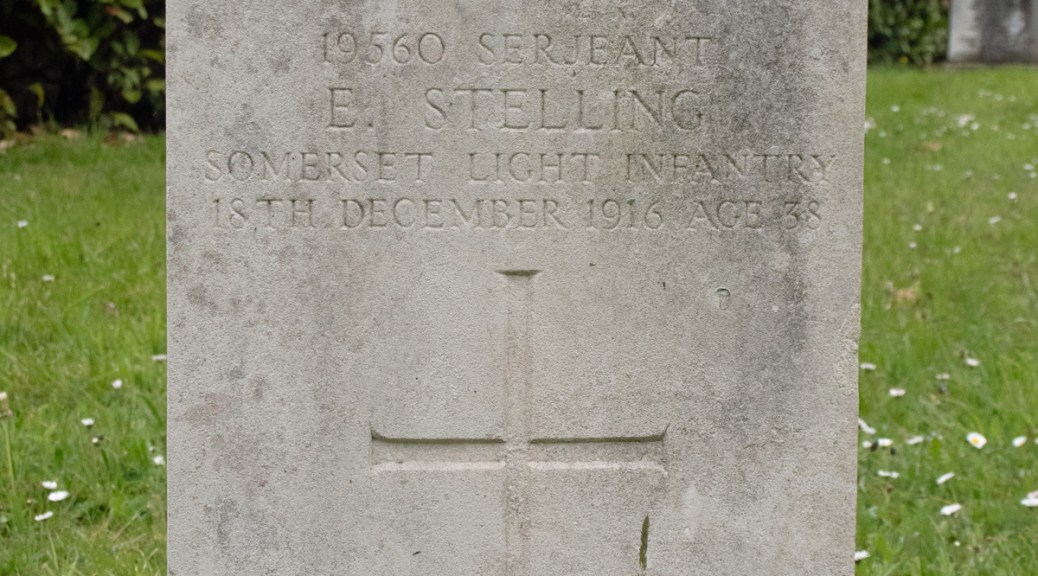
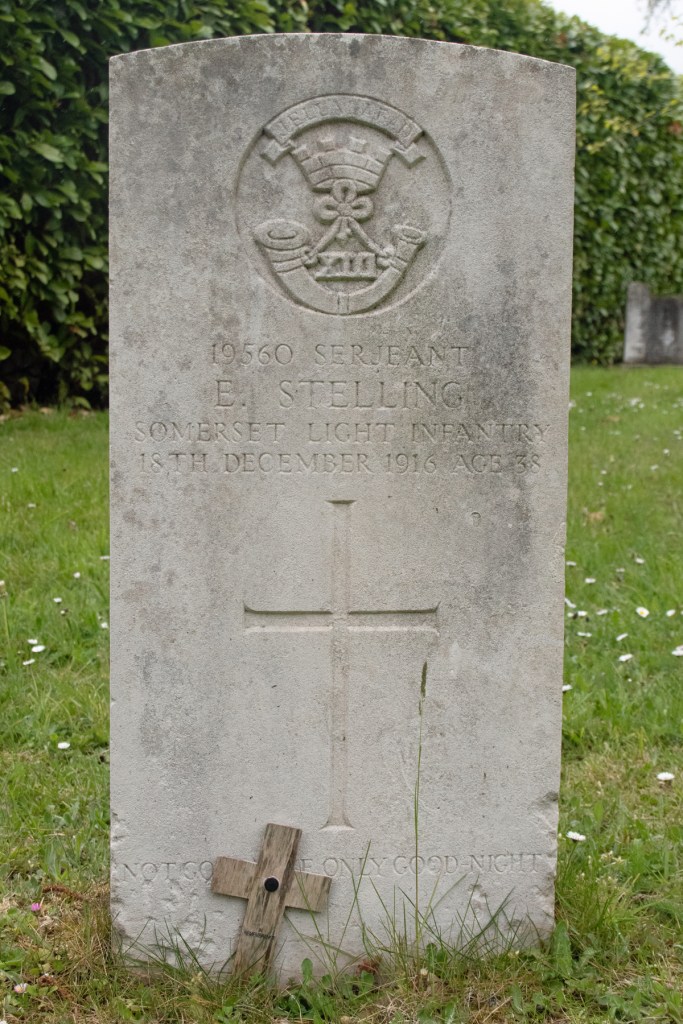
Serjeant Ernest Stelling

Serjeant Ernest Stelling

Ernest Leonard Stelling was born in the summer of 1881, the oldest of six children to Charles and Bertha Stelling. Charles was a tailor from London, and while Ernest was born in Suffolk, by the time of the 1891 census, the family had settled in Reading, Berkshire.

Ernest followed in his father’s footsteps, becoming a tailor and cutter in his own right. He met a woman from Reading called Lettie Eliza Mazey, and the couple married in 1904. The couple set up home with Lettie’s brother and his family in Tilehurst, but didn’t go on to have any children themselves.

Details of Ernest’s military service are a bit scarce. He initially enlisted in the Royal Berkshire Regiment, but quickly moved to the Somerset Light Infantry in the early stages of the First World War.

Sadly, no formal documents of Ernest’s time in the army are available, but a local newspaper gave a good insight into his Somerset service.

Death of a Master Tailor

After an illness of only seven days, the death took place at the military hospital on Monday afternoon of Sergeant EL Stelling, who has been master tailor of the Depot for the past two years. The cause of death was pneumonia, and the loss of so popular a member of the Depot staff is deeply regretted by all ranks.

Sergeant Stelling, who was 37 years of age, came to the Somersets from the Royal Berkshire Regiment, and succeeded the late Sergeant-Master-Tailor Chambers. He was a native of Reading, and one of four brothers serving their King and country. His father, Mr Charles Stelling, for many years carried on business as a master tailor in Reading.

Since he had been at Taunton barracks, Sergeant Stelling had made many friends, and actively identified himself with the social life of the sergeants’ mess, taking a prominent part in the arrangement of concerts, etc.

He was of a bright, generous disposition, and before his illness he was making a collection at the Depot on behalf of the Buffaloes’ Christmas treat to poor children of the town. He was a valued member of the local Lodge of the Royal Order of Buffaloes, and his death is greatly regretted by all the brethren.

He leaves a widow but no family. Much sympathy is felt for Mrs Stelling, who has for some years been a confirmed invalid.

The funeral took place with full military honours at St Mary’s Cemetery on Friday afternoon.

Taunton Courier and Western Advertiser: Wednesday 27th December 1916

This gives a real insight into Ernest’s personal life. He was obviously very active socially, and committed to the community. Whether Lettie’s infirmity contributed to the couple’s lack of family will never be known, but, from his support of the poor children of Taunton, it seems evident that he would have been a good family man.

The next document relating to Serjeant Stelling is his pension record; this confirms the news article’s report that he contracted pneumonia and influenza, and he succumbed to the conditions on 18th December 1916. He had, in fact, just turned 38 years old.

Ernest Leonard Stelling lies at rest in St Mary’s Cemetery in his wartime adopted home town of Taunton, Somerset.


Serjeant Ernest Stelling (from Ancestry.co.uk)

Private Jack Alston

Private Jack Alston

John Thomas Alston, also known as Jack, was born in Chorley, Lancashire, in 1865 and was one of thirteen children to Richard and Elizabeth Alston. Before he died in 1878, Richard was a stripper and a grinder in a cotton mill, and it was millwork that the majority of his and Elizabeth’s children went into.

When he left school, Jack and his siblings worked as cotton piecers in the mills, tying together any threads that broke on the machines. This was a job aimed at children, whose hands were often the only ones small enough to reach into the equipment.

By 1895, Elizabeth too had passed away. Jack, who was 30 by this point, had moved from Chorley to nearby Oswaldtwistle, and met Mary Ellen Wilcock. She was a widow with two children, and the couple married on 14th February 1897. Their marriage certificate shows that she was the daughter of a weaver, while Jack was working as a furnace man in the mill. The couple went on to have a child together, Amy, who was born in 1900.

The couple settled into if not a comfortable life, then a continued existence. While Mary and her two older children were working in the cotton mill, Jack began labouring at the local chemical works. The family lived in a small, two up, two down cottage right next to Mary and the children’s place of work, and life continued apace.

War was coming however, and Jack volunteered to do his bit. His service records no longer exist, but it can only be assumed that he joined of his own accord; he would have been 50 when hostilities commenced, and so exempt from the initial call-up.

Private Alston was assigned to the Somerset Light Infantry, and was based at their Depot in Taunton. Little information about his time there is available, and sadly, the next accessible document is his pension record. This confirms that he died on 7th April 1916, from “shock caused by a fall while on duty”. There is no other reference to what or how this happened, so the circumstances will remain a mystery. He was 51 years old when he passed away.

It seems that his widow may not have had the funds to bring Jack back home; instead he lies at rest in St Mary’s Cemetery in Taunton, Somerset, close to the depot where he was based.


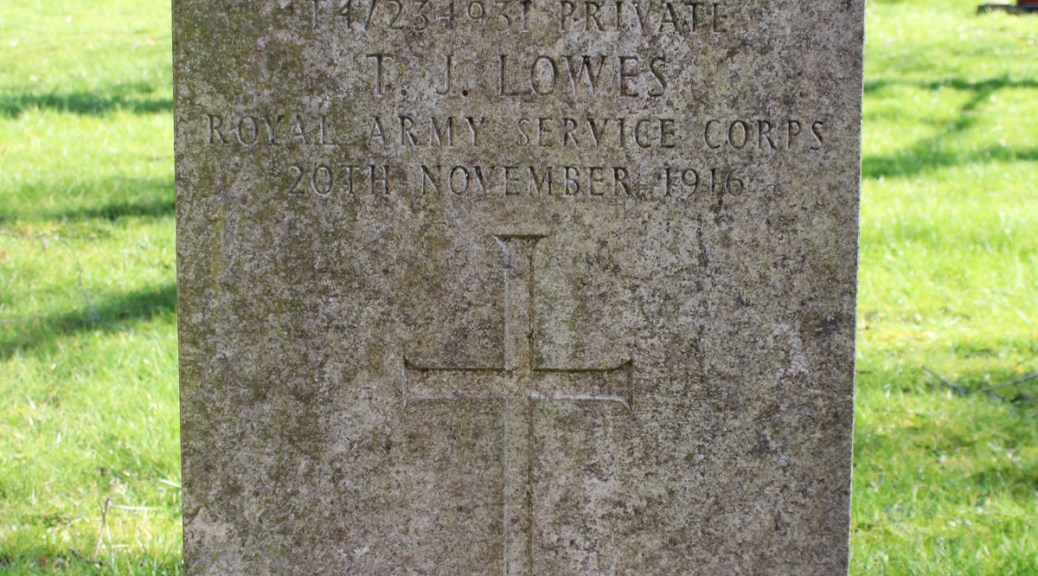
Private Thomas Lowes

Private Thomas Lowes

TJ Lowes is another of those names that challenges you to find out more about their lives. A quick search against the surname and service number identified the full name of Thomas James Lowes, and the Commonwealth War Graves Commission website confirms he was the husband of Mary Lowes.

There is enough circumstantial evidence available to suggest a particular set of records, but nothing to fully connect this gravestone to those records.

Based on that documentation, this is what I believe to be the Thomas James Lowes’ life.


Thomas James Lowes was born in Chatham, Kent, in 1863. One of eight children, his parents were Joseph and Jane Lowes, who came from Durham. Joseph was a shipwright, and moved the family to Hampshire in around 1860, before settling in Kent a year or so later. Given his trade, it the sea ports were an obvious draw, and he found work in the Naval Dockyard in Chatham.

When he left school, Thomas found work as a painter, and this was work that stood him in good stead all his life. He started decorating houses, but soon found employment in the dockyard.

Joseph died at some point in the 1880s, and by the 1891 census, Thomas was living at home with his mother and three of his younger siblings, all working to bring money in.

It was later that year that he got married, to a woman called Mary. The couple went on to have two children – Elsie (who was born in Sutton, Surrey) and Thomas Jr (who was born back in Kent). The young family came to live close to the dockyard again, as this is where Thomas was obviously earning his living.

War was on the horizon and, while Thomas’ full service records do not exist, it’s been possible to piece some bits together. He enlisted in the Royal Army Service Corps early on in the conflict, and worked as a farrier for No. 2 Company Depot. From here on in, however, Private Lowes’ documentation becomes confusing.

The Army Register of Soldier’s Effects confirms the service number documented elsewhere – T4/234931 – and that he passed away on 20th November 1916. It states that the the money was passed to his father, Thomas, which doesn’t tally up with the other records.

The other documentation available – the Pension Ledger and Index Cards – all include the Private Lowes’ service number, but give his widow , Mary Lowes, as his beneficiary.

Thomas contracted pneumonia while on active service; he was admitted to the Royal Herbert Hospital in Woolwich, but succumbed to the illness on 20th November 1916. He was 53 years old.

Thomas James Lowes was laid to rest in the Woodlands Cemetery in Gillingham, Kent.


Private Thomas Lowes

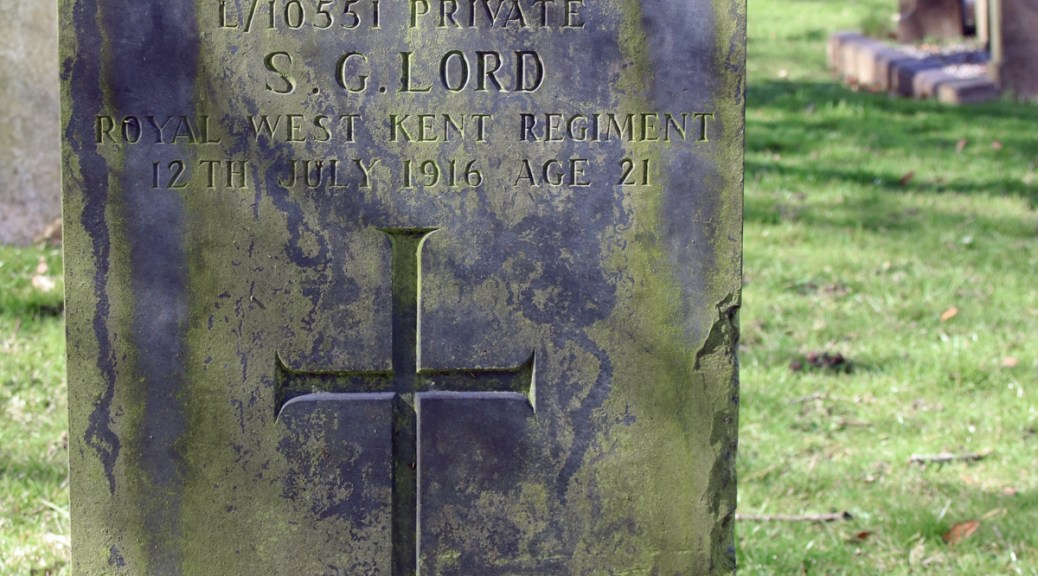
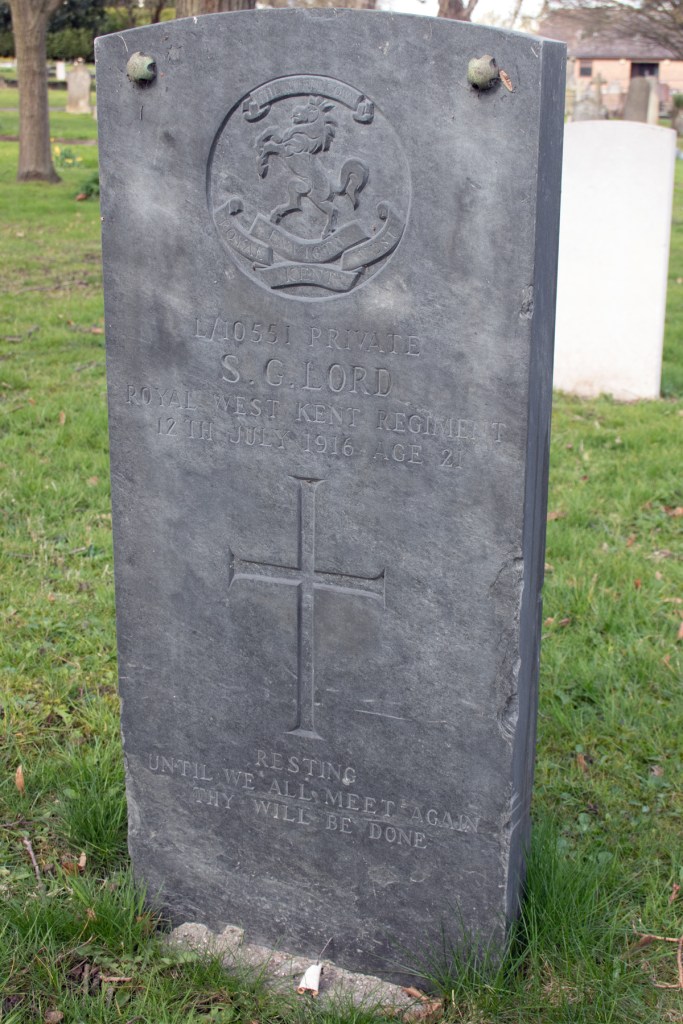
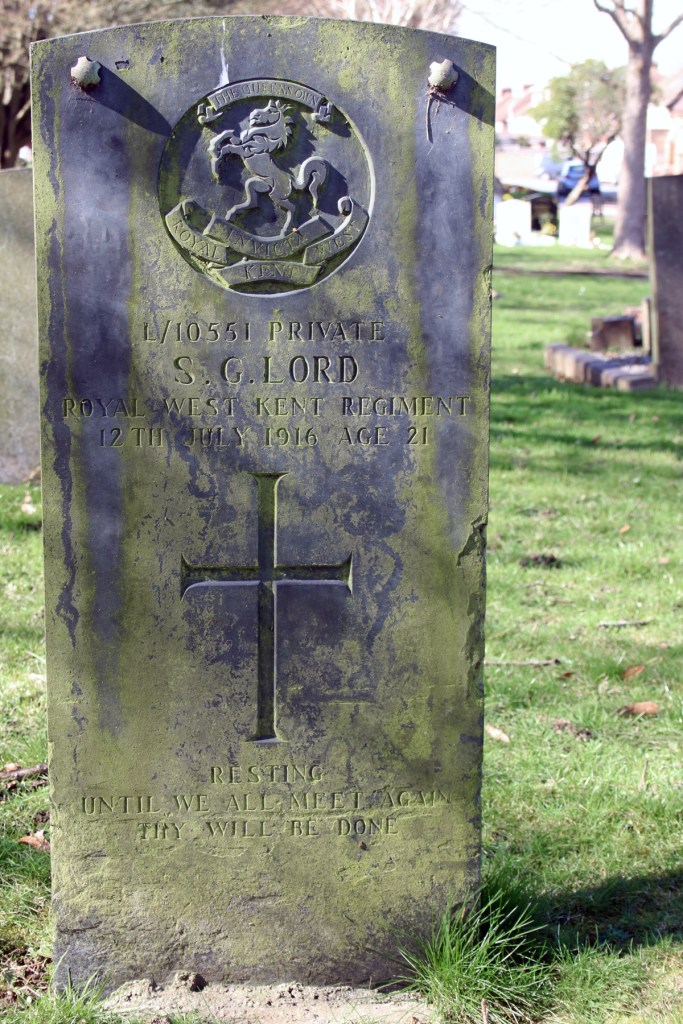
Private Sidney Lord

Private Sidney Lord

Sidney George Lord was born on 29th March 1895, one of six children to Sidney and Clara Lord. Sidney Sr was a shipwright from Bideford in Devon, and he brought the family to Kent, presumably for work at the Naval Dockyard in Chatham.

Sidney Sr passed away in 1912 and his son left school, finding work as a plumber’s apprentice. War was on the horizon, however and he was keen to do his bit as soon as possible. Sidney Jr enlisted in November 1914, joining the Queen’s Own Royal West Kent Regiment.

After his initial training, Private Lord was sent to the Front on 22nd April 1915, serving in France with his regiment for just over a year. Towards the end of this time he became anaemic, and was shipped back to England for treatment.

Private Lord was admitted to the Yeatman Hospital in Sherborne, but sadly succumbed to his anaemia a matter of weeks later. He passed away on 12th July 1916, having not lung turned 21 years of age.

Sidney George Lord was laid to rest in the Woodlands Cemetery in Gillingham, Kent, close to where his father was buried.


Private Sidney Lord

Chief Stoker Ernest Ware

Chief Stoker Ernest Ware

Ernest George Ware was born in the autumn of 1871 in Marylebone, London. Details of his early life are scant, but records show that he enlisted in the Royal Navy in February 1895, serving as a Stoker for an initial period of twelve years.

During this time, he worked on a number of different vessels – Wildfire, Theseus, Warspite, Amphion, Acheron and Sapphire. He was also based on a number of shore vessels; potentially Southsea in Hampshire and Pembroke in Wales.

In 1905 he married Mary Emery; she was the same age as Ernest, and was born in Hampshire. The young couple had a daughter, Muriel, and, by the time of the 1911 census, the family were living in Pembroke Dock, in South Wales.

War was inching closer, and Stoker Ware’s service was extended for the duration; he served on a number of other vessels – Leander, Blenheim, Blake and Tyne – before being promoted to Chief Stoker on HMS Blonde in 1911. He transferred to HMS St George two years later, before moving on shore to the training vessel HMS Victory II (based in Crystal Palace, South London) in 1915.

Chief Stoker Ware’s health seemed to have been in decline by this point; he was admitted to the Royal Naval Hospital Haslar in Gosport in early 1916, suffering from malignant endocarditis. Sadly, he passed away on 16th February, aged 44 years old.

Ernest George Ware was buried in the Woodlands Cemetery in Gillingham, Kent, close to where his widow was now living.


Private Henry McCahearty

Private Henry McCahearty

Henry McCahearty was born in Glasgow in October 1864, one of four children to Henry and Bridget McCaherty. Sadly, few records remain, but it seems that Henry Sr, who had been born in Northern Ireland, was a soldier.

Henry falls off the radar quite quickly; from later records we can determine that he worked as a skilled labourer at the Naval Dockyard in Chatham, although it is not certain what particular skills he had.

He married Alice Radford on 3rd September 1901 in Walmer, on the Kent coast, although the couple subsequently moved to Gillingham. They went on to have four children – Reginald, James, Leonard and Alfred.

Henry was 49 when war broke out. While over the initial recruitment age, he did enlist – becoming a Private in the Royal Marine Light Infantry – although it is not certain exactly when he joined up.

Sadly Private McCahearty’s passing is also a mystery. There is nothing in the newspapers of the time to suggest anything out of the ordinary, so I can only assume that he died as a result of one of the illnesses that were rife at the time. Either way, he died on 14th November 1916, at the age of 51.

Henry McCahearty lies at rest in the Woodlands Cemetery in Gilingham, Kent.


Private Alfred Lowes

Private Alfred Lowes

Alfred William Lowes was born in 1893, one of eight children to George and Ann. George was a railway porter from Kent, Ann was born in Berkshire, and the couple had settled in Gillingham, Kent, by the time they started a family.

The naval dockyard in Chatham was one of the main employers in the Medway area of Kent, and Alfred was drawn there for work. After leaving school, he found a job there as a messenger, following his older brother George, who was a labourer there.

In the spring of 1916, Alfred married Edith Kennett, and it seems like the timing was due to his military service. Private Lowes joined the Prince of Wales’ Own Civil Service Rifles (also known as the 15th Battalion London Regiment) and by the beginning of August his troop was bound for France.

Full details of Private Lowes’ military service is not available, although it seems not to have been a lengthy one. He would have fought on the front line, and was wounded as a result. Repatriated back to England for treatment, Alfred passed away at home on 12th November 1916. He was just 23 years of age.

Alfred William Lowes lies at rest in the Woodlands Cemetery in his home town of Gillingham.


Private Herbert Packer

Guardsman Herbert Packer

Herbert Packer was born in December 1889, the youngest of nine children to Joseph and Ann Packer. Joseph was a railway carrier (or porter) and the family lived in Cheddar, Somerset.

The 1911 census found Herbert on his travels; he was working as a grocer’s assistant, and boarding with a family in Abergavenny, South Wales. He was obviously keen to develop his skills, and soon moved to Barnstaple in Devon to work for the Lipton’s grocery there.

In the autumn of 1914, Herbert married Lydia Snell, a dressmaker from Wales and the young couple lived together in the Devon town where he worked. He was very active in the community; he was a teacher at the local Wesleyan Sunday School, and active in the church choir having, according to a local newspaper, “a capital voice”.

Herbert enlisted in the spring of 1916, and had the honour of joining the Coldstream Guards. He did his training in London, and was due back to Barnstaple on leave before starting his active service when he was taken ill. Admitted to the London Hospital with pneumonia, within a couple of weeks he had succumbed to the condition. Guardsman Packer died on 3rd December 1916, aged just 26 years old.

Herbert Packer lies at rest in St Andrew’s Churchyard in his home town of Cheddar in Somerset.