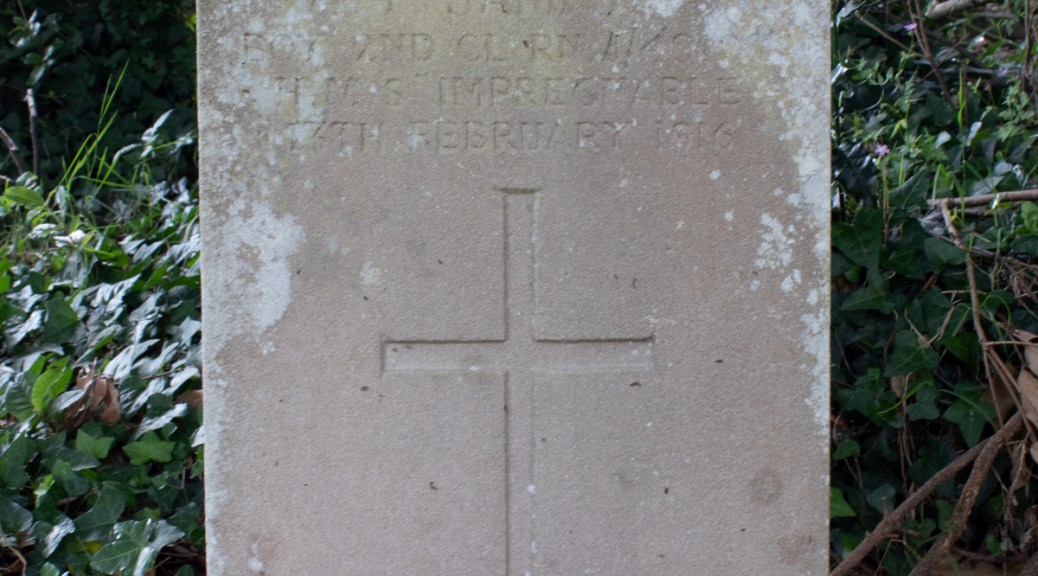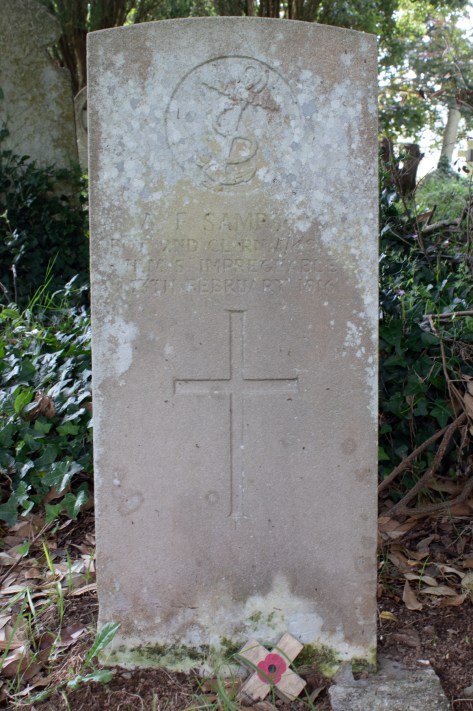
Albert Frederick Sampson was born on 7th November 1900, and was the older of two children to Albert and Beatrice. Albert Sr was a steward in the Royal Naval College in Dartmouth, Devon, and the family lived in a four-roomed cottage on Victoria Road.
When he finished his schooling, Albert found work as a cabin boy on a merchant vessel. When war broke out, the transition to the Royal Navy was an obvious one, and he enlisted at the start of 1916. His service records show that he was 5ft 4ins (1.62m) tall, with red hair, blue eyes and a fresh complexion. Still under the age to formally enlist, he was given the rank of Boy 2nd Class.
Albert’s time in the navy was to be tragically short. He was admitted to the Royal Naval Hospital in Plymouth, Devon, with acute quinsy, and passed away quickly. He died on 13th February 1916, at the age of just 15 years old.
Albert Frederick Sampson’s body was taken back to Dartmouth for burial. He was laid to rest in St Clement’s Churchyard.
At Dartmouth on Saturday, Mr AM Dawson held an inquest on Douglass [sic] Davidson Mitchell Ferguson, cook, aged 30, of a Government trawler, whose body was recovered from the boat float the previous afternoon.
TG Elliott, of the Britannia Inn, said deceased had one drop of whiskey at his house on Thursday.
W Bursey, seaman, said he saw deceased at the King’s Arms Hotel, the same evening. He was very quiet and chatted with others.
Frank Lavers, coal lumper, said he thought he saw Ferguson at 9.50 on his way to the Embankment. Deceased asked the time and spoke quite rationally.
After evidence as to the recovery of the body, and Dr GM Soper’s evidence that the death was due to drowning, an open verdict was returned.
Lieut. PN Taylor [Royal Naval Reserve], commander of the vessel to which deceased had belonged, said Dartmouth was the most dangerous place for the embarkation at night that he had visited, owing to the restricted lighting. He thought rails should eb placed not only around the Boat Float, but along the whole of the Embankment.
Members of the jury agreed that lights in the vicinity of the Boat Float were inadequate, and the jury added a rider to their verdict urging the authorities to provide adequate lighting as advised by the Town Council, for the benefit of persons embarking in the vicinity of the Boat Float, and with a view to preventing further tragedies.
[Western Times: Tuesday 29th February 1916]
Douglas Davidson Ferguson was born in Stirling, Scotland, on 28th August 1896. One of four children, his parents were Andrew and Mary Ferguson. There is little information available about his early life, unfortunately, but it is clear that he enlisted in the Royal Naval Reserve on the 6th September 1915.
Assigned the role of Trimmer Cook, Douglas’s records show that he was 5ft 3ins (1.6m) tall, with brown eyes and a pale complexion. He was also noted as having a tattoo of a dancing girl on his left arm.
Douglas was initially assigned to the cruiser HMS Pactolus, and travelled from Scotland to Devon, where the Royal Naval Dockyard in Devonport would become his base. He remained stationed there for the next few months, working on ships’ galleys as they patrolled out the Channel coastline. It was during one of these voyages that he fell into the River Dart and drowned.
It would seem that Douglas Davidson Ferguson’s family were unable to cover the cost of taking his body back to Scotland for burial. Instead, he was laid to rest in the graveyard of Dartmouth’s St Clement’s Church.
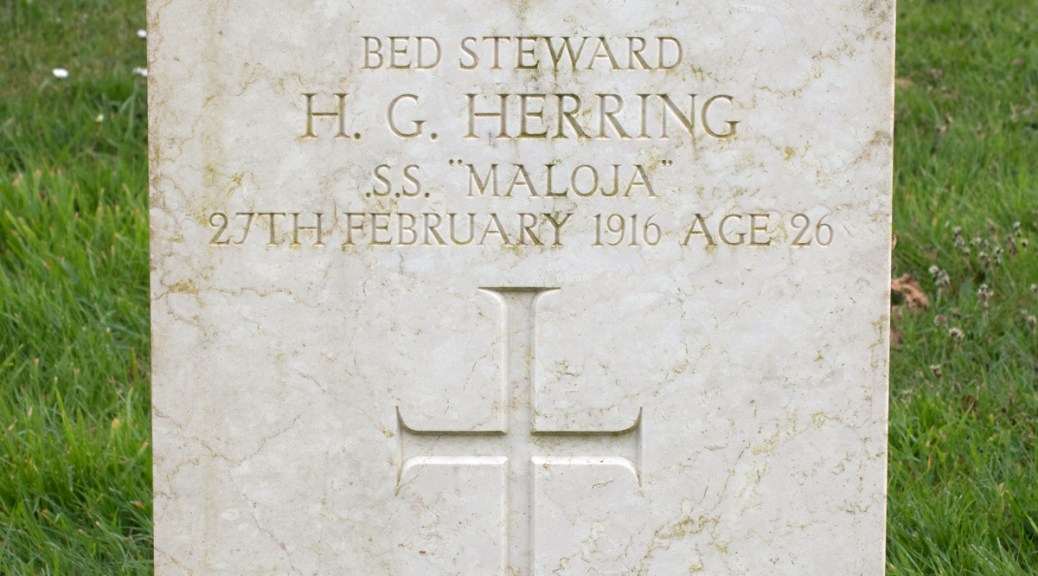
Henry George Herring – also known as Harry – was born on 10th November 1889. The second of six children, his parents were Thomas and Mary Herring. Thomas was a tailor from Tiverton, Devon, and the family lived at 131 West Exe South in the town.
Henry sought a life of adventure, and joined the Merchant Navy. Sadly, details of his service have been lost to time, so it is not possible to get a clear picture of his time at sea. Certainly he had moved out of the family home by the time of the 1911 census, though it is unclear whether he had enlisted by this point.
By the start of 1916, Henry was serving as a Bed Steward on board the SS Maloja, a passenger steamship that travelled between Britain and India. On 26th February she left Tilbury, Essex, bound for Bombay, with a crew of 301 and 122 passengers on board.
The following morning, Maloja was sailing through the Strait of Dover when she hit a mine. There was a large explosion and she faltered. The Canadian ship Empress of Fort William was only a short distance behind, and she steamed forward to assist, but she also struck a mine just 1km (0.6miles) away.
The Maloja’s lifeboats were readied to launch and passengers started to board, but the ships engine room had flooded, and she began to list. Three of the four lifeboats were unable to launch, and, as she was unable to stop, no rescue ships could come alongside.
The Maloja sank 24 minutes after hitting the mine. Many of the crew and passengers ended up in the water: most were rescued, but 44 bodies – including that of Bed Steward Herring – were recovered and around 100 people were unaccounted for.
Henry George Herring’s body was taken to shore: he was just 26 years old when he died. He was taken back to Devon for burial and laid to rest in Tiverton Cemetery, not far from where his grieving family still lived.
It was with painful regret that the inhabitants of Bratton Fleming heard of the death of Private Havelock Webber… who passed away at Hursley, near Winchester, on Tuesday in last week. On being called to the Colours a few weeks ago, he was attached to the 3/6th Devons. Previous to joining up he followed the occupation of a tailor, and was also a part-time postman. Deceased was well-known and highly respected. He was closely connected with every movement at the Village Hall, and was a member of the Committee of Management.
[North Devon Journal: Thursday 11th May 1916]
Havelock Webber was born in Bratton Fleming early in 1878. There is no information available for his parents, but the 1891 census recorded him as living with his paternal grandparents, George and Grace Webber. At 13 years old, Havelock was already learning the tailoring trade.
Havelock doesn’t appear in the 1901 census, and the 1911 return gives little information away either. At this point he is boarding in a house with either the Bale or Musworthy family (his is a separate record, with those two families adjoining his).
Beyond this, there is little information available about Private Webber’s life or military service. He died from peritonitis on 2nd May 1916 in the Hampshire Camp. He was 38 years of age.
Havelock Webber’s body was brought back to Devon for burial. He was laid to rest in the graveyard of St Peter’s Church in his home village of Bratton Fleming, Devon.
James McLeod was born on 15th April 1893 in Dunedin, New Zealand. There is little further information about his early life, although the Commonwealth War Graves Commission give his father’s name as Samuel, and his service records note his next-of-kin as his brother, George McLeod.
James was employed by A&T Watt as a French polisher. However, he gave that up on 25th January 1915, when he enlisted in the New Zealand Expeditionary Force. His service records show that he was 5ft 8.5ins (1.74m) tall, and weighed 166lbs (75.3kg). He was recorded a having fair hair, blue eyes and a fair complexion.
Private McLeod was assigned to the New Zealand Otago Regiment, and undertook his initial training on home soil. He evidently showed some promise as, on 1st May, he was promoted to Lance Corporal. Six weeks later his unit was heading for Europe, and by the summer James was in Egypt.
On 20th August 1915, Private McLeod was admitted to the New Zealand and Australian Convalescent Hospital in Mena with a gun shot wound to his finger. He remained there for three weeks, returning to his unit in time for them to leave for the Dardanelles on 7th November 1915.
What happened to James over the next couple of months is uncertain. Certainly he was on the Greek island of Moudros by 18th November and in the Dardanelles on 7th December 1915. Just 20 days later he was back in Alexandria, and he would remain there for the next few months. There is, however, nothing in his medical record to suggest that his return to Egypt was on health reasons.
On 6th April 1916, Private McLeod was on the move again, this time to France. He was wounded again on 14th July 1916, and medically evacuated to Britain for treatment. Details of this injury are not clear, but he was admitted to the 2nd London General Hospital in Chelsea, Middlesex. After a month recuperating, James was released from hospital and sent to camp in Hornchurch, Essex. At this point he was also demoted to Private, although, again, the reason is unclear: it may have been a personal choice, or the reversion may have been connected to his injuries.
In September 1916, Private McLeod was transferred to the ANZAC Camp on the outskirts of Codford, Wiltshire. That winter he contracted pleurisy, and he was admitted to the No. 3 New Zealand Hospital, which was connected to the camp, on Christmas Day. His condition worsened, and James passed away from pneumonia on 28th December 1916. He was just 23 years of age.
Thousands of miles from home, James McLeod was laid to rest alongside his fellow soldiers in the extension to the graveyard of St Mary’s Church, Codford.
William Garlick was born in Whakatane, New Zealand, on 18th October 1888. The oldest of seven children, his parents were Wiltshire-born Charles and New Zealander Maria Garlick. There is little information about William’s early life, but it is clear that by the outbreak of war he was working as a shearer in Gisborne.
William enlisted on 19th November 1915, and was assigned to the New Zealand Rifle Brigade. His service records show that he was 5ft 9ins (1.75m) tall, and weighed 168lbs (76.2kg). He was noted as having black hair, brown eyes ad a dark complexion. He had a tattoo of an anchor on his upper right arm and a few boil scars on his leg.
Rifleman Garlick spent most of the next year training in the army camp at Trentham. On 25th September 1916 his unit finally left for Europe, and he set foot on British soil two months later. From Devonport, Devon, the battalion made its way to Sling Camp in Wiltshire. William was not to spend much time there, however, and within a fortnight he had fallen ill.
Admitted to the No. 3 New Zealand General Hospital in Codford, Rifleman Garlick had contracted pneumonia, and this was to get the better of him. William passed away on 13th December 1916: he was 28 years of age.
Thousands of miles from home, William Garlick was laid to rest in the ANZAC extension to St Mary’s Churchyard in Codford, not far from the medical facility in which he had breathed his last.
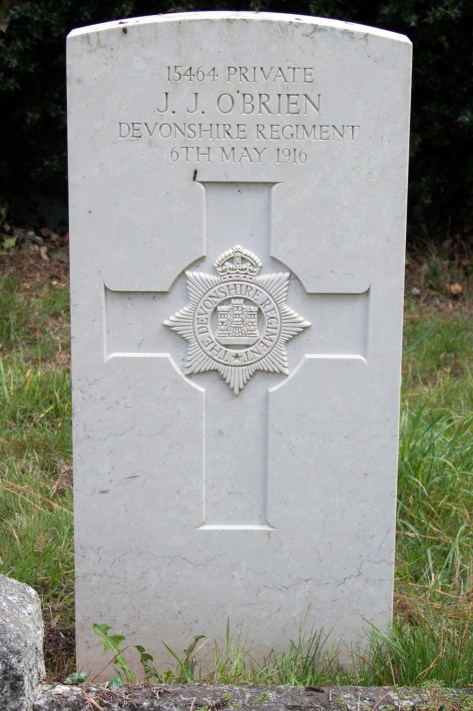
Jeremiah Joseph O’Brien was born in Paignton, Devon, in 1888. The fifth of seven children, his parents were James and Susan O’Brien. James was a general labourer, and his son followed suit when he completed his schooling.
The is little more information available about Jeremiah’s early life, and it is only in the papers for his military service that we pick him up again. These confirm that he was working as a labourer when he volunteered for the Devonshire Regiment on 20th January 1915.
The documents confirm that Jeremiah was living at 4 Well Street, Paignton, when he joined up, and that he was just over 5ft 5ins (1.65m) tall. Assigned to the 3rd (Reserve) Battalion, he remained on home soil, his unit being used to defend Plymouth, Devon.
Private O’Brien’s time in the army was not to be a lengthy one. He came down with haemoptysis, a condition he had initially suffered from in childhood. He was declared unfit for military service, and was discharged from the army on 4th March 1916.
Jeremiah appears to have returned home at this point and succumbed to the lung condition on 6th May 1916. He was 29 years of age.
Jeremiah Joseph O’Brien was laid to rest in Paignton Cemetery, overlooking his home town and the sea.
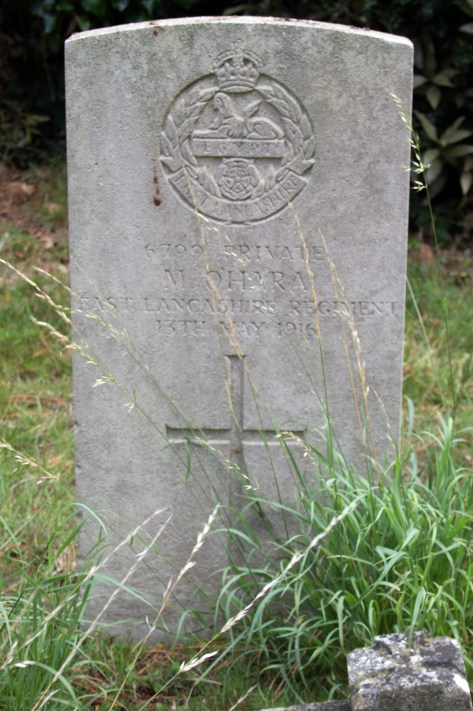
In Paignton Cemetery, Devon, is a headstone dedicated to Private Michael O’Hara of the East Lancashire Regiment. There is little concrete information available about Michael, and a lot of what exists is contradictory.
The British Army Register of Soldiers’ Effects states Private O’Hara was attached to the regiment’s 7th Battalion, and confirms that his next-of-kin was his sister, Margaret Barrus.
An entry in the 1881 census suggests that Michael and Margaret’s parents may have been William and Mary O’Hara. The family were living in rooms a 5 Shed Street in Habergham Eaves, Lancashire, and 14-year-old Michael, who had been born in Bacup, was working as a mule spinner in a local cotton mill.
At this point the Michael’s story becomes vague again, and subsequent census returns throw up too many inconsistencies to corroborate a definite path for his life.
When war came to Europe, Michael stepped up to play his part. Again, full service details have been lost, but it is evident that he was sent to France on 17th July 1915. By the following spring Private O’Hara was back on British soil again, and had been admitted to the American Women’s Hospital at Oldway House in Paignton, Devon. The reason he was there is unclear, but it was to prove fatal: Michael passed away on 13th May 1916. Based on the 1881 census, he would have been around 49 years of age.
The body of Michael O’Hara was laid to rest in Paignton Cemetery, much of his life story buried there with him.
Alfred George Glastonbury – who was better known as Jack – was born on 26th June 1882 in Canvastown, New Zealand. The oldest of fourteen children, he was one of nine sons to Alfred and Matilda Glastonbury.
There is little concrete information about Jack’s early life. He found work with New Zealand Railways, and married Eliza Taylor on 30th January 1904. The couple had a son – also called Alfred – on 2nd December 1908, but Eliza passed away just a couple of weeks after he was born.
Jack married a second time in July 1914, to Ann Leeks. Setting up home in Ohingaiti, they went on to have three children: John, Norah and Harold.
When war came, men of the Empire were called upon to play their part. Jack enlisted on 30th May 1916, and was assigned tot he New Zealand Rifle Brigade. His service records show that he was 5ft 4ins (1.63m) tall, and weighed 182lbs (82.6kg). He had light brown hair, blie eyes and a fair complexion: he was also recorded as never being absent from his job as a surfaceman through sickness or accident, but did have signs of varicose veins in his left leg.
Rifleman Glastonbury’s unit departed from Wellington on 25th September 1916. The troop ship Devon arrived in Devonport, England, two months later, and the regiment marched to Sling, near Bulford, Wiltshire, where they would be based.
Jack’s time there would be brief, however. He was admitted to the No. 3 New Zealand General Hospital in Codford on 3rd December, suffering from gastritis. He would succumb to the condition quickly, passing away on 5th December 1916: he was 34 years of age.
Alfred George ‘Jack’ Glastonbury was laid to rest in the ANZAC extension to St Mary’s Churchyard, Codford, cloe to the hospital in which he had breathed his last.
Alfred James Darch was born early in 1884, the second of seven children to James and Emily Darch. James was a postman and labourer from Somerset, but the family were brought up in Devon village of Clayhidon.
By the time of the 1901 census, the family had moved over the border to Wellington. Alfred had completed his schooling, and was working as a showmaker’s assistant. He committed himself to the role, and by 1911 was a shoemaker in his own right. By this point he was one of two of the Darch children to still be living with his parents: the family were settled at 22 Eight Acres Lane in Wellington.
When war broke out, Alfred stepped up to play his part. On 19th October 1916 he enlisted, joining the Army Medical Corps. His service records show that he was 5ft 4ins (1.63m) tall. They also suggested that his right leg was slightly shorter than his left, following an old dislocation. Private Darch had also had an operation for appendicitis five years previously.
Alfred was sent to Codford, Wiltshire, where the No. 3 New Zealand General Hospital was located. His time there was to be tragically short, however. On 17th November he was admitted himself, suffering with some breathing complications. The medical report noted that he was “vaccinated a fortnight ago. Bad, sore, inflamed arm. Reported sick eight days later with general malaise, slightly sore throat, slight headache – some cough. He had one anti-typhoid inoculation 2 or 3 days before vaccination… Has had no [previous] chest trouble… Face flushed. Temp 104.8. Pulse 100. Tongue white in centre, red at sides. Breath extremely foul. Voice hoarse. Breathing quiet. Not distressed.”
Over the nest week, Private Darch’s health deteriorated. Pleurisy was suggested, but when he passed away, at 5:45am on 24th November 1916, the diagnosis was pneumonia. He was 32 years of age.
Alfred James Darch was laid to rest in the extension to St Marys Church, Codford, not far from the base to which he had been sent just weeks before.