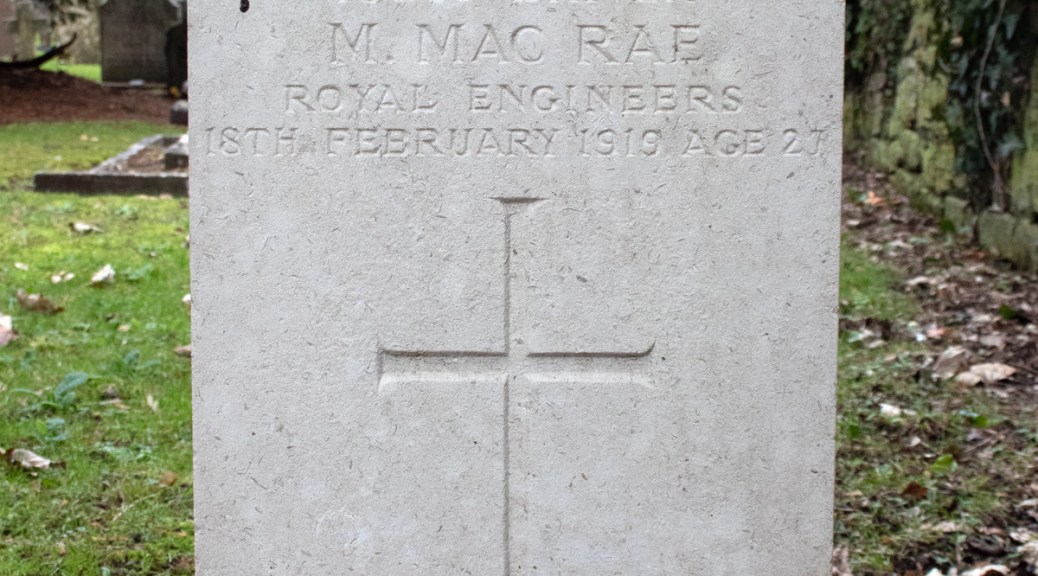
Much of Matthew Alexander MacRae’s life is destined to remain a mystery. He was born in Scotland in 1892, and was the second of three children to Thomas and Christiana MacRae. The family had moved to Birmingham – where Thomas had found work as a garment dyer – by the time of the 1901 census.
When war came to Europe, Matthew enlisted in the Royal Engineers. Nothing of his service records survives, but it is clear that he had joined as a Driver by the summer of 1918.
The next evidence for Driver MacRae is that of his passing, on 18th February 1919, at the age of 27 years. No cause of death is evident, although there is nothing in contemporary newspapers to suggest anything other than natural causes.
Two documents add a little more mystery to Matthew’s legacy. The Army Register of Soldiers’ Effects notes his father, Thomas, as the beneficiary of his estate. The Dependents’ Pension, however, suggests that an Emily MacRae, was to be provided with support. This was not Matthew’s sister, and Emily’s address – Cross Street in Bath, not far from where Driver MacRae was buried – would suggest that she was his widow, although there are no marriage records to corroborate this.
Matthew Alexander MacRae was laid to rest in the Roman Catholic Cemetery in Bath, Somerset.
John Maguire was born in Dublin, Ireland, in 1874. There is scant information about his life, and his name is too common to be able to narrow down details of his family.
The only documentation that links to his life is that of his army service. He was working as a labourer when he enlisted in the Royal Army Medical Corps on 27th April 1918. His service records confirm he was 5ft 7ins (1.7m) tall, with blue eyes, grey hair and a sallow complexion. Interestingly, he reported that he did not have any next-of-kin.
Private Maguire seemed to serve on home soil, and was primarily based in Lancashire. It was while here in the January of 1919 that he fell ill with nephritis – kidney disease – and was admitted to the hospital on Adelaide Street, Blackpool.
His condition was such that it led to John’s discharge from military service on medical grounds. On 23rd February he was moved to the 2nd Southern General Hospital in Bristol, and two days later he left army life. John was transferred to the War Hospital in Bath a couple of weeks later, and it was here that he passed away on 16th April 1919. He was 45 years of age.
An addition to John’s initial service records noted that a next-of-kin had been confirmed, and so Mary Prestige, who was living in Bedminster, to the south of Bristol, was informer of her friend’s death.
Respecting the Irishman’s religion, John Maguire was laid to rest in the Roman Catholic Cemetery in Bath, the city in which he died.
John’s friend, Mary Prestige, is also destined to remain a mystery. There are no records of her at the address John’s service records provide – Pipe Cottage, North Street, Bedminster.
There are two census records for Somerset for a Mary Prestige: 1901 records a Durham-born 18 year old Mary working as one of a number of laundry maids at the Marlborough Hill House of Refuge in Bristol.
The 1911 census records the same Mary Prestige visiting a William and Amelia Hockerday in Yatton, Somerset. It is impossible to confirm, however, whether this is the woman John notified the army as his next of kin.
Herbert Henry Cleal was born on 6th November 1899, in the Somerset village of Hambridge. The tenth of twelve children, his parents were Daniel and Emily Cleal.
Daniel was a cowman on a farm, and it is likely that Herbert would have started in agricultural labouring, had war not intervened.
Full details of Herbert’s military service are not available, although it is clear that he had enlisted in the Worcestershire Regiment by the summer of 1918. By this point in the war, Private Cleal’s battalion – the 2nd/8th Battalion – was already in France, although, according to his records, it does not appear as if he saw any service overseas himself.
The only other record for Herbert is his entry in the Army Register of Soldiers’ Effects. This confirms that he passed away at Bradford War Hospital on 1st January 1919. The cause of his passing is not noted, but he had just turned 19 years of age.
Herbert Henry Cleal was brought back to Somerset for burial. He was laid to rest in the graveyard of St James-the-Less Church in his home village of Hambridge.
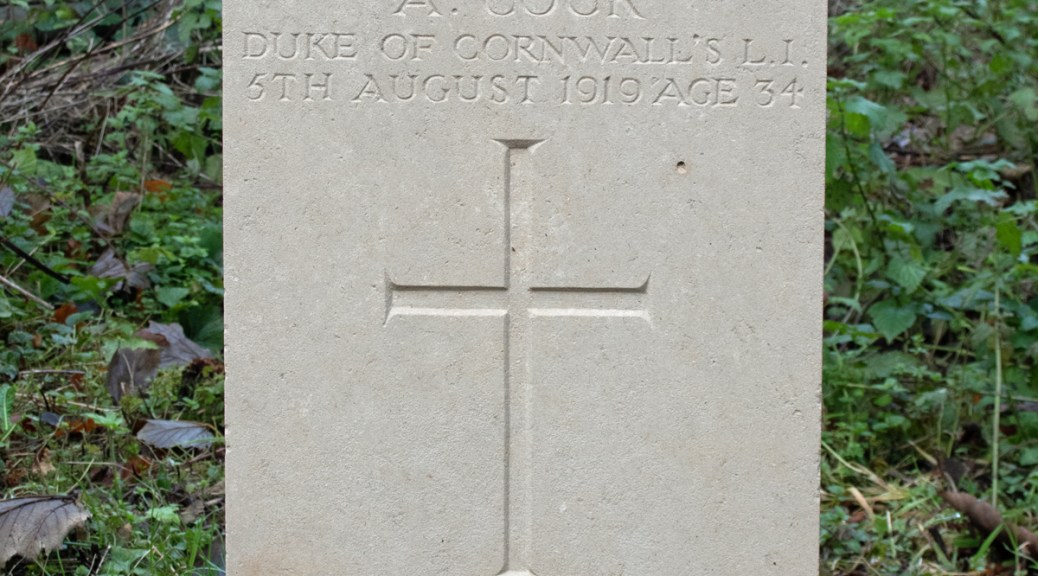
Arthur Cock was born in around 1885 in Wadebridge, Cornwall. One of eleven children, he was the son of mortar mason William Cock, and his wife, Louisa.
When he left school Arthur helper his father out in the business, but when war came to Europe’s shores, he stepped up to play his part. Sadly, his service records are lost to time, and it is a challenge to piece together his time during the conflict from a confusion of other documents.
It is clear that Arthur enlisted in the Duke of Cornwall’s Light Infantry, as this is what is engraved on his headstone. However, his Medal Roll suggests that he also served in the Gloucestershire Regiment and the Labour Corps. He seems not to have fought overseas, and was awarded the Victory and British Medals for doing his duty.
Private Cock’s entry in the Army Register of Soldier’s Effects confirms that he must have enlisted before February 1919, and that he passed away at Whitchurch Hospital.
An entry in the local newspaper, reporting on his death, reads as follows:
In loving memory of Pte. Arthur Cock, son of William, and the late Louisa Cock, of Wadebridge, who died August 5th, at Whitchurch War Hospital, Cardiff.
Cornish Guardian: Friday 8th August 1919
Interestingly, the facility Arthur had been admitted to was a psychiatric hospital, but with no other confirmation as to his passing, it is only possible to assume the cause of his death. He was 34 years old when he passed away.
Arthur Cock’s body was brought back to Cornwall for burial. He was laid to rest in the peaceful, wooded graveyard of St Breoke’s Church, next to the family grave in which Louisa had been buried three years previously.
The family grave, by this time, was tragically quite full. William was able to mourn his son, wife and six of Arthur’s siblings – Mary, William, John, Fred, Charles and Ernest – who had all passed in childhood and were laid to rest there.
Arthur’s younger brother – another William – also fought in the First World War. His service records reveal a lot about his life.
Private Cock enlisted in the Australian Imperial Force on 7th September 1914. At the time he was working as a railway porter in Morphettville, now a suburb of Adelaide, Australia. His records confirm that he was 5ft 8.5ins (1.74m) tall, and weighed 158lbs (72kg). He had brown hair, brown eyes an a fresh complexion.
William left Australia for the battlefield on 20th October 1914, and soon found himself in the Eastern Mediterranean. Sadly, this was to be the end of the line for him: he was killed on the battlefields of Gallipoli on 23rd March 1915, aged just 28 year of age.
William Cock was laid to rest in the Shrapnel Valley Cemetery in Gallipoli. He is commemorated on the headstone of the family grave back in St Breock.
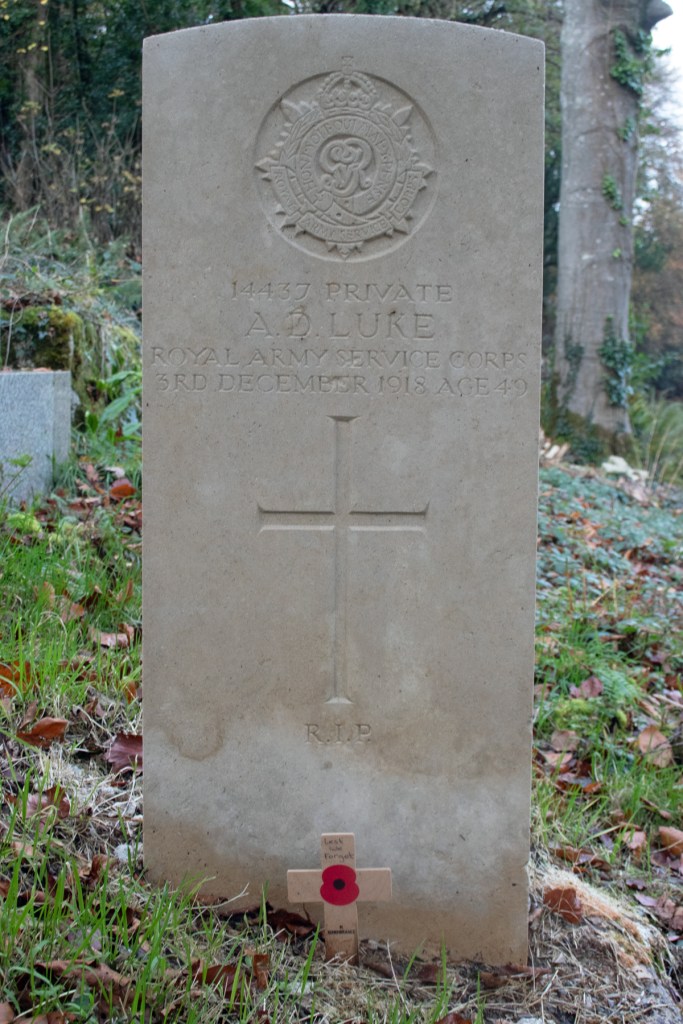
Alfred Docking Luke was born in 1869 in the village of St Breock, near Wadebridge, Cornwall. One of thirteen children, his parents were William and Selina Luke. William was a general labourer, and this is a trade into which Alfred followed.
Alfred wanted bigger and better things, however, and, on 27th September 1893, he enlisted in the Royal Garrison Artillery. Gunner Luke’s service records show that he was 5ft 9ins (1.75m) tall, and weighed 146lbs (66kg). He was noted as having blue eyes, brown hair and a fresh complexion. The record also noted a number of tattoos: a cross and a square and compass on his left forearm, the letters AL on the back of his left hand and rings on his middle and little fingers of the same hand.
Initially enlisting for seven years’ service, Alfred soon found himself sent to India. He served his whole time there, and it appears not to have been without incident. He was noted as having sustained a fractured skull on 2nd October 1896, although there is no further detail on the injury.
When Gunner Luke’s initial term of service came to an end, he elected to remain on active duty and, in the end, remained in India until December 1905, before returning home to be demobbed.
Back in Cornwall, Alfred built his life again. He found more labouring work, this time in a manure store in Wadebridge, and married the recently widowed Bessie Williams. She had two children, and the family set up home together.
A sense of duty, or a love of the army life, remained in Alfred’s heart, however and, when war was declared, he was keen to play his part again. He enlisted in the Royal Army Service Corps in July 1915, and, despite being 45 years old by this point, he soon found himself in Northern France.
Private Luke spent the next three years supporting the lines on the Western Front, but by the autumn of 1918, life was taking its toll on him. On 8th November 1918 he was admitted to a camp hospital, having contracted influenza. Tests for tuberculosis proved negative, although his breathing was laboured, and he was medically evacuated back to Britain for further treatment.
Admitted to St John’s Hospital in Cheltenham, the medical report makes for some grim reading:
Patient on admission had paralysis of soft palate lulateral and ptosis rt. eye. Tongue slightly pointing to the left. Difficulty in articulation due not only to palatal paralysis but also to apparently labial and dysphagia for fluids and solids. Fluids returned through nose. The symptoms, in short, of bulbar paralysis.
Private Luke’s condition worsened. He passed away the day after being admitted, on 3rd December 1918. He was 49 years of age.
Alfred Docking Luke’s body was brought back to Cornwall for burial. He was laid to rest in the peaceful, wooded graveyard of St Breoke’s Church in his home village.
St Breoke’s was the family church, and the Luke family were to be reunited again. Alfred’s mother Selina passed away a month after her son, at the age of 68; his father William followed in May 1919, at the age of 78.
Edgar George Bowditch was born in the spring of 1887, in the Dorset village of Melbury Osmond. One of seven children, his parents were William and Sarah Bowditch. William was an agricultural labourer turned gamekeeper, and Edgar helped his father out when he left school.
William passed away in 1911, and Edgar fell off the radar until March 1914, when he married local mason’s daughter Rosetta Morris. The couple settled down in her home village of West Coker, Somerset.
When war was declared, Edgar stepped up to serve his King and Country, and enlisted in the Machine Gun Corps as a Private. He was assigned to the 37th Battalion, and certainly saw action overseas. He “came through without a scratch and in good health until demobilised in France.” [Western Chronicle: Friday 21st February 1919]
Private Bowditch was unwell when he arrived back in West Coker on 4th February 1919. While his condition is unclear, it worsened, and he passed away at home ten days later. He was 32 years of age.
Edgar George Bowditch was laid to rest in the graveyard of St Martin’s Church in his adopted home of West Coker.
Rosetta married again in 1921, to a John Axe. The couple remained in the same part of Somerset, John dying in 1947. Rosetta lived on, passing away in Yeovil in 1963, at the age of 77 years old.
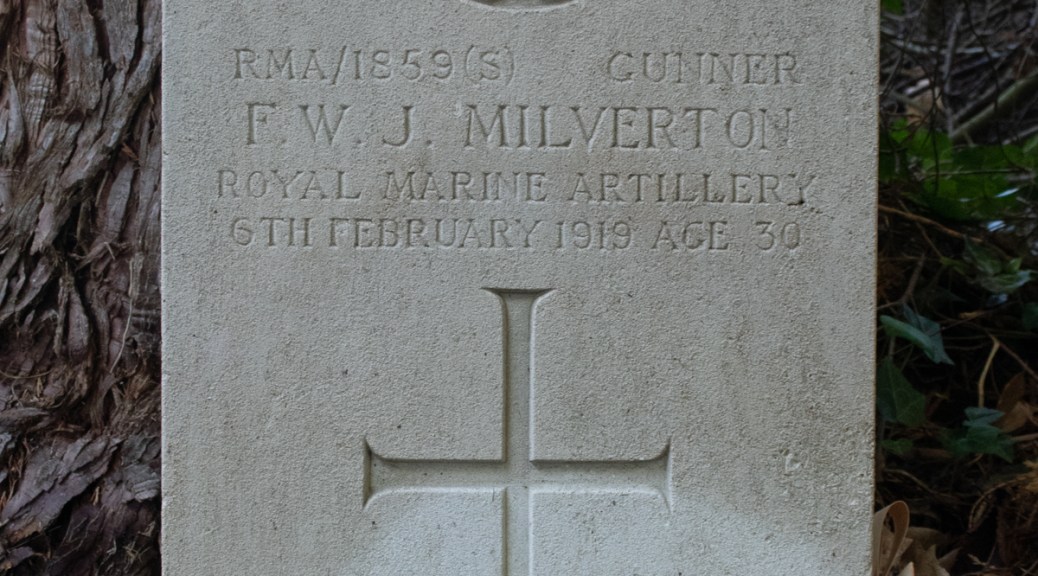
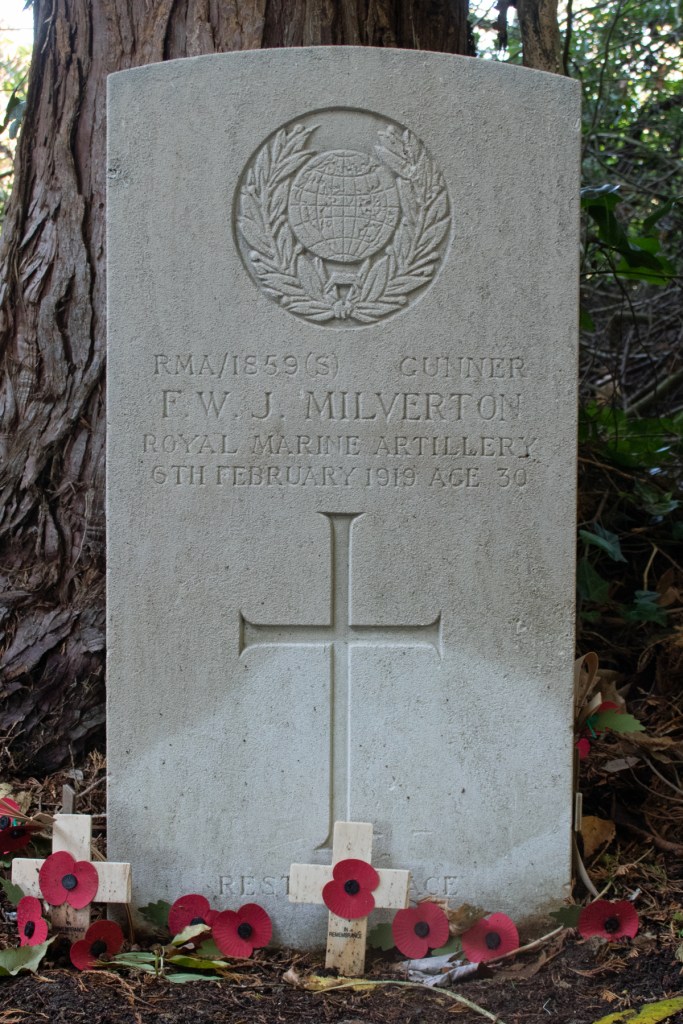
Frederick Walter John Milverton was born on 26th June 1888 in the Somerset village of Rimpton. One of seven children, his parents were farm workers George and Mary Milverton.
When he left school, it was natural for Frederick to follow in his father’s footsteps. The 1901 census recorded him as working as a farm lad in Leigh, Dorset, while in 1911 he was back at the family home, where he was formally employed as a rabbit trapper.
George passed away in 1913 and, with war fast approaching, Frederick remained at home, to help support his mother. But he eventually received his enlistment notice and, on 28th February 1916, he joined the Royal Marine Artillery.
Private Milverton’s service records show that he was 5ft 8ins (1.73m) tall, with dark brown hair, blue eyes and a fresh complexion. After five months’ initial training, Frederick was awarded the rank of Gunner 2nd Class, and assigned to the cruiser HMS Euryalus.
For the next couple of years Gunner Milverton remained on board Euryalus, serving in the Mediterranean, the Middle East, India and Hong Kong. He transferred to HMS Lavatera in March 1918, and saw out the remainder of the war on board.
In January 1919 Gunner Milverton returned to home soil, and was assigned to the Royal Marine Artillery Headquarters in Eastney, Hampshire. It was here, however, that he fell ill, and was admitted to the Royal Naval Haslar Hospital with bronchial pneumonia. Tragically the condition was to get the better of him: Frederick passed away on 6th February 1919, at the age of 30 years old.
Frederick Walter John Milverton’s body was brought back to Somerset for burial. He was laid to rest in the quiet graveyard of St Mary’s Church in his home village of Rimpton.
Fredrick James Baker was born in the spring of 1894, in the Kent village of Malling. One of eleven children, his parents were James and Elizabeth Baker. James was a labourer in the local chalk and clay pits and, by the time of the 1911 census, the family had moved to Burnham, near Aylesford.
Frederick followed his father into labouring work, and they made a living at the local lime works. War was closing in on Europe, however, and he felt he needed to play his part for King and Country. He joined the Royal Army Veterinary Corps and, while his service records no longer exist, it is evident that he had enlisted by November 1916.
It is unclear whether Private Baker served at home or overseas, but he appeared to be dogged by ill health. He was medically discharged from the army on 26th May 1917, and returned to civilian life.
Sadly, it is at this point that Frederick’s trail goes cold. The only other evidence for him is that of his passing. He died from illness at home on 25th February 1919, at the age of just 24 years old.
Frederick James Baker was laid to rest in the graveyard of St Peter & St Paul’s Church in Aylesford, not far from where his grieving family still lived.
While buried in the churchyard, the location of Frederick’s grave is not known. Instead, he is commemorated on a joint headstone in the First World War section of the graveyard.
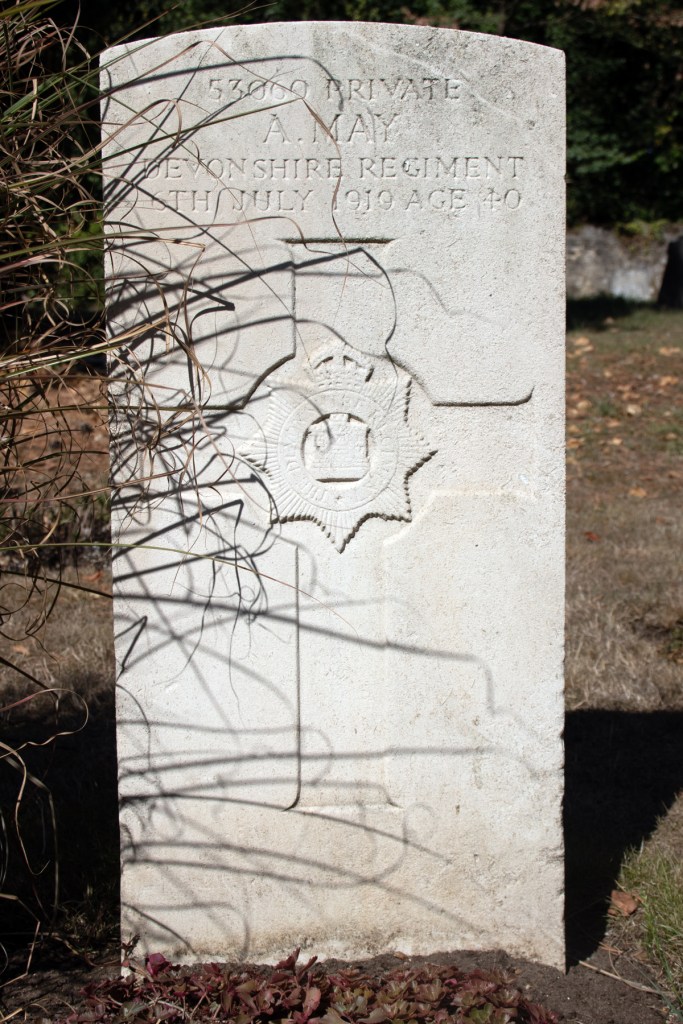
The life of Arthur May is a difficult one to uncover. Born in Aylesford, Kent, in the summer of 1879, he was baptised on 10th August, and only his mother’s name – Eliza May – recorded.
There is a record of an Arthur May from Aylesford in the 1881 census, but that gives his mother’s name as Ann (and the father’s as labourer William May). Twenty years later, the same Arthur may is listed as boarding with his sister and brother-in-law’s family in Halling, Kent, where he was working as a labourer in the local cement works. Again, however, it is impossible to confirm that this Arthur May is the one being sought.
Further records identify Arthur’s wife as a woman called Annie, although no marriage records remain to confirm a union.
Details of Private May’s war service is pretty limited, but he seems to have enlisted in the Devonshire Regiment in February 1917. He subsequently transferred to the 167th Coy Labour Corps and was sent to France, but returned to Britain a month later, having fallen ill. His condition turned out to be tuberculosis and he was medically discharged from the army in August 1917.
Private May’s medical report adds some tantalising detail to his military service. He is recorded as being 39 years and one month old, 5ft 9ins (1.75m) tall, with a pale complexion, blue eye and light brown hair. He had a tattoo on his left forearm and was working as a labourer, while living in Ditton, near Maidstone, in Kent.
The report also suggests that Arthur had initially enlisted in the Royal Naval Volunteer Reserve in November 1915. It notes that he was frequently disabled with shortness of breath and a cough during his fourteen months with the navy.
Arthur returned home after his discharge. While his trail goes cold, it is likely that his lung condition continued to dog his civilian life. On 6th July 1919, he passed away and, although no cause is freely recorded, as there is a lack of comment in contemporary local newspapers, illness would be a possible cause. He was 40 years of age.
Arthur May was laid to rest in the graveyard of his local church, St Peter’s & St Paul’s in Aylesford, Kent.
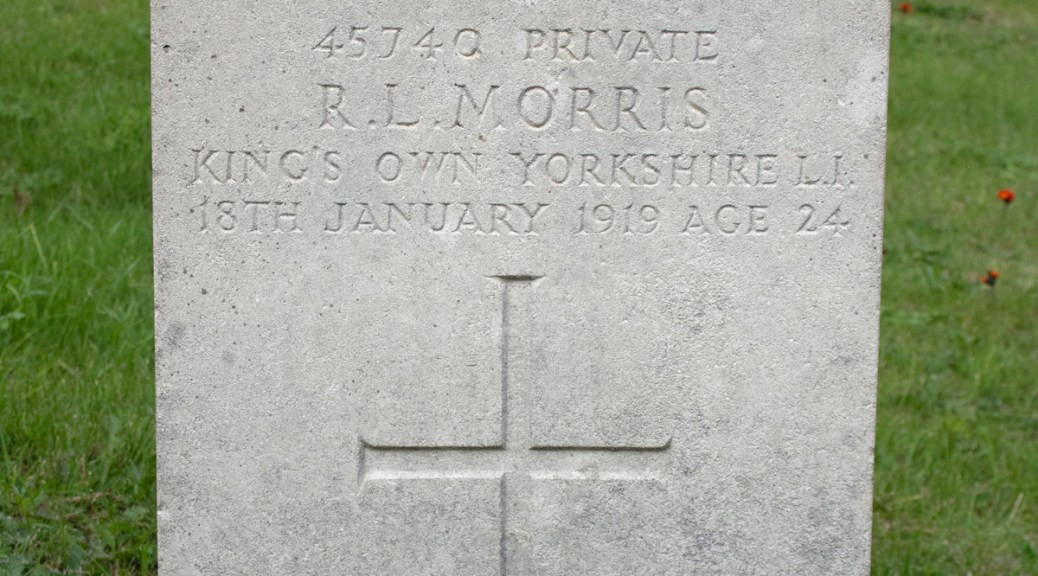
Richard Levi Morris was born in the village of Carno, mid-Wales, in the autumn of 1895. He was the oldest of five children to John and Hannah Morris. John was a tailor who, when Richard was still a babe in arms, moved the family north to the Denbighshire town of Llangollen.
When he left school, Richard found work as baker’s apprentice. He was employed by the Model Bakery on Church Street, Llangollen, a business that would go on to win, according to its subsequent advertising, a bronze medal for both its white and brown bread in both 1912 and 1913 [North Wales Journal: Friday 7th August 1914].
War was coming to Europe, and Richard stepped up to play his part. Full details of his service are sadly lost to time, but he had enlisted in the King’s Own Yorkshire Light Infantry by the summer of 1918. Initially assigned to the 9th (Service) Battalion, Private Morris subsequently transferred to the 2nd/4th Battalion and was attached to one of the regiment’s depots.
What little documentation around Richard’s actual service confirms that he was sent to the Western Front. At some point towards the end of the conflict – possibly during the final advance in Picardy – he was wounded. Medically evacuated to Britain, he was admitted to a cottage hospital in Oswestry, Shropshire.
Sadly, it was here that Private Morris was to breath his last: he succumbed to his injuries on 18th January 1919, at the tender age of just 24 years old.
The body of Richard Levi Morris was brought back to Wales for burial. He was laid to rest in the quiet Fron Cemetery in Llangollen.










 Death and Service