Thomas William Perrett was born in October 1878, the seventh of eight children to Lewin and Ann Perrett. Lewin was an agricultural labourer from Wiltshire, and it was in Aldbourn, near Marlborough, that the family were raised.
Initially finding work as a farm labourer, Thomas was soon drawn to the bright lights and big city. By the early 1900s he had moved to London, and it was here that he met, and in 1909 married, Mary Sterry, a labourer’s daughter from Middlesex. The couple went on to have three children, Elsie, Rose and Alice.
Thomas, by this point, had found work on the railways: the 1911 census records him as a railway porter, presumably at Paddington Railway Station, which was within a few minutes’ walk of where the Perrett family were living.
War came to Europe, and Thomas was keen to play his part. Full details of his service are not available, but he enlisted in the East Surrey Regiment, where he was assigned to the 2nd/5th Battalion. This was a second line unit, and Private Perrett remained on home soil for the duration of the war.
This territorial role was reinforced when he transferred across to the 696th Agricultural Company of the Labour Corps. Details of his work are not available, but it seems likely that he was assigned to farm work in the mid-Sussex area.
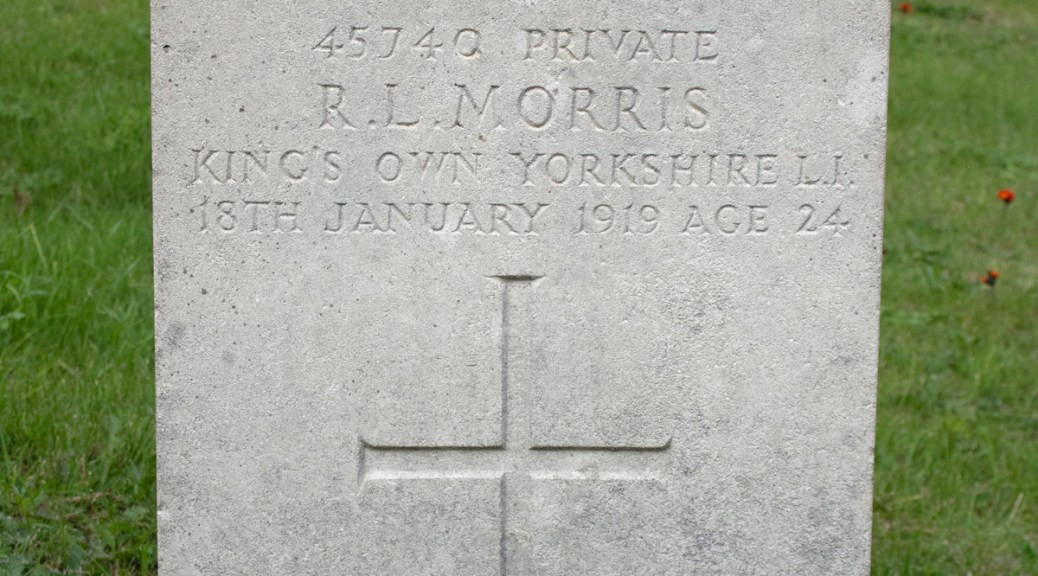
This too is where Private Perrett remained after the war and where, on 24th February 1919, he was to pass away. Details of his death are vague and the cause is unknown, but he was 40 years of age.
Thomas William Perrett was laid to rest in the cemetery in Cuckfield, West Sussex.
Sydney Francis Proctor was born in the autumn of 1886 in the Hertfordshire town of Bushey. The middle of three children, his parents were George and Annie Proctor. George was a stationary engine driver, and Sydney found work at a local iron foundry – possibly working alongside his father – when he left school.
This was not to be Sydney’s long term career, however, as, by the time of the 1911 census, he had moved to West Sussex and settled in Cuckfield, near Haywards Heath. By this time he was working as a gardener, and was employed at the nearby Borde Hill estate.
It is likely that Sydney had made the move to Sussex a few years earlier, as the same document confirms that he was married to a London-born woman called Florence, who was five years his senior. The couple would go on to have a daughter, Frances, who was born in December 1912.
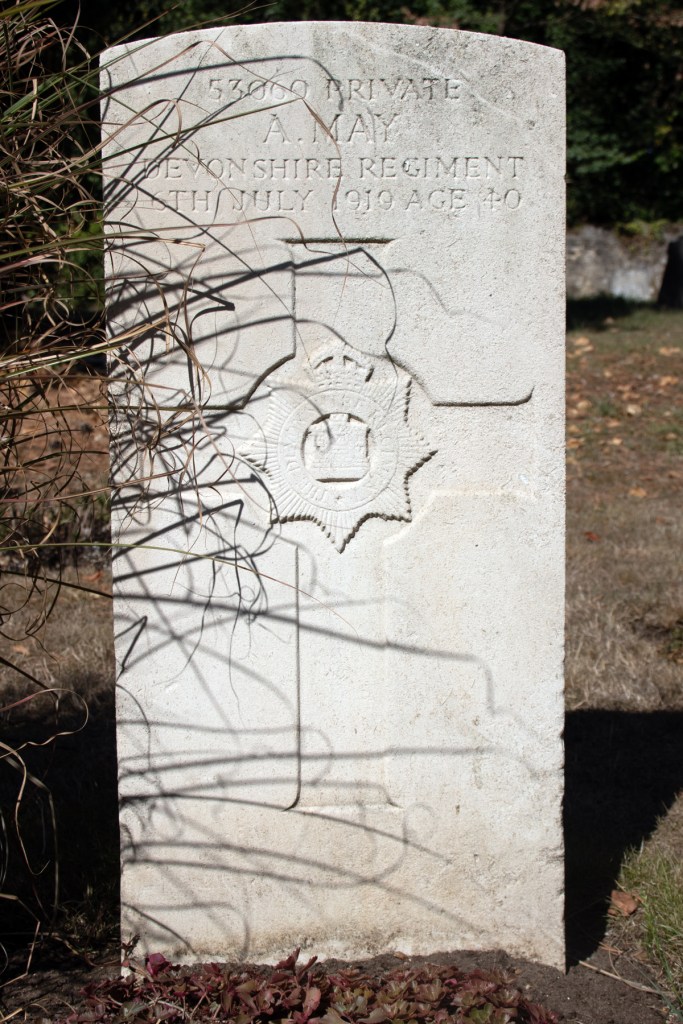
Sydney’s wartime service is a little sketchy. He enlisted in the Coldstream Guards in November 1914, and was assigned to the 4th Battalion. While full details of his service are not available, Guardsman Proctor certainly served overseas, and may have seen some of the fiercest fighting of the conflict, at Loos, Ypres and the Somme.
Guardsman Proctor survived the conflict, but paid a price. In October 1918, he was medically discharged from military service, as he was suffering from aortic regurgitation – a heart complaint. He returned home to Sussex, but this respite was not to be for long. Sydney passed away on 17th July 1919, at the age of 32 years old.
Sydney Francis Proctor was laid to rest in the cemetery of his adopted home town, Cuckfield.
Henry Street – known as Harry – was born on 22nd April 1875 in Oxted, Surrey and was one of thirteen children to Jacob and Emma. Jacob was an agricultural labourer, and this is work Harry initially went into when he left school.
However, it seems that Harry was after more of a career, and looks to have enlisted in the Royal Field Artillery by 1895. His trail goes cold for a while, and it can be assumed that he served abroad, although exact details of his career are lost to time.
By 1906, Harry was back in England, and, on 15th October he married Janette Street at St Peter’s Church in Tandridge, Surrey. The marriage record confirms that Harry was a soldier, while his new wife was the daughter of a labourer. Janette was three years Harry’s junior, and there does not seem to be any close family connection, in spite of their shared surname.
Again, information on Harry’s life at this point is sparse. When war was declared, he was either still serving with the Royal Field Artillery, or was called back in to duty. By December 1914, he had been promoted to Lieutenant: this was to be a rank he would continue to hold until the end of the conflict. He certainly served abroad, and was awarded the Long Service and Good Conduct Medals, in addition to the Victory and British Medals. He was also given the French Medaille Militaire, although reasons for this award are lost to time.
Lieutenant Street survived the war, and by the autumn of 1919, he was living at Bright Farm in Cuckfield, West Sussex. It was here, too, that he passed away, through causes unknown. He died on 5th October 1919, at the age of 44 years old.
Harry Street was laid to rest in Cuckfield Cemetery, in the shadow of the village’s Holy Trinity Church.
Charles Wilfred Tucker was born in the summer of 1898 in Penarth, Glamorgan. He was the oldest of four children to Wilfred and Elizabeth Tucker, restaurant owners on Windsor Terrace in the centre of the town.
Little information is available about Charles’ early life. When war broke out, he enlisted in the Welch Regiment, before transferring to the Machine Gun Corps at some point during the conflict. In the autumn of 1919, Private Tucker was put on furlough while waiting to be demobbed, and he returned home.
Sadly, it was while here that Charles contracted pneumonia, and it was from the lung condition that he was to pass away. He breathed his last on 30th October 1919, at the age of just 21 years old.
Charles Wilfred Tucker was laid to rest in the family grave in St Augustine’s Churchyard in his home town of Penarth.
William Richard Radford was born in the spring of 1900 in Cogan, on the outskirts of Penarth, Glamorgan. He was one of eight children to coal trimmer turned dock labourer Richard Radford and his wife, Susan.
Little information is available about William’s life. What is documented is that he enlisted in the Royal Navy, and, by the time he came of age in 1918, he held the rank of Ordinary Seaman. William was serving at HMS Victory, the Royal Naval Dockyard, by the end of the war.
At this point, details of Ordinary Seaman Radford’s life become a little unclear. He seems to have been stepped down to the Marine Mercantile Reserve, returning home in January 1919, when he passed away. His Pension Ledger Card gives the cause of death as a fractured shoulder, while another document states that he died from a sarcoma.
Whatever the cause of his passing, William Richard Radford was laid to rest in the graveyard of St Augustine’s Church in Penarth. He shared his grave with his mother, who had passed away the previous year. Richard Radford was also buried in the same plot when he passed away in 1926.
George Charles Walrond Sweet was born on 4th December 1889, the oldest of three children to Reverend Charles Sweet and his wife Maud. A Church of England vicar, Charles moved around with his work, and, when George was born, he was based in Winterborne Kingston in Devon.
George was sent away to school, and, by the time of the 1901 census, Charles and the family had moved to Milton Lilbourne in Wiltshire, to tend the local flock.
After school, George studied at Oxford, then followed in his father’s footsteps by taking holy orders, and was soon appointed rector of Symondsbury, Dorset.
When war broke out, his calling was to serve in the Royal Army Chaplain’s Department. Details of his time during the conflict are unclear, although by the spring of 1919, he was attached to the headquarters of the Army of the Rhine.
It was here that he met Phyllis Squire Hickson, who was serving as a Nurse in the Queen Mary’s Auxiliary Army Corps. The couple fell in love and, in June 1919 they returned to England to marry. The wedding occurred on 6th August 1919, and the newlyweds set off on honeymoon the following day.
On his honeymoon tour, the Revd. George C Walrond Sweet… was drowned on Thursday evening in the Cherwell at Oxford, in the presence of his wife.
Mr and Mrs Sweet engaged a punt at Tims’s boathouse and went for a trip on the river. On returning about seven o’clock, when within 300 yards of the boathouse, the punt pole was embedded in the mud and, in attempting to dislodge it the pole broke.
Mr Sweet fell on the side of the boat and then over-balanced into the river. His wife tried to reach him, but without success, and then jumped into a second punt and from that into another boat, but failed to reach him, and he disappeared. The body was not recovered until a quarter of an hour had elapsed, and life was then extinct.
Mr Sweet, who was an MA of Keble College, was only married on Wednesday at St James’s Church, West Hampstead…
[Phyllis’ father] Mr William Hickson… said his daughter became engaged to Mr Sweet in France. He did not meet him until last Tuesday. They came to England to be married. Mr Sweet met with a bicycle accident some years ago and [he] understood from his daughter that her husband was unable to swim or take any active exercise, but while he had been in France his health had much improved.
It was stated [at the inquest] that Mr and Mrs Sweet had been married only one day when the accident occurred and Dr Brooks, a university coroner, said that the tragedy was one of the saddest that had ever come under his notice.
Taunton Courier and Western Advertiser: Wednesday 13th August 1919
The inquest confirmed that the punt pole had broken about 2.5ft (0.76m) from the top. When George was dragged from the river, artificial respiration was carried out for around 50 minutes, but proved unsuccessful. The inquest returned a verdict of accidental death. George was just 29 years of age.
Reverend George Charles Walrond Sweet’s body was brought to Somerset for burial. He was laid to rest in the graveyard of Holy Cross Church in Sampford Arundel, more than likely because he or his father had been vicars there.
This was the second tragedy to befall the Sweet family. George’s younger brother, Leonard, had been schooled in Sherborne, then at the Military College in Sandhurst. He joined the 1st Battalion of the Hampshire Regiment as Second Lieutenant on 5th February 1913, and was promoted to full Lieutenant in September 1914, and Captain in October 1915.
Captain Sweet was then attached to the 29th Squadron of the Royal Flying Corps, and gained his wings at the British Flying School in Le Crotoy, France, in August 1915. On 22nd June 1916, he was on patrol duty over the British lines, when he was involved in a skirmish, and his plane crashed, killing him instantly. He was just 23 years of age.
Captain Leonard Sweet was laid to rest at the Lijssenthoek Military Cemetery in Poperinge, near Ypres.
Captain Leonard Sweet (from findagrave.com)
Phyllis Sweet never remarried. By the time of the 1939 England and Wales Register, she was living in Bridport, Dorset, and working as a political organiser and speaker. She passed away in August 1944 in Cannock, Staffordshire, at the age of 63 years old.
Robert Thomas Creasey (also known as Thomas Robert Creasey) was born in the village of Ash, near Farnham in Surrey, on 3rd January 1896. He was the youngest of four children to Edwin and Elizabeth Creasey. Edwin was the landlord of the Standard of England public house in the village.
When he died in 1902, Elizabeth moved her family to Somerset, where she had been born and where she still had relatives living. With four young children to raise, she married again in April 1903, to local dairy farmer Frederick Gould.
Robert was working as a farmer when war was declared, but was one of the first to step forward and volunteer. He enlisted in the Somerset Light Infantry and in the autumn of 1915 was involved in the fighting in Gallipoli.
In July 1916 Private Creasey transferred to the Machine Gun Corps. Sadly, little further information about his military life is available, but he survived the war, and returned home to Somerset on furlough, before being demobbed.
This is where Robert’s trail ends. He passed away at home on 15th February 1919, presumably from one of the lung conditions running rampant across a war-torn continent. He was just 23 years of age.
Robert Thomas Creasey was laid to rest in the graveyard of St Michael and All Angel’s Church in Angersleigh, Somerset, not far from where his mother lived.
Sidney Alfred Buttle was born on 7th November 1900, one of eight children to Walter and Alice Buttle. Walter was a brickyard labourer from the Somerset hamlet of Churchstanton, but it was in nearby Wellington that he and weaver Alice raised their young family.
Sidney was just 13 years old when war broke out, but he was a young man who appeared keen to play his part. On 31st July 1917, he enlisted in the Royal Naval Reserve, a regiment that suggests that, even at his young age, he had some experience of working with boats.
His service records show that Sidney was just 5ft 2.5ins (1.59m) tall, had a fresh complexion with hazel eyes. Given the rank of Boy, he was initially posted to Falmouth, Cornwall, where he spent nine months training. After this, he spent a further six months on short postings as a deck hand, before being sent to HMS Victory, the Royal Naval Dockyard in Portsmouth, Hampshire.
Boy Buttle was, by this point, suffering from neurasthenia, a nerve disorder, and it was this condition that led to his eventual discharge from naval service in December 1918.
Sidney returned home, but seems to have been weakened by the condition. He passed away at home on 3rd August 1919, at the tender age of just eighteen years of age. He was laid to rest in Wellington Cemetery, not far from where his family still lived.
Much of William Woodgate’s life seems destined to remain a mystery. He was born in Dunsford, Devon, in around 1877, and was the son of Lewis Woodgate.
By the age of 14, he was living on a farm on Bovey Tracey, working as an agricultural labourer for the farm owners, Thomas and Betsy Dayment. Ten years later, William had made the move to Wellington in Somerset, where he was lodging with the Denner family, and working as a carter.
On 20th June 1903, William married Mary Jane Grinter, a signalman’s daughter from Wellington; the couple went on to have three children, Lewis, Leonard and Francis. The young family set up home in North Street, near the centre of the town. By the 1911 census, William had changed profession, and was working as a fish salesman.
War was about to descend on Europe, and, in May 1916, William signed up to play his part. He was enlisted as a Private in the North Somerset Yeomanry, and was assigned to the 2nd/1st Battalion. His service record shows that he was 5ft 2.5ins (1.59m) tall, and weighed 117lbs (53kg), and had a fair physical development.
Private Woodgate did not see any service abroad: his battalion became part of the 6th Cyclist Brigade, and he was based in East Anglia and, for a short while, in Northumberland.
There is little further detail about Private Woodgate’s life. He survived the war, and was transferred to the Army Reserve on 9th February 1919, having served for just under three years.
At this point, William’s trail goes cold. He returned home to Somerset, and passed away nine months later, on 11th November 1919. He was 42 years of age.
William Woodgate was laid to rest in Wellington Cemetery, not far from where Mary and their children lived.
Wilson John Woodbury was born on 8th December 1888, and was the third of seven children to Daniel and Elizabeth Woodbury. Daniel was a chair maker from Wellington, Somerset, and this is where the family – including six boys and one girl – were raised.
By the time of the 1901 census, Daniel had had a change of career – he was now working as an oil presser. His and Elizabeth’s oldest three boys, Wilson included, had also found work, and were employed as wool spinners.
Elizabeth passed away in 1906, when Wilson was just seventeen years old. This may have pushed him to bigger and better things, and a career. On 13th August 1908, at the age of 19, he enlisted in the Royal Navy as a Stoker 2nd Class. His service record shows that he was 5ft 7.5ins (1.71m) tall, had light brown hair, blue eyes and a fresh complexion. It also noted that he had a tattoo of a cross on his right forearm.
Stoker Woodbury was initially trained at HMS Vivid – the naval dockyard at Devonport. On 9th February 1909, however, he was given his first posting, on board HMS Defence. He spent two years on board the armoured cruiser, and, gained a promotion to Stoker 1st Class.
During the remainder of his initial service, Wilson served on two further ships – HMS Sentinel and HMS Bellona – returning to Devonport between each posting. When he completed his five-year contract, Wilson voluntarily signed up for a further seven years with the Royal Navy.
As war came to Europe, Stoker Woodbury was given a number of assignments, on the battleships HMS Caesar and Lord Nelson, the cruisers HMS Blake and Apollo, and the depot ship HMS Blenheim. Further promotions followed – Leading Stoker in 1915 and Stoker Petty Officer two years later.
Wilson’s oldest brother, James, was serving in the Labour Corps during the conflict. Based in Northern France, he was assigned to the 720th Company, although further details are unclear. He almost survived the war unscathed, but contracted an illness of some description and died on 3rd November 1918, aged 34 years old. He was laid to rest in the Terlincthun British Cemetery in Wimille, France.
Stoker Petty Officer Woodbury returned home on leave in July 1919. The plan was to meet up with his fiancée who lived in Rockwell Green, near Wellington, but he instead turned up unexpectedly at his brother Fred’s home instead. Wilson said he had returned to Somerset because his girlfriend had broken off the engagement the previous week: the couple had been due to marry when he next came home on leave.
Fred told Wilson that she was not worth it, and they had gone drinking with a friend. Fred later said that on his previous leaves his brother had taken to drinking more than was good for him, but on that evening – Saturday 2nd August 1919 – he did not get drunk.
The following Monday, Stoker Petty Office Woodbury had taken himself down to the railway at Wellington, and been hit by a train. The action was deliberate, as, about his person were three letters. The first was to Daniel.
To My Dear Father,
Sorry to cause you any inconvenience or trouble, and please don’t worry about me, as I’m not fit to worry about. I have had this in mind for about a week. I can’t sleep and can’t eat, as I am broken-hearted, but not insane. This is through love. Now I must exit myself, and I am in great pain. Written at 4:15pm Sunday afternoon…
This is all I have to say in this world. Hoping you and my dear sister will soon forget their broken-hearted
Wilson John Woodbury.
Wilson’s second letter was to his only sister, Ivy. This included details of a parcel left on board his ship, in which was the ring he had given to his fiancée, which he asked that Ivy wear as a memory of him.
Knowing the implications of what he was doing, the third letter was addressed to the jury of the inquest.
My leave expires at 1pm, and my life expires just before by my own hand. I wait to get the chance to put a stop to my life. This would not have happened to bring disgrace on my relations. I am quite sane. Written at 2pm.
On the afternoon of Monday 4th August 1919, Wilson made his way to the Woodford crossing, a short distance from Wellington Railway Station.
…he waited by the side of the line at the crossing for a train, and as the Northern express approached he laid down with his head on the metals, being practically decapitated.
Taunton Courier and Western Advertiser: Wednesday 13th August 1919
The fiancée in question did attend Wilson’s inquest, although the Coroner did not think it was necessary to call her. The newspaper report referred to her, but not by name. She will remain a mystery.
Despite the evidence of his own hand, the inquest found that Stoker Petty Officer Woodbury had committed suicide while temporarily insane. He was just 30 years of age.
Wilson John Woodbury was laid to rest in the cemetery of his home town, Wellington.