Tag Archives: 1920

Corporal James Davies

Corporal James Davies

James Lloyd Davies was born in Dyffryn, Llanwnda, Pembrokeshire, early in 1897. One of six children, his parents were Hugh and Margaret Davies. Hugh was a farm worker, but when he died in 1907, Margaret was left to raise the family on her own.

The 1911 census found the family living in a 4-roomed house on Cross Street. Margaret had found work as a charwoman, while James was employed as a butcher’s errand boy. His three younger siblings were still at school.

When war broke out, James stepped up to play his part. He enlisted in the Royal Garrison Artillery, but from here on in his trail goes cold. All that can be confirmed is that he had risen to the rank of Corporal by the end of the conflict.

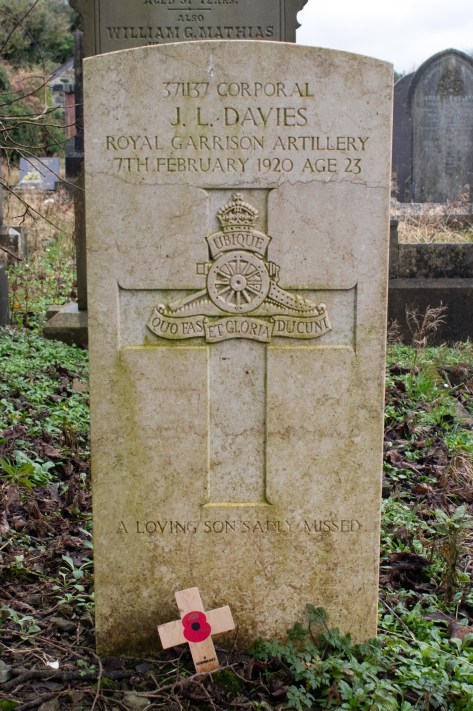
James Lloyd Davies returned home after the war, and passed away on 7th February 1920. He was 23 years of age. He was laid to rest in the Hermon Baptist Burial Ground in Fishguard, Pembrokeshire.


James was only accepted for commemoration as war dead in 2012. It was at this point that the Commonwealth War Graves Commission erected a headstone in his honour.


Sapper Harold Chandler

Sapper Harold Chandler

Harold Frederic Chandler was born on 8th April 1886, and was the only child to Frederic and Rhoda. Frederic was a newspaper publisher, and the family lived in North London. The 1891 census found the Chandlers living at 1 Parolles Road, Islington; ten years later they were at 14 West View on Highgate Hill.

Those census returns included family members as part of the household. By the time of the 1911 census, however, when the were living in a substantial house at 22 Hillside Gardens, Highgate, there were no other family members with them, although they did have a boarder – banker’s clerk Alfred Schleicher – and domestic servant Esther Tebbutt living with them.

By this point, Harold was 24 years of age, and was employed as an architect’s assistant. War was coming, however, and he was called upon to play his part.

Full details of Harold’s service have been lost to time, but it is clear that he enlisted in the Royal Engineers as a Sapper, likely using the skills he had learnt in his civilian life.

The only documentation confirms Harold’s passing. Discharged from the army on 29th October 1919, he died just over a year later. He breathed his last on 17th December 1920, at the age of 34 years old. His death was registered in Edmonton, Essex, so it seems likely that he was there in some sort of convalescent capacity.

The body of Harold Frederic Chandler was taken back to Middlesex for burial, and he was laid to rest in Highgate Cemetery.


Gunner Charles Walters

Gunner Charles Walters

Charles Archibald Walters was born in 1896, and was one of nine children to Arthur and Minnie. Arthur was a painter in the shipyards, and the 1901 census found the family living in a small cottage at 29 Cambrian Terrace in Neyland, Pembrokeshire.

By 1911, Charles had finished his schooling, and had found labouring work on a local farm. He was still living at home, however, and the family has moved to 46 Cambrian Road, overlooking the shipyard where Arthur still worked, and the Westward Pill and Cleddau Ddu rivers beyond.

When war came to Europe, Charles was called upon to play his part. Details of his military service are sketchy, but it is clear that he enlisted in the Royal Garrison Artillery, and was assigned to the Pembrokeshire Territorial Force.

Gunner Walters survived the war, but was suffering from nephritis. He was medically discharged from the army on 12th May 1919, and returned to the family home.

By this point Arthur had moved the family to Goodwick, near Fishguard, by this point, as he had taken up a job in the town as a painter for Great Western Railways.

Charles’ condition would ultimately get the better of him. He passed away on 4th April 1920: he was just 24 years of age.

Charles Archibald Walters was laid to rest in Llanwnda Cemetery, not far from where his family now lived.


The 1921 census found that two of Charles’ brother were also working for Great Western Railways, Frederick as a porter, and William as a boiler sealer in their engineering works (presumably the same place as Arthur).

Minnie died the following year, Arthur passing in 1924. Both were buried with their son, Charles, and they are remembered on his Commonwealth War Grave.


Corporal Gwyn Thomas

Corporal Gwyn Thomas

Gwyn Lewis Thomas was born in Llanrhian, Pembrokeshire, in 1894, and was the youngest of five children to George and Jane Thomas. George was a farmer, and by the time of the 1911 census, his son had been sent to work with another farmer, William Miles, in Mathry, four miles to the east.

When war broke out, Gwyn stepped up to serve his country. He enlisted in the Royal Engineers as a Sapper and, while little information about his service, it is clear that he was sent to France on 23rd August 1915. By the end of the conflict, he had achieved the rank of Corporal, and when the Armistice was declared, he returned home to Wales.

The only other documents connected to Corporal Thomas are those relating to his passing. He died from disease on 2nd March 1920, at the age of 25 years old. His death was registered in Haverfordwest, Pembrokeshire, which would suggest that he either passed there, or that that was the registry office to his home.

Gwyn Lewis Thomas was laid to rest in Mathry Congregational Chapelyard in Rehoboth, midway between his parents’ farm and that of his former employer. His headstone is inscribed with the words Bu farw o effaith y Rhyfel Mawrth (He died from the effects of the Great War).


Driver Thomas Dicker

Driver Thomas Dicker

Thomas Lockyer Dicker was born at the start of 1890 in Tiverton, Devon. One of six children, his parents were Thomas and Mary Dicker. Thomas Sr was a cab driver, and the family lived at 4 Back Lane in the town.

Thomas Jr’s later life is a challenge to pin down. He doesn’t appear on the 1911 census, and his service records have been lost to time. It is clear that he had enlisted before October 1919 – and, in all likelihood, while the war was being fought. Assigned to the Royal Field Artillery, he worked as a driver, and again it is possible that he served overseas at some point.

Thomas Lockyer Dicker died at the Queen Alexandra Hospital in Cosham, Hampshire, on 12th April 1920, although the cause of his passing is unclear. He was 30 years of age. His body was taken back to Devon for burial, and he was laid to rest in Tiverton Cemetery, not far from the family home.


Private John McKinnon, aka James Chalk

Private John McKinnon, aka James Chalk

In Mere Cemetery, Wiltshire, is a headstone dedicated to JE Chalk, who served as Private J McKinnon in the Canadian Army Veterinary Corps. He died on 25th June 1920, and gives his age as 53 years old.

Private McKinnon’s service records suggest, however, that he was born on 14th October 1874 in Inverness, Scotland, and give his army name as John. The Commonwealth War Graves Commission give his other name as James Edward Chalk. James seems to have been keen to disguise his background, and it is only with some digging that the real story comes out.

James was the youngest of five children to Edward and Mary Chalk. Edward was a carpenter from Mere, and this is where the family were born and raised.

When he finished his schooling, James found work as a booking clerk. Edward died in the 1880s, and the 1891 census found James living at home with his mother, who had taken on laundry work to help with their finances.

By 1901, Mary and James were living on Water Street, to the south of the town centre. There’s was now an extended household, and included James’ sister Olive. James is noted as being married, and while no marriage records exist, it would seem that his wife, Mary, and their daughter, Ivy, were also living there.

The next census, taken in 1911, suggests James’ life had taken a different turn. Employed as a railway foreman, he was now living with his older sister, Olive, in her home. He is noted as being married with a child, but neither Mary nor Ivy appear in the same census.

At some point in the next five years, James took the decision to move overseas, and create himself a new identity.

John McKinnon was living in Montreal when the call came to join up. He enlisted on 29th April 1916, by which point he was 41 years of age. Assigned to the Canadian Army Veterinary Corps, his service records confirm that he was 5ft 9ins (1.75m) tall, with greying brown hair, grey eyes and a sallow complexion. He was noted as having scars on both legs, and another on the second toe of his right foot.

Private McKinnon’s unit were quick to be dispatched to Britain, and he arrived in Shornecliffe, Kent, on 29th June. He spent the next five months at the army base, and had two spells of a month each in hospital during that time: the first for asthma, the second for bronchitis.

In November 1916, John moved along the coast to Shoreham, West Sussex. His health was badly impacted, though, the medical report stating that ‘his chest is of the emphysematous type but at present free from bronchitis. He will not do well in England.’ John was formally discharged from the army on 15th November 1916.

At this point, John’s already sparse trail goes cold once more. It is possible that he moved to Wiltshire to be nearer to family, although nothing can be confirmed.

James Edward Chalk, who serves as Private John McKinnon, died on 26th June 1920: His service records suggest that he was 45, but he was, in fact, 53 years of age. He was laid to rest in Mere Cemetery, on the outskirts of the town he had called home for so long.


Private Gilbert Smyth

Private Gilbert Smyth

Gilbert Rowland Locke Smyth was born in the summer of 1897, and was the oldest of three children to Charles and Elizabeth. Charles was a postman and bootmaker and both he and his wife came from North Molton in Devon. The 1901 found the young family taking rooms in Dobbs Cottage on East Street, midway between two pubs: the Poltimore Arms and the Miner’s Arms.

Gilbert – who was better known as Roy – found work as a clerk she he finished his schooling. By the time war broke out, he was had moved to East Sheen, Surrey, and was employed by the civil service. He was keen to play his part, and enlisted in the army on 10th December 1915.

Initially assigned to the Suffolk Regiment, Private Smyth’s service records give an insight into the young man he had become. At eighteen years of age, he was 5ft 8.5ins (1.74m) tall, and weighed 112lbs (50.8kg). While he had worn spectacles for a couple of years, he was noted as being of fair physical development. The document confirms that he had a mole on the top of his right arm.

Roy was not formally mobilised until October 1916. After four months’ training on home soil, his unit, the 14th Battalion, was sent to France. Private Smyth remained overseas for nearly a year, during which time he transferred to the 12th Battalion of the York & Lancashire Regiment.

At the end of July 1918 Roy was caught up in a German gas attack, and this would have a long-term effect on his health, particularly his eyesight. He returned to Britain on 30th November 1918, and, after a couple more months spent in France, he was formally discharged from the army on medical grounds on 5th April 1919.

The deepest sympathy is extended to Mr and Mrs C Smyth in the loss of their eldest son, Roy… Deceased, who was employed in London in the Civil Service, was taken ill with pneumonia, and died before his father could arrive.

[Exeter and Plymouth Gazette: Friday 6th August 1920]

Gilbert Rowland Locke Smyth died on 3rd August 1920: he was 22 years of age. He was brought back to Devon for burial, and was laid to rest in All Saints’ Churchyard in his home village of North Molton.


Private John Lethaby

Private John Lethaby

The news of the death of ex-Gunner JC Lethaby, who passed away early on Monday morning last. was received… with deep regret. On the outbreak of war he was only 16 years old, but when the call came for volunteers, he put his age to 19 and enlisted. He proved his worth on the battlefields of Flanders and after being wounded, was gassed, his work as a first class machine gunner calling him into much danger. He recovered from his injuries to some extent, but after demobilisation, his health broke down and he gradually sank. His pain and suffering during the past months were borne with much patience. Last week he earnestly begged to be removed to his home… and he was brought by motor car.. on Sunday afternoon, but he passed away the next morning. He leaves a wife and child to mourn their loss, and sympathy is expressed with them as also with his mother, father, brothers and sisters… Always of a cheerful disposition deceased had a host of friends, especially among the young men of the parish. He was awarded the Meritorious Service Medal and was entitled to the 1915-1915 Bronze Star.

[Tiverton Gazette (Mid-Devon Gazette): Tuesday 15th June 1920]

Despite the John Charles Lethaby’s obituary, there is little additional information about his early life. He does not appear on the 1901 or 1911 census returns, and there is no obvious sign of a birth or marriage certificate.

The Commonwealth War Graves Commission gives his wife’s name as Clara, and a later military record suggests that she moved to Hitchin, Hertfordshire, after her husband’s death. The 1921 census noted that she was living with her parents, Arthur and Eliza King, and had her daughter, Ada, with her.

The newspaper report suggests that John was born in 1898, which would have made him 22 when he died on 7th June 1920. His headstone gives his age as 25, which would fit in with the obituary commenting that he had added three years to his age in order to enlist. He appears to have joined the 3rd Battalion of the Devonshire Regiment, before transferring across to the Machine Gun Corps.

John Charles Lethaby was discharged from army on medical grounds on 19th April 1919. He died of pulmonary tuberculosis just over a year later, and was laid to rest in All Saints’ Churchyard, North Molton, Devon.


Acting Bombardier Frederick Lavers

Acting Bombardier Frederick Lavers

Frederick William Lavers was born in Paignton, Devon, on 5th November 1889. The middle of five children, and the only son, his parents were John and Jane Lavers. John was a carman, and the family had rooms in a house on Winner Street in the town.

When Frederick finished his schooling, he found work as a butcher’s boy. This wasn’t the career for him, however, and, on 16th January 1905, he signed up to join the Royal Navy. His service records suggest that he had said he was a year older, and confirm that he was 5ft 3ins (1.6m) tall, with light brown hair, blue eyes and a fresh complexion.

As he was under the age to formally enlist with the Royal Navy, Frederick was given the rank of Boy, and dispatched to HMS Vivid, the dockyard in Devonport, for his training. Something was amiss, however, and, after eighteen months, he was discharged as being unsuitable.

Undeterred, Frederick tried another tack and, on 26th April 1909, he enlisted in the Royal Garrison Artillery. By the time of the 1911 census Gunner Lavers was stationed at West Ridge in Rawalpindi, India. There is little information available about his service, however, and Frederick is only picked up again on 30th December 1918.

At this point, the now Acting Bombardier Lavers was put on a hospital train from Marseilles, as he was suffering from psoriasis. He disembarked three days later in Le Havre, and, is appears, then returned to Britain for treatment. On 24th February 1919 he was medically discharged from army service, and awarded the Silver War Badge.

Frederick’s trail goes cold again after this. He appears to have returned home, and passed away on 20th October 1920. He was 28 years of age.

Frederick William Lavers was laid to rest in Paignton Cemetery, overlooking his home town.


Serjeant Samuel Dymond

Serjeant Samuel Dymond

Samuel John Dymond was born in Broadhempston, Devon, in 1878. The son of Samuel and Jane Dymond, his childhood appears to have been disjointed: the 1881 census found him living with his uncle and aunt, while a decade later he was under his grandmother’s roof.

This background may have driven him to a more stable life and, on 22nd May 1896, he enlisted in the army. Joining the Devonshire Regiment, his service records show that he was 5ft 5.5ins (1.66m) tall and weighed 126lbs (57.2kg). He had fair hair, grey eyes, a fresh complexion and two scars on his right kneecap.

Private Dymond spent the first couple of years on home soil. In February 1898, however, he journeyed overseas, serving in the East Indies and South Africa, for which he was awarded the South Africa Medal, with a clasp for the defence of Ladysmith. By January 1902, Samuel was on the move again, and he spent the next two years in India.

At the beginning of 1904, Samuel returned to Britain. He remained on home soil until his contract came to an end on 21st May 1912.

Away from the army life, love beckoned. Samuel married Alice Reynolds on 9th October 1904 in the parish church at Marldon, Devon. The couple went on to have three children: Dorothy, Annie and Albert.

By the time of the 1911 census, Samuel was working as a labourer, and the family were living at Vine Cottage on Church Street, Paignton, Devon.

When war broke out, Samuel was called into service once more but, frustratingly, it is at this point that his trail goes cold. Returning to the Devonshire Regiment, he was certainly in France by 11th December 1914. Later on in the war he transferred across to the regimental depot, but whether this was on home soil of overseas is unclear.

The next record for Samuel is that of his passing. He died in a military hospital in Devonport on 13th January 1920, the British Record of Soldiers’ Effects only at that point confirming that he had reached the rank of Serjeant. He was 42 years of age.

Samuel John Diamond was laid to rest in Paignton Cemetery, overlooking the town that had become his home.