Tag Archives: accident

Private Samuel Smith

Private Samuel Smith

Samuel Herbert Smith was born on 15th March 1886 in Liverpool, Lancashire. He was one of six children to parents Henry – a road labourer for the local council – and Elizabeth.

There is little concrete information about Samuel’s early life. While the 1901 census confirms he was employed as an apprentice, the writing is not legible enough to identify the trade he was in. A later record suggests he spent two years in the Royal Engineers, although, again, no supporting documents evidences this.

Samuel married a woman from South Wales. Her details are lost, but his war pension record gives the name Mrs SH Smith, and gives her address as 34 Albany Street, Newport, Monmouthshire.

It would seem that Samuel was keen to build a bigger and better life for the couple, and left Britain to find work overseas. By 1914 he was living in Valcartier, Quebec, and working as a bartender. War was declared in the summer of that year, however, and he immediately stepped up to serve his country.

Samuel enlisted in the Canadian Expeditionary Force on 23rd September, and was assigned to the 13th Battalion of the Canadian Infantry. His service records suggest he cut a striking figure: he stood 6ft 1in (1.85m) tall and weighed 168lbs (76.2kg). He had light brown hair, hazel eyes and a medium complexion, and his records note that he had a crossed hands tattoo on his right arm.

His unit set sail for England and, by the end of October, Private Smith was installed at Bustard Camp on Salisbury Plain, Wiltshire.

An enquiry was led into the death of Samuel Herbert Smith… Private Smith was travelling… in a motor car, and while the car was passing over uneven ground he fell into the road and was almost instantaneously killed.

George William Hincks, a private in the Canadian Force… was driving from Salisbury… in a motor car, which was meant to carry a machine gun, and was, therefore, open at the sides. Private Smith was seated next to [him] and was inclined to be rather sleepy. He had travelled in the train from Liverpool on the previous day. hey had gone some distance on their journey when deceased said “I want to get out of this.” [Hincks] said “Sit still, Bert. We will be soon be there,” Smith smiled and said “Oh, all right.” Almost immediately the car jolted on a rough piece of road, and Smith pitched on his head in the road. The car was immediately stopped, and [Hincks] went back to him and found him lying with his knees up, on his back, with wounds in his head. He was dead. [Hincks] returned to Salisbury and reported the occurrence to superior officers. The road on which fatality happened was rough and had been badly cut up, more especially at the place where deceased fell from the car.

Salisbury and Winchester Journal: Saturday 31st October 1914

The accident occurred on 29th October, Private Smith was just 28 years of age.

Samuel Herbert Smith’s widow was unable to cover the cost of bringing her husband back to Wales for burial. Instead, he was laid to rest in Amesbury Cemetery, not car from Bustard Camp.

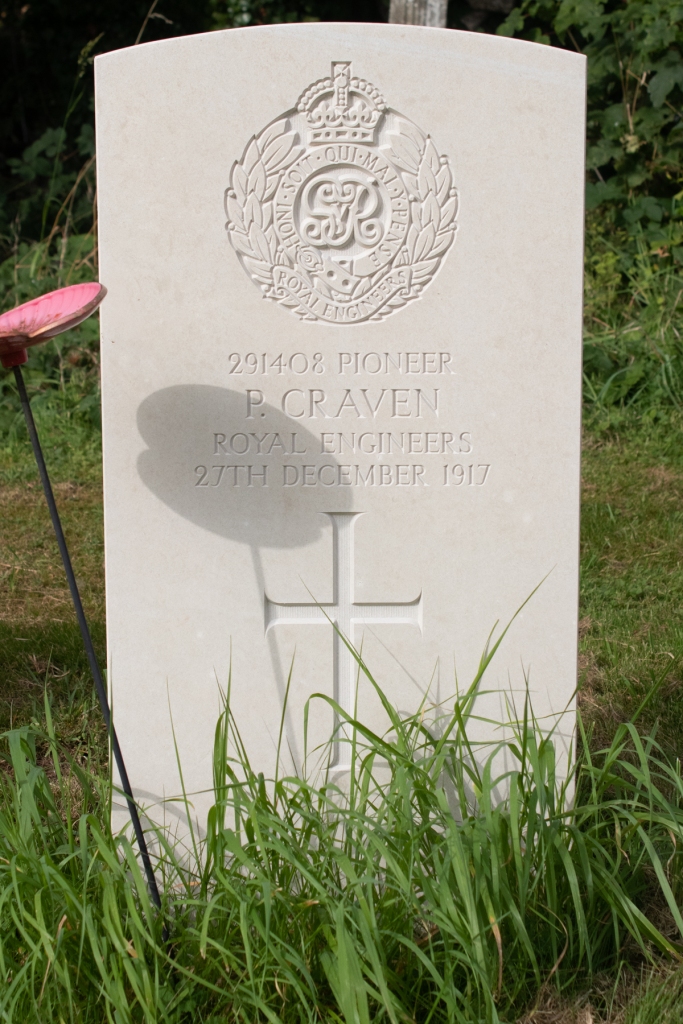
Pioneer Patrick Craven

Pioneer Patrick Craven

Patrick Craven was born in the summer of 1898 in Drogheda, County Louth. The oldest of three children, his parents were Francis (or Frank) and Mary Craven. Mary died in 1909, and the following year Patrick’s father remarried, to widow Kate Devin. The 1911 census found the extended family living in a cottage on North Road, Frank, Kate and their seven children.

Frank was a farm labourer, and this is work that Patrick also went into when he finished his schooling. War came to Europe in 1914, and he was to be called upon to play his part.

Patrick enlisted in the Royal Engineers on 6th June 1917. His service records confirm that he was 5ft 6ins (1.68m) tall, and weighed 127lbs (57.6kg). Pioneer Craven was assigned to the Inland Waterways Transport Division, and sent to Henbury, on the outskirts of Bristol, Gloucestershire, for training.

There was one blip on Patrick’s otherwise spotless service when, on 1st October 1917, he was confined to barracks for two days for ‘conduct to the prejudice of good order and military discipline, leaving the ranks without permission‘. Shortly after this, Pioneer Craven was assigned to a unit in Portbury, Somerset.

The wet summer of 1917 had given way to a cold, harsh winter, and the conditions were to lead to Pioneer Craven’s tragic demise on 27th December. The detailed report from the Medical Officer explained what had happened:

This man was found dead… in a small harness room at the Lodway Brewery, Pill, a room occupied by the IW&D, Portbury. I was called in to see him and pronounced him dead, the body was quite stiff and cold and death had probably taken place several hours before. When first discovered the body was fully pronated, with the mouth flattened against the floor, the hands were gripping the Army greatcoat which he had pulled over himself.

The harness room was heated by a coke stove the flue of which passed through the room to the ceiling and was cracked, allowing the fumes of the burning coke to emanate into the room. There was no ventilation except through a door communicating with the stables, which was found shut at the time the cadavre [sic] was found. The stove was situate[d] between the position where the body lay and the door, in a cul-de-sac.

One other man slept in the same room the same night, the deceased man having evidently entered the place after the former had fallen asleep. The second man was not affected by the fumes to any degree, but was lying between the stove and the door under which there was a certain amount of draught.

Sheltering himself from the cold winter night, Private Craven had passed away in his sleep from carbon monoxide poisoning. He was just 19 years of age.

Patrick Craven’s family were unable to afford to bring him back to Ireland for burial. Instead, he was laid to rest in the peaceful graveyard of St George’s Church in Easton-in-Gordano, not far from the brewery stables where he had passed.


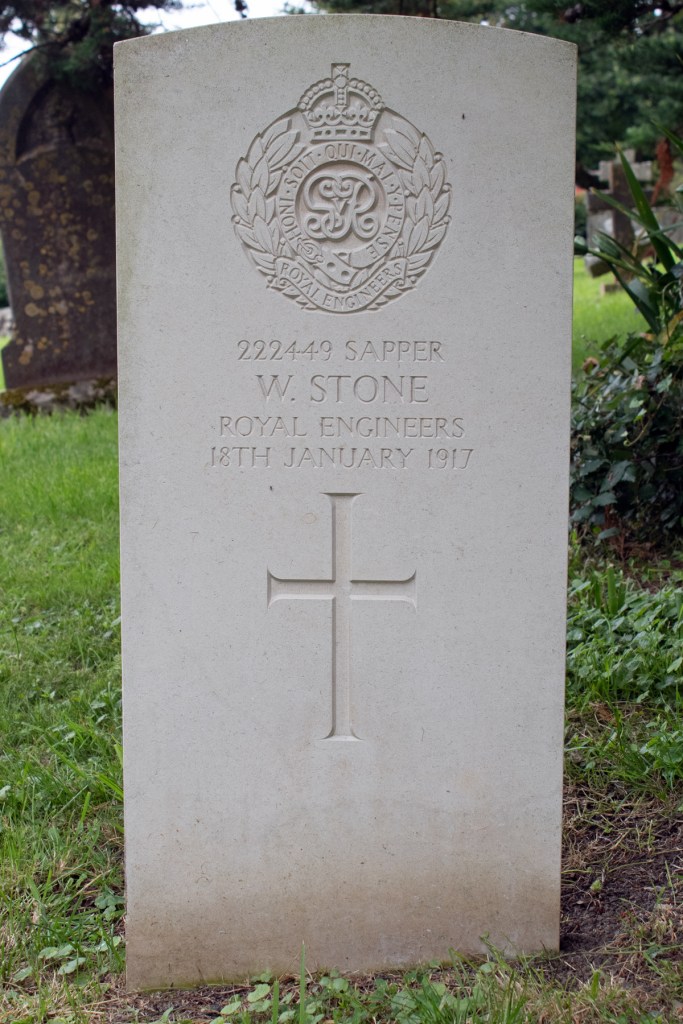
Sapper Walter Stone

Sapper Walter Stone

Walter Stone was born at the start of 1880 in Lympsham, Somerset. The middle of three children, his parents were coal merchant George Stone and his wife, Ellen.

When he finished his schooling, Walter found work as a painter and plumber. In January 1902 he married Alice Charman. Eighteen years older than Walter, she was the widow of a milkman from Bristol, and had raised her son, Edgar, since her husband had passed away a few months before. The couple settled in the village of Brent Knoll, and went on to have three children of their own: Albert, Florence and Alice.

When war came to Europe, Walter was called upon to play his part. He enlisted after June 1916, and joined the Royal Engineers as a Sapper. He was attached to the Inland Waterways and Docks division, but, as no documentation remains to confirm his service, it is not possible to confirm whether he saw any action overseas

Sapper Stone’s time in the army was not to be a long one. The next record for him is that of his admission to a military hospital in Herne Bay, Kent. He was suffering from pneumonia, and this would take his life on 18th January 1917. He was 36 years of age.

Walter Stone’s body was brought back to Somerset for burial. He was laid to rest in the tranquil graveyard of St Michael’s Church in Brent Knoll.


Further tragedy was to strike Walter’s widow, Alice. Edgar, her son from her first marriage, enlisted in the Somerset Light Infantry when war broke out. Attached to the 7th (Service) Battalion, he found himself on the Front Line by the end of July 1915.

Private Stone is reported to have been accidentally killed on 1st May 1917. No other detail is given, but he was just 24 years of age when he passed. He was buried at the Thiepval Memorial at the Somme.

Alice had lost her husband and her oldest child within a matter of months.


Cadet Richard Whitting

Cadet Richard Whitting

Richard Harcourt Whitting was born on 21st March 1900 in the Somerset village of Uphill. The younger of two children, his parents were local landowner and Justice of the Peace Charles Whitting and his second wife, Jessie. The 1911 census records father, mother and two children residing at Uphill Grange, where they were supported by six live-in staff: a cook, parlour maid, two house maids, a kitchen maid and a nurse.

As the son of a gentleman, education was an expected prospect for young Richard. Indeed, after finishing his schooling locally, he was sent to the Royal Military College in Sandhurst.

He entered the school in 1913 and left in April 1918. He was then Head of the Modern Side, and also a good runner who achieved a fine record when he won the Junior Athletic Cup and, still more, as mentioned in a notice of him in the Meteor of October 16th, 1918… “he had very delightful manners, and a sympathetic appreciation of the difficulties of other people, which is less rare in women than in men. These qualities, combined with a great fund of common sense, made him a particularly helpful and agreeable companion in all kinds of occupations, from spraying a potato field to managing a House.

He was intended for the University and the Bar, but the War caused him to leave School early and to go to the [Royal Military College], Sandhurst. There he showed himself a most promising Cadet, and continued his athletic successes by winning the Mile and being in the winning team in the Relay Race.

Memorials of the Rugbeans Who Fell in The Great War, Volume VIII

It was while he was at the college, that Richard met his untimely end.

On Saturday [21st September 1918] a cadet of the Royal Military College, named Richard H Whitting, was killed while cycling along the Bagshot main road near St Alban’s Church. Deceased, who was accompanied by two other cadets’ names respectively Money and Shute, was holding on to the rear of a motor vehicle, when his bike swerved, and he was thrown on his head. At the inquest a verdict of “Accidental death” was returned.

Reading Mercury: Saturday 28th September 1918

Cadet Whitting was just 18 years of age when he died. His body was brought back to Somerset for burial: he was laid to rest in the family plot at St Nicholas’ Church in Uphill.


Cadet Richard Whitting
(from fold3.com)

Stoker 2nd Class Harry Gadd

Stoker 2nd Class Harry Gadd

Harry Payton Gadd was born on 3rd November 1899, one of ten children to Elijah and Ada Gadd. Elijah was a stone mason from the Somerset village of Dundry, and this is where the family were born and raised.

Harry found work as a farm hand when he finished his schooling but he seems to have been eager to play his part for King and Country. As soon as he turned 18, he enlisted in the Royal Navy. His service records show that he joined up as a Stoker 2nd Class on 6th November 1917. He was 5ft 3.5ins (1.61m) tall, with brown hair, grey eyes and a fresh complexion.

Stoker Gadd was initially sent to HMS Vivid, the Royal Naval Dockyard in Devonport, for training. On 28th January 1918, he was assigned his first ocean-going post, on board the frigate HMS Leander. He spent a couple of months on board, before transferring to the store ship HMS Tyne, then moving to HMT Wallington (also branded as HMS Sylvia), a requisitioned trawler, on 15th April 1918.

Stoker Gadd was on board Wallington for six weeks, when he was killed in an accident. No other information is available, and his service records state that “the death of this man… was caused… from an accident on board. No blame attributable to anyone.”

A contemporary newspaper echoes this, but gives no further information: “News has been received that Stoker Harry (Joe) Gadd, the 18-year-old son of Mr and Mrs E Gadd, of Dundry, has been killed by accident on one of his Majesty’s ships.” [Bristol Times and Mirror: Saturday 6th July 1918]

The body of Harry Payton Gadd was brought back to Dundry for burial. He was laid to rest in the graveyard of St Michael’s Church.


Lieutenant Harold Redler

Lieutenant Harold Redler

News has been received at Bathpool, Taunton, that Lieutenant HB Redler, MC (RAF), was killed while flying at Turnberry, near Ayr. Lieutenant Redler, who was 21 years of age, was the eldest son of Mr and Mrs DB Redler, of Moorreesbury [sic], South Africa, and formerly of Bathpool, Taunton, and he sailed from South Africa with a schoolfellow at the end of 1915, at the age of 18, in order to join the Royal Flying Corps. On arrival in England they found no vacancies, and entered the Artists’ Rifles OTC, from which they joined the RFC. After obtaining his commission, Lieut. Redler spent a few months in France last year, and was then sent to Ayr as a fighting instructor. In March of this year he was sent to France for a six weeks’ course, during which he won the Military Cross, and it is believed that his record will show a total of nearly twenty enemy machines brought down.

Taunton Courier and Western Advertiser: Wednesday 3rd July 1918

Harold Bolton Redler was born in Worcester, Worcestershire, on 27th January 1897. The oldest of five children, his parents were Daniel and Annie. Daniel was a flour miller from Devon, and the family had moved to Worcester the year before Harold was born.

In 1903, the Redlers emigrated to South Africa. Initially settling in King William’s Town (now Qonce), they moved to Moorreesburg after the birth of Harold’s youngest sibling, Norman, in 1906.

Harold was educated at the Bishops Diocesan College in Rondebosch, Cape Town, and it was from here that he and his friend decided to step up and serve their King and Empire. Sadly, his service records have been consigned to history, and only the newspaper report remains to piece together his time in service.

Lieutenant Redler’s awarding of the Military Cross, however, is documented:

For conspicuous gallantry and devotion to duty. He encountered four enemy two-seater machines and attacking the lowest drove it to the ground with its engine damaged. Later he attacked one of five enemy two-seater machines and drove it down out of control. He has destroyed in all three enemy machines and driven three others down out of control. He continually attacked enemy troops and transport from a low altitude during operations and showed splendid qualities of courage and determination throughout.

London Gazette: 22nd June 1918

On the morning of 21st June 1918, Lieutenant Redler was flying a de Havilland DH9 aircraft, accompanied by Captain Ian Henderson. The plane was fitted with a Lewis gun, which the pair were testing. At 10am, the aircraft crashed, and both were killed. No immediate cause was identified, and their RAF cards record an open verdict. Harold was just 21 years of age.

With his parents and siblings in South Africa, Harold Bolton Redler’s body was taken to Somerset for burial. He was laid to rest with his paternal grandparents in the peaceful St Augustine’s Churchyard in West Monkton.


Lieutenant Harold Redler

Private Francis Hill

Private Francis Hill

Francis Robert Hill was born in the spring of 1868, the middle of seven children to William and Mary Hill. William was a shoemaker from Wiveliscombe, Somerset, and this is where he and Mary raised their family.

When Francis finished his schooling, he found work as a baker. However, he wanted bigger and better things and, in June 1886, he enlisted in the 1st Battalion of the Oxfordshire Light Infantry. Private Hill would have cut a striking figure: at eighteen years old, he was 5ft 10ins (1.78m) tall and weighed 136lbs (62.6kg). He had light brown hair, grey eyes and a fair complexion.

Francis did not spend any time overseas, instead working in the regiment’s depot in Alverstoke, near Gosport, Hampshire. He spent seven years in the military, and was stood down on 16th June 1893.

By the end of 1895, Francis was back in Somerset as, on Boxing Day that year, he married Florence Ida Giles, a shoemaker’s daughter. The couple were both living in Milverton at the time, and Francis’ profession was noted as storekeeper. On 23rd November 1896, the couple had a son, Harold, and the family were living on Fore Street, the village’s main road.

The 1901 census shows another change in work for Francis, who was now noted as being a house painter. This was a career that seemed to stick with him, as he was still employed in the role by the time of the next census, in 1911. The Hills had moved to Staplegrove, on the outskirts of Taunton, by this point. Florence had taken in work as a glove maker, Harold, now 14 years old, was employed as an office boy, and the family had a boarder, Reginald Cave, who was a nursery foreman.

At this point Francis’ trail goes tantalisingly cold. When war broke out, he enlisted once more, this time joining the Somerset Light Infantry. The only other confirmed document gives a tragic hint as to his death, at the age of 48. His entry in the Pension Ledger reads simply “18.2.16: Accidentally killed by passing train while on military duty.” There are no other records to back this up, and no contemporary newspapers report on his passing.

However it happened, Francis Robert Hill’s body was brought back to Somerset for burial. He was laid to rest in the graveyard of St John’s Church, Staplegrove. His grave is lost to time, but he is commemorated on a special memorial, close to the entrance of the church.


Tragedy was to strike a second time for Francis’ widow, Florence, when, in October 1916, Harold was also to pass away. Read his story here.


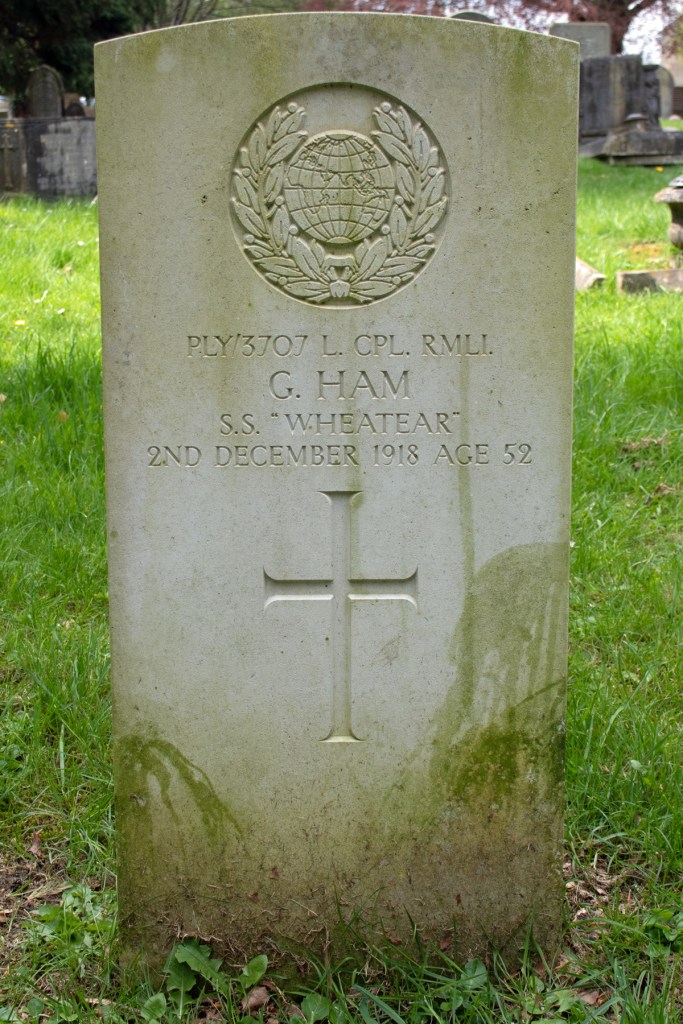
Lance Corporal George Ham

Lance Corporal George Ham

George Ham was born on 19th December 1867 in Twerton, Somerset. His parents were George and Emily Ham, and he was the oldest of their nine children. George Sr was a mason, and initially his first born followed suit, but he was pulled towards something bigger and better and, on 19th January 1886, he enlisted in the Royal Marine Light Infantry.

George’s service records note that he was 5ft 6ins (1.68m) tall, with brown hair, grey eyes and a fresh complexion. He was initially sent to the barracks at Walmer in Kent, and it was from here that Private Ham began a 21 year career in the Royal Marines. Over that time, he served on seven separate ships, and, between voyages, he was based in barracks in Plymouth, Devon. Both his character and ability were consistently noted as being very good.

Private Ham’s career took him around the world and, in 1887, he found himself on the gunboat HMS Banterer, on which he served for three years. His tour of duty included a period of time in Galway, Ireland, and it was here that he met Mary Ann Goode. On 5th July 1889, the couple married in city’s St Nicholas’ Church. The church’s records suggest that the couple went on to have four children – Frederick George; Emily, who died just after her first birthday; Albert; and Katherine.

George’s records from this point become a little disjointed. In October 1890, he returned to his Plymouth base, and the following year’s census recorded him as living in the East Stonehouse Barracks, although his marital status was noted as single.

The next census, in 1901, presents a different picture. George and Mary were, by this time, living in family barracks in East Stonehouse, with two children, (Frederick) George and Albert. Katherine, the couple’s youngest child, was born the following year.

In January 1907, after more than two decades’ service, George was stood down from active service in the Royal Marines. He was placed on reserve status, and took up work as a mason once more. At this point, however, the family seemed to have hit more troubled times, underlined by four separate 1911 census documents.

George, who was 44 by this point, was recorded as being an inmate in the Bath Union Workhouse and Infirmary in Lyncombe, Somerset. Mary and Katherine, meanwhile, were in two rooms in a house in Stonehouse, Devon. Frederick, who was now better known as George, had followed his father into military service, and was a Private in the Royal Marine Light Infantry, serving on HMS Colossus. Albert, who was 13 years old, was one of 946 students boarding at the Royal Hospital School for Sons of Seamen in Greenwich, London.

George spent nine years in the reserves, and, in 1914, was called up again for war service, this time as a Lance Corporal. According to a contemporary newspaper:

[He was] engaged on naval patrol work against submarines off the Canadian coast and elsewhere, and was in charge of a gun on an armed merchant ship. Once the boat he was on was torpedoed, and on another occasion he had a long running fight with a submarine in the Irish Channel. The ship, however, reached Portrush (Ireland), and the inhabitants gave Lance-Corporal Ham a testimonial, and he was also rewarded in other ways, the Cardiff owners of the vessel recognising his skill and gallantry.

Bath Chronicle and Weekly Gazette: Saturday 7th December 1918

Tragedy was to strike in the end, however, and George was to meet a sad end to a distinguished career.

While at Cork [George] fell, either from a boat or the dock, and sustained an injury to the side of his head. It did not appear very serious, and it is understood that he made a trip to Cardiff and back to Londonderry, [where] he became so seriously ill as to necessitate his going to a military hospital in Londonderry. Hemorrhage [sic] of the brain set in, and he died on Monday [2nd December 1918] before his brother, Mr Albert Ham, who had been telegraphed for, could reach him.

Bath Chronicle and Weekly Gazette: Saturday 7th December 1918

Lance Corporal George Ham was days short of his 51st birthday when he died. His body was brought back to Somerset for burial, and he was laid to rest in Twerton Cemetery. The newspaper report give no indication as to whether Mary or their children were in attendance and, in fact, does not mention his wife and family at all.


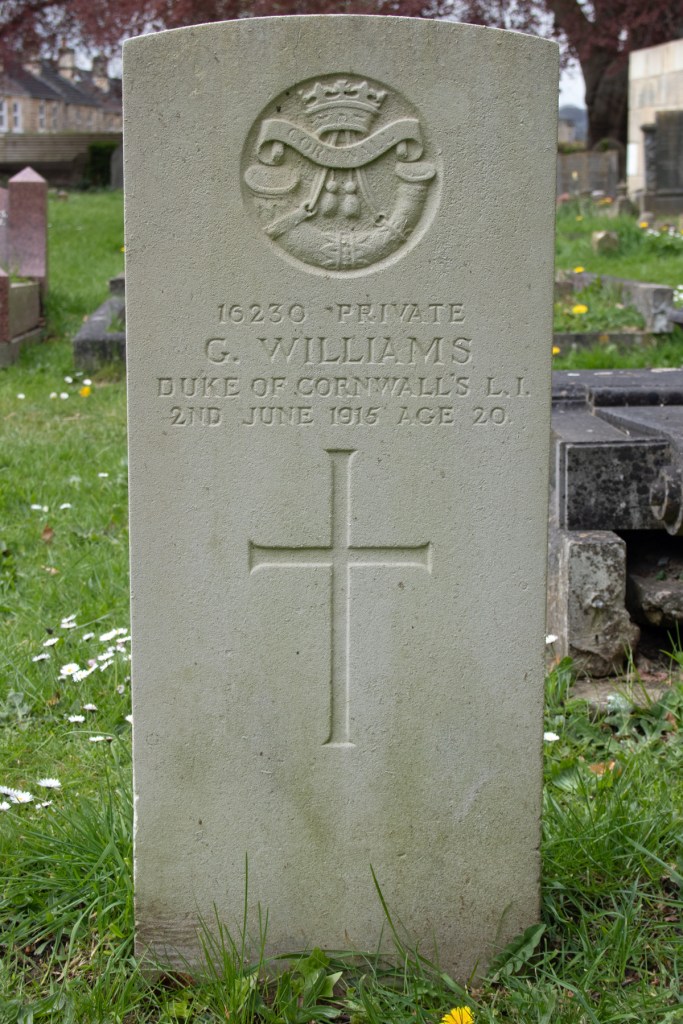
Private George Williams

Private George Williams

George Williams was born in West Bromwich, Staffordshire, in 1895. One of ten children, his parents were George and Sarah. When George Sr died in 1908, his widow was left to raise the family herself. By the time of the 1911 census, all of the children were still living at home, and four of them, including George Jr, who was working as a labourer, were bringing in a wage.

When conflict broke out, George stepped up to play his part. He enlisted in the Duke of Cornwall’s Light Infantry before the end of 1914 and, as a Private, was assigned to the 8th Battalion.

Little information is available about George’s military life and, indeed, the only other details available for him are that of his passing, based on reports available in a contemporary newspaper.

About half-past eight on Thursday [3rd June 1915] the body of a soldier was found in the river at Bath… The corpse was in a somewhat advanced state of decomposition, its condition suggesting it may have been in the river about three weeks. The man had on his full regimentals, with top coat.

Papers found in the pocket indicate that the deceased is Private George Williams, of the 8th Battalion Duke of Cornwall’s Light Infantry, now encamped at Sutton Veny, Wilts. This regiment was quartered in Bath during the winter, and left the city some weeks ago.

There are.. no marks of violence on the body.

There was found on the body a pass dated 14th May, giving him three days’ leave. The leave expired at 11:55pm on May 17th. The permit allowed him to proceed to Birmingham. There was also found on the deceased a telegram addressed to 22 Green Street, West Bromwich, which said “Leave extended.”

The supposition is that Williams returned as far as Bath, on his way back to camp, by Midland Railway, and when in the city by some means or other fell into the river.

Curiously enough, the Bath police had been advised of the absence without leave from camp at Sutton Veny of a soldier of the same name. But in this case the man belonged to the 10th Devons. They had received no notification regarding Private Williams of the 8th Cornwalls.

Bath Chronicle and Weekly Gazette: Saturday 5th June 1915

The telegram mentioned in the report is likely one sent to George’s family, who was living at 22 Queen Street (possibly an error on the newspaper’s part).

George was just 20 years old when he died: the army report gave the date of his death as 2nd June 1915, although it seems likely that he had passed some weeks before.

Sarah and the family were possibly unable to afford to have George’s body taken back to Staffordshire for burial. Instead, he was laid to rest in the Twerton Cemetery in Bath, with Sarah and two of his brothers, Leonard and William, in attendance. Another member of his battalion, “deceased’s chum” [Bath Chronicle and Weekly Gazette: Saturday 5th June 1915] Private Fred Cotton, was also at the funeral, and sent his own wreath – from “his old pal Fred” [Bath Chronicle and Weekly Gazette: Saturday 5th June 1915].


Driver William Stitch

Driver William Stitch

William Ephraim Stitch was born in Biddisham, Somerset, on 6th August 1879. The oldest of seven children, his parents were James and Mary Stitch. James was a farmer, and this was a trade into which William followed.

The 1901 census found William boarding with a farmer in nearby Badgworth. His employer was George Burrow, who had a live-in housekeeper, Ellen Norris. Ten years later, William was boarding with another family in the village – Benjamin and Bertha Wall and their two children – and, at 32 years old, he was still employed as a farm labourer.

When war came to Europe, William stepped up to play his part for King and Country. He enlisted in the Royal Army Service Corps on 3rd December 1915, and was assigned to the 530th Horse Transport Company. His service records note that he was 5ft 4ins (1.63m) tall and weighed 126lbs (57.2kg).

Driver Stitch was based in Northumberland, and remained on home soil throughout his time in the army. He returned to Somerset a couple of times, most noticeably in September 1917, when he married Bertha Wall, who he had been boarding with according to the 1911 census. There is no evidence of the passing of Bertha’s husband, Benjamin, but William’s service records note that he classed Bertha’s two children as his own.

Driver Stitch went back to Somerset on leave over Christmas 1917, arriving back in Blyth, Northumberland, on 28th December. He was billeted at Link View Villa in the town, and looked after the horses stabled there.

William was last seen in the Orderly Room that evening, by a Corporal John Kearton, his senior officer who was based in the same digs. He disappeared, and, despite a lengthy search, it was only on 1st February 1918 that his body was found in the brickyard pond, close to where the horses were stabled.

At the subsequent inquest, the doctor who carried out the postmortem confirmed that there was no sign of violence. Corporal Kearton suggested that, as William was getting water from the pond, he might have slipped into the water accidentally. With no evidence of any deliberate intention to end his life, the jury returned a verdict of drowning, but that there was no evidence to show how Driver Stitch had gotten into the water. William was recorded as having died on 28th December 1918, at the age of 39 years of age.

The body of William Ephraim Stitch was brought back to Somerset for burial. He was laid to rest in the quiet graveyard of St Congar’s Church in Badgworth.