Tag Archives: accident

Private Frederick Bundy

Private Frederick Bundy

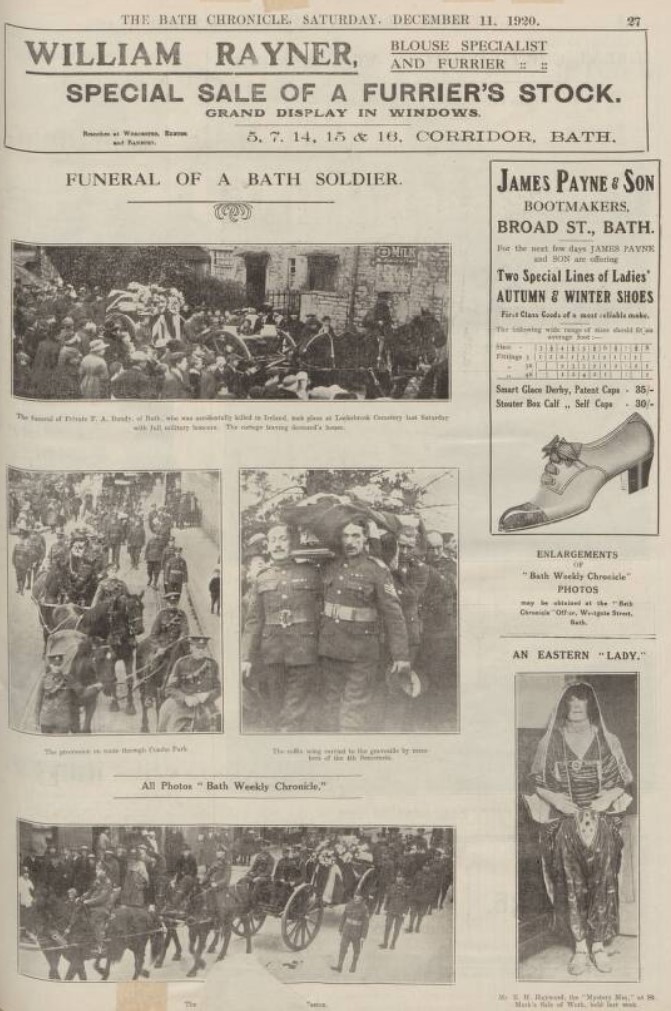
Private Frederick Arthur Bundy, of the 1st Somerset Light Infantry is to be buried in Locksbrook Cemetery tomorrow (Saturday) afternoon with full military honours. He met with a fatal accident in Belfast on Sunday last. In the afternoon when in quarters he was passing from one room to another when a rifle which was bring cleaned by a comrade in the room which he was entering went off. The bullet passed through Private Bundy’s wrist and entered the stomach. He was at once removed to the military hospital, but passed away at midnight, from internal haemorrhage. Deceased, was the son of Mr FA Bundy, of 93 High Street, Upper Weston, and enlisted at the Drill Hall, Bath, in August 1919, when only 15 years of age, being accepted as he was a youth of exceptionally fine stature. At the time of his death he was 16 years and 10 months of age. After a short period of training at Taunton he went with a draft of Somersets to Ireland and was stationed for some time at Carrickfergus Castle, being moved into Belfast when the riots occurred there.

[Bath Chronicle and Weekly Gazette: Saturday 4th December 1920]

Frederick Arthur Bundy was born early in 1904, and was the middle of three children to Frederick and Mary Ann Bundy. Frederick Sr was a labourer from Bath, Somerset, and it was in the Weston area of the city that the family were born and raised.

The 1911 census – the only one Frederick Jr would be recorded on – noted the family as living at 45 High Street, Weston. The household consisted of Frederick Sr, Mary Ann, Frederick Jr, his older sister Sarah, younger brother William and Mary Ann’s daughter from a previous marriage, Annie.

Sadly, due to his young age, there is little additional documentation to build a picture of Frederick Jr’s life. He passed away on 28th November 1920, and was laid to rest in Bath’s Locksbrook Cemetery, not far from the family home.

Frederick Arthur Bundy’s funeral was shown in a photo-spread in the Bath Chronicle of 11th December 1920.


Editor’s Note: While Frederick enlisted nine months after the end of the First World War, his acceptance for a Commonwealth War Grave is because his passing being between the qualifying dates and the cause being as a result of his military service.


Petty Officer Ellis Sayer

Petty Officer Ellis Sayer

Much of the life of Ellis Edward Sayer seems destined to remained shrouded in the mists of time. Born in Attleborough, Norfolk on 31st January 1888, the only census return he appears on dates from 1891. This records him as living with his grandmother, Maria Simons, who was noted as being married and working as a laundress. Ellis’ 16-year-old uncle, William, was also living there and employed as a groom.

Jumping forward a few years and, on 31st December 1907, Ellis enlisted in the Royal Navy. His service records note that he had previously been employed as a messenger, and there seems to have been some previous marine connection. The document shows that he was 5ft 8ins (1.72m), with dark brown hair, blue eyes and a fresh complexion. He was also noted as having tattoos of a dragon, a rose and the word ‘unity’ on his left forearm.

As an Ordinary Seaman, Ellis was initially sent to HMS Pembroke, the Royal Naval Dockyard in Chatham, Kent, for his training. He was only there for a matter of weeks before being assigned to the HMS Cochrane then HMS Natal.

On 7th April 1908, Ordinary Seaman Sayer was attached to the cruiser HMS Lancaster, and he was to remain with her for close to two years. Promoted to Able Seaman on 26th November 1909, his time on board came to a close in May 1910.

Over the next few years, Ellis continued his progress in his naval career. After a year on shore in Chatham, he was assigned to HMS Blonde, and was promoted to Leading Seaman in August 1912. He returned to HMS Pembroke the next month, and remained attached to the dockyard for the next year and a half: his experience likely being used to support newer recruits.

On 6th March 1914, Leading Seaman Sayer was assigned to the battleship HMS Commonwealth. Over the next three years she patrolled the North Sea, from the Norwegian coast and Shetland in the north to Dogger Bank in the south. On 1st August 1915, Ellis receive a further promotion, holding the rank of Petty Officer for the remainder of his time on board Commonwealth.

On 18th February 1917, Ellis’ life came to an abrupt end. There is little information available about his passing, one record stating that he died from an injury to his kidney which was as a result of an accident, while another states ‘rupture of kidney caused through [a] fall’. HMS Commonwealth seems to have been moored in Chatham, however, as he passed away in the town’s Royal Naval Hospital. He was 29 years of age.

Petty Officer Sayer’s next-of-kins were noted as his sister, Mrs J Andrews, who lived in Norwich, and a friend, Mrs Ethel Hampton, who lived in Gillingham, Kent.

Ellis Edward Sayer’s body was laid to rest in the Woodlands Cemetery, Gillingham, not far from the dockyard he had called home for so long.


Private John Merritt

Private John Merritt

John Merritt was born on 17th August 1880 in Shoreditch, London, and was the youngest of three children to James and Emily Merritt. James was a dock labourer, who passed away when his son was just four years old. Emily remarried the following year, having a child with her new husband, George Wise, in 1888.

When he completed his schooling, John found work as a stoker. However, he sought bigger and better things and, on 21st February 1898, he enlisted in the Royal Marine Light Infantry. Not yet eighteen years old, his service records show that he was 5ft 5.5ins (1.64m) tall, with grey eyes, brown hair and a fresh complexion. His service records also record a couple of tattoos: an anchor on his left forearm, and a crossed heart on his right.

Over the next two decades, Private Merritt sailed and saw the world. Primarily based out of the Royal Naval Dockyard in Chatham, Kent, he served on ten ships in all. His superiors obviously thought highly of him, as his records note his character and ability as very good throughout his service.

On 3rd July 1909, John married Harriett Wise. She was a lighterman’s daughter from East London, who was working as a cork cutter when the couple exchanged their vows. They went on to have two children: Florence, who was born in 1910, and Reginald, who came along six years later.

By the time war was declared in the summer of 1914, John seems to have been mainly shore-based, his time being split between Chatham and Portsmouth, Hampshire.

On 7th March 1917, Private Merritt was on board the gunboat HMS Spey, which was carrying out diving operations in the Thames Estuary. At 4 o’clock in the afternoon, in “bitterly cold and boisterous conditions” [Whitstable Times and Herne Bay Herald: Saturday 24th March 1917], the ship lost an anchor, and the decision was made to return to base at Sheerness, Kent. Another vessel, the HMS Belvedere, was close by and turned towards the Spey, and, despite trying to avoid a collision, the smaller ship was struck a glancing blow.

The Spey was 40 years old, and the impact sheered numerous rivets from the side. Water gushed in, and the gunboat sunk beneath the Thames within a matter of minutes. Some of the crew had managed to escape on a life raft, but it was not fitted with lights or flags. The boat drifted and was not found until five hours later, partially submerged: all on board had died.

In total, twenty of the thirty-seven crew perished on that March afternoon, including Private Merritt. He was 36 years of age.

It would seem that Harriett was unable to cover the cost of bringing her late husband’s body back to London for burial. Instead, John Merritt was laid to rest in Woodlands Cemetery in Gillingham, Kent, not far from the naval base in Chatham which he had called home for so long.


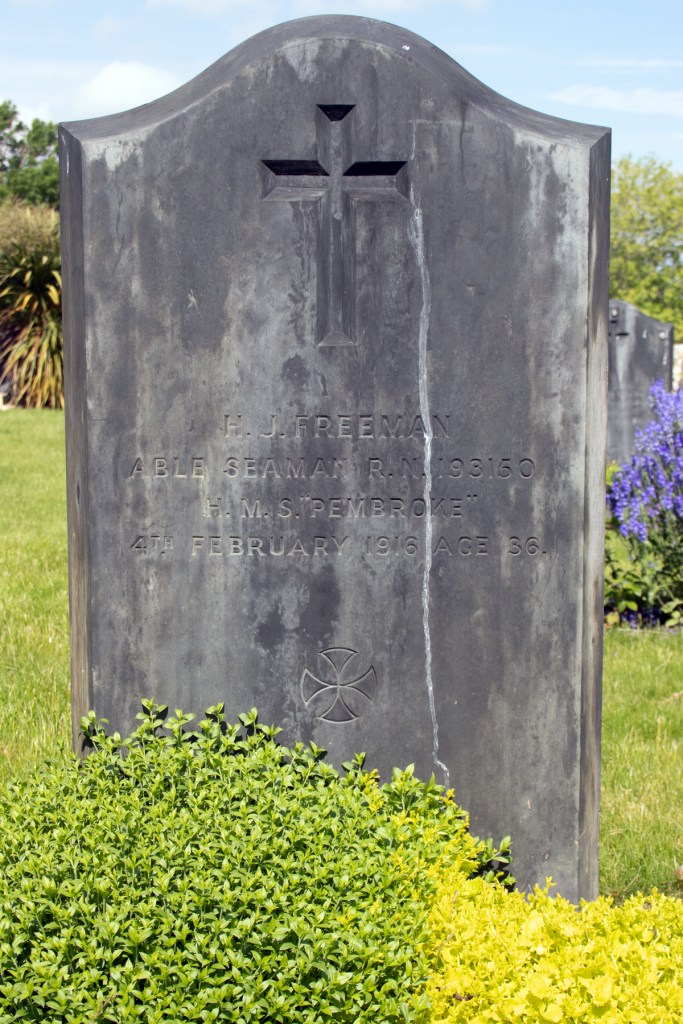
Able Seaman Horace Freeman

Able Seaman Horace Freeman

Horace James Freeman was born in Hackney, East London, on 16th September 1879. The second of five children, his parents were Archibald and Mary Freeman. According to the 1891 census, Archibald was employed as a carman, but the next document had him listed simply as a ‘traveller’.

When he completed his schooling, Horace found work as a baker’s assistant. He sought bigger and better things, however, and, on 13th February 1897, he enlisted in the Royal Navy. His service records show that he was 5ft 5.5ins (1.66m) tall, with brown hair, hazel eyes and a fresh complexion.

A few months under full age, Horace was initially given the rank of Boy 2nd Class. He was sent to the training ship HMS Northampton, and seemingly impressed his superiors, rising to Boy 1st Class within a couple of months. He moved to another training vessel, HMS Calliope, in July 1897, and was serving on board when he came of age that September.

Now formally inducted into the Royal Navy, Ordinary Seaman Freeman began what was to be an eighteen year career at sea. He would become based at HMS Pembroke, the Royal Naval Dockyard in Chatham, Kent, and went on to serve aboard nine ships during his time.

Promoted to the rank of Able Seaman in October 1899, Horace’s time in the navy was not to be without incident. He spent eight separate periods of time in the cells, 158 days in total. Full details of his misdemeanours are lost to time, but at least on at least one occasion he was placed in the brig for refusing orders.

On Christmas Day 1911, Horace married Sarah Byatt. She was a bricklayer’s daughter from Tottenham, and the couple went on to have two children: Clifford, born in 1913, and Leslie, born two years later.

While Sarah was looking after their young family, Horace spent a lot of his time at sea. As time moved on, however, he was based at HMS Pembroke for longer spells, and it was while he was in Chatham early in 1916 that fate befell him.

The body of Horace J Freeman, an able seaman of the RFR, who had been missing from his ship since February 25th, was found floating in South Lock at Chatham Dockyard on Saturday.

[South Eastern Gazette: Tuesday 11th April 1916]

Little additional information is available about Horace’s death, and it is unclear how he had fallen into the lock. He was 36 years of age.

The body of Able Seaman Horace James Freeman was laid to rest in Gillingham’s Woodlands Cemetery, not far from the naval base he had called home for so long.


Captain Lewis White

Captain Lewis White

Lewis Scott White was born at the start of 1896 in Bath, Somerset. The youngest of four children, his parents were surgeon Edward White and his wife, Fanny. The 1911 census recorded the family living in a substantial property in Green Park: the now medical practitioner Edward, Fanny and Lewis sharing the 12-room house with a servant, Ellen Fry.

As befitting of his station in life, Lewis’ education was a well rounded one: “[he] was educated at Bath College and Kelly College, Tavistock, and was coached for his matriculation examination by Mr Samuel Edwards, of Grosvenor College. He exhibited a fondness for aeronautics when quite a lad. While at Victoria College he evinced much enthusiasm for the art of flying, and made models of flying machines. One of these miniature planes he flew successfully on Lansdown, and we believe showed at an exhibition in London. He was one of the leading spirits in the Bath Aerial Club, which used to meet at the Church Institute.” [Bath Chronicle and Weekly Gazette – Saturday 06 October 1917]

Lewis’s mechanical mind was put to good use in his working life as well. He found employment as a motor fitter, and this is what he was doing when war broke out in the summer of 1914. He felt duty bound to service his King and his Country, and, on 20th October, he enlisted in the Royal Flying Corps as an Air Mechanic. His service records confirm the man he had become: at 18 years of age, he was 5ft 4ins (1.63m) tall and weighed 117lbs (53kg). He had dark brown hair, brown eyes and a fresh complexion.

His skill and daring earned promotion, and he was given a commission… He accomplished many fine feats in actual aerial warfare on the Western Front, and for one of these some months ago he was awarded the Military Cross. He was acting as an observer when the flight occurred; the pilot in the same machine was given the DSO.

While wearing only one wing he came home to England to train as a pilot. He rapidly passed all the tests for this, and obtained the two wings, and was gazetted Captain of the RFC on May 5th last. It was only on Wednesday last week that Captain White attended an investiture at Buckingham Palace and was decorated by the King with the MC. So complete was his mastery of flying machines and so great his initiative that Captain White was appointed Flight Instructor, and for the last two months he had been Flight Commander quartered in Wiltshire.

[Bath Chronicle and Weekly Gazette – Saturday 06 October 1917]

On 29th September 1917, Captain White was piloting a Sopwith Camel from RAF Yatesbury, Wiltshire, when the aircraft failed to pull up from a dive. It crashed into the ground and Lewis was killed instantly. He was just 21 years of age.

It is no secret that the aeronaut whose intrepid feats in the air above Bath of late had caused much notice was Captain White. He would loop the loop with the greatest ease, and his nose-diving was most daring. When questioned why he performed these dangerous acts in the air Captain White would declare that there was no risk from engine trouble unless a man ‘lost his head,’ and apparently he had no idea that is was possible for him to get into difficulties from that cause. It is to be surmised therefore that in the accident which had cost his life, so especially valuable to the country now, something beyond engine trouble must have happened.

To stay-at-home and peacefully minded citizens some of the manoeuvring by aeroplanes in flight savours too much of the sensational, and they are apt to think that it is unnecessarily throwing away chances. But such an impression is as unjust as it is unkind. The strange evolutions described by machines in mid-air are just the kind that have to be executed in actual aerial warfare when seeking to gain an advantage over the foe, and unless this preliminary training were carefully and systematically gone through it would be hopeless to seek to acquire the necessary skill in the moment of crisis. Captain White was absolutely fearless, and his death will be deeply deplored by by many comrades who knew his worth.

[Bath Chronicle and Weekly Gazette – Saturday 06 October 1917]

A subsequent inquest found no immediate cause for the crash, but suggested that Captain White may have misjudged the distance whilst diving and flew into ground.

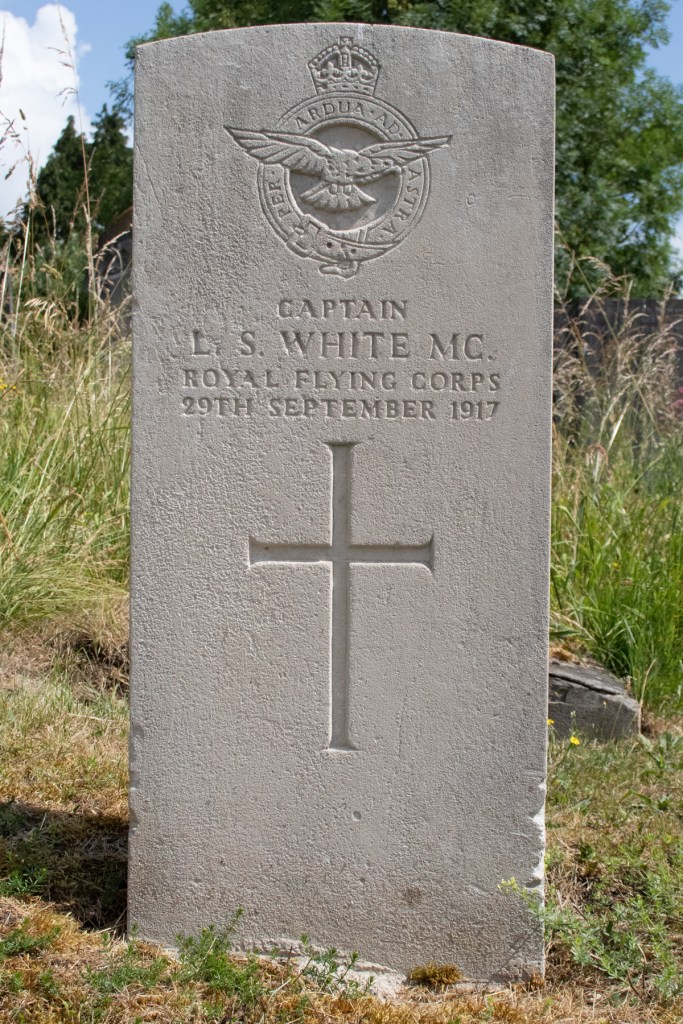
The body of Lewis Scott White was brought back to Somerset for burial He was laid to rest in the majestic Locksbook Cemetery in Bath, his funeral attracting a full page report in the city’s Chronicle and Weekly Gazette.


Captain Lewis White
(from findagrave.com)

Second Lieutenant Leo Aldrich

Second Lieutenant Leo Aldrich

Leo Edwin Aldrich was born on 14th July 1897 in the Ohio city of Elyria, and was the only child to Hiram and Agnes Aldrich. Hiram was a machinist from New York and, by the time of the 1910 census, he had found work as a toolmaker for a motor company, and the family has moved to Detroit, Michigan, 150 miles (240km) along Lake Erie’s coastline.

When war came to Europe, Leo seemed keen to get involved. Full details of his military service are lost to time, but it seems that he enlisted in the Canadian Royal Engineers. By the summer of 1918, Leo was in Britain, and had transferred to the Royal Air Force. He had reached the rank of Second Lieutenant and was based at Yatesbury Airfield in Wiltshire.

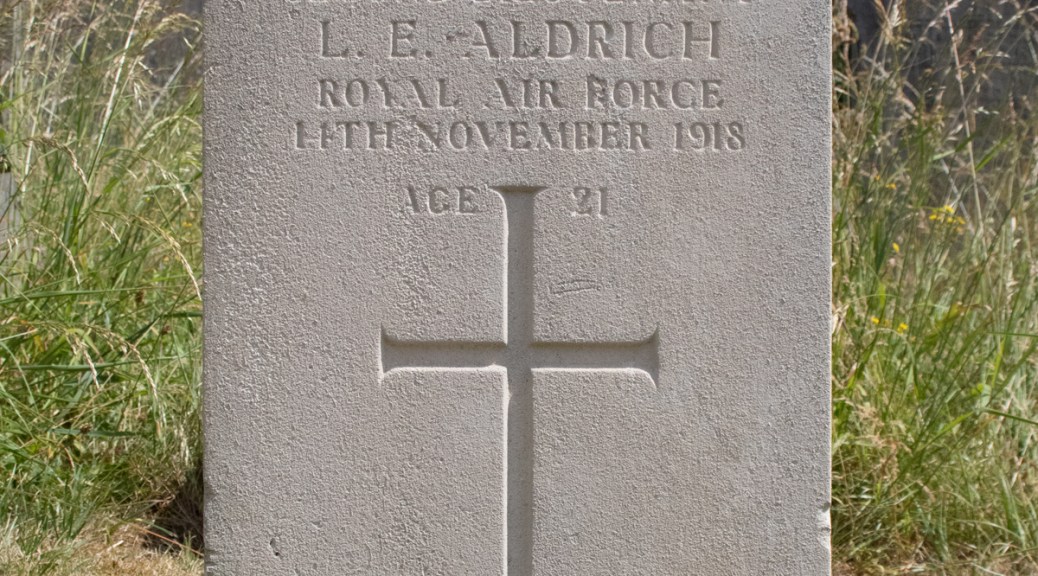
On 14th November 1918, just three days after the Armistice was signed, he was flying in a Bristol F2b fighter aircraft, when it nosedived into the ground. Both Second Lieutant Aldrich and his passenger Second Lieutenant McDougall were seriously injured, and were taken to Bath War Hospital for treatment.

Sadly, Leo’s injuries were to prove to be too severe. He passed away the same day: he was just 21 years of age.

Leo Edwin Aldrich was laid to rest in Locksbrook Cemetery, not far from the hospital in which he passed.


Leo’s service records suggest that his next of kin was his wife, Mrs Leo Aldrich of 480 East 112th Street, Cleveland, Ohio. There are no identifiable marriage records for him although, intriguingly another one does exist.

This confirms the wedding of a George L Aldrich to a Helen J Seymour on 6th August 1918 in Cuyahoga, Ohio. As the names do not match, the record would normally be dismissed, but the parents’ names – Hiram and Agnes – match Leo’s, as does the place of birth – Elyria – and his occupation – Second Lieutenant.

Further details for Helen Seymour, and why Leo may have given the name George, are lost to time.


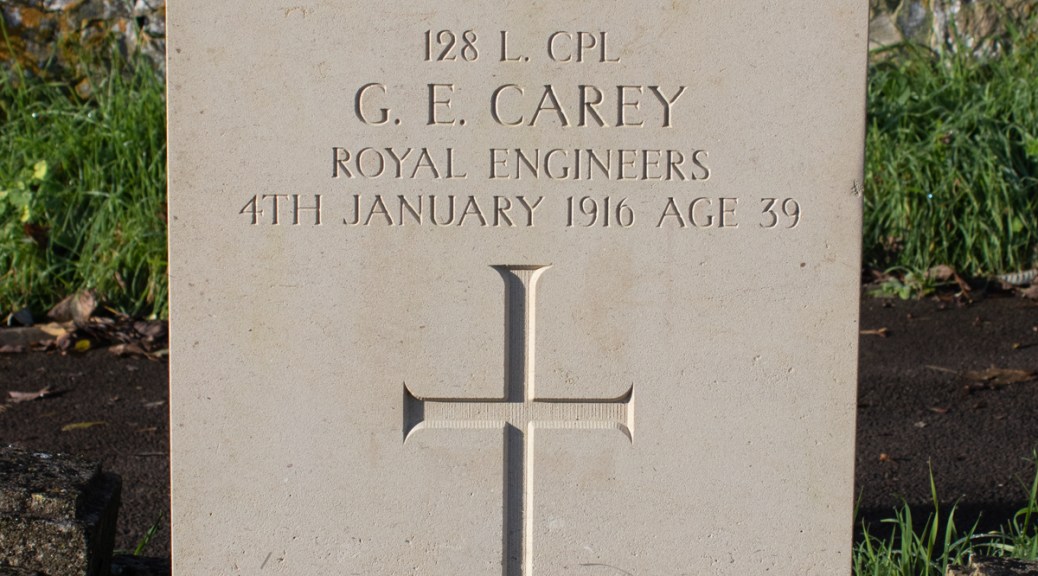
Lance Corporal George Carey

Lance Corporal George Carey

George Edward Carey was born at the start of 1877 and was the oldest of eight children to Samuel and Hester Carey. Samuel was a solicitor’s clerk from Clevedon in Somerset, and this is where the family were born and raised. Samuel was not one to sit on his laurels, however, and the 1891 census recorded his occupations as law clerk, innkeeper and insurance agent.

George followed a different path to his father, and found work as a printer’s apprentice when he finished his schooling. He worked up to being a full compositor quite quickly, and was employed as such when, on 30th January 1899, he married Lizzie Taylor. A civil engineer’s daughter, she was working as a teacher when the couple wed: they set up home in Clevedon, and went on to have four children.

By 1911, the Carey family were living in a seven-room house on Strode Road, Clevedon. George was still working as a compositor, but was employed by the local sanitary works. His widowed brother, Albert, who was lodging with his brother and sister-in-law also did the same job.

With storm clouds brewing over Europe, George stepped up to play his part. He enlisted in the Royal Engineers in the autumn of 1914 and was attached to the 503rd Field Company in Exeter. Little information is available about his time in the army, and he only comes to light again a year or so later.

Lance-Corporal Carey, 2nd Wessex RE, who has been employed at the office in Colleton-crescent, Exeter, was found dead, with his neck broken, at the bottom of a flight of stairs at the Grapes Inn, South-street, on Thursday morning. The discovery was made by Mrs Dorothy, wife of the licensee of the inn. Information was given to the police, and Dr Pereira visited the scene, and subsequently the body was removed to the mortuary by PCs Wise and Barrett. Carey was fully dressed. He was about 48 years of age, and leaves a widow and four children. For about fourteen months he had been engaged on the Wessex RE staff, and was billeted at a house in the Friars. His home is at Clevedon, Somerset, where he was engaged as a compositor before mobilisation with the Territorials. He was under orders for transfer to another station.

Taunton Courier and Western Advertiser: Wednesday 12th January 1916

George Edward Carey died on 4th January 1916: the coroner made it clear that, while he died at the Grapes Inn, there was no evidence that alcohol played any part his his death. His body was brought back to Somerset for burial and was laid to rest in the stunning graveyard of St Andrew’s Church in his home town of Clevedon.


Private Samuel Smith

Private Samuel Smith

Samuel Herbert Smith was born on 15th March 1886 in Liverpool, Lancashire. He was one of six children to parents Henry – a road labourer for the local council – and Elizabeth.

There is little concrete information about Samuel’s early life. While the 1901 census confirms he was employed as an apprentice, the writing is not legible enough to identify the trade he was in. A later record suggests he spent two years in the Royal Engineers, although, again, no supporting documents evidences this.

Samuel married a woman from South Wales. Her details are lost, but his war pension record gives the name Mrs SH Smith, and gives her address as 34 Albany Street, Newport, Monmouthshire.

It would seem that Samuel was keen to build a bigger and better life for the couple, and left Britain to find work overseas. By 1914 he was living in Valcartier, Quebec, and working as a bartender. War was declared in the summer of that year, however, and he immediately stepped up to serve his country.

Samuel enlisted in the Canadian Expeditionary Force on 23rd September, and was assigned to the 13th Battalion of the Canadian Infantry. His service records suggest he cut a striking figure: he stood 6ft 1in (1.85m) tall and weighed 168lbs (76.2kg). He had light brown hair, hazel eyes and a medium complexion, and his records note that he had a crossed hands tattoo on his right arm.

His unit set sail for England and, by the end of October, Private Smith was installed at Bustard Camp on Salisbury Plain, Wiltshire.

An enquiry was led into the death of Samuel Herbert Smith… Private Smith was travelling… in a motor car, and while the car was passing over uneven ground he fell into the road and was almost instantaneously killed.

George William Hincks, a private in the Canadian Force… was driving from Salisbury… in a motor car, which was meant to carry a machine gun, and was, therefore, open at the sides. Private Smith was seated next to [him] and was inclined to be rather sleepy. He had travelled in the train from Liverpool on the previous day. hey had gone some distance on their journey when deceased said “I want to get out of this.” [Hincks] said “Sit still, Bert. We will be soon be there,” Smith smiled and said “Oh, all right.” Almost immediately the car jolted on a rough piece of road, and Smith pitched on his head in the road. The car was immediately stopped, and [Hincks] went back to him and found him lying with his knees up, on his back, with wounds in his head. He was dead. [Hincks] returned to Salisbury and reported the occurrence to superior officers. The road on which fatality happened was rough and had been badly cut up, more especially at the place where deceased fell from the car.

Salisbury and Winchester Journal: Saturday 31st October 1914

The accident occurred on 29th October, Private Smith was just 28 years of age.

Samuel Herbert Smith’s widow was unable to cover the cost of bringing her husband back to Wales for burial. Instead, he was laid to rest in Amesbury Cemetery, not car from Bustard Camp.


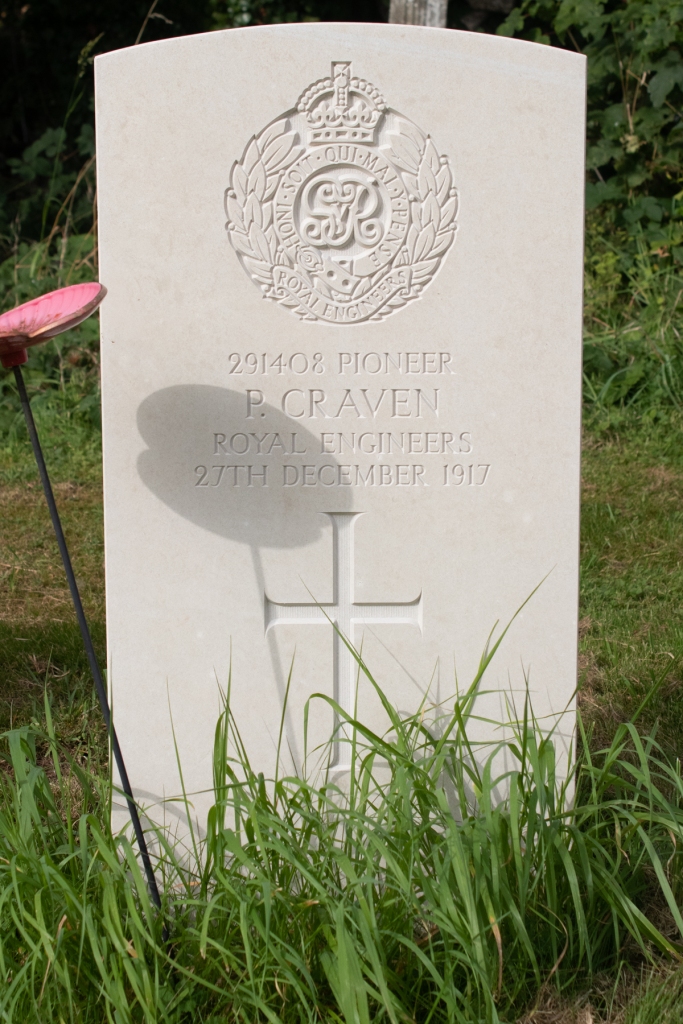
Pioneer Patrick Craven

Pioneer Patrick Craven

Patrick Craven was born in the summer of 1898 in Drogheda, County Louth. The oldest of three children, his parents were Francis (or Frank) and Mary Craven. Mary died in 1909, and the following year Patrick’s father remarried, to widow Kate Devin. The 1911 census found the extended family living in a cottage on North Road, Frank, Kate and their seven children.

Frank was a farm labourer, and this is work that Patrick also went into when he finished his schooling. War came to Europe in 1914, and he was to be called upon to play his part.

Patrick enlisted in the Royal Engineers on 6th June 1917. His service records confirm that he was 5ft 6ins (1.68m) tall, and weighed 127lbs (57.6kg). Pioneer Craven was assigned to the Inland Waterways Transport Division, and sent to Henbury, on the outskirts of Bristol, Gloucestershire, for training.

There was one blip on Patrick’s otherwise spotless service when, on 1st October 1917, he was confined to barracks for two days for ‘conduct to the prejudice of good order and military discipline, leaving the ranks without permission‘. Shortly after this, Pioneer Craven was assigned to a unit in Portbury, Somerset.

The wet summer of 1917 had given way to a cold, harsh winter, and the conditions were to lead to Pioneer Craven’s tragic demise on 27th December. The detailed report from the Medical Officer explained what had happened:

This man was found dead… in a small harness room at the Lodway Brewery, Pill, a room occupied by the IW&D, Portbury. I was called in to see him and pronounced him dead, the body was quite stiff and cold and death had probably taken place several hours before. When first discovered the body was fully pronated, with the mouth flattened against the floor, the hands were gripping the Army greatcoat which he had pulled over himself.

The harness room was heated by a coke stove the flue of which passed through the room to the ceiling and was cracked, allowing the fumes of the burning coke to emanate into the room. There was no ventilation except through a door communicating with the stables, which was found shut at the time the cadavre [sic] was found. The stove was situate[d] between the position where the body lay and the door, in a cul-de-sac.

One other man slept in the same room the same night, the deceased man having evidently entered the place after the former had fallen asleep. The second man was not affected by the fumes to any degree, but was lying between the stove and the door under which there was a certain amount of draught.

Sheltering himself from the cold winter night, Private Craven had passed away in his sleep from carbon monoxide poisoning. He was just 19 years of age.

Patrick Craven’s family were unable to afford to bring him back to Ireland for burial. Instead, he was laid to rest in the peaceful graveyard of St George’s Church in Easton-in-Gordano, not far from the brewery stables where he had passed.


Sapper Walter Stone

Sapper Walter Stone

Walter Stone was born at the start of 1880 in Lympsham, Somerset. The middle of three children, his parents were coal merchant George Stone and his wife, Ellen.

When he finished his schooling, Walter found work as a painter and plumber. In January 1902 he married Alice Charman. Eighteen years older than Walter, she was the widow of a milkman from Bristol, and had raised her son, Edgar, since her husband had passed away a few months before. The couple settled in the village of Brent Knoll, and went on to have three children of their own: Albert, Florence and Alice.

When war came to Europe, Walter was called upon to play his part. He enlisted after June 1916, and joined the Royal Engineers as a Sapper. He was attached to the Inland Waterways and Docks division, but, as no documentation remains to confirm his service, it is not possible to confirm whether he saw any action overseas

Sapper Stone’s time in the army was not to be a long one. The next record for him is that of his admission to a military hospital in Herne Bay, Kent. He was suffering from pneumonia, and this would take his life on 18th January 1917. He was 36 years of age.

Walter Stone’s body was brought back to Somerset for burial. He was laid to rest in the tranquil graveyard of St Michael’s Church in Brent Knoll.


Further tragedy was to strike Walter’s widow, Alice. Edgar, her son from her first marriage, enlisted in the Somerset Light Infantry when war broke out. Attached to the 7th (Service) Battalion, he found himself on the Front Line by the end of July 1915.

Private Stone is reported to have been accidentally killed on 1st May 1917. No other detail is given, but he was just 24 years of age when he passed. He was buried at the Thiepval Memorial at the Somme.

Alice had lost her husband and her oldest child within a matter of months.