Tag Archives: aircraft

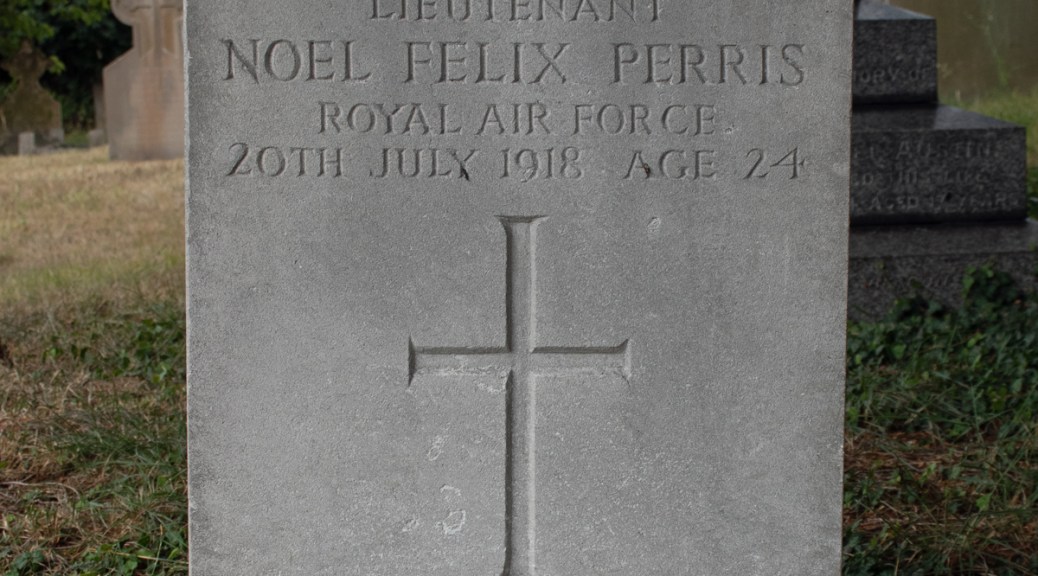
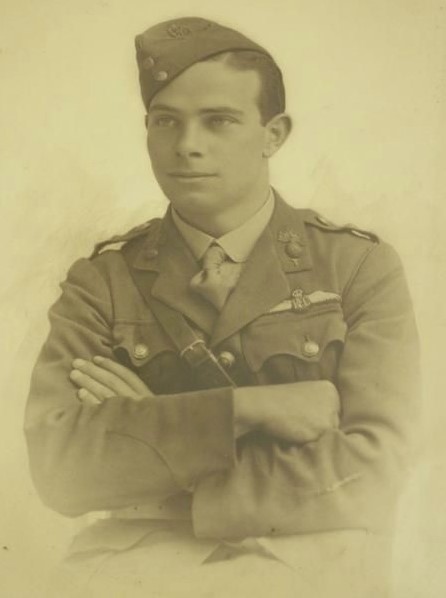
Lieutenant Noel Perris

Lieutenant Noel Perris

Noel Felix Perris was born early in 1894 in Chiswick, London and was the oldest of three children to George and Mary Perris. George was from Liverpool, and he and Yorkshire-born Mary made the move to south in the late 1880s.

Noel went on to study science at school, but when war broke out, he clearly felt a duty to play his part. George used his writing skills to become a war correspondent with the French army, while his son joined the 2nd London Regiment.

Quickly promoted to the rank of Lieutenant, Noel served in France and Egypt. In 1916, he was badly injured at Hébuterne, to the south of Arras, and returned to England to recuperate. When he had recovered, he transferred to the Royal Flying Corps, subsequently gaining his wings in the newly-formed Royal Air Force.

Lieutenant Perris was based in Kent as part of 143 Squadron. On the morning of 20th July 1918, he took off from Detling Airfield as part of a normal patrol flight. His aircraft – a single-seater RAF SE5a – collided with another plane, piloted by Lieutenant Thomas Wright, and both crashed to the ground in flames. Both piloted were killed on impact.

An inquest found that the cause of the pilots demise was accidental death. Lieutenant Perris was just 24 years old.

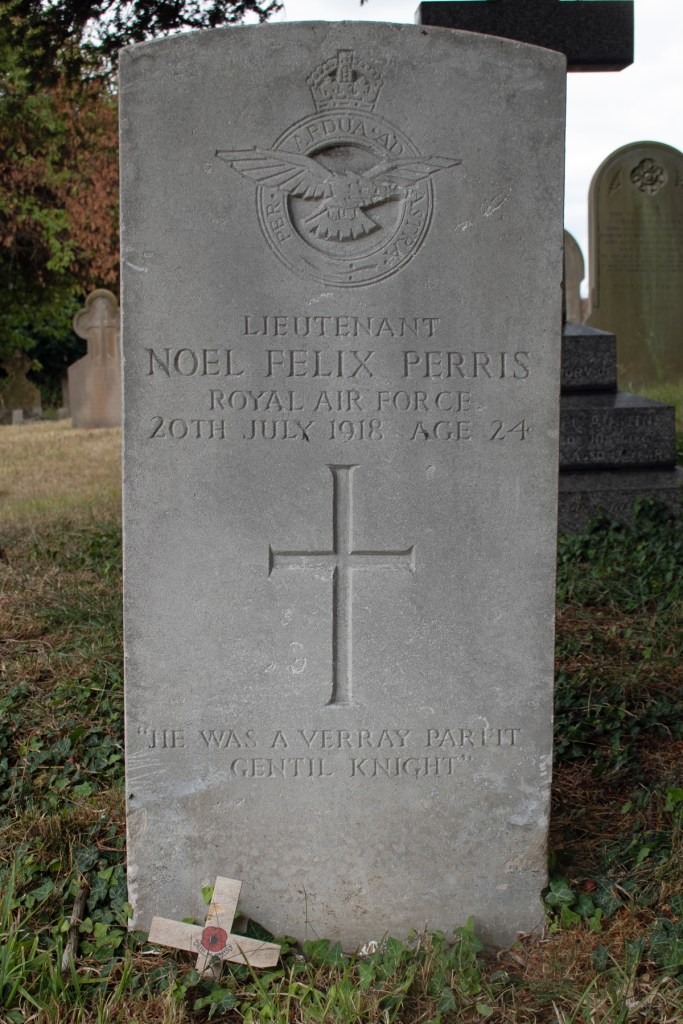
Thomas Wright’s body was taken home to Fleetwood, Lancashire, for burial. Noel Felix Perris was laid to rest in the quiet graveyard of St Martin’s Church in Detling, not far from the base.


Lieutenant Noel Perris
(from findagrave.com)

The epitaph on Noel’s headstone comes from Geoffrey Chaucer’s The Knight’s Tale.

He was a verray parfit gentil knight

A modern day translation might be “He was a true, perfect knight of noble character.”


Flight Lieutenant Lewis Morgan

Flight Lieutenant Lewis Morgan

Lewis Morgan was born on 22nd May 1892 in Plymouth, Devon. He was one of six children to former army officer and rector Lewis Harold Gilbert Morgan and his wife, Mary.

Growing up in Plymouth, it seems inevitable that the sea life would take hold in Lewis Jr. He first took up a post in the Merchant Navy, rising to Second Mate in December 1911.

By this point, however, he had set his sights on something more formal and soon enlisted in the Royal Navy. He served on a number of vessels over the years, and was re-engaged when war broke out. By the summer of 1915, he transferred to the Royal Naval Air Service, earning his wings on 5th August that year.

The now Flight Lieutenant Morgan’s service grew as the war continued. The life of air crew at this point in the era of flight was notoriously dangerous, and Lewis was to meet his own fate. On 11th May 1917, he was flying with Probationer Flight Officer Randolph Seed around Edmonton, Middlesex, when an accident occurred. The local newspaper reported on the incident and the subsequent inquest:

Flight-Lieutenant Mitchell gave a graphic account of the accident. He said that about eight o’clock in the evening he was flying at a height of 1,000 feet, and the machine containing the deceased officers was just ahead, but 500 feet higher. The flying conditions were good, and at the time both machines were going steadily. Glancing upwards he notices that the other machine suddenly appeared to collapse, the front extension of the main plane crumpling up. The machine nose-dived, and a black object fell out of it. The machine continued its descent and fell into the Edmonton Sewage Farm… The machine was so entirely broken up that it was impossible to theorise upon the cause of the accident. Morgan was said to have fallen on a concrete path. The deaths were instantaneous.

Taunton Courier and Western Advertiser: Wednesday 23rd May 1917

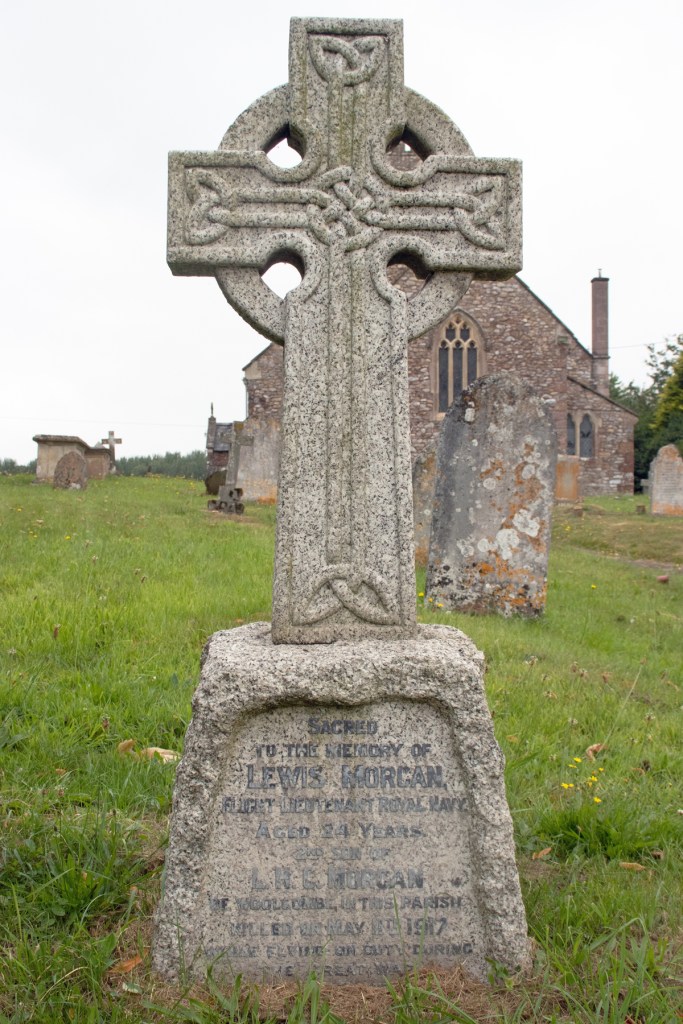
Lewis Morgan was just 24 years old, and days away from his 25th birthday. His body was brought back to Somerset, and laid to rest in the graveyard of Holy Cross Church in Sampford Arundel. By this point, his parents were living in the nearby Woolcombe House, so their son was, in a way, brought home.


The newspaper article went on to report that Flight Lieutenant Morgan was the third and last son to Lewis and Mary.

Francis Morgan – five years Lewis’ senior – enlisted in the Royal Field Artillery when war broke out. He rose to the rank of Captain, and was mentioned in Despatches for his actions. He was killed in the Dardanelles – potentially at Gallipoli – on 2nd May 1915, at the age of 28 years old.

Walter Morgan was a year younger than Lewis. He also played his part in the First World War, joining the South Lancashire Regiment, and rising to the rank of Second Lieutenant. Walter was also sent to fight in Gallipoli, and this is where he also lost his life. He was killed just three months after Francis, on 9th August 1915. He was just 22 years of age.

The loss of three sons in two years was to take a further toll on the Morgan family. Mary had suffered from poor health for a while, and the deaths of Francis, Walter and Lewis was to prove too much. She passed away at home on 15th July 1917, aged just 56 years old.


Flight Lieutenant Lewis Morgan

Captain Roden Chatterton

Captain Roden Chatterton

Roden Latham Chatterton was born on 13th July 1895, in Budin, Bengal, India. He was the only child to George and Ella Chatterton. George was a Lieutenant Colonel in the army, and had married Ella in India, where he was based.

The family had returned to England by the time of the 1911 census, but then moved permanently to Ireland. When war broke out, Roden joined up, enlisting in the 1st Battalion of the Leinster Regiment with the rank of Lieutenant. Full details of Roden’s military service are not available, but he arrived in France in January 1915 and, stayed there for the best part of two years.

In December 1917, the now Captain Chatterton transferred to the Royal Flying Corps. Based in Kent, he learnt to fly, and was close to gaining his wings, when an accident befell him in March 1918.

About 5:30pm on March 27th, [Captain Chatterton] was about 1.500 feet up, was trying to land near an aerodrome, and the wind was very rough. He shut off the engine and tried a left hand turn when the machine stalled and came down in a spin nose down and crashed to the ground. Several [people] went to his assistance. He was in great pain and made no remarks. He had been strapped in, but the belt had broken. The wind was from the south south-west. He came own into the wind and was trying to turn head into it when the machine got into a spin. It was not an ideal day for flying. Another machine… was flying with the deceased, and that landed all right. There was no collision in the air. When [he] turned he had not got the nose down far enough to keep up the engine speed and, in the witness’ opinion it was through an error of judgment on his part that the machine crashed. Had there been more space he would have got out of the spin. There was nothing wrong with the machine, but it was a type that was very difficult to handle in rough weather.

Whitstable Times and Herne Bay Herald: Saturday 6th April 1918

Captain Chatterton was taken to the Lees Court Military Hospital south of Faversham for treatment, but died of his injuries on 29th March 1918. He was 22 years of age.

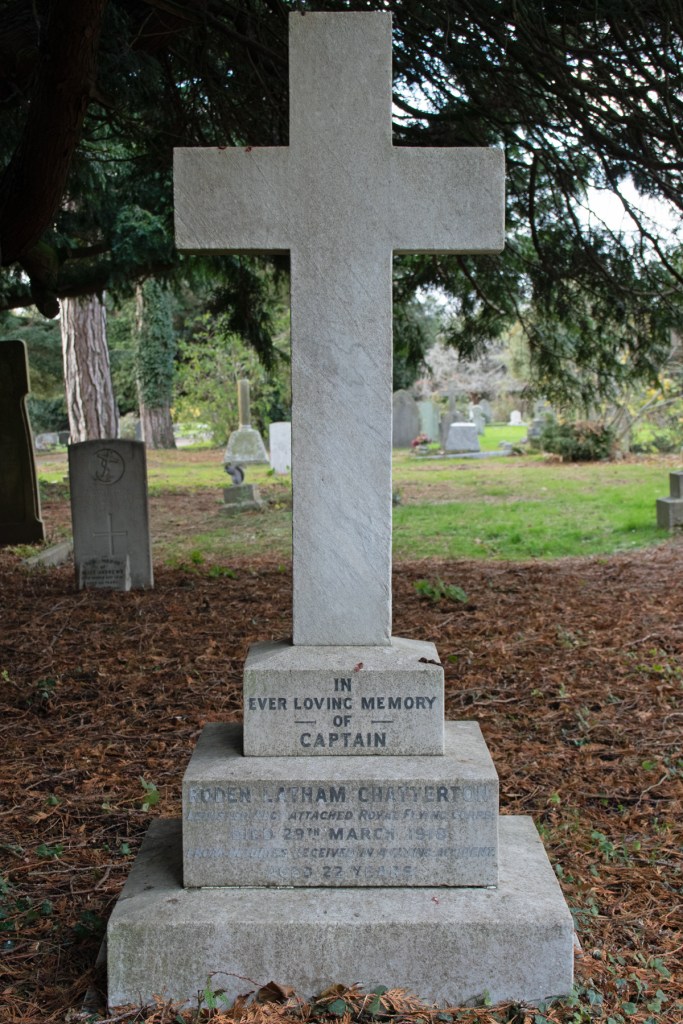
Roden Latham Chatterton was laid to rest in a quiet corner of the Borough Cemetery in Faversham.


Flight Officer Walter Stevens

Flight Officer Walter Stevens

Walter James Stevens was born on 29th November 1899, the oldest of three children to James and Elizabeth. James was a labourer in the munitions factory in Faversham, Kent, and this is where Walter and his siblings were born and raised.

Initially attending the council schools, Walter won a scholarship to Wreight’s Grammar School, before gaining work as a clerk at the Shepherd Neame brewery in the town.

From the age of 11, Walter was also an active member of the local United Methodist Church. He was a keen organist, taught at the Sunday School, and played a key role in the Wesley Guild. He was also a sometime member of the St John’s Ambulance, undertaking duties at The Mount Hospital in the town.

When was broke out, Walter was keen to play his part. He enlisted in the Royal Naval Air Service, and was sent for training at their air base in Cranwell, Lincolnshire. While on a flight on 11th March 1918, Flight Officer Stevens’ aircraft crashed, and he was killed instantly. He was just 18 years of age.

Walter James Stevens’ body was brought back to Kent: he was laid to rest in the Faversham Borough Cemetery, not fat from his family home. At the funeral, Walter’s senior officers reported the promise he had shown, and that he was close to passing his probationary exams. Two weeks after his burial, a memorial service to him was given at the church to which he had dedicated so much of his young life.


Lieutenant Alan Lloyd

Lieutenant Alan Lloyd

Alan Edward Lloyd was born in around 1899, the second of five children – all boys – to William and Edith Lloyd. Both of his parents were Welsh, and his older brother was born in Cardiff. Railway clerk William moved around the country with work, however, and Alan was born in Lydney, Gloucestershire, his younger brother in Paddington, London, and his two youngest siblings were born in Windsor, Berkshire.

There is little information about Alan’s early life; what is clear is that, by the autumn of 1918, he had been in the army, reaching the rank of Lieutenant. He transferred across to the newly formed Royal Air Force and, in December that year was training as a Flight Cadet at Shotwick Airfield near Chester.

On the 4th December, Alan was flying his Sopwith Camel, when he got into a flat spin; the aircraft crashed and Alan was killed. He was just 19 years old.

Alan Edward Lloyd was brought to Devon – where his family were now living – for burial. He was laid to rest in the graveyard of All Saints Church in Highweek, near Newton Abbot.


Lieutenant Alan Lloyd
(from ancestry.co.uk)

Second Lieutenant George Woodland

Second Lieutenant George Woodland

George Henry Woodland was born on 9th June 1899, and was one of six children – three boys and three girls – to Mark and Ada Woodland. Mark was a hewer in a coalmine in Radstock, Somerset, and this is where the family were raised.

George – who was better known as Harry – was still at school when war broke out. He had been taught at the Church of England School in his home town, before winning a scholarship to Shepton Mallet Grammar School. Having passed his exams there, he was taken on as a member of staff at his former school, before joining the army in June 1917 when he turned eighteen.

Initially joining the Infantry Training Reserve, Harry was subsequently transferred to the Royal Air Force. After training in Yorkshire for five months, he was transferred to the 52nd Training Depot Station at Cramlington Airfield in Northumberland.

Second Lieutenant Woodland returned home on leave in October 1918. This was the first time that he and his two brothers had been together since war had been declared – one had been serving in France, the other had been injured and was recuperating at a hospital in Bristol. Harry returned to Northumberland on 14th October.

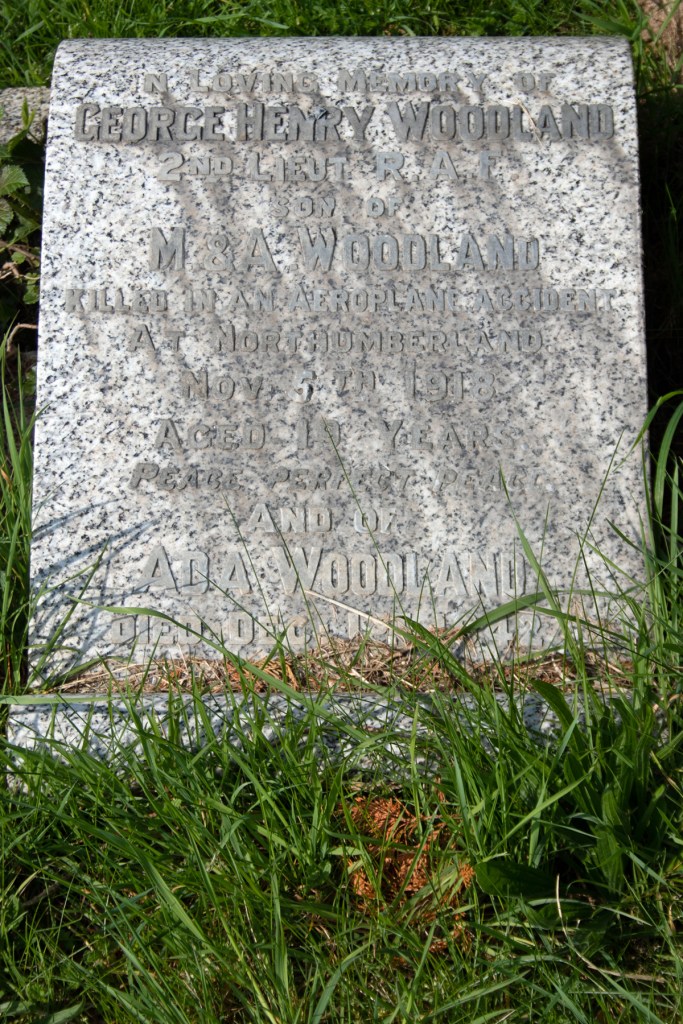
On 5th November 1918, Harry was flying at the Cramlington base; shortly after take off, while carrying out a flat turn at a height of about 100ft, his aircraft stalled and nosedived, catching fire on impact. Tragically, Second Lieutenant Woodland and his passenger – Air Mechanic Ryder – were burnt to death. Harry was just 19 years of age.

George Henry “Harry” Woodland was brought back to Somerset for burial. He was laid to rest in the family plot in the graveyard of St Nicholas’ Church in his home town of Radstock.


Second Lieutenant George Woodland
(from britishnewspaperarchive.co.uk)

Captain John Jackson-Barstow

Captain John Jackson-Barstow

John Eric Jackson-Barstow was born on 10th August 1895, and was one of seven children – and the only boy – to John and Mary Jackson-Barstow. John Sr was a Justice of the Peace from Yorkshire, who had moved his family to Somerset in the early 1890s; this is where John Jr and his sisters were born.

When war broke out, John Jr enlisted as a Trooper in the North Somerset Yeomanry and, by the autumn of 1914, he was moved to France.

On the outskirts of Ypres, his regiment were involved in a prolonged attack by German forces and Trooper Jackson-Barstow was injured. Medically evacuated to England, he received a commission and was given the role of aide-de-camp to a general based on the East Coast.

In 1917, Captain Jackson-Barstow transferred to the Royal Flying Corps – later moving to the newly-formed Royal Air Force. Over the following months, he regularly flew sorties across France and did extensive piloting in English skies.

Captain Jackson-Barstow continued in his role when the Armistice was signed. On 27th January 1919, he was flying in Surrey; it was snowing heavily, which limited what he could see. Flying low, he crashed into a hill near Oxted, and was killed instantly. He was just 23 years of age.

John Eric Jackson-Barstow’s body was brought back to Somerset; he was laid to rest in the family grave in the Milton Road Cemetery in Weston-super-Mare.


Captain John Jackson-Barstow
(from findagrave.com)

Captain Fergusson Barclay

Captain Fergusson Barclay

Fergusson Barclay was born in Cheltenham, Gloucestershire, towards the end of 1877 and was the oldest of six children. His father, Henry, was a retired army captain, and so it is of little surprise that Fergusson and his siblings had something of a privileged upbringing.

The 1881 census recorded Henry and his wife, Agnes, bringing up the family in Tenby, South Wales. With three children under four, the Barclays employed two live-in nursemaids to support them.

Ten years later, the family had moved to Weston-super-Mare, Somerset, living in a large house to the north of the town centre. With five children now living at home, Henry and Agnes found additional help was needed: they were now employing a governess, manservant, cook and a housemaid. The family were not alone in this support: the 1891 census shows that all of the Barclays’ neighbours had at least one domestic servant.

The new century turned, and a new census followed. Captain Barclay and his family were still living in their three-storey Victorian villa in Weston-super-Mare. By this point, however, only three of the children were still living at home. Fergusson, now 23, was working as an architect, his brother Herbert was a legal professional, and his sister, Hermione, also still lived there. The house was not empty, however, as the Barclays’ retinue of staff remained. By this point, they were employing a gardener, groom, coachman, parlour maid, cook, kitchen maid and house maid. Agnes, who was around 20 years younger than her husband, also had a live-in companion, spinster Helen Empson.

Little had changed for the family when the next census was recorded in 1911. Henry was by now 84 years old, and he and Agnes had been married 34 years. Fergusson and Herbert were still living at home, fully immersed in their jobs. Helen was still providing companionship for Agnes, and the family still employed four members of staff: butler Daniel O’Brien and his wife, Jesse, who was the cook; parlour maid Rosie Davies and house maid Edith Booden.

In March 1912, Henry passed away, and it was inevitable that things would change for the Barclay household. Fergusson had been a volunteer for the Royal Engineers since the late 1890s and had steadily worked his way up through the ranks. With the outbreak of war, he found himself called into a more formal role.

Full details of his military career are not evident, but it is clear that, by the spring of 1918, Fergusson had gained the rank of Captain. He joined the Royal Air Force and was assigned to 75th Squadron.

On the afternoon of 7th December 1918, Captain Barclay took off from Elmswell Aerodrome in Suffolk, when the engine of his Avro 504K aircraft cut out. He attempted to turn the plane to land, but it nosedived into the ground and Fergusson was seriously wounded. He was taken to hospital, and died of his injuries later that day. He was 40 years old.

Captain Fergusson Barclay’s body was taken back to Somerset – he lies at rest in the Milton Road Cemetery in Weston-super-Mare, walking distance from his family home.


Captain Fergusson Barclay
(from findagrave.com)

Lieutenant Herbert Marshall

Lieutenant Herbert Marshall

Herbert William Hare Marshall was born in Ambala, India, on 19th August 1890. His father – Herbert Seymour Marshall – was a Colonel in the army, and was serving in India with his wife, Charlotte, when their children – Charlotte (known as Jessie) and Herbert Jr – were born.

The family were back in England by 1898, and had set up home in the Somerset seaside town of Weston-super-Mare. When Herbert Sr passed away that year, Charlotte was set up on a widow’s pension, and this allowed her to send her son to St Peter’s, a private boarding school in the town.

When her son’s schooling was complete, Charlotte took the family off to Canada. They settled in British Colombia, in Revelstoke, a mountain town halfway between Calgary and Vancouver. Here, Herbert found work as a bank clerk, but war came to Europe, and he felt a need to do his bit for King and Country.

Herbert enlisted in the Canadian Expeditionary Force (CEF) in November 1914; his service papers record him as being 5ft 8ins (1.73m) tall, 148lbs (67kg) in weight. He had black eyes, brown hair and a dark complexion – something that he may well have inherited through his mother’s genes.

Shipped to England, by August 1915, Private Marshall had been discharged from the CEF as part of a transfer to the New Army – also known as Kitchener’s Army, the volunteer British Army raised as a direct result of the outbreak of war.

Detailed information about Herbert’s military service is lacking, although it seems that he joined the 17th Battalion of the West Yorkshire Regiment, one of the regiments heavily involved during the Battle of the Somme.

By October 1916, however, the now Lieutenant Marshall had made another move, this time joining the Royal Flying Corps. On the afternoon of 26th August 1917, he was an observer on a flight at Marham, in Norfolk. The pilot, a Lieutenant Challington, was banking the aircraft, when it dived and crashed, killing both men. Lieutenant Marshall had turned 27 years old the week before.

Herbert William Hare Marshall’s body was brought back to his adopted home of Weston-super-Mare. He lies at rest alongside his father in the town’s Milton Road Cemetery.


Lieutenant John Scrace

Lieutenant John Scrace

John Scrace was born on 31st July 1892 in Chatham, Kent, the oldest of five children to John and Adelaide Scrace. John Sr was a relieving officer for the Medway Board of Guardians, a role which involved “taking charge of poor or insane persons not otherwise cared for” [census1891.com]. Adelaide worked in a similar role, as an infant protection visitor.

It is fair to say, therefore, that John Jr had a very supportive childhood. He attended King’s School in Rochester, where he obtained a scholarship to Peterhouse College, Cambridge.

When war broke out, John was keen to do his part. Initially joining The Buffs (the East Kent Regiment), he transferred across to the newly-formed Royal Air Force in June 1918. By this point he had risen to the rank of Lieutenant, and, as part of his new RAF role, was based at Driffield in Yorkshire.

On 24th August 1918, the aircraft John was flying at the base, spun into the ground, and John was killed instantly. A subsequent inquest identified that “the cause of the accident was due to the fact that, for reasons unknown, part of the top of the left-hand plane of the machine crumpled up in the air and thereby [caused] the pilot to lose control of his machine.” [rafmuseumstoryvault.org.uk] Lieutenant Scrace was just 26 years of age.

John Scrace was buried in Christ Church Churchyard in Luton, Kent; he is commemorated in Woodlands Cemetery in nearby Gillingham.