Harry John Gurd was born in the Wiltshire parish of Berwick St John in the spring of 1881. He was one of three children to dairyman Ebenezer Gurd and his wife, Elizabeth.
Details of Harry’s early life are fragmented, but by the time of the 1911 census, he had moved to West Sussex, and was working as a gardener. The document confirms that he had married Alice three years before, and that they were living in North End, Findon. By this point, the couple had three children: Alice, Ronald and Walter, and they would go on to have another daughter, Hester, in 1913.
Harry stepped up to play his part when war was declared. Full details of his service have been lost, but it is evident that he enlisted by December 1917 at the latest and, as a Private, joined the Army Veterinary Corps. He was initially attached to the 15th Veterinary Hospital, but transferred across to the Labour Corps, joining the 695th Company.
In the summer of 1918, Private Gurd fell ill. He was admitted to hospital, but his condition – a duodenal ulcer – was to prove fatal. He passed away on 25th June 1918, at the age of 37 years old.
The body of Harry John Gurd was brought back to Sussex for burial. He was laid to rest in the graveyard of St John the Baptist Church, Findon, the village that had become his home. When Alice died in the summer of 1958, she was buried alongside Harry: husband and wife reunited after forty years.
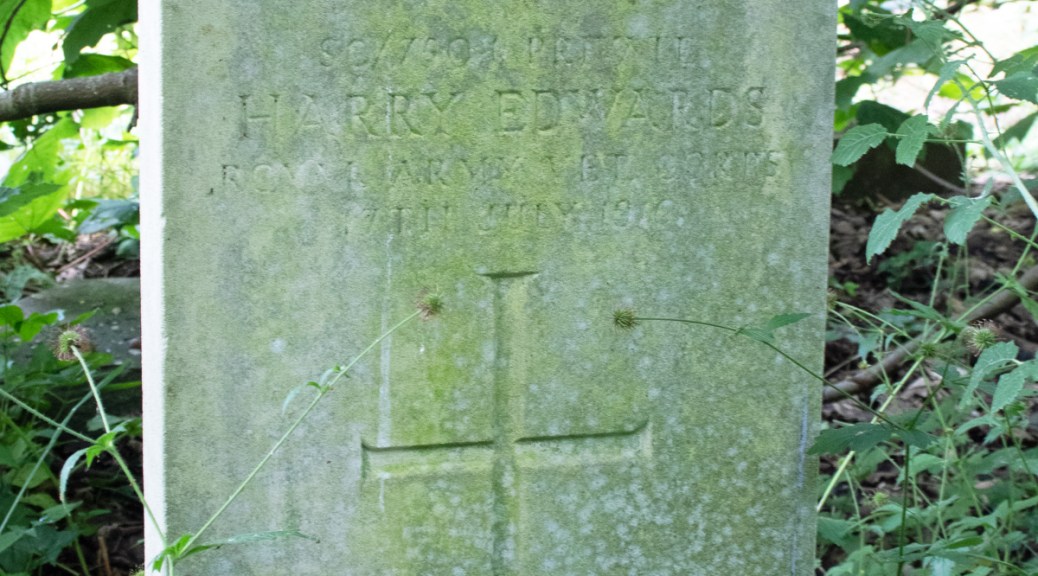
Harry Edwards was born early in 1855 in South London. One of eleven children, his parents were John and Sarah Edwards. John was a carpenter, and the family were raised in Bermondsey, first in a small terrace in Chapel Place, then sharing a slightly larger house in Grange Walk.
Much of Harry’s life is lost to time. He married Mary Ellerington on 27th July 1879: she was a tailor’s daughter from Southwark, and the couple set up home at 29 Newington Causeway. The marriage certificate confirmed that Harry was employed as a warehouseman at the time, and their daughter, Amelia, was born the following spring.
A later document suggests that Harry went on to join the army, fighting as part of the South Africa Campaign. Sadly, however, his service records are lost to time, and so it is not possible to confirm when and for how long he served. Certainly, there is no mention of the family in the census returns from 1881 to 1911, so he may well have been overseas.
The next records available for Harry are those relating to his military service during the First World War. He enlisted early in 1915, joining the Royal Army Veterinary Corps. He found himself in France by mid-April, and was awarded the British and Victory Medals and the 1915 Star for his service.
Private Edwards came down with bronchitis in the spring of 1916: he was medically evacuated to Britain for treatment, and was admitted to the Bath War Hospital in Somerset. It seems that Harry’s age was against him: he passed away from the condition on 17th July 1916, at the age of 61 years old.
Harry Edwards’ family may have been unable to afford the cost of bring him back to London for burial. Instead, he was laid to rest in the sweeping Locksbrook Cemetery, not far from the hospital in which he had breathed his last.
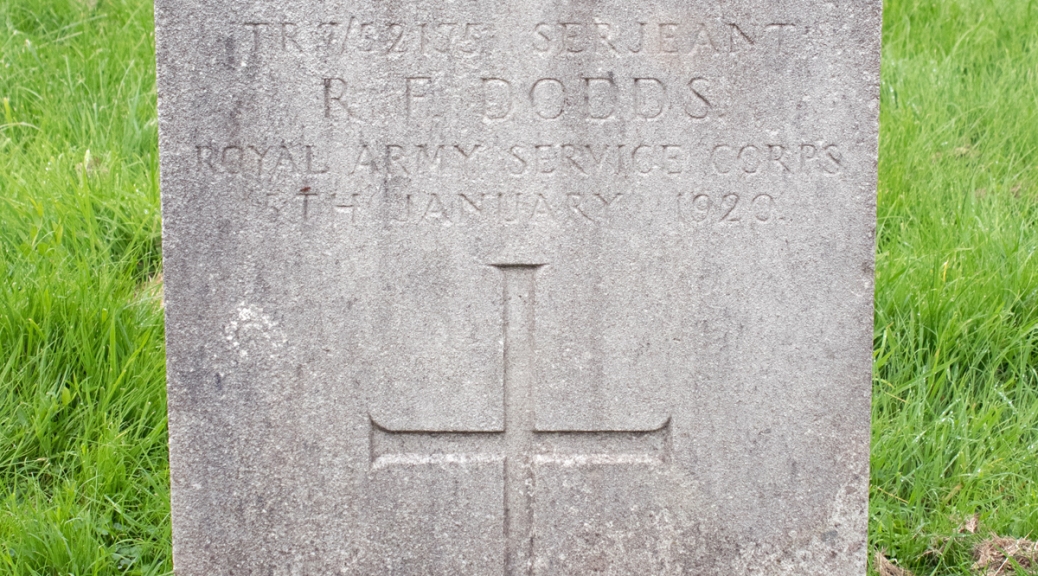
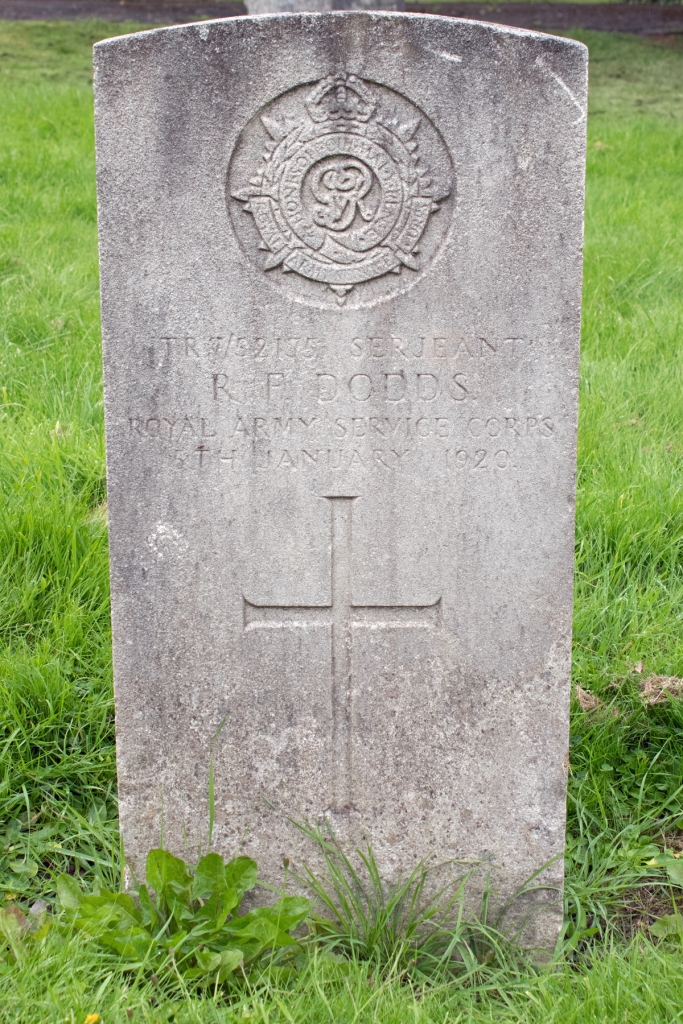
Robert Frederic Dodds was born in 1874 in Darlington, Country Durham. The third of nine children, his parents were Robert and Elizabeth Dodds. Robert Sr was a carter and furniture remover and, when he finished his schooling, Robert Jr joined his father in his work.
Robert Sr died in 1898, at the age of 61. Whether this was a catalyst for his son to move on is unclear, but by the following year, Robert Jr was working as a labourer in Weston-super-Mare, Somerset. On 16th September 1899, he married Elizabeth Counsell, a fisherman’s daughter from the town.
It seems that Robert was keen to build a life for his new wife: the next census, taken in 1901, found the couple living in Cardiff, Glamorgan, where he was employed as a stone mason. The Dodds remained in Wales for the next decade, having three children – Lily, William and Rosie – there. By the spring of 1911, however, they were back in Somerset, living in a three-roomed cottage in Castle Street. Elizabeth had had a fourth child just a month before the census, with a second son, Bertie, adding to the family.
When war came to Britain, Robert stepped up to play his part. He initially joined the Royal Army Veterinary Corps as a Private, and found himself in France on 6th March 1915. Elizabeth, meanwhile, remained at home in Somerset, seeking support from her family. With four children to look after, her workload was to increase again when, just a week after Robert arrived on the Western Front, she gave birth to their fifth child, the patriotically named Frederick Gordon Kitchener Dodds.
Robert remained in the Royal Army Veterinary Corps for the next four years, rising to the rank of Serjeant. Details of his time in the service are unclear, but he survived the war and, on 11th July 1919, he transferred to the Royal Army Service Corps.
Little further information is available about Robert’s life. By the winter of 1919/1920, he was based in Midlothian, Scotland. He was admitted to the 2nd Scottish General Hospital, Edinburgh, although his condition is unclear. Whatever it was, it was to be fatal: he passed away on 6th January 1920, at the age of 45 years old.
Robert Frederic Dodds’ body was taken back to Somerset for burial. He was laid to rest in Highbridge Cemetery.
Frederick Chilcott was born in Bridgwater, Somerset, early in 1867. He was the fifth of thirteen children to labourer and kiln worker Henry Chilcott and his wife, Ellen.
When he finished his schooling, Frederick also found labouring work. He wanted bigger and better things, however, and the opportunity for a career in the army offered him just that. On 14th January 1888 he enlisted in the Royal Artillery. His service records confirm he was 5ft 6ins (1.68m) tall, and weighed 119lbs (54kg). He was noted as having dark brown hair, dark hazel eyes and a fresh complexion. He also had a scar on his forehead and a tattooed dot on his right forearm.
Frederick was initially given the rank of Driver and was assigned to the regiment’s 3rd Brigade Depot. He was sent to India in February 1889, and remained there until November the following year, when his troop returned to Britain.
Back on home soil Frederick’s role changed and he was given the rank of Gunner. On 1st January 1892, he was promoted to Acting Bombardier, but, on his own request, he reverted to his previous rank just three months later. On 15th January 1895, Gunner Chilcott was stood down to reserve status, having completed seven years’ service.
On 16th April 1895, Frederick married Eliza Stockham. She was a labourer’s daughter from the village of Puriton, to the north of Bridgwater, and it was here that the couple settled. Living in a small cottage, they went on to have six children between 1898 and 1911.
Frederick’s time in the army, however, wasn’t quite done. With the Second Boer War breaking out, he was recalled to the now Royal Field Artillery in January 1900. Sent to South Africa, Gunner Chilcott remained overseas for a year and was recognised for his commitment in the campaign.
Frederick returned to Britain on 3rd January 1901, and was finally stood down from the army in March that year, having fulfilled his twelve years’ contract. He returned home to Puriton, his service records noting that his character was ‘very good’.
The 1911 census found Frederick employed as a labourer in the local cement works. He and Eliza living in a small cottage in Puriton with four of the children (their oldest son was with Eliza’s parents, while she was pregnant with their youngest).
Conflict was knocking on England’s shore by this point, and when conflict broke out, Frederick appears to have stepped up to play his part once more. He was 47 years old when war was declared and, as such, would not have been required to enlist. Full details of his service are no longer available, but he had certainly joined the Army Veterinary Corps by the summer of 1917.
Private Chilcott is likely to have remained on home soil, but towards the end of his service was based in Curragh, County Kildare, Ireland. It was while here, on 23rd December 1917, that he suffered an aneurysm, passing away in the town’s military hospital as a result. He was 50 years of age.
Frederick Chilcott’s body was brought back to Somerset for burial. He was laid to rest in the quiet graveyard of St Michael’s Church in his home village, Puriton.
Ernest Simmons was born in Priddy, Somerset, in 1869, the oldest child to Henry and Ellen Simmons. Henry was a mason who, by the time of the 1881 census, was employing ten men and a boy. Three doors down lived another Simmons family, Daniel and Elizabeth, and it is likely that Ernest’s father was somehow related to them.
Ernest sought a bigger and better life away from the Somerset countryside, and enlisted in the army, joining the Army Veterinary Corps. “[He] served for 28 years… 10 of which were spent in India and 5 in South Africa.” [Wells Journal: Friday 23rd August 1918]
His service did him well, and he progressed through the ranks. The 1911 census recorded him back in the UK, renting a room in a terraced house in Preston, near Brighton. He was still serving in the army, however, and was listed as being a Farrier Sergeant Major in the 4th Battalion of the Dragoon Guards.
When war was declared, Ernest was quick to return to the fray, arriving in France on 16th August 1914. He served his battalion well, and was mentioned in dispatches for his action in the retreat from Mons the following month.
Farrier Sergeant Major Simmons returned to Britain, and transferred across to the 6th Reserve Regiment of Cavalry. This new regiment, formed in 1917, trained men for a number of regiments, including the 3rd, 4th, 6th and 7th Battalions of the Dragoon Guards. Ernest’s previous experience with horses, including his time in the Army Veterinary Corps, likely stood him in good stead for the role.
It was while he was at the camp in Tidworth, on Salisbury Plain, Wiltshire, that Ernest met with an accident. “[He] was thrown through his horse tripping over some wire. He was found in an unconscious state and died the same day.” [Wells Journal:Friday 23rd August 1918] Farrier Sergeant Major Simmons died on 26th July 1918: he was 49 years of age.
Ernest Simmons’ body was brought back to Somerset for burial. He was laid to rest in the peaceful graveyard of St Lawrence’s Church in his home village of Priddy.
Louis Blake Stevens was born in the spring of 1870 in Pilton, now a suburb of Barnstaple, Devon. One of nine children, his parents were Devon-born sawyer John Stevens and his wife Mary, who was from Swansea.
When he left school, Louis found work in the leather industry, working as a parer and grinder. In the autumn of 1890, he married an Edith Turner, the couple went on to have two children – Edith and Albert – although they seem to have parted company soon after.
On 4th April 1896, Louis married again, this time to a Mary Webber. The couple set up home in Stoke-under-Hamdon (now Stoke-sub-Hamdon), Somerset, and went on to have seven children of their own. By the time of the 1911 census, the family had moved to South Petherton, Somerset, where Louis and Albert were working as a glovers.
Storm clouds were brewing over Europe and, despite his age, Louis was keen to step up and play his part and, on 7th August 1915, he enlisted in the Army Veterinary Corps. His service records confirm he was 42 years old, 5ft 4ins (1.63m) tall, with a dark complexion, dark brown hair and brown eyes.
After some initial training at the Army Veterinary Corps depot, Private Stevens was sent to France. Arriving there on 25th October 1915, he spent the next nine months overseas. During this time, he had issues with his teeth, breaking several on the hard biscuits the army were provided with.
Private Stevens was sent to a camp hospital in Boulogne, where his teeth were extracted, and he was then sent back to Britain to recover. The operation identified epithelioma (a malignant tumour) on his tongue and face, caused by the state of his teeth. He was initially sent to a hospital in Epsom, before being transferred to the Horton City of London War Hospital in Woolwich.
Treatment was ongoing, and, in the end, Private Stevens was finally discharged from the army on medical grounds on 2nd July 1917. The report noted permanent total incapacity, and that treatment was required.
At this point, Louis’ trail goes cold. He returned home to Somerset, and, died there on 23rd January 1918, aged 47 years old. Louis Blake Stevens was laid to rest in South Petherton Cemetery, within walking distance of his widow and family’s home.
Fredrick James Baker was born in the spring of 1894, in the Kent village of Malling. One of eleven children, his parents were James and Elizabeth Baker. James was a labourer in the local chalk and clay pits and, by the time of the 1911 census, the family had moved to Burnham, near Aylesford.
Frederick followed his father into labouring work, and they made a living at the local lime works. War was closing in on Europe, however, and he felt he needed to play his part for King and Country. He joined the Royal Army Veterinary Corps and, while his service records no longer exist, it is evident that he had enlisted by November 1916.
It is unclear whether Private Baker served at home or overseas, but he appeared to be dogged by ill health. He was medically discharged from the army on 26th May 1917, and returned to civilian life.
Sadly, it is at this point that Frederick’s trail goes cold. The only other evidence for him is that of his passing. He died from illness at home on 25th February 1919, at the age of just 24 years old.
Frederick James Baker was laid to rest in the graveyard of St Peter & St Paul’s Church in Aylesford, not far from where his grieving family still lived.
While buried in the churchyard, the location of Frederick’s grave is not known. Instead, he is commemorated on a joint headstone in the First World War section of the graveyard.
William John Hicks was born in the village of Northlew, Devon, in the spring of 1886 and one of seven children to John and Sophia Hicks. Both of his parents were born in the village, and that was where John found employment as a farm labourer.
By the time of the 1901 census the family had moved to the southern side of Dartmoor, and were living in Wolborough, near Newton Abbot. William had left school, and was also employed, working as a grocer’s porter in the town.
In December 1908, William married Maud Alice Wotton, and the couple set up home near the town’s station. They went on to have a son, also called William, who was born the following year. By this point, William had found more secure employment, and was working as a wagoner for a flour mill.
War was approaching Europe, and when the time came, William joined up to play his part. He enlisted in the Army Veterinary Corps, and there is no doubt that his pre-war employment stood him in good stead for the role. There is little information about Private Hicks’ military service, but it is clear that he had joined up by March 1916, and, for some part at least, was based in Hampshire.
Sadly, the other other available information relating to Private Hicks is that confirming his passing. He died, of causes unknown, on 19th September 1916, in Aldershot, where he was billeted. He was 30 years old.
William John Hicks’ body was brought back to Devon for burial. He was laid to rest in the graveyard of St Mary’s Church in Woborough.
Frederick Henry Harvey Finch was born in 1876 in the Sussex village of Ripe. He was one of eleven children, born to James and Eliza Finch. James was an agricultural labourer, a trade into which most of his children, Frederick included, followed.
In the spring of 1900, Frederick married Ellen Maloney. She had been born in Fareham, Hampshire, and, by the time of the 1891 census, ages just nine years old, was recorded in the Union Workhouse in Portsea. The couple wed in Hailsham, and went on to have three children, Frederick Jr, Hilda and Herbert.
By now, Frederick had moved on from farm labouring, and was working as a groom and a gardener. Within ten years, however, he had moved the family to the coast and the village of Angmering; he had found new employment, working as a carter for a coal merchant.
Frederick continued in this line of work as war broke out, but was one of the first to join the village’s contingent of the Voluntary Training Corps. He seemed to be content with this and at the start of 1917, he enlisted in the armed forces, joining the Army Veterinary Corps.
Private Finch was sent to Woolwich for training, but within a matter of weeks fell ill. Admitted to the Royal Herbert Hospital, he passed away on 24th January 1917, at the age of 40. No specific cause of death is recorded, but a local newspaper report of his funeral suggests, rather disingenuously, that “his health, which was never very robust, proved unequal to the strain of Army life”. [Worthing Gazette: Wednesday 7th February 1917]
Frederick Henry Harvey Finch was brought back to Angmering for burial He lies at rest in the graveyard of St Margaret’s Church in the village.
Joseph Redgrave was born at the start of 1897, the youngest of nine children to Charles and Hannah. Tragically, five of Joseph’s siblings passed away and, by the time of the 1911 census, the family were living in a three-roomed cottage within a few minutes’ walk of Charles’ place of work, the Naval Dockyard in Chatham, Kent.
Sadly, little documentation about Joseph remains. When it comes to his military service, his records confirm that he enlisted prior to November 1916, joining the Army Veterinary Corps as a Private. There is no evidence that he served overseas, but documents place him at the Larkhill Camp just north of Stonehenge in Wiltshire.
Tragically, Private Redgrave died from unrecorded causes at the camp’s hospital on 15th May 1917, at the age of just 20 years old.
Joseph’s body was brought back to Kent; he was laid to rest in the Woodlands Cemetery in Gillingham.






 Death and Service