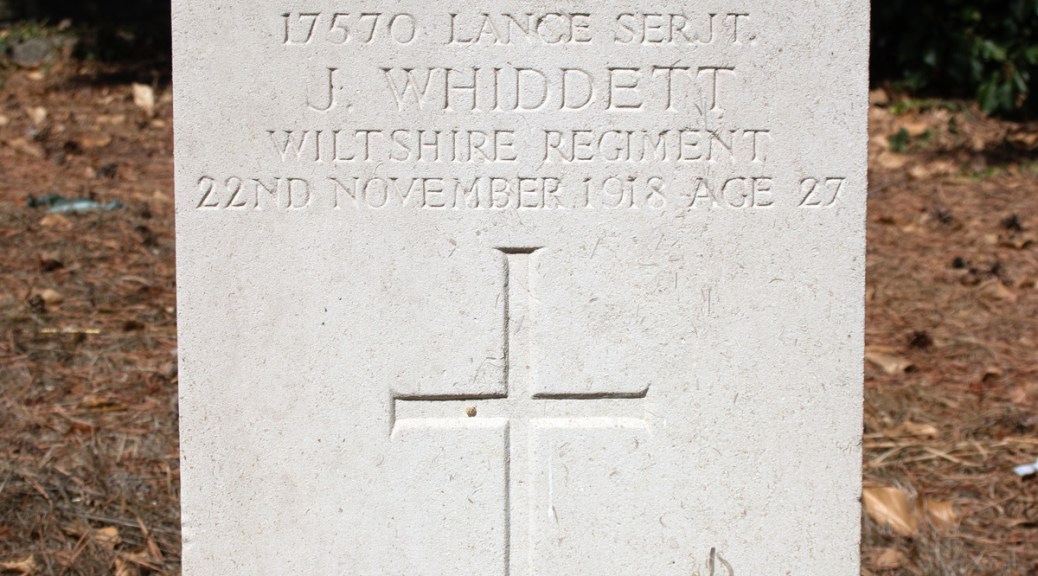
John Whiddett was born in Hammersmith, Middlesex, in 1892, and was one of thirteen children to Alfred and Mary Ann Whiddett. Alfred was a house painter while Mary Ann worked as a charwoman to bring in some additional money for the growing family.
John worked as a porter when he left school, but when war came to Europe, he stepped up to play his part. He enlisted in the Wiltshire Regiment in the summer of 1915, and was assigned to the 3rd (Reserve) Battalion.
While Private Whiddett served in France, he returned to Britain, and promoted to Corporal and then Lance Serjeant. His battalion eventually formed part of the Thames & Medway Garrison. Frederick found himself in Kent by the autumn of 1917 and served out the remainder of the war there.
At some point during the autumn of 1918, Lance Serjeant Whiddett fell ill. He was admitted to the Preston Hall Military Hospital in Aylesford, suffering from a combination of influenza and pneumonia. Sadly he was not to survive these lung conditions, and he succumbed to them on 22nd November 1918. He was just 26 years of age.
Finances may have restricted John’s family’s ability to bring his body back to Middlesex. Instead, he was laid to rest in the graveyard of St Peter and St Paul’s Church in Aylesford, Kent.
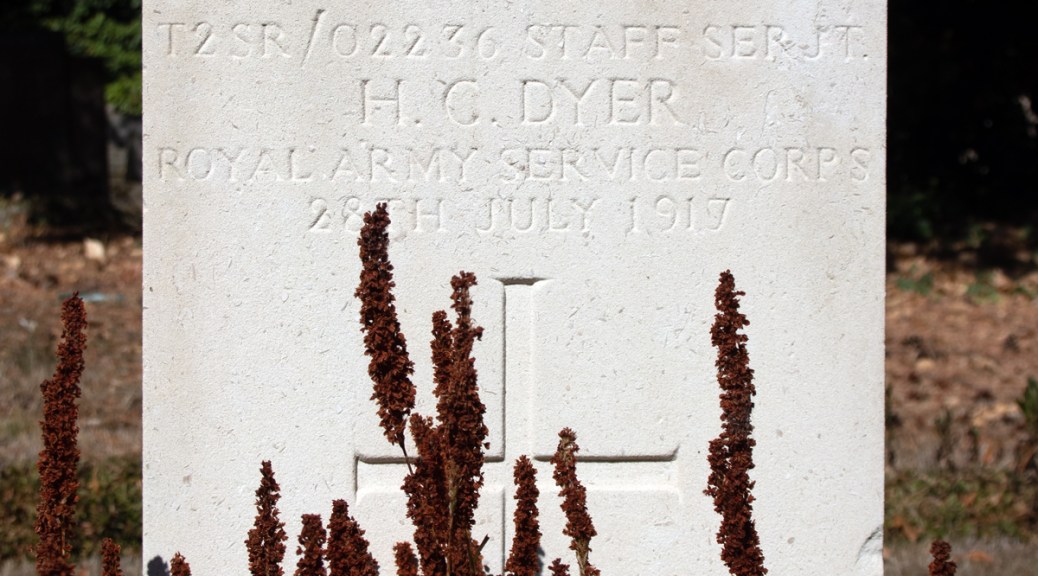
Henry Charles Dyer was born in January 1865 in the Devon town of Ivybridge. The oldest of five children, his parents were carpenter James and dressmaker Mary Dyer. When he left school, Henry found work as a cordwainer’s apprentice but, after James died in 1886, he sought out a career that would help support his mother.
Henry enlisted in the Army Service Corps on 10th July 1886 and, by the time of the next census was based at barracks in Woolwich, South London. His service records note that he was 5ft 4.5ins (1.64m) tall and weighed 124lbs (56.25kg). He had a dark hair, grey eyes and a dark complexion. He was also noted as having a tattoo of a cross on his left forearm.
Private Dyer served in the regiment on home soil for more than thirteen years, qualifying as a horse collar maker and saddler during this time and rising through the ranks. He was made a Driver in 1889, Corporal in 1895 and Staff Sergeant in October 1899.
Trouble was afoot on the other side of the world by this time and his promotion was linked to Henry being sent to South Africa. He was there for eighteen months, and was awarded the Queen’s South Africa Medal, as well as clasps for service at Tugela Heights, the Relief of Ladysmith, Laing’s Nek, Transvaal and Orange Free State.
Staff Sergeant Dyer went back to Britain in April 1901, where he remained for a further six years. On 4th July 1907, reached the end of his term of service and having completed 21 years with the Army Service Corps he returned to civilian life.
Henry moved back to Devon, moving back in with his mother and younger brother. Mary had remarried after James passed, but her second husband had also passed away, and so having two of her sons home would have been of comfort to her. The 1911 census records the family as living in three rooms of a house in Grenville Street, Plymouth. They shared the property with the Smith family, a husband, wife and two children. Henry was recorded as an army pensioner (saddler), while his brother Ernest was listed as being a watchmaker, while also in the army reserve.
War was on the horizon again, and, Henry was one of the first to step up when it was declared. He was 49 years old by this point, and so technically exempt from enlisting, but as an army life had served him well before, it must have seemed fit for him to serve King and Country once more.
Staff Sergeant Dyer’s new service records noted that he was formally employed as a saddler, and that he had put on 18lbs (8kg) since he initially signed up.
Henry was based firmly on home soil this time round, and while he was initially based in Aldershot, Hampshire, he seems to have been moved to barracks in Kent. He served for more than two and a half years, but his health seems to have been suffering by this point. At a medical on 24th July 1917, he was deemed to be no longer fit enough for war service and was discharged from the army.
It is likely that this discharge came while he was admitted to the Preston Hall Military Hospital in Aylesford. While Staff Sergeant Dyer’s earlier military service is fairly detailed, his later career is not. What is clear is that, four days after being discharged, he passed away. He was, by this time, 52 years of age.
A lack of funds may have prevented Mary from bringing her son home to Devon. Instead Henry Charles Dyer was laid to rest in the graveyard of St Peter and St Pauls Church in Aylesford, not far from the Kent hospital in which he passed.
Albert Edward Rumbelow was born in 1879 in Wycombe Marsh, Buckinghamshire. One of eleven children, his parents were Suffolk-born paper maker Philip Rumbelow and his wife, Jane.
Little information is available about Albert’s early life, although by the time of the 1901 census, he is recorded as being a Private in the Rifle Brigade. The family had moved to the village of Little Chart in Kent by this point, where his father was still continuing in the manufacture of paper.
Private Rumbelow’s military service is evidenced in later documents. He served with the 1st Battalion from 1895 to 1907, was awarded the South Africa medals for 1901 and 1902: he was also granted the clasp for his involvement in the defence of Ladysmith. He appears to have been wounded at this point, and was invalided out of full military service and placed on reserve.
In 1904, Albert was back in England, and living in London. That year he married Ellen Sillis, a cordwainer’s daughter from Norfolk. The couple set up home in Fulham, and went on to have five children: Abert Jr, Iris, Florence, Doris and Hilda.
By the time of the 1911 census, Albert was working at the local Public Hall, as a labourer, hall attendant and cleaner. The family were living at 9 Crabtree Lane in Fulham, sharing the property with the Fitzgerald family.
War was closing in on Europe by this point, and, once again, Albert stepped up to plat his part. He enlisted within days of conflict being declared, and within weeks had been given the rank of Corporal. His service records note that he was 5ft 10ins (1.78m) tall, weighed 156lbs (70.8kg), had brown hair and blue eyes. He was also recorded as having a tattoo of crossed rifles and a crown on his right forearm, and scared on his left calf, knee and eyebrow.
By the spring of 1915, Albert had been promoted again, to the rank of Serjeant. He was sent to France on 19th May, having been assigned to the 7th (Service) Battalion. Serjeant Rumbelow was involved at the Somme and was awarded the Distinguished Conduct Medal “for conspicuous gallantry” on 3rd June 1916. “He exposed himself to machine-gun and rifle fire when going across the open to rescue a wounded man. Later he went under fire to fetch a stretcher.”
Serjeant Rumbelow appears to have been injured in the skirmish, and was invalided to the UK later that month. When he recovered he was posted again, this time to the 18th (London) Battalion of the Rifle Brigade.
The following February he made the transfer across to the Labour Corps, and by March 1917, Serjeant Rumbelow was back in France. In August he was promoted to Company Sergeant Major, but was invalided back to England with bronchitis in February 1918.
When he recovered Albert was assigned to the 364th Area Employment Coy. in Kent, and seems to have voluntarily taken a drop in rank – back to Serjeant – in doing so. His health was dogging him by this point and in the late summer of 1918, he was admitted to Preston Hall Military Hospital in Aylesford, suffering from VDH, or heart disease.
Sadly, the strain of his military service was to be his undoing. He passed away from the heart condition on 21st September 1918, at the age of 39 years of age.
Albert Edward Rumbelow was laid to rest in the graveyard of St Peter & St Paul’s Church in Aylesford, not far from the hospital where he had breathed his last.
Now widowed, Ellen was left with the unenviable task of raising five young children on her own. She married again, to Private William Lake, on 8th June 1919, and the family moved to Essex. She lived until the age of 79, and was laid to rest in Sutton Road Cemetery in Southend.
Ernest Gilbert Jenkins was born on 4th April 1888, the tenth of eleven children to Eli and Julia Jenkins. Eli was a dairyman from Dorset, but the family were born an raised in Marksbury, a village in Somerset. When Eli passed away in 1910, he was laid to rest in the nearby town of Keynsham, and this is where Julia and the family moved.
Ernest tried to make his mark by finding a career in the army and enlisted in the Royal Field Artillery on 22nd June 1908. He gave his trade as a electrician for the National Telephone Company and his records noted that he stood 5ft 7ins (1.70m) tall, with good vision and good physical development.
The 1911 census records the widowed Julia and five of her children living on Charlton Road, Keynsham, in a 12-roomed house, with a domestic servant and three visitors. While not noted as such, it would seem that Julia was running a boarding house, but without any further details, this is impossible to confirm.
Ernest may have completed his initial term of service by this point and he was recorded as living with his mother and working as a salesman of cattle feed. Bombardier Jenkins’ military records show uninterrupted service from 1908 to 1917, so it is likely that, at the time of the 1911 census, he was, in fact, on reserve.
When war broke out in 1914, Ernest was called back into duty. By March 1915, he found himself in France, having been promoted to Acting Corporal. He served on the Western Front until June 1916, when he was sent back home.
Corporal Jenkins seems to have been suffering with his health and, in July 1916 was admitted to hospital with pyrexia (fever). Medically evacuated to England for treatment, a heart murmur was also identified, and after treatment, he was relieved of active duty and placed on reserve in January 1917. The heart condition continued, however, and by the end of the year, he was medically discharged from the army.
At this point, Ernest’s trail goes cold. He returned to Bristol and is noted in the 1919 edition of Kelly’s Directory, as living back in Charlton Road with Julia.
The next record for Ernest confirms his passing. He died on 25th July 1919 in a nursing home in Bristol. He was just 31 years of age.
Ernest Gilbert Jenkins was laid to rest in the family plot in Keynsham Cemetery. When Julia passed away in 1929, at the age of 78, she was buried there as well, finally reunited with her husband and son.
William John Dunster was born in Uffculme, Devon, at the beginning of 1894. The older of two children, his parents were Robert and Mary Dunster. Robert was a carter and farm labourer, but when William left school, he found work on the railways. By the time of the 1911 census, the family had moved to Milverton in Somerset, and William was employed as an engine cleaner at the station in Taunton.
William had always had a keen interest in the army, and joined the Somerset Light Infantry early in 1914. His full service records are not available, but he was assigned to the 1st Battalion and, when hostilities were declared, he was dispatched to France.
On 26th August 1914, with the heroic men of his Regiment, he leaped over the trench amid a hail of bullets: a terrible gunshot wound laid him low, and he was taken prisoner by the Germans. For two years he remained in the hands of his captors, and endured all those sufferings and privations which our brave men have to bear in Germany.
[In 1916] he was removed to Switzerland Then all was done that could be done to save a young soldier’s life – the skill of the doctor, the comfort of the hospital, the care of the nurse – but unfortunately his constitution had been undermined.
In December 1916, by the kindness of [the secretary of the Prisoners of War Society] Mrs Walsh, he was enabled to see his mother, who paid him a visit, and this for a time revived him wonderfully.
Taunton Courier and Western Advertiser: Wednesday 26th June 1918
By the spring of 1918, Corporal Dunster had been medically evacuated to England, and was admitted to a military hospital in Southampton. This gave Robert and Mary the chance to see their son again, and Mary remained at her son’s side until he passed away on 19th June 1918. He was 23 years of age.
William John Dunster was brought back to Somerset for burial. He was laid to rest in the graveyard of St Bartholomew’s Church in the village of Oake, where his family were living.
Herbert Woodley Lyon was born in Lincoln early in 1897, one of five children to Walter and Emma Lyon. Walter was a cashier for an engineering company, and the family grew up in some comfort, employing a housekeeper, sick nurse and servant by the time of the 1911 census.
When he finished school, Herbert found work as a draper’s assistant, but with war closing in things were to change. Initially joining the Lincolnshire Regiment, by February 1918, he had transferred across to the Royal Flying Corps, moving to the Royal Air Force when it was founded that April.
Corporal Lyon was based with 112 Squadron at RAF Throwley, just to the south of Faversham, Kent. Details of his service are scarce, but it seems that he trained and qualified as a fitter, helping with the maintenance of the aircraft. His service records show that he stood 5ft (1.52m) tall.
Herbert’s time in the Royal Air Force was limited. His records show that he died of natural causes on 1st November 1918. He was just 21 years of age.
Corporal Herbert Woodley Lyon’s family had relocated to Wells in Somerset by this point. He was laid to rest in Faversham Borough Cemetery, not far from the airfield at which he had been based.
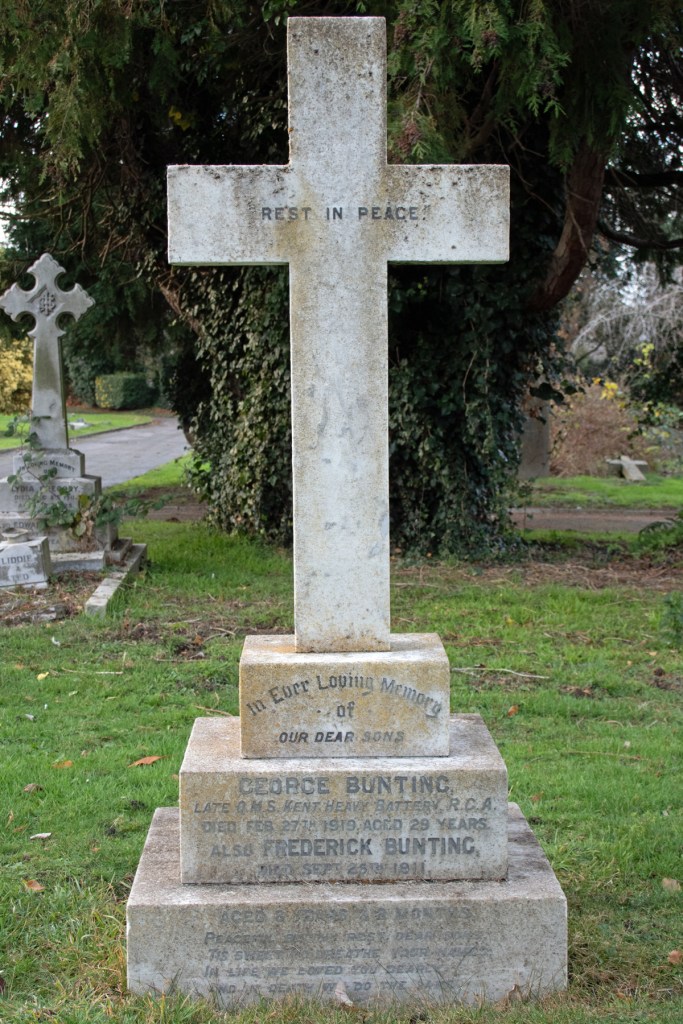
George William Willis Bunting was born in Faversham, Kent, in the spring of 1889. The middle of eleven children to George and Mary Ann Bunting, he was also the oldest boy. George Sr was a labourer in the town’s munitions works, and his son followed suit, and was recorded as a cordite labourer there in the 1911 census.
When war came to Europe, George Jr was keen to play his part. He enlisted in the Royal Garrison Artillery, and was assigned to the 343rd Siege Battery. While full details of his service are not available, George’s life was laid out in a newspaper report following his death:
The death has occurred in quite pathetic circumstances of Battery Quartermaster Sergeant George William Bunting, 1st Kent Heavy Battery, Royal Garrison Artillery… who, after serving throughout the war, and coming unscathed through more than three years service in France, though he had several narrow escapes, had died of pneumonia at his home, just as he was anticipating return to civil life.
BQMS Bunting joined the Faversham Volunteer Corps (in which his father also formerly served) some seven years before the war, and when was broke out he was at the annual training with the Battery. War service immediately followed and in 1915 he went to France and, except for leave, had been out there ever since until a few weeks back when he returned for demobilisation. He was not feeling at all well when he arrived home, indeed he seems to have been so unwell that when he got indoors he remarked “I’m done.”
His words, unhappily, were only too prophetic, for he never left the house again, pneumonia developing and culminating in his death on February 27th, only nice days after his arrival.
Prior to the war the deceased, who was in his 30th year and unmarried, had been employed at the Cotton Powder Works ever since he left school. At the commencement of his war service, he was a Corporal, but his keenness at his work steadily gained him promotion and eventually he reached the rank of Battery Quarter Master Sergeant. Keen and conscientious himself, he expected the same in others, and it says much for his example and influence that he was held in the very highest regard by the men of his Battery, while to his officers he was a greatly valued NCO.
Faversham News: Saturday 15th March 1919
Quartermaster Serjeant George William Willis Bunting died at his Faversham home on 27th February 1919. He was just 29 years of age. He was laid to rest in the town’s Borough Cemetery.
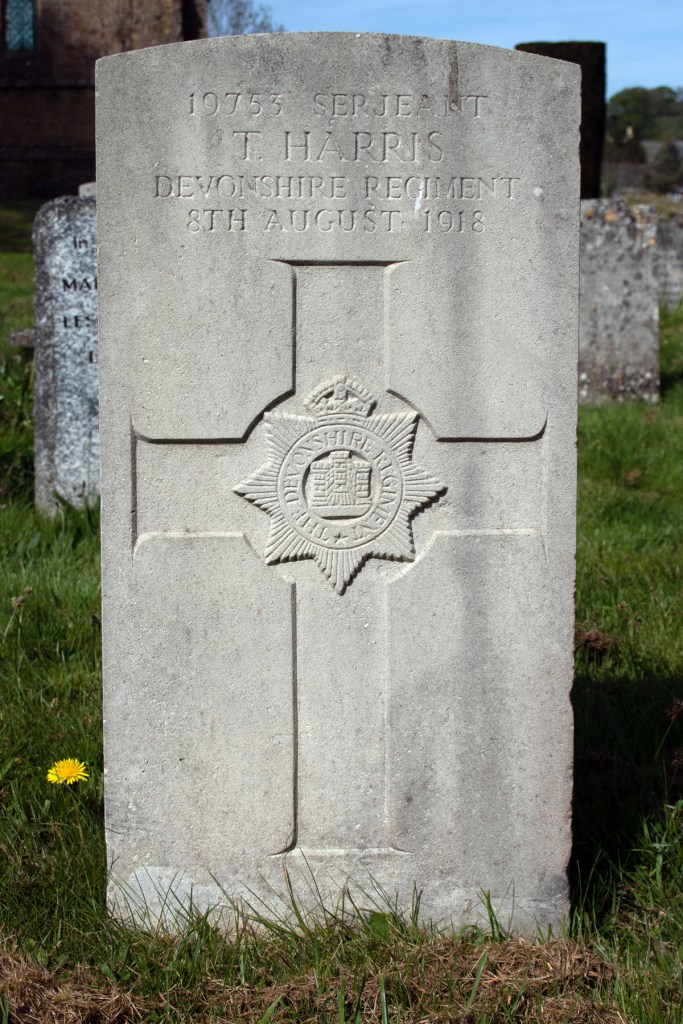
Thomas Harris – known as Tom – was born on 13th October 1876, the only son of Edmund and Mary Harris. Edmund was an agricultural labourer from the Somerset village of Seavington St Mary, and this is where Tom was born and raised.
Mary had married Edmund in the spring of 1876, but had been married before; she was widowed when her previous husband, Alfred Vickery, died ten years before. They had had seven children of their own, half-siblings to Tom.
Edmund died in the Wells Lunatic Asylum when Tom was only six years old. When he left school, he found work as a farm labourer, but sought bigger and better things, even though he was now the only one of Mary’s children still living at home.
Tom enlisted in the Somerset Light Infantry in January 1893, and soon found himself overseas. During his sixteen years’ service, he spent seven years in India and six months fighting in the Second Boer War. Corporal Harris seems to have had a sickly time of it, and while in India, was admitted to hospital a number of times for fever, ague and diarrhoea, as well as a bout of conjunctivitis.
When Tom’s contract came to an end in 1909, he returned to Britain, setting up home in Newport, South Wales, where he found work as a sheet weigher at the local steel works.
Mary died of senile decay and cardiac failure in May 1910. She was 74 years old, and sadly passed away in the Chard Workhouse, in similar circumstances to her late husband.
In October 1913, Tom married Ada Long in Chard. She was the daughter of a shopkeeper, and the couple set up home in South Wales, where Tom was still working.
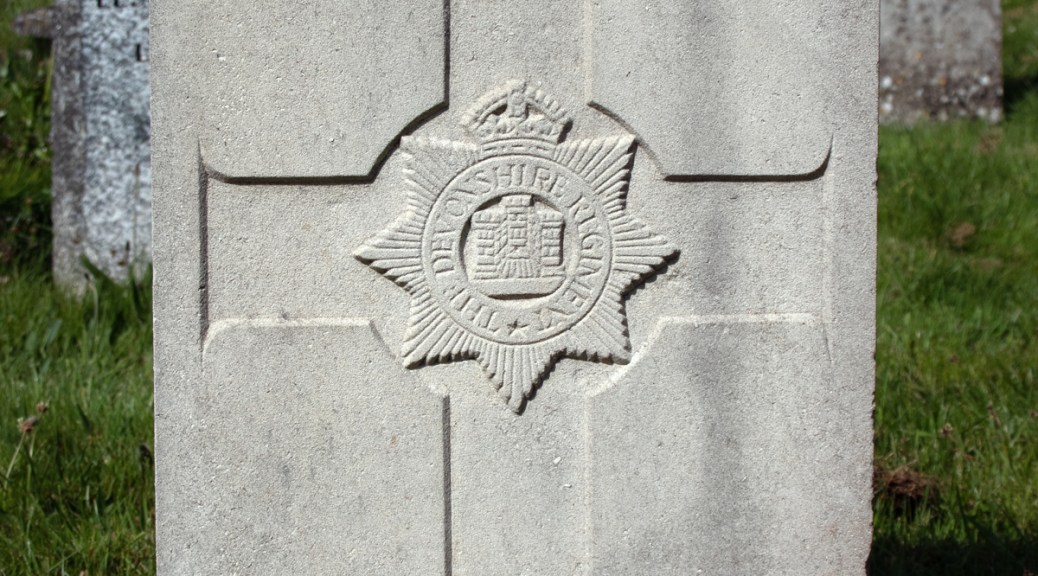
War, by now, was closing in on Europe, and Tom wanted to use his previous experience to serve his country once again. He enlisted on 20th August 1914 in Newport, joining the Devonshire Regiment as a Private, although he was quickly promoted first to Corporal and then to Serjeant. His service records show that he was 5ft 8ins (1.73m) tall, had blue eyes, brown hair and a tattoo of a Spanish girl on his right forearm.
After a year on the Home Front, Serjeant Harris was sent to Egypt in September 1915. On the way out, he contracted a severe cold, which left him deaf in his left ear. He was also suffering from varicose veins, which left him in pain in his right leg. He was treated for both conditions, and put on light duties for three months.
In November 1916, Serjeant Harris was supporting a food convoy when it came under attack. Buried in sand and wounded, he was laid up in a hole for two days and nights before help came. He was initially treated for shell shock in the camp hospital, but was eventually evacuated to Britain for treatment.
The incident had put too much of a strain on Tom, and he was medically discharged from the army in April 1917. While his medical report confirmed that the general paralysis he was suffering from was a result of the attack, it also noted on six separate occasions that he had previously suffered from syphilis, suggesting this may also have been a contributing factor to his mental state.
Tom was discharged initially to an asylum in South Wales, before returning home to Ada. The couple were soon expecting a child, and a boy, Sidney, was born in February 1918. By that summer, however, Tom’s condition had worsened enough for him to be admitted back to the Whitchurch Military Hospital in Cardiff.
It was here that Tom passed away, dying from a combination of chronic phlebitis – an extension of the varicose veins he had previously complained of – and general paralysis on 8th August 1918. He was, by this point, 41 years of age.
Tom Harris was brought back to Somerset for burial. He was laid to rest – finally at peace – in Chard Cemetery.
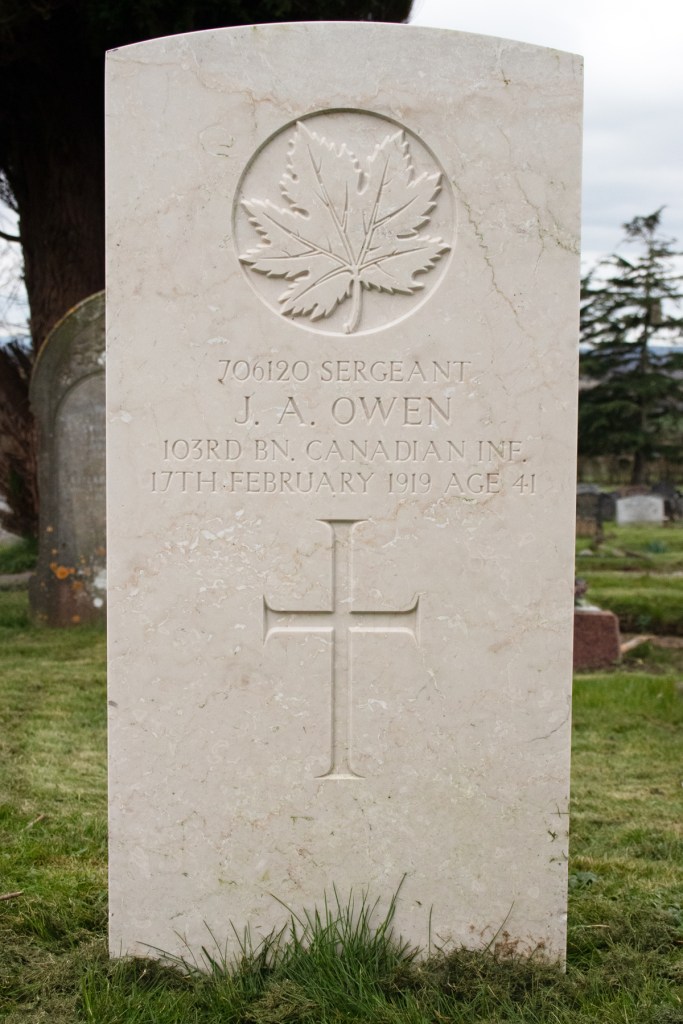
James Alfred Owen was born on 4th August 1877 and was the middle of three children to James and Sarah Owen. James Sr was a woodman from Herefordshire, who had moved the family to Radnor in mid-Wales.
James Jr’s early life has been lost to time, but by the time he turned 30, he had emigrated to Canada. He settled in the west coast town of Prince Rupert and found work as a salesman. On 28th January 1910 he married Hattie Whidden: the couple went on to have three children – Annie, Louisa and Dorothy.
War was coming to Europe, and James wanted to play his part for King and Country. He enlisted on 4th December 1915, joining the 103rd Battalion of the Canadian Infantry. His service records show that he stood 5ft 9ins (1.75m) tall and weighed 156lbs (70.8kg). His physical development was recorded as ‘average’, he had a ruddy complexion, brown hair and brown eyes. It was also noted that he had a birthmark in his left groin and his teeth were poor and required attention.
Private Owen departed for England in July 1916 and was assigned to the Oxney Camp in Hampshire. He was promoted to Corporal and then to Sergeant and, over the next few years, he remained in England. He was primarily based in barracks at Bramshott – also in Hampshire – though did spend time in Seaford in Sussex.
Sergeant Owen survived the war, but was admitted to the Ripon Military Hospital on 8th February 1919, having contracted bronchitis and malaria. The hospital didn’t have any specific expertise in contagious diseases, so it is likely that his move to Ripon was one stage of his move back to Canada.
Sadly, the conditions proved too much for James. He passed away on 17th February 1919, at the age of 41 years of age.
James Alfred Owen’s body was brought to Castle Cary in Somerset, where his sister Eleanor lived with her family. He was laid to rest in the town’s cemetery.
Frederick Davis was born in Street, near Glastonbury, in February 1876. One of four children, his parents were Frank and Ann. Frank was an agricultural labourer, while Ann worked as a shoe binder in the local Clark’s Factory.
By the 1891 census, Frederick had left school, and had also left home, boarding with a farmer in nearby Walton, where he also worked as a labourer on the farm. Ten years later, he was living with his paternal grandmother and his older brother in the village, with both brothers working as labourers.
During this time, it seems that Frederick had his sights on bigger and better things. Full details are not available, although it appears that he enlisted in the Army and served in India and South Africa between at least 1897 and 1902. He was awarded the Distinguished Conduct Medal in 1902 for his actions, although again little information around this survives.
Confirmation of his service overseas at this time appears on Frederick’s later military service records as, in January 1909, he again enlisted in the army. Frederick’s 1909 records show that his next of kin was his wife, Mrs AL Davis, although no marriage documents are apparent. He is also recorded as living in Castle Cary, just to the south of Glastonbury.
This time he was assigned to the 4th Battalion of the Somerset Light Infantry, serving for five years on home soil. During this time, he rose through the ranks from Private to Lance Corporal to Corporal to Sergeant.
When war was declared, the 4th Battalion was sent out to India. Sergeant Davis spent the next eighteen months there, before being moved to the Persian Gulf. He was obviously well thought of as, with the move came a further promotion, this time to Company Sergeant Major.
In June 1917, Frederick returned to England from overseas, and, at the end of his term of service two months later, he was demobbed. He returned home to Somerset, but, within a couple of months, on 2nd October 1917, he passed away. The cause of his death is not recorded, but he was 42 years of age.
Frederick Davis was laid to rest in the peaceful surrounds of the Castle Cary Cemetery.








 Death and Service