Thomas Ellis was born in 1896 in St Leonard’s, Sussex. The third of twelve children, his parents were George and Ellen Ellis. George was a general labourer, but when he finished his schooling, Thomas found work as a golf caddy. The 1911 census recorded the Ellis family living in four rooms at 7 Caves Road to the east of the town centre.
There is little additional information about Thomas, sadly. He joined the Royal Navy when war broke out, and was working as a Stoker 1st Class by the closing months of the conflict. He passed away, through causes unknown, on 7th July 1918, at the age of just 23 years old.
Thomas Ellis was laid to rest in the naval section of the Woodlands Cemetery in Gillingham, Kent, not far from the Royal Naval Dockyard in Chatham – HMS Pembroke – at which he was based.
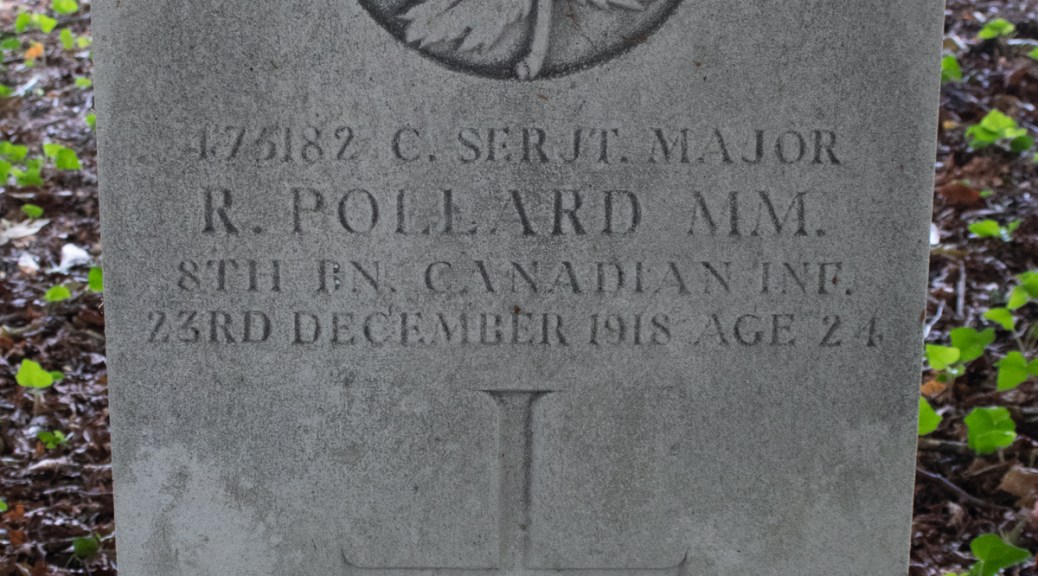
Robert Edwin Dawe Pollard was born on 8th April 1894 in Bath, Somerset. The youngest of three children, his parents were Joseph and Elizabeth Pollard. Joseph was a gardener from Banwell, but it seems that Robert had his sights on bigger and better things.
At some point Robert emigrated to Canada, and, by the time war was declared in Europe, he was working as an insurance clerk in Winnipeg. He felt a duty to serve his country, however, and on 2nd August 1915, he enlisted in the Canadian Expeditionary Force.
Private Pollard’s service records confirm he was 5ft 6ins (1.69m) tall, with dark brown hair, brown eyes and a fair complexion. He was also noted as being a Presbyterian.
Robert’s commitment to the cause is underlined by his rise through the ranks. Attached to to the 8th Battalion of the Canadian Infantry (also known as the 90th Winnipeg Rifles), he arrived in France on 27th February 1916.
The 8th Battalion was involved in some of the fiercest fighting of the war, and, on the 1st June 1916, he was wounded in his left arm. Admitted to a hospital in Camiers, he was moved to Etaples, before returning to his unit before the month was out.
For good or for bad, this was just before the Battle of the Somme and, over the next few months, Private Pollard fought bravely and hard. Moving from the Somme, his unit fought at Passchendaele and Ypres. On 1st October 1916, Robert was promoted to Corporal, and made Sergeant just three months later.
In April 1917, Robert was admitted to hospital again, this time with an infected foot. Within six weeks he was back with his unit, though, and on 7th November 1917, he was promoted to Company Serjeant Major. He was obviously good at what he did, and this was recognised. On 28th December 1917, he was mentioned in despatches, and the following June he was awarded the Meritorious Service Medal.
As the war entered its closing months, Company Serjeant Major Pollard, still led from the front. He returned to Britain at the end of November 1918, and was attached to the 18th Reserve Battalion in Seaford, Sussex ahead of being demobbed.
It was here that Robert contracted influenza. Whether at his family’s request is unclear, but he was admitted to Bath War Hospital for treatment but, after everything that he had been through, it was a combination of the flu and toxaemia, or blood poisoning, that was to prove his undoing. Company Serjeant Major Pollard died on 23rd December 1918, aged just 24 years old. His mother, Elizabeth was by his side.
Robert Edwin Dawe Pollard was laid to rest Bath’s sweeping Locksbrook Cemetery, not far from where his family lived. His headstone recognises the Military Medal he was posthumously awarded.
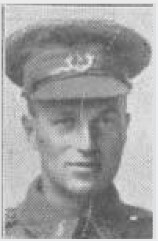
Company Serjeant Major Robert Pollard (from findagrave.com)
Conrad Thomas Bedford was born on 8th August 1891 in Bowes Park, Middlesex. The younger of two children, his parents were Thomas and Clara Bedford. Thomas was a bank clerk, who had a strong focus on education and, after his untimely death in 1899, aged just 40, Clara was keen to ensure that her only son received the best.
Conrad was educated at Seaford College in Sussex, and was boarding there at the time of the 1901 census. Whilst there, he served in the College Cadet Corps, which was attached to the Royal Sussex Engineers, and by the time he left, in 1909, he had taken the rank of Corporal.
When he completed his schooling, Conrad found work as a clerk in the London Joint Stock Bank, and soon volunteered for the London Rifle Brigade. When war broke out, he willingly stepped up to serve his country, and became attached to the regiment’s 5th Battalion.
The 1/5th (City of London) Battalion (London Rifle Brigade), to give the London Regiment’s unit it’s full title, fought on the Western Front, and Rifleman Bedford arrived in the Wallonia region of Belgium on 4th November 1914.
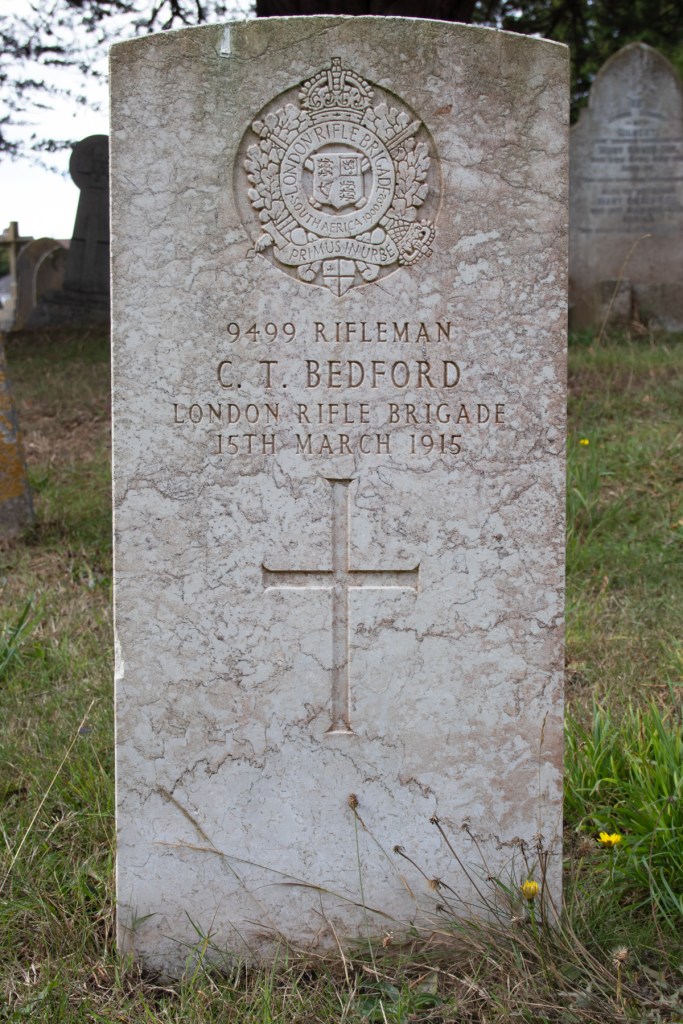
Early in 1915, Conrad was based near Ploegsteert, when, at around 2am on 27th February, he was shot in the right shoulder. He was medically evacuated to Britain, and admitted to the American Women’s War Hospital, in Paignton, Devon. While his injury was treated, sepsis set in, and Rifleman Bedford succumbed to it: he passed away on 15th March 1915, at the age of 23 years old.
Surprisingly, Clara did not bring her son back to London, where she was living. Instead, Conrad Thomas Bedford was laid to rest in Paignton Cemetery, not far from where he had breathed his last.
Laurence Edward Horsnell la Vavasour dit Durell was born on 24th December 1894, one of seven children to Edward and Julia. Edward was born in Jersey, in the Channel Islands, but he and Julia were living in Camberwell, Surrey, when Laurence was born.
The census records from the time show a family who came to be divided. In 1901, Edward was working as an artificial limb maker, while Julia looked after their son and the house the family shared at 14 Kerfield Crescent.
By 1911, things had changed significantly. Edward was now employed as a grocer’s storeman, and he and Laurence – apprenticed to a carpenter – were living with his parents, Edward and Sarah, at their home in St Clement, Jersey. Julia, meanwhile, was still on the mainland, where she was employed as a housekeeper for Frederick Manford, a 31-year-old cinema attendant in Hastings. Laurence’s younger sister, Phyllis, was also living there.
Laurence seemed keen to carve out a career for himself and, on 3rd January 1913, he enlisted in the Royal Navy as a Ship’s Carpenter. His service records show that he was 5ft 8ins (1.72m) tall, with dark hair, blue eyes and a fresh complexion. He was first sent to HMS Victory, the Royal Naval Dockyard in Portsmouth, Hampshire, for his training.
Over the next five years, Ship’s Carpenter Durell served on six ships, and as war broke out in the summer of 1914, his role became more and more vital. In May 1917, while serving on board the cruiser HMS Castor, he was promoted to the rank of Shipwright 2nd Class.
During the summer of 1918, Laurence contracted pneumonia. He was transferred to the hospital ship Soudan, but the condition was to prove too severe. He passed away on 15th July 1918, at the age of 23 years of age.
Laurence Edward Horsnell la Vavasour dit Durell was taken back to Jersey for burial. He was laid to rest a family plot in St Clement Churchyard, not far from where his relatives still lived.
Arthur Edward Naile was born in the summer of 1888, the youngest of ten children to James and Mary Naile. Both of his parents were born in Bath, Somerset, and this is where they raised their growing family.
The Nailes lived in the Camden area of the city, consecutive census returns showing different addresses, as the children grew and then left home. In 1891, they lived at 11 Malvern Buildings, a small terraced house on a steep hill. Ten years later, they had moved to 3 George’s Road, to another terraced cottage close to their old home. By 1911, only Arthur was still living at home, which was now the four-roomed terrace at 51 Brooklyn Road, in the more built up Larkhall area no the northern outskirts of the city.
During all of this time, James had worked as a printer’s compositor. By 1911 he was 64 years of age, and was employed by a newspaper in the area. Arthur, meanwhile, was working as a grocer’s assistant.
On 9th August 1914, he married soldier’s daughter Bessie Brine. She was working as a dressmaker, and lodging with Charles and Eleanor Richman, in a small cottage in Dover Place. Their marriage certificate shows that Arthur was living three doors down, so it is likely she caught his eye not long after he moved in. They went on to have a son, Leslie, in November 1916.
War was raging across Europe by this point, and Arthur had stepped up to serve his country. He joined the Royal Engineers as a Sapper, but there is little concrete information about his time in the army. He was awarded the Silver War Badge, which was given to men medically discharged from military service during the conflict, which would suggest that he was badly wounded at some point. He died in a hospital in Hastings, East Sussex, an annexe of which was dedicated to personnel who had been blinded during the war.
Sapper Arthur Edward Naile passed away from a combination of influenza and diabetes on 31st October 1918: he was 30 years of age. His body was taken back to Somerset for burial, and he lies at rest in a peaceful corner of Bath’s sweeping Locksbrook Cemetery.
After Arthur’s death, Bessie was left to bring up their young son. In the autumn of 1923, she married again, to John Forman, and not long afterwards the three of them emigrated to Australia, in search of a better life. They settled in Bunbury, Western Australia, and went on to have two children, Ron and Nan.
When war broke out again, Leslie was old enough to step up, and joined the Royal Australian Air Force. By 1943, he found himself as a Flight Sergeant in Waltham, Lincolnshire. He had joined 100 Squadron of Bomber Command and, on the night of 25th June 1943, was piloting a Lancaster over the Netherlands. His plane was hit and destroyed, killing all those on board. Father and son both lost to war, Flight Sergeant Naile was just 26 years of age when he passed. He was buried in Westbeemster, and commemorated on memorials in Runnymede, Surrey, and Canberra, Australia.
Bessie lived on until her early 70s. She died on 8th December 1960, and is buried in the family plot in Bunbury Cemetery.
Valentine Burnett Wilkinson was born early in 1889 in Combe Down, Somerset. One of eight children, his parents were Harry and Eliza Wilkinson, Harry was from nearby Bath and worked as a gardener, and this is the trade into which Valentine also went when he finished school.
In the spring of 1913, Valentine married Florence Moody. She was the daughter of a stone mason and, at the time of the 1911 census, she was employed as a live-in sewing maid at Monkton Combe Junior School.
Gardening seems to have been a footstep to something bigger for Valentine, and he soon found other employment, as a police constable. He and Florence moved to Street, near Glastonbury, and this is where they were living when war broke out.
Keen to play his part, Valentine enlisted in the Royal Garrison Artillery on 11th December 1915. He was placed on reserve, possibly because of his occupation, and was not formally mobilised until the end of June 1917, just six weeks after Florence had given birth to their first and only child, Joan.
Gunner Wilkinson’s service records note that he was 5ft 11ins (1.8m) tall, and had a scar on his right wrist. He spent five months training, split between No. 3 Depot in Plymouth, Devon, 473 Siege Battery and No. 1 Reinforcing Depot in Bexhill-on-Sea, Sussex. On 3rd November 1917, however, he was sent to France, and was attached to the 234th Siege Battery.
Gunner Wilkinson’s time overseas was to be brief, however. He was caught up in a gas attack in December, and evacuated back to Britain for treatment. His health was now impacted and, during the summer of 1918, he was admitted to hospital having contracted pleurisy. After two months in hospital, Valentine was sent to the Military Convalescent Hospital in Ashton-in-Makerfield, near Wigan.
The war was in its closing stages by this point, and in November 1918 Gunner Wilkinson resumed some of his duties, albeit on home soil. His health was still suffering, and he contracted tuberculosis on the lung and throat. He was formally discharged from the army on 27th February 1919, no longer physically fit to serve.
Valentine returned home to Somerset, and it was here, on 1st April 1919, that his body finally succumbed to the lung conditions that had dogged him for nearly eighteen months. He was just 30 years of age.
Valentine Burnett Wilkinson was laid to rest in the quiet graveyard of St Michael’s Church in the parish of his childhood home, Monkton Combe.
Harold Stanley Weston’s early life is destined to remain a mystery. He was born, according to his Royal Air Force service records, in Southgate, Middlesex in 1887 and, before war broke our, was working as a waiter before enlisting.
On 3rd August 1915, he married a woman called Gertrude in Hastings, Eat Sussex, and it appears that this is where the couple set up home. Harold has initially enlisted in the army, but transferred across to the Royal Flying Corps on 28th October 1915. Air Mechanic 2nd Class Weston’s service records show that he stood just 5ft 2.5ins (1.59m) tall.
Over the next three years, Harold rose through the ranks to Air Mechanic 1st Class, and served in France for nine months during 1916. He then returned to England, and was based at an airfield near Detling, Kent. When the Royal Flying Corps and the Royal Naval Air Service merged in April 1918, he transferred across to the newly-formed Royal Air Force, and was attached to 27 Squadron.
In November that year, Harold was admitted to the Military Hospital in Maidstone, also in Kent, having contracted influenza and pneumonia. Sadly, the lung conditions were to get the better of him, and he passed away on 1st November 1918, at the age of just 31 years old.
Air Mechanic 1st Class Harold Stanley Weston’s body was laid to rest in the quiet graveyard of St Martin’s Church in Detling, not far from the base at which he served. Gertrude posted her thanks to “all [their] friends for their kindness and sympathy shown to her in her sad bereavement, more especially Captain Saunders, RAF, Major Chapman, KCC [Kent County Council?], Sergeant Fowle, KCC, and Sergeant Weller, RAMC [Royal Army Medical Corps]” [Maidstone Telegraph: Saturday 9th November 1918]
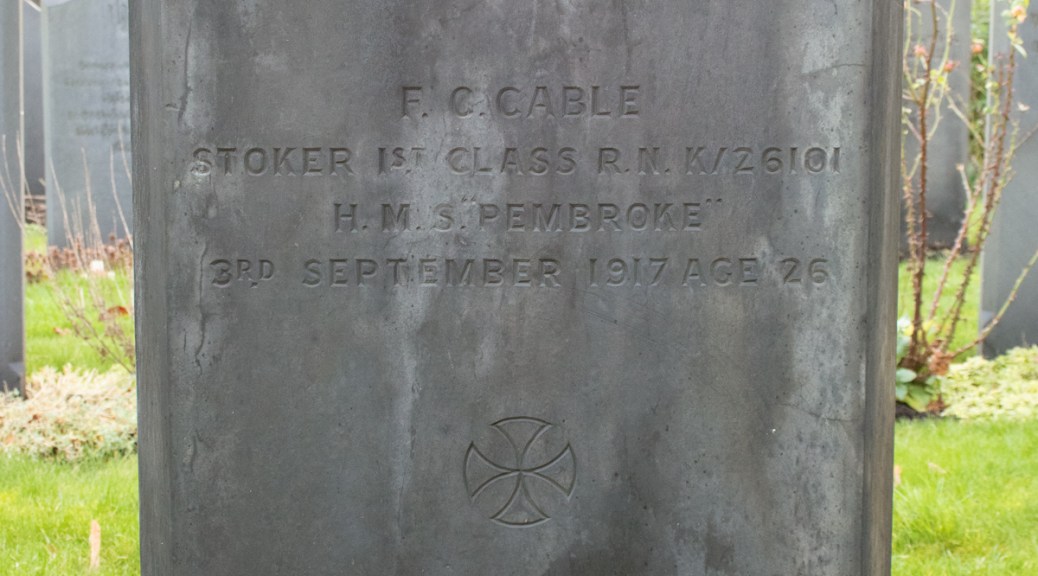
Frederick Charles Cable was born on 22nd November 1890 in Eastbourne, West Sussex. He was the younger of three children to John and Louisa Cable, and the family lived on one floor of a three-storey house in the middle of the town.
When Frederick was born, John was working as a billiard marker, but it seems that this was a poor way to scratch together a living for a young father. The 1901 census found the family in London, where John had been born, and where he was not employed as a hotel waiter.
Sadly, the new set-up was not to last long: John died in 1905, leaving Louisa to raise her boys on her own. The next census record, in 1911, records the two of them living a five-room terraced house in East Finchley. They were not alone, however, as they were sharing it with a widow – Elizbeth Hickinbottom – and her 34-year old son, George.
A year later, George and Louisa married, and went on to have a daughter, also called Louisa. Frederick, meanwhile, was to find love of his own, and, in the spring of 1914, while working as a milkman, he married Dorothy Ada Laurence. They would go on to have a son, who they named after his father, a year later.
By this point, war was raging in Europe, and Frederick was called to do his duty in May 1915. His records show that he was 5ft 7ins (1.70m) tall, had dark brown hair, brown eyes and a dark complexion and was given the rank of Stoker 2nd Class.
Over the next couple of years, Frederick served on two ships – HMS Actaeon and HMS Weymouth – and it was on board the latter that he was promoted to Stoker 1st Class in April 1916. The majority of his time, however, was spent on shore-based establishments: HMS Victory in Hampshire and HMS Pembroke in Kent.
The Royal Naval Dockyard in Chatham (HMS Pembroke) was where he spent most of his time, and was where he returned to in the summer of 1917. It was a particularly busy place at that point in the war and temporary accommodation was set up. Frederick found himself billeted at The Drill Hall, away from the main barracks.
On the night of 3rd September 1917, Chatham suddenly found itself in the firing line, as the German Air Force launched a bombing raid. One of the bombs landed squarely on the Drill Hall, and Stoker Cable was killed instantly. He was just 26 years old.
Ninety-eight servicemen perished during the Chatham Air Raid that night. They were buried in a mass funeral at the Woodlands Cemetery in nearby Gillingham. This, too, is where Frederick Charles Cable was laid to rest.
Frederick’s brother John Cable also fought in the First World War. He served as a Sergeant in the 21st Battalion Middlesex Regiment and was killed at the Battle of St Quentin on 25th March 1918. He was 28 years old and left a widow and three children. #
Serjeant John Cable is commemorated on the Arras Memorial in Northern France.
John Walker Lake was born in Eastbourne, East Sussex, in the spring of 1892, the only child of estate manager and auctioneer Percy Lake and his wife Elizabeth.
John’s mother passed away in 1900, when he was only eight years old, and details of his early life are hard to come by. However, by the time of the 1911 census, he had left school and enrolled in a mining college in Guston, near Dover, Kent.
When war broke out, John was quick to enlist. He joined the London Regiment on 18th September 1914, and was assigned to the 2nd/23rd Battalion. His service records show that he stood 5ft 8ins (1.72m) tall, had light hair, blue eyes and a fair complexion.
Private Lake was not to remain in the army for long. Within weeks of joining, he contracted tuberculosis and, on 22nd February 1915, after just 158 days, he was discharged from service as being no longer medically fit for duty.
At this point, John’s trail goes cold. He initially returned to live with his father in Eastbourne. By the autumn of 1918, however, he was in Weston-super-Mare, Somerset, probably for health reasons.
The tuberculosis got the better of John Walker Lake, however; he passed away on 20th October 1918, at the age of 26 years old. He was laid to rest in the Milton Road Cemetery in Weston-super-Mare.
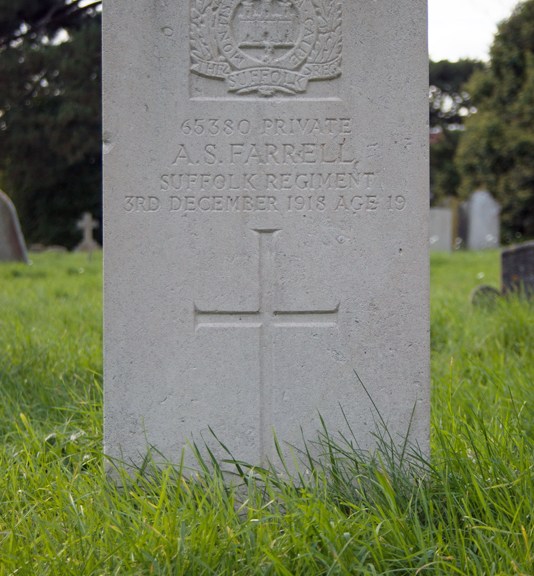
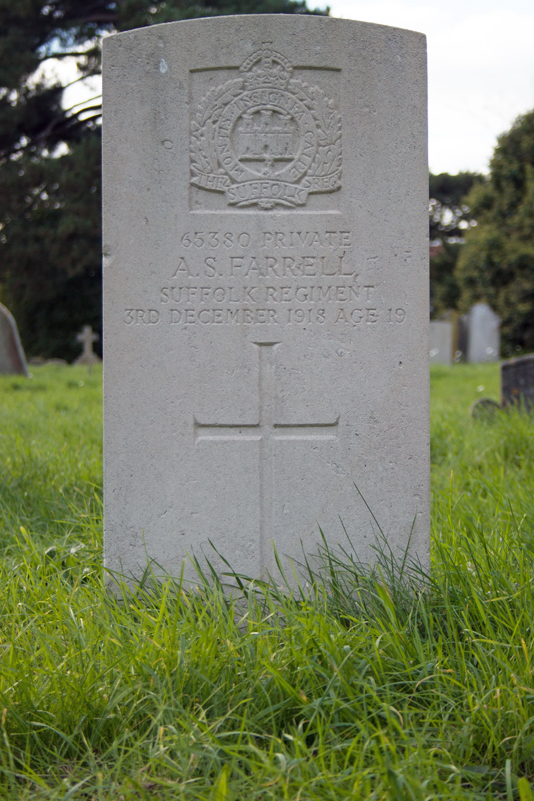
Albert Sydney Farrell was born in Mayfield, East Sussex, in the summer of 1899. One of four children his parents were gardener and coachman Arthur Farrell and his wife, Sarah Ann. Arthur had been born in Findon, a village to the north of Worthing, and is was to this town that he returned with his family. By the time of the 1911 census, when Albert was listed as a schoolboy, they were living in a small cottage within spitting distance of the sea.
Because of his youth, there is little further documentation on Albert’s early life. The war was coming, however, and he wanted to do his part. Dates cannot be confirmed, but he enlisted later in the conflict, at east before June 1918.
Private Farrell joined the Suffolk Regiment, and was assigned to the 1st (Reserve) Garrison Battalion. He would have carried out guard, escort and other similar duties from where he was based on the Isle of Grain in Kent.
Towards the end of the conflict, Albert fell ill; he was admitted to the Military Hospital in Sheerness, but sadly passed away on 3rd December 1918. He was just 19 years of age.
Albert Sydney Farrell was brought back to Worthing; he lies buried in the Broadwater Cemetery to the north of the town.











 Death and Service