Tag Archives: explosion

Able Seaman Andrew Jacobs

Able Seaman Andrew Jacobs

Andrew William Jacobs was born on 7th May 1895 in Battersea, Surrey. One of nine children, his parents were Andrew and Ellen Jacobs. Andrew Sr was a bricklayer by trade, and, at the time of the 1901 census, the family lived at 37 Gwynne Road, sharing the house with Arthur and Florence Pitman.

Not long afterwards, the Jacobs family has moved to 31 Farlton Road, and Andrew Jr and his brother Henry were sent to Garratt Lane School. Both were registered on 23rd September 1903, and remained there until 18th November 1904, when they were moved to another school. By this point, Andrew Jr had reached Grade II in the key subjects of reading, writing, arithmetic and spelling.

When he completed his education, Andrew Jr found work as a machine and minder for Price’s Candle Company. According to the 1911 census he was boarding with his older sister, Ellen, and her family, living in a three-room lodging in Durham Buildings, York Road, Battersea.

Later that year, with adventure in mind, Andrew joined the Royal Navy. By this point he gave his employment as a candle wick maker, and, being under the age to fully enlist, he was given the rank of Boy 2nd Class. Sent to the training base in Devonport, Devon, he quickly learnt the tools of his trade and, in January 1912, he was promoted to Boy 1st Class.

On 7th May 1913, Andrew came of age, and formally signed up to the Royal Navy. His papers show that he was 5ft 9.5ins (1.77m) tall, with brown hair, brown eyes and a fresh complexion. The now Ordinary Seaman Jacobs had already served on board the armoured cruiser HMS Leviathan, and was into his second year aboard the training ship HMS St Vincent. Even though he had spent less than two years with the navy, his reviews were promising, noting a very good character and superior ability.

In April 1914, Ordinary Seaman Jacobs was moved to another vessel, the battleship HMS Bulwark. With war on the horizon, she formed part of the Channel Fleet, and was tasked with patrolling and defending Britain’s southern coast. Here Andrew’s dedication continued, and he was promoted to Able Seaman on 9th September 1914.

Two months later, on 26th November 1914, Bulwark was moored in the River Medway, close to Sheerness, and was being stocked with shells and ammunition. That morning, some poorly stowed cordite charges overheated, detonating the shells stored nearby. The resulting explosion ripped through the battleship, sinking her and and killing more than 740 crew, Able Seaman Jacobs included. He was just 19 years of age.

Many of the bodies from HMS Bulwark were not recovered, while those that were, but were unable to be identified, were laid to rest in a communal grave in Woodlands Cemetery, Gillingham, Kent. The remains of Andrew William Jacobs were both recovered and identified: he was buried in a marked grave in the same cemetery.

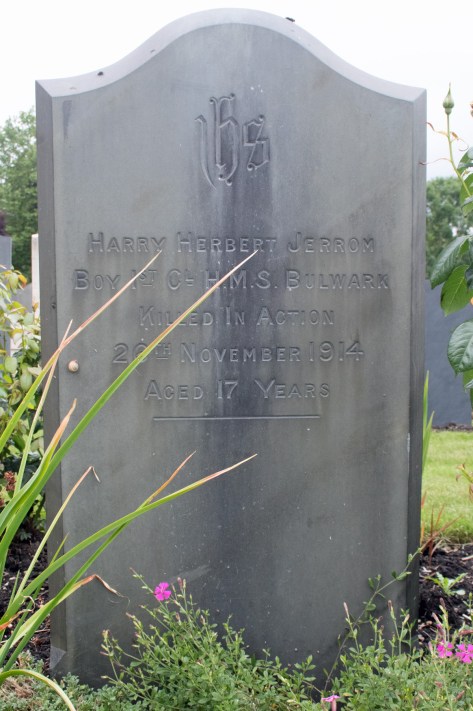
Boy 1st Class Harry Jerrom

Boy 1st Class Harry Jerrom

Harry Herbert Jerrom was born in the parish of Shinfield, Berkshire, on 26th July 1897. The oldest of eight children, his parents were caller Harry and Alice. Harry Sr was a farm labourer, and the family lived in Three Mile Cross.

Details of Harry Jr’s short life are scarce. Certainly when war broke out he stepped up to play his part, and had enlisted in the Royal Navy by the autumn of 1914. He was under the age to fully enlist by this point, and so held the rank of Boy 1st Class.

Harry was assigned to the battleship HMS Bulwark. Part of the Channel Fleet, she was tasked with patrolling and defending Britain’s southern coast. On 26th November 1914, Bulwark was moored in the River Medway, close to Sheerness, and was being stocked with shells and ammunition. That morning, some poorly stowed cordite charges overheated, detonating the shells stored nearby. The resulting explosion ripped through the battleship, and more than 740 crew were killed. Boy 1st Class Jerrom’s was among the bodies to be recovered: he was 17 years of age.

Those who were killed in the explosion were laid to rest in the naval section of Woodlands Cemetery, Gillingham, Kent. As his body had been identified, Harry Herbert Jerrom was laid to rest in a marked grave.


Boy 1st Class Harry Jerrom
(from findagrave.com)

Sergeant Herbert Marriott

Sergeant Herbert Marriott

Herbert Ernest Marriott was born on 15th November 1881 in the Hampshire village of Alverstoke (now part of Gosport). The younger of two children, his parents were George and Sarah Marriott. George was a navy pensioner, who died a matter of months after his youngest son was born, leaving Sarah to raise their two children alone.

The 1891 census found Sarah living at Prince Alfred Cottage in Alverstoke, with her two sons – Herbert, aged 9, and Joseph, aged 22 – and grandson, one-year-old Charles. She was employed as a launderess, while Joseph was employed as a bricklayer’s labourer.

Herbert was keen to build a career for himself and, on 20th July 1897, he enlisted in the Royal Marine Light Infantry. His service record shows that he was 5ft 7.5ins (1.71m) tall, with dark brown hair, brown eyes and a fresh complexion. He was also recorded as having a small scar on his left shoulder.

Private Marriott was sent just along the coast to Portsmouth for his training: this would become his land base in between voyages. He evidently showed some musical talent as, just two months after enlisting, he was given the rank of Bugler. Over the years the career he had sought grew, and his abilities grew with it.

Between 1897 and 1914, Herbert would serve on nine vessels in total. In February 1900 he became a Private once more, but by the end of the following year he had been promoted to Corporal. He continued to rise through the ranks, becoming Lance Sergeant in January 1905 and full Sergeant in the summer of 1907.

In the spring of 1901, Herbert married navy pensioner’s daughter Annie Hill. The newlyweds would set up home at 140 Queen’s Road, Gosport, and have six children between 1904 and 1914.

Back at sea and, by the time war was declared, Sergeant Marriott had been assigned to the battleship HMS Bulwark for two years. Part of the Channel Fleet, she was charged with patrolling and protecting the water off the south coast of England.

On 16th November, Bulwark was moored in the River Medway, near Sheerness, Kent, and being restocked with ammunition. A number of cordite charges had been stored incorrectly and overheated. These detonated the nearby shells and the resulting chain reaction of explosions ripped apart the battleship, sinking it and killing more than 740 crewmen, including Sergeant Marriott. He had turned 33 years of age just the day before.

The bodies recovered were laid to rest in the naval section of Woodlands Cemetery, Gillingham, Kent. As his had been identified, Herbert Ernest Marriott was buried in a marked grave.


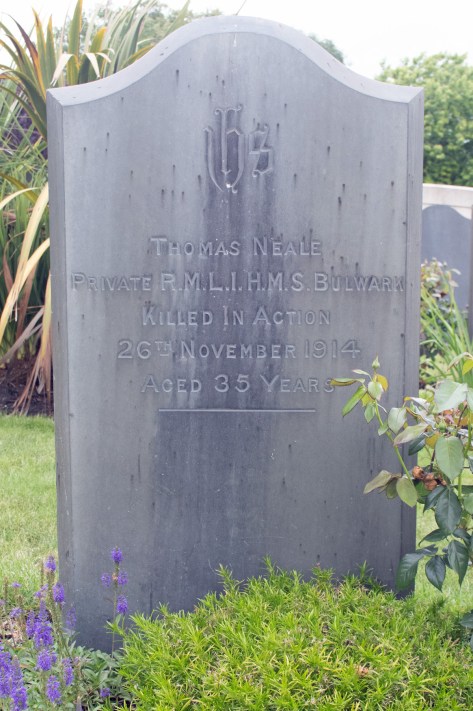
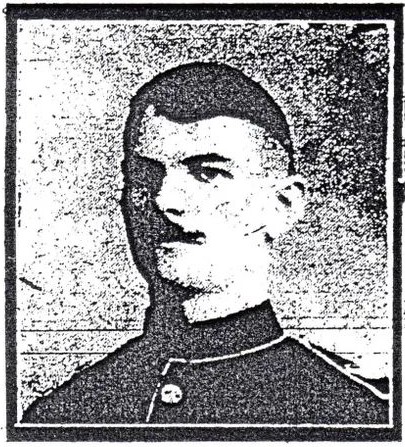
Private Thomas Neale

Private Thomas Neale

Thomas Neale was born in the Botley, Oxfordshire, on 3rd June 1876. One of eight children, his parents were George and Mary Neale. George was an agricultural labourer and the family would settle in Cumnor, just over the Berkshire border.

Thomas was keen to make a life for himself and, on 29th December 1898, he enlisted as a Private in the Royal Marine Light Infantry. HIs service papers show that he had been employed as a general labour and the point he signed up, and give an indication into the man he was becoming. He was noted as being 5ft 7ins (1.7m) tall, with grey eyes, brown hair and a fresh complexion. He was also recorded as having a small scar on his right knee.

Private Neale was initially sent to the Royal Marines barracks in Deal, Kent, for his training. Over the next sixteen years, he would serve on eight ships, each time returning to what would become his home base, the Royal Naval Dockyard in Portsmouth, Hampshire, in between voyages. While never outstanding, his annual reviews reported his good or very good character, and very good ability.

When war broke out in the summer of 1914, Private Neale was serving on board the battleship HMS Bulwark. Part of the Channel Fleet, her role was to patrol and protect the English Channel and south coast.

On 26th November she was moored up in the lower reaches of the River Medway, not far from Sheerness, being re-stocked with ammunition. That morning, a number of cordite charges overheated, detonating the shells stored nearby. The resulting explosion ripped through the battleship, and more than 740 crew were killed. Thomas was amongst those whose bodies were recovered and identified: he was 38 years of age.

The bodies that were recovered from the tragedy were taken to the Woodlands Cemetery in nearby Gillingham and laid to rest. Thomas Neale was buried alongside his colleagues in a marked grave, while those whose remains had not been identified were laid to rest in a mass grave nearby.


Private Thomas Neale
(from findagrave.com)

Ordinary Seaman Frederick Millis

Ordinary Seaman Frederick Millis

Frederick Harold Millis was born in Marylebone, Middlesex, on 18th March 1896, and was one of five children to horse keeper William Millis and his wife Emily. Details of his early life are a challenge to piece together – he does not appear on the 1901 census, although Emily and his siblings are recorded at 1 Linhope Street.

William died in 1908, and by the time of the 1911 census, Emily had moved to Brighton, Sussex, where she was living at 49 Bernard Street with Frederick and two of his brothers. Fred was 15 years old by this point, and was working as a telegraph messenger, while his older sibling Alfred was working as a draper’s assistant.

Frederick sought a better life for himself, and, on 28th January 1913, he signed up to the Royal Navy. Being under age, he was given the rank of Boy 2nd Class, and was sent to HMS Vivid, the Royal Naval Dockyard in Devonport, Devon, for his training.

After just three months, Frederick was promoted to Boy 1st Class, and just a few weeks later was assigned to the battleship HMS Prince of Wales. In October 1913, he was moved to another battleship, HMS Bulwark, and it was here that he was formally inducted into the navy.

The now Ordinary Seaman Millis signed up for twelve years’ service, and his papers note that he was 5ft 8ins (1.73m) tall, with dark brown hair, dark brown eyes and a fresh complexion. He was also recorded as having a clasped hands tattoo on his right forearm and another of a sailor on his left arm.

Ordinary Seaman Millis would remain on board HMS Bulwark for a year. The battleship was part of the Channel Fleet, tasked with patrolling and defending Britain’s southern coast. On 26th November 1914, she was moored in the River Medway, close to Sheerness, and was being stocked with shells and ammunition. That morning, some poorly stowed cordite charges overheated, detonating the shells stored nearby. The resulting explosion ripped through the battleship, and more than 740 crew were killed. Frederick was amongst those whose bodies were recovered and identified: he was 18 years of age.

The bodies that were recovered from the tragedy were taken to the Woodlands Cemetery in nearby Gillingham and laid to rest. Frederick Harold Millis was buried alongside his colleagues in a marked grave.


Frederick’s headstone suggests he held the rank of Officer’s Steward: this seems to be an error, and possible a mis-interpretation of the initials of Ordinary Seaman.


Able Seaman Bertram Warner

Able Seaman Bertram Warner

Bertram William Warner was born on 16th February 1895 in Greenford, Middlesex. The youngest of four children, his parents were jobbing gardener Henry Warner and his wife, Elizabeth.

Bertram began working with his father after he completed his schooling, but he had his heart set on bigger and better things. A life at sea drew him in and, on 7th February 1913, he enlisted in the Royal Navy. His service records show the young man he had become: he was 5ft 2ins (1.58m) tall, with dark hair, grey eyes and a fair complexion.

Initially taken on as a Boy 2nd Class, Bertram was sent to HMS Vivid, the Royal Naval Dockyard in Devonport, Devon, for his training. His records outline his ability and commitment to the role. On 28th May 1913, as he moved to the training ship HMS Prince of Wales, he was promoted to Boy 1st Class. On 8th August he was deemed to be of age, and officially inducted into the Royal Navy.

On 4th October, Ordinary Seaman Warner was transferred to the pre-dreadnought battleship HMS Bulwark. Based in Portland, Dorset, at the start of the First World War, she would form part of the Channel Fleet patrolling and defending Britain’s southern coast. Bertram was continuing to prove his mettle and, on 13th October 1914, just eighteen months after initially joining the navy, he was promoted again, to Able Seaman.

Bertram was on board Bulwark on the 26th November 1914, when she was moored close to Sheerness, Kent. That morning, some poorly stowed cordite charges overheated, detonating some of the hundreds of shells stored shells nearby. The resulting explosion ripped through the battleship, killing more than 740 people. Able Seaman Warner was amongst those killed whose bodies were recovered and identified: he was 19 years of age.

The body of Bertram William Warner was taken to Woodlands Cemetery in Gillingham, Kent, and laid to rest alongside his colleagues.


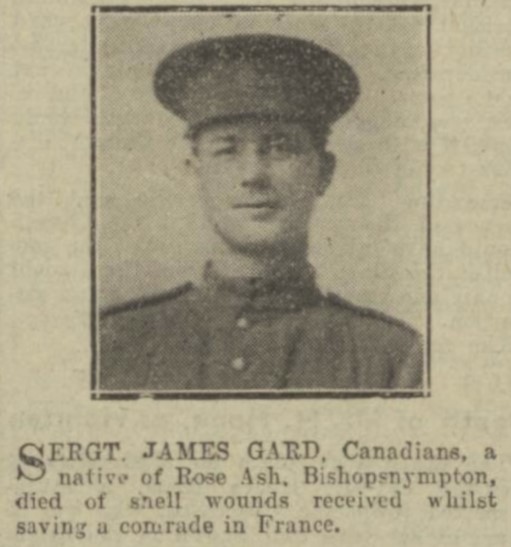
Sergeant James Gard

Sergeant James Gard

James Gard was born on 8th March 1889 in the Devon village of Rose Ash. One of fourteen children, he was the fourth of six sons to George and Mary Gard. George was a poultry dealer, but when both he and Mary died within two months of each other in 1897, their children were suddenly left as orphans.

The 1901 census found 12-year-old James visiting the Cole family, farmers who lived a few miles away in Bishops Nympton. James’ older brother Philip had plans, however, and in 1907, the two of them set out for a new life in Canada.

Boarding the SS Saxonia in Liverpool, they arrived in Boston with 50s (approx. £390 in today’s money) between them. Their final destination was to be Winnipeg in Manitoba, but the soon moved further north, setting up neighbouring homes in the town of Fisher Branch.

Both siblings found farming work, but when war broke out in Europe, James stepped up to play his part. On 24th February 1916 he enlisted in the Canadian Expeditionary Force, and was assigned to the Canadian Infantry. His service records show that he was 6ft (1.83m) tall and weighed 155lbs (70.3kg). He had dark brown hair, blue eyes and a ruddy complexion.

Private Gard set sail for Britain within a matter of weeks, arriving in Shorncliffe, Kent, on 12th May 1916. His unit – the 44th Battalion – moved to their base in Bramshott, Hampshire, and this is where he would receive his training.

James’ unit was involved in the fighting at the Somme and Ancre, and his commitment was rewarded when, on 20th January 1917, he was promoted to the rank of Sergeant. Just days later, however, he was badly injured.

A high explosive shell exploded near Sergeant Gard that day, bursting both of his eardrums. Initially treated on site, he was medically evacuated to Britain for treatment, and was admitted to the Military Hospital in Tooting, Surrey. He developed mastoiditis in both ears, and this, combined with septicaemia, lead to his ultimate death. He passed away on 1st April 1917, at the age of 28 years of age.

The body of James Gard was taken back to Devon for burial. He was laid to rest in the graveyard of St Peter’s Church in his home village, Rose Ash.


Sergeant James Gard
(from findagrave.com)

Seaman James McNichol

Seaman James McNichol

James McNichol was born on 21st December 1884, in Greenock, Renfrewshire. His parents were James and Elizabeth McNichol, but there is little additional information about his early life.

On 22nd May 1908, James enlisted as a Seaman in the Royal Naval Reserve. Again, little information is available, although he appears to have spent most of his career based out of his home town or on the ship Spindrift, based out of Glasgow.

James’ service records do shed some light on him. His height was recorded as 5ft 4ins (1.63m), he had a fair complexion and blue eyes. He also had a tattoo of a tombstone on his right arm and the words True Love on his right.

James had married a woman called Elizabeth at some point, and, while the marriage documents are lost to time, she is noted as his next of kin on his naval death records.

By the summer of 1912, Seaman McNichol was assigned to the battleship HMS Bulwark. The ship patrolled the English Channel at the outbreak of war, but by that autumn of 1914, she had moved to North Kent, guarding the waters around the Isle of Sheppey against potential German invasion.

James was on board Bulwark on the morning of 26th November 1914, when an explosion ripped through the ship and sinking it. More than 740 lives were lost, Seaman McNichol among them. He was just 29 years of age.

James McNichol was laid to rest in a marked grave in Woodlands Cemetery, Gillingham, not far from a mass grave where scores of his colleagues had been buried.


Seaman James McNichol
(from findagrave.com)

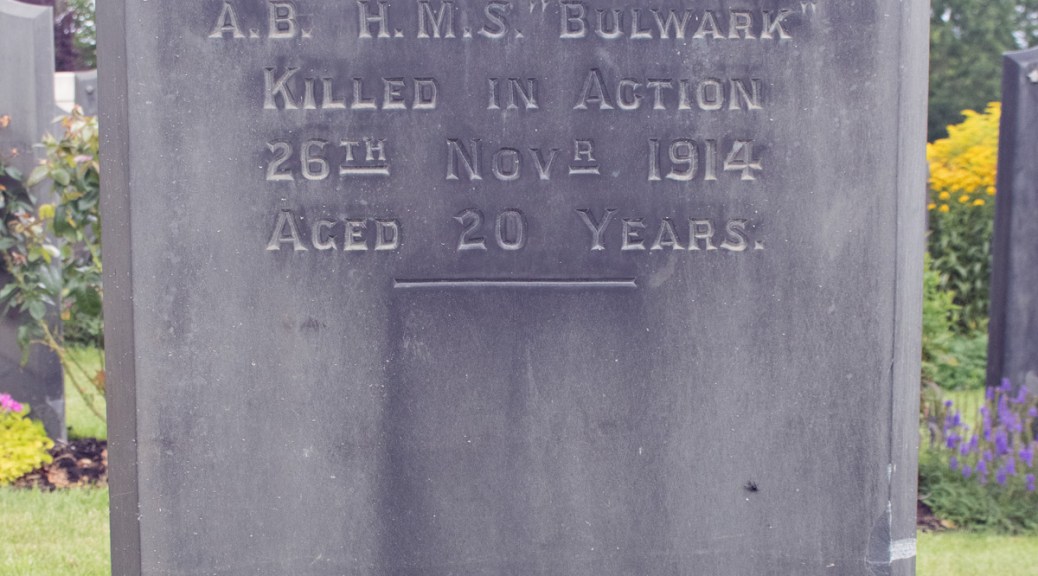
Private Thomas Clarke

Private Thomas Clarke

Thomas Clarke was born on 18th July 1893 in the Cheshire town of Altrincham. The second of nine children, his parents were Irish-born couple Thomas and Mary Clarke. Thomas Sr worked in the building trade as a bricklayer, but, by the time of the 1911 census, his older children had found other trades. His oldest child, Nora, was a shop assistant, Thomas Jr was a shorthand typist, while the next two Clarke children worked in the printing industry.

Thomas Jr, however, wanted to see the world and, on 3rd October 1911, he took his first step towards that aim, enlisting in the Royal Marine Light Infantry. His service records note that he was 5ft 6ins (1.68m) tall, had blue eyes, fair hair and a fresh complexion. They also record a scar on his left hand and a tattoo on his right arm.

Private Clarke was first sent for training in Deal, Kent, and his swimming ability tested there on 6th December, presumably in the freezing English Channel. In August 1912 he moved to barracks in Portsmouth, Hampshire. Over the next couple of years, he served on two ships – HMS Prince of Wales and HMS Dido – returning to the Royal Naval Dockyard in Portsmouth after each assignment.

In July 1914, Thomas was assigned to the battleship HMS Bulwark. The ship patrolled the English Channel when he first came on board. By that autumn, however, she had moved to North Kent, guarding the waters around the Isle of Sheppey against potential German invasion.

Thomas was on board Bulwark on the morning of 26th November 1914, when an explosion ripped through the ship and sinking it. More than 740 lives were lost, Private Clarke among them. He was just 21 years of age.

Thomas Clarke was laid to rest in a marked grave in Woodlands Cemetery, Gillingham, not far from a mass grave where scores of his colleagues had been buried.


Note: While Thomas’ surname is spelt Clark on his headstone, all documents relating to him – and the Commonwealth War Graves Commission website – give the correct spelling as Clarke.


Able Seaman John Griffin

Able Seaman John Griffin

John Griffin was born on 26th November 1885, one of six children to John and Mary Griffin. John Sr was a shoemaker from Limerick, Ireland, but it was in neighbouring County Clare, in the coastal town of Kilrush, that he and Mary raised their family.

John Jr’s siblings found labouring work when they left school, but he was after bigger and better things. In July 1901 he enlisted in the Royal Navy, set for a life at sea. As he was only fifteen years old at this point, he was not formally enrolled in service, but given the rank of Boy 2nd Class. He was initially posted to the training ship HMS Black Prince, which was based in Queenstown – now Cobh – County Cork.

Boy Griffin spent nine months on board the Black Prince, rising to the rank of Boy 1st Class in the process. In May 1902 he was given his first posting, aboard the battleship HMS Minotaur. After six months he transferred to the frigate HMS Agincourt, before moving again – to HMS Russell – on 18th February 1903.

It was while John was assigned to this battleship that he came of age. On his eighteenth birthday, he was formally enlisted into the Royal Navy for a period of 12 years’ service. He was given the rank of Ordinary Seaman and his records give an indication of the man he had become. They note that he was 5ft 4.5ins (1.64m) tall, with dark brown hair, brown eyes and a fresh complexion.

In April 1904, Ordinary Seaman Griffin was transferred to the battleship HMS Queen. He spent two years on board, gaining a further promotion – to Able Seaman – in September 1905.

Over the next nine years, John served on seven further vessels and, when not at sea, was based primarily at HMS Vivid, the Royal Naval Dockyard in Plymouth/Devonport, Devon. In July 1914, with Europe on the brink of war, he was given another transfer, to the battleship HMS Bulwark. Boarding in Portsmouth, Hampshire, the ship sailed to the North Kent coast, off Sheerness.

Able Seaman Griffin was on board Bulwark when, on the morning of 26th November 1914, an explosion ripped through the ship, tearing it apart and sinking it. In all 741 souls were lost, John among them. He should have been celebrating his 29th birthday.

The majority of those who died in the explosion aboard HMS Bulwark were buried in a mass grave in Woodland Cemetery, Gillingham, Kent. John’s body, however, was not recovered until 24th January 1915, some two months after the explosion.

The sixteenth inquest on the victims of the Bulwark disaster was held at Chatham Naval Hospital on Monday. A body clothed in the dress of a patty officer was identified as that of Thomas Henry Treacher, who was a gun-layer. Two stokers were identified by marks on their clothing as Daniel Johnson, of Blackfields, Co. Kerry. and Edward Henry Buckingham of Nunhead, London, and an able seaman’s body proved to be that of John Griffin, of Kilrush, Co. Clare. The jury returned a verdict of accidental death in each case. Twenty-five bodies have now been recovered.

Westerham Herald: Saturday 30th January 1915

John Griffin was laid to rest in a marked grave in Woodlands Cemetery, not far from his fellow servicemen.