Tag Archives: family

Bombardier Thomas Greenslade

Bombardier Thomas Greenslade

Thomas Greenslade was born in Alcombe, on the outskirts of Dunster in Somerset, in the spring of 1894 and was one of ten children. His parents were Devon-born cab proprietor Richard, and his wife Emma, who passed away in 1905, aged 38 years old.

When he left school, Thomas helped his father with his business; the 1911 census recorded him and his older brother Charles as drivers, his younger two sisters as housekeepers for their father, and his youngest two siblings as still being at school.

Storm clouds were approaching Europe and, in the summer of 1915, Thomas signed up to play his part for King and Country. He joined the Royal Field Artillery, and was assigned as a Bombardier to C Battery of the 74th Brigade. His troop was one of the Howitzer Brigades, and it seems likely that his knowledge of horses stood him in good stead.

Little information on Bombardier Greenslade’s military service survives. His regiment saw conflict at Loos, the 1916 Battles of the Somme and the Third Battle of Ypres, and it is likely that he was involved in these skirmishes.

What can be confirmed is that, by July 1917, Thomas was in the War Hospital in Bristol. The reason for his admission is unclear, but it led to his demise. Bombardier Greenslade passed away on 11th July 1917: he was just 23 years of age.

Thomas Greenslade’s body was brought back to Dunster. He was laid to rest in a quiet corner of the village’s cemetery.


Sapper Ronald Blackwell

Sapper Ronald Blackwell

Ronald James Ewart Blackwell was born in London in February 1890, one of eight children to Frederick and Elizabeth Blackwell. Frederick was a tailor from Devon, while Elizabeth had been born in Somerset. By the time of the 1911 census, they had moved back to Somerset, settling in the village of Dunster.

Ronald followed in his father’s footsteps and, by the time war broke out, was living and working in Taunton. It’s clear that he wanted to play his part in the growing conflict, enlisting in the Royal Engineers in January 1915.

Sapper Blackwell’s service records confirm that he stood 5ft 6.5ins (1.69m) tall; they also note that he had the tattoo of a heart on his left forearm. His skill as a tailor is mentioned numerous times, and it appears that this talent was how his time was put to use. He was shipped to France on 25th January 1915, and, by the end of the conflict, he was in Italy. It was from here that he returned to England on 26th January 1919.

It seems that Ronald’s return to the UK was as a result of him becoming ill, as, within a month of coming home, he was medically discharged from the army, having been suffering from tuberculosis.

Ronald returned to Somerset, but was to be dogged by the lung disease for a further year. He passed away at home on 25th June 1920, aged just 30 years old.

Ronald James Ewart Blackwell was laid to rest in Dunster Cemetery, not far from his parents’ then home.


Ronald’s older brother, Harold Frederick Blackwell, also fought in the First World War. He was a Private in the 2nd Battalion of the Essex Regiment. He was killed during the Allied advance into Flanders in August 1918, and was laid to rest in the Terlincthun British Cemetery in Northern France.


Serjeant Howard Parker

Serjeant Howard Parker

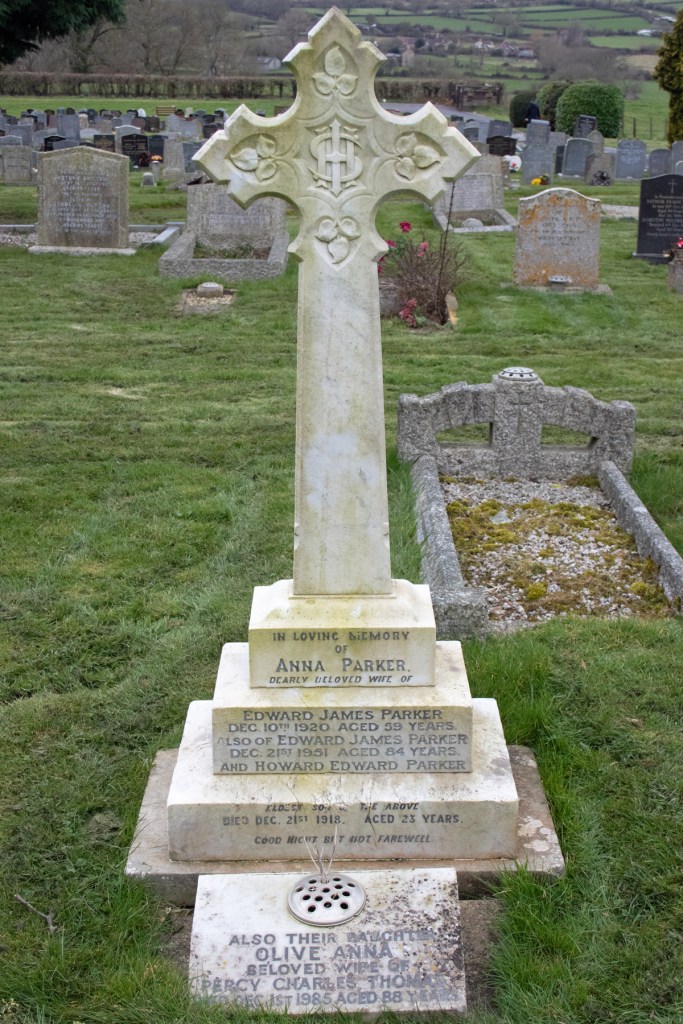
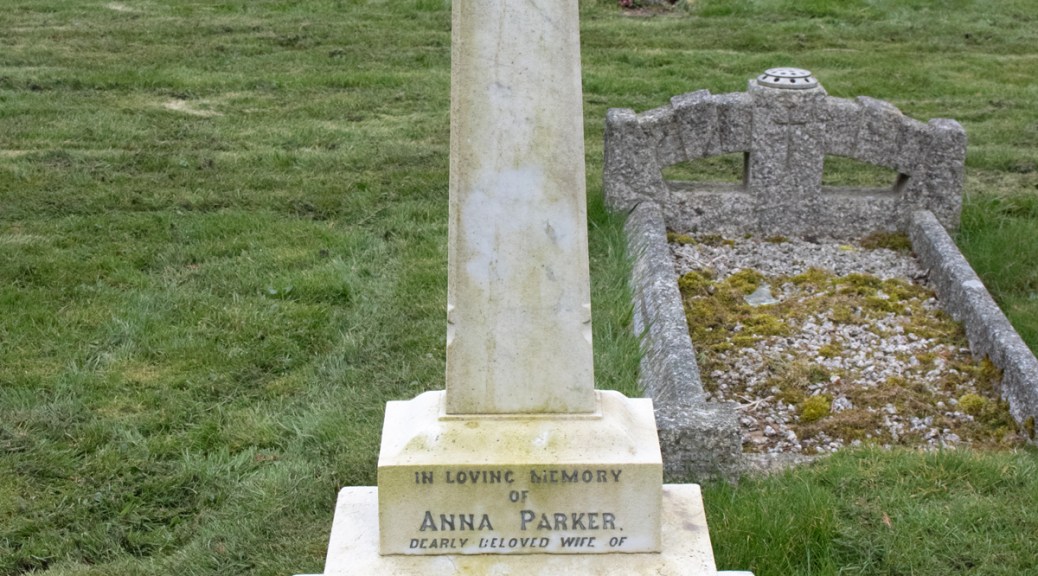
Howard Edward Parker was born in the summer of 1895 and was one of six children to Edward and Anna Parker. Edward was a tailor from Castle Cary, Somerset, and it was in his home town that he raised his young family. When he left school, Edward worked as his father’s clerk.

War was on the way, however, and Edward was keen to play his part. Unfortunately, details of his military service are limited, but from what little remains, it’s possible to piece some bits together.

Edward joined the Army Ordnance Corps at some point before June 1918. During his time in the army, he rose to the rank of Serjeant, but it is unclear whether he served on home soil or abroad.

The only other certain information is Serjeant Parker died in Southampton on 21st December 1918; the cause of his passing is unclear, and there is nothing in contemporary newspapers to suggest anything out of the ordinary. He was just 23 years of age.

Howard Edward Parker’s body was brought back to Somerset for burial. He was laid to rest in the family grave in Castle Cary Cemetery.


Serjeant Howard Parker
(from findagrave.com)

Rifleman George Hill

Rifleman George Hill

George Hill was born in Castle Cary, Somerset, in 1868. Documents relating to his early life are hard to pin down and, as his is a common name, it is not possible to identify any parental relationships.

The first document that can be categorically connected to George is the 1891 census. This confirms that he was living in his home town, and was married to a woman called Ellen. The couple had a year-old daughter, Elsie, and were both employed as horsehair workers, getting the material ready for use in upholstery.

It seems that Ellen must have died soon after the census as, in the autumn of 1893, he married Florence Cave, a stonemason’s daughter, who was also from Castle Cary. The 1901 census finds George and Florence living with Elsie, but with two children of their own, Laura and Edward.

By the time of the following census, in 1911, the family had grown again, with two more children, Percy and Doris. George’s eldest daughter was, at this point, working as a housemaid for a family in Winchester, while Laura was employed as a tailoress. George himself was still working as a horsehair curler, a trade he had been in for more than twenty years.

War was on its way, and despite being in his mid-forties, George appeared to have been keen to play his part. Full details are not available, but it seems that he had enlisted by May 1918, initially joining the Somerset Light Infantry, where he was assigned to the 4th Battalion. He was soon transferred over to the Rifle Brigade, however, and was attached to the 22nd (Wessex and Welsh) Battalion.

This particular troop initially served on home soil but was sent to Salonika in the Eastern Mediterranean in 1916. There is nothing in Rifleman Hill’s records to suggest that he went with them, however, and it may be that he had not yet enlisted at this point in the conflict. His medal records show that he was awarded the Victory and British Medals, but that these were for his territorial work, rather than anything overseas.

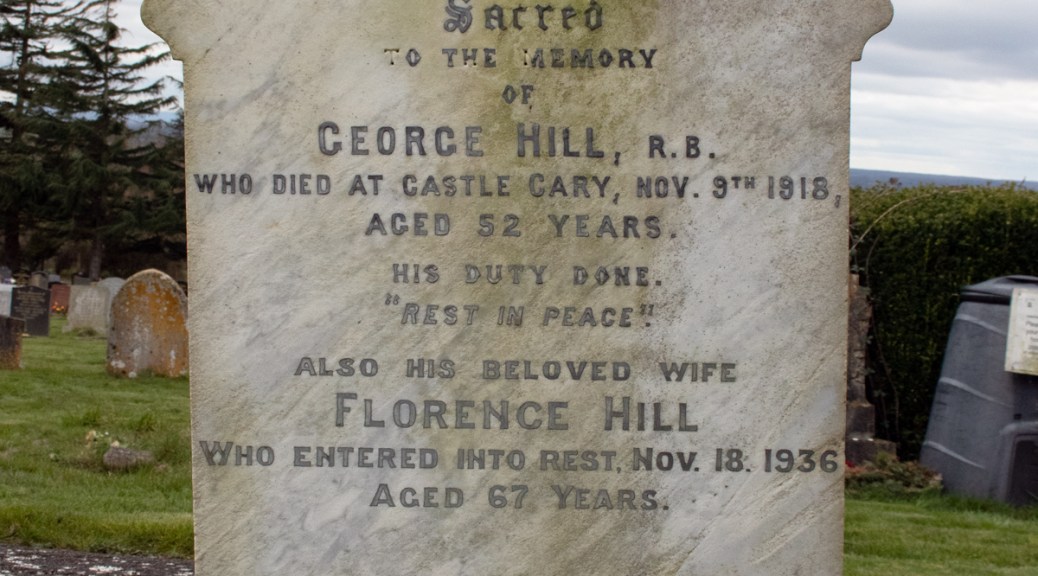
Rifleman Hill served until near the end of the war. He had returned home by November 1918, and it was here, on the 9th, that he passed away from pneumonia. He was 52 years of age.

George Hill was buried in the cemetery of his home town, in the family plot. Florence was also laid to rest there, some eighteen years later, husband and wife together again at last.


Sergeant James Owen

Sergeant James Owen

James Alfred Owen was born on 4th August 1877 and was the middle of three children to James and Sarah Owen. James Sr was a woodman from Herefordshire, who had moved the family to Radnor in mid-Wales.

James Jr’s early life has been lost to time, but by the time he turned 30, he had emigrated to Canada. He settled in the west coast town of Prince Rupert and found work as a salesman. On 28th January 1910 he married Hattie Whidden: the couple went on to have three children – Annie, Louisa and Dorothy.

War was coming to Europe, and James wanted to play his part for King and Country. He enlisted on 4th December 1915, joining the 103rd Battalion of the Canadian Infantry. His service records show that he stood 5ft 9ins (1.75m) tall and weighed 156lbs (70.8kg). His physical development was recorded as ‘average’, he had a ruddy complexion, brown hair and brown eyes. It was also noted that he had a birthmark in his left groin and his teeth were poor and required attention.

Private Owen departed for England in July 1916 and was assigned to the Oxney Camp in Hampshire. He was promoted to Corporal and then to Sergeant and, over the next few years, he remained in England. He was primarily based in barracks at Bramshott – also in Hampshire – though did spend time in Seaford in Sussex.

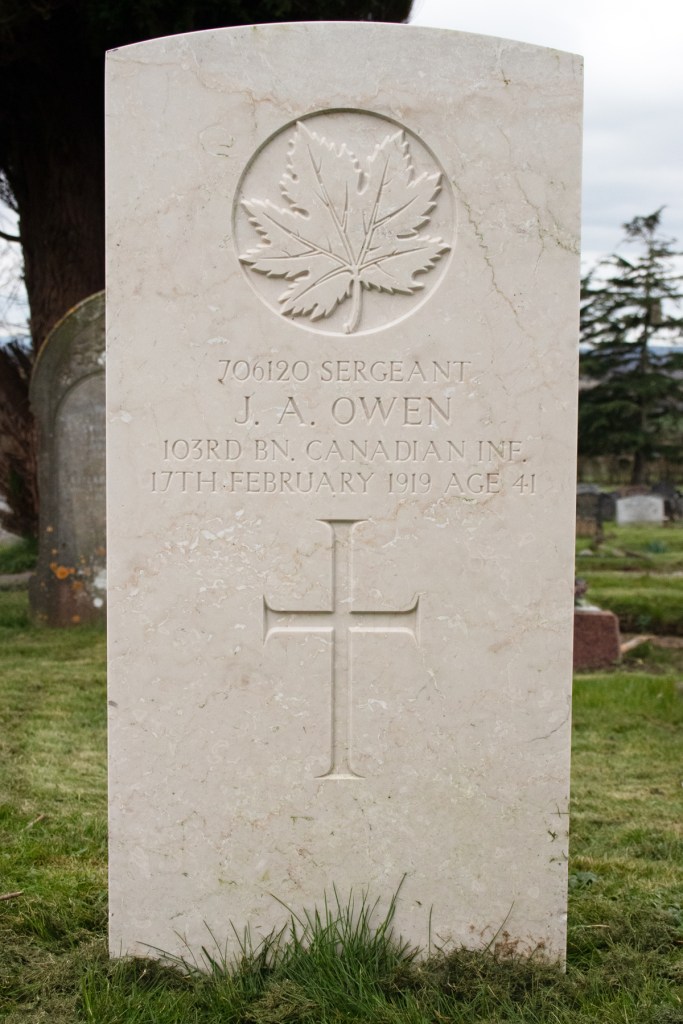
Sergeant Owen survived the war, but was admitted to the Ripon Military Hospital on 8th February 1919, having contracted bronchitis and malaria. The hospital didn’t have any specific expertise in contagious diseases, so it is likely that his move to Ripon was one stage of his move back to Canada.

Sadly, the conditions proved too much for James. He passed away on 17th February 1919, at the age of 41 years of age.

James Alfred Owen’s body was brought to Castle Cary in Somerset, where his sister Eleanor lived with her family. He was laid to rest in the town’s cemetery.


Private Arthur Foote

Private Arthur Foote

Arthur Thomas Foote was born on 18th June 1880 in the Dorset town of Sherborne. One of three children to Jane Foote, his mother married widower James Rose in 1887, giving Arthur a half-sibling. James passed away in 1889, and Jane married another widower – Albin Pitman – and Arthur had a further six siblings and half-siblings.

By this point, the family had moved to Somerset, settling in Compton Pauncefoot. The 1901 census recorded Arthur as having left the family home and he was boarding in nearby Holton. He had, by this time, found work as a carter.

Arthur had met Agnes Wetherall, a tailor’s daughter from the village of Baltonsborough. The couple married in Wells in April 1902, and set up home in nearby Glastonbury. They went on to have two children – Robert, who had been born in 1898, and Lillian, who was born in 1902 – and Arthur continued working as a carter for a miller.

When war broke out, Arthur enlisted. While full details of his service are not available, he joined the Royal Berkshire Regiment as a Private, and was assigned to their Labour Corps.

Robert had also enlisted early on in the war. He joined the 2nd Battalion Coldstream Guards, and was killed in fighting in Northern France in September 1916. He was awarded the Mons Star, and is commemorated on the memorial at Thiepval.

Arthur survived the war, and returned home in early 1919. He quickly came down with pneumonia, and passed away within a week of his return, on 11th February 1919. He was 38 years old.

Arthur Thomas Foote was laid to rest in a now overgrown plot at the top of Glastonbury Cemetery, walking distance from the family home.


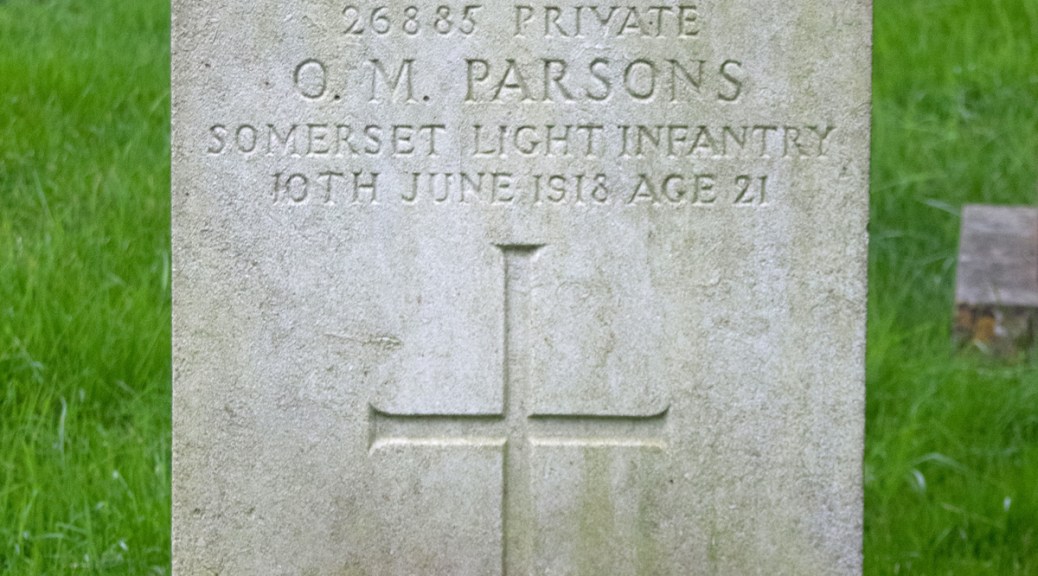
Private Oliver Parsons

Private Oliver Parsons

Oliver Metford Parsons was born in North Newton, Somerset, on 3rd January 1897. His parents were Thomas and Lily Parsons, and he was one of four children.

Thomas was a carter and labourer on a farm, and this is the trade his son took up when he left school. The 1911 census recorded Oliver as living with the market gardener Edmund Durridge and his family – who lived in the same village – and working as a labourer for them.

Lily had passed away in 1907, so this move may have had something to do with a change in family circumstances – the 1911 census recorded Thomas living in the village with Hannah Parsons, having been married for just a year.

When war came to Europe, Oliver was keen to play his part for King and Country. While full service records are not available, documents confirm that he enlisted in the Somerset Light Infantry in the spring of 1917. Private Parsons was assigned to the 7th (Service) Battalion and soon found himself on the Front Line.

While it is not possible to pinpoint exactly where Oliver fought, his battalion fought at the Third Battle of Ypres and, in April 1918 moved to Amiens.

It was in June 1918 that Private Parsons was caught up in a gas attack. He was injured and medically evacuated to England for treatment, where he was admitted to the Ipswich Hospital in Suffolk. Sadly, his injuries proved too severe, and he passed away at the hospital on 10th June 1918. He was just 21 years of age.

Oliver Metford Parsons’ body was brought back to his Somerset home. He was laid to rest in the graveyard of St Peter’s Church in North Newton.


Private Oliver Parsons
(from ancestry.com)

Private John Lake

Private John Lake

John Walker Lake was born in Eastbourne, East Sussex, in the spring of 1892, the only child of estate manager and auctioneer Percy Lake and his wife Elizabeth.

John’s mother passed away in 1900, when he was only eight years old, and details of his early life are hard to come by. However, by the time of the 1911 census, he had left school and enrolled in a mining college in Guston, near Dover, Kent.

When war broke out, John was quick to enlist. He joined the London Regiment on 18th September 1914, and was assigned to the 2nd/23rd Battalion. His service records show that he stood 5ft 8ins (1.72m) tall, had light hair, blue eyes and a fair complexion.

Private Lake was not to remain in the army for long. Within weeks of joining, he contracted tuberculosis and, on 22nd February 1915, after just 158 days, he was discharged from service as being no longer medically fit for duty.

At this point, John’s trail goes cold. He initially returned to live with his father in Eastbourne. By the autumn of 1918, however, he was in Weston-super-Mare, Somerset, probably for health reasons.

The tuberculosis got the better of John Walker Lake, however; he passed away on 20th October 1918, at the age of 26 years old. He was laid to rest in the Milton Road Cemetery in Weston-super-Mare.


Lieutenant Cecil Pearse

Lieutenant Cecil Pearse

Cecil George Lunell Pearse was born in the spring of 1883, one of seven children to George and Elizabeth Pearse. George was a schoolmaster from Devon, who moved the family to Weston-super-Mare in Somerset in the the 1870s to take up a post at the National School in the centre of the town.

Cecil and at least two of his siblings also went on to become teachers. By the time of the 1911 census, he was living in Plumstead, South East London, with his brother and sister-in-law, and teaching locally.

War was about to descend on Europe, and it is at this point that Cecil’s trail begins to go cold. He enlisted in the Royal Field Artillery, serving as part of the 8th London Howitzer Brigade. During his time, he rose to the rank of Lieutenant, and it seems that he remained part of the Territorial Force, but there is little more information available about his time in the army.

Nor is there much detail around Lieutenant Pearse’s death. He passed away on 20th October 1918, at the age of 35 years old, through causes unrecorded.

Cecil George Lunell Pearse was laid to rest in the Milton Road Cemetery in Weston-super-Mare, the town of his birth.


Private Roderick Smith

Private Roderick Smith

Roderick Morgan Smith was born on 14th April 1896 in Upton Park, Essex. One of twin sons to Francis and Frances Smith, he had three siblings altogether. Francis is absent from the two census returns on which Roderick features, but the documents confirm that Frances – who was a certified teacher – was married, so he may have been elsewhere at the time.

By the time of the 1901 census, the family had moved from East London to Monmouthshire, where Roderick’s mother was teaching at the school in the village of Wonastow. Ten years later, they had moved across the River Severn to Withycombe in Somerset, not far from where Frances had been born. Other records show that they subsequently moved to Bath, then to Weston-super-Mare.

When war broke out, Roderick was keen to join up. He enlisted as a Private in the Durham Light Infantry, and was assigned to the 7th Battalion. He was sent to France in the spring of 1915, and would have been involved with his regiment at Ypres and the Somme.

It was at the Somme that Private Smith was gassed and wounded. Full details are not recorded, but they were enough for him to be medically evacuated to England. He was admitted to the military hospital in Taunton, but passed away on 7th May 1916. He was just 20 years of age.

Roderick Morgan Smith was brought to Weston-super-Mare and laid to rest in the town’s Milton Road Cemetery.


Roderick’s twin, Frank Morgan Smith, also played his part in the First World War. He enlisted in the Bedfordshire Regiment as a Private, and was assigned to the 7th Battalion. He also found himself embroiled at the Somme, and he too was wounded.

Sadly, Frank’s wounds were too severe for him to be repatriated to England; he died in a French hospital on 3rd December 1916, also aged 20 years old. He was laid to rest at the Wimeraux Cemetery.