Tag Archives: heart

Private Albert Sweetland

Private Albert Sweetland

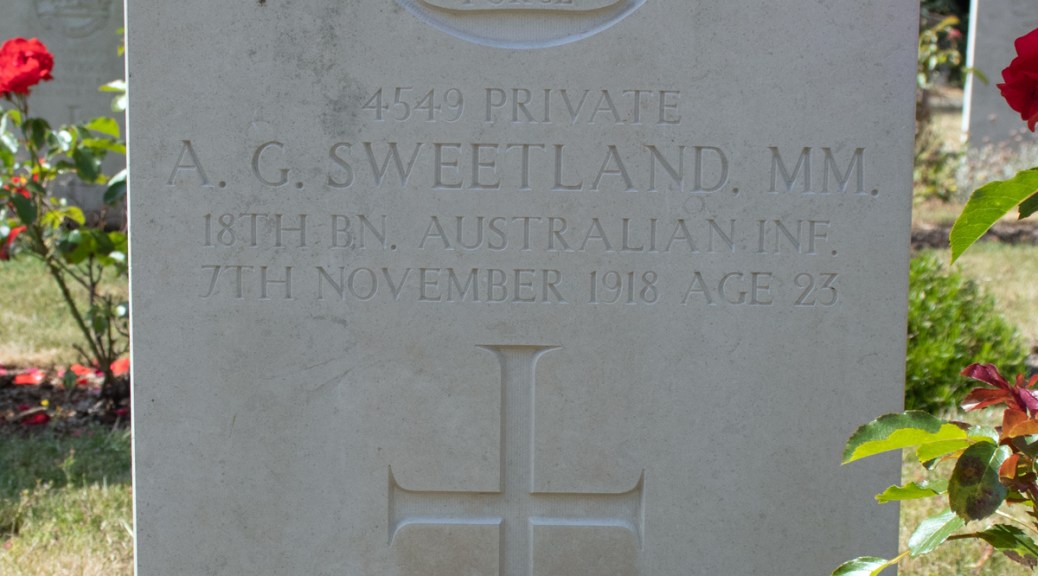
Albert Graham Sweetland was born on 6th January 1895 in Kensington, Middlesex. The oldest of seven children, his parents were mechanical engineer Albert Sweetland and his wife, Edith.

A work ethic was instilled into Albert Jr from an early age. By the time of the 1911 census, he had been sent to Truro, Cornwall, where he worked as a servant to the Faull family, tending to their poultry.

Albert was set on developing a life for himself and, in the next few years, he emigrated to Australia. He settled in the town of Liverpool, now a suburb of Sydney, and found work as a station hand. War was on the horizon, however, and people of the empire were called upon to serve their King.

Albert enlisted on 22nd January 1916, joining the 18th Battalion of the Australian Infantry. His service records tell a little about the man he was becoming. He was 5ft 7ins (1.7m) tall, and weighed 143lbs (64.9kg), with fair hair, blue eyes and a fair complexion. The document also notes that he was a Methodist, and that he had tried to enlist in the British army before emigrating, but that a slight defect in his right eye had prevented him.

Private Sweetland set sail for Europe on 9th April 1916. His unit sailed via Suez, reaching Folkestone, Kent, that November. His time back in Britain was to be brief, however: within a matter of days he was in Etaples, France.

Albert was thrown into the thick of things. On 5th May 1917, he was wounded while fighting at Arras. He was shot in the legs, and medically evacuated to Britain for treatment and recuperation. He was to remain on home soil for the next year, before returning to his unit in June 1918.

On 3rd October 1918, Private Sweetland was injured during the Battle of the Beaurevoir Line. His unit’s push forward was initially successful, but ultimately failed to capture the the village. The German forces attacked with gas, and Albert was caught up in it, receiving a gun shot wound to his back.

By the time Beaurevoir was in Australian hands three days later, more than 430 Allied soldiers had been killed. Albert was awarded the Military Medal for his bravery during the battle.

Private Sweetland was medically evacuated to Britain once more, and was admitted to Bath War Hospital for treatment. This time, however, he was not to be as luck as he had been eighteen months previously. He died on 7th November 1918, from a combination of appendicitis, pneumonia and heart failure. He was just 23 years of age.

Albert Graham Sweetland was laid to rest in the military section of Bath’s Locksbrook Cemetery, not far from the facility where he had passed. His parents and his sister Winifred attended the funeral.


Serjeant Alfred Pollard

Serjeant Alfred Pollard

Alfred Pollard was born in the spring of 1869 in Hinton Charterhouse, Somerset. His early life seems to have been a little disjointed. The son of Harriett Pollard, who had him out of wedlock, his baptism record gives no details of his father.

The 1871 census found him living with his mother and her widowed father, Thomas Pollard. Ten years later, Harriett is living with her husband, Walter Hayden, and four children, including Alfred – who has also taken the name of Hayden. Thomas is also recorded as living with the family.

Alfred is missing from the 1891 census return. Harriett, however, is now listed as married and the head of the household. She and Walter had a further three children – their youngest, Percy, being just three months old. Times must have been tough for her: the same census recorded Walter as being an inmate of the Somerset and Bath Asylum, where he is listed as being a lunatic.

Harriett died at the start of 1892, aged just 46 years old: Walter died three years later, at the age of 55. Both are buried in the graveyard of St John the Baptist Church, Hinton Charterhouse.

The passing of his mother and the diminishing health of his stepfather seems to have spurred Alfred into building a career to support his siblings. Having been working as an engine driver, on 7th December 1892, he enlisted in the Somerset Light Infantry.

Alfred’s service records give his height as 5ft 7ins (1.7m) and his weight as 137lbs (62kg). He was noted as having black hair, bark eyes and a coarse complexion. He also had a number of tattoos, including a cross on his right forearm; a circle of dots on his right wrist; crossed flags, an anchor and Jubilee 1887 VR and crown on his left forearm; and a bracelet on his left wrist. The records also noted the loss part of the middle finger on his right hand.

Private Pollard quickly became a career soldier. Over 21 years, he rose through the ranks to Lance Corporal (July 1902), Corporal (April 1906), Lance Sergeant (November 1907) and Serjeant (June 1911). He spent more than 14 years in India, and was involved in the Mohmand Campaign of 1897. He was formally discharged on 6th December 1913, having served as a signaller for eleven years, and a Provost Sergeant for three. His discharge papers confirmed his exemplary character, and that he was “thoroughly hardworking, sober and reliable.

Back on civvy street, Alfred found work as a labourer in an iron foundry. This was not to last long, however, as he stepped up once more when war was declared in the summer of 1914. Joining the Somerset Light Infantry on 12th October, he retook his previous rank of Serjeant.

Alfred served on home soil during this second period in the army. Initially attached to the 3rd (Reserve) Battalion, his unit was based in Devonport, Devon. In September 1916, Sergeant Pollard was transferred to the 2nd Garrison Battalion of the Devonshire Regiment, which was based in nearby Plymouth. In January 1917, he moved again, to the Hampshire Regiment. He spent most of the year with 18th (Home Service) Battalion in Aldershot, Hampshire, and by December had moved to the 3rd (Reserve) Battalion, which was based in Gosport.

Sergeant Pollard remained on active service until the end of February 1919, when he was formally demobbed. At this point, his trail goes cold, although he seems to have settled in Bath, Somerset. He went on to marry, although details of his wife are limited to the name Mrs AE Pollard and her date of birth, 15th March 1879.

Alfred Pollard died of cardiac failure on 7th March 1921: he was 52 years of age. He was laid to rest in the army section of Bath’s Locksbrook Cemetery.


Private William Higgins

Private William Higgins

William George Newton was born in Culmstock, Devon, early in 1889. His mother, Ada, was unmarried at the time, and there is no indication as to who his father was. The 1891 census found mother and son living with Ada’s parents, John and Hannah, in South Street, Wellington, Somerset.

In the summer of 1892, Ada married Frederick Higgins, a police constable from Baltonsborough. The couple set up home in the village of Mark, and went on to have ten children. It was at this point that William took on Frederick’s name, though whether that was because he was actually his birth father is unclear.

When he finished his schooling, William found labouring work. On 9th March 1910, he married Annie Achilles, a painter’s daughter from Glastonbury. The couple set up home in a small cottage in Bank Street, Highbridge, and went on to have three children.

The next year’s census recorded that William was employed as a stoker for Highbridge Bacon Co Ltd, a large factory to the south of the town. His and Annie’s oldest child, son William Jr, who was just two months old at this point, and William’s grandfather, the now widowed John, completed the household.

When war broke out, William stepped up to play his part. He enlisted on 28th October 1915, joining the 3rd Battalion of the Gloucestershire Regiment as a Private. His service records show that he was 26 years and 10 months old, and stood 5ft 2ins (1.57m) tall.

Private Higgins’ service documents confirm that he served for nine months before being medically discharged from the army. He had contracted haemoptysis and had an enlarged heart. His medical records confirmed that, at the time of his dismissal, he was totally incapacitated and unable to work.

William returned to Somerset, but is would seem that his health continued to dog him over the next couple of years. He passed away on 29th October 1918, at the age of 29 years of age.

William George Higgins was laid to rest in the cemetery of his adopted home town, Highbridge.


Annie was now a widow, with three young children to support. She married again in the spring of 1922, to bus conductor William Davey. Annie was to outlive not only her husband, but all three of her children.

William and Annie’s youngest, Cyril, passed away when he was just a couple of months old.

Albert, their middle son, “had been for a great while a cripple from trouble in his leg, but was able to get about on crutches.” [Central Somerset Gazette: Friday 22nd July 1932] He passed away on 16th July 1932, aged just 18 years old.

William Jr had tried out in the Royal Navy when he was sixteen years of age. Beginning with the rank of Boy 2nd Class, he was dismissed in March 1928, as he was deemed unsuitable for the rank of Boy 1st Class.

In the autumn of 1934, he married Nettie King, the daughter of a factory worker from Street, Somerset. The couple went on to have three children, although in an echo of his parents’ tragedy, their middle child, Phyllis, passed away when just eighteen months old.

When war came to Europe for a second time, William sought to serve his country for a second time. He enlisted in the Royal Air Force, and rose to the rank of Leading Aircraftman. On 18th June 1940, he was on board a Blenheim aircraft flying from the UK to Malta, when the plane came down in bad weather near Marseille. William and his two companions, Pilot Officer Johnston and Sergeant Micklethwaite were all killed.

Leading Aircraftman Higgins was laid to rest in the Mazargues War Cemetery near Marseille.


Private Herbert Griffith

Private Herbert Griffith

Herbert Griffith was born in the summer of 1883 in the Somerset village of Crowcombe. One of eight children, his parents were coachman James Griffith and his wife, Selina.

Herbert’s early life is a challenge to piece together. The 1901 census recorded him as living at Weacombe House, West Quantoxhead, where he was employed as a footman.

On 16th December 1909, Herbert married Selina May Davies. Also born in Crowcombe, she was the daughter of a tailor. The couple’s marriage certificate confirms the wedding was conducted at the village church. The couple went on to have two children, Dorothy in 1912, and Geoffrey four years later.

Herbert, at this point, was living in Farnborough, Warwickshire, where he was employed as a valet. (While no document remains to confirm this, it seems possible that this was actually Farnborough Hall, home to generations of the Holbech family.)

When war broke out, Herbert seemed keen to serve his country. He enlisted in the Royal Army Medical Corps, although his full service records no longer remain, so it is not possible to confirm whether he served on home soil or overseas.

The next record relating to Private Griffith is that of his passing. He died in Southampton, Hampshire, on 22nd February 1916, as a result of a combination of bronchitis, asthma and cardiac failure. He was 32 years of age, and would never get to meet his son, who was born two weeks later.

The body of Herbert Griffith was taken back to Somerset for burial. He was laid to rest in the peaceful surroundings of the Church of the Holy Ghost in his home village, Crowcombe.


Driver Albert Hall

Driver Albert Hall

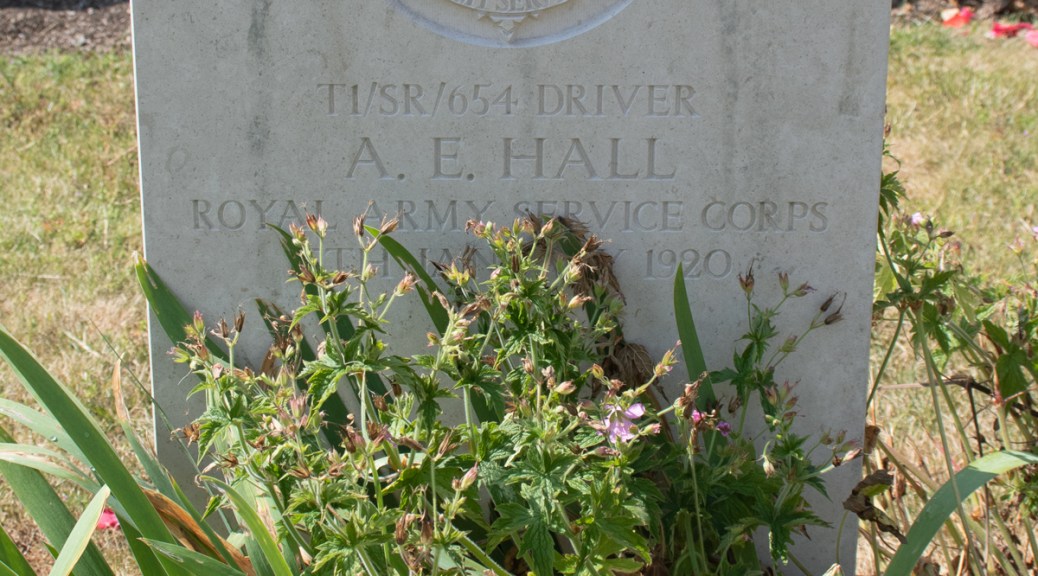
The life of Albert Edward Hall is a challenging one to unpick. His headstone, in Bath’s Locksbrook Cemetery, confirms that he was a Driver in the Royal Army Service Corps, and passed away on 15th January 1920.

Driver Hall’s service records confirm that he enlisted in Gloucester on 21th September 1914, at which point he was 45 years of age. He was born in Bristol, stood 5ft 6.5ins (1.69m) tall and weighed 172lbs (78kg). He had blue eyes and brown hair. The only next of kin that Albert recorded were two brothers, Arthur and Alfred, although their addresses were not known.

Driver Hall was sent to France within a couple of weeks of enlisting. He became attached to the 23rd Field Ambulance Unit, and, barring leave, remained on the Western Front for the next four-and-half years. His service appears to have been impeccable, although in August 1918, he docked a week’s pay when he returned back to the unit a day late following a period of leave.

In June 1919, having been back on home soil for a month, Albert was discharged from the army. This seems to have been partially on medical grounds, as his records suggest he was suffering from heart disease.

At this point, Albert’s trail goes cold. He may well have returned to Bristol, but by the start of 1920 it is likely that his health was failing. He was admitted to the Pensioner’s Hospital in Bath, Somerset, and it was here that he breathed his last. He was 50 years of age.

Albert Edward Hall was laid to rest in the sweeping visa on the city’s Locksbrook Cemetery.


Private William Haines

Private William Haines

Tauntonians will learn with deep regret of the death of Private W Haines, of the No. 5 Supernumerary Company, 4th Battalion Somerset Light Infantry, which took place at the Portishead Red Cross Hospital, at the age of 64. The funeral took place at the Portishead Cemetery on Friday of last week, the deceased being buried with full military honours… The late Private Haines… came up with the last Company of the National Reserves, about 14 months ago… and during that time did his duty to the satisfaction of the office commanding and all other officers concerned. Corporal Jarman, who is a well-known Tauntonian of the same Company writes: “Private Haines was a fine old soldier, doing his duty in a manner with would be a credit to any youngster, and his death came as a surprise to all of us. There are still with us half-a-dozen of the old ‘sixties’, and I hope when some of these conscientious objectors see this they will alter their mind, and do their little bit for their King and country like he did.”

Taunton Courier and Western Advertiser: Wednesday 29th March 1916

William Haines was born in the spring of 1850 in Hinton St George, Somerset. The younger of two children, his parents were William and Sophia Haines. William Sr died when his son was a teenager, leaving Sophia to raise the family. She found work as a nurse to bring in some income and, by the time of the 1871 census, the family were living together, William Jr working as a stonemason and his older sister earned money through glovemaking.

On 23rd December 1871, William married Jane Shuter, a sawyer’s daughter from Stoke-sub-Hamdon. The couple set up home in South Petherton, and had a son called William Jr the following year. The family remained together through the next three census returns, William Sr continuing as a mason, while his son found work as a plumber. By 1911 they family had moved again, this time to Taunton, where Jane was now working as a dealer in wardrobes.

When war broke out, William Sr stepped up to play his part, as the report suggests. He enlisted at the start of 1915, volunteering his services, despite having reached 64 years of age. Assigned to the 4th Battalion of the Somerset Light Infantry, and attached to the 5th Supernumerary Company – a territorial reserve force – Private Haines he remained in Somerset.

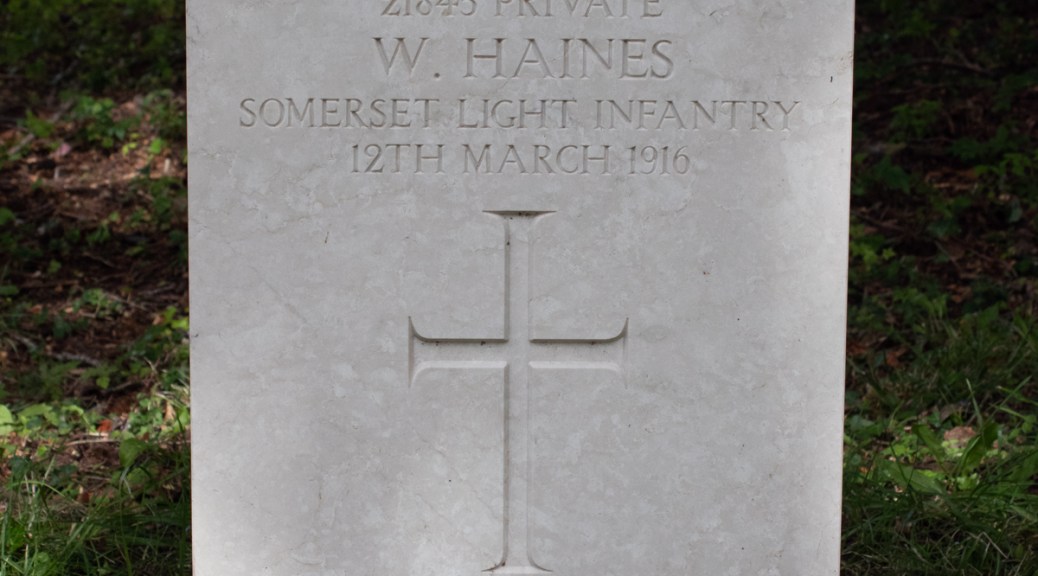
William suffered a heart attack on 12th March 1916. He was rushed to the Red Cross Hospital in Portishead, but passed away soon after being admitted. He was 66 years of age (the newspaper report giving the incorrect age).

William Haines did not travel far to be laid to rest. He was buried in Portishead Cemetery, on the southern outskirts of the town.


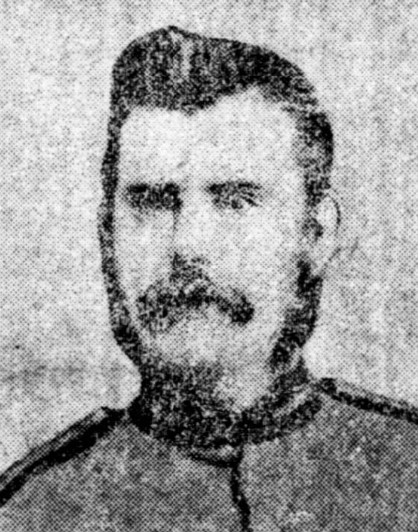
Private William Haines
(from britishnewspaperarchive.co.uk)

Private Henry Wiggs

Private Henry Wiggs

Henry Wiggs was born in Camberwell, Surrey, in the autumn of 1880. One of eleven children, his parents were dock labourer Thomas Wiggs and his wife, Sarah.

When he finished his schooling, Henry also took up labouring work and, by the time of the 1911 census, was working as a partition block maker in the building trade. The census shows him a living with his brother William and his family.

On 3rd August 1913, Henry married Blanche Hill. She was eight years older than Henry, and the daughter of a Sergeant in the Royal Horse Artillery. Blanche had been widowed ten years earlier, and had four children, who Henry took on as his own.

At this point, Henry’s trail goes cold. When war broke out, he stepped up to play his part, initially joining the Worcestershire Regiment. At some point he was transferred to the Royal Berkshire Regiment, subsequently becoming attached to the Labour Corps.

Details of Private Wiggs’ military service are lost to time, and it is unclear whether he served on the Home Front or overseas. He survived the war, and was discharged from the army on 13th March 1919. He was suffering from heart disease, directly attributable to his military service.

Again, Henry falls off the radar at this point. He and Blanche made the move to Somerset, setting up home in Weston-super-Mare. His heart problem seems to have dogged him, however, and likely caused his admission to a hospital in Bath towards the end of 1920. It was in the city that he passed away, on 28th December 1920, at the age of 40 years old.

Henry Wiggs’ body was not brought back to Weston-super-Mare for burial – the cost of doing so may have been too much for the now twice-widowed Blanche to afford. Instead, he was laid to rest in the sweeping Locksbrook Cemetery in Bath.


Private John Mahaffey

Private John Mahaffey

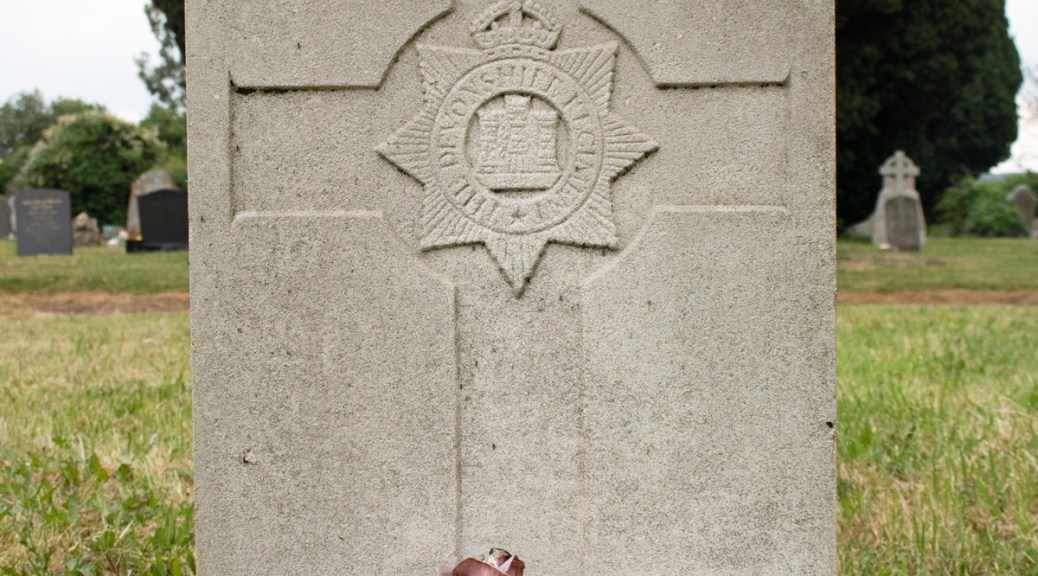
In a quiet spot in North Petherton Cemetery, Somerset, is a headstone dedicated to Private J Mahaffey of the Devonshire Regiment. He died on 5th February 1916, but there is little further information available for him.

Private Mahaffey’s service number leads you to one military record, his army pension ledger card. This confirms a little more information: his first name was John, he had two children noted (underage, and therefore eligible for part of his pension) – Elsie and Thomas – and a guardian is also given – Mrs Elizabeth Broom, who lived in Kentisbeare, Devon. The pension card also confirms the cause of John’s death: heart failure due to disease contracted on active service.

An unusual surname made searching contemporary newspapers easier, and a mystery was unveiled:

Private John Mahaffey, a native of Devonport.. was found dead in the Great Western Railway train at Durston on Saturday.

Deceased, who was in the Devon Regiment (86th Battalion Provisional Territorial Force), was 49 years of age, and had served twelve years in the Army. At the outbreak of war he re-enlisted, and latterly had been quartered at Blythe. It appears that he had been on a visit to his children at Devonport, and was upon his return journey when his death occurred. At Taunton he conversed with the guard of the train by while he travelled, and was then apparently in good health.

PS Hill, North Petherton, state that on Saturday, he… saw the body of the deceased… He examined the body, and found a bruise above the left eye and a scar on the nose. He found upon him his regimental pass and the return railway ticket. There was also money in his pockets.

George William Grinnett, a guard on the GWR, said… he was approached by deceased, who asked as to the train service to Newcastle. Witness understood that he had travelled from Exeter… He advised him to… change at Bristol. He then appeared to be all right, and in good health. On arrival at Durston [George] walked the train, and when passing the compartment that deceased entered at Taunton he noticed a man on the floor in the corridor. He went inside and found that the man was dead. He then communicated with three soldiers, who said they had not travelled with deceased. They had merely opened the door, and, seeing a man there, had walked away without telling anybody.

Dr William C Ghent… said her was called to see deceased. He was quite unable to form an opinion as to the cause of death. There was a good deal of blood on the face, and a slight wound on the nose. From a post-mortem examination he found that one of the valves of the heart was incompetent, and in his opinion death was due to heart failure. The blood on the nose might have been caused by a fall. There was no serious injury from the blow which would cause death.

Taunton Courier and Western Advertiser: Wednesday 9th February 1916

John’s previous twelve years in the army may relate to a Royal Marine Light Infantry service document for a John Mahaffoy. Born on 24th May 1864 in Newcastle-upon-Tyne, he enlisted in Bristol as a Private on 24th April 1888. Primarily based out of Plymouth, he served until the summer of 1900, and was assigned to the Royal Fleet Reserve for a further seven years.

Further complexity is added to John’s story, with a marriage record for 6th April 1896. This confirms his wife’s name as Elizabeth Brown, the couple marrying in Devon. The 1901 census confirms two older children for the couple, Kathleen (mentioned in the newspaper report, who was born in 1897) and Margaret, who came along two years later.

The next census, however, shows a divided family. John was recorded as being one of 1200 patients in the Devon County Lunatic Asylum in Exminster. Elizabeth was living in Portsmouth, with their son, Thomas. She also had a boarder, Bertram Bound, an Able Seaman in the Merchant Navy. Kathleen was a patient in the Sanatorium for Devon and Cornwall Consumptive Patients in South Brent, Devon. Elsie, meanwhile, was recorded as living in Kentisbeare with her grandparents, Edmund and Elizabeth Broom.

This would suggest that John’s wife Elizabeth had died by the time of his death, and that guardianship of his children passed to his mother-in-law when he too passed away.

The last sad element of this tale is that John Mahaffey was not to be reunited with his children. There may have been a financial element, with the Brooms possibly unable to cover the cost of bringing him down to Devon. John was laid to rest in North Petherton Cemetery, a few miles from Durston Station, where his body had been discovered.


Private Arthur Turner

Private Arthur Turner

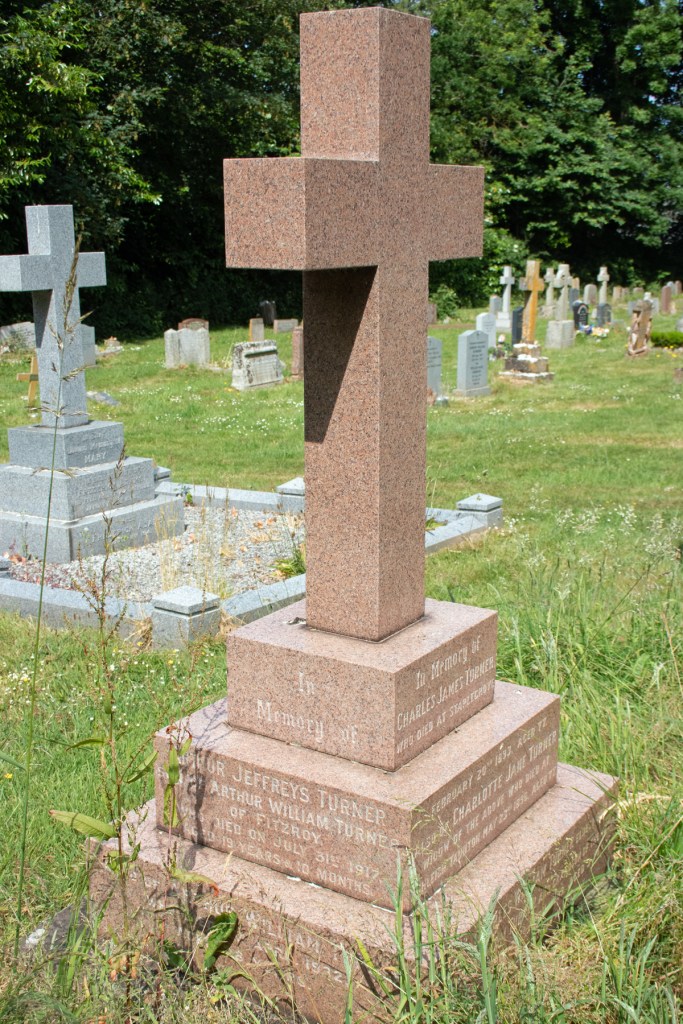
It is with great regret that we announce the death of Mr Arthur Jeffreys Turner, which took place on Tuesday last. The deceased was the only surviving son of Mr AW Turner, or Fitzroy.

Taunton Courier and Western Advertiser: Wednesday 8th August 1917

Arthur Jeffreys Turner was born in Staplegrove, near Taunton, in 1897. There is little concrete information about his life, although the newspaper report of his funeral acts as a starting point.

Arthur – who, the report suggests, was known as Jeff – was the son of Arthur William Turner. The son of a gentleman, Arthur Sr was a coffee planter, who disappears from the UK Census returns from 1881 and 1891. On 4th August 1894, he married Carsina Florence Marie le Gay, the Paris-born daughter of Gustave Ferdinand le Gay, an officer in the French Army. Arthur was 40 years old, and gave his address as the Travellers’ Club in Piccadilly, London, while Carsina, who was just 21 years of age, lived in Richmond.

Of Carsina, there appears to be no further record. The 1901 census found Arthur Sr based back in his Piccadilly Club, and gives his marital status as married. Ten years later, Arthur Sr is recorded as living in Fitzroy House, to the north west of Taunton. He is still noted as married, and a retired coffee planter, and that he had two children, of whom only one survived. Arthur Sr’s only companions in the 14-roomed manor house, however, were two servants, Bessie Hill and Eva Caddy.

The same census recorded Arthur Jr boarding at a prep school in Berrow, Somerset. Naish House been purpose-built just seven years before, when the school moved down the coast from Clevedon. Arthur was one of 39 boarders, who were supported by a dozen staff.

Within three years of the census being taken, Britain was at war. Arthur Jr was 17 at this point, and was sent to Cambridge, where he enlisted in the Officers’ Training Corps (OTC). No details of his military career exist, but at some point he made the move to the Somerset Light Infantry. He was given the rank of Private, somewhat unusually, given his time in Cambridge. This would suggest either that he didn’t complete his OTC training, that he did not pass it, or that he chose to work his way up through the ranks, rather than accepting a paid commission.

At this point, Private Turner’s trail goes cold. There are no records to expand on his military career and the newspaper report spends more time focused on the inscriptions on the floral tributes at his funeral, than on his short life.

The Commonwealth War Graves Commission documentation confirms that Arthur had died “of heart failure 31st July 1917. Age 20.” No other context is available, to whether heart failure was the primary cause, or it was brought on by another illness or injury can only be guessed at.

The body of Arthur Jefferys Turner was laid to rest in the graveyard of St John’s Church in Staplegrove, once a separate village, now a suburb of north west Taunton. He was buried in the family plot, alongside his paternal grandparents, Charles and Charlotte Turner.


Private Arthur Turner
(from findagrave.com)

Arthur Turner Sr lived on for a further six years after his son’s death. He died on 9th April 1923, and was also laid to rest in the family plot in St John’s Churchyard, Staplegrove. The newspaper report on his funeral gives similarly little away about his life:

The funeral took place at Staplegrove, Taunton, on Tuesday, of Mr Arthur William Turner, of Fitzroy, Norton Fitzwarren, who died… in his 79th year.

…the chief mourners were Lieut.-Com. Kenderdine and Mrs Kenderdine (son-in-law and daughter)…

The late Turner was a keen follower for many years of the Culmstock Otter Hounds, and the oldest member of the Somerset Country Club.

Langport & Somerton Herald: Saturday 16th April 1932

Bombardier Charles Newbery

Bombardier Charles Newbery

Charles James Anderson Newbery was born in Misterton, a stone’s throw from Crewkerne, Somerset, in the spring of 1895. The oldest of eight children, his parents were Benjamin and Edith Newbery. Benjamin was a farmer, who passed away in 1908, when his son was just 13 years of age.

Charles seems not to have spent a great deal of time in the family home, however: the 1901 census found him living with his paternal grandmother, while the 1911 census, taken three years after his father’s death, recorded him as living with his paternal aunt, and working on their farm.

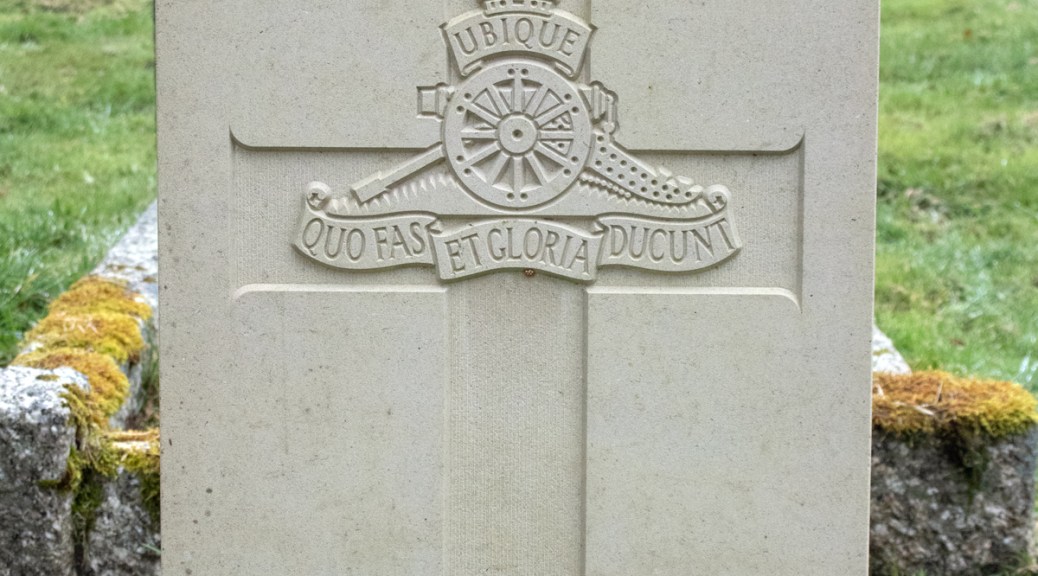
The farming life seemed to suit Charles: indeed he emigrated to Australia to pursue the life. When war broke out in Europe, however, he returned to England’s shores to better serve King and Country. He enlisted in the Royal Garrison Artillery on 18th October 1915, and was given the rank of Gunner.

Charles’ service records confirm that he was 5ft 5ins (1.65m) tall and weighed 140lbs (63.5kg). He was noted as having a mole on his left shoulder and an upper denture.

Private Newbery was sent to France in April 1916 and, a little over a year later, was promoted to Bombardier. He was attached to the 137th Heavy Battery and all seemed to be going reasonably well for him. He had ten days’ in England in July 1917, and a further two weeks’ in March 1918.

On 13th August 1918, possible during the Battle of Amiens, Charles was injured by a gun shot wound to his right leg. He was initially treated at the 47th General Hospital at Le Treport on the French coast, but was medically evacuated to Britain for further treatment.

Charles was moved to the 4th Northern General Hospital in Lincoln. To complicate matters, he had contracted bronchitis and, while his injury was being managed, it was a combination of the lung condition and cardiac failure to which he succumbed. Private Newbery passed away on 2nd September 1918, his mother and sisters by his side. He was just 23 years of age.

Charles James Anderson Newbery was taken back to Somerset for burial. He was laid to rest in Crewkerne’s Townsend Cemetery, not far from the family home.


Bombardier Charles Newbery
(from ancestry.co.uk)

Edith had to write to the regimental office three times to get her late son’s belongings back, and in the end it took more than six months to do so. She received the items he had on him in Lincoln in April 1919: they included and “upper row [of] teeth, cigarette case, wallet containing letters, hair brush [and] comb, disc, letter, wristlet watch, note paper and envelopes.”