Tag Archives: history

Boy 2nd Class Albert Sampson

Boy 2nd Class Albert Sampson

Albert Frederick Sampson was born on 7th November 1900, and was the older of two children to Albert and Beatrice. Albert Sr was a steward in the Royal Naval College in Dartmouth, Devon, and the family lived in a four-roomed cottage on Victoria Road.

When he finished his schooling, Albert found work as a cabin boy on a merchant vessel. When war broke out, the transition to the Royal Navy was an obvious one, and he enlisted at the start of 1916. His service records show that he was 5ft 4ins (1.62m) tall, with red hair, blue eyes and a fresh complexion. Still under the age to formally enlist, he was given the rank of Boy 2nd Class.

Albert’s time in the navy was to be tragically short. He was admitted to the Royal Naval Hospital in Plymouth, Devon, with acute quinsy, and passed away quickly. He died on 13th February 1916, at the age of just 15 years old.

Albert Frederick Sampson’s body was taken back to Dartmouth for burial. He was laid to rest in St Clement’s Churchyard.


Ordinary Seaman Thomas Fleet

Ordinary Seaman Thomas Fleet

Thomas Fleet was born on 3rd February 1879 in Kingswear, Devon, and was the sixth of nine children to Thomas and Emma. Thomas Sr was a fish dealer, and the family lived on Lower Street over the river in Dartmouth. Most of the family were involved in the fish industry, and by the time of the 1901 census, Thomas Jr was also working as a fisherman.

On Christmas Day 1901, Thomas Jr married Hannah Jury. She was a farm labourer’s daughter from Torquay, Devon. The couple married in Hannah’s home town, but settled back in Dartmouth. They had five children – Reginald, Elspeth, Edith, Florence and Thomas – and set up home in a five-roomed house on Victoria Road.

By the time of the 1911 census, Thomas had changed jobs, and was working as a yachtsman. The following year, Reginald died, at the age of just 9 years old. It is unclear how he died, but he passed in August 1912, and was buried on 2nd September, in St Clement’s Churchyard, Dartmouth.

When war broke out, Thomas would be called upon to serve. Unsurprisingly, given his job, he joined the Royal Navy, enlisting on 30th March 1917 as an Ordinary Seaman. His service records show that, at 5ft 2ins (1.57m) tall, he had brown hair, blue eyes and a fresh complexion.

Ordinary Seaman Fleet was sent to HMS Vivid, the Royal Naval Dockyard in Devonport, Devon, for his formal training. Tragically, however, his time in the service was to be a brief one. He contracted lobar pneumonia and was admitted to the barracks’ sick quarters. He passed away from heart failure on 13th May 1917, at the age of 38 years old.

The body of Thomas Fleet was taken back to Dartmouth for burial. He was laid to rest in the family plot in St Clement’s Churchyard, reunited with his oldest son, Reginald.


Flight Cadet Ernest Tracey

Flight Cadet Ernest Tracey

Flt-Cadet Ernest Osborn Tracey, RAF, who died on Friday, the result of injuries sustained through a collision in the air when undergoing his final training, was the only son of Rev. HF and Mrs Tracey, of Dartmouth. He was born in Oct. 1899, at St Saviour’s Vicarage, of which church his father was vicar for 23 years, retiring from the living in 1913 in order to take up clerical duties in New Zealand. Mr Tracey was educated at Blundell’s, where he held a house master’s scholarship. When he left in the middle of last year he was the winner of the Coles’ prize for science; was one of the shooting VIII, of which he had his cap and colours; a member of the Upper Sixth, the OTC, and he had also won the first prize for drawing. On leaving Blundell’s he obtained a cadetship at Woolwich, and was transferred to the RAF.

[Western Morning News: Tuesday 4th June 1918]

Ernest Osborn Tracey was born in Dartmouth, Devon, on 25th October 1899, and was baptised in his father’s church six weeks later. The younger of two children to Reverend Henry and Alice Tracey, he gave up his schooling to enlist in the Royal Flying Corps on 12th November 1917.

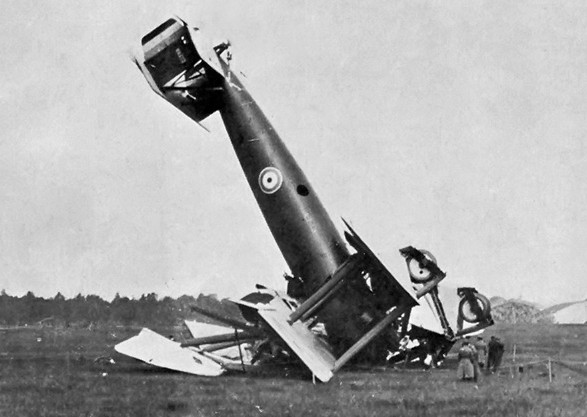
When the Royal Air Force was formed the following April, Flight Cadet Tracey automatically transferred across. Training to be a reconnaissance pilot, Ernest would have cut a dashing figure, standing 6ft 1in (1.85m) tall. He was based at Yatesbury Airfield in Wiltshire, and was learning to fly a BE2, twin seater biplane.

At 8:30pm on 31st May, his aircraft collided with another, sending Ernest’s machine spinning into a nosedive. He crashed into the ground and was killed instantly.

The body of Ernest Osborn Tracey was taken back to Devon for burial. He was laid to rest in the graveyard of St Clement’s Church, Dartmouth.


Ernest’s will gave his mother, Alice, as his beneficiary. The newspaper report suggests that Henry had travelled to New Zealand to tend a new flock there, and the Commonwealth War Graves Commission records him as being “Chaplain to the Forces” and Vicar of Dartmouth.

It certainly seems that any time spent in New Zealand was limited. By the time of the 1921 census, Reverend Tracey had found a new posting, in the Staffordshire village of Gentleshaw. The same census return found Alice staying with their daughter, Rosamond, and her family, in Totnes, Devon.


Petty Officer 1st Class Frederick Morgan

Petty Officer 1st Class Frederick Morgan

Frederick Morgan was born on 15th July 1871, the oldest of four children to Samuel and Selina. Samuel was a miner from Bristol, Gloucestershire, but it was in the Staffordshire town of Tipton that he and local girl Selina married and raised their family. The 1881 census found the Morgans living at 17 Brewery Street, to the south of the town centre.

Frederick was not destined to follow in his father’s footsteps, however, and had his sights set on a life at sea, rather than in the depths of a coal mine. On 23rd November 1896 he joined the Royal Navy, and was sent to HMS Impregnable, the training base in Devonport, Devon, for his induction.

Being too young to formally enlist, Frederick was given the rank of Boy 2nd Class. Over the next three years, he learnt the tools of his trade, and served at three further bases: HMS Lion, HMS Penelope and HMS Raleigh. During this time, he was promoted to Boy 1st Class and, on 15th July 1889, when he turned 18, he was formally inducted into the Royal Navy.

Ordinary Seaman Morgan’s service records show that he was just 5ft 2.5ins (1.59m) tall. He had light brown hair, blue eyes and a fair complexion. He also had a tattoo by this point, of a dancing sailor on the inside of his right arm.

Frederick remained at HMS Raleigh for the next couple of years, and was promoted to Able Seaman on 1st July 1891. From the autumn, however, his sea-going life really took hold. Over the next ten years, he served on five ships, and was to be based at HMS Vivid, the Royal Naval Dockyard in Devonport, in between voyages. His dedication to the service was recognised – his annual reviews regularly noted his character as very good, and he rose through the ranks to Leading Seaman in May 1898, Petty Officer 2nd Class that October, and Petty Officer 1st Class in January 1901.

Away from work, Frederick’s love life was blossoming. In the autumn of 1893 he married Zipporah Elizabeth Beatrice Griffiths. Better known as Beatrice, she was the daughter of waterman Thomas Griffiths and his wife, Zipporah. The family came from Dartmouth, and this is likely where the young couple got to know each other. They married in St Clement’s Church, Dartmouth, and went on to have two children, George and Kathleen.

On 15th July 1901, Petty Officer Morgan’s initial contract with the Royal Navy came to an end. He renewed it straight away, and would spend the next decade sailing the world. Again Frederick was based at HMS Vivid in between voyages. On 11th July 1911, after 21 years in service, he was formally stood down to reserve status, and he returned to shore.

Frederick’s trail goes cold over the next couple of years, but when war broke out, he was called into service once more. Petty Officer Morgan would serve on the depot ships HMS Leander and Cyclops, which served out of Scapa Flow. He also spent time at HMS Gunner, the naval base to the north of Edinburgh. By March 1919, with the Armistice signed, he found himself based back in Devon.

At the Royal Naval Hospital, Plymouth, on Saturday, an inquest was held relative to the death of Fredk Morgan, 47, a naval pensioner, who died suddenly in the train on Thursday last.

Wm. Griffiths, inspector, GWR, at Millbay, said that PO Morgan was removed from the 6.20 train from Saltash on Thursday, apparently in a fit. He was laid on a seat, and a doctor who was about to travel on another train pronounced life extinct.

Charles Evans Jenkins, surgeon-lieutenant at the Naval Hospital said death was due to fatty degeneration of the heart.

The Coroner, who expressed his sympathy with the widow, declared that death was due to natural causes.

[Western Times: Tuesday 1st April 1919]

Frederick Morgan died of a heart attack on 27th Match 1919. He was laid to rest in the graveyard of St Clement’s Churchyard, Dartmouth, where he and Beatrice had been married.


Corporal Stanley Vinton

Corporal Stanley Vinton

Stanley William Vinton was born on 30th April 1898 in Dartmouth, Devon. The second of eight children, his parents were William and Kate. William was an outfitter’s assistant, and by the time of the 1911 census, the family of ten were living in a four-roomed cottage on South Ford Road.

When he finished his schooling, Stanley was apprenticed to a shipwright. Away from work, he volunteered with the Dartmouth Cadet Company, and was drawn towards an army career. On 25th May 1914, he enlisted, joining the 7th (Cyclist) Battalion of the Devonshire Regiment. His service records show that he gave his age as 17 years and four months old. He was 5ft 6.5ins (1.69m) tall, and weighed 154lbs (69.9kg). Private Vinton was of good physical development and had good eyesight.

Stanley was formally mobilised on 5th August 1914. He remained on home soil for the next three years, primarily because soldiers were unable to fight on the Western Front until they turned 19 years of age. During this time, he appears to have impressed his superiors: in July 1916 he was promoted to Lance Corporal, and just four months later he rose to full Corporal.

In July 1917, Stanley’s chance to see some action arrived, when he was posted to the 2nd Battalion, and sent overseas. This move came with a caveat, however, and he reverted to the rank of Private. It was a challenging time for the regiment, and Stanley quickly found himself in the thick of it at Passchendaele.

On 30th November 1917, after four months on the Western Front, Private Vinton’s luck came to end. Caught up in the fighting, he was wounded in his left thigh by shrapnel and the fingers of his left hand by a gun shot wound. He was medically evacuated to Britain for treatment, and admitted to the Edinburgh War Hospital in Bangour.

Thankfully, the injury to Stanley’s hand was minimal, but his leg took longer to heal, and he remained in hospital for more than two months. When he was discharged, Private Vinton was transferred to the regiment’s command depot in Sutton Coldfield. In March 1918, he was promoted to Corporal, but his injured leg was still causing him discomfort. In the end, he was reassigned to a munitions works in Lowestoft, Suffolk, and this is where he would spend the remainder of the year.

Stanley’s constitution was weakened by this point, and that winter, he contracted influenza. The condition was to prove fatal, and he passed away on 2nd December 1918. He was just 20 years of age.

The body of Stanley William Vinton was taken back to Devon for burial. He was laid to rest in the graveyard of St Clement’s Church, Dartmouth, high above the town’s centre, but within walking distance of his grieving family’s home.


Gunner William Foxworthy

Gunner William Foxworthy

William George Foxworthy was born in Dartmouth, Devon early in 1880. The middle of five children, his parents were William and Mary Foxworthy. William Sr (whose full name was William George Foxworthy, and who was known by his middle name) was a house painter, but when he finished his schooling, William Jr found work as a boat builder.

The 1901 census found the family living in a small house on Crowther’s Hill, to the Dartmouth town centre. The cottage would have been cramped, but there were five wages coming in from George, William and William’s siblings.

William does not appear on the 1911 census, and it seems that he took the step from building boats to sailing on them. When war broke out, he was quick to step up and play his part, enlisting in Exeter on the 22nd October 1914. While he had previously been a volunteer in the Devonshire Regiment, William was assigned to the Royal Garrison Artillery.

Gunner Foxworthy’s service records show that he was 5ft 4.5ins (1.64m) tall, and weighed 121lbs (54.9kg). He was noted as having brown hair, hazel eyes and a fresh complexion. Deemed fit for military service, he was packed off to a base in Sheerness, Kent.

William spent the next year on the north Kent coast, before being reassigned. By 1st November 1915 he was on the Front Line, and remained in France until the following June.

In the spring of 1916, Gunner Foxworthy fell ill. He contracted tuberculosis, and this was to dog him for the rest of his life. The contagious nature of the condition meant that he was no longer fit for military service, and he was medically discharged on 11th July 1916.

The death occurred on Tuesday of last week at Roseville Street, of Mr William George Foxworthy, second son of Mr and Mrs Foxworthy, after a long and painful illness. In 1914 deceased joined the [Royal Garrison Artillery] as a gunner, and saw much fighting around Ypres in the winter of 1915-16, during which time he contracted the disease which has now terminated fatally. This is the second son Mr and Mrs Foxworthy have lost in the war, their youngest boy having been killed some two months ago. Great sympathy has been shown the parents in their second bereavement.

[Dartmouth & South Hams Chronicle:  Friday 20th December 1918]

William George Foxworthy was 38 years of age when he died on 10th December 1918. He was laid to rest in the graveyard of St Clement’s Church in his home town, Dartmouth.


William’s younger brother, Louis Henry Foxworthy, was a Corporal in the 9th (Service) Battalion of the Devonshire Regiment. He served on the Western Front as well and, in September 1918, he was caught up in the fighting in St Riquier, near Abbeville. Corporal Foxworthy was killed in action on 8th October 1918: he was 31 years of age.

Louis’ body was not recovered, and he is commemorated on the Vis-en-Artois British Memorial in Harcourt, France.


Deck Hand James Lineham

Deck Hand James Lineham

A verdict of drowned was returned at the inquest at Dartmouth on Saturday evening on James Lineham (18), a seaman, whose body was recovered from the sea. Lineham was bathing in Dartmouth harbour nine days ago. He called for help, and a comrade with him caught him by the hair, but could not retain his hold. The skipper found the body drifting towards the ship on Saturday.

[Western Times: Tuesday 13th August 1918]

Beyond the newspaper report on James Lineham’s death, there is tantalisingly little information about him or his life. The Commonwealth War Graves Commission confirm he was a Deck Hand in the Mercantile Marine Reserve, and that he was assigned to the HM Drifter Niedra.

James’ pension record add a little more light and a little more confusion to the matter. This names Miss Beatrice Lineham as his dependant, and confirms she was in the care of Mrs Buchly of 22 Vera Road Fulham.

The document has another name on it, written in red, that of a Acting Corporal Thomas Lineham of the Army Service Corps, who died from disease on 7th February 1917. The word daughter is also written in red, so it would seem that Beatrice was Thomas’ child, and potentially James’ niece.

Frustratingly, Thomas’ service number is the same as Deck Hand Lineham’s so it is not possible to trace any more information about his army service.

A more general search of census records draws a blank too: there is no combination of James and Thomas Lineham, with or without Beatrice, in the Fulham area in the 1901 or 1911 records.

It would seem, therefore, that the life of Deck Hand James Lineham , who drowned in the River Dart on 2nd August 1918, is destined to remain lost to time. His secrets were buried with him in St Clements’ Churchyard, Dartmouth, Devon.


Trimmer Cook Douglas Ferguson

Trimmer Cook Douglas Ferguson

At Dartmouth on Saturday, Mr AM Dawson held an inquest on Douglass [sic] Davidson Mitchell Ferguson, cook, aged 30, of a Government trawler, whose body was recovered from the boat float the previous afternoon.

TG Elliott, of the Britannia Inn, said deceased had one drop of whiskey at his house on Thursday.

W Bursey, seaman, said he saw deceased at the King’s Arms Hotel, the same evening. He was very quiet and chatted with others.

Frank Lavers, coal lumper, said he thought he saw Ferguson at 9.50 on his way to the Embankment. Deceased asked the time and spoke quite rationally.

After evidence as to the recovery of the body, and Dr GM Soper’s evidence that the death was due to drowning, an open verdict was returned.

Lieut. PN Taylor [Royal Naval Reserve], commander of the vessel to which deceased had belonged, said Dartmouth was the most dangerous place for the embarkation at night that he had visited, owing to the restricted lighting. He thought rails should eb placed not only around the Boat Float, but along the whole of the Embankment.

Members of the jury agreed that lights in the vicinity of the Boat Float were inadequate, and the jury added a rider to their verdict urging the authorities to provide adequate lighting as advised by the Town Council, for the benefit of persons embarking in the vicinity of the Boat Float, and with a view to preventing further tragedies.

[Western Times: Tuesday 29th February 1916]

Douglas Davidson Ferguson was born in Stirling, Scotland, on 28th August 1896. One of four children, his parents were Andrew and Mary Ferguson. There is little information available about his early life, unfortunately, but it is clear that he enlisted in the Royal Naval Reserve on the 6th September 1915.

Assigned the role of Trimmer Cook, Douglas’s records show that he was 5ft 3ins (1.6m) tall, with brown eyes and a pale complexion. He was also noted as having a tattoo of a dancing girl on his left arm.

Douglas was initially assigned to the cruiser HMS Pactolus, and travelled from Scotland to Devon, where the Royal Naval Dockyard in Devonport would become his base. He remained stationed there for the next few months, working on ships’ galleys as they patrolled out the Channel coastline. It was during one of these voyages that he fell into the River Dart and drowned.

It would seem that Douglas Davidson Ferguson’s family were unable to cover the cost of taking his body back to Scotland for burial. Instead, he was laid to rest in the graveyard of Dartmouth’s St Clement’s Church.


Leading Seaman Frederick Tillier

Leading Seaman Frederick Tillier

Frederick Francis Charles Vizzard was born on 12th December 1894 in Ottershaw, Surrey. The younger of two children, his parents were nurseryman Frederick Vizzard and his wife, Frances.

Details of Frederick Jr’s life are a challenge to unpick. Frederick Sr had died in 1909, and is seems that from this point on, he used his mother’s maiden name, Tillier, as his own. He found work as a labourer, and this is what he was doing when war broke out.

By this point Frederick had moved to Reading, Berkshire, and he was living in a small terraced house at 12 Highgrove Street. He enlisted in the Royal Naval Division on 18th October 1915, and was mobilised six months later.

Frederick’s records show that he was 5ft 7.5ins (1.71m) tall, with brown hair and grey eyes. He joined as an Able Seaman, which would suggest some previous experience, although there are no records to confirm this.

Able Seaman Tillier’s time in the navy seems to have been spent on shore. He was initially sent to Portsmouth, Hampshire, where he served on HMS Victory and HMS Excellent. On 19th December 1916, Frederick was reassigned to the Royal Naval Volunteer Reserve as a Leading Seaman, and sent to HMS President, the unit’s shore base near Tower Bridge in London.

Frederick would remain attached to HMS President for the next couple of years. The next entry on his service papers states that he was admitted to the Cottage Hospital in Dartmouth, Devon, as he was very seriously injured. What those injuries were, and how he received them is unclear, but Leading Seaman Tillier would succumb to them on 26th May 1918. He was 23 years of age.

Frederick Frances Charles Tillier was laid to rest in the graveyard of St Clement’s Church in Dartmouth.


Leading Seaman Tillier
(from ancestery.co.uk)

Air Mechanic 2nd Class Jack Gauntlett

Air Mechanic 2nd Class Jack Gauntlett

Jack Wallis Gauntlett was born in Burbage, Wiltshire, in the spring of 1898. The oldest of four children, his parents were George and Florence Gauntlett. On Jack’s baptism record, George gives his trade as a yeoman, while later census records confirm he was a farmer.

Jack was baptised in St Mary’s Church in Stapleford, near Salisbury, some distance south of Burbage, and, given that his parents had no connection to that area, it seems that his father’s work took the family around the county. The 1901 census record found them Gauntletts back in Burbage, but by the time of the 1911 return, they had moved to Middleton Farm in Norton Bavant.

When war broke out, Jack stepped up to serve his country. He enlisted in the Royal Flying Corps in January 1917 and, as an Air Mechanic 2nd Class, was sent to Farnborough, Hampshire, for training.

Much sympathy is felt with Mr and Mrs FG Gauntlett, of Middleton Farm, in the loss they have sustained by the death of their eldest son, JW Gauntlett… He came home three weeks ago on leave before proceeding to France, and was then sickening for measles and had bronchitis. He was taken to Sutton Veny military hospital and died there on Friday from an attack of pneumonia.

[Wiltshire Times and Trowbridge Advertiser: Saturday 19th May 1917]

Jack Wallis Gauntlett was just 19 years of age when he died on 11th May 1917. He was buried in the family plot in All Saints’ Churchyard, Norton Bavant.