Tag Archives: influenza

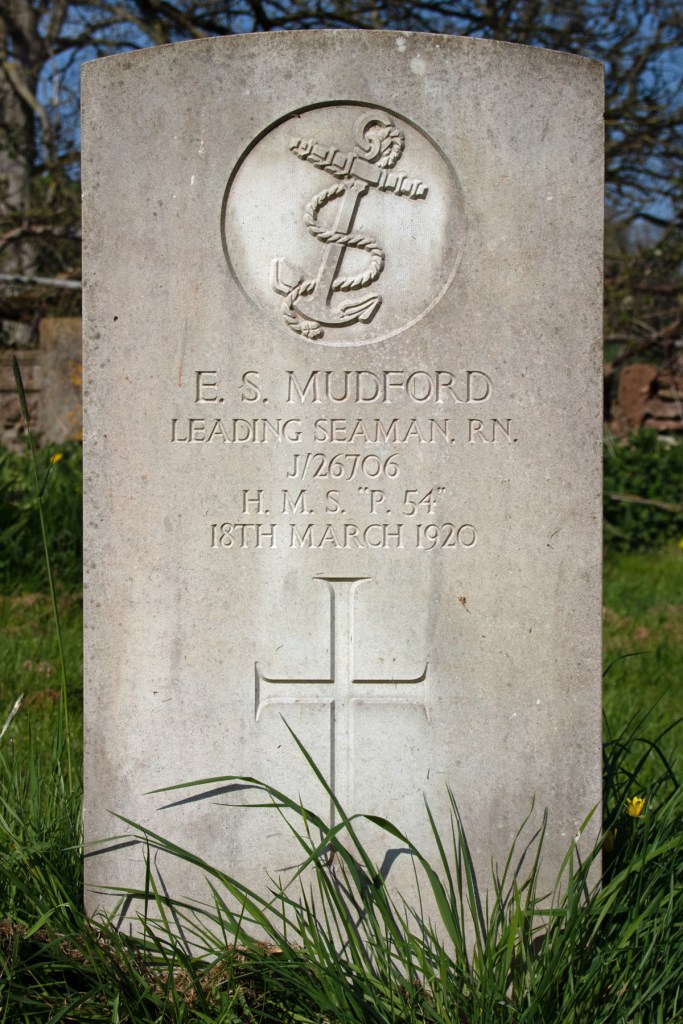
Leading Seaman Edward Mudford

Leading Seaman Edward Mudford

Edward Short Mudford was born on 29th March 1898 in the Somerset village of Stratton-on-the-Fosse. He was one of nine children to Joseph and Mary Mudford.

Information about his early life is confusing: the 1901 census gives his name as Edwin, rather than Edward; his father appears to have died by this point, leaving Mary to raise the family alone. The 1911 census records Edward and a younger sister living in the Union Workhouse in Shepton Mallet, while Mary has apparently remarried and was living in Radstock with two of Edward’s siblings and a daughter from her second marriage, although her new husband is noticeable in his absence from the document.

From this shaky start, however, Edward sought a new life for himself. On 21st August 1913 he enlists in the Royal Navy. His service records show that he stood just 5ft 1ins (1.55m) tall, had fair hair, hazel eyes and a fresh complexion. Being under age at the time, he was given the rank of Boy 2nd Class.

Edward was initially sent to HMS Ganges, the naval training establishment outside Ipswich, Suffolk. Promoted to Boy 1st Class in February 1914, he was soon given his first posting, on the cruiser HMS Crescent.

After another short spell at HMS Vivid, the Naval Dockyard in Plymouth, Boy Mudford found himself on board HMS Thunderer. Edward spent nearly four years aboard the battleship, coming of age and gaining the rank of Ordinary Seaman, while also being promoted to Able Seaman in March 1916.

Edward returned to Plymouth in February 1918, and spent the next couple of years between there, Portsmouth and Woolwich Dockyards. He was again promoted, given the rank of Leading Seaman in September 1918.

Life at sea and in barracks took its toll, however, and, in in the spring of 1920, Leading Seaman Mudford contracted influenza and pneumonia. Sadly the conditions proved too much to bear: he passed away on 20th March 1920, a week shy of his 22nd birthday.

Brought back to Somerset, where, presumably some of his family still lived, Edward Short Mudford was laid to rest in the graveyard of St John the Baptist Church in Chilcompton.

Boy Leslie Perkins

Boy Leslie Perkins

Leslie Harry Perkins was born on 15th June 1901, the only child to Harry and Rosalie. Harry was a solicitor’s clerk from Taunton in Somerset, and Leslie was born and raised in nearby Weston-super-Mare.

Given Leslie’s young age, there is very little documentation about his early life. When he left school, he found work as a motor fitter but, with war raging across Europe by this point, he was keen to put his skills to use.

On 9th October 1917, he enlisted in the Royal Flying Corps (RFC). His service records show that he stood 5ft 10ins (1.77m) tall and noted that he had three scars on his left hand. Because of his age, he was given the rather diminutive rank of Boy.

He worked in the Engine Repair Section just outside Sheffield, Yorkshire, and, transferred across to the RFC’s successor – the Royal Air Force – when it was formed on 1st April 1918.

It was here, in the autumn of 1918, that Boy Perkins contracted influenza. Sadly, like so many others of his generation, he was to succumb to the disease, and passed away in the camp’s hospital on 1st December 1918. He was just 17 years old.

Leslie Harry Perkins’ body was brought back to Somerset for burial. He was laid to rest in the family grave in Milton Cemetery, in his home town of Weston-super-Mare.


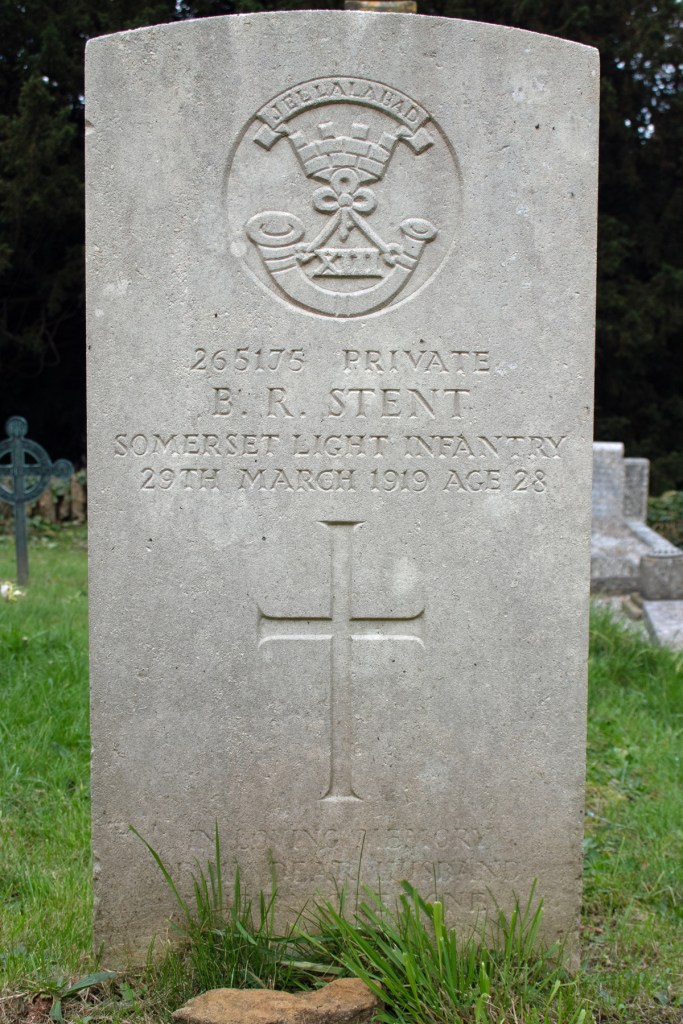
Private Bertie Stent

Private Bertie Stent

Bertie Reginald Stent was born early in 1892, one of fifteen children to Henry and Emily. Henry was a painter – initially for the railways, and then a house painter – from Frome, Somerset, and the family were raised on The Mint in town.

When he left school, Bertie also left an overcrowded home. He found work as a carter, and moved to Wellow, near Bath, where he boarded with stonemason Albert Barnes and his family. War was coming to Europe, however, and things were about to change.

Bertie enlisted in the 85th Provisional Battalion of the Territorial Force early on in the conflict. He was initially based on home soil, serving in Herne Bay in Kent and Wrentham in Suffolk. His troop became the 11th Battalion of the Somerset Light Infantry at the start of 1917 and, by the spring of the following year, he found himself in Northern France.

By this point, Bertie had met and married a woman called Ethel May. Sadly, little further information about the wedding is available, but the couple set up home in the same road as his parents and went on to have two children.

Private Stent was involved in some of the final battles of the war – the Battle of Albert and the advances in Artois and Flanders. When the Armistice was signed, he remained in France, returning home in the following spring.

Tragically, he had contracted influenza while waiting to be demobbed and, on 29th March 1919, he passed away at home from pneumonia. He was just 27 years old and had been back in Frome for just a week.

Bertie Reginald Stent was laid to rest in the churchyard of Holy Trinity Church in Frome, within sight of his family home.


While there is little information about Bertie and Ethel’s marriage, there is some detail about her life after her husband’s death. Ethel continued to live in Frome, on the same road as her marital home. The 1939 Register lists her as an unpaid domestic worker – in effect, a housewife – and she is living with Reginald, her and Bertie’s second child, who was a land worker.


Bertie’s sister, Annie, married Albert Withey, who also died after coming home from war. Read his story here.

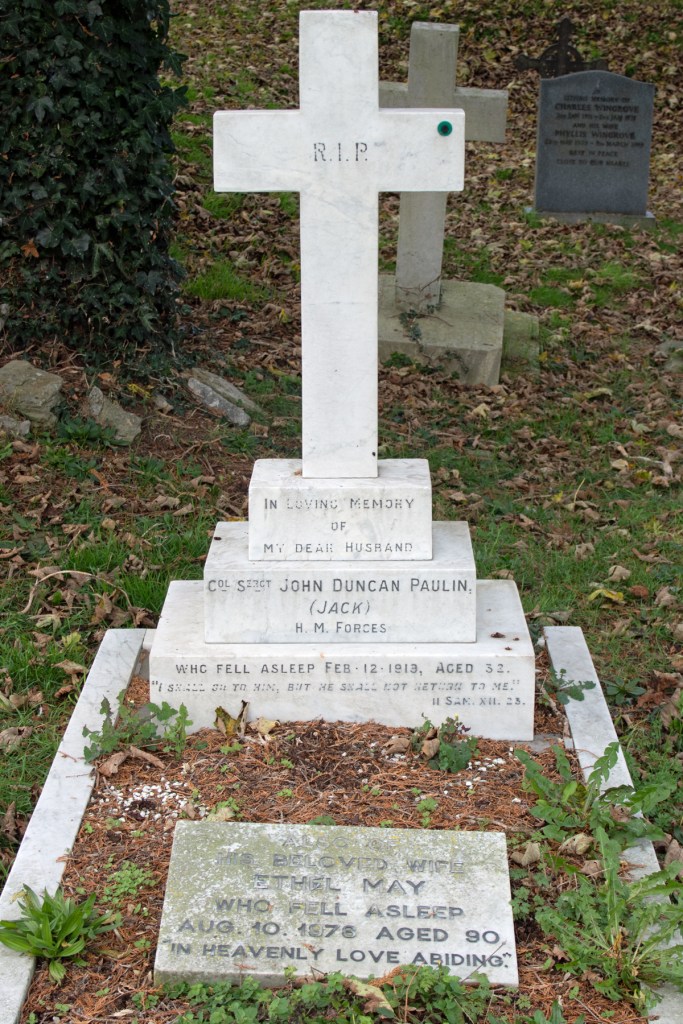
Colour Sergeant John Paulin

Colour Sergeant John Paulin

John Duncan Paulin was born in January 1885 in Liverpool, the youngest of two children. His parents – John Robert (known by his middle name) and Jane Paulin – were born in Scotland, but seemed to have moved to the Lancashire port by the late 1870s.

When he left school, John – who became known as Jack – found work as a clerk, but a life of adventure – and a more reliable career – beckoned. On 14th August 1904, he enlisted in the Border Regiment as a Private for a period of seven years. During that time, he served in barracks across the country – from Carlisle to Plymouth – and, by the time he was put on reserve in 1911, he had reached the rank of Corporal.

When war was declared, those servicemen on reserve were called back into action, and Jack found himself reposted with an increased rank of Sergeant. Over the next few years, he remained based in England and seemed to take on more of a training role, transferring to the Middlesex Regiment and, by the end of 1917, attaining the rank of Colour Sergeant.

At some point Jack met Ethel May Smith, who lived in Frome, Somerset. She was the same age as Jack, and was the daughter of the foreman of one of the cloth manufacturers in the town – she also went on to work in the factory. The couple married in St John’s Church in the town on 1st June 1916, but did not go on to have any children.

Colour Sergeant Paulin’s military career was free of any medical issues or hospital admissions until February 1919. He had not been demobbed by this point, even though the war was over. However, as with many other servicemen at the time, Jack fell ill with influenza, and was admitted to Grove Military Hospital (now St George’s Hospital) in Tooting, South London. Pneumonia set in, and Jack passed away on 12th February 1919, at the age of 34 years old.

Jack Duncan Paulin’s body was brought back to Somerset, and he was laid to rest in the graveyard of Christ Church, Frome. Ethel lived on until 1978; she was laid to rest with her husband.


Corporal Cyril Allen

Corporal Cyril Allen

Cyril Starr Allen was born on 15th June 1891 in the village of Baughurst, near Tadley in Hampshire. He was the second youngest of five children to Charles and Martha Allen. Charles was a rate collector, and the family moved around the county during Cyril’s early years.

By the time Cyril left school, Charles had become an assistant bursar in Wootton, near Basingstoke. Cyril, meanwhile, had found similar administrative employment and was working as a clerk for a local land agent.

At the start of 1911, Cyril enlisted in the British Army. He joined the 4th Battalion of the Wiltshire Regiment as a Private and was soon based on Salisbury Plain. His service records confirm that he was 19 years and 7 months old, and stood at 5ft 5ins (1.65m) tall. Private Allen served for his initial term of four years, before being remobilised.

In November 1915, Cyril married Mabel Young. She was a printer’s daughter from Wiltshire, and the couple married in Salisbury, before settling down in Frome, Somerset. They went on to have a child, a daughter they called Kathleen.

Remobilised in the autumn of 1915 Private Allen received a series of promotions – to Lance Corporal, Corporal, Lance Sergeant and Sergeant, and, by June 1917, he found himself at the Front.

On 22nd April 1918, Cyril was injured, sustaining gunshot wounds to his shoulder and left arm. He was invalided back to England for treatment, and was hospitalised in the north of the country. He was then transferred to the Royal Welch Fusiliers with the rank of Corporal and sent to Ireland to continue his recovery and work light duties.

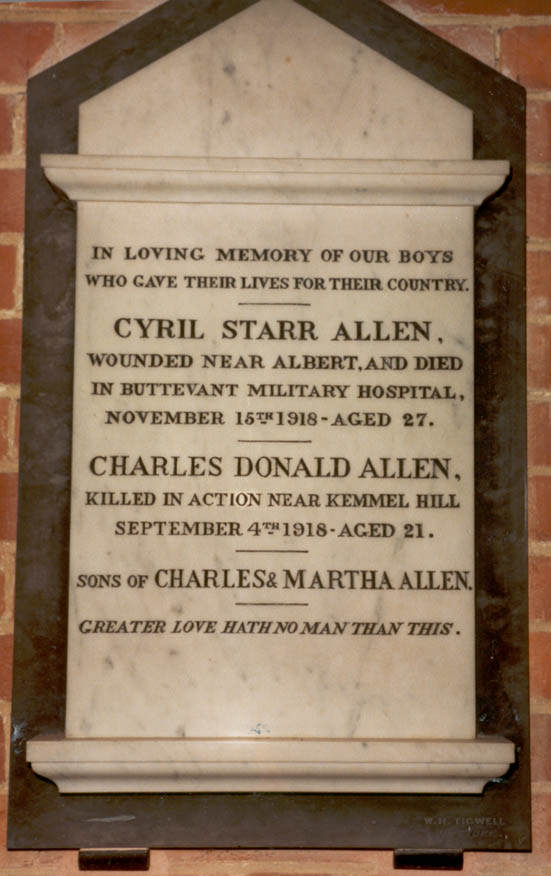
While in Ireland, Corporal Allen contracted influenza and was admitted to the Buttevant Hospital in County Cork. Sadly, in his weakened state, it was something he was to succumb to, and he passed away, with Mabel at his bedside, on 15th November 1918. He was just 27 years of age.

Cyril Starr Allen’s body was brought back to England; he was laid to rest in the graveyard of Christ Church in Frome, Somerset.


Corporal Cyril Allen (from ancestry.co.uk)

After the loss of her husband, Mabel went on to live her life. In 1923, she married James Burr, a draughtsman from Frome; they went on to have a child – a brother for Kathleen – called James.


Cyril’s two brothers, Winthrop and Charles, also fought in the First World War.

(from ancestry.co.uk)

Winthrop had emigrated to North America in 1911, but returned to Europe as part of the Canadian Expeditionary Force when war broke out.

Lance Corporal Charles Allen served with the 15th Battalion of the Hampshire Regiment. He fought on the Western Front and was killed near Kemmel Hill in Belgium on 4th September 1918. He was just 21 years old. Charles is commemorated at the Tyne Cot Memorial in Zonnebeke, Belgium.


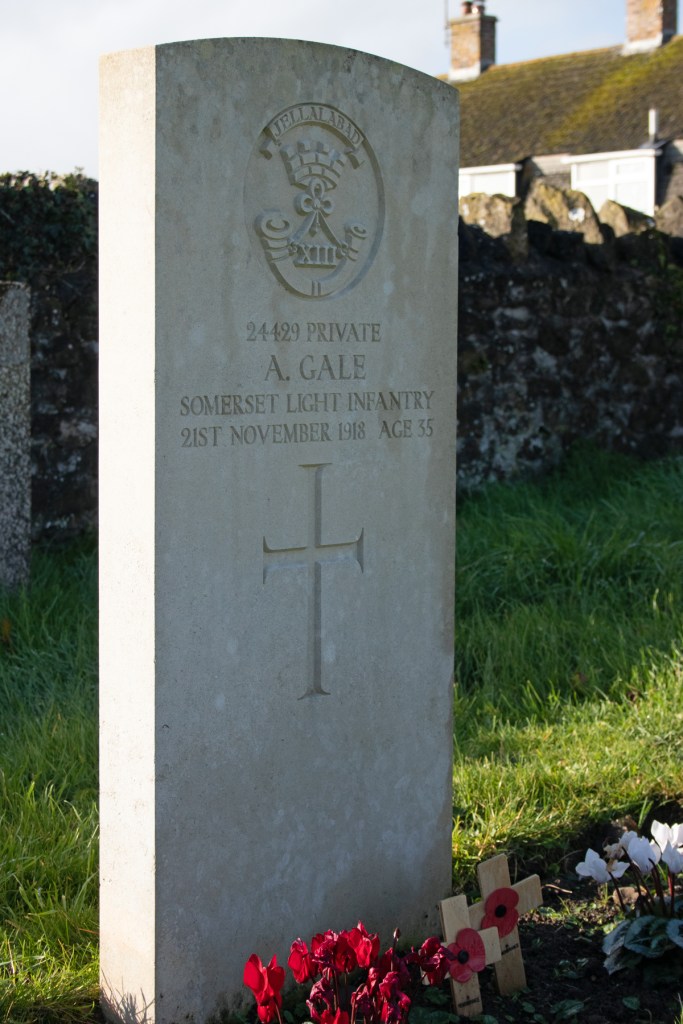
Private Albert Gale

Private Albert Gale

Albert Gale was born in the Devon village of Chudleigh Knighton in October 1883, one of five children to John and Elizabeth Gale. It seems that Elizabeth may have died when Albert was young, as, by the time of the 1901 census, John was married to a Sarah Gale, and the family were living in the village of Hennock.

John was a clay cutter, and this was a trade into which Albert followed his father. Again, as time moves on, things change; the 1911 census found Albert boarding with his sister Sophy and her husband, fellow cutter Thomas Willcocks, back in Chudleigh Knighton.

War was coming to Europe and, in April 1916, Albert enlisted, joining the Somerset Light Infantry as a Private. He would have cut a commanding figure; his enlistment papers show that he stood at 5ft 10ins (1.77m) tall.

Albert served on home soil. While attached to the Somerset Light Infantry, he was assigned to the 661st Agricultural Company of the Labour Corps, working in Kent and Sussex.

During this time, he received hospital treatment on four separate occasions: in August 1916, he was admitted with cellulitis of the arm; in December 1916 and January 1917, he was treated on two separate occasions for scabies. In November 1918, however, he was admitted to the Military Hospital in Chichester, West Sussex, as he was suffering from influenza. Sadly, this last condition was to worsen and, on 21st November 1918, Private Gale died, having subsequently contracted pneumonia. He was 35 years old.

Albert Gale’s body was brought back to Devon for burial. His brother-in-law Thomas had died the previous summer; his story can be found here. Albert was laid to rest in the grave next to his sister’s husband in the churchyard of St Paul’s in Chudleigh Knighton.


With Thomas dead, Sophy had been left a widow. Understandably bitter at what the war had taken from her, when she was asked if she wanted a memorial for her brother, she returned the form with the following statement: “I don’t require the plaque and scroll in memory of my dear brother; a piece of paper won’t keep me.”

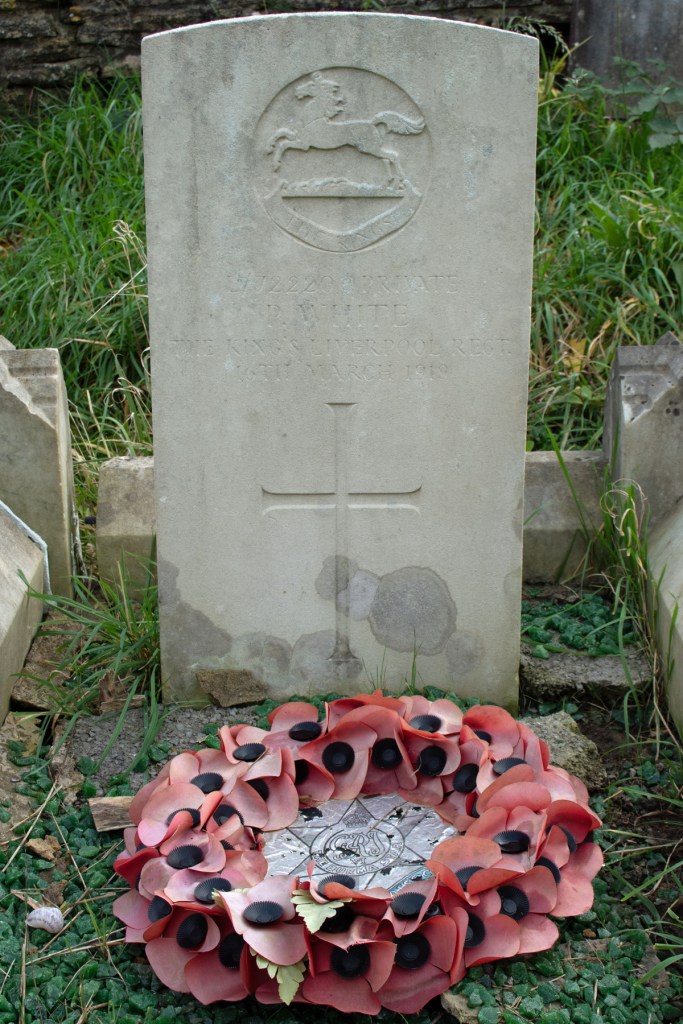
Private Percy White

Private Percy White

Percy White was born in the spring of 1890, the youngest of four children to Frank and Fanny White. Frank was a tailor from Frome, Somerset, and this is where the family were raised and settled for most of Percy’s life.

By the time of the 1911 census, Frank and Fanny had been married for 30 years. Frank was still working as a tailor, while Percy’s three older siblings – all girls – were working as silk weavers and packers. Percy had moved away from the family’s clothing heritage, and had found work as a hairdresser.

War was on the horizon, however, and Percy was called upon to do his duty for King and Country. He was initially assigned as a Private to the King’s (Liverpool Regiment) when he joined up in the autumn of 1914. Full details of his military service are not readily available, but it seems that he served on the Front Line in France, but was invalided out late in 1917.

By that point, he had met Bessie Cundick, who had been born in Wiltshire. They married in Andover in the spring of 1916, when they were both 26 years old.

Back in England, and discharged from the King’s (Liverpool Regiment), Percy was transferred to the Labour Corps and, for the last year of the war had done agricultural work in Cambridgeshire. After the armistice was signed, Frank fell ill and died on 4th February 1919.

Private White attended the funeral at the Vallis Road Cemetery in Frome with his family, before returning to his unit. By this point, however, he had himself fallen ill with influenza, and was admitted to the East General Hospital in Cambridge. The condition was to prove too much, however, and he passed away on 16th March, less than six weeks after his father’s death. He was just 29 years of age.

Percy’s body was brought back to Frome; he too was laid to rest in the Dissenters’ Cemetery in Vallis Road, Frome.


Serjeant Edwin Lloyd

Serjeant Edwin Lloyd

Edwin Lloyd was born at the start of 1885 and was the youngest of ten children. His father, Henry, was from Bristol; while his mother, Mary, had been born in Ireland.

Henry had been a Serjeant in the armed forces, and his postings are reflected in the places where Edwin and his siblings were born. Henry and Mary’s oldest two children were born in Aden, Arabia (now Yemen), but by 1875, the family were back in England and their next oldest child was born in Dover, Kent. Sarah, the youngest of Edwin’s sisters, was born in Colchester, Essex the following year, but by 1879, Henry had left the army, and had moved the family to Frome, Somerset.

In his retirement, Henry took a job as a grocer, the family living above the shop on the main thoroughfare into the town. Edwin did not follow his father’s trade when he left school; instead the 1901 census lists him as a metal engineer, one of only two of the siblings still living above Henry’s shop.

Henry died in 1907 – a lot of the documentation about his life suggests he was a bit free about his age. The notice in the Somerset Standard announcing his passing gives his age as 69, although it is likely that he was closer to 80.

The following year, Edwin married Florence Emily Letchford in St Matthew’s Church, Bristol. Florence was the daughter of a travelling salesman, but their marriage record sheds more light onto Edwin’s life by this stage and he was recorded as a police constable.

Edwin’s time in the police seems to have been short-lived, however, as, by the census three years later, his role had reverted to memorial brass engraver.

War was coming to Europe, and, while Edwin’s full service records are not available, it’s possible to piece together some of his life in the army. He enlisted in 1915, joining the Dorsetshire Regiment, and was assigned to the 5th (Service) Battalion.

Edwin’s battalion fought at Gallipoli and served in Egypt, moving finally to France in the summer of 1916. He was obviously a diligent soldier, as, by the end of the conflict, he had made the rank of Serjeant.

A local newspaper reported on the end of his army life:

He had served with the forces for about four years, and on his way home from France he was taken ill, and was, when he arrived at home, in a somewhat critical condition. The fatigue of the journey told still further upon him, and he passed away three days after his arrival.

Somerset Standard: Friday 7th March 1919

Serjeant Lloyd’s pension record gives the cause his passing as influenza, pneumonia and syncope, sadly none of which were uncommon for soldiers returning from the front. He was just 34 years old when he died on 25th February 1919.

Edwin Lloyd was laid to rest in the Vallis Road Cemetery (also known as the Dissenters’ Cemetery) in Frome.


Gunner Percy Gast

Rustington

Percy Cyril Edward Gast was born in the West Sussex village of Nutbourne in 1889. His parents were William and Eliza Gast and he was one of sixteen children, seven of whom survived.

William was an agricultural labourer, and farming was the line of work the whole family went into; by the time of the 1911 census, they had moved to Rustington, near Worthing, where Percy was working as a cowman.

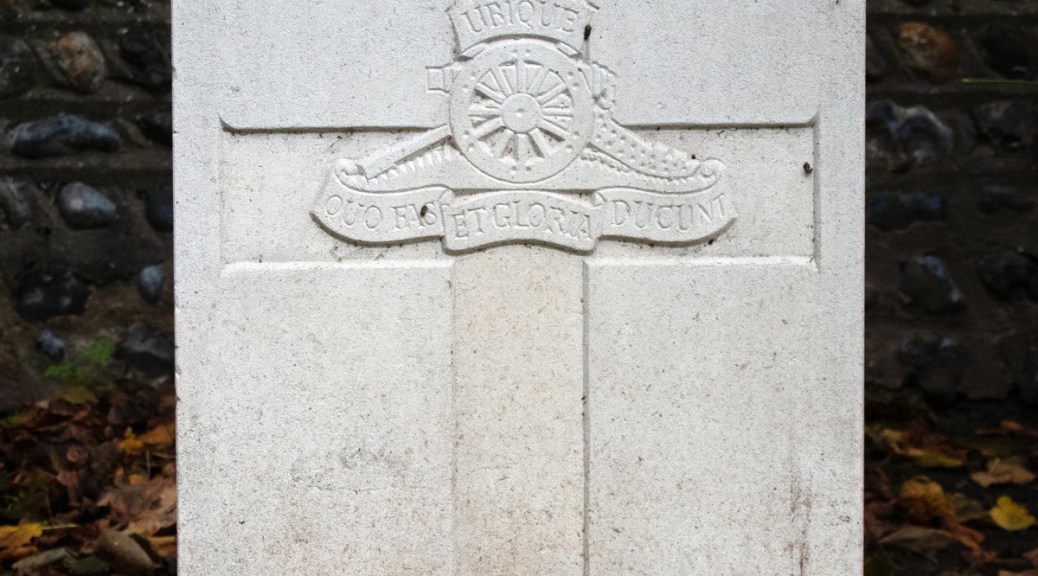
When war broke out, Percy enlisted, joining the Royal Garrison Artillery. His skillset soon identified, he was transferred over to the 696th Agricultural Company of the Labour Corps.

While full details of his time in the army are not readily available, Private Gast served his time on home soil. Towards the end of the war he contracted influenza and pneumonia and was admitted to the Mile End Military Hospital in Newham, East London.

Sadly, the lung conditions were to prove his undoing; Private Gast passed away on 20th November 1918, at the age of just 29 years old.

Percy Cyril Edward Gast’s body was brought back to Rustington for burial. He lies at rest in the graveyard of St Peter and St Paul’s Church in the Sussex village.


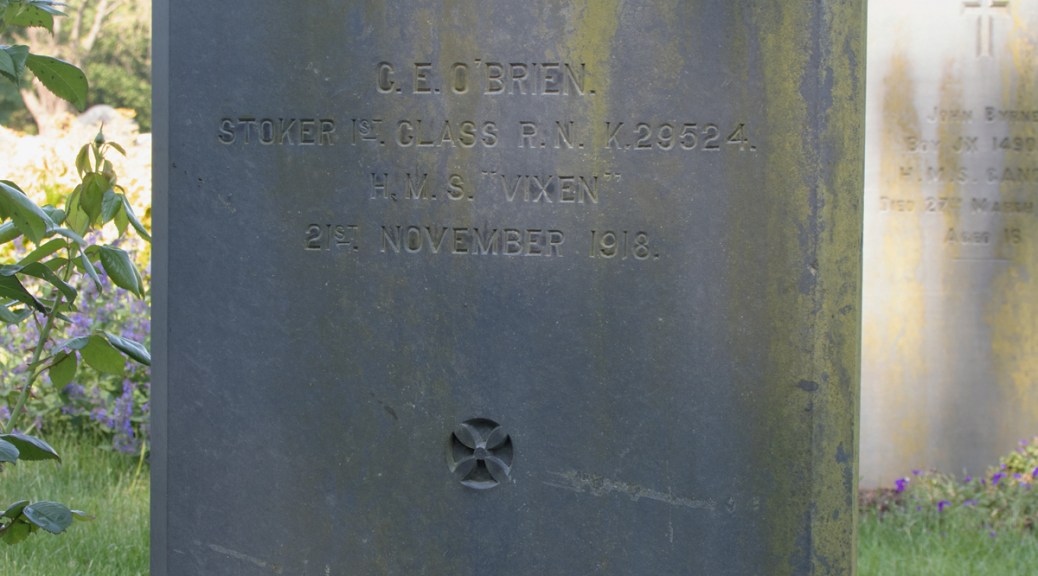
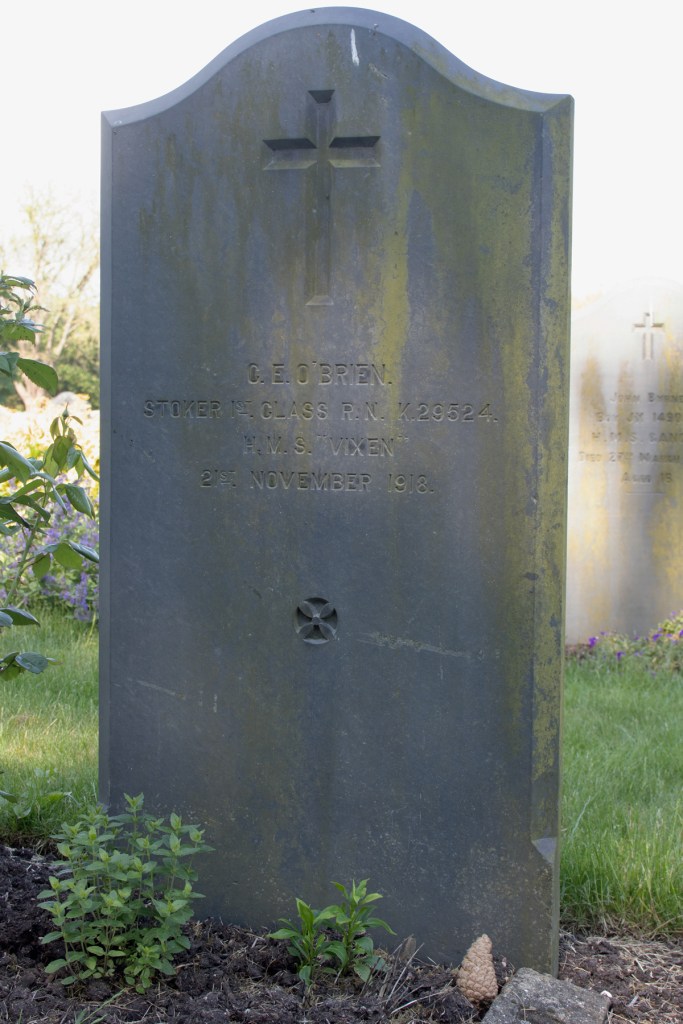
Stoker 1st Class Cornelius O’Brien

Stoker Cornelius O’Brien

Documentation on the early life of Cornelius Edward O’Brien is pretty scarce, so it is impossible to build a picture of him before the First World War. He was born in the late 1890s in Whitechapel, East London and was working as a carman when he received his enlistment papers.

Cornelius joined the Royal Navy as a stoker on 27th November 1915 and was sent to HMS Vivid II, the shore-based establishment in Devonport that served as the Stokers and Engine Room Artificers School. He trained there for a couple of months before being assigned to HMS Drake, where he spent most of 1916.

Returning to Devonport, Stoker O’Brien spent a further year on board HMS Vivid II, gaining the rank of Stoker 1st Class. By the end of 1917, however, he was back at sea, having been sent to HMS Vixen, a naval destroyer that served in the Thames Estuary, performing anti-submarine patrols and counter mining operations there.

In mid-November 1918, with the war officially over, Cornelius was admitted to the Royal Naval Hospital in Chatham, suffering from influenza, pneumonia and pleurisy. Sadly these were to prove too much of a challenge for him and he passed away on 21st November 1918.

Cornelius Edward O’Brien was laid to rest in the Woodlands Cemetery in Gillingham, not far from the Naval Dockyard in Chatham.