James Hurley was born in Timoleague, County Cork, Ireland, on 1st August 1894. His was not an uncommon name so full details of his early life are a challenge to unpick. However, later records confirm that his father was also called James Hurley, and when he finished his schooling, he found work as a farm labourer.
When war broke out in Europe, James Jr was quick to step up and play his part. He enlisted in the Royal Navy on 12th January 1915, and took the role of Stoker 2nd Class. His service records show that he was 5ft 5.5ins (1.66m) tall, with dark brown hair, grey eyes and a fresh complexion.
Stoker 2nd Class Hurley was sent to HMS Pembroke, the Royal Naval Dockyard in Chatham, Kent, for his training. However, his time there was to be tragically brief. He was admitted to the Welcome Hospital when he contracted pneumonia and empyema, but the condition was to prove too severe. He passed away on 6th February 1915, at the age of just 20 years old. He had been in the Royal Navy for just 25 days.
James Hurley’s parents were unable to bring him back to Ireland for burial. Instead, he was laid to rest in the Roman Catholic section of the Woodlands Cemetery in Gillingham, not far from the dockyard in which he had so briefly served.
Thomas McCall was born in Bootle, Lancashire, in 1892 and was one of two children to Francis and Elizabeth. Frank was a stoker on the steamers leaving Liverpool docks and, after working at the docks himself, Thomas soon followed his father onto the ships. By the summer of 1911, he had worked as a trimmer on at least two liners, the RMS Carmania and the RMS Empress of Britain.
When war came to Europe, Thomas stepped up, joining the Mercantile Marine Reserve – now better known as the Merchant Navy. By the summer of 1915, he was assigned to the seaplane carrier HMS Vindex, which spent most of the war in the North Sea.
Stoker McCall’s time there was to be brief. Details are sparse, but he passed away on 14th October 1915, with records suggesting this was due to disease. He was just 23 years of age.
Finances may have limited Frank and Elizabeth from bringing their son back to Lancashire: Thomas McCall was instead laid to rest in the Roman Catholic section of Woodlands Cemetery in Gillingham, Kent, not far from the dockyard in which he had been based.
Thomas’ headstone gives MaCall as his surname. This is an error: his name was spelt McCall.
Peter Bennoit was born in 1897 in St George’s, Newfoundland. The son of fisherman and sporting guide Peter Bennoit and his wife, Selina, little more is known about his early life.
When war was declared in Europe, he was quick to take up the call to arms. He made the journey to St John’s, and enlisted in the Newfoundland Royal Naval Reserve on 14th October 1914. He set sail for Britain on board the training ship HMS Calypso and, having arrived in November, he was transferred to HMS Pembroke, the Royal Naval Dockyard in Chatham, Kent.
Seaman Bennoit remained in Chatham for the next couple of month, presumably to await a formal posting. This was not to happen, however: he was admitted to the Royal Naval Hospital in Chatham with mastoiditis, a bacterial infection of the inner ear. The condition was so serious that Peter succumbed to it: he passed away on 20th January 1915, at the age of just 18 years old.
Peter Bennoit was 2500 miles (4000km) from home, so it was not possible for him to be interred in Newfoundland. Instead, he was laid to rest in the Roman Catholic section of Woodlands Cemetery in Gillingham, Kent, not far from where he had passed.
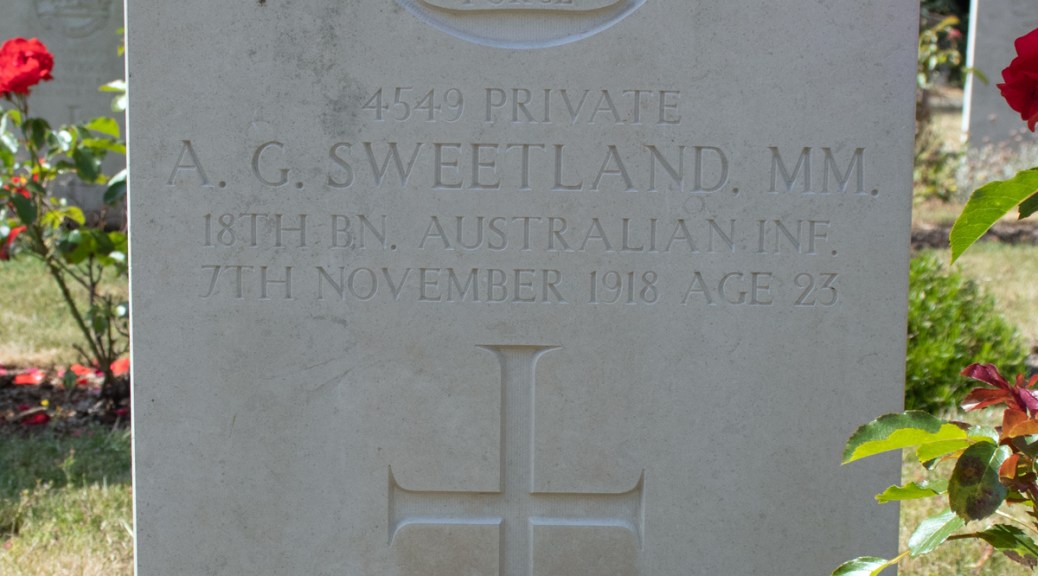
Albert Graham Sweetland was born on 6th January 1895 in Kensington, Middlesex. The oldest of seven children, his parents were mechanical engineer Albert Sweetland and his wife, Edith.
A work ethic was instilled into Albert Jr from an early age. By the time of the 1911 census, he had been sent to Truro, Cornwall, where he worked as a servant to the Faull family, tending to their poultry.
Albert was set on developing a life for himself and, in the next few years, he emigrated to Australia. He settled in the town of Liverpool, now a suburb of Sydney, and found work as a station hand. War was on the horizon, however, and people of the empire were called upon to serve their King.
Albert enlisted on 22nd January 1916, joining the 18th Battalion of the Australian Infantry. His service records tell a little about the man he was becoming. He was 5ft 7ins (1.7m) tall, and weighed 143lbs (64.9kg), with fair hair, blue eyes and a fair complexion. The document also notes that he was a Methodist, and that he had tried to enlist in the British army before emigrating, but that a slight defect in his right eye had prevented him.
Private Sweetland set sail for Europe on 9th April 1916. His unit sailed via Suez, reaching Folkestone, Kent, that November. His time back in Britain was to be brief, however: within a matter of days he was in Etaples, France.
Albert was thrown into the thick of things. On 5th May 1917, he was wounded while fighting at Arras. He was shot in the legs, and medically evacuated to Britain for treatment and recuperation. He was to remain on home soil for the next year, before returning to his unit in June 1918.
On 3rd October 1918, Private Sweetland was injured during the Battle of the Beaurevoir Line. His unit’s push forward was initially successful, but ultimately failed to capture the the village. The German forces attacked with gas, and Albert was caught up in it, receiving a gun shot wound to his back.
By the time Beaurevoir was in Australian hands three days later, more than 430 Allied soldiers had been killed. Albert was awarded the Military Medal for his bravery during the battle.
Private Sweetland was medically evacuated to Britain once more, and was admitted to Bath War Hospital for treatment. This time, however, he was not to be as luck as he had been eighteen months previously. He died on 7th November 1918, from a combination of appendicitis, pneumonia and heart failure. He was just 23 years of age.
Albert Graham Sweetland was laid to rest in the military section of Bath’s Locksbrook Cemetery, not far from the facility where he had passed. His parents and his sister Winifred attended the funeral.
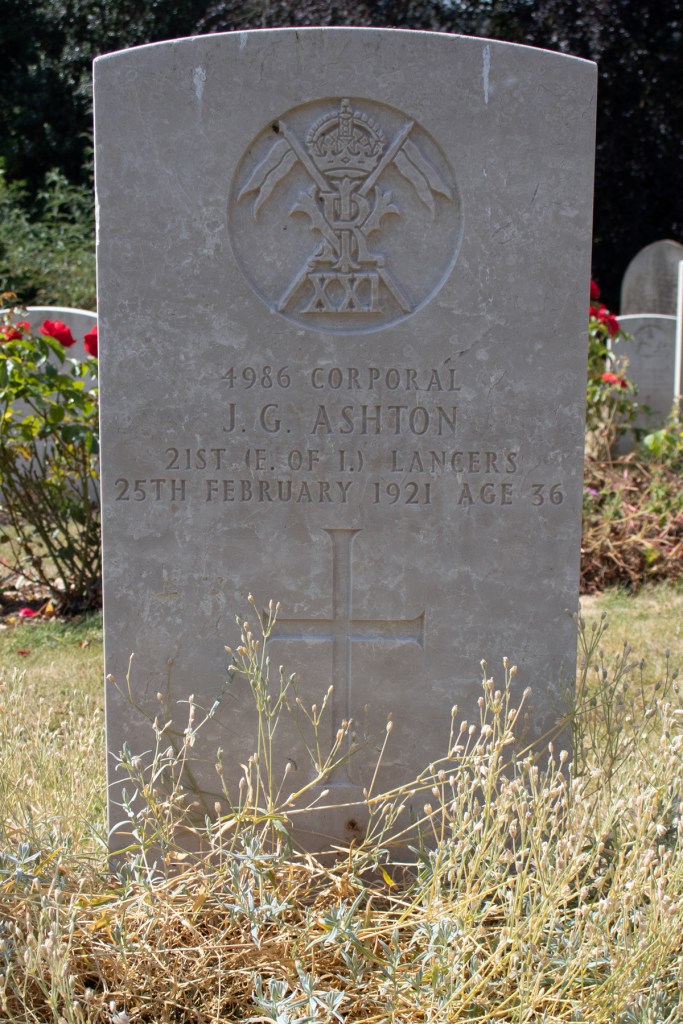
John Gordon Ashton was born at the start of 1885, and was one of at least two children to John and Elizabeth. Little information is available about his early life, although later records confirm that he was born in Newcastle-upon-Tyne, and that the family were living on Elswick Road, leading west out of the city, by 1900.
John found work as a musician, but sought a bigger and better career for himself. On 3rd October 1900, he enlisted in the army, joining the 21st (Empress of India’s) Lancers. His service records show that, at not yet sixteen years of age, he was just 5ft 1in (1.55m) tall, and weighed 101lbs (46kg). He had brown hair, grey eyes and a dark complexion, and two moles on the front of his left shoulder.
Private Ashton joined up for a period of 12 years’ service, and spent most of it on home soil. The army seemed to suit him, and he steadily rose through the ranks. By August 1901, John was promoted to Bandsman; five years later, he took the rank of Trumpeter; the start of 1908 brought with it a promotion to Lance Corporal.
In September 1910, John’s unit was sent to Egypt: the move brought him a further promotion. Corporal Ashton spent two years in Cairo, before returning to Britain in the autumn of 1912. He had completed his contract of service with the 21st Lancers, and was formally discharged from service on 4th October.
Back on civvy street, John once again found work as a musician. Life outside of the army seemed not to suit him, however, and he joined the reserve forces in March 1913. The now Lance Sergeant’s service records show the man he had become: he now stood 5ft 9ins (1.75m) tall, and bore a large oval scar on the underside of his right knee.
When war was declared the following summer, John was formally mobilised once more. He was attached to the 9th (Queen’s Royal) Lancers and, by 27th August 1914, was in France. Lance Sergeant Ashton’s time overseas was not to last long, however; he returned to Britain just before Christmas that year, and was based at Tidworth Camp in Wiltshire.
John’s military record was not without its hiccups. On 11th March 1910, while based in Canterbury, he was severely reprimanded for being in neglect of his duty whilst in charge of a barrack room. In 1915, however, he received a more severe punishment: on 23rd January, he was found guilty of using insubordinate language to his superior officer – in front of six ranking witnesses – and was demoted to Corporal.
It would seem that John’s health was beginning to suffer, and, after a career of nearly sixteen years, he was medically discharged from the army because of a heart condition.
At this point, his trail goes cold. He remained in the Wiltshire area, and seems to have been receiving ongoing medical treatment. At some point, he married a woman called Mary, although no other information is readily available for her.
Early in 1921, John was admitted to the Pensions Hospital in Bath, Somerset, having contracted pneumonia. He passed away there on 25th February following an aneurysm of the heart. He was 36 years of age.
John Gordon Ashton was laid to rest in the sweeping Locksbrook Cemetery in Bath.
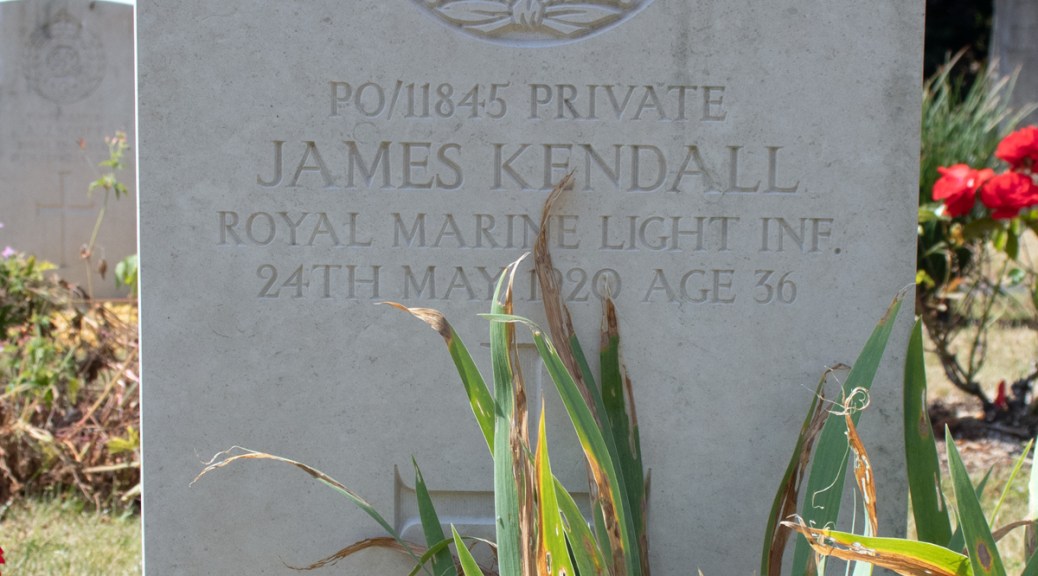
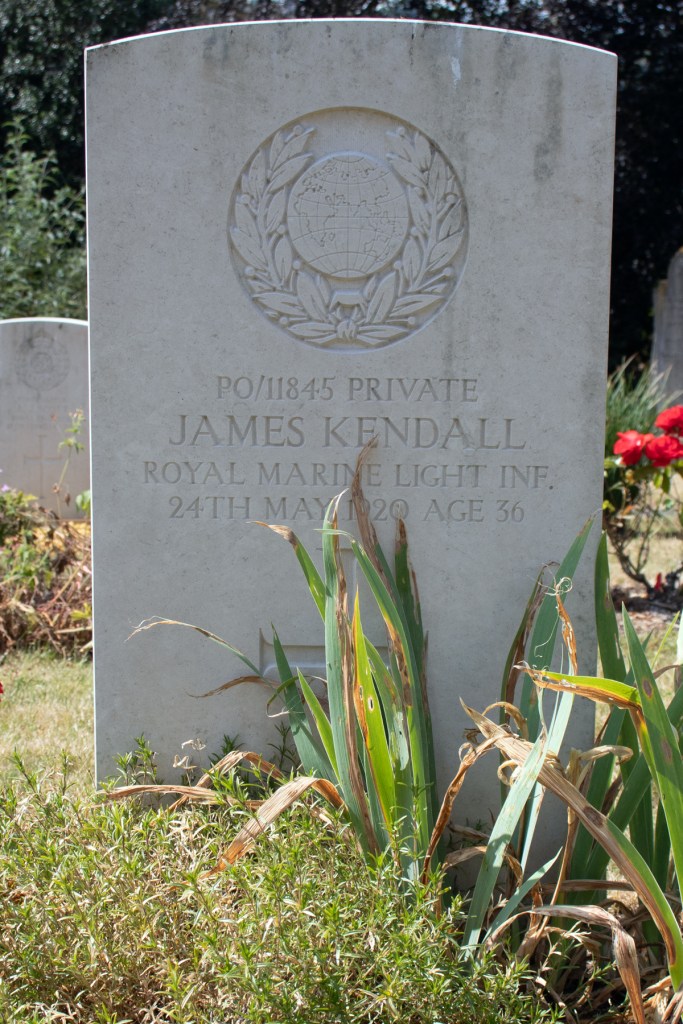
Much of the early life of James Kendall is destined to remain shrouded in the mists of time. Born on 10th June 1883 in Stalbridge, Dorset, his parents are recorded as James Kendall and Anna Louisa Yeatman.
The 1901 census recorded James as being the head of a household, despite being only 17 years old. He was working as an agricultural labourer, and was living with his maternal grandmother, Mary Ann Yeatman, and her daughter, Louisa (the census recorded her as James’ aunt, although she shared a name with his mother).
James sought a proper career, however, and, on 19th July 1901, he enlisted in the Royal Marine Light Infantry. His service records show that he was 5ft 6.5ins (1.69m) tall, with brown eyes, light brown hair and a fresh complexion.
Private Kendall was sent to Deal in Kent for his training: he remained here for nine months, before being transferred to Portsmouth, Hampshire. Over the next twelve years, he served on ten ships – including the HMS Duke of Wellington, HMS Egmont and HMS Renown – returning to the HMS Victory, the Royal Naval Dockyard in Portsmouth, in between each assignment.
James was billeted at HMS Victory when war was declared. During the conflict he remained based in Portsmouth, while being assigned to HMS Cornwall and HMS Birmingham for spells. It seems likely that his shore service helped support new recruits: Private Kendall’s experience would have been invaluable.
In 1915, James married a woman called Edith: there are no other details for her, other than that she his named as his next of kin on his service records.
When the armistice was declared, Private Kendall was serving on HMS President III, a shore base split between Bristol, Windsor and London. He returned to Portsmouth in the summer of 1919 and was formally stood down the following January, having been invalided out of the Royal Marines. He had served for more than eighteen years, and consistently received notices of high levels of character and ability.
James’ dismissal from service was as a result of an unrecorded illness, likely to be one of the lung conditions prevalent at the time. The next record for him is that of his passing, on 24th May 1920, at Bath War Hospital, Somerset. He was 36 years of age.
James Kendall was laid to rest in the city’s Locksbrook Cemetery. He was interred in the military section on the graveyard, often reserved for those servicemen whose families were unable to afford to bring their loved ones home.
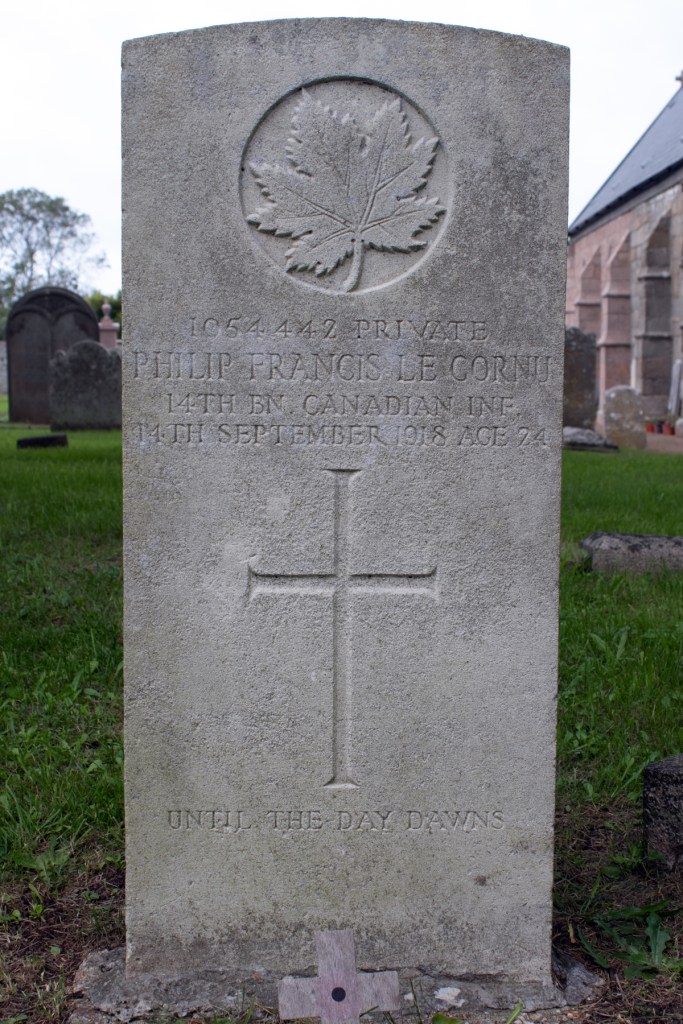
Philip Francis le Cornu was born on 29th July 1894 in St Peter’s, Jersey. The youngest of five children, his parents were Philip and Mary le Cornu. Philip Sr was a farmer, but it seems that both he and Mary passed away not long after his youngest son’s birth. By the time of the 1901 census the children had been split between family members, and Philip Jr was living with his maternal grandparents.
Philip finished his schooling, and seems to have sought a purpose in life. He emigrated to Canada and, by the time war broke out, was living in Grande-Mère, Quebec. He found employment as a clerk, but with conflict raging on the other side of the Atlantic, he responded to the call to arms.
Philip enlisted in the Canadian Expeditionary Force on 12th September 1916. His service records show that he was 22 years and 2 months old and stood 5ft 6ins (1.68m) tall. He had black hair, blue eyes and a dark complexion. Private le Cornu sailed to Britain, and arrived there on 7th April 1917.
Billeted in Shoreham, West Sussex, Philip was attached to the 14th Battalion of the Canadian Infantry. Within weeks he was sent to France, and, on 15th August 1917, was caught up in the Battle of Hill 70 near Lens.
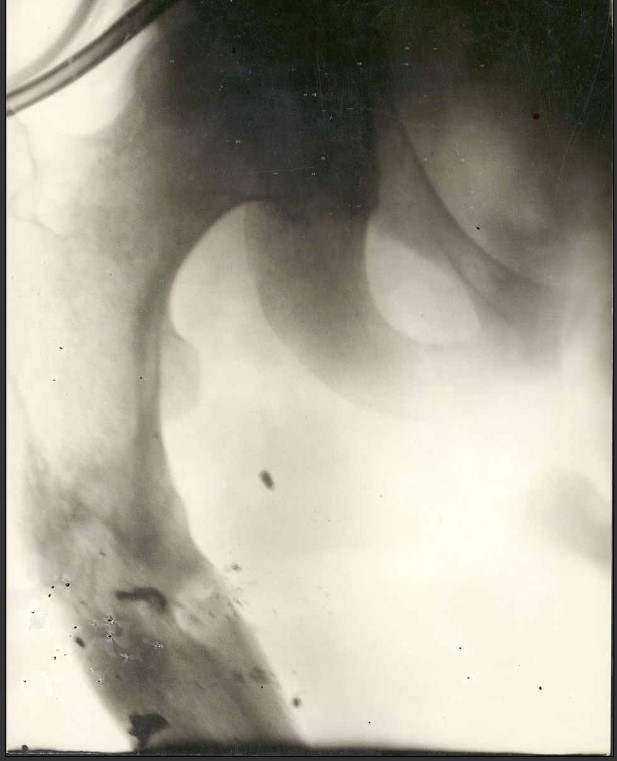
During the skirmish, Private le Cornu was badly wounded in the thigh and sent to the 58th Casualty Clearing Station. Within days he was moved to the 4th General Hospital in Camiens, but his condition necessitated medical evacuation to Britain.
Over the next year, Philip had three operations on his leg, and spent time at the 3rd Southern General Hospital in Oxford, the Manor War Hospital in Epsom, Surrey, and the 16th Canadian General Hospital in Orpington, Kent. Tragically, all of the medical treatment was to prove to no avail. Private le Cornu passed away from his injuries on 14th September 1918, more than a year after Hill 70. He was 24 years of age.
Philip Francis le Cornu’s body was taken back to the Channel Islands for burial. He was laid to rest in the quiet graveyard of St Mary’s Church on Jersey.
X-ray of Private Philip le Cornu’s left femur (from uk.forceswarrecords.com)
Oliver Banwell was born in Burnham-on-Sea, Somerset, in 1882. One of nine children, his parents were mason William Banwell and his wife Jane. When he completed his schooling, Oliver followed his father into manual work and, by the time of the 1901 census, he was employed as a bricklayer.
In 1910, Oliver married Mary Ann Burrows, a carter’s daughter from Axbridge: the couple settled down in lodgings on Oxford Street, near the centre of Burnham-on-Sea, and went on to have three children: Stanley, Primrose and Violet.
When war came to Europe, Oliver stepped up to serve his King and Country. He gave up his new employment as a groom and enlisted on 13th September 1915, joining the Royal Engineers as a Sapper. His service records give some idea of the man he had become. He was 5ft 8.5ins (1.74m) tall, weighing 141lbs (64kg), and was noted to be of good physical development, although he had slight varicose veins in both legs.
Sapper Banwell found himself in France by the end of April 1916. He spent six months overseas, before being posted back to Britain. Initially attached to the 82nd Training Reserve Battalion at the Royal Engineers Barracks in Chatham, Kent, by July 1917, he had moved again, to the 39th Fortress Company, in Sheerness.
In July 1918, Oliver was back in France again, where he was to remain until after the Armistice. By this point his health was beginning to fail and, on his return to Britain in December 1918, a medical examination deemed him no longer fit for army service. He was formally discharged from the Royal Engineers on 30th January 1919, suffering from cancer of the rectum.
Oliver returned to Burnham-on-Sea, and spent the next ten months with his family. His battle with cancer finally proved too much: he passed away on 4th December 1919, at the age of 37 years old.
Oliver Banwell was laid to rest in the family plot in Burnham Cemetery. Mary Ann was buried alongside him when she passed away in 1965, husband and wife reunited after 46 years.
Amos William Cornish was born on 16th August 1887 in Dunster, Somerset. One of five children, his parents were George and Elizabeth Cornish. George, who was a brickmaker, died in 1893, and at this point the family relationships seemed to have broken down.
By the time of the 1901 census, Elizabeth had remarried, and was living with her new husband and Amos’ youngest sibling, sister Lily. Two of Amos’ brothers, Walter and George, were living with his maternal grandparents, while Amos himself was one of three hundred inmates at the Horton Kirby Home for Homeless Boys in the Dartford area of Kent.
Amos’ schooling would have finished by the time he was 14 years old, and he quickly sought work that allow him to support himself as a young man with no home to go to. A career in the Royal Navy seemed to provide that regular pay and, on 4th June 1902, he enlisted.
As he was under age, Amos was given the rank of Boy 2nd Class, and sent to the shore-based training ship HMS Impregnable in Devonport, Devon. His service records show that he stood just 5ft 4ins (1.63m) tall, had brown hair, brown eyes and a fresh complexion. He was noted as having a scar in the centre of his forehead, and a tattoo of clasped hands over a heart on his right forearm.
Boy Cornish transferred to another training vessel – HMS Lion – after a month or so, and it was here, in February 1904, that he was promoted to Boy 1st Class.
Over the next eighteen months, Boy Cornish served at two more training bases – HMS Boscawen and HMS Vivid. He was given his first sea-going posting in April 1905, aboard the cruiser HMS Blake. It was on his next assignment, however, that he came into his own.
In May 1905, Amos boarded HMS Carnarvon, an armoured cruiser that had been launched a couple of years before. He was to spend the next two years as part of her crew, gaining the rank of Ordinary Seaman when he came of age in August 1905, and Able Seaman a year later.
When his time on board Carnarvon came to an end, Amos returned to shore, to HMS Pembroke, the Royal Naval Dockyard in Chatham, Kent, which was to be his base on and off for the next eight years. During that time, he served on six more ships, and rose to the rank of Leading Seaman in December 1911. This new rank, however, seemed not to suit Amos, and he reverted back to his previous rank eight months later.
Able Seaman Cornish’s longest posting was on board the cruiser HMS Antrim. He joined her crew in September 1913 and, over the next three-and-a-half years he travelled far and wide. Initially patrolling the North Sea – particularly around the Scottish Isles – Amos was on board for a journey to Arkhangelsk in Russia. The ship then transferred to the Western Atlantic, patrolling around America and the West Indies.
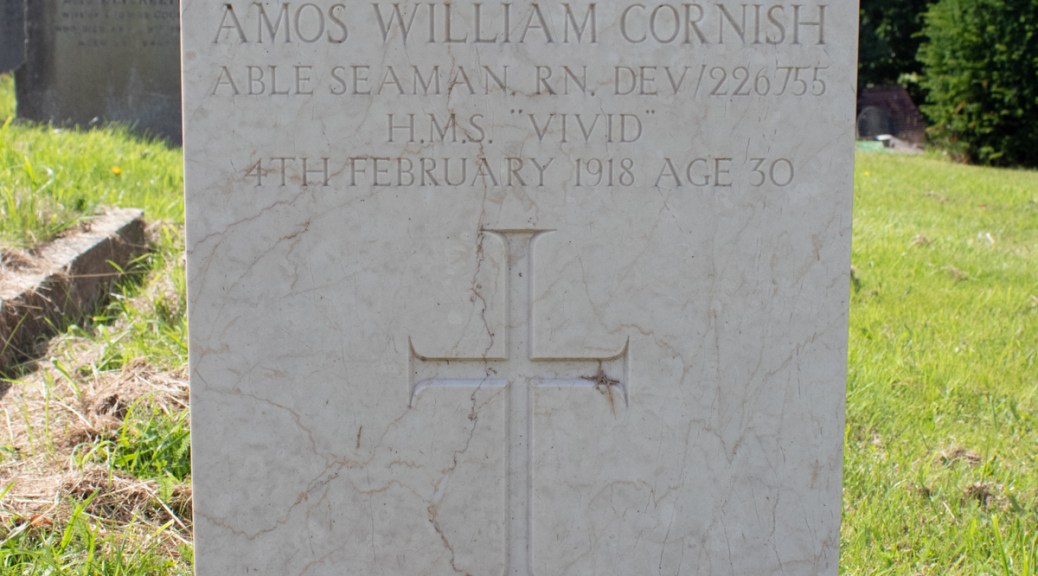
Able Seaman Cornish returned to British shores in April 1917, to be based at HMS Vivid, the Royal Naval Dockyard in Devonport, for the nest nine months. During this time, he became ill and was admitted to the Royal Naval Hospital in Truro with double pneumonia. Tragically, this was something he was not to recover from: Amos passed away on 4th February 1918, at the age of 30 years old.
While somewhat stretched, Amos’ family bond still remained. Elizabeth was living in Minehead by this point, with husband Alfred and their two children. It was to the Somerset town, therefore, that Amos William Cornish’s body was brought. He was laid to rest in the town’s sweeping cemetery.
George’s death in 1893, and Elizabeth’s remarriage a few years later split the family, and Amos’ siblings all followed separate paths.
The oldest of his siblings, Walter, also followed a military path. He joined the Royal Garrison Artillery as a Gunner and, by the time of the census, was based in Gibraltar. On completing his service, he returned to Somerset, marrying Florence Peddle in 1925. The 1939 Register found the couple living with his cousin, Amelia, while he worked as a gardener. Walter died in Weston-super-Mare in 1962, at the age of 74.
Amos’ next sibling, brother Harold, seems to have had a less fortunate time of things. Absent from the 1901 census, he appears in prison records four years later. He was incarcerated for six months’ hard labour in Brecon Prison, having been found guilty of “Gross Indecency with another male person”. Harold was 14 years and three months old at the time. A newspaper report from around this time suggests that the other party was a George Williams, but there is no further information about him. Harold seems to have come out the other side of his experience, however: the 1911 census recorded him as living and working with draper and grocer James Ridler and his family in Dunster, Somerset.
Amos’ third sibling, sister Lily, found work as a servant to bakers Joseph and Minnie Bagley in Minehead. She married painter and decorator William Whitting in 1916 and the couple went on to have a daughter, Kathleen, eight years later. The family settled in Weston-super-Mare, Lily passing away in 1968, at the age of 75.
The youngest of the Cornish siblings was George. He remained living with his maternal grandparents in Dunster, and found work as a printer. In the spring of 1921, he married Clara Govier and, by the time of the 1939 Register, they couple were living in Aylesbury, Buckinghamshire, where George was working as a printer and compositor. He died in 1957, at the age of 62 years old.
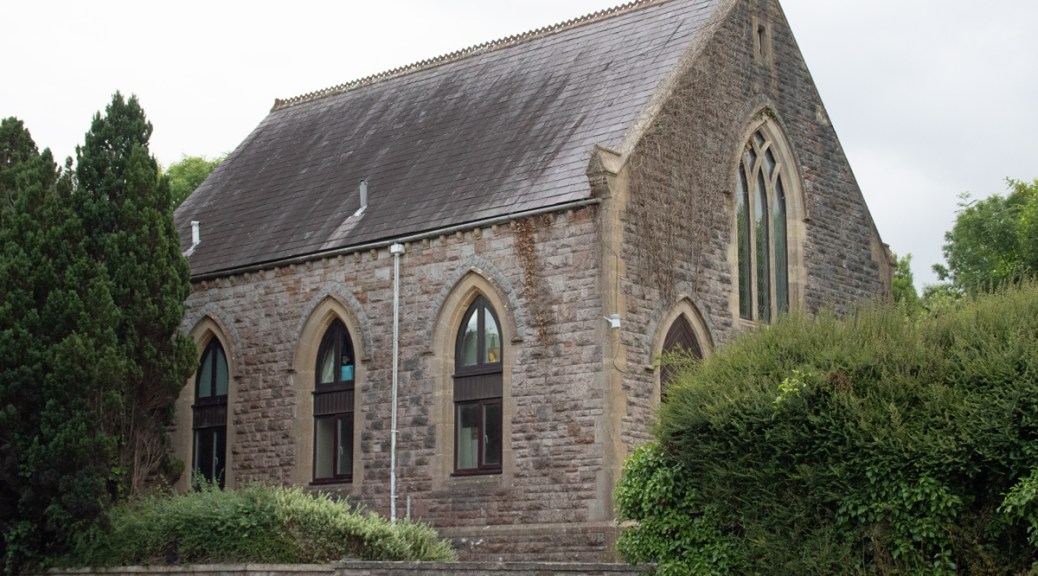
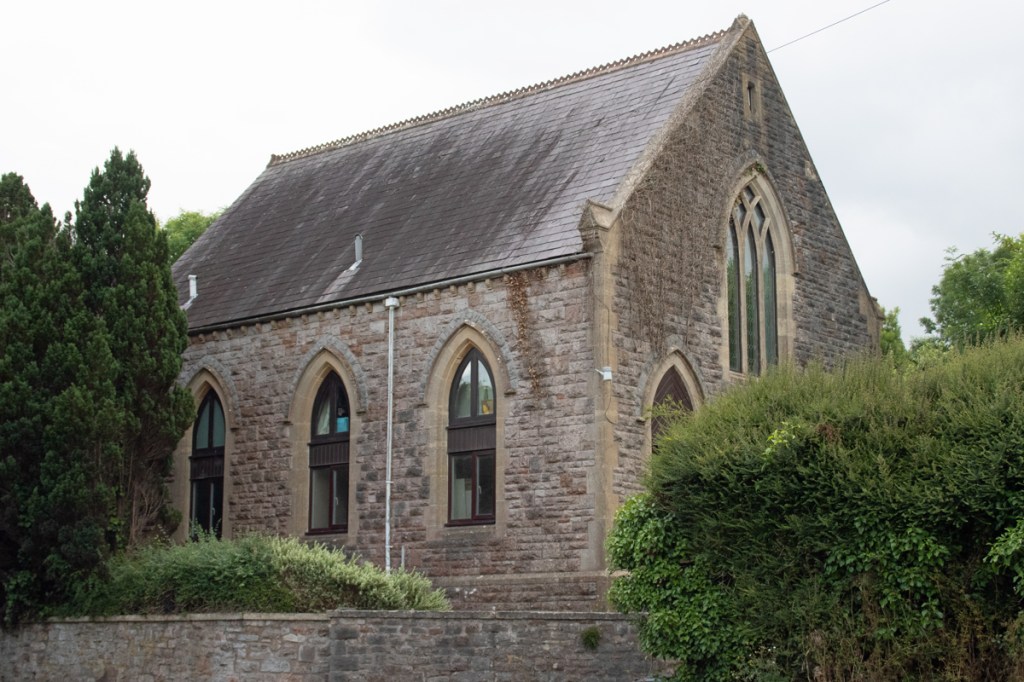
On the main road between Glastonbury and Wells, on the outskirts of the village of Coxley is the old Wesleyan Methodist Chapel. Now converted to a house, its back garden contains the remains of Private WR Parsons, who died in January 1919.
William Reginald Parsons was born on 22nd February 1895 in the hamlet of Chilton Burtle, near Bridgwater. The second of eight children, his parents were Wallace and Harriet Parsons. By the time of the 1901 census, the family had moved to Wells, where William was employed as a platelayer by Great Western Railways.
When he left school, William found employment as a paper maker, and was employed by the St Cuthbert’s Paper Mill to the west of the city. He wanted bigger and better things, however, and, on 11th April 1912, he enlisted in the Royal Marine Light Infantry.
Private Parsons’ service records show that he was 5ft 6.5ins (1.68m) tall, with brown hair, hazel eyes and a fresh complexion. It was also noted that he had a small scar on the right side of his back. Initially sent to the regiment’s depot in Deal, Kent, this is where he was tested for his swimming ability: he passed on 24th June 1912.
William remained in Deal until the end of the year. After seven months in Portsmouth, Hampshire, he embarked on a number of postings that lasted for the next six years. Initially assigned to the battleship HMS Bulwark, Private Parsons’ main posting was on board another battleship, HMS Zealandia.
Primarily based guarding the North Sea Coast, Zealandia also served in the Mediterranean, sailing as far as the Dardanelles towards the end of 1915. In all, Private Parsons spent more than three years on board the battleship.
William’s next posting was on board the cruiser HMS Royalist, on which he served until the end of the First World War. While he was on board, it appears that he became unwell, and he was admitted to the Royal Naval Hospital in Granton, near Edinburgh. Details of his condition are not readily available, but they were serious enough for him to succumb to them: he passed away on 30th January 1919, at the age of just 23 years old.
The body of William Reginald Parsons was brought back to Somerset for burial. He was laid to rest in the quiet churchyard of the Wesleyan Methodist Chapel in Coxley.
(c) Sharky Ward 2025
As the chapel is now a family home, its garden is not readily accessible. The photo of Private Parsons’ grave was taken by Commonwealth War Graves Commission volunteer Sharky Ward, to whom I am indebted for its use.










 Death and Service