Tag Archives: Kent

Stoker 1st Class James Duffy

Stoker 1st Class James Duffy

James Albert Duffy was born on 21st May 1888 in the town of Monaghan, Ireland. The son of Francis and Elizabeth Duffy, he was one of ten children. Francis was a policeman, but James took up plastering when he left school; by the time of the 1911 census, the family had left Monaghan and moved to Belfast.

War was coming, and James received his call up in March 1916. He joined the Royal Navy as a Stoker 2nd Class; his service record shows that he stood 5ft 5ins (1.65m) tall and had fair hair, blue eyes and a fresh complexion.

After two months’ training at HMS Pembroke in Chatham, Kent, Stoker Duffy was assigned to HMS Chatham, a cruiser that served in the Mediterranean. He spent eighteen months on board, and was promoted to Stoker 1st Class for his service.

At the end of 1917, James returned to Chatham Dockyard. While there, he fell ill, and was admitted to the Naval Hospital in the town. Sadly, while in hospital he passed away, having suffered a cerebral abscess. He died on 29th January 1918, aged just 29 years old.

James Albert Duffy was laid to rest in the Woodlands Cemetery in Gillingham, not far from the dockyard at which he had been based.


Petty Officer 1st Class George Fawcett

Petty Officer 1st Class George Fawcett

George Fawcett was born on 3rd February 1873, one of ten children to John and Maria (or Mary). John was a stonemason who raised his family in Essex, and it was in Stratford that George and most of his siblings were born.

When George left school, he was drawn to a life of adventure. He joined the Royal Navy on 5th May 1888, and was first assigned the role of Boy, as he was under age. He was formally enlisted on 3rd February 1891 – his 18th birthday. He had, by this point, been serving on HMS Hotspur for nine months, and was given the rank of Ordinary Seaman. His hard work must have held him in good stead, because he was promoted to Able Seamen just two months later.

Over the course of his initial twelve years’ service, Able Seaman Fawcett served on eight different ships, and continued to rise through the ranks. He mad made Leading Seaman by 1894 and Petty Officer 2nd Class five years later. By the time his first term of service had ended, he had been promoted again, this time to Petty Officer 1st Class.

George voluntarily renewed his service in 1903, and over the next few years, he served on a number of other vessels. His shore base was always HMS Pembroke, though, and his time at sea was interspersed with periods at the Naval Dockyard in Chatham.

Petty Officer Fawcett had been in the Royal Navy for 23 years by the time war was declared. He was still at sea in August 1914, but was transferred to a permanent shore role at the beginning of the following year. He spent three years fulfilling his duties at HMS Pembroke, but fell ill in the spring of 1918.

He was admitted to the Naval Hospital in Chatham with liver disease, and this was a condition he was not to recover from. Petty Officer Fawcett passed away on 12th April 1918, at the age of 45.

George Fawcett’s body was laid to rest in the Woodlands Cemetery, Gillingham, not far from the naval base at which he was based.


Gunner George Hewlett

Gunner George Hewlett

George Henry Hewlett was born on 11th July 1892, the oldest of four children to Henry and Louisa Hewlett. Henry was a painter from Hampshire, who travelled for work. George and his youngest sibling were born in Romsey, while his two brothers were born in Swindon, Wiltshire. By the time of the 1901 census, when George was eight years old, the family had settled in Hammersmith, London.

The next census, in 1911, recorded the family as living in Caterham, Surrey. By this time, George and his father were working as gardeners, while his brothers were working as grocers. Louisa, meanwhile, was employed as a live-in housekeeper for a spinster and her mother just around the corner.

War was coming and George was determined to do his bit. Full details are not available, but he enlisted in the Royal Marine Light Infantry, taking on the role of Gunner. In May 1918 he was on board HMS Iris, a Mersey ferry requisitioned by the Royal Navy for support in the planned raid on Zeebrugge.

On 23 April 1918, HMS Iris was towed across the English Channel to Zeebrugge by HMS Vindictive; she was carrying a couple of platoons of the 4th Battalion of the Royal Marines as a raiding party. When the Vindictive neared the Zeebrugge she cast the ferry aside. Iris tried to pull up to the breakwater under heavy fire in order to off-load the raiding parties which were on board. She sustained heavy fire and a shell burst through the deck into an area where the marines were preparing to land. Forty-nine men were killed, including Gunner Hewlett. George was 28 years of age.

George Henry Hewett’s body was brought back to England. He was laid to rest in the Woodlands Cemetery in Gillingham, Kent, not far from the dockyard at which he was based.


George’s two brothers also fought in the First World War.

John William Hewlett, who was two years younger than George, joined the 1st Royal Marine Battalion of the Royal Naval Division as a Private. He fought on the Western Front, and was killed in fighting on 22nd October 1916. He was 21 years of age. John was laid to rest at the Mesnil-Matinsart Cemetery near the town of Albert in Northern France.

Joseph Herbert Hewlett was born three years after George. When war was declared, he enlisted in the Buffs (East Kent Regiment), joining the 4th Battalion as a Private. Dispatched to India, he was initially based in Bombay, but was injured in fighting. He was sent back to England, and treated at the Military Hospital at Netley, near Southampton. Sadly, his wounds proved too severe – he passed away on 4th April 1915, aged just 20 years old.

In the space of three years, Henry and Louisa Hewlett had lost all three of their sons to the war. After George’s death, a local newspaper reported this was their “sad and proud record”. [Dover Express: Friday 31st May 1918]


Leading Stoker John Madden

Leading Stoker John Madden

John Joseph Madden was born in Cork, Eire, on 13th August 1894, one of ten children to John and Mary Madden. John Sr was a jarvey – or coach/cab driver – while his son found work as a messenger boy when he left school.

John Jr wanted bigger and better things, however, and so, on 26th June 1913, at the age of 19, he left Cork for a life in the Royal Navy. Joining up as a Stoker 2nd Class, his initial posting was at HMS Pembroke, the shore-based establishment at the Naval Dockyard in Chatham. After five months’ training there, he was assigned to HMS St George for his first posting.

Over the next few years, Stoker Madden served on five different vessels, rising through the ranks to Stoker 1st Class, and Leading Stoker. His final ship was HMS Conquest, which he boarded on 1st April 1916. The cruiser served in the North Sea and was damaged by a shell during the German raid on Lowestoft just weeks after John came on board.

HMS Conquest was involved in a number of other skirmishes during Leading Stoker Madden’s time on board, On 13th June 1918, while on patrol, she struck a mine, and was badly damaged. Seven of those on board, including John, lost their lives in the incident. He was just 23 years of age.

The ship sailed back to the Naval Dockyard in Chatham; John Joseph Madden was laid to rest in the Woodlands Cemetery in nearby Gillingham.


Able Seaman John Hannon

Able Seaman John Hannon

John Hannon (or Hannan) was born on 9th November 1885, in the Cork village of Ladysbridge. He was one of ten children to labourer Michael Hannon and his wife, Kate.

Given his proximity to the coastal port of Cork, it is no surprise that John sought adventure on the high seas. In May 1903, he joined the Royal Navy as a Boy, and served on HMS Black Prince. His enlistment papers gave his height as 5ft 4ins (1.62m), and recorded that he light brown hair, blue eyes and a sallow complexion. He also had a tattoo on each wrist.

As soon as he turned eighteen, on 9th November 1903, he was formally signed up, and given the rank of Ordinary Seaman. Over the next eighteen months, he served on two more ships – HMS Minotaur and the training ship HMS Boscawen – and was promoted to Able Seaman in August 1905.

John’s naval career continued apace up until the Great War. When hostilities broke out, he was assigned to HMS Tiger, and served on the ship at the Battles of Dogger Bank (1915) and Jutland (1916).

At the start of 1918, Able Seaman Hannon was transferred to HMS Hindustan; this was one of the many ships that supported the Zeebrugge Raid on the 23rd April. The plan was to scuttle a number of ships in the entrance to the Zeebrugge Canal in Belgium, thus preventing the German Navy from launching into the North Sea.

Over 1700 men were involved in the raid and heavy fighting left close to 300 sailors dead, with a similar number wounded. Sadly Able Seaman Hannon was one of those to lose their lives in the battle. He was just 32 years old.

John Hannon’s body was brought back to England; he was laid to rest in the Woodlands Cemetery in Gillingham, Kent, close to the Naval Dockyard in Chatham that he had occasionally called home.


Stoker 2nd Class William Bonham

Stoker 2nd Class William Bonham

William Bonham was born in Abbeyleix, Queen’s County (now County Laois) on 6th September 1895. One of ten children, his parents were labourer John Bonham and his wife Mary.

Little information about William’s early life is available; when he left school, he found work as a railway porter, but when he was 23, with war having be raging across Europe, he received his enlistment papers.

William joined the Royal Navy on 13th October 1918, and set sail for England. Assigned the role of a Stoker, he was sent to HMS Pembroke – the shore-based establishment at the Naval Dockyard in Chatham, Kent – for training. Less than eight weeks later, however, he was dead.

Stoker Bonham had contracted pneumonia that winter, and died at his home in Chatham on 12th December 1918. He was just 23 years old.

William was laid to rest in the Woodlands Cemetery in nearby Gillingham.


Officer’s Cook 3rd Class Paolo Spiteri

Officer’s Cook Paolo Spiteri

Paolo Spiteri was born in Valetta, Malta, on 25th January 1881, the son of Stephen Spiteri. Sadly there is very little further information on his early life, other than he worked as a cook when he left school.

Paolo saw a life at sea as a good career, and, in August 1901, aged 20, joined the Royal Navy. Over the next twenty years, he travelled the world, serving on more than twenty ships and working his way up from a domestic in the kitchen to an Officer’s Cook 3rd Class.

By 1921, Paolo was based at HMS Pembroke – the shore establishment at the Naval Dockyard in Chatham, Kent – and contracted pneumonia there. Admitted to the Naval Hospital in the town, the condition sadly got the better of him, and he passed away on 5th April 1921. He was 42 years old.

Officer’s Cook Paolo Spiteri was laid to rest in the Woodlands Cemetery, not far from the dockyard at which he was based.


Trimmer Cuthbert Kean

Trimmer Cuthbert Kean

Cuthbert Kean was born on 2nd October 1862, the eldest of four children to John and Jane Kean. John was a tailor from Manchester, who brought his young family up in the town of Crook, County Durham.

Cuthbert followed in his father’s footsteps and, by the time of the 1891 census – when he was 26 years old – was lodging in central Edinburgh, and was working as a tailor.

There is little more information available on Cuthbert’s early years. When war broke out, he enlisted in the Royal Navy, joining up on 26th October 1914. His papers show that he stood 5ft 2ins (1.57m) tall, had a fair complexion and grey eyes.

By 1917, having turned 55, he was transferred to the Royal Naval Reserve, and worked as a Trimmer – an alternative title for a Stoker. He had served on a number of vessels, joining HMS Firefly towards the end of the war.

Early in 1919, Trimmer Kean was admitted to the Royal Naval Hospital in Chatham, Kent, suffering from a sarcoma of the neck. Sadly, he was to succumb to this, and he passed away on 4th March 1919. He was 58 years old. His records give his next of kin as his sister Mary, who was living in Durham.

Cuthbert Kean was laid to rest in the Woodlands Cemetery in Gillingham, Kent.


Private Henry Teahen

Private Henry Teahen

Henry Teahen (or Teahan) was born in around 1898 in Castlegregory, County Kerry, Ireland. One of twelve children – eight of whom survived infancy – his parents were John and Catherine Teahan.

John was a wayman (or road surveyor), who was born in Kerry. Catherine was born in Wandsworth and it was in London that the couple met and married. By the time Henry was born, the family had moved back to Ireland, although Catherine had made the journey back to England in the early 1900s, after John passed away.

The 1911 census found the family living in Forest Gate in the east of the capital; Henry’s oldest brother, Joseph, was head of the household and, at 24, was working as a police constable. Schoolboy Henry was there, as was his mother, two more of his brothers, one of his sisters and his niece and nephew.

War was imminent, though, and, within a week of hostilities breaking out, Henry – who had been working as a waiter – enlisted in the Royal Marine Light Infantry. Private Teahen’s service records show that he was 5ft 8ins (1.72m) tall, had a fair complexion, grey eyes and brown hair. They also give his date of birth as 22nd June 1896, although he may have adapted this, as he would have been underage at the point he joined up.

Over the next few years, he served on a number of ships, switching between the Plymouth and Chatham divisions of the regiment. Full details of his duties are not immediately apparent, although is seems that he was injured while on board HMS Valiant in February 1916 – six months before her involvement in the Battle of Jutland – receiving a contusion to his right knee.

By the closing months of the war, Private Teahen had transferred back to the Naval Dockyard in Chatham, Kent. It was while here, early in 1919, that he fell ill. Details of his condition are lost to time, but it is known that he succumbed to them, passing away on 1st March 1919; he was 21 years old when he died.

Henry Teahen was laid to rest in the Woodlands Cemetery in Gillingham, within walking distance of the dockyard at which he was based.


Henry’s older brother James, also fought in the First World War. Full details are not clear, but documents show that he enlisted in the 6th City of London Regiment (also known as the City of London Rifles).

James’ regiment fought in many of the fiercest battles on the Western Front, including Loos, Vimy, High Wood and Messines, but it was at Ypres in the late summer of 1917, that he was injured. He died of his wounds on 30th September, aged just 23 years old.

Private James Teahan was laid to rest at the Mendinghem Military Cemetery in Poperinghe, Belgium.


Stoker 1st Class Henry Wate

Stoker Henry Wate

Henry Wate was born on 15th June 1897, the youngest of seven children (four of whom survived) to Henry and Norah Wate. Henry Sr was from the East End of London. He raised his family in a three-room tenement in White Horse Alley, just off Cowcross Street, next to the busy Farringdon Station.

By the time of the 1911 census, Henry Sr and Norah had been married for thirty years. The head of the household, Henry was working as a rad dealer, while Norah was a housewife. Of their children, William (the eldest) worked as a labourer for a bike dealer, Annie was a packer in a chocolate factory, Nellie was a waitress and Henry Jr was still at school, though only just. Henry’s niece Julia was also staying with them, and was employed as a fancy leather worker.

When war broke out, Henry Jr was working as a carman, carting goods to and from the nearby railway. When the call came, however, he joined up, enlisting in the Royal Navy as a Stoker 2nd Class. After a couple of months training at HMS Pembroke – the shore establishment at the Naval Dockyard in Chatham – he was assigned to HMS Wallington. This was a trawler, requisitioned by the Royal Navy to act as a boom/balloon vessel, presumably to tether barrage balloons.

In January 1917, Henry received a promotion to Stoker 1st Class. He returned to Chatham six months later. That summer, HMS Pembroke was becoming crowded and he was billeted at the Chatham Drill Hall.

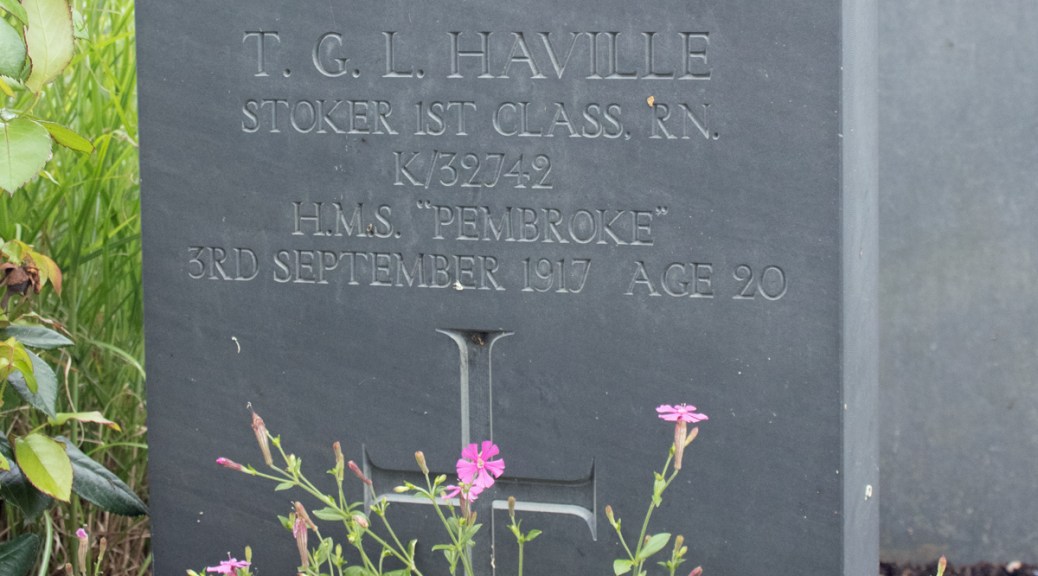
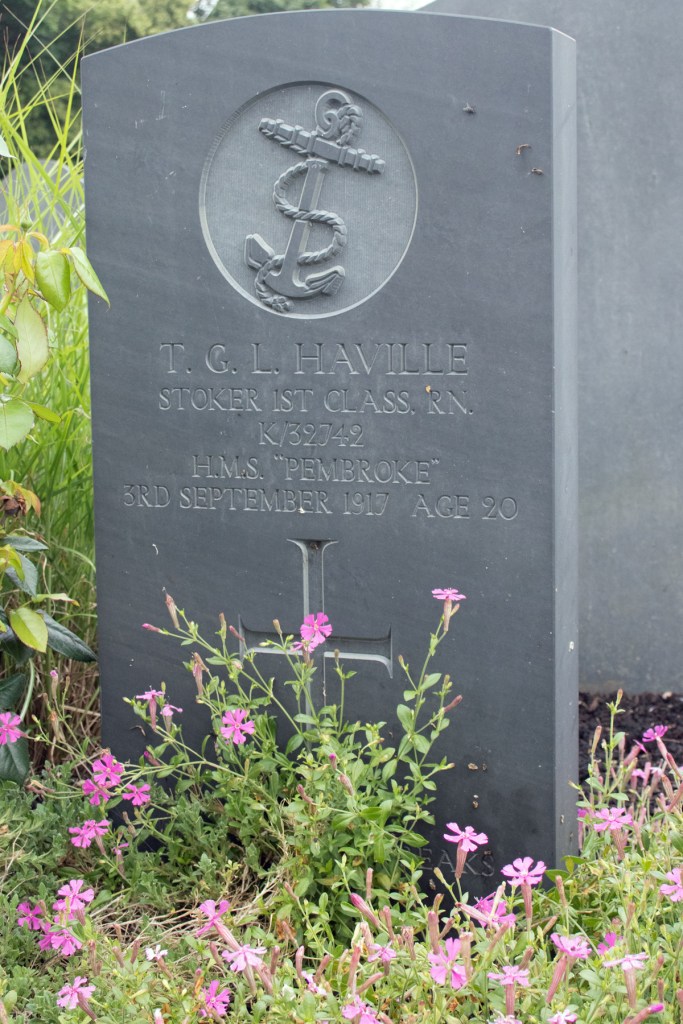
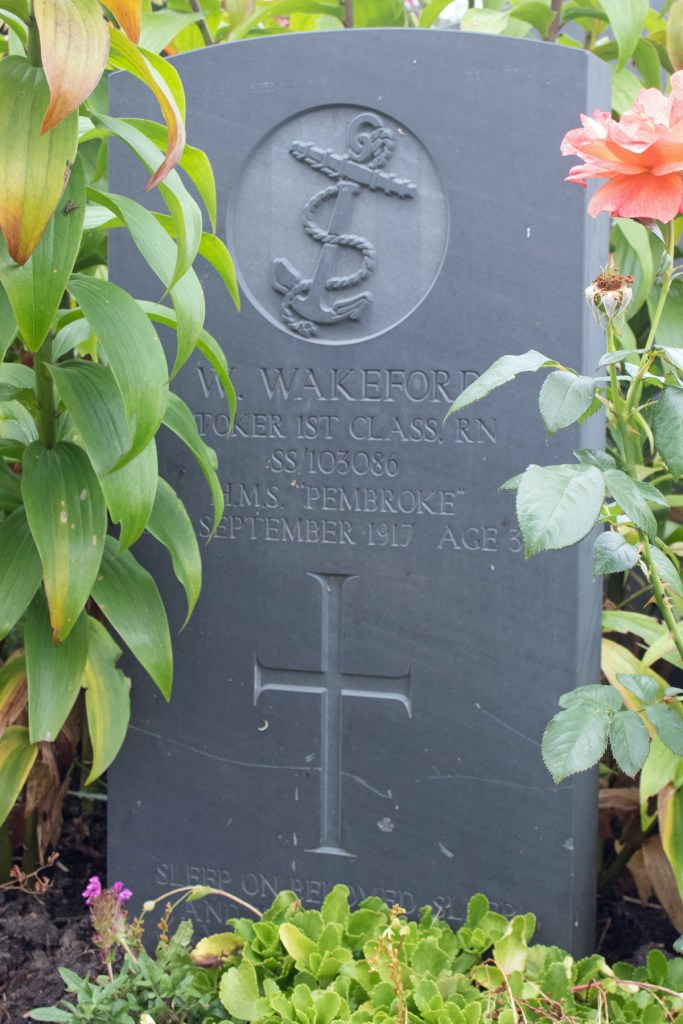
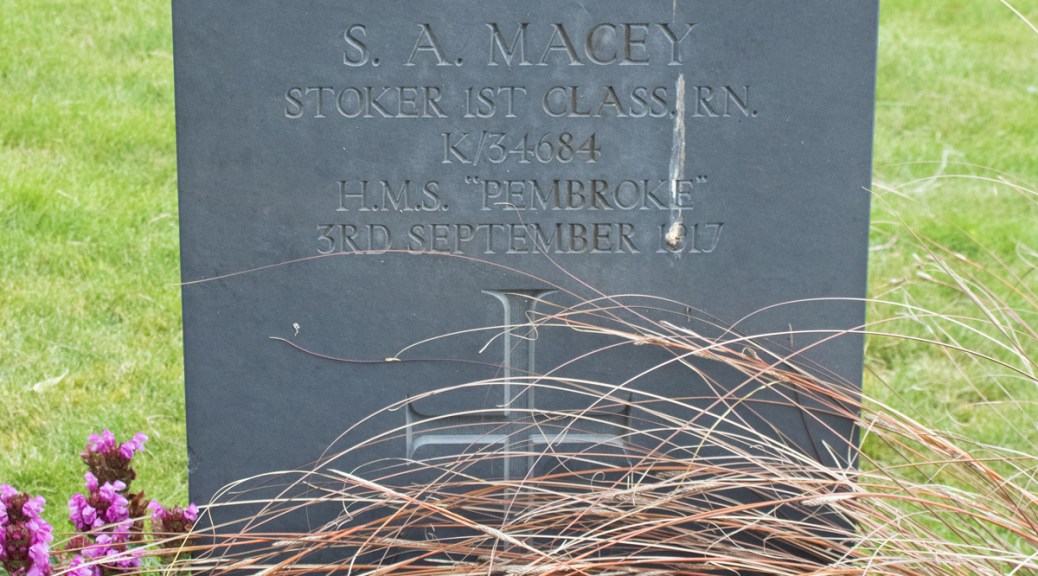
On 3rd September 1917, the building took a direct hit from a German bomber. Stoker Wate, along with 97 others, was killed instantly. He was just 20 years old.

Henry Wate was laid to rest – along with the others who perished that night – in a mass funeral on 6th September 1917 at the nearby Woodlands Cemetery in Gillingham.


Full details of the night raid on Chatham Drill Hall can be found here.


Henry’s older brother William also served in the Great War. Twelve years older than his brother, William joined the Royal West Surrey Regiment in January 1915 as a Private. He was posted to France in July, and ended up serving on the Front Line for nearly four months.

In September 1915, Private Wate fell ill with heart palpitations. Shipped back to England for treatment, he was admitted to the Brook War Hospital in Greenwich, South London. The medical report confirmed that William had had rheumatic fever as a child, and had had an attack of ‘sycope’ (low blood pressure and a loss of consciousness) in 1911. The report concluded that he had heart disease and he was discharged from military service in 1916, as a result of this.

Little is known about Williams post-army life. All that can be confirmed is that he passed away from his heart condition on 23rd November 1918 aged 33. He was buried in St Mary’s Roman Catholic Cemetery in Kensal Green, North London.