Tag Archives: Labour Corps

Private Percival Peacock

Private Percival Peacock

Percival William Peacock was born in early 1888, the son of Thomas and Louisa Peacock. Little information survives about Percival’s early life, other than that he was one of two children, and that, like his parents, he had been born in Gillingham, Kent. Thomas was a sexton and gravedigger, but Percival found work as a hairdresser.

The 1911 census shows him as head of the household in a cottage in the village of Stone, near Dartford; he was living there with his cousin James and his family.

On 21st April 1913, now living in Kensal Green, North London, Percival married Clara Milton, a labourer’s daughter from just a few doors up.

War was now imminent, but again there is limited information about Percival’s involvement. He did enlist, joining the Labour Corps as a Private, but this seems to have been later in the war. He appears to have served on home soil, although there is nothing to confirm this either way.

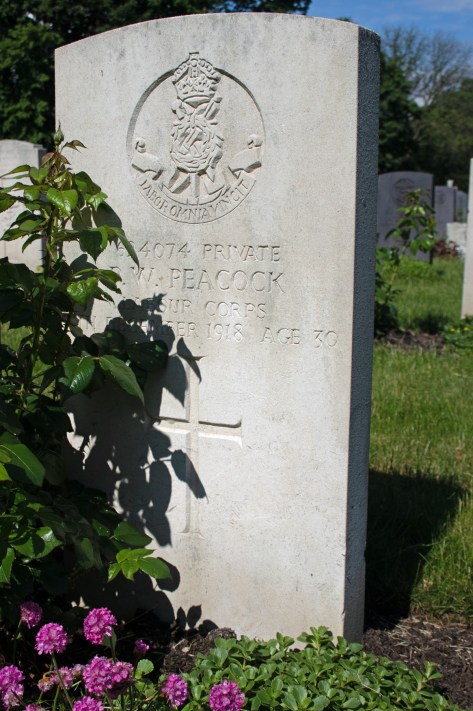
The next concrete evidence for Percival is the Army Register of Soldiers’ Effects. This confirms that he passed away on 5th December 1918 at the Paddington Military Hospital in London. No cause of death is provided, and the beneficiary given is his father, Thomas. Private Peacock was just 30 years old.

Percival William Peacock was laid to rest in the Grange Road Cemetery in Gillingham, Kent. Hs is commemorated in the nearby Woodlands Cemetery.


Tragedy was not far from the Peacocks’ life. Clara’s mother, Bessie, had passed away just a couple of weeks before Percival. Clara herself died on 5th March 1919, three months after her husband.


Private James Butcher

Private James Butcher

James Butcher was born in the village of Durrington, West Sussex, on 12th April 1880. He was one of seven children to agricultural labourer Henry Butcher and his laundress wife, Sarah. The family were dedicated to the countryside life; by the time of the 1891 census, James was listed as a cowboy, as was his older brother, so at 10 years old, his time would have been spent up on the South Downs, tending a farmer’s bovine herd.

In 1904, James married Eleanor Andrews, the daughter of a publisher’s packer from London. The couple would go on to have six children: William, Thomas, George, Walter, Ernest and Gladys. By the time of the 1911 census, the family were living in Broadwater, to the north of Worthing, and James was listed as a general labourer for the town council.

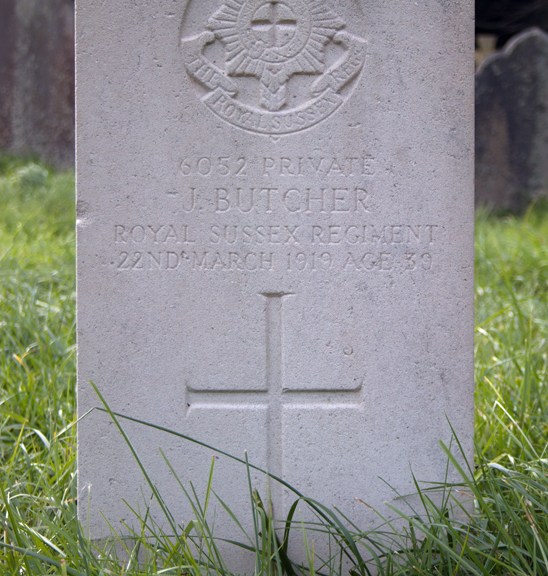
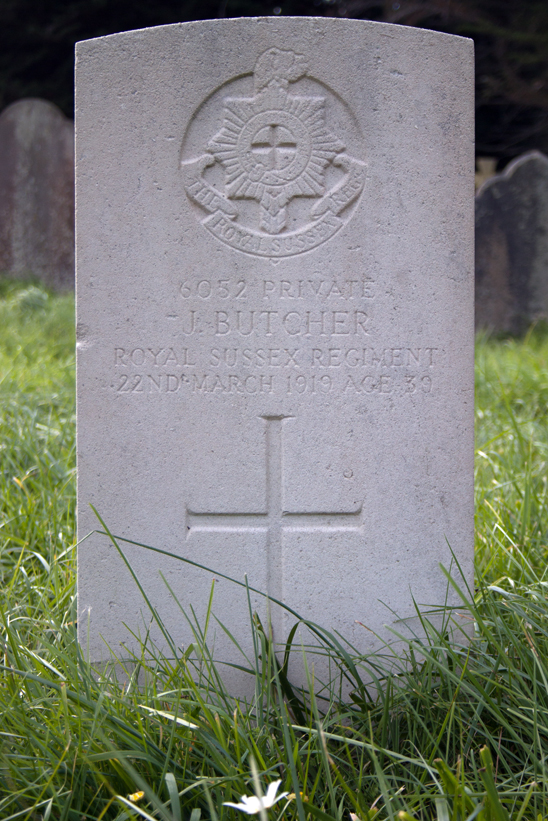
When war arrived on England’s shores, James was keen to to his bit. He initially joined the Royal Sussex Regiment, although subsequently moved to the Agricultural Company of the Labour Corps. Sadly, Private Butcher’s military service records are no longer available, so it’s impossible to confirm exact dates for his time in the army.

James survived the conflict, but the next record for him is the Army Register of Soldiers’ Effects. This confirms that he was admitted to the Swandean Isolation Hospital on the outskirts of Worthing, and subsequently passed away there. There’s nothing to confirm his cause of death, although, based on the nature of the hospital, it is likely to have been one of the lung conditions prevalent at the close of the war.

James Butcher died on the 22nd March 1919, at the age of 38 years old. He was laid to rest in the Broadwater Cemetery, not far from his home.


James Butcher
James Butcher
(from ancestry.co.uk)

Corporal Richard Cadenaci

Corporal Richard Cadenaci

Richard Edward Cadenaci was born in Sutton, Surrey, in around 1886. His father, who was also called Richard Edward Cadenaci, was a house painter and, with his wife Maria, had thirteen or fourteen children, of whom Richard Jr was the middle one.

Documentation on the Cadenaci family is scarce. On 5th April 1896, when Richard Jr was 10, he and three siblings were baptised together.

By the turn of the century, the family were living on Merton High Street, in Wimbledon. Richard Sr and Maria were there with their youngest five children.

Richard Jr seemed keen on a life of adventure – the 1911 census lists him as a Private in the 3rd Battalion of the Royal Fusiliers, and that he was based in Mauritius. His full military service records are not available, but it is likely that his term of service with the army was extended as war loomed.

Private Cadenaci was sent to France in January 1915 and, during his time in the Great War, he received the Victory and British Medals and the 1915 Star. At some point during the conflict he was transferred across to the Labour Corps, though the move came with a promotion to Corporal. Again, there is little further information about his service, but records suggest that he was discharged from the army – possibly through health reasons – on 20th September 1918.

Here, Richard’s trail goes cold. He died on 23rd March 1920, just eighteen months after the end of this military service, at the age of 32. There is no record of the cause of his passing and nothing to connect him to the town in which he was buried, Worthing, West Sussex.

It is possible that Corporal Cadenaci left the army for medical reasons, and his move out of London was for cleaner air, but this is only presumption on my part, and there is nothing to confirm this either way.

Richard Edward Cadenaci lies at rest in the Broadwater Cemetery in Worthing.


Gunner Alfred Taylor

Broadwater Cemetery

Alfred R Taylor was born in Portsmouth, Hampshire, in 1886, and was one of six children to James and Agnes Taylor. James was a jobbing gardener, who had been born near Chichester in West Sussex.

Agnes had been born in Tarring, near Worthing, and strong connections to her home town seemed to remain. In the 1891 census, Alfred was boarding with his aunt – Agnes’ sister – in Worthing and, ten years later, both of his parents and all of his siblings were also living there.

By 1911, Alfred was working as a nursery gardener – given his father’s work, this is not surprising, and, at the time, the coastal slopes of the South Downs were filled with orchards, farms and nursery greenhouses.

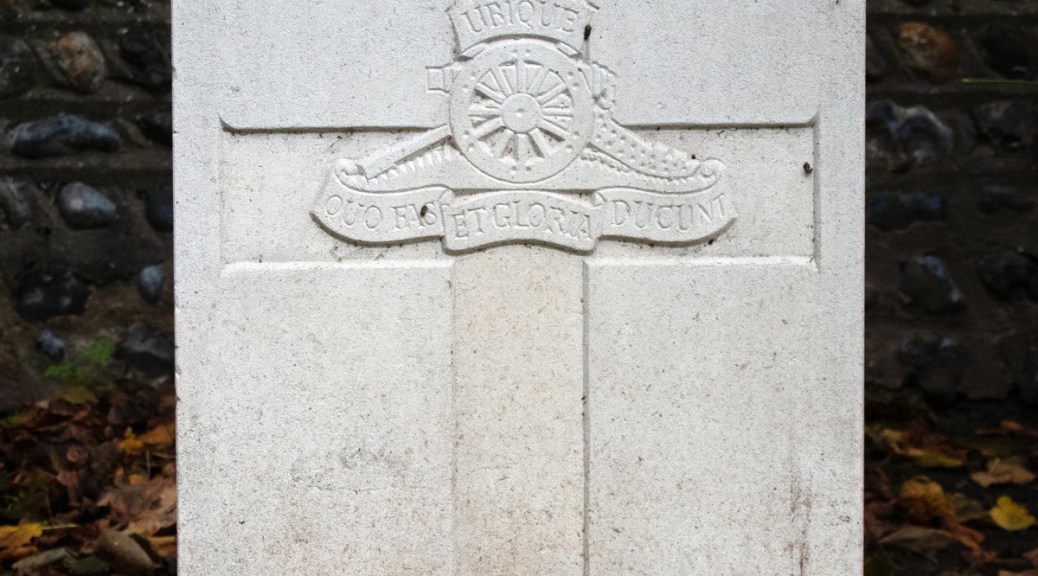
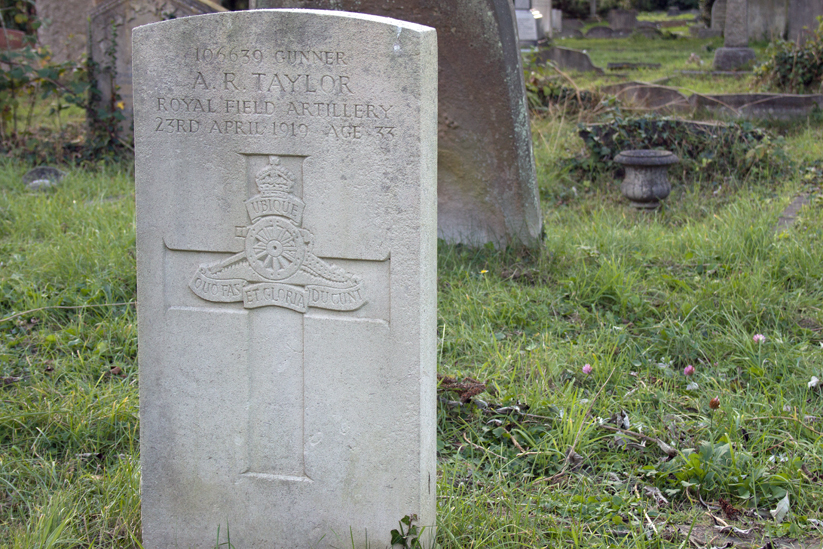
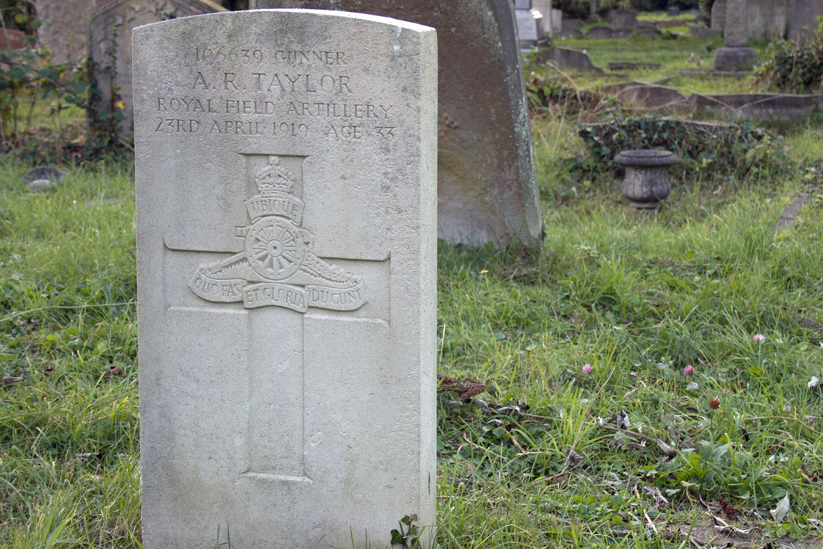
Tantalisingly, there is not a lot more documentation relating to Alfred’s life. When war broke out, he enlisted in the Royal Field Artillery as a Gunner. He joined up in October 1915 and was sent to the Balkans and, as a result of his service, was awarded the Victory and British Medals and the 1915 Star.

Back home on leave, Gunner Taylor married Ellen Mary Sayers at the start of 1918. She was a plumber’s daughter from Worthing, and this was where she and Alfred married.

When the Armistice was declared, Alfred was transferred to the Labour Corps, as part of the Army Reserve force. He passed away on 23rd April 1919, and, while there are no details of his death, it is likely that he fell victim to one of the lung conditions impacting the returning troops at the time. He was just 33 years of age when he died.

Alfred R Taylor was laid to rest in the Broadwater Cemetery in Worthing, not far from where his widow lived.


There are some further details about Ellen Taylor. She and Alfred did not have any children, and she never married again. She passed away in the spring of 1968 in her home town, at the age of 88 years old.


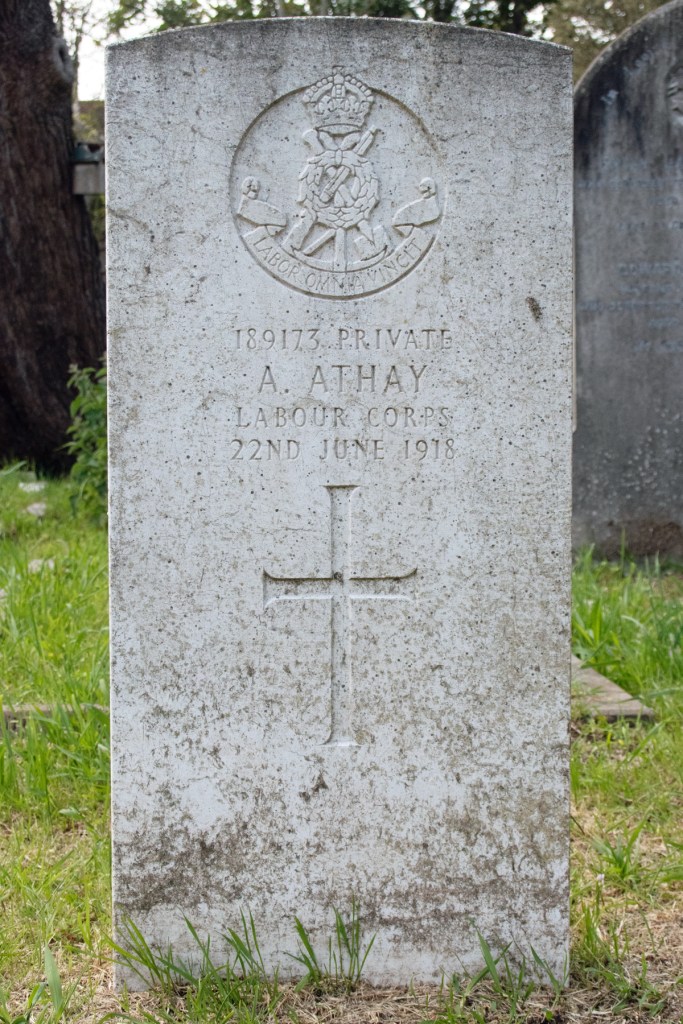
Private Albert Athay

Private Albert Athay

Albert Athay was born in 1887, one of eight children to Thomas and Emily. Thomas was a labourer for the local council in Weston-super-Mare, and the family lived in a small house on a road leading inland from the seafront.

Thomas died when Albert was only 14 years old, and, having left school, he found labouring work to help support his now widowed mother and younger siblings.

In August 1910, Albert married Mable Dunstone, a cowherd’s daughter from Somerset. The couple continued to live with Albert’s mother and brother right up until the outbreak of war. They went on to have three children, Milicent, Freda and Charles.

Albert, by this time, has been volunteering with the local Labour Battalion; he formalised his military service in June 1917, officially enlisting in the Labour Corps. He served as part of the territorial force, in and around Salisbury Plain.

Private Athay fell ill in the summer of 1918, and was admitted to hospital on 11th June with pneumonia. Sadly, as the days progressed, so did the condition, and he passed away from it just eleven days later. He was just 31 years old.

Brought back to Weston-super-Mare, Albert Athay was laid to rest in the Milton Cemetery in his home town.


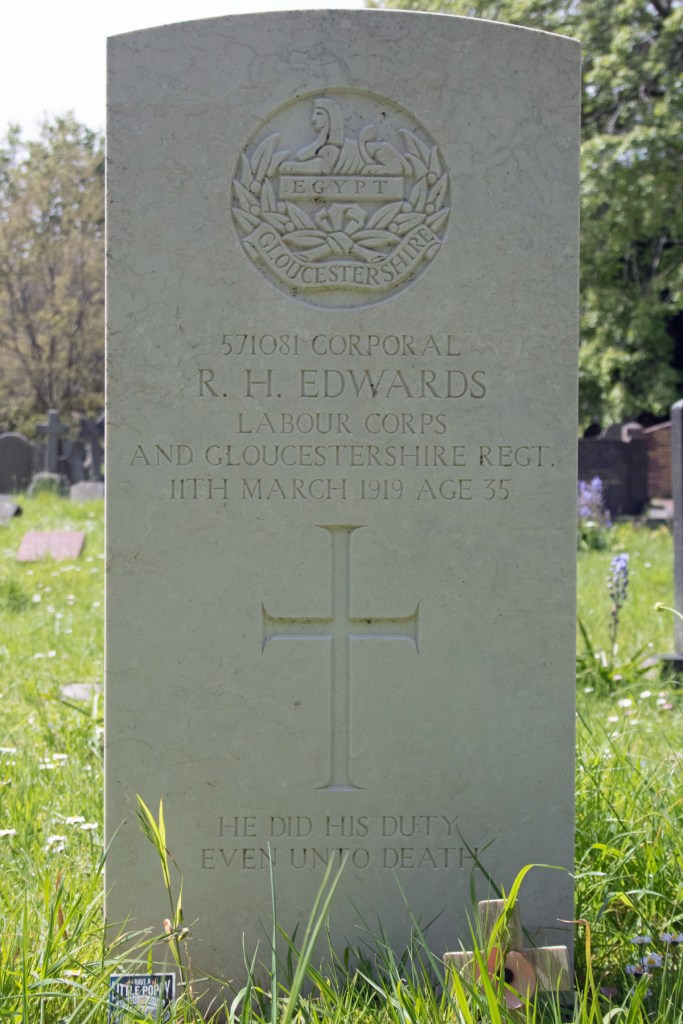
Corporal Ralph Edwards

Corporal Ralph Edwards

Ralph Henry Edwards was born in December 1883, the oldest of six children to Charles and Emma. Charles was a house painter from Somerset, and raised his family in the coastal town of Weston-super-Mare.

When he left school, Ralph followed in his father’s footsteps, taking over the business when Charles passed away in 1909. By the time of the census two years later, Ralph was living with his mother Emma, his two younger brothers and Emma’s brother Harry. Harry was also a house painter, while Ralph’s siblings were working a grocer’s assistants. The family were living in a five-room, semi-detached house within walking distance of the town centre.

War was on the horizon, and Ralph was keen to do his part. Full details of his service are no longer available, but what is certain is that he enlisted in the Gloucestershire Regiment and was assigned to the 8th (Service) Battalion. Initially formed in Bristol, the battalion spent the first year of the war on home soil, before being sent to France in July 1915.

By the middle of the war, Ralph had been promoted to the rank of Corporal. He transferred over to the Labour Corps and was attached to the 106th Prisoner of War Company. Initially, German POWs had been shipped to England, but by 1916 those with useful skills were retained in France and drafted into the Forestry Companies, Army Service Corps and Royal Engineers. Corporal Edwards’ role would have been to oversee such men. (Whether this was in France or back in England is unclear.)

At this point, Ralph’s trail goes cold. He served out the war, passing away back at home on 11th March 1919, although the cause of his death has been lost to time. He was 35 years of age.

Ralph Henry Edwards lies at rest in the Milton Cemetery in his home town of Weston-super-Mare.


Private Percy Payne

Private Percy Payne

Percy Payne was born in the village of Kingston Seymour, between Weston-super-Mare and Yatton, Somerset. His parents were agricultural labourer Harry Payne and his wife, Elizabeth, and he had three brothers.

It seems that Percy’s parents may well have separated by 1911; Elizabeth is listed as a widow in the 1911 census, but Harry appears to be alive and well and living in South Wales.

According to the census records, Elizabeth was working as a charwoman, while three of her children were working to help support the family. Percy’s two older brothers were employed as a carter and a domestic servant, while Percy himself was working as an errand boy.

By the time war broke out, Percy has stepped up the ladder. His service records listed his trade as a groom, working in Congresbury, near Bristol. He enlisted in March 1916, at the age of 19 years and 8 months, and was assigned as a Private in the Northumberland Fusiliers. He spent most of that year training on home soil, before being shipped out to France at the end of December.

Illness seems to have dogged Private Payne; he returned to England after a couple of months, and was transferred to the Labour Corps fairly soon afterwards. By September 1917 a further transfer was made, this time to the Royal Army Medical Corps, before he was finally discharged from military service on 21st January 1918, suffering from tuberculosis.

Sadly, the lung condition was to prove fatal, and Percy passed away on 26th June 1918. He was just 21 years old.

Percy Payne lies at rest in the graveyard of St Mary’s Church in the village of Yatton, Somerset.

Private John Thick

Private John Thick

John Valentine Thick was born in 1883, the youngest of two children to John Thick and his wife Anna. John Sr was a plumber, and evidently moved around with his work. He was born in Surrey, Anna came from Berkshire; their older child, Grace was born in Hampshire, while John Jr was also born in Berkshire.

By the time of the 1891 census, John Sr had moved the family down to Blandford Forum in Dorset. Little more is known about his son’s early life, but by 1907, he was back in Berkshire, and married Henrietta Entwistle, who had grown up in Chelsea.

The young couple went on to have three children – John, Muriel and Margaret – and settled down in Reading, Berkshire. John, by this time, was working as a domestic gardener.

Little documentation exists relating to John’s military service. He enlisted in the Hampshire Regiment, and was assigned to the 1st Labour Company. Private Thick would have been part of the regiment’s territorial force, presumably using his gardening skills to help with the war effort.

While it is difficult to confirm the dates of his service, it seems that John had enlisted towards the end of 1916. It was early the following year that he fell ill, and was soon admitted to hospital with bronchitis. Sadly, this condition was to get the better of him, and Private Thick passed away on 8th March 1917. He was just 34 years old.

John Valentine Thick lies at rest in St Mary’s Cemetery in Taunton, Somerset.


Private Frederick Ashton

Private Frederick Ashton

Frederick John Ashton was born in Taunton, Somerset, in 1892. He was one of eight children to scavenger and labourer Thomas Ashton and his wife Susanna.

When he left school, Frederick found work as a carter, and this is the job he was doing in 1913, when he married local woman Ethel May Lock. The young couple went on to have two children, Olive and Phyllis.

War was on the horizon, and Frederick enlisted in June 1916. Initially assigned to the Royal Berkshire Regiment, Private Ashton was shipped off to France within a couple of months.

During his time there, he was promoted to Lance Corporal, but requested being reverted back to his previous rank a few months later. By this point, he had been transferred to the Labour Corps, the regiment in which he served for the rest of his time.

In March 1918, Frederick was badly wounded, and found himself invalided back to England. He was admitted to the Northumberland War Hospital in Newcastle-upon-Tyne, where his right leg was amputated. Sadly, it appears that the treatment came too late, and Private Ashton passed away on 27th August 1918. He was just 26 years old.

Frederick John Ashton lies at rest in St Mary’s Cemetery in his home town of Taunton.


Private William Gulliford

Private William Gulliford

William Gulliford was born on 8th November 1877 in the village of Thurloxton, just to the north of Taunton, Somerset. William’s father – also called William – was an agricultural labourer who, with his wife Charlotte, had nine children in total.

William Jr found work as a labourer for a brewery and, by 1899, had moved to Staffordshire, met and married a local woman called Elsie Sutton. The couple settled down in Burton-on-Trent, and went on to have a daughter, also called Elsie.

War was coming, however, and, in August 1916, William enlisted. Initially assigned as a Private in the 14th Devonshire Regiment, he was soon moved to the Labour Corps, and within a couple of months was on the Western Front as part of the British Expeditionary Force.

In November 1917, Private Gulliford was shipped back to England, suffering from ill health. He was admitted to the Military Hospital in Taunton with heart failure, and sadly passed away from this a month later. He had just turned 40 years old.

William Gulliford lies at rest in St Mary’s Cemetery in Taunton, Somerset.