Banfield Sidney Carey – who was also known by his middle name – was born in 1868 in Farmborough, Somerset. His father, Abel, was a wheelwright, and both he and Sidney’s mother, Hannah, came from the village.
Sadly, little of Sidney’s life remains documented. He married Janet Morgan in Blackburn, Lancashire, in the autumn of 1912; they had had a daughter, Dorcas, five years before, and Janet had another daughter, Viola, from a previous relationship.
War came to Europe and Sidney enlisted in the Royal Horse Artillery as a Gunner (Wheeler), at some point before February 1918. By that year he was based at the regiment’s cadet school in St John’s Wood, London.
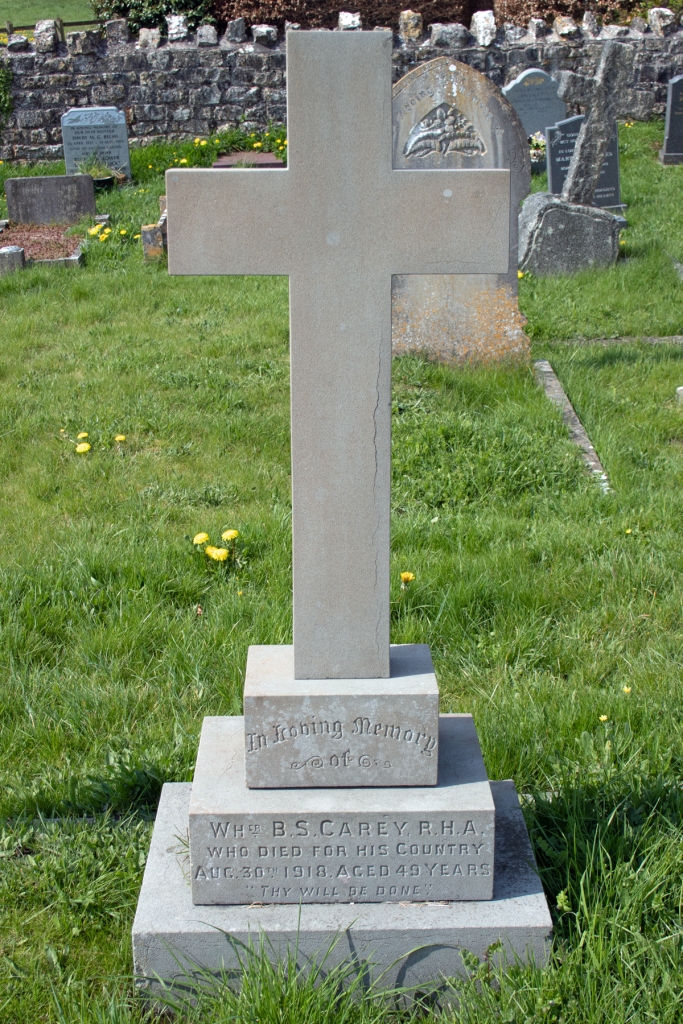
On 30th August Gunner Carey suffered a ruptured aneurysm and, despite being rushed to the nearby Hampstead Military Hospital, he died. He was 49 years old.
Sidney Carey was brought back to Somerset for burial in the family plot. He was laid to rest in the graveyard of All Saints’ Church in his home village of Farmborough.
Frederick John Parker was born on 26th November 1889 in Wavertree, Liverpool. He was the oldest of four children to John and Ellen Parker, both of whom had been born in North Ireland, and had sought out a new life in the busy English port.
There is little concrete information about Frederick’s early life. What is clear is that he wound work as a painter when he left school, and enlisted in the Royal Navy on 22nd April 1908, as a Stoker. He joined the service for five years, and was places on reserve in 1913.
When war broke out, Stoker Parker was called into action again and, during his time back in the Royal Navy was based at HMS Pembroke, the shore-based establishment in Chatham, Kent.
The base was a bustling place during the war and, by the summer of 1917 temporary accommodation was set up in the barracks’ Drill Hall; this is where Frederick found himself billeted.
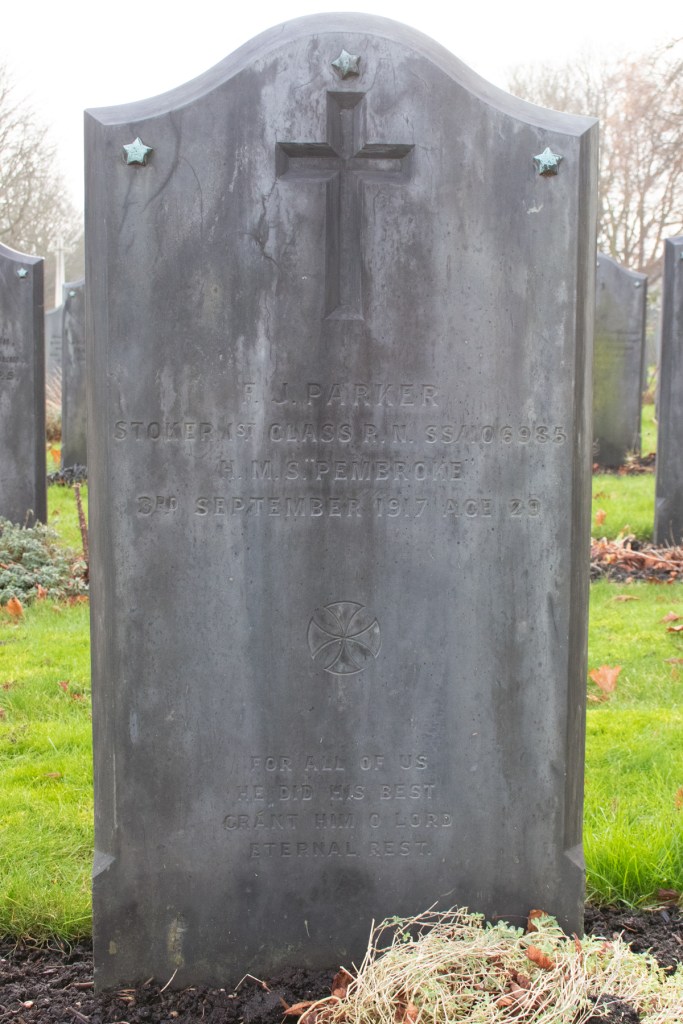
On the night of 3rd September 1917, Chatham suddenly found itself in the firing line as a wave of German aircraft bombed the town. The Drill Hall received a direct hit, and Stoker 1st Class Parker was amongst those to be instantly killed. He was 29 years old.
Ninety-eight servicemen perished during the Chatham Air Raid that night. They were buried in a mass funeral at the Woodlands Cemetery in nearby Gillingham. This, too, is where Frederick John Parker was laid to rest.
John Duncan Paulin was born in January 1885 in Liverpool, the youngest of two children. His parents – John Robert (known by his middle name) and Jane Paulin – were born in Scotland, but seemed to have moved to the Lancashire port by the late 1870s.
When he left school, John – who became known as Jack – found work as a clerk, but a life of adventure – and a more reliable career – beckoned. On 14th August 1904, he enlisted in the Border Regiment as a Private for a period of seven years. During that time, he served in barracks across the country – from Carlisle to Plymouth – and, by the time he was put on reserve in 1911, he had reached the rank of Corporal.
When war was declared, those servicemen on reserve were called back into action, and Jack found himself reposted with an increased rank of Sergeant. Over the next few years, he remained based in England and seemed to take on more of a training role, transferring to the Middlesex Regiment and, by the end of 1917, attaining the rank of Colour Sergeant.
At some point Jack met Ethel May Smith, who lived in Frome, Somerset. She was the same age as Jack, and was the daughter of the foreman of one of the cloth manufacturers in the town – she also went on to work in the factory. The couple married in St John’s Church in the town on 1st June 1916, but did not go on to have any children.
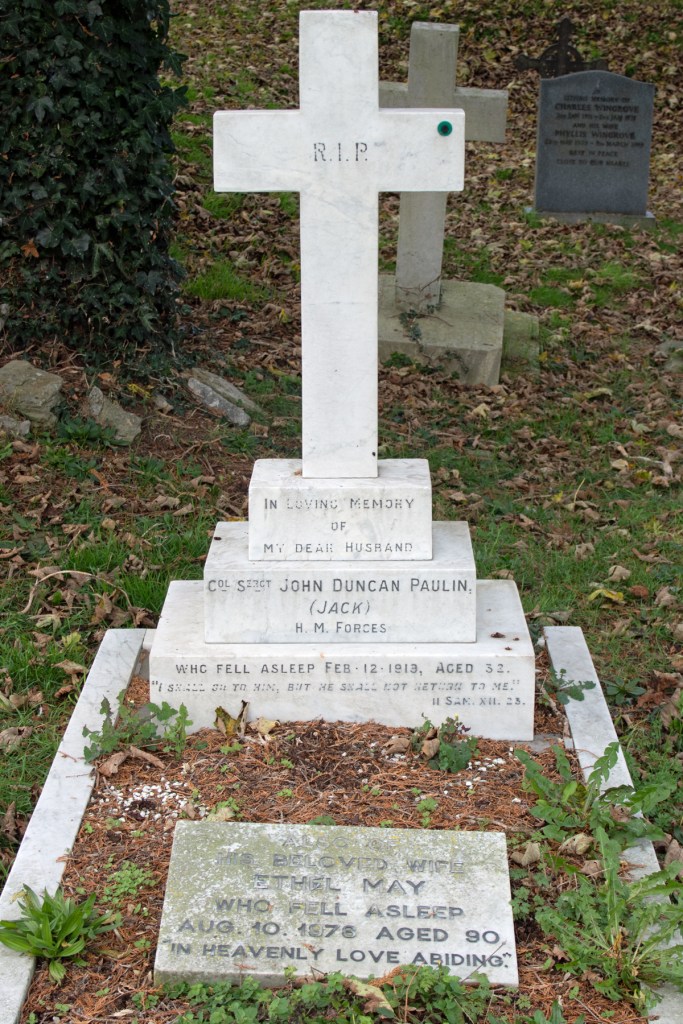
Colour Sergeant Paulin’s military career was free of any medical issues or hospital admissions until February 1919. He had not been demobbed by this point, even though the war was over. However, as with many other servicemen at the time, Jack fell ill with influenza, and was admitted to Grove Military Hospital (now St George’s Hospital) in Tooting, South London. Pneumonia set in, and Jack passed away on 12th February 1919, at the age of 34 years old.
Jack Duncan Paulin’s body was brought back to Somerset, and he was laid to rest in the graveyard of Christ Church, Frome. Ethel lived on until 1978; she was laid to rest with her husband.
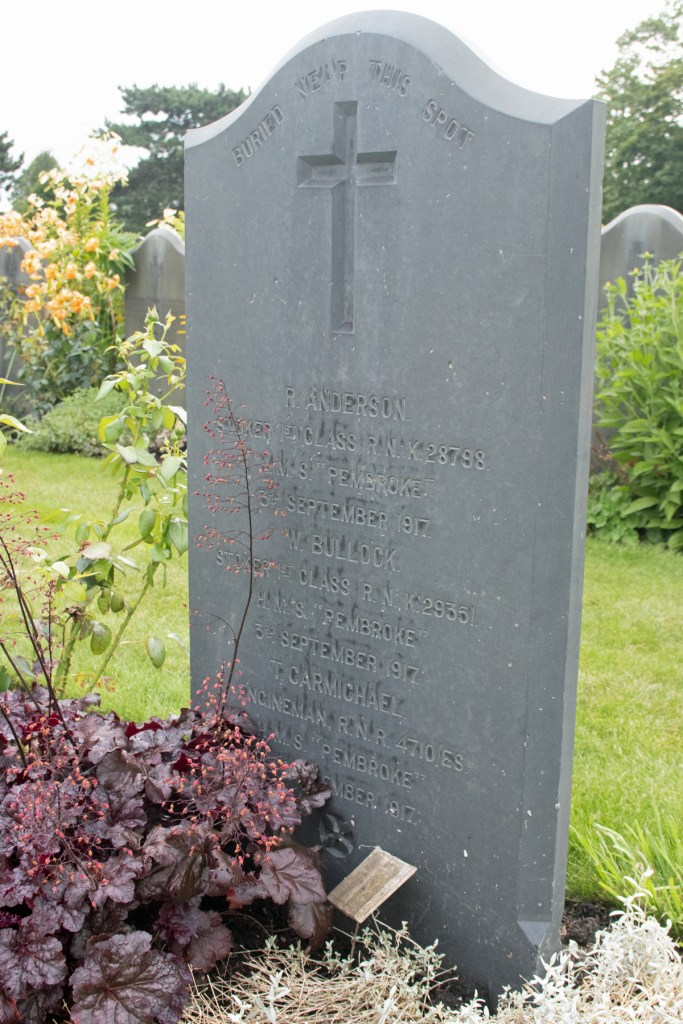
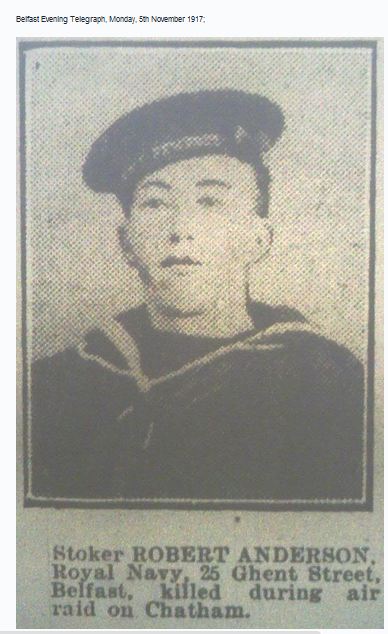
Robert Anderson was born on 4th September 1889, one of ten children – of whom tragically only three survived – to James and Emily Anderson. James was a storekeeper from Belfast, who had moved his family to Preston, Lancashire, but who had subsequently moved them back to Northern Ireland after Robert had been born.
In 1911, while working as a town labourer, Robert had met and married Rebecca Barkley; the couple went on to have to children, Mary and Agnes.
War was coming to Europe, however, and Robert was keen to play his part. He enlisted in the 3rd Battalion of the Royal Irish Rifles and, according to a subsequent newspaper report, saw action at Mons and the Marne early in the conflict.
The Belfast Evening Telegraph reported that “He completed his time, and instead of re-enlisting in the Army, he joined the Navy.” [Thursday 4th October 1917] Given that Robert enlisted in the Royal Navy in the autumn of 1915, this raises the question of how he left the army at the height of the conflict, particularly given that the same report suggests that he had come through the major battles “unscathed“.
Either way, Private Anderson made the move to Stoker 2nd Class on 10th November 1915. He record show that he stood 5ft 5.5ins (1.66m) tall, had fair hair, brown eyes and a fresh complexion. On his arms he sported a number of tattoos; a lady, crossed flags and a ship on his right, and his initials on the left.
Robert’s first posting was HMS Pembroke, the Royal Naval Dockyard at Chatham, Kent, where he received a couple of months’ training. He was then assigned to HMS Egremont, also known as Fort St Angelo in Birgu, Malta, where he spent a couple of months. Stoker Anderson then returned to England, serving at HMS Victory, the Royal Naval Dockyard in Portsmouth, and gaining a promotion to Stoker 1st Class in the process.
By August 1917, he had returned to HMS Pembroke. The Dockyard was particularly busy that summer, and the large number of extra servicemen meant that Robert was billeted in temporary accommodation in Chatham Drill Hall.
On the 3rd September 1917, the first night air raid carried out by the German Air Force bombarded the town, and scored a direct hit on the Drill Hall; Stoker 1st Class Anderson was among those killed instantly. He was a day short of his 28th birthday.
Robert Anderson was laid to rest, along with the other victims of the Chatham Air Raid, in the Woodlands Cemetery, Gillingham.
Stoker 1st Class Robert Anderson (from findagrave.com)
William Hardwick Smith was born in Slingsby, Yorkshire, on 12th April 1887, the oldest of four children to John and Sarah Smith. John was a house painter, but William had his sights set a seafaring career.
By the summer of 1909, he had enlisted in the Royal Navy. He gave his previous profession as seaman, and his place of birth as Manchester, but there is no documentation to confirm either his previous role, or to challenge his Yorkshire birth.
Joining the navy as a Stoker 2nd Class, his service records give his height as 5ft 8.5ins (1.74m) and show that he had auburn hair, grey eyes and a fresh complexion. William had a number of tattoos as well, including a ship and anchor, clasped hands and heart, a woman’s head and bird and the words “True Love” and “W Smith” on his right forearm.
During his initial five years’ service, Stoker Smith served on six different vessels, attaining the rank of Stoker 1st Class in the process. His career was not entirely without problems, however, and his records show that he was detained for 28 days for being AWOL in 1911, and imprisoned again for a further twelve days two years later.
As his term of service came to an end, the storm clouds of war were knocking on England’s shores, and William volunteered for a further seven years. During this time, he was primarily based at HMS Pembroke, the Royal Naval Dockyard at Chatham, Kent, although he was also assigned to the depot ship HMS Dido. Again, his time on board saw him spend two further periods in the brig, although his exact misdemeanours are lost to time.
Back at HMS Pembroke in the summer of 1917, William found himself in an overly packed base. He was billeted in the Chatham Drill Hall, which was being used as temporary accommodation.
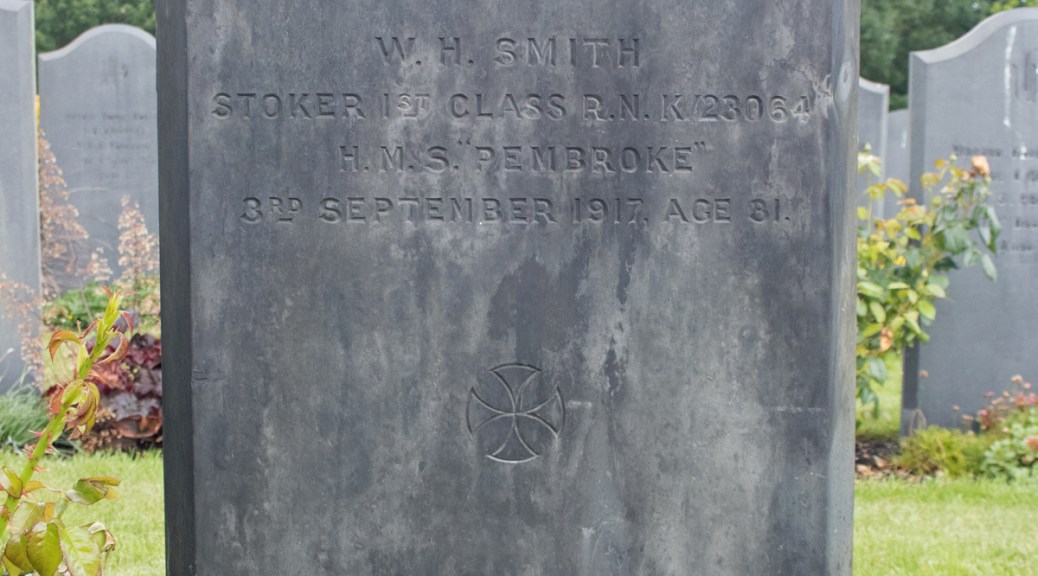
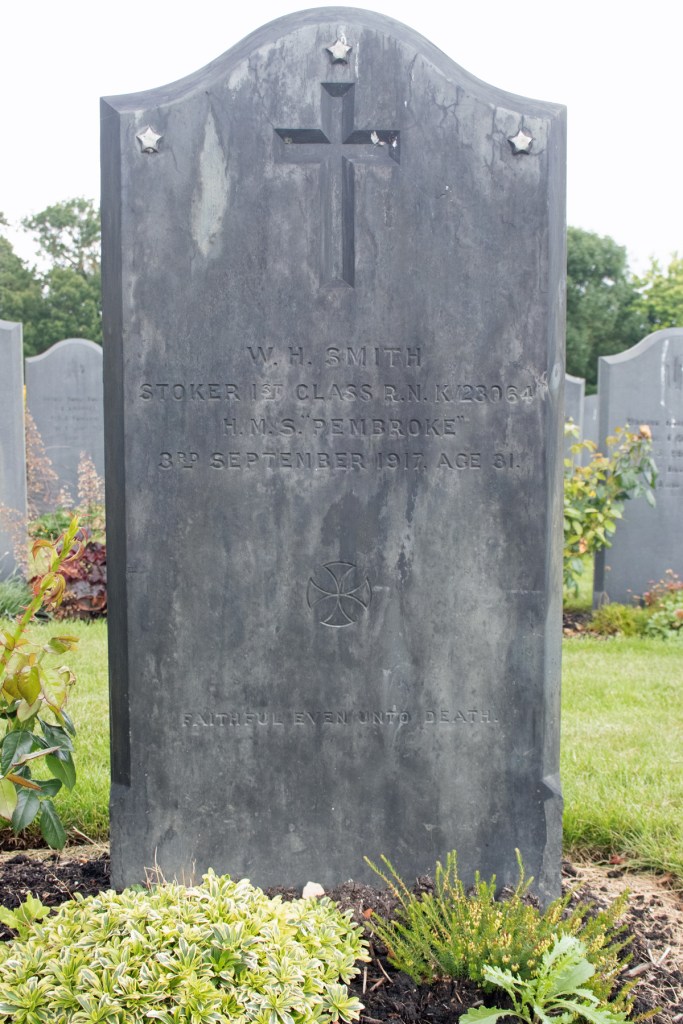
On the 3rd September 1917, the German Air Force carried out its first night-time air raid. They scored a direct hit on the Drill Hall; Stoker 1st Class Smith was amongst those killed instantly. He was 30 years old.
William Hardwick Smith was laid to rest, alongside the other victims of the Chatham Air Raid, in the Woodlands Cemetery, Gillingham.
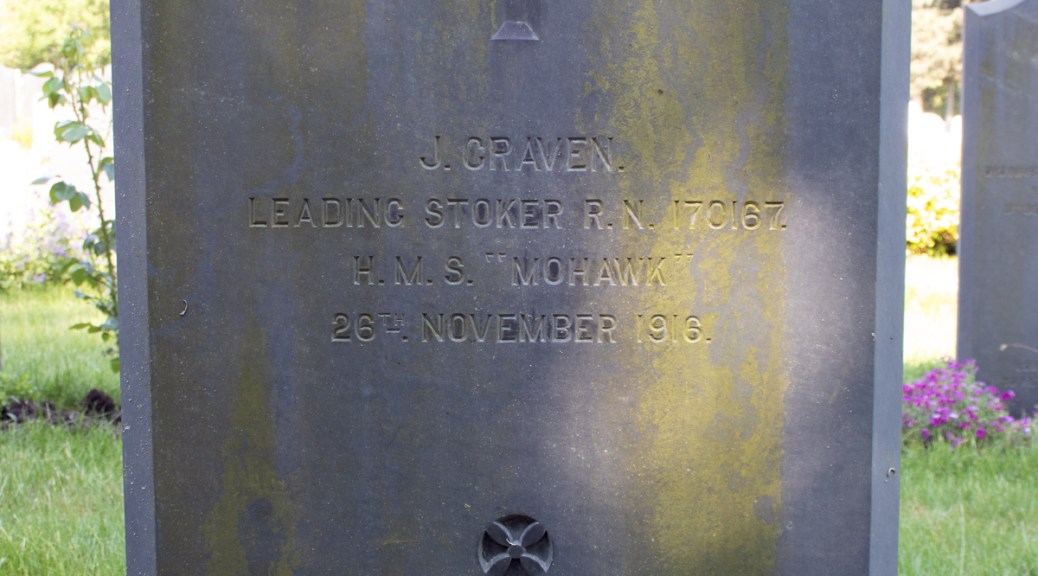
Joseph Craven was born in Liverpool on 6th January 1870. There is little information available about his early life, but by the time of the 1891 census, he was boarding with a blacksmith and his family in Bootle, Lancashire. By this point he was working as a fireman – probably a stoker-type role, rather than for the fire service.
The following year, Joseph found an opportunity to broaden his horizons and, on 21st October 1892, he enlisted in the Royal Navy as a Stoker 2nd Class. His papers show that, at the time of joining up, he was 5ft 4ins (1.62m) in height, had dark brown hair, blue eyes and a fresh complexion. No distinguishing marks were noted.
Joseph’s previous employment seemed to have stood him in good stead. After initial assessments at HMS Pembroke – the shore-based establishment at the Royal Naval Dockyard in Chatham, Kent – he was quickly moved on to HMS Wildfire, based in Sheerness. His first sea posting was aboard the battlecruiser HMS Howe, and, within a couple of months, he had been promoted to Stoker 1st Class.
By the time Joseph’s initial twelve-year contract came to an end, he had served on board nine ships and travelled the world. When the time came, he voluntarily renewed his contract and continued his life at sea.
When back in port, he developed a private life. He met a young widow called Sarah Baker in Portsmouth, and the couple married in 1908. The census three years later found Joseph as the head of the household, living in a seven-room house with Sarah, her 13-year-old daughter, 80-year-old widowed mother and two boarders.
Stoker Craven’s naval service was, by this point, continuing apace. By the time hostilities were declared in August 1914, he had served on twelve further ships, and been promoted again, this time to the role of Leading Stoker. In between his voyages, he was based primarily at HMS Victory, Portsmouth Dockyard’s shore-base.
By the end of the following year, Joseph was almost entirely shore-based, moving from HMS Victory in Portsmouth to HMS Pembroke in Chatham and HMS Attentive in Dover. On 26th November 1916, he was serving in Chatham. A local newspaper picks up on what happened to him next:
Joseph Craven… belonging to Portsmouth, met his death under shocking circumstances at Chatham Dockyard on Sunday. When walking by the side of his ship, which was in dry dock, he tripped over some hose and fell headlong into the dock, turning two or three somersaults in his descent, and falling upon his head at the bottom, 80ft [24.3m] below. He was killed instantly.
Kent Messenger and Gravesend Telegraph: 2nd December 1916
An inquest on the 46-year-old’s death was held, and a result of accidental death was returned.
Joseph Craven was laid to rest in the Woodlands Cemetery, Gillingham, walking distance from the dockyard in which he lost his life.
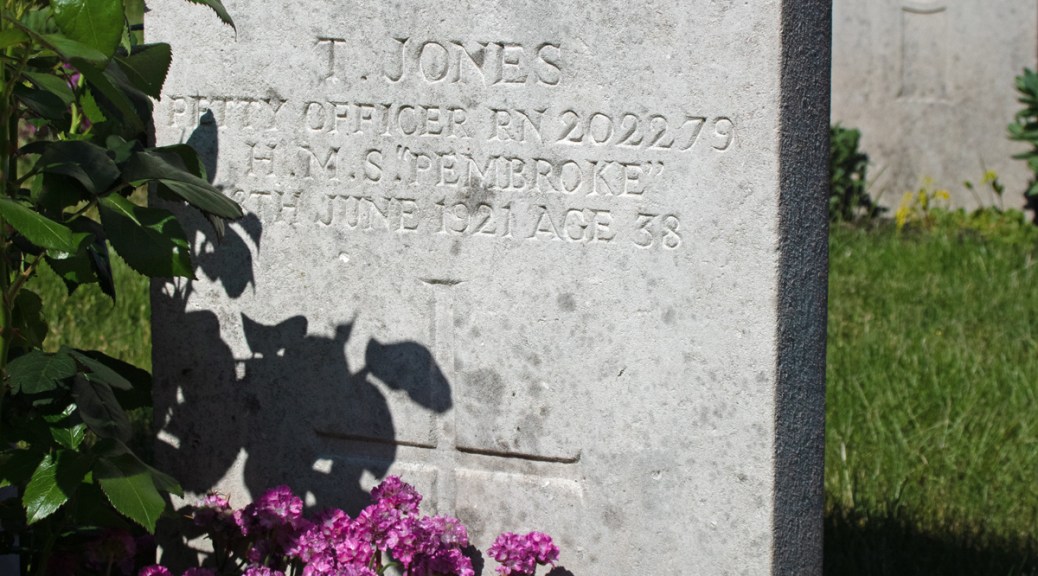
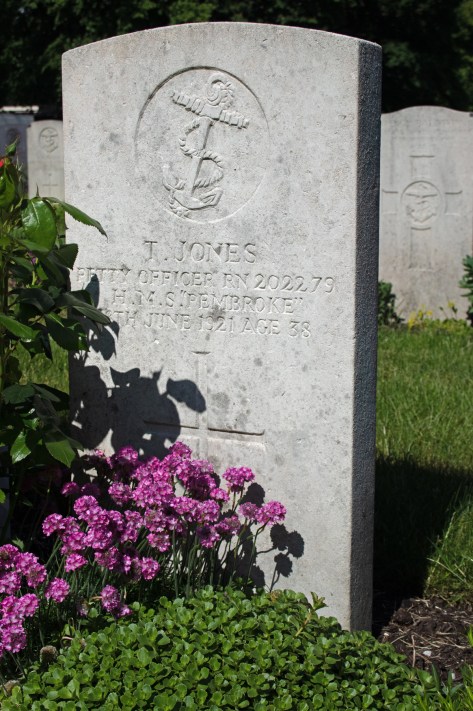
Thomas Jones (known as Tom) was born in Wednesbury on 7th September 1882 and was the middle of seven children. His father, also called Thomas, was a grocer and, with his mother Mary, they raised their family first in the Staffordshire town and then in Blackpool, Lancashire.
When he left school Tom helped his dad in the shop, primarily dealing with meat. His mind was on greater adventures, however, and in November 1898, he enlisted in the Royal Navy. Due to his age, he was initially given the rank of Boy, but was officially signed up as an Ordinary Seaman on the day after his 18th birthday.
Over the time of his initial twelve years’ service, Tom rose through the ranks, from Able Seaman to Leading Seaman and Petty Officer. In May 1912, however, he was ‘disrated’ back to Able Seaman, but there is no evidence to confirm why this was done. By this time, he had served on nine ships, as well as having time in shore-based establishments, and had completed his twelve years as a mariner.
Meanwhile, in the autumn of 1904, Tom had married Hannah Kennedy, a dockyard labourer’s daughter from Gillingham, Kent. The couple went on to have four children and set up home in the centre of the town, not far from the Naval Dockyard where Tom was sometimes based.
With war in Europe on the horizon, Tom immediately volunteered to continue his duty when he term of service came to an end. Working hard, he soon regained the rank of Leading Seaman and, by April 1915, was back up to Petty Officer once more.
During the remainder of his time in the Royal Navy, Petty Officer Jones served on a further seven vessels. In October 1920, after more than two decades’ service, he was invalided out, having contracted tuberculosis, rendering him unfit to continue.
At this point Tom’s trail goes cold. It seems likely that his lung condition got the better of him; he passed away on 20th June 1921, at the age of 38 years old.
Petty Officer Tom Jones was laid to rest in the Woodlands Cemetery in Gillingham, Kent.
Petty Officer Tom Jones (courtesy of ancestry.co.uk)
William John Neads was born on 16th December 1892, the middle of three children to cab driver and groom William Neads and his wife Ellen. Both William Sr and Ellen were from Somerset, although William Jr and his brother Charles – who was eleven months older – were both born in the Monmouthshire village of Cwmcarn.
William’s parents soon moved the family back to Clevedon in Somerset, and, when he left school, he found work as a farm labourer. He was eager to see more of the world, however and, in April 1913, he emigrated to Canada.
After working as a labourer there for a year or so, back in Europe war was declared. Keen to do his bit for King and Country, William enlisted in the 1st Battalion of the Canadian Infantry in January 1915. He soon found himself caught up on the Front Line.
In October 1916, he was involved in the Battle of the Somme – either at Le Transloy or The Battle of the Ancre Heights – and received a shrapnel wound to his left shoulder. Initially admitted to the Canadian General Hospital in Etaples, he was subsequently evacuated to England and the Northern General Hospital in Leeds. He spent three months recovering from his injuries, and was back on the Western Front in January 1917.
Later that year, William – now a Lance Corporal – was involved in the fighting at the Second Battle of Passchendaele (part of the Third Battle of Ypres). He was wounded again, this time receiving a rather unceremonious gunshot wound to the right buttock. Treated at the scene, he was evacuated back to England and admitted to the Fusehill War Hospital in Carlisle on 17th November.
Sadly, despite treatment, Lance Corporal Neads’ health deteriorated, and he passed away from his injuries on 16th December 1917, his 25th birthday.
William John Neads was brought back to his family’s home of Clevedon, and buried in the clifftop churchyard of St Andrew’s, overlooking the sea.
Tragically, William’s father had died in May 1917, at the age of 51. While no details of his passing are recorded, it meant that Ellen had, in just over a year, seen her son wounded, her husband die and her son wounded again and die as a result.
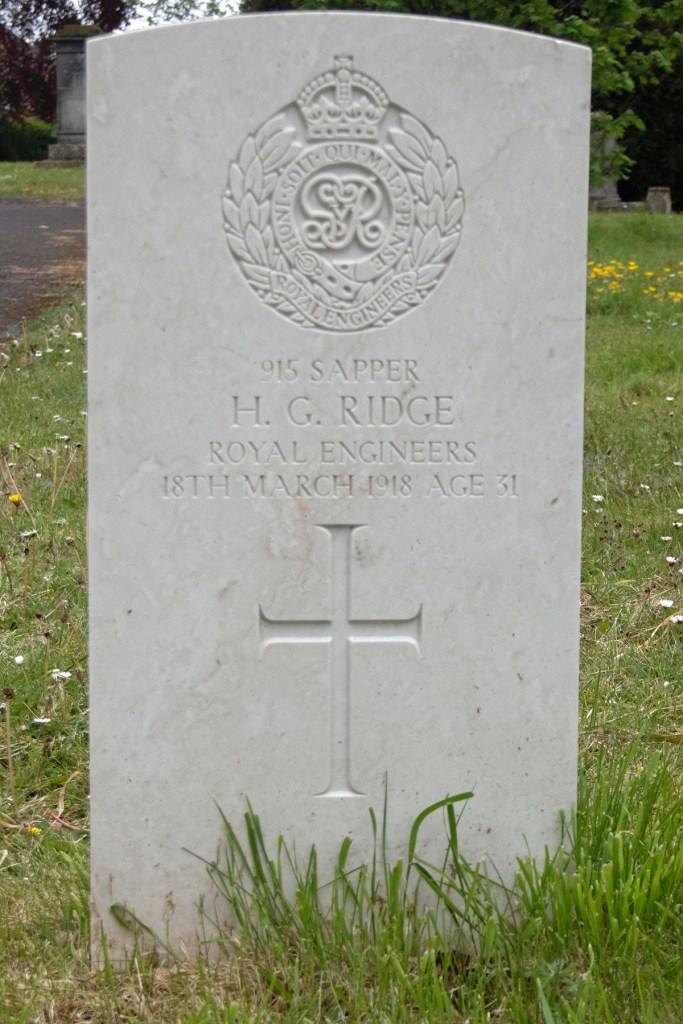
Herbert Gladstone Ridge was born in December 1886, the youngest of three children to Alfred and Sarah. Alfred was from Lancashire and had met and married his wife in Ireland, which is where Herbert’s older siblings had been born.
Sarah had died when Herbert was only eleven years old. Alfred’s skills were as a machine engineer, and, after his wife had passed away, he brought his family down to Somerset. Initially living with his father in Taunton, Herbert had found work as a piano tuner, and moved to a boarding house in Bristol to further his trade.
War was close, however, and, in July 1915, Herbert enlisted. Joining the Welsh Field Company of the Royal Engineers as a Sapper, he was quickly posted as part of the Mediterranean Expeditionary Force. He served nearly a year in Egypt, before being sent back to England in September 1916.
By this point, Sapper Ridge was suffering from a bout of tuberculosis, and had been sent back to England for treatment. The condition refused to clear up, however, and he was eventually discharged from the army on medical grounds three months after returning home.
Details of Herbert’s life after the army are sparse. It can be assumed, however, that he remained dogged by tuberculosis, and this is what eventually killed him. He passed away on 18th March 1918, aged just 31 years old.
Herbert Gladstone Ridge lies at rest in St Mary’s Cemetery in his adopted home town of Taunton in Somerset.
John Thomas Alston, also known as Jack, was born in Chorley, Lancashire, in 1865 and was one of thirteen children to Richard and Elizabeth Alston. Before he died in 1878, Richard was a stripper and a grinder in a cotton mill, and it was millwork that the majority of his and Elizabeth’s children went into.
When he left school, Jack and his siblings worked as cotton piecers in the mills, tying together any threads that broke on the machines. This was a job aimed at children, whose hands were often the only ones small enough to reach into the equipment.
By 1895, Elizabeth too had passed away. Jack, who was 30 by this point, had moved from Chorley to nearby Oswaldtwistle, and met Mary Ellen Wilcock. She was a widow with two children, and the couple married on 14th February 1897. Their marriage certificate shows that she was the daughter of a weaver, while Jack was working as a furnace man in the mill. The couple went on to have a child together, Amy, who was born in 1900.
The couple settled into if not a comfortable life, then a continued existence. While Mary and her two older children were working in the cotton mill, Jack began labouring at the local chemical works. The family lived in a small, two up, two down cottage right next to Mary and the children’s place of work, and life continued apace.
War was coming however, and Jack volunteered to do his bit. His service records no longer exist, but it can only be assumed that he joined of his own accord; he would have been 50 when hostilities commenced, and so exempt from the initial call-up.
Private Alston was assigned to the Somerset Light Infantry, and was based at their Depot in Taunton. Little information about his time there is available, and sadly, the next accessible document is his pension record. This confirms that he died on 7th April 1916, from “shock caused by a fall while on duty”. There is no other reference to what or how this happened, so the circumstances will remain a mystery. He was 51 years old when he passed away.
It seems that his widow may not have had the funds to bring Jack back home; instead he lies at rest in St Mary’s Cemetery in Taunton, Somerset, close to the depot where he was based.









 Death and Service