Tag Archives: Lance Corporal

Sapper William Dove

Sapper William Dove

William Henry Dove was born in the autumn of 1871 in Stafford, Staffordshire and was one of seven children to William and Louisa Dove. William Sr was a gardener by trade, but his son wanted bigger and better things.

On leaving school, he initially took up a post as a junior teacher, but military service was calling him and, on 21st February 1891 he enlisted in the Royal Lancaster Regiment. Private Dove’s service records show that he was 5ft 7ins (1.70cm) tall and 136lbs (61.8kg) in weight. He had sandy hair, grey eyes and a fair complexion. He also gave his age as 18 years and 3 months, although he was actually a year older.

Private Dove signed up for seven years’ service and completed this on home soil. In October 1891 he was promoted to Lance Corporal, and a year later he was promoted again, this time to Corporal.

In November 1894, William was found guilty of ‘conduct to the prejudice of good order and drunkenness‘ and was sentenced to be reduced in rank, so became a Private again. He learnt the error of his ways, though, and was reinstated to Lance Corporal in March 1897.

William’s service was completed in February 1898, and he was transferred across to the Army Reserve. This was intended to be for a further five years, but on 15th February 1900, he was discharged from future active service, having been found to be medically unfit. During his time in the army, William had been treated for a two bouts of gonorrhoea, as well as four further infections. The cause of his final medical discharge, however, is unclear.

While on reserve, William had found employment as a railway porter. His work took him to Llangollen, Denbighshire and, this is where he set up home. On 18th April 1899, he married Ellenor Roberts, a labourer’s daughter from the town: the young couple set up home in Ashfield House, Regent Street – now the busy A5.

The 1911 census records William as a porter: the couple had no children of their own, but had adopted a girl, Cissie, who was then eight years old. A live-in domestic servant – Esther Williams – was also recorded on the census.

War was coming to Europe by this point and, while details of his service are unclear, William stepped up to play his part once more. He enlisted in the Royal Engineers as a Sapper, at some point during the conflict, although exact details are lost to time.

Sapper Dove survived the war and returned to Llangollen. The 1921 census records him Ellenor and Cissie living at Bronhaul, and that William was working as a parcel’s porter for Great Western Railways. On 18th August 1921, he collapsed and died with a brain aneurysm. He was 39 years of age.

William Henry Dove was buried in the graveyard of St John’s Church in Llangollen, a short distance from the station at which he portered for so long.


Ellenor lived on until her late 70s. When she passed away, she was laid to rest in the family plot, reunited with her husband after 35 years.


Lance Corporal James Toop

Lance Corporal James Toop

James Toop was born in the Somerset village of Galhampton on 13th January 1879. He was the fifth of eleven children to William and Elizabeth Toop. William was a farm labourer, and James followed his father’s line of work when he left school.

James disappears from documents for a while, only surfacing again in October 1914, when he enlisted for army service. At this point, he was working as a bricklayer, and notes that he had previously served in the Somerset Light Infantry. He is recorded as being 5ft 8ins (1.73m) tall, weighing 136lbs (61.7kg). He had brown hair, grey eyes, and gave his religion as Congregationalist. James also lied about his age, saying that he was 29 years and 9 months when, in fact, he would have been closer to 36 years old when he joined up.

Sapper Toop was assigned to the Royal Engineers, and spent nine months on home soil, during which time he was promoted to Lance Corporal. On 18th July 1915 he went to France, but returned just five days later.

Admitted to the Royal Victoria War Hospital in Netley, Hampshire, James was recorded as suffering the stress of campaign. He was moved to Napsbury War Hospital, near St Albans in Hertfordshire, after a couple of weeks. This institution – formerly the Middlesex County Asylum – was where servicemen suffering from shell shock were sent for rehabilitation, and Lance Corporal Toop joined the near 2,000 other residents.

James’ diagnosis was recorded as being neurasthenia with depression and, in October 1916, he was medically discharged from the army. The medical report noted that he had “had nervous breakdown, complained of vomiting of his food. Had defective memory. Had religious mania 5 years before enlistment.” While his condition was not the result of his war service, the medical board recorded that his mental debility has been aggravated by the strain.

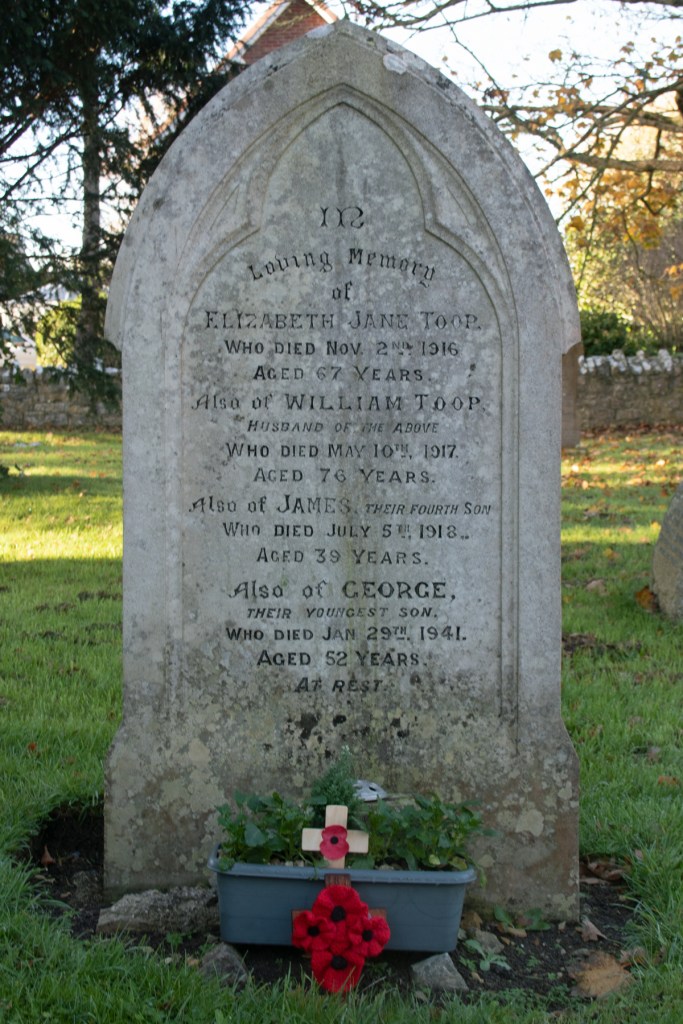
James falls off the radar again at this point. When he recovered, he returned to bricklaying for work. In 1916 his mother died, followed a year later by his father. Both were laid to rest in the family grave in St Mary Magdalene’s Church, Sparkford, Somerset.

James Toop died on 5th July 1918 at the age of 39 years old. He was also buried in the family plot, reunited with his parents far too soon.


Second Lieutenant Cyril Croft

Second Lieutenant Cyril Croft

Cyril Talbot Burney Croft was born on 28th January 1891 in Streetsville, Ontario, Canada. He was the only child of Dorset clergyman Otho Croft and his Canadian-born wife, Lucy.

Otho brought his young family back to England when Cyril was a boy. The 1901 census found him and Lucy living in South Cadbury, Somerset, where he had taken the role of the local rector. Their young son, meanwhile, was boarding at a school in St Leonard’s in East Sussex.

Education was key to Cyril’s development. He was sent to King’s College in Taunton and St Boniface College in Warminster, and enlisted in the Officer’s Training Corps for three years.

During this time, he and Lucy had travelled back to Canada, and there was an obvious draw for the young man as, in 1913, he made a move to Quebec, becoming the Assistant to the Commissioner of Harbour Works in the city.

When war broke out, Cyril was quick to step up and play his part. Joining the Canadian Expeditionary Force on 23rd September 1914, his service records show that he was 6ft 1in (1.85m) tall, with black hair, grey eyes and a dark complexion.

Cyril was initially assigned to the 12th Battalion of the Canadian Infantry, where he held the rank of Lance Corporal. On arriving in England, however, he took his leave of the Canadian force, and accepted a role in the King’s Royal Rifles. Within a few months, he transferred again, gaining the rank of Second Lieutenant in the 8th (Service) Battalion of the Somerset Light Infantry.

Details of Cyril’s actual service are vague, however, as his British Army service records are no longer available. It appears that he did not serve any time overseas, as his battalion was raised in Taunton, Somerset, and did not move to France until the end of 1915.

Second Lieutenant Croft had made a further transfer by this point, joining the Royal Flying Corps in the summer. He gained his wings on 27th October 1915 at a Military School in Birmingham.

On 8th December 1915, he was a passenger in an aircraft being piloted by a Lieutenant McDonald at Castle Bromwich.

The weather was “bumpy” but not bad… They went towards Birmingham, and then made a turn to the left. [McDonald] noticed that the engine was missing fire when he was at a height of 1,500ft [460m], and decided to land. He turned off the petrol, but did not switch off the electric ignition. He made a right-hand turn, so as to reduce the height, the machine then being at a normal angle, when, owing to the wind, the aeroplane banked. To put the machine back again he put the control lever over to the left, but finding that the machine did not answer to the control, he put on the right rudder, and Lieutenant C Black, of the Royal Flying Corps, who had instructions to watch the aeroplane, stated that shortly after eleven o’clock in the morning it ascended to a height of 1,500ft. Shortly afterwards he saw the machine coming down: it made a short spiral, then a complete circle, and while turning to make another at a height of 500ft [150m], fell straight to the ground, nose downwards. The aeroplane was in proper working order, and the witness was of the opinion that the accident was due to wind disturbances.

De Ruvigny’s Roll of Honour

Croft and McDonald were both killed. Cyril was just 24 years of age. His Colonel wrote to Otho and Lucy, noting that Cyril “did so well that it makes one feel the loss all the more of such a promising young officer. He is, indeed, a great loss to our country, especially in these times.” Cyril’s Major noted “he had a most charming, lovable character, and was thoroughly popular with all his brother officers. He was exceedingly keen at his work, and in him the service has lost a most promising and capable officer.”

Cyril Talbot Burney Croft was brought back to Somerset for burial. He was laid to rest in the graveyard of his father’s church: St Thomas a Becket’s in South Cadbury.


Second Lieutenant Cyril Croft
(from ancestry.co.uk)

Lance Corporal Thomas Roberts

Lance Corporal Thomas Roberts

Thomas Roberts was born in Llangollen, Denbighshire, in 1895. One of seven children, his parents were William and Ellen Roberts. William was a butter merchant, and his wife helped in the business.

When Thomas left school, he found work as a greengrocer’s assistant, but when war was declared he saw an opportunity for glory. While full details of his military service are no longer available, it’s clear that he enlisted in the Royal Welch Fusiliers.

Private Roberts was assigned to the 13th (Service) Battalion (1st North Wales) and on 1st December 1915, found himself in France. For the next eighteen months, he was firmly ensconced on the Western Front, and rose to the rank of Lance Corporal for his service.

In April 1917, Thomas was injured in fighting and was medically evacuated to Britain for treatment to his bullet wounds. Admitted to the Edmonton Military Hospital in North London, his injuries were to prove too severe. Lance Corporal Roberts passed away on 22nd April 1917. He was just 21 years of age.

Brought back to Wales for burial, Thomas Roberts was laid to rest in the family plot in Llangollen’s Fron Cemetery.


Thomas was buried along with his brother David, who had passed away in 1912. They were joined by their father William, who died in 1919, and their sister Elizabeth, who passed away in 1945. The family were finally reunited with Ellen, when she died in 1947, at the age of 86.


Lieutenant Thomas Denny

Lieutenant Thomas Denny

Thomas David William Denny was born on 26th December 1890 in Glasgow, Lanarkshire. There is little information on his early life, other than that his parents were Thomas and Annie Denny.

By the time of the 1911 census, Thomas Jr was serving as a Lance Corporal in the 2nd Battalion of the Gloucestershire Regiment, and was based at the Verdola Barracks in Malta.

When war broke out, the battalion was called back to mainland Europe. By 19th December 1914, Thomas found himself in France; two years later, he was in Salonika, Greece.

Thomas’ bravery was not in doubt. While serving in France, he received the Military Medal for conspicuous gallantry. This went hand in hand with a promotion to Sergeant. In 1917, he received a commission as Second Lieutenant and was moved to the regiment’s 3rd Battalion.

In the spring of 1918, Second Lieutenant Denny married Elsie, a woman from Bearsted, near Maidstone in Kent. Sadly, little else is known of her, and even a later newspaper report only referred to her as “a Bearsted lady” [East Kent Gazette: Saturday 15th March 1919].

By early 1919, Thomas was back in Britain. Whether he had been demobbed is unclear, but is seems more likely that he had returned home for medical treatment. On 6th March, he passed away in Maidstone. He was just 28 years of age.

Thomas David William Denny was laid to rest in the graveyard of Holy Cross Church in Bearsted close to where the now-widowed Elsie must have lived.


Lance Corporal James Matthews

Lance Corporal James Matthews

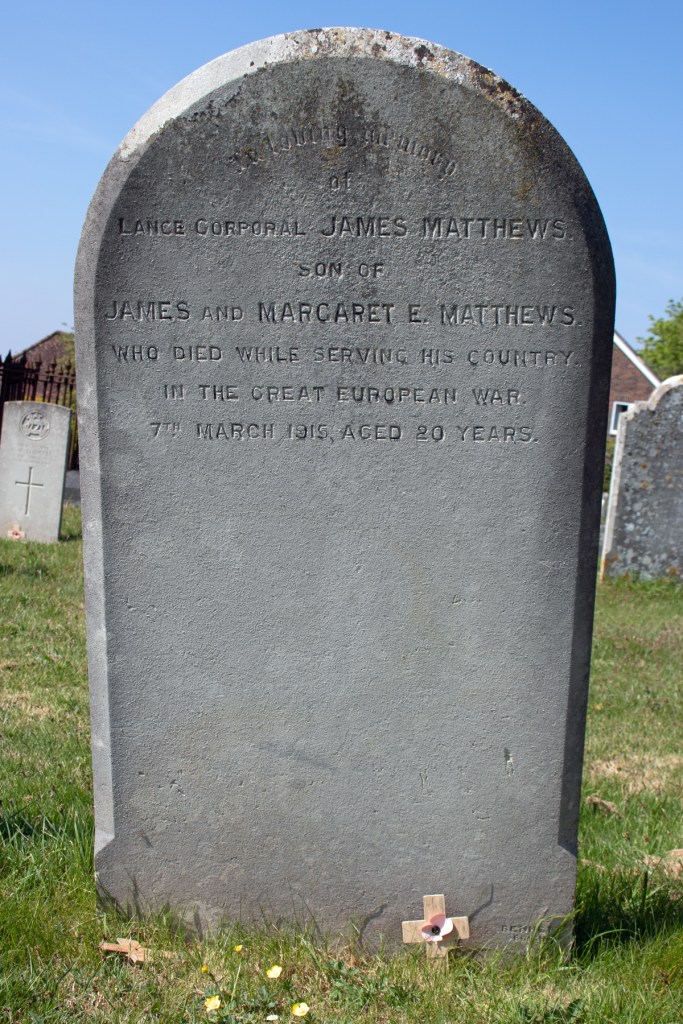
James Matthews was born in the summer of 1894, the youngest of five children to James and Margaret Matthews. James Sr was a farm worker from Cuckfield in West Sussex, and it was on Hodshrove Farm in nearby Ansty that the family were raised.

James Jr worked on the farm when he left school, but when war broke out, he found a bigger calling for himself. Full details of his military service are not available, but he seemed to have enlisted early on in the conflict, joining the 9th (Service) Battalion of the Royal Sussex Regiment. Originally formed in Chichester, West Sussex, he soon found himself billeted in the South Down near Portslade.

James must have impressed his superiors, as he was soon promoted to Lance Corporal for his work. All was not to go well, however, as, during the early months of 1915, he contracted pneumonia.

Lance Corporal Matthews was admitted to the 2nd Eastern General Hospital in Brighton, but the lung condition was to get the better of him, and he passed away on 7th March 1915. He was just 20 years of age.

James Matthews was brought back to his home village for burial. He lies at rest in Cuckfield Cemetery, in the shadow of Holy Trinity Church.


Lance Corporal Colin Clarke

Lance Corporal Colin Clarke

Colin Lewis Clarke was born in the spring of 1879 in Cardiff, South Wales. He was one of seven children to Bernard and Elizabeth Clarke. Bernard was a carpenter, but after Elizabeth died in 1886, he took over the running of the Windsor Hotel in Penarth.

When he left school, Colin found work as a clerk. Bernard also died in 1908, and the 1911 census records Colin and his brother Thomas living with his sister, Beatrice. They were sharing the house with Beatrice’s second husband, Charles, and her six children from her first marriage in the Cheshire village of Poulton.

Colin’s trail goes tantalisingly cold at this point. When war broke out, he enlisted to play his part, joining the 16th (Transport Workers) Battalion of the York and Lancaster Regiment by the summer of 1916. This troop was a territorial force, and Private – and then Lance Corporal – Clarke was based in the Yorkshire Dales.

At some point during the autumn Colin fell ill, and was admitted to the Military Hospital in Middlesbrough. His condition is unclear, but he was to succumb to it, passing away on 5th November 1916, the age of 37 years old.

Colin Lewis Clarke’s body was brought back to Wales for burial. He was laid to rest in the graveyard of St Augustine’s Church in Penarth, Glamorganshire.


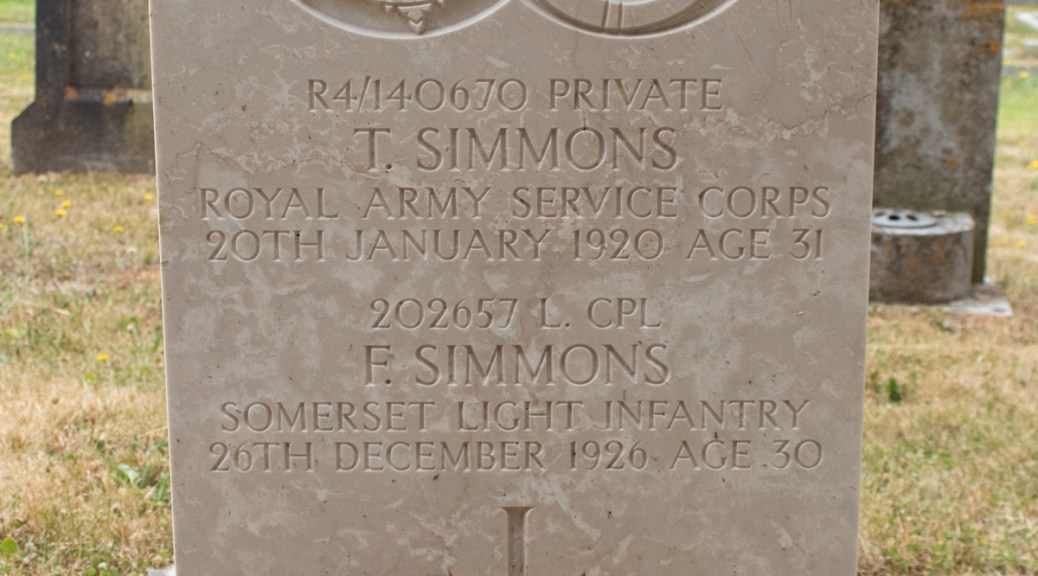
Private Tom Simmons

Private Tom Simmons

Tom Simmons was born early in 1889, one of fourteen children to William and Elizabeth Simmons. William was a farm labourer from Devon, who had moved to Runnington, near Wellington in Somerset, with Elizabeth in the late 1880s. This was where their growing family was born and raised.

Tom found work away from Somerset when he left school and, by the time of the 1911 census, he was lodging in a house in Llanwonno, Glamorgan. He was employed as an assistant machine repairer at the local colliery.

War was beginning to encroach on England’s shores, and Tom was to play his part. Full service details are not available, but he enlisted in the Royal Army Service Corps and served as part of a territorial force. For the part he played, he was awarded the Victory and British Medals and the Silver War Badge.

It would seem that Private Simmons survived the war and was demobbed, returning to Somerset at some point by the end of 1919. Sadly, his trail goes cold: the next record available is of his death – through causes unspecified – at home on 20th January 1920, at the age of 31 years old.

Tom was buried in Wellington Cemetery, not far from his family home.


Tom’s headstone also includes a dedication to a Lance Corporal F Simmons.

Frederick Simmons was seven years younger than his brother. When he left school, he worked as a wool spinner in the local wool mill. When war came to Europe, he too played his part. Again, full details of his service are sketchy, but he enlisted in the Somerset Light Infantry.

Like Tom, Frederick served as part of the territorial force, and worked his way to the rank of Lance Corporal. After the war he returned home, but his life there was not set to be a long one. He passed away, through causes not noted, on 26th December 1926. He was just 30 years of age.

Frederick was laid to rest in the same grave as his brother. Technically not entitled to an official Commonwealth War Grave (the rules are laid out here), his service was remembered alongside that of Tom’s.


Serjeant-Trumpeter Alexander de Vere

Serjeant-Trumpeter Alexander de Vere

Alexander Johnstone de Vere was born on 10th August 1889 in Murree, India (now Pakistan). He was one of five children to Norfolk-born Alexander Johnstone (also known as John Ralph de Vere), and his wife Dorothea who had been born in Sangor, India. Alexander Sr was a Sergeant Major in the 12th Lancers, and the family returned to England not long after his son was born, settling first in Aldershot, then in Sandhurst.

Alexander’s youngest sibling, George, was born in Cairo, Egypt, so the family was on the move again. Sadly, Alexander Sr died in a nursing home in the city just two years later and, after returning to England, Dorothea passed away in a Holborn infirmary just two years later.

Documents for the de Vere children – Ellen, Alexander, Dorothea, William and George – are few and far between. The 1911 census places Dorothea boarding with a family in Kingston-upon-Thames, where she was employed as a dress maker. The same document records William as a Bandsman in the 1st Battalion of the Seaforth Highlanders, based at Chanpatia, in Northern India. George, meanwhile, was a schoolboy at the Duke of York’s Royal Military School on the outskirts of Dover. Of the two eldest siblings, however, there is no record.

In the autumn of 1912, Alexander married Emily Louise Collins. Born in Norfolk in 1884, she was working as a servant in a house in Surrey when she and Alexander met. The couple married in Faversham, Kent, and settle down there, their daughter, Dora, being born in the town in January 1915.

Given his family’s military background, it is not unsurprising that Alexander enlisted in the army almost as soon as war was declared. He may have already seen military service, as he enlisted in the 11th Hussars as a Lance Corporal. By 15th August 1914, Alexander was in France.

Lance Corporal de Vere was quickly caught up in the fighting. He saw action at Mons and Nery in 1914, and at Ypres the following year. By this point, he had been promoted to the rank of Sergeant Trumpeter, reflecting the musical connection he shared with his younger brother, William.

Alexander remained in France until January 1916, when he was invalided home. He was admitted to Dorchester County Hospital in Dorset, suffering from a cerebral abscess. Despite treatment, he succumbed to the condition, passing away on 17th March 1916, at the age of just 26 years old.

Alexander Johnstone de Vere was brought back to Kent for burial. He was laid to rest in Faversham Borough Cemetery.


Lance Corporal Frederick Twist

Lance Corporal Frederick Twist

Frederick William Twist was born in around 1884, the older of two children to William and Clara Twist. William had been born in Faversham, Kent, and was a labourer in the cement works there.

Frederick did not follow his father’s trade, however, and, on leaving school, he found work in the printing office of the Faversham News, before moving on to Filmer Bros., a local nursery and bulb grower. He was a keen member of the Salvation Army, and played in the local Corps’ band. After more than a decade at Filmer Bros., Frederick took up new employment with Salvation Army Insurance, and worked out of the Whitstable office.

In the spring of 1909, Frederick married Helen Bedster, a bargeman’s daughter from Faversham. At the time of their wedding, she was working as a servant for a brewer manager in the town. The couple settled down in a terraced house in the centre of the town, and went on to have two children.

When war broke out, Frederick was called upon to play his part, but his time in military service was to be a troubled one. A contemporary newspaper expanded on this:

The toll of war continues through nearly a year has elapsed since the war practically ceased… [following] the death of Lance Corporal Frederick William Twist, 16th Lancers, a Faversham man, who passed away at the Military Hospital Woolwich, after a great deal of suffering.

Lance Corporal Twist enlisted under the Derby Scheme and being called up in May 1916, he joined the 16th Lancers and was sent to Ireland. At the end of that year he was drafted to France but in the following May he was invalided home with trench fever.

On his discharge from hospital in Devonshire he returned to Ireland. Then in March of last year there came the great offensive on the Western Front and for the second time deceased was drafted to France. He was not, however, at all fit, and the result was that he was obliged to fall out.

After a further spell in hospital and convalescent camp at the base he was employed on light duty – stores keeping and clerical work – to which he stuck with dogged spirit until in June last he again broke down and was once more in hospital.

Later he was transferred to the Royal Herbert Hospital, Woolwich, where he died on October 7th – a fine example of a British soldier who had struggled, even against weakness and suffering, to do his duty to the very last.

Faversham News: Saturday 18th October 1919

Lance Corporal Frederick William Twist was 35 years of age when he passed. He was laid to rest in the Borough Cemetery of his home town, Faversham.