Tag Archives: Machine Gun Corps

Private Edgar Bowditch

Private Edgar Bowditch

Edgar George Bowditch was born in the spring of 1887, in the Dorset village of Melbury Osmond. One of seven children, his parents were William and Sarah Bowditch. William was an agricultural labourer turned gamekeeper, and Edgar helped his father out when he left school.

William passed away in 1911, and Edgar fell off the radar until March 1914, when he married local mason’s daughter Rosetta Morris. The couple settled down in her home village of West Coker, Somerset.

When war was declared, Edgar stepped up to serve his King and Country, and enlisted in the Machine Gun Corps as a Private. He was assigned to the 37th Battalion, and certainly saw action overseas. He “came through without a scratch and in good health until demobilised in France.” [Western Chronicle: Friday 21st February 1919]

Private Bowditch was unwell when he arrived back in West Coker on 4th February 1919. While his condition is unclear, it worsened, and he passed away at home ten days later. He was 32 years of age.

Edgar George Bowditch was laid to rest in the graveyard of St Martin’s Church in his adopted home of West Coker.


Rosetta married again in 1921, to a John Axe. The couple remained in the same part of Somerset, John dying in 1947. Rosetta lived on, passing away in Yeovil in 1963, at the age of 77 years old.


Lance Corporal Ernest Green

Lance Corporal Ernest Green

Ernest Green was born on 31st March 1881 – four days before that year’s census – in the Kent village of Aylesford. The middle of eleven children, his parent were William and Sarah Green. William was a labourer in the local clay works, and this is employment that Ernest and his brothers also entered into.

On 10th December 1904, Ernest married Emily Chapman. She was the daughter of another labourer, and the couple went on to have seven children, the oldest of whom was born in May 1905.

The family set up home in Aylesford, not far from Ernest’s parents, and life would have been set, had it not been for the intervention of the First World War.

Ernest enlisted early on, joining The Buffs (East Kent Regiment) in December 1914. His service records confirm that he was 33 years old when he enlisted, and stood 5ft 4ins (1.63m) tall. Sadly, Private Green’s service records are a little sketchy, and it is unclear whether he ever saw action overseas, although it is likely that he did at some point.

Private Green transferred to the Machine Gun Corps in February 1916, and then moved again – to the Labour Corps – in the summer of 1918. He joined the 426th Agricultural Coy, and was based in Canterbury.

Working outside through the summer and autumn, it seems that Ernest’s health may have begun to suffer and he was admitted to the Canterbury Military Hospital in December 1918, having contracted influenza. Sadly, the lung condition was to prove his undoing: Private Green passed away at the facility on 20th December 1918. He was 37 years of age.

Ernest Green was brought back to Aylesford for burial. He was laid to rest in the graveyard of St Peter & St Paul’s Church, although the exact location of his grave is not longer known. Instead, he is commemorated on a joint headstone in the First World War section of the graveyard.


Private Charles Tucker

Private Charles Tucker

Charles Wilfred Tucker was born in the summer of 1898 in Penarth, Glamorgan. He was the oldest of four children to Wilfred and Elizabeth Tucker, restaurant owners on Windsor Terrace in the centre of the town.

Little information is available about Charles’ early life. When war broke out, he enlisted in the Welch Regiment, before transferring to the Machine Gun Corps at some point during the conflict. In the autumn of 1919, Private Tucker was put on furlough while waiting to be demobbed, and he returned home.

Sadly, it was while here that Charles contracted pneumonia, and it was from the lung condition that he was to pass away. He breathed his last on 30th October 1919, at the age of just 21 years old.

Charles Wilfred Tucker was laid to rest in the family grave in St Augustine’s Churchyard in his home town of Penarth.


Lieutenant Alexander Spurway

Lieutenant Alexander Spurway

Alexander Popham Spurway was born on 8th April 1891 in Newbury, Berkshire. He was the second of six children to Edward and Gertrude Spurway. Edward was a clergyman, and the family moved to Heathfield in Somerset when Alexander was a small boy. Education was key to Edward and, the 1901 census records show Alexander as being a boarder at the Portmore School in Weymouth, Dorset.

Reverend Spurway set the family up well in Heathfield: by the time of the next census in 1911, the family were living in the village rectory, with five members of staff.

Alexander, meanwhile, had taken a different route, entering the Royal Naval College at Osborne on the Isle of Wight in January 1904. He was a keen sportsman and, while there, he represented the college at both cricket and football.

In September 1908, he passed out from the college as a Midshipman, and served on HMS Canopus in the Mediterranean. His career continued, and he was made Sub-Lieutenant in December 1911, and Lieutenant two years later.

Reverend Spurway died at home in February 1914 and, by the time war broke out, Lieutenant Spurway was assigned to HMS Achilles. He remained on board the cruiser for the next two years and it was during this time that he developed diabetes: something that was to prove an ongoing issue for him.

Returning home in the autumn of 1915, the condition was to prove too much, and he passed away on 29th November 1915, at the age of 24 years old.

Alexander Popham Spurway was laid to rest in the graveyard of his late father’s church, St John the Baptist in Heathfield.


Lieutenant Spurway (from findagrave.com)

Sadly, Alexander was not the only member of the Spurway family to lose their life as a result of the war.

Richard Popham Spurway, Alexander’s older brother, was a 2nd Lieutenant in the Somerset Light Infantry, and was attached to the Hampshire Regiment, when it was moved to Gallipoli in 1915. He was killed on 13th August 1915, and is commemorated on the Helles Memorial at Canakkale, Turkey.

Alexander’s younger brother, George Vyvyan Spurway, joined the Royal Fusiliers, before transferring to the Machine Gun Corps. He had arrived in France in September 1916, and was killed while fighting on the Western Front on 28th March 1918. He was laid to rest at Arras and is commemorated on the memorial there.


Private Robert Creasey

Private Robert Creasey

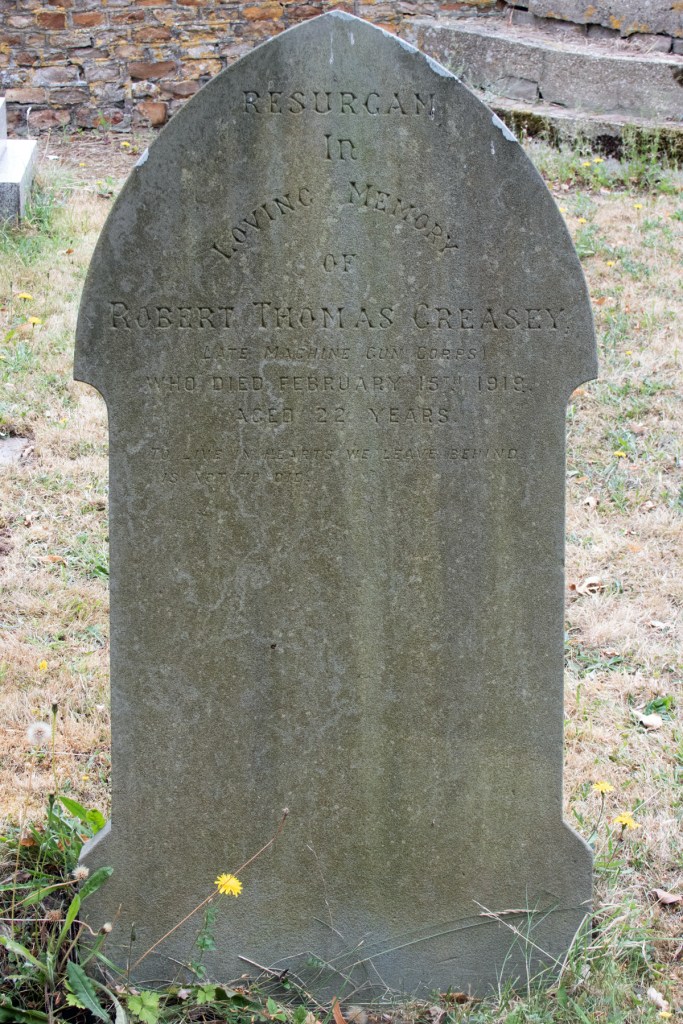
Robert Thomas Creasey (also known as Thomas Robert Creasey) was born in the village of Ash, near Farnham in Surrey, on 3rd January 1896. He was the youngest of four children to Edwin and Elizabeth Creasey. Edwin was the landlord of the Standard of England public house in the village.

When he died in 1902, Elizabeth moved her family to Somerset, where she had been born and where she still had relatives living. With four young children to raise, she married again in April 1903, to local dairy farmer Frederick Gould.

Robert was working as a farmer when war was declared, but was one of the first to step forward and volunteer. He enlisted in the Somerset Light Infantry and in the autumn of 1915 was involved in the fighting in Gallipoli.

In July 1916 Private Creasey transferred to the Machine Gun Corps. Sadly, little further information about his military life is available, but he survived the war, and returned home to Somerset on furlough, before being demobbed.

This is where Robert’s trail ends. He passed away at home on 15th February 1919, presumably from one of the lung conditions running rampant across a war-torn continent. He was just 23 years of age.

Robert Thomas Creasey was laid to rest in the graveyard of St Michael and All Angel’s Church in Angersleigh, Somerset, not far from where his mother lived.


Private William Small

Private William Small

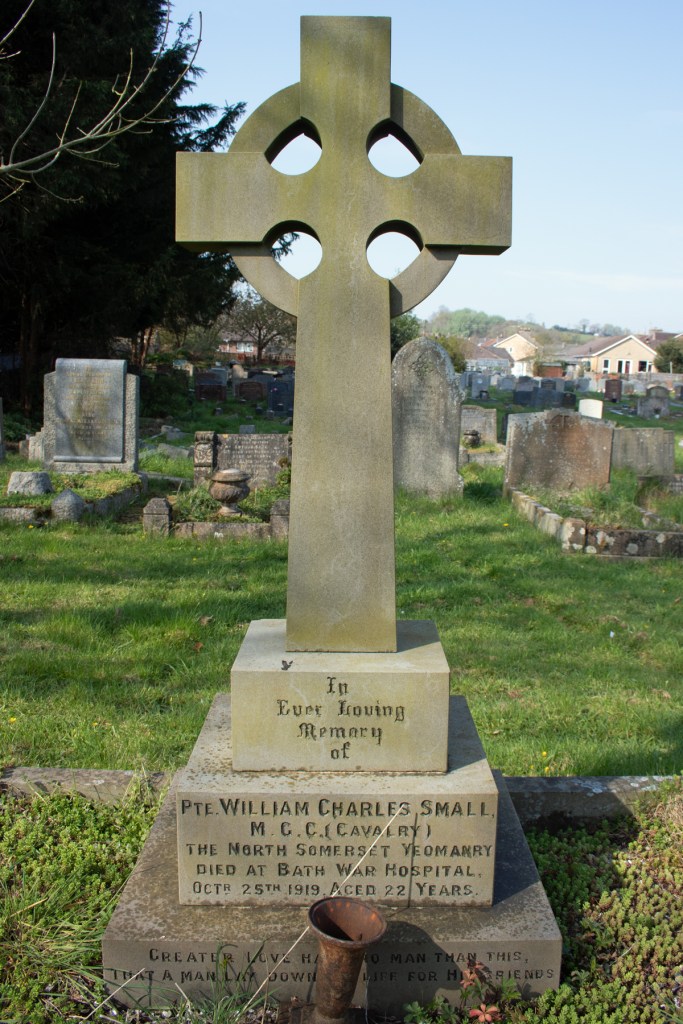
William Charles Small was born towards the end of 1896 in the Somerset town of Midsomer Norton. He was one of six children to coal hewer William George Small and his wife Margaret.

When he left school, William worked for the Co-op store in nearby Radstock, but when war came, he was keen to play his part. His service records are lost to time, but the local newspaper’s report on his funeral in 1919 sheds light on Private Small’s army career:

…he joined the army in May 1915, then being only 18 years of age. He joined the North Somerset Yeomanry and went to France on active service in September the same year, being sent straight to Belgium. There being a shortage of machine gunners, he was transferred to the [Machine Gun Corps], in the 3rd Cavalry Division.

He fought at Peronne, at Cambrai, Arras and Verdun, and other places. His regiment were commended by its General for their bravery in holding back the Germans. He first had leave after one year and eight months’ service in France, and another in August 1918.

He was in the Third Army which stemmed the German attack when they attempted to break through, and fought night and day till they succeeded in holding the enemy back. He had many narrow escapes while in battle, but came through without a scratch.

He was demobilised in January 1919, and was discharged A1, but the strain of 3 years and 6 months of active service proved too much and his health entirely broke down, and he was not able to follow his employment at all. His case was taken up by the military two months ago, and he was sent to Bath War Hospital, where he never recovered from the severe strain…

Somerset Guardian and Radstock Observer: Friday 7th November 1919

Private William Small died in the hospital on 25th October 1919, at the age of just 22 years of age. His body was brought back to Midsomer Norton for burial and he was laid to rest in the family plot in the graveyard of St John the Baptist Church there.


Private William Small
(from britishnewspaperarchive.co.uk)

Private Percy Coward

Private Percy Coward

Percy Herbert Coward was born in the Wiltshire town of Westbury in the autumn of 1896. He was one of seven children – all boys – to Lily Coward and her weaver husband Charles. Not long after Percy was born, the family moved across the county border to Frome, Somerset, presumably for Charles’ work.

By the time of the 1911 census, the Coward family were living in a five-room end-of-terrace cottage on the outskirts of the town. Charles and Percy were both working as warpers – threading looms – in the cloth industry; two of his brothers were working for a printer in the town. Percy was proving himself an integral part of the community.

[Percy] was very highly esteemed by a large circle of acquaintances… He was a worker with the YMCA and Frome Brotherhood, a member of the band and in other directions showed himself a young man of much promise. He was employed successively at Messrs Houston’s [Woollen Mill] and at the Silk Factory.

Somerset Standard: Friday 26th April 1918

An active member of the town’s territorial force, when the Great War broke out he was mobilised. Initially attached to the Royal Army Medical Corps, he subsequently served with the Royal Army Service Corps and the North Staffordshire Regiment, before obtaining his final transfer to the 42nd Company of the Machine Gun Corps.

During his time in the army, Private Coward would have seen action in some of the fiercest battles of the war – at the Somme, Arras and Ypres. In the spring of 1918, his battalion was involved in the Battles of St Quentin and the Avre, and it was during this last skirmish that he was wounded.

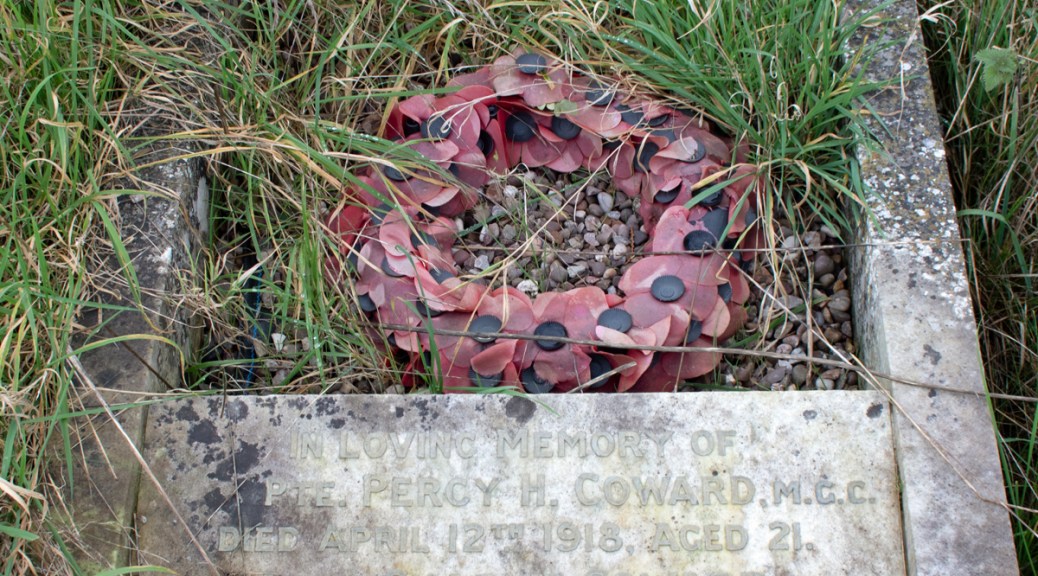
Percy’s injuries were severe enough for him to be medically evacuated back to England and, once there, he was admitted to the Royal Woolwich Hospital in South London. His wounds were to prove too much for him, however, and he passed away at the hospital on 12th April 1918. He was just 21 years of age.

Percy Herbert Coward was brought back to Somerset for burial. He was laid to rest in the Dissenters’ Cemetery, Vallis Road, within walking distance of his family home.


Lieutenant Basil Scott-Holmes

Lieutenant Basil Scott-Holmes

Basil Scott-Holmes was born on 2nd February 1884 in the Somerset village of Wookey. The oldest of two children, his father was Liverpool-born Thomas Scott-Holmes and his wife, Katherine. When Basil was born, Thomas was the vicar of St Matthew’s Church, Wookey, but by 1901, he had risen to the role of clergyman – and subsequently Chancellor – at Wells Cathedral.

Basil’s pedigree stood him in good stead. Initially educated in Llandaff, South Wales, he subsequently attended Sherborne School in Dorset. Sent up to Cambridge, he studied history at Sidney Sussex College.

After leaving university, Basil spent time in Europe learning German and French. He was then assigned the role of Assistant Commissioner in North Nigeria but, after a year there he was invalided home taking up a teaching role at the Bristol Grammar School in 1912.

In July 1913, Basil married Barbara Willey, a surgeon’s daughter from Reigate, Surrey. The marriage record shows that Basil was registrar for an architectural association by this point; the couple went on to have two children, daughters Annette and Prudence.

When the war broke out, he was obviously keen to do his bit. In September 1914 he enlisted in the Royal Army Service Corps, before gaining a commission in the King’s Royal Rifle Corps a couple of months later. In the spring of 1916, Lieutenant Scott-Holmes had been seconded to the Machine Gun Corps, although it is unclear whether he served abroad during any of his time in the army.

On the evening of 24th October 1916, Lieutenant Scott-Holmes was riding in a motorcycle sidecar through central London, on the way back to camp. A local newspaper picked up the story:

…they stopped when going through Wandsworth to re-light the near light, and in the dark a motor omnibus ran into them, and Lieutenant [Scott-Holmes], who was strapped in the side-car, was, with the car, flung across the road. He died as he was being taken to Wandsworth Hospital. At the subsequent inquest, a verdict of “accidental death” was returned.

Central Somerset Gazette: Friday 3rd November 1916

Basil Scott-Holmes was just 32 years old. His body was brought back to Somerset; he was laid to rest in the cemetery at Wells Cathedral.


Larger memorial image loading...
Basil Scott-Holmes
(from ancestry.co.uk)

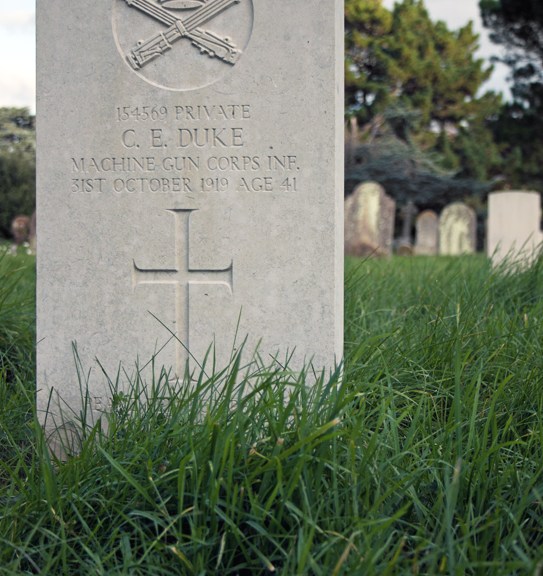
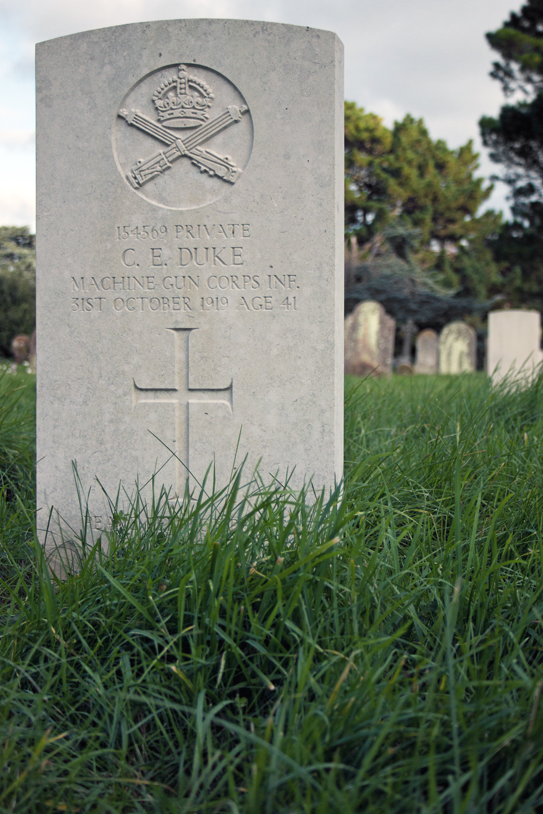
Private Charles Duke

Private Charles Duke

Charles Edward Duke was born in early 1880, the oldest of three children to George and Charlotte Duke. George was a market gardener, but for all of Charles’ childhood censuses – 1881, 1891 and 1901 – his father is absent. Instead, Charlotte is listed as the head of the household, married and working as a launderess. Given that the censuses were all taken in the spring, it is possible that her husband was working away each time the document was recorded, although this is supposition. In every census, though, it is interesting to note that she had taken in lodgers to help pay the bills.

The family lived in Worthing, West Sussex, in a small house near the centre of town. When he left school, Charles found work as an errand boy for a local stationer, before finding more gainful employment as a gardener in one of the multitude of nurseries surrounding the coastal town.

In 1901, Charles married Lucy Barnes, a carter’s daughter from the town; the young couple set up home in Broadwater, to the north of Worthing town centre, and went on to have four children; Alice, Henry, Dorothy and Margaret.

When war arrived on European shores, Charles played his part. Sadly his military records are all but non-existent, but from what remains it’s possible to piece together something of his military life.

Private Duke enlisted in the Machine Gun Corps, and was assigned to the 16th Company. While it is impossible to place him in any specific location, his company was certainly involved in the Battle of the Somme.

Charles survived the war; the next evidence available for him notes that he died on 31st October 1919 in a hospital in Brighton, although o cause is given for his death. The Commonwealth War Graves Commission give his age as 41, although it seems likely he was a couple of years younger than this, based on when his birth was registered.

Charles Edward Duke was buried in the Broadwater Cemetery, a short walk from where his widow and children were living.


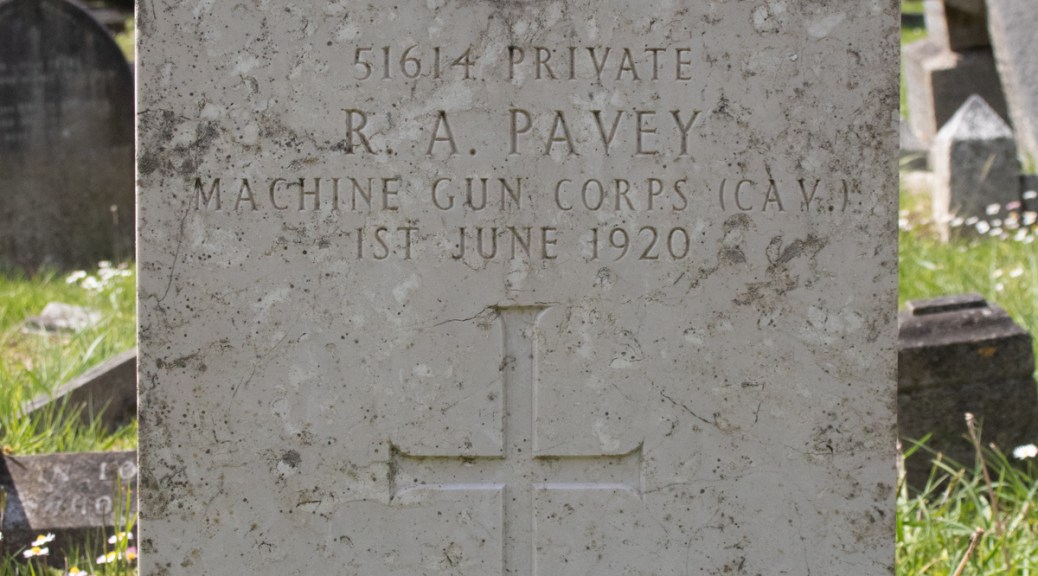
Private Roland Pavey

Private Roland Pavey

Roland Adams Pavey was born in the summer of 1891, the youngest of three children to Anthony Pavey and his wife, Mary. Anthony was a painter, and both he and his wife were born in the Somerset town of Cheddar. Their life took them travelling, though, with their first child, Edward being born in Cheddar, while their middle child, Ada, was born in Oxford, and Roland born in Bath .

Anthony passed away in 1910, leaving Roland living with his widowed mother, earning a living as a draper’s clerk. War was coming, however, and new opportunities lie in store.

Roland enlisted in the army in January 1915. Initially joining the North Somerset Yeomanry, he soon transferred across to the Cavalry Division of the Machine Gun Corps. Sadly, Private Pavey’s military records are lost to time, but he definitely saw action on the Western Front, gaining the Victory and British Medals and the 1915 Star for his efforts.

The next record for Roland comes in the form of a newspaper article from South Wales.

SAD CASE OF NANTYGLO GIRL

Behind the untimely death of Mr Roland A Pavey, a popular young ex-Service man, and secretary of the Weston-super-Mare Federation of Discharged Soldiers and Sailors, lies a pathetic story of the double bereavement of a pretty Welsh girl, Miss Dorothy Morgan of Nantyglo.

Prior to the war, Miss Morgan was engaged to a compatriot of her own, who answered his country’s call and, like so many thousands of others, made the great sacrifice. Time rolled on and the old wound was eventually healed. Then Miss Morgan went on a visit to Weston last year, and there met young Roland Pavey, just demobilised from the Army.

A mutual attraction soon ripened into affection, and the couple became engaged, and they were to have been married towards the end of the present month, but Fate intervened.

Pavey’s long war service impaired his constitution, though how seriously was probably not realised until the damage was done. Returning from a Whitsuntide visit to Exeter, Mr Pavey was so ill that he was compelled to take to his bed. He rapidly became worse, and though his fiancée was hurriedly summoned, he passed away before she arrived at Weston.

Thus, within a short time, Miss Morgan has been twice bereaved as a result of the war.

Merthyr Express: Saturday 12th June 1920

Roland Adams Pavey was just 29 years old when he died. He was laid to rest in the Milton Cemetery in Weston-super-Mare, where his mother then lived.


Sadly, Dorothy Morgan is too common a name in South Wales to confirm much more information on her life. We are unlikely ever to discover if she ever found a lasting love.