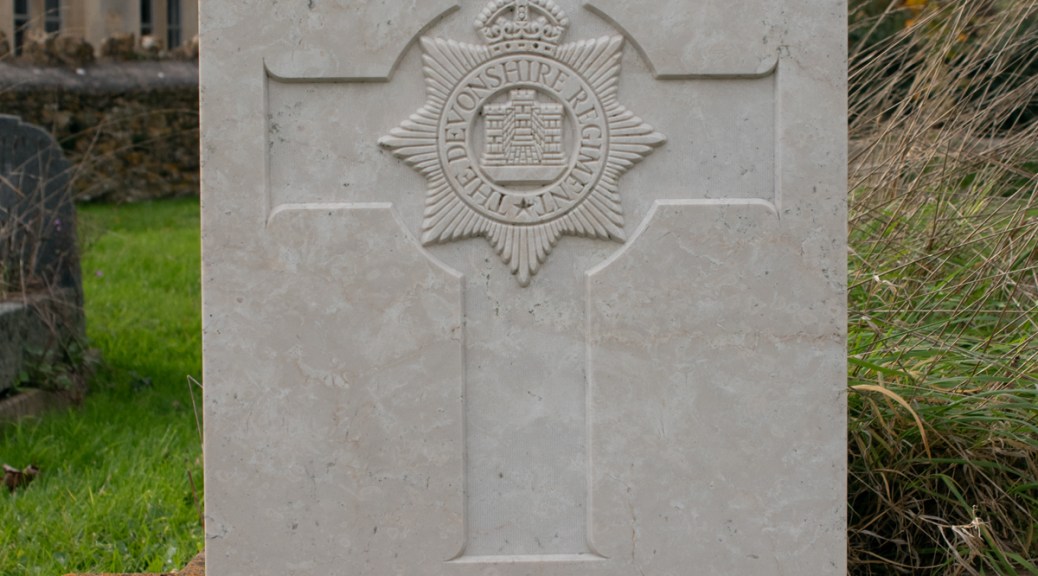
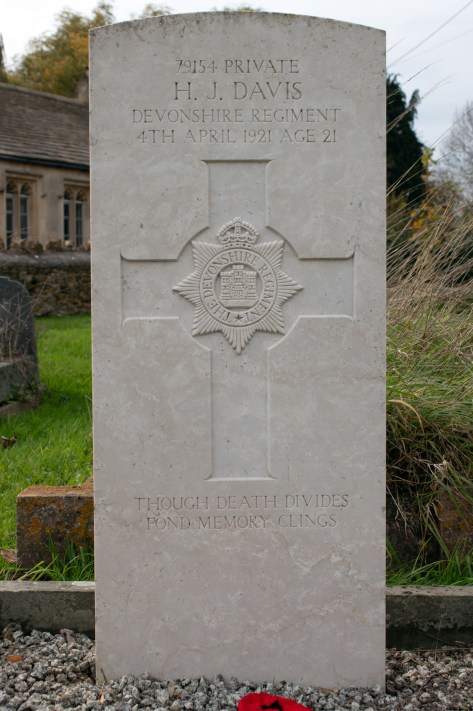
Henry John Davis was born in the village of Broughton Gifford, Wiltshire, in December 1899. The middle of nine children, his parents were John and Annie Davis. John was a cowman, and he worked for the Chalfield estate, not far from the village.
After the 1911 census, Henry’s life is a challenge to piece together. When war broke out, he was too young to serve his country, but it is clear that he enlisted in the Devonshire Regiment at some point. As a Private, he was assigned to the 52nd (Graduated) Battalion, and was based in Norfolk during the second half of the conflict.
By the spring of 1918 Private Davis’ unit was in France, although there is no evidence that Henry was there himself. All that can be confirmed is that he was medically discharged from the army on 26th March 1920, as he was suffering from adenitis, a swelling of the lymph nodes in the abdomen.
Henry John Davis passed away on 4th April 1921, at the age of 21 years old. He seems to have died at home, although the exact cause of his passing is not known. He was laid to rest in Holt Old Cemetery, not far from where his family were living.
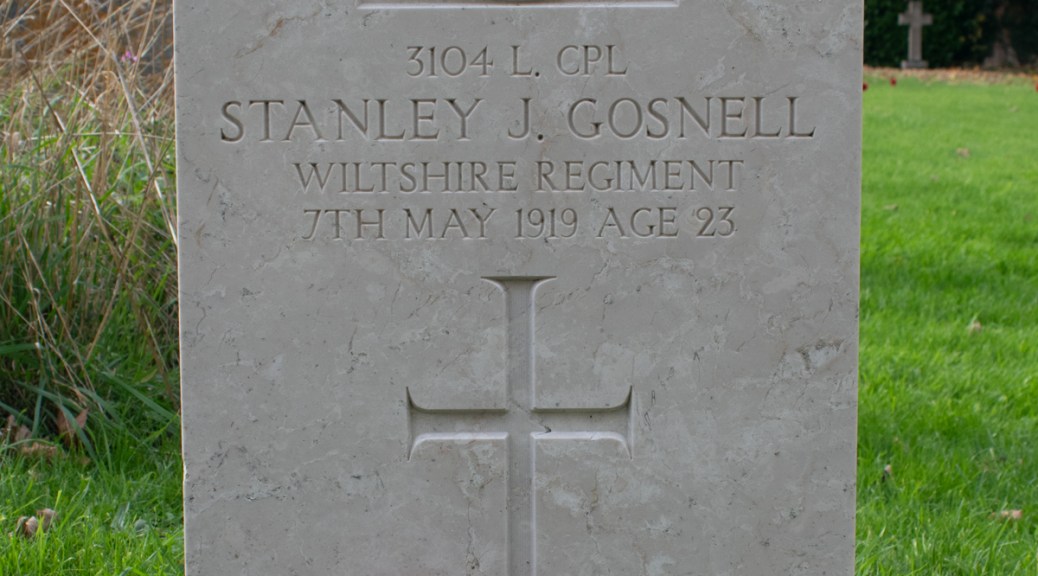
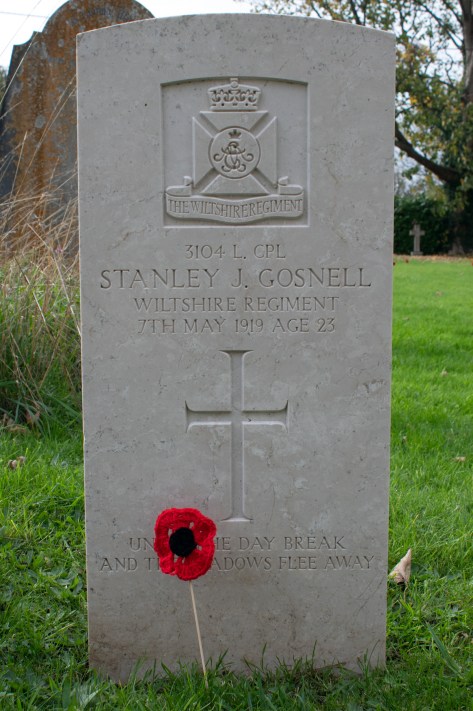
Joseph Roger Stanley Gosnell was born in Birmingham, Warwickshire, in the autumn of 1895. He wad the only child to William and Florence Gosnell. William was a draughtsman, who died when his son was just 4 years old.
Florence was left to raise her son on her own and moved back to Bradford-on-Avon, Wiltshire, where her family lived. On 14th April 1903, she remarried, her new husband being head teacher of Holt Congregational School, John Longstaff. The 1911 census found the family living at Eglington Villa, not far from the school.
When war broke out, Joseph was quick to step up and play his part. Now going by Stanley, he enlisted in the Wiltshire Regiment on 17th September 1914, and was assigned to the 4th Battalion. His service papers show that he was 5ft 11ins (1.8m) tall, with brown hair, blue eyes and a fair complexion. He was noted as having normal vision and good physical development.
Private Gosnell seemed to impress his superiors, and, on 12th December 1914, he was promoted Lance Corporal. The following day his unit was dispatched oversees, and he was sent to India. He would go on to spend the next eight months in Pune, but not in the way he might have hoped.
On 27th February 1915, Stanley was admitted to hospital, suffering from pneumonia. He would remain admitted for nearly three months. Sent back to his unit in mid-May, he was taken back into hospital just three weeks later with tuberculosis. This time, he would only be there for three weeks before being sent back to his unit.
Lance Corporal Gosnell was sent back to Britain in August 1915, and he would remain on home soil for the next year. During this time his health deteriorated, to the point that, no 25th August 1916, he was medically discharged from the army.
At this point, Stanley’s trail goes cold, and it is only a later newspaper report that confirms what happened:
Mrs Longstaff, of Eglington Villa, who a short time since was called upon to mourn the loss of her husband, Mr JC Longstaff, was on Wednesday further bereaved by the death of her only son, Mr Stanley Gosnell. Mr Gosnell’s constitution was never of the most robust kind, and though he volunteered for service and proceeded to India with the Territorials, he was unable to withstand the climate and the work entailed, and was invalided home. His death so soon after reaching manhood’s estate is a heavy blow to his mother and the utmost sympathy will go out to her in her irreparable loss.
[Wiltshire Times and Trowbridge Advertiser: Saturday 10th May 1919]
Details of John’s passing are unclear, but he died just a few months before his stepson. Joseph Roger Stanley Gosnell was just 23 when he died on 7th May 1919. He was laid to rest in Holt Old Cemetery, not far from where his twice-grieving mother lived.
Florence had now been widowed twice, on top of losing her only child. She found some solace in her grief, however, and, in the autumn of 1923, she married for a third time. Her new husband, Joseph Scarisbrick, was a widow thirteen years her senior, and worked as a customs and excise man.
Joseph died in 1938, at the age of 85: Florence had outlived all three of her husbands. She passed away on 4th October 1954, at the age of 88 years old.
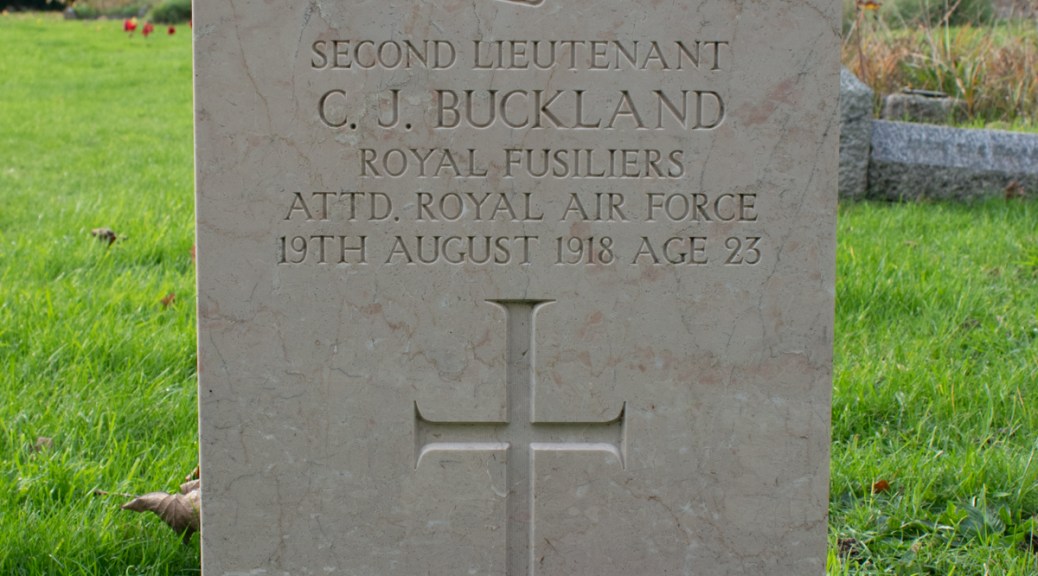
Cecil John Buckland was born on 5th July 1895 in Holloway, Middlesex. The third of four children, his parents were bicycle salesman Arthur Buckland, and his wife, Mary. The 1901 census found the family in rooms at a terraced cottage at 8 Burrard Road, Hampstead.
By 1911, things had changed for the family. They had moved to 73 Finchley Road, which was a ten-roomed property. Arthur was now recorded as being a commercial traveller for a motor company, and they employed a domestic servant, Mary Jones, to help support the family. Cecil had followed in his father’s footsteps and was an apprentice salesman for the same motor company. His older brothers, Arthur Jr an Harold, were also working as salesmen in the same business.
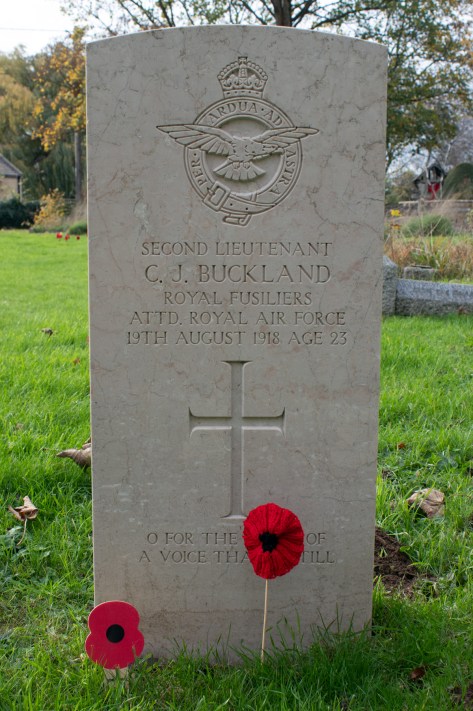
When war broke out, Cecil was called upon to play his part. Full service details have been lost to time, but it seems that he initially joined the Royal Fusiliers, and was attached to the 5th Battalion. It isn’t clear where or when he served, but by the spring of 1918 – just weeks after its formation – he gained a commission in the Royal Air Force.
Second Lieutenant Buckland was stationed at 44 Training Depot Station at Holt Airfield in Wiltshire, and it was here that he learnt the ropes using a Bristol F.2b Fighter. On the 19th August 1918, Cecil took off on a practice flight. Shortly after take-off, he attempted to turn the aircraft and got into a spin as too low height to recover. The aeroplane crashed to the ground, and he was killed instantly: he was just 23 years of age.
The body of Cecil John Buckland was laid to rest in Holt Old Cemetery, not far from the airfield at which he had been based.
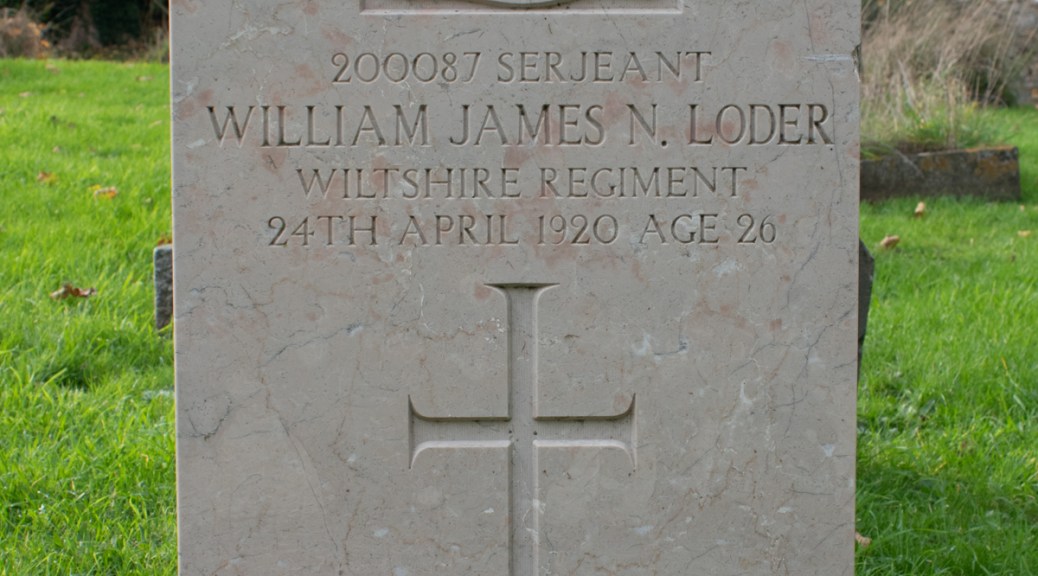
William James Nelson Loder was born in the summer of 1893 in Trowbridge, Wiltshire. The oldest of seven children, his parents were Harry and Rosina. Harry was an engineer at a wool mill, and his son obviously followed in his father’s practical footsteps: the 1911 census found him employed as a coach builder’s apprentice.
The document found the Loder family living at 1 Canal Road, a five-roomed cottage on the outskirts of town. Alongside Harry and his son, William’s younger sister, Ethel was also working as an apprentice dress maker.
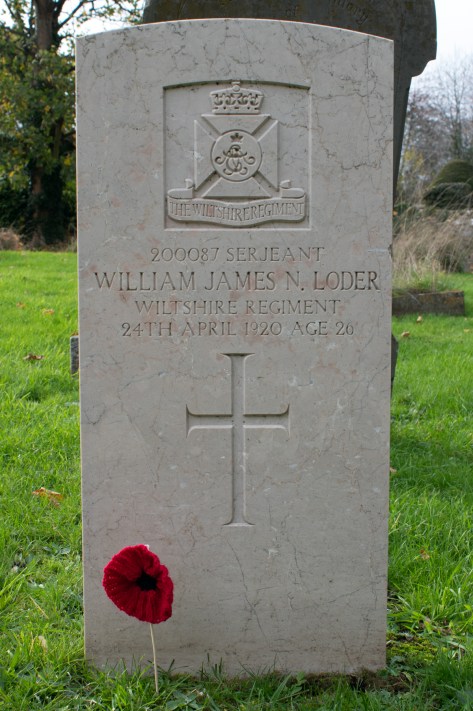
Away from work, it seems that William also joined the local militia, with a later document showing that he enlisted in the Wiltshire Regiment on 4th February 1909. When war broke out, he was called upon to play his part. He was assigned to the 4th Battalion, and was sent to India in September 1914. While his service papers have been lost to time, it is clear that he rose to the rank of Serjeant, but by the start of 1917, he was back in Britain.
On 27th January 1917, William married Angelin Gliddon. She was a coachman’s daughter from Holt, Wiltshire, and was working as a draper’s assistant when she and her husband exchanged vows.
William’s health was failing by this point and, on 21st May 1917, he was formally discharged from the army on medical grounds. His trail goes cold as this point, and it is only three years later that documents confirm his passing. He died on 24th April 1920 at the age of 26 years old.
The body of William James Nelson Loder was laid to rest in Holt Old Cemetery, not far from where his grieving wife still lived.
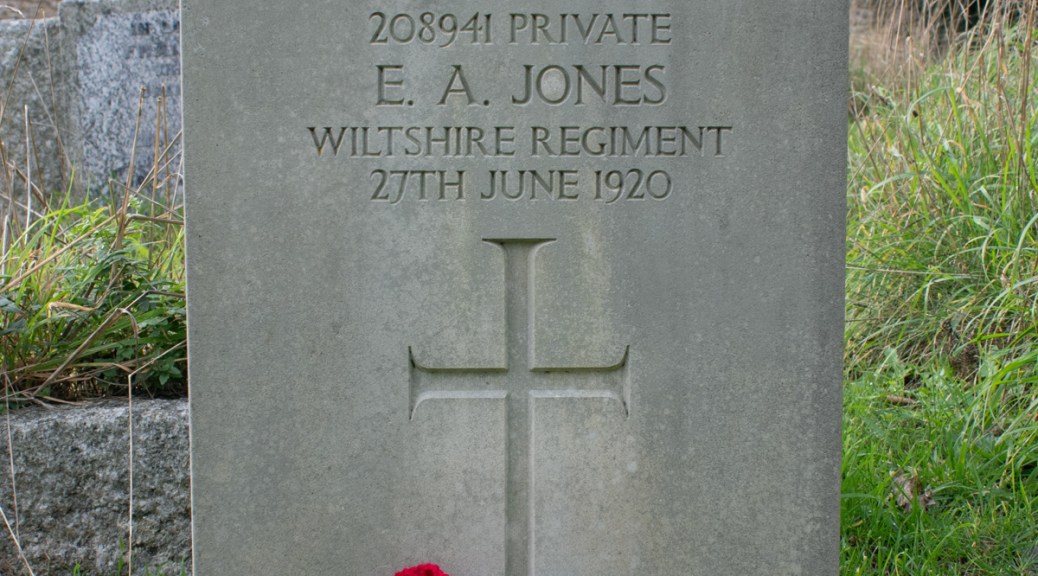
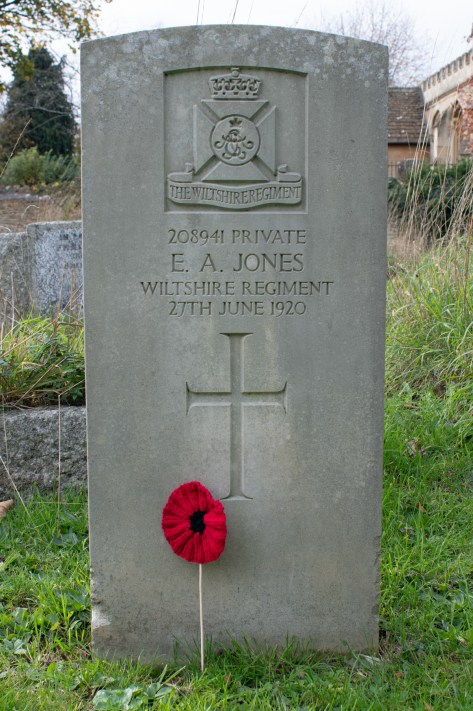
Ernest Albert Jones was born in the spring of 1878. The sixth of seven children, he wad the youngest son to Thomas and Maria Jones. Thomas was an agricultural labourer, and the family lived in a cottage on The Rank in the Wiltshire village of Holt.
Ernest found work as a gardener’s assistant when he completed his schooling, but, by the time of the 1911 census, he was employed as a leather dresser for a local fellmonger. According to the document, he was the only one of the Jones children to still be living at home, bringing in money to support his parents.
Maria died in the spring of 1911, and it is likely that Ernest remained at home to support his father. When war broke out, he stepped up to serve his country and, although his service papers have been lost to time, the documents that remain suggest he joined the Royal Warwickshire Regiment. He wasn’t with them for long, however, as he transferred to the Wiltshire Regiment.
It is unclear where or how Private Jones served. He was attached to the 6th (Royal Wiltshire Yeomanry) Battalion, who served on the Western Front from 1915 onwards, but nothing in Ernest’s remaining records suggest he spent any time overseas.
Ernest survived the war, and returned to the family home. He passed away on 27th June 1920, through causes unknown, at the age of 42.
The body of Ernest Albert Jones was laid to rest in Hold Old Cemetery, not far from the home in which his family had lived for more than four decades.
Thomas passed away nearly two years after his son, at the age of 87 years old. By this point, his granddaughter, Nellie, had moved in to look after him: it was she who Ernest had nominated as his next of kin.
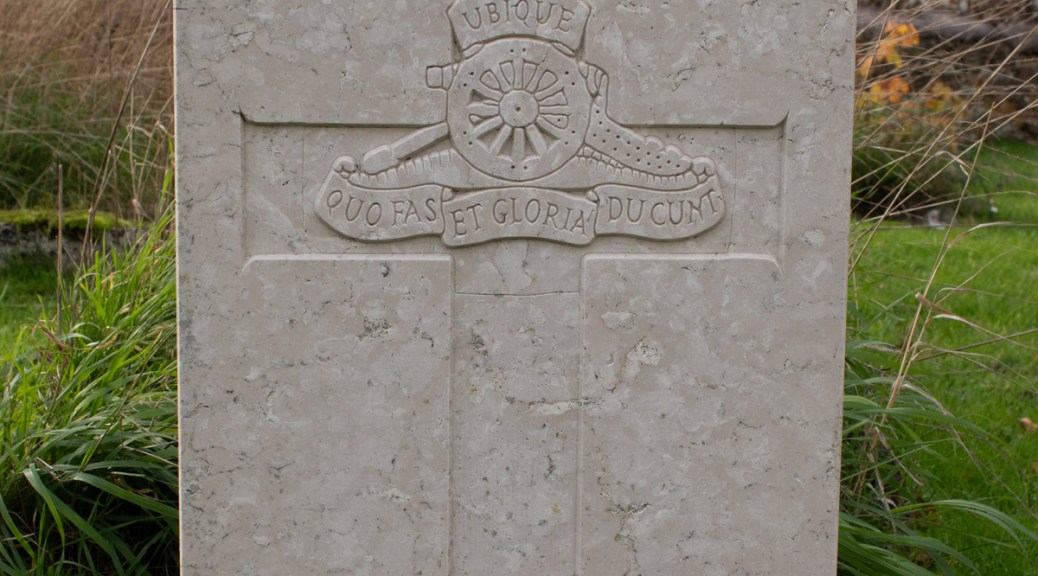
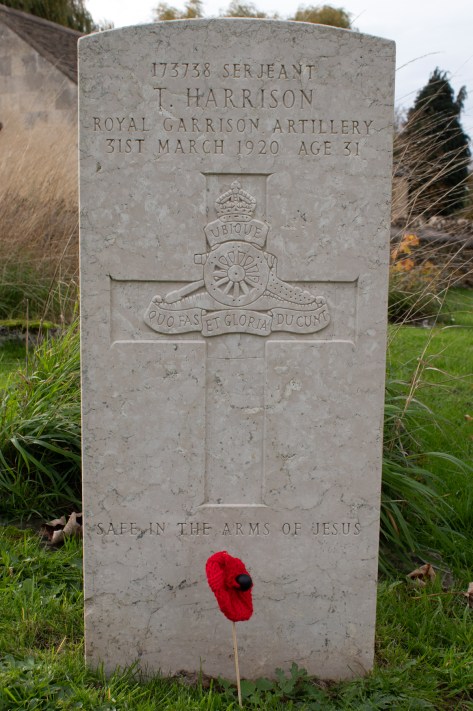
The life of Thomas Harrison, buried in Holt Old Cemetery, Wiltshire, is a challenge to unpick. No service papers remain, but the Commonwealth War Graves Commission note that he was married to Annie Harrison, who lived in Trowbridge, Wiltshire.
The couple do not appear together in the 1911 census, so it is likely that they exchanged vows after this date. There is a Thomas Harrison recorded in the return: he was an Acting Bombardier in the Royal Horse Artillery, billeted in the barracks in Trowbridge. It is likely that he is the gentleman buried in Holt Cemetery, but it cannot be confirmed either way.
Acting Bombardier Harrison was born in Motherwell, Lanarkshire, in around 1889, but his name is not uncommon, so it is not possible to identify his parents or early life.
Thomas served during the First World War, rising to the rank of Serjeant in the Anti-Aircraft Depot of the Royal Garrison Artillery. He and Annie had two children: Vera, who was born in 1912, and Ivy, who was four years younger.
When the Armistice was declared, Serjeant Harrison returned home, but, in the spring of 1920, he suffered a bout of gastritis. The condition was to prove fatal, and he passed away on 31st March 1920. He was 31 years of age.
The body of Thomas Harrison was laid to rest in Holt Old Cemetery, not far from where Annie and the girls lived.
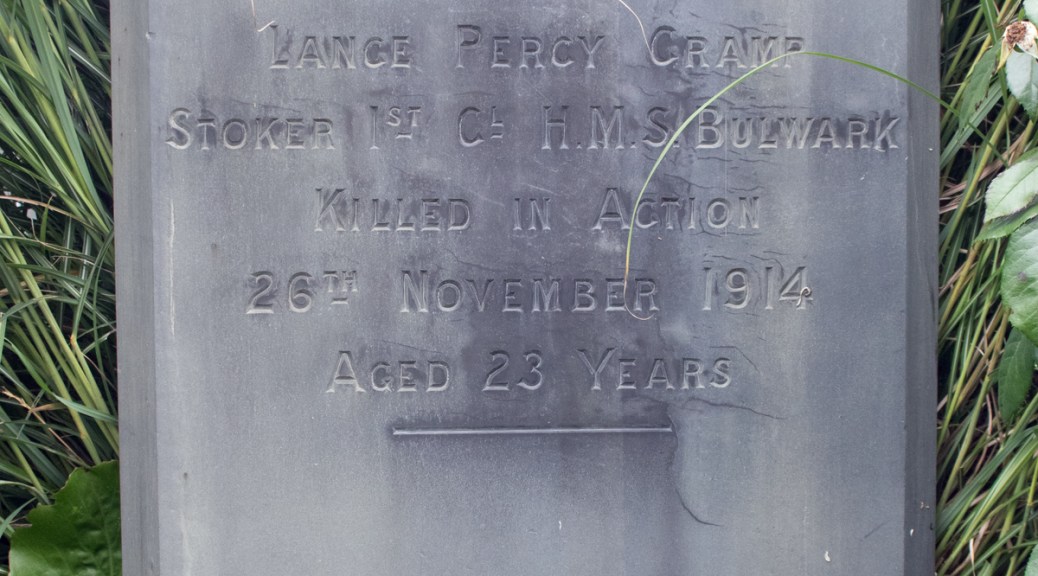
Lancelot Percival Cramp was born in the Kent village of Sutton on 7th June 1891. The youngest of five children, his parents were bootmaker Alfred Cramp and his wife Elizabeth.
Lancelot – who preferred to be called Lance – seems to have had a disjointed childhood. Neither of his parents are recorded in the 1901 census, while he is noted as living with his widowed aunt, also called Elizabeth, in Ticehurst, Kent.
By the time he completed his schooling, Lance found work as a tinsmith. However, he sought a bigger and better career and, on 30th April 1910, he enlisted in the Royal Navy. Assigned the role of Stoker 2nd Class, his papers note that he was 5ft 3ins (1.6m) tall, with auburn hair, grey eyes and a fresh complexion.
Stoker Cramp was sent to HMS Victory, the Royal Naval Dockyard in Chatham, Kent, for his training. He was then sent to the battleship HMS Renown for his first assignment.
Over the next four years, Lance would serve on seven ships in total, returning to Portsmouth in between assignments. His service record notes a very good character and satisfactory ability and, in September 1911, he was promoted to Stoker 1st Class.
On 8 February 1914, Lance was given a new posting aboard the battleship HMS Bulwark. When war broke out, she was assigned to the Channel Fleet, which had the responsibility for patrolling and protecting Britain’s southern coastline.
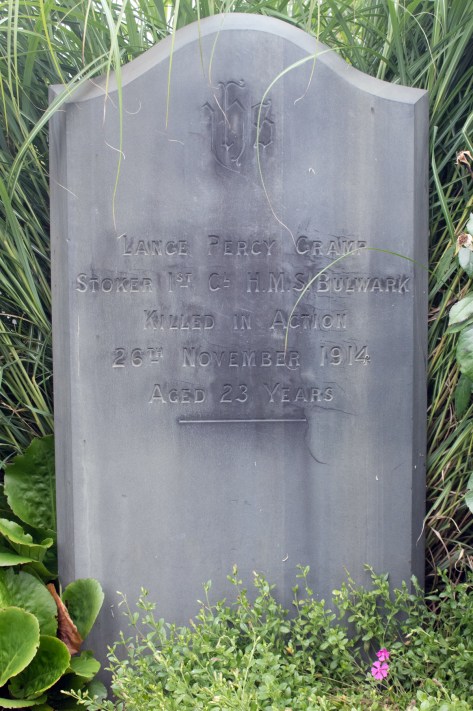
On the morning of 26 November 1914, Bulwark lay anchored in the River Medway near Sheerness while taking on shells and ammunition. During the process, improperly stored cordite charges overheated and ignited nearby munitions. The massive explosion that followed tore the ship apart, killing more than 740 members of the crew. Stoker Lance Cramp was amongst those who died: he was 23 years of age.
Those who were killed in the explosion were buried in the naval section of Woodlands Cemetery, Gillingham, Kent. The body of Lancelot Percival Cramp was identified, and laid to rest in a marked grave.
William Ernest Gubbey was born on 21st February 1896 in Portsmouth, Hampshire. He was the only child to William and Alice Gubbey. William Sr was a Petty Officer in the Coastguard, and the family travelled to where he was needed. The 1901 census found them in Malinmore, County Donegal, while ten years later, they were living in Tara, County Down.
It seemed natural for William Jr to follow in his father’s footsteps and, on 3rd August 1912, he joined the Royal Navy. He was too young to formally enlist, and was given the rank of Boy 2nd Class. Sent to HMS Impregnable, the school ship based in Devonport, she would remain his home for the next ten months while he was trained.
William was promoted to Boy 1st Class on 17th June 1913, and was assigned to the cruiser HMS Gibraltar the following day. After six months on board, and a short stopover at HMS Victory, the Royal Naval Dockyard in Portsmouth, Hampshire, he received his next posting, the battleship HMS Bulwark.
Boy Gubbey would spend the next year attached to Bulwark and, during this time, he came of age. Now formally inducted into the navy as an Ordinary Seaman, his service papers show the young man he had become. He was recorded as being 5ft 5.5ins (1.66m) tall, with brown hair, blue eyes and a dark complexion.
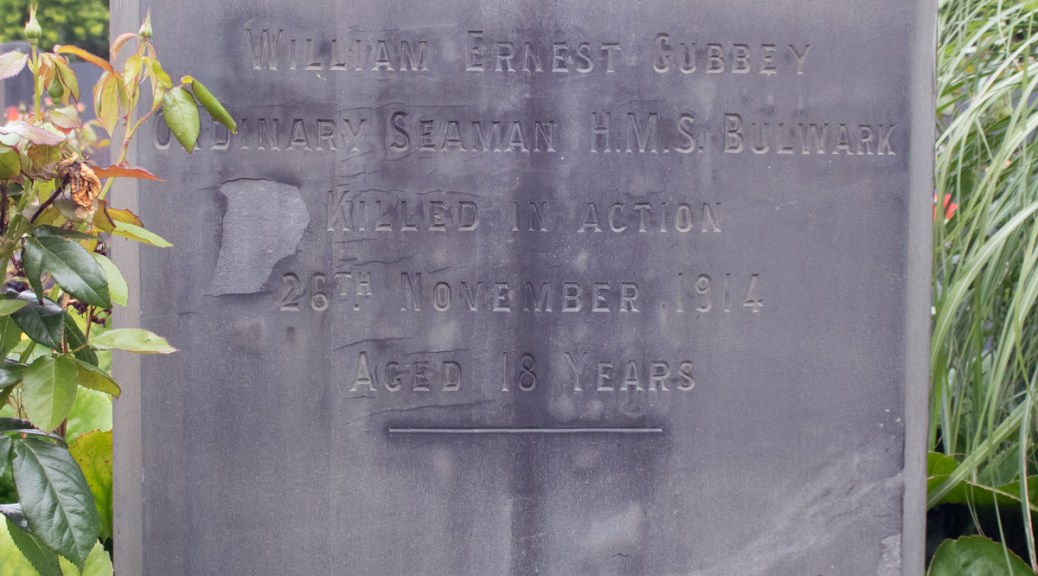
When was was declared in the summer of 1914, Bulwark was assigned to the Channel Fleet, patrolling and defending Britain’s southern coast. On 26th November 1914, she was moored in the River Medway, close to Sheerness, Kent, being reloaded with ammunition.
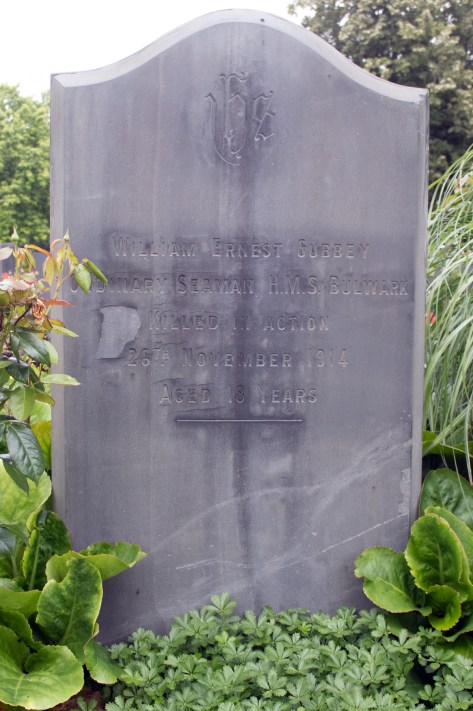
Some of the new cargo overheated and the resulting explosion ripped through the battleship. More than 740 crew were killed, including Ordinary Seaman Gubbey: he was just 18 years of age.
The bodes of the dead were laid to rest in Woodlands Cemetery, Gillingham, Kent. As his had been identified, William Ernest Gubbey was laid to rest in a marked grave.
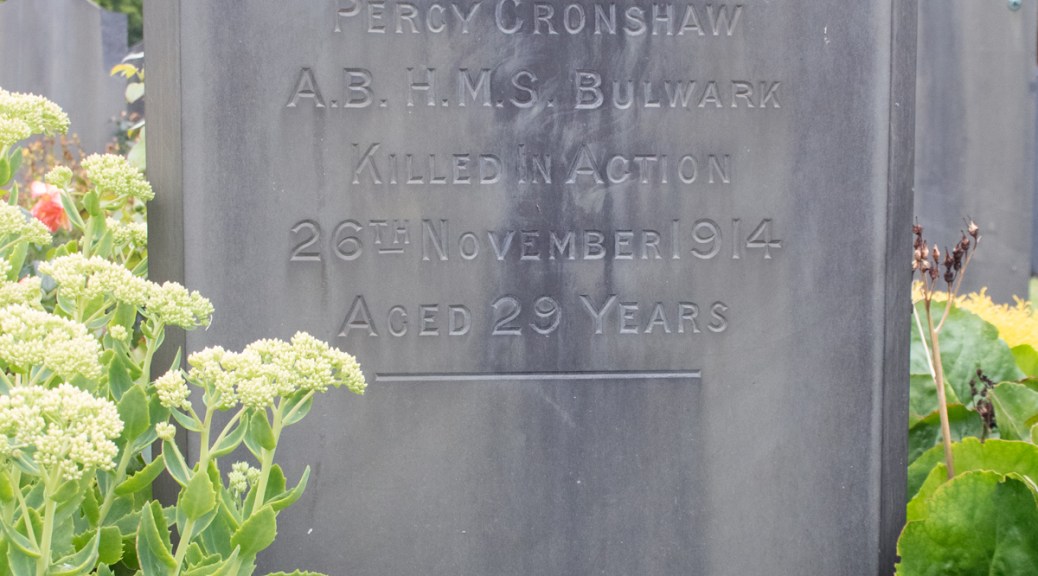
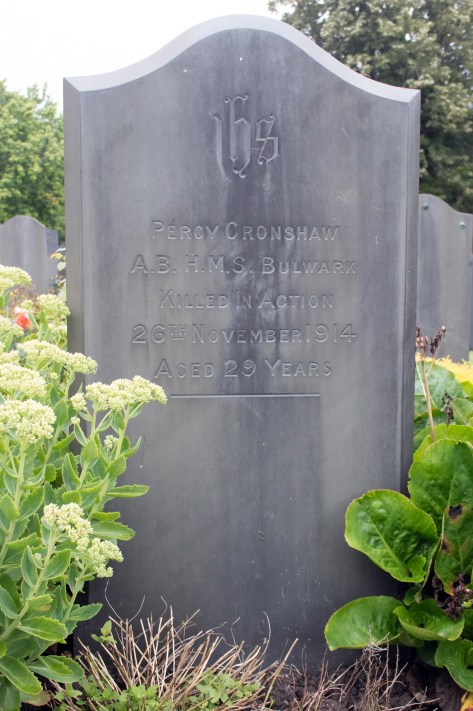
Percy Cronshaw was born in Ashton-under-Lyne, Lancashire, on 10th January 1885. The second of five children, he was the oldest son to Thomas and Alice Cronshaw. Thomas was a loom overseer in a local mill, and when Percy completed his schooling, he found work as a calico weaver. Alice had died by the time of the 1901 census, and the family has moved to a cottage on Loxham Street in Bolton.
Percy wanted a better life for himself and, on 12th February 1902, he joined in the Royal Navy. Too young to fully enlist, he was given the rank of Boy 2nd Class, and sent to HMS Northampton for his training. Over the next year he learnt the tools of his trade, rising to Boy 1st Class after just three months.
By the time of Percy’s eighteenth birthday, he had had three further postings: the shore bases HMS Calliope in Gateshead and HMS Victory in Portsmouth; and the cruiser HMS Good Hope. It was with her that he came of age, and was in a position to formally enlist in the Royal Navy.
The now Ordinary Seaman Cronshaw’s papers show the man he had become. He was 5ft 4.5ins (1.64m) tall, with auburn hair, black eyes and a fresh complexion. He was also noted as having moles on the right side of his face and neck, and two tattoos: his initials on his right forearm, and an anchor on his left.
Percy remained aboard HMS Good Hope until the spring of 1905. By this point, he had been promoted, taking the rank of Able Seaman. With his promotion came more training, and he spent the next year split between HMS Victory and HMS Excellent, another shore base in Portsmouth. His annual reviews noted a very good character and an ability to match.
Over the next seven years, Able Seaman Cronshaw would go on to serve on two further ships – HMS Venus and HMS Superb. In between voyages he returned to Portsmouth, with HMS Excellent becoming his home port. This land base offered some continuity, and the unexpected bonus of romance. On 28th January 1912, Percy married Frances Stubbington, a shoemaker’s daughter from the city: the couple would go on to have a child, Violet, who was born later that year.
By this point, Percy had been given a new posting, on board the battleship HMS Bulwark. When war was declared, she became a part of the Channel Fleet, tasked with patrolling and defending Britain’s southern coast.
On 26th November 1914, Bulwark was moored in the River Medway, close to Sheerness, and was being stocked with shells and ammunition. That morning, some poorly stowed charges overheated, detonating the shells stored nearby. The resulting explosion ripped through the battleship, and more than 740 crew were killed. Able Seaman Cronshaw was among those to be recovered: he was 29 years of age.
Percy Cronshaw’s body as laid to rest alongside his colleagues in Woodlands Cemetery, Gillingham, Kent. As his body had been identified, he was able to be buried in a marked grave.
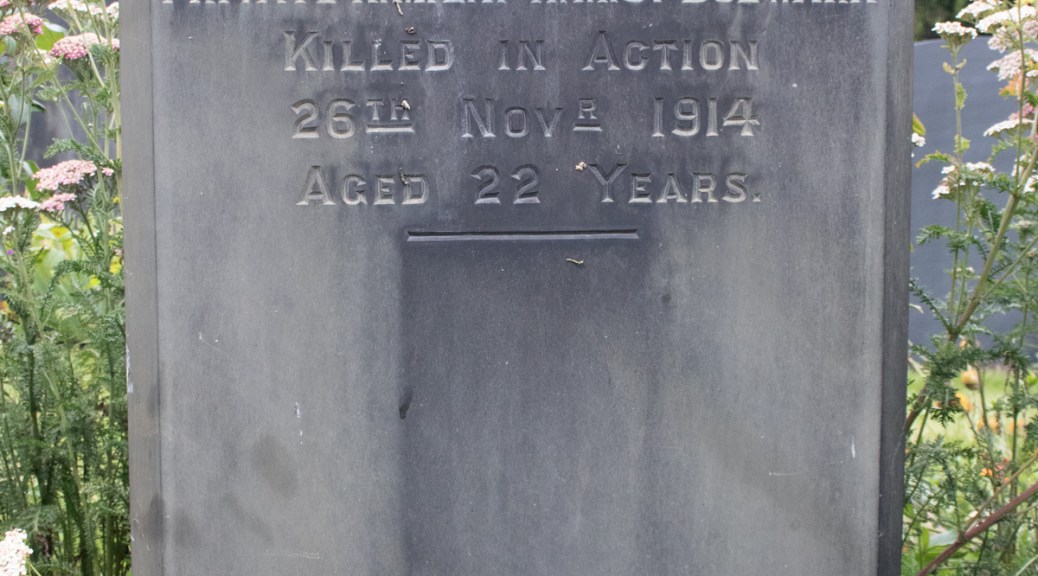
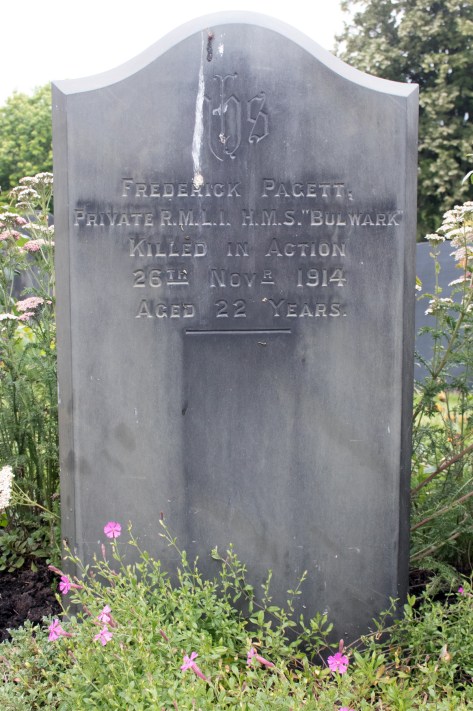
Frederick Pagett was born in the Worcestershire village of Hanley Castle on 27th July 1892. The seventh of eight children, he was the youngest son to Samuel and Ann Pagett.
Samuel was a policeman, but when he completed his schooling, Frederick found work as a miner. This seemed not to suit him, however, and, on 20th December 1910, he enlisted in the Royal Marine Light Infantry.
Private Pagett’s service records show that he was 5ft 4.5ins tall, and that he had brown hair, blue eyes and a fresh complexion. He had two small scars on his upper lip, and was noted as being able to swim.
Frederick was sent to Deal in Kent for his training. Over the next couple of years, he learnt his trade, and would serve in the Hampshire towns of Gosport and Portsmouth. His papers noted a very good character.
On 12th June 1912, Private Pagett was assigned to the battleship HMS Bulwark. He would remain part of her crew for the next couple of years.
On the 26th November 1914, when Bulwark was moored close to Sheerness, Kent, an explosion ripped through the ship, sinking it and killing more than 740 people. Frederick was on board at the time, and was amongst those to be killed: he just was 22 years of age.
The body of Frederick Pagett was laid to rest in a marked grave in the naval section of Woodlands Cemetery, Gillingham, Kent.

 Death and Service