Albert Arthur Harris was born on 14th December 1893 in Huon, Tasmania, Australia. The second of seven children – and the oldest son – his parents were Arthur and Eliza.
There is little information available about Albert’s early life. When he finished his schooling, he found work as an orchardist, and this was his line of work when, on 12th April 1916, he stepped up to serve his King and Empire.
Albert joined the Australian Imperial Force, and his records suggest that he had tried to enlist before, but had been turned down because of varicose veins. His medical report confirms that he was 6ft (1.83m) tall and weighed 155lbs (70.3kg). He had fair hair, blue eyes and a fair complexion.
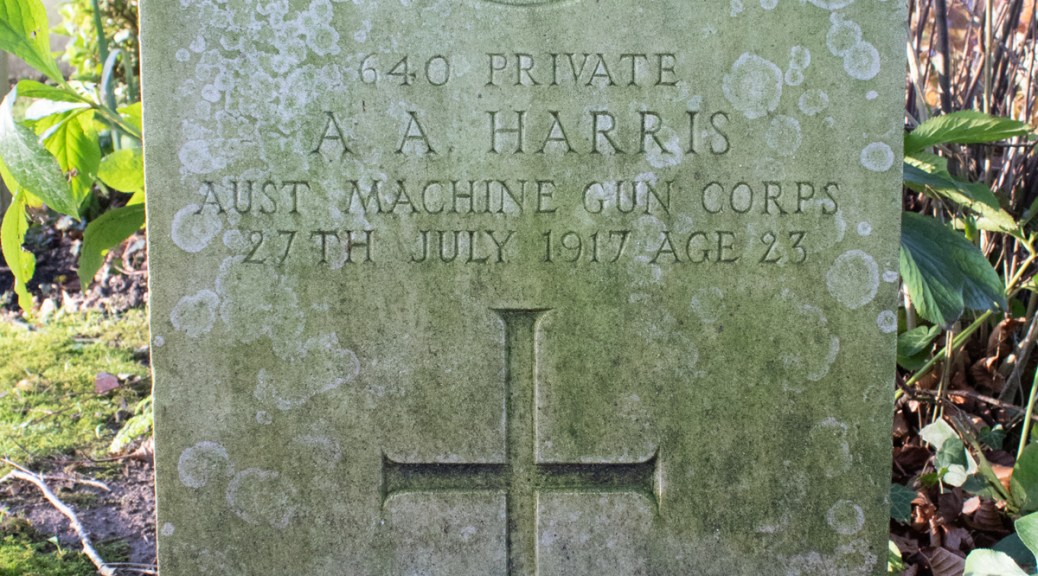
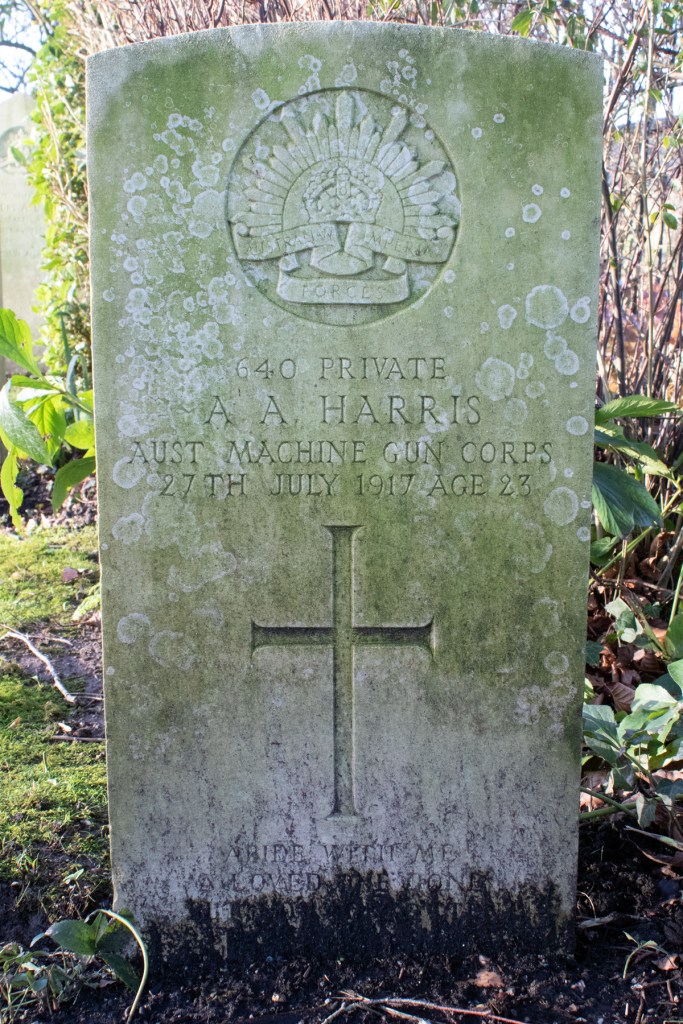
Private Harris set sail from Australia on 11th May 1917, arriving in Plymouth, Devon, two months later. He was billeted near Codford in Wiltshire, and assigned to the Australian Machine Gun Corps.
Albert’s time in Britain was to be brief. While in camp, he came down with peritonitis, and hospitalised. He developed septicaemia, and died on 27th July 1917: he was just 23 years of age.
Albert Arthur Harris was laid to rest in the newly extended graveyard of St Mary’s Church in Codford.
Harry David Fletcher was born in Leichhardt, New South Wales, Australia, on 1st November 1883. The seventh of ten children – and the only surviving son – his parents were Daniel and Charlotte Fletcher.
There is little information about Harry’s early life: he found work as a labourer when he finished school and, on 11th March 1911, he married Lillian Bosworth. The couple went on to have a son, Harold, who was born the following February.
When war came to Europe, the British Empire was called upon to play its part. On 19th February 1917, Harry enlisted in the Australian Infantry, although he did so under the alias of Harry Conway. His service records show that he had dark brown hair, hazel eyes and a medium complexion. He was also 5ft 7.75ins (1.72m) tall and weighed 140lbs (63.5kg). He had two noticeable scars: one on the inside of his right arm, the other on his right shin.
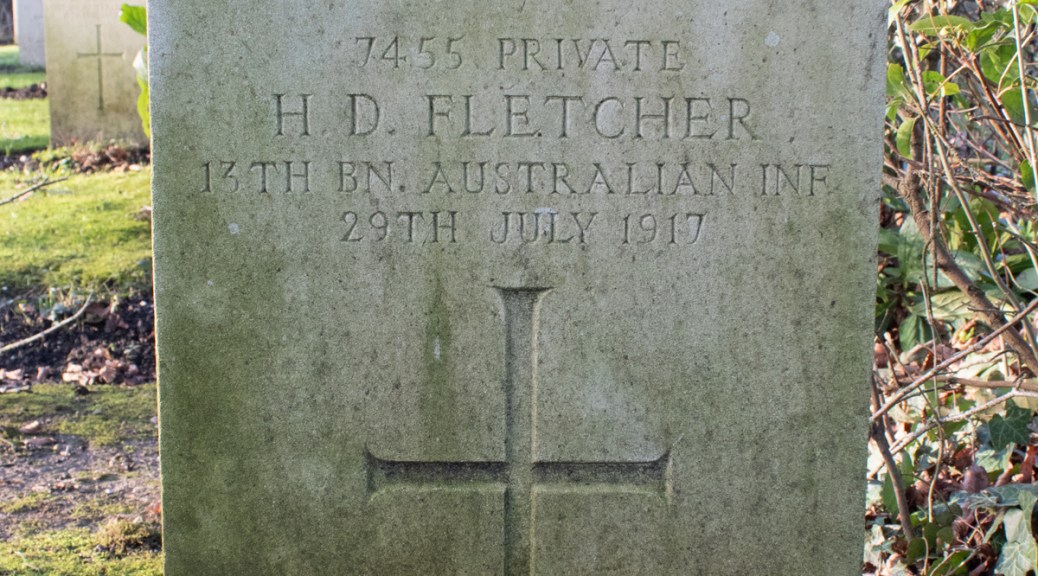
Private Conway/Fletcher set sail for Europe on 10th May 1917, arriving in Britain two months later. His unit – the 13th Battalion – was billeted in Wiltshire, near the village of Codford. Tragically, his time in the army was to be brief: he suffered issues with his gallbladder, and died in the camp hospital from cholecystitis and septicaemia on 29th July 1917. He was 33 years of age.
Harry David Fletcher was laid to rest in the Australian section of the new churchyard of St Mary’s Church in Codford. His burial records note that the service was officiated by Chaplain Captain Collins, with six of his friends from the battalion acting as pallbearers. He was buried in an elm and brass coffin, with a small oak cross being erected over the grave.
Albert Jenner was born on 27th April 1887 in the Kent village of Hollingbourne. He was one of nine children to scaffolder and builder’s labourer Thomas Jenner and his wife, Emma.
By the time of the 1911 census, Albert was living with his parents and three of his siblings in a house on Well Street in Loose, near Maidstone. He was employed as a bricklayer’s labourer, while his brothers and father were all doing farm work.
At this point, Albert’s trail goes cold. It is clear that, when war was declared, he enlisted in the Royal Naval Air Service, although the specific dates are unknown. His younger brother Private Arthur Jenner, of the 6th Battalion of the Queen’s Own (Royal West Kent) Regiment died in northern France in July 1916, but it is unclear whether Albert had already stepped up to serve by this point.
Second Aircraftman Jenner was based at the Kingsnorth Air Base, on the Hoo Peninsula in Kent. This was a Royal Naval Air Service training station, which also experimented with air ships. There is little to document Albert’s time there, however, and, given his rank, it is likely that he was not there for very long.
The only other document directly connected to Albert confirms his passing. He died at the base on 3rd April 1917, having contracted measles, which escalated into pyaemia, or sepsis. He was a few days away from his 30th birthday.
Albert Jenner was laid to rest in the Woodlands Cemetery, in Gillingham, Kent.
Robert Edwin Dawe Pollard was born on 8th April 1894 in Bath, Somerset. The youngest of three children, his parents were Joseph and Elizabeth Pollard. Joseph was a gardener from Banwell, but it seems that Robert had his sights on bigger and better things.
At some point Robert emigrated to Canada, and, by the time war was declared in Europe, he was working as an insurance clerk in Winnipeg. He felt a duty to serve his country, however, and on 2nd August 1915, he enlisted in the Canadian Expeditionary Force.
Private Pollard’s service records confirm he was 5ft 6ins (1.69m) tall, with dark brown hair, brown eyes and a fair complexion. He was also noted as being a Presbyterian.
Robert’s commitment to the cause is underlined by his rise through the ranks. Attached to to the 8th Battalion of the Canadian Infantry (also known as the 90th Winnipeg Rifles), he arrived in France on 27th February 1916.
The 8th Battalion was involved in some of the fiercest fighting of the war, and, on the 1st June 1916, he was wounded in his left arm. Admitted to a hospital in Camiers, he was moved to Etaples, before returning to his unit before the month was out.
For good or for bad, this was just before the Battle of the Somme and, over the next few months, Private Pollard fought bravely and hard. Moving from the Somme, his unit fought at Passchendaele and Ypres. On 1st October 1916, Robert was promoted to Corporal, and made Sergeant just three months later.
In April 1917, Robert was admitted to hospital again, this time with an infected foot. Within six weeks he was back with his unit, though, and on 7th November 1917, he was promoted to Company Serjeant Major. He was obviously good at what he did, and this was recognised. On 28th December 1917, he was mentioned in despatches, and the following June he was awarded the Meritorious Service Medal.
As the war entered its closing months, Company Serjeant Major Pollard, still led from the front. He returned to Britain at the end of November 1918, and was attached to the 18th Reserve Battalion in Seaford, Sussex ahead of being demobbed.
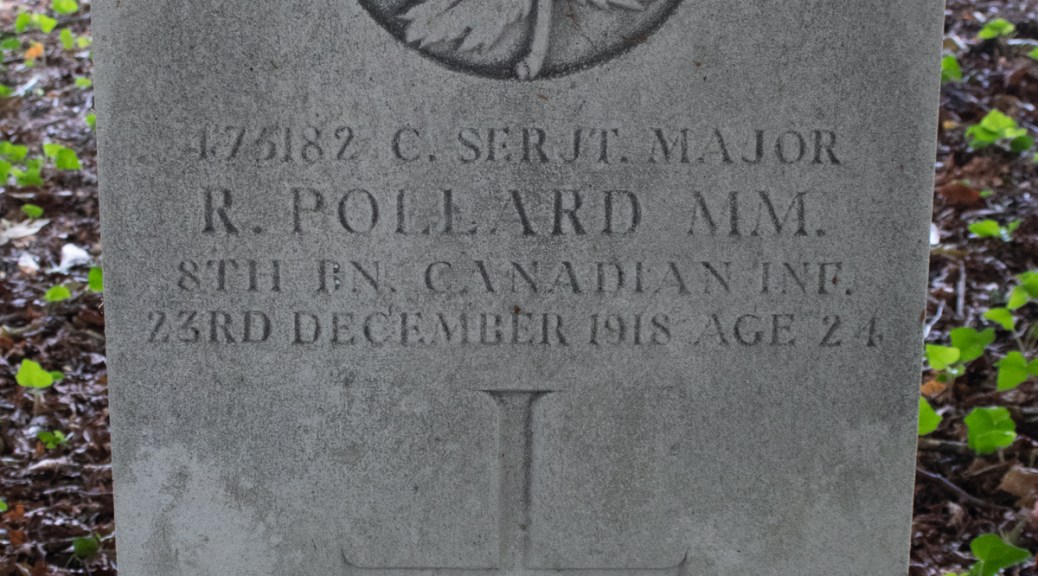
It was here that Robert contracted influenza. Whether at his family’s request is unclear, but he was admitted to Bath War Hospital for treatment but, after everything that he had been through, it was a combination of the flu and toxaemia, or blood poisoning, that was to prove his undoing. Company Serjeant Major Pollard died on 23rd December 1918, aged just 24 years old. His mother, Elizabeth was by his side.
Robert Edwin Dawe Pollard was laid to rest Bath’s sweeping Locksbrook Cemetery, not far from where his family lived. His headstone recognises the Military Medal he was posthumously awarded.
Company Serjeant Major Robert Pollard (from findagrave.com)
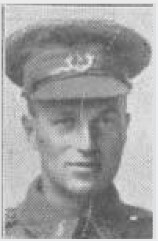
Conrad Thomas Bedford was born on 8th August 1891 in Bowes Park, Middlesex. The younger of two children, his parents were Thomas and Clara Bedford. Thomas was a bank clerk, who had a strong focus on education and, after his untimely death in 1899, aged just 40, Clara was keen to ensure that her only son received the best.
Conrad was educated at Seaford College in Sussex, and was boarding there at the time of the 1901 census. Whilst there, he served in the College Cadet Corps, which was attached to the Royal Sussex Engineers, and by the time he left, in 1909, he had taken the rank of Corporal.
When he completed his schooling, Conrad found work as a clerk in the London Joint Stock Bank, and soon volunteered for the London Rifle Brigade. When war broke out, he willingly stepped up to serve his country, and became attached to the regiment’s 5th Battalion.
The 1/5th (City of London) Battalion (London Rifle Brigade), to give the London Regiment’s unit it’s full title, fought on the Western Front, and Rifleman Bedford arrived in the Wallonia region of Belgium on 4th November 1914.
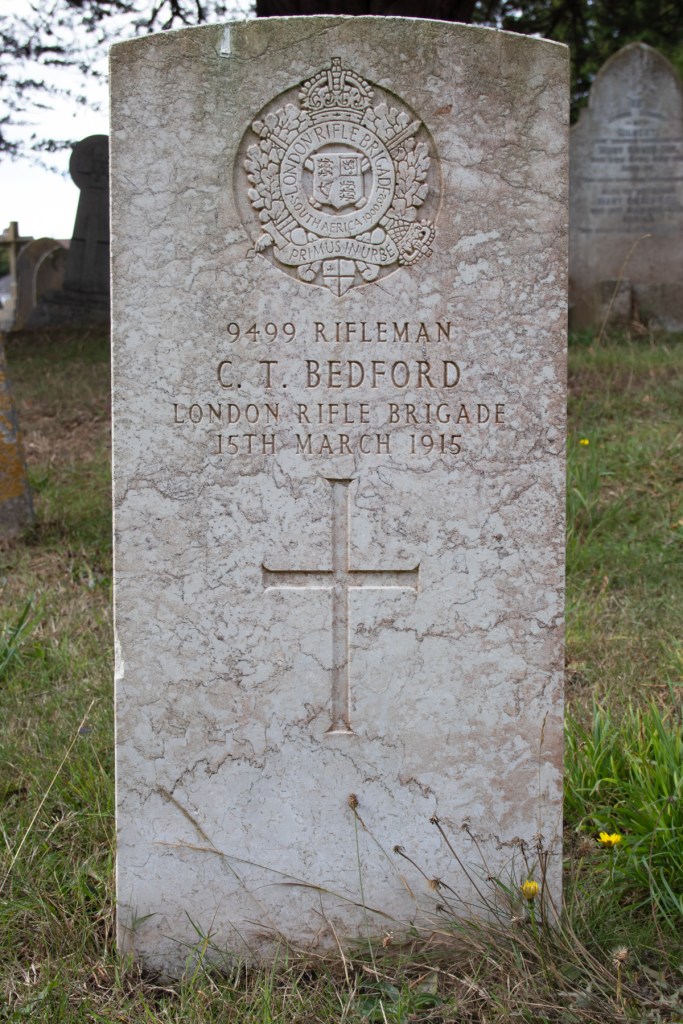
Early in 1915, Conrad was based near Ploegsteert, when, at around 2am on 27th February, he was shot in the right shoulder. He was medically evacuated to Britain, and admitted to the American Women’s War Hospital, in Paignton, Devon. While his injury was treated, sepsis set in, and Rifleman Bedford succumbed to it: he passed away on 15th March 1915, at the age of 23 years old.
Surprisingly, Clara did not bring her son back to London, where she was living. Instead, Conrad Thomas Bedford was laid to rest in Paignton Cemetery, not far from where he had breathed his last.
In a quiet corner of Portishead Cemetery, Somerset, is the grave of Private EG Davies. His headstone confirms that he was in the Duke of Cornwall’s Light Infantry, give the date of his death – 23rd March 1919 – and his age when he passed – 40 years old. The Commonwealth War Graves Commission website confirms that Private Davies transferred to the Labour Corps, but only a couple of documents remain from his time in the army.
The soldier’s pension records confirm that his full name was Edward George Davies, and that, at the time of his death, he was living with his ‘unofficial wife’, Minnie Louisa Holbrook. The records also give the cause of death: influenza and septic bronchitis.
Minnie Louisa Fido was born in the spring of 1874 in Bedminster, Bristol, one of thirteen children to farmworker David Fido and his wife, Sarah. She married Arthur Holbrook on 28th April 1895, and had Gertrude four months later.
The Somerset School Register from 1906 notes that Gertrude Fido joined the Church of England School in Weston-in-Gordano on 12th February. It gives her mother’s name as Minnie Fido, but doesn’t give a father’s name. It seems that Gertrude left the school in November 1914, as she had found work.
A search of the 1911 census records shows Edward and Minnie (whose surname is now given as Davies), living in George Street, Portishead. Edward is listed as a wagoner on a farm, and that he was born in Gloucestershire. Minnie is noted as a charwoman from Nailsea, Somerset. Making up the household is Gertrude, noted as being Edward’s stepdaughter, and who was working as a domestic servant.
Edward’s history is more of a challenge to piece together. His name is too common to be able to single him out on census records, and, while the 1911 census suggests he and Minnie had been married for eight years, there is no marriage record to shed any further light on his family. (This is not surprising, given that his army pension documents suggest Minnie was his unofficial wife.)
Most of Edward’s life, therefore, is destined to remain lost to time. Minnie did not marry, or co-habit, again, and she passed away on Christmas Day 1949, at the age of 75 years old. Gertrude looks to have married a man called Bessant. The 1939 England and Wales Register recorded her living in the Portishead area, and working as a supervisor in a boot factory. She was living with her maternal uncle, Herbert Fido, but was noted as being the head of the household. She died early in 1967 in Weston-super-Mare.
Albert Edward Ferris was born in the spring of 1884, one of six children to Charles and Juliana. Charles was quarryman turned farm labourer from Gloucestershire, but it was in the village of Claverton, near Bath, that the family were born and raised.
When he finished his schooling, Albert found work as a baker, but soon sought out a career in the military. On 2nd January 1903 he enlisted in the Royal Marine Light Infantry as a Private. His services records show that he was 5ft 6ins (1.68m) tall, with brown hair, blue eyes and a fair complexion.
Based out of Plymouth, over the next nine years Private Ferris served on four different ships and was recognised as having a very good character and an ability to match.
In 1910, Albert married Eliza Jane Warren, a mason’s daughter from Monkton Combe. The 1911 census found Albert on board the armoured cruiser HMS Cumberland, while Eliza was living with her parents. Military life was taking a toll on married life and, on 6th December 1911 bought an end to his naval career and was ‘discharged by purchase’.
Returning to Somerset, Albert found employment as a motor-man with Bath Electric Tramways. He and Eliza settled into married life, but war was on the horizon and things were to change.
At the outbreak of war, [Albert] promptly responded to his country’s call, and enlisted in the [Somerset Light Infantry], as a Private. When his battalion was sent to France, he distinguished himself in a short time by his excellent work as a sniper, speedily earning his first stripes as a consequence. With his battalion he participated in the heavy fighting around the Ypres district, over an extended period, without sustaining any serious injury. Later his battalion was moved further down the line to take part in the “Great Push,” where, for meritorious conduct, he was… promoted to Sergeant in the field…
Bath Chronicle and Weekly Gazette: Saturday 7th October 1916
Sergeant Ferris’ luck was not to last, however, and things took a turn in September 1916.
In the… fighting around Delville Wood… Sergt, Ferris was severely wounded in the right thigh by a machine-gun bullet. One of his officers gave him the best first-aid treatment possible under the circumstances, and later he crawled nearly three miles in an endeavour to reach the nearest field dressing station. Through loss of blood, shock, and general exhaustion he was on the point of collapse when picked up by a field ambulance, after which he was transferred to the base and later to Tooting Military Hospital, where, despite skilled treatment and the greatest care, septic poisoning intervened and he passed away…
Bath Chronicle and Weekly Gazette: Saturday 7th October 1916
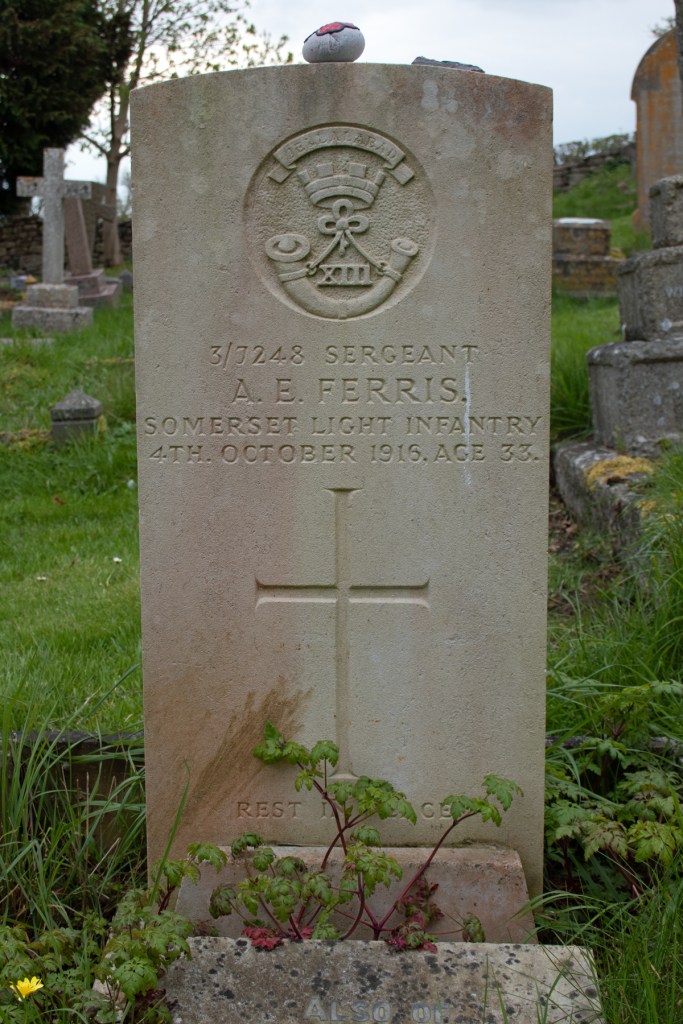
Sergeant Ferris died while admitted in the Surrey hospital on 4th October 1916. He was just 32 years of age.
The body of Albert Edward Ferris was brought back to Somerset for burial. He was laid to rest in the peaceful graveyard of St Michael’s Church, Monkton Combe.
Albert Henry Townsend was born on 7th November 1890 in Bath, Somerset. One of thirteen children, his parents were George and Annie Townsend. George was a painter by trade, but when he died in the autumn of 1895, Annie was left to take in laundry to earn money to support her and the four of her children still living at home.
By the time of the 1911 census, Albert was 21, and had found work as a baker. He was still living with his mother, two siblings and a nephew in a house in the centre of the city. All but Annie’s grandson were earning money by this point, and, with five rooms, the family were in a better position than some of their neighbours. Next door was Albert Smith, a coal carter, who had to support a family of ten people.
In the summer of 1914 war broke out, and within months, three of the Townsend brothers – Albert and his older brothers Arthur and Charles – had enlisted.
Arthur Townsend had joined the Duke of Cornwall’s Light Infantry earlier in the year, and within weeks of conflict being declared, he was on the Western Front. He was to be one of the early casualties of the conflict, and was killed in action during the Battle of the Marne on 9th September. He was just 29 years old and, while his body was never identified, he was commemorated on the La Ferte-sous-Jouarre Memorial.
Albert’s service records have been lost to time, so it is not possible to identify when he enlisted. He joined the Somerset Light Infantry, and was assigned to the 4th Battalion, who set sail for India in October 1914. Private Townsend was not to travel with them, however as he had contracted septicaemia while camped on Salisbury Plain, Wiltshire. He was transferred to the Royal United Hospital in Bath for further treatment, but his condition was to prove too severe. He passed away while still admitted on 19th October 1914. He was just 23 years of age.
Albert Henry Townsend was laid to rest in the St James’ Cemetery in his home city, Bath.
Annie Townsend had now been a widow for nearly twenty years and, within a matter of weeks, had lost two of her sons. Tragically, the war was not done with her family yet.
Charles Townsend was still serving, having enlisted in the 8th Battalion of the Somerset Light Infantry. He arrived in France in July 1915, and over the next year, wascaught up in some of the fiercest fighting of the conflict. On 1st July 1916, the Battle of the Somme began, the darkest day in history for the British Army. Twenty thousand soldiers were killed, and Private Charles Townsend was amongst the fallen. He was just 30 years of age. He was commemorated on the Theipval Memorial.
Annie had lost a third son to the conflict in a little under two years, and her pain must have been unimaginable. She lived on until 1923, when she died at home in Bath. She was laid to rest close to her husband and Albert, a family partly reunited once more.
Harry Ernest Macklin was born in the Frome area of Somerset in the autumn of 1893. The oldest of four children, his parents were Henry and Elizabeth Macklin. Henry Sr was a groom who travelled with work, and by the time of the 1901 census, the family were living in East Adderbury, Oxfordshire, which is where the third of the four siblings, Evelyn, was born.
Harry Jr seems to have been known as Ernest, probably to avoid confusion with his father. When he left school, he found work as a page. The family had moved again by 1902, to Witham Friary, to the south east of Frome. Harry Sr was now working as a farm labourer, while Minnie, his and Elizabeth’s second child, was employed as a house maid. The two younger children – Evelyn and George – were both at school, while Elizabeth’s widowed father, also called George, was visiting his daughter and their family.
Ernest changed jobs, becoming a gardener – possibly a euphemistic way of saying he had followed his father into agricultural labouring – but when war was declared he found the need to play his part. On 15th February 1915 he joined the Royal Navy as an Officer’s Steward 3rd Class, possibly drawing on his experience as a page.
For some reason, Ernest’s service records give his date of birth as 18th October 1894: they also confirm he was 5th 7.5ins (1.71m) tall, had dark brown hair, brown eyes and a fresh complexion. They also note that he had a scar on his left thigh.
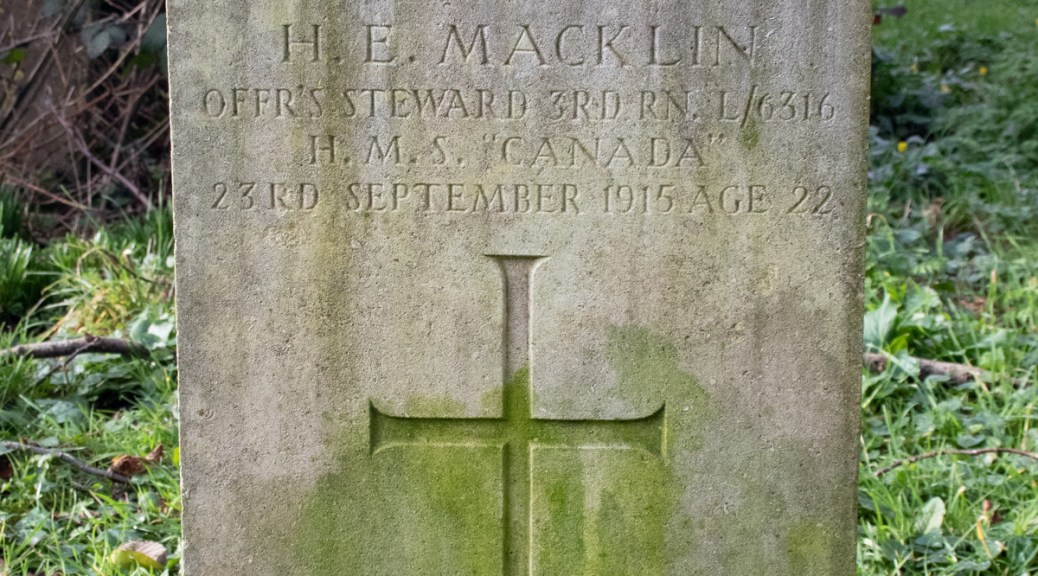
Officer’s Steward 3rd Class Macklin’s first posting was HMS Victory, the Royal Naval Dockyard in Portsmouth, Hampshire. This is where he received his training and, on 10th August 1915, he was given his first posting, on board the Chilean-built HMS Canada.
The ship sailed to Scapa Flow, following the North Sea Coast. When it reached Newcastle-upon-Tyne, however, Ernest was disembarked, and admitted to the Armstrong College Hospital, suffering from an ear infection. Tragically his condition turned septic, and he died of blood poisoning on 23rd September 1915, having served just 43 days at sea. Officer’s Steward 3rd Class Macklin was just 22 years of age.
Harry Ernest Macklin’s body was brought back to Somerset for burial. He was laid to rest in the quiet graveyard of St Mary’s Church in Witham Friary. “He was a promising young fellow, liked by all who knew him, and he was a member of the Witham Church Choir from boyhood.” [Somerset Standard : Friday 1st October 1915]
William Cecil Rowell was born on 29th November 1892 in Wolborough, Newton Abbot, Devon. He was the youngest of three children to architectural surveyor Spencer Rowell and his wife, Annie.
The 1911 census recorded that William had left the family home to study to be a civil servant, and was boarding with a family in Fulham, London. His studies complete, he was driven by a need to serve his country and, on 22nd January 1913, aged just 20 years old, he enlisted in the Loyal North Lancashire Regiment.
Full details of his service are not available, but it is clear that he was committed to his purpose. He was promoted to Second Lieutenant soon after enlisting, rose to full Lieutenant in November 1914, and Captain a year later. It’s not possible to pinpoint where he served, he was wounded twice and, after his second recovery, he made a transfer to the Royal Flying Corps (later moving to the new Royal Air Force when it was founded in 1918).
Captain Rowell was based at Bekesbourne Airfield in Kent. He qualified as a pilot with 50 Squadron in October 1918, but was injured when, on the 12th November, his Sopwith Camel collided with the hanger. William was admitted to the Military Hospital in nearby Canterbury, but the injuries to his leg proved too severe for it to be saved, and he underwent an amputation in January 1919.
Tragically, while the initial prognosis was good, within a few weeks sepsis set in; Captain Rowell passed away on 22nd May 1919, aged just 26 years old.
William Cecil Rowell’s body was brought back to Devon for burial. He was laid to rest in the family plot in the graveyard of St Mary’s Church in Wolborough.












 Death and Service