Tag Archives: story

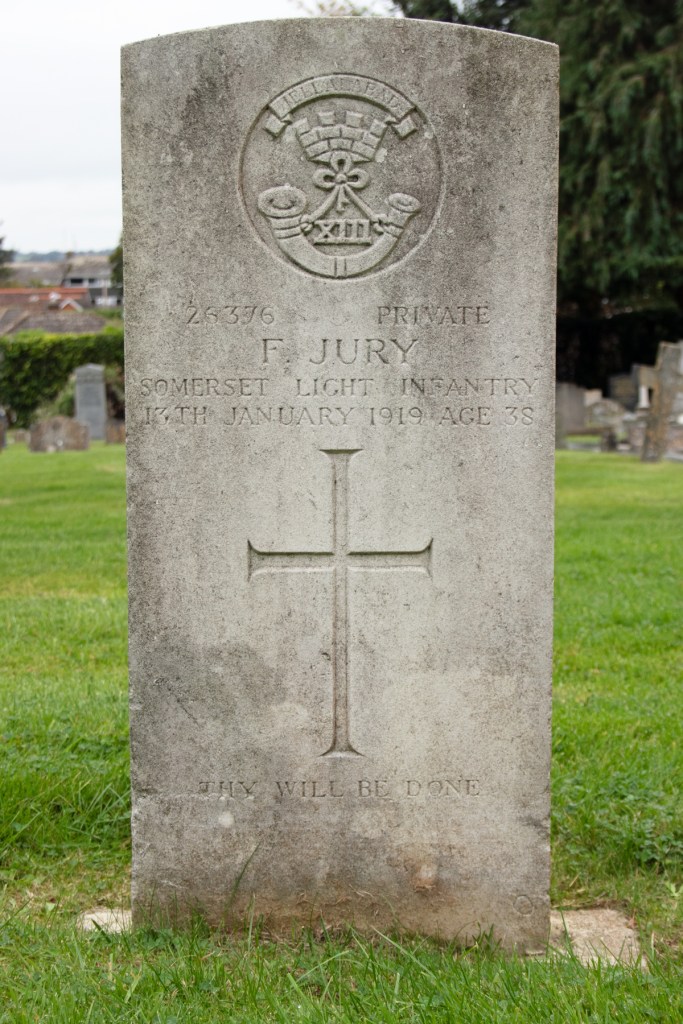
Private Frederick Jury

Private Frederick Jury

Frederick Jury was born in 1882, the oldest of four children to William and Lucy. William was a farm labourer from Minehead, Somerset, and this is where the young couple raised their family.

When he left school, Frederick found work as a labourer for a stonemason, but he had his sights on a higher calling. In March 1903, he enlisted in the Somerset Light Infantry and, after two years’ service, he was assigned to the Army Reserve.

By the time of the 1911 census, Lucy has been widowed; she was working as a charwoman in Minehead and living in a small cottage with her youngest daughter – Frederick’s youngest sister – Alice. Sadly, there is no record to confirm where Frederick was at this time.

When war broke out, Private Jury was called back into service. He was dispatched to France on 19th September 1914, and served there with his regiment for eight months before returning to England in May 1915 and transferring across to the Agricultural Company of the Labour Corps.

Private Jury’s time in the army seems to have been a troubled one. He was pulled up at least six times between 1903 and 1905, for being absent from parade, and for smoking in the stables. He was subsequently censured for failing to attend training during both 1910 and 1911, and the list went on into his time on active duty. He was punished for overstaying his pass in July, October and November 1915, for having a rusty rifle on inspection in August 1915 and for quitting his guard duty in January 1916. On each of these latter occasions, he was brought back by the Military Police and fined.

Frederick’s service records also confirm that he was treated in hospital for gonorrhoea in January 1905, something that may well have been par for the course for young soldiers at the time.

The continuous lapses in duty, however, may have proved too much for his regiment, and Frederick was discharge from military service on 8th March 1916.

At this point, Frederick Jury’s trail goes cold. The only further information available is that he died on 13th January 1919, at the age of 38 years old. He was laid to rest at Yeovil Cemetery in his home county of Somerset.

Private Frederick Major

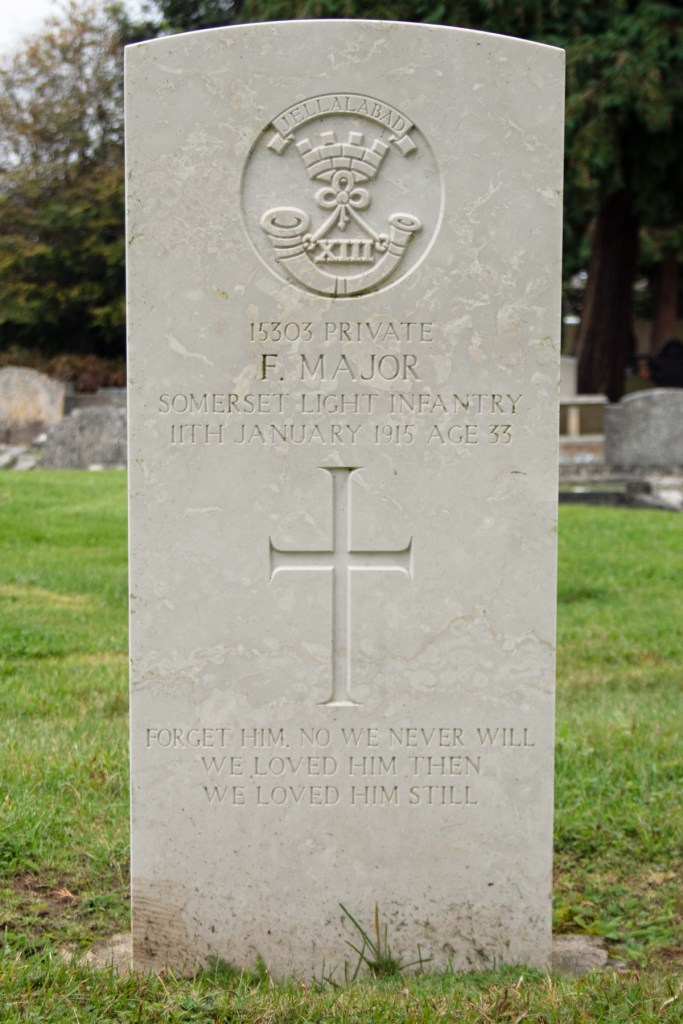
Private Frederick Major

Frederick John Major was born in the spring of 1882, the oldest of seven children to John and Eliza Major. John was a farm labourer and he and Eliza – who was 20 years his junior – raised their family in the Dorset village of Batcombe.

John passed away in 1900, when Frederick was just 18 years old. He was already working as a carter, and continued to live with his mother, helping support her financially, along with his brother and sister.

With war on the horizon, Frederick was keen to do his part. He enlisted in the Somerset Light Infantry, and was assigned to the 9th Battalion as a Private. This was a service battalion based in Plymouth, and it is unlikely, therefore, that Private Major saw any active service overseas.

Sadly, Frederick’s time in the army was to be short. He passed away in Somerset on 11th January 1915, aged just 33 years old. No evidence of the cause of his death is documented.

Frederick John Major was laid to rest in Yeovil Cemetery, in the town in which he died.


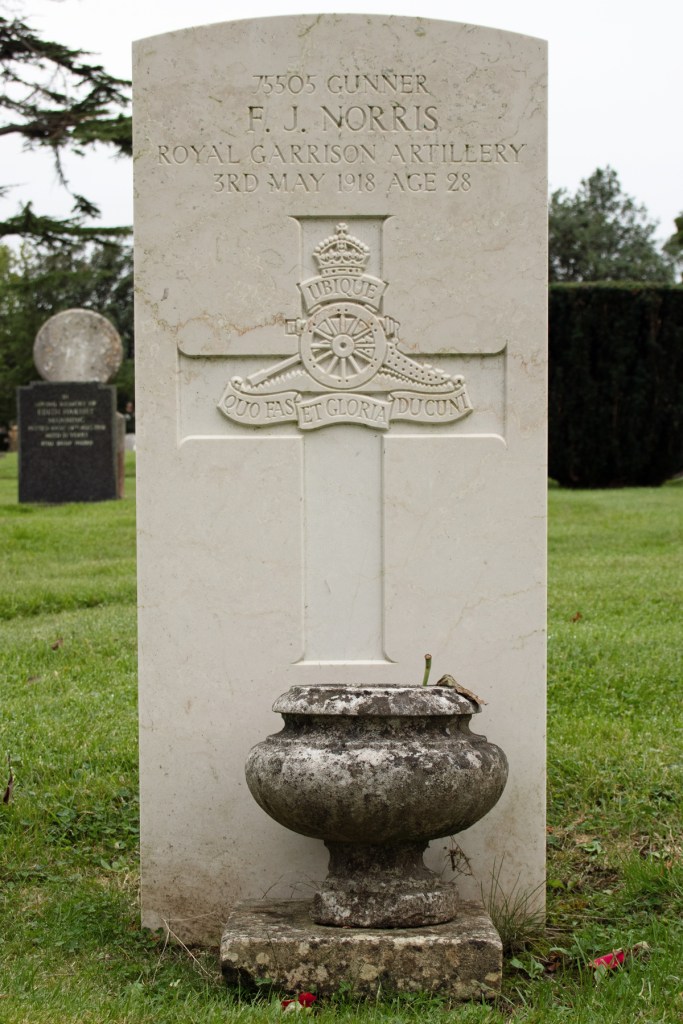
Gunner Frederick Norris

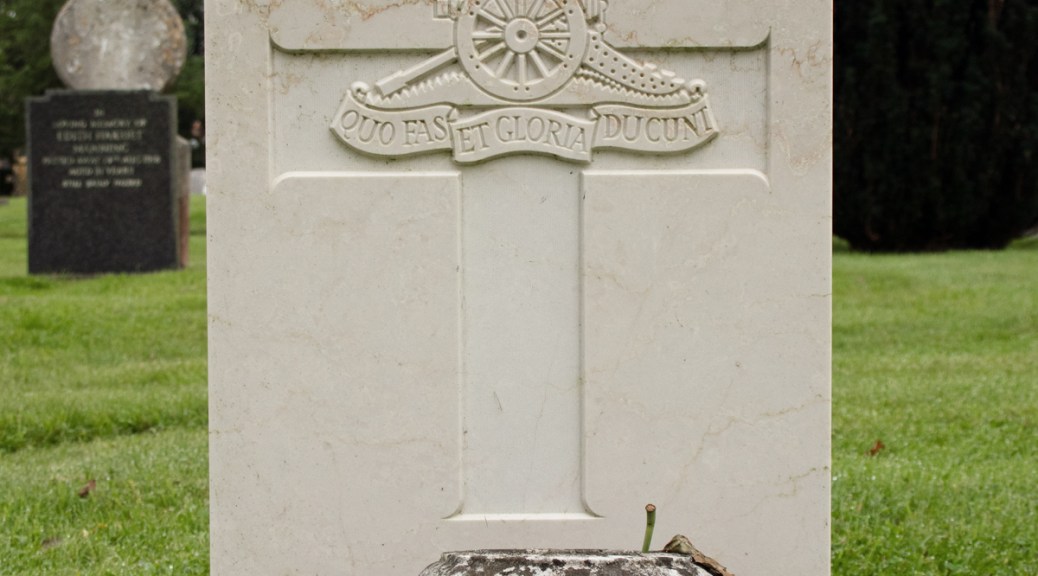
Gunner Frederick Norris

Frederick James Norris was born in the spring of 1890, one of eight children to Henry and Sarah Norris. Henry was a brewer’s drayman and groom, Sarah a milliner, and together they raised their family in the Somerset town of Yeovil.

When he left school, Frederick found work as a carman and carter, following in his father’s footsteps. Henry had died in 1907, followed by his two older brothers, Alfred in 1911 and Frank in 1912. Frederick, by this time, had met Emily Katherine White, and the couple married in Yeovil Parish Church on 23rd May 1909. They went on to have a daughter, Gwendoline, the following year.

War was fast approaching and, in December 1915, Frederick enlisted, joining the Royal Garrison Artillery as a Gunner. After a few months’ training, he was sent to Columbo, Ceylon (now Sri Lanka), where he served for just over a year. During his time there, he had contracted tuberculosis, a condition that ultimately resulted in his return to the UK.

Gunner Norris arrived back in England in August 1917, where he was again admitted to hospital with the respiratory condition. He was ultimately discharged from the army on medical grounds in August of that year.

After leaving the army, Frederick was admitted to a sanitorium, but at this point his trail goes cold. He died on 3rd May 1918, at the age of 28. While the cause of death is not stated, it seems likely to have been as a result of his already debilitated health.

Frederick James Norris was laid to rest in the cemetery in his home town of Yeovil.


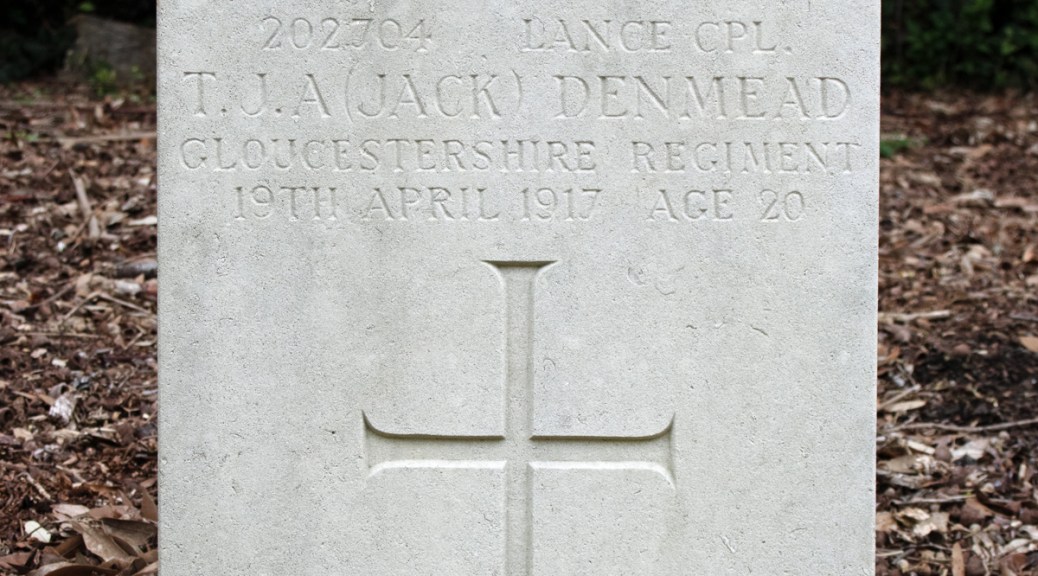
Lance Corporal Thomas Denmead

Lance Corporal Thomas Denmead

Thomas John Ambrose Denmead – better known as Jack – was born in Yeovil in the summer of 1896. The oldest of seven children, his parents were Thomas and Elizabeth Denmead. Thomas was a glover – the key industry in the Somerset town – who raised his young family in the middle of the town.

When he left school, Jack found work as a clerk at Petters’ Ltd, a local engine manufacturer and iron foundry. War was on the horizon, though, and he enlisted in the spring of 1916.

Jack joined the Gloucestershire Regiment, and was assigned to the 2nd/4th (City of Bristol) Battalion. He was sent to France in May 1916, and was involved in the Attack at Fromelles, part of the larger Somme offensive. He had started as a Private, but rose to the rank of Lance Corporal.

Towards the end of 1916, Jack fell ill. He was medically evacuated to the UK, and was admitted to the Royal General Infirmary in Paisley, Scotland. His condition was serious enough to need an operation, but the Lance Corporal sadly passed away not long after this treatment. He was just 20 years of age.

Jack’s body was brought back to Somerset for burial. He was laid to rest in the cemetery in his home town, Yeovil.


Lieutenant John Scrace

Lieutenant John Scrace

John Scrace was born on 31st July 1892 in Chatham, Kent, the oldest of five children to John and Adelaide Scrace. John Sr was a relieving officer for the Medway Board of Guardians, a role which involved “taking charge of poor or insane persons not otherwise cared for” [census1891.com]. Adelaide worked in a similar role, as an infant protection visitor.

It is fair to say, therefore, that John Jr had a very supportive childhood. He attended King’s School in Rochester, where he obtained a scholarship to Peterhouse College, Cambridge.

When war broke out, John was keen to do his part. Initially joining The Buffs (the East Kent Regiment), he transferred across to the newly-formed Royal Air Force in June 1918. By this point he had risen to the rank of Lieutenant, and, as part of his new RAF role, was based at Driffield in Yorkshire.

On 24th August 1918, the aircraft John was flying at the base, spun into the ground, and John was killed instantly. A subsequent inquest identified that “the cause of the accident was due to the fact that, for reasons unknown, part of the top of the left-hand plane of the machine crumpled up in the air and thereby [caused] the pilot to lose control of his machine.” [rafmuseumstoryvault.org.uk] Lieutenant Scrace was just 26 years of age.

John Scrace was buried in Christ Church Churchyard in Luton, Kent; he is commemorated in Woodlands Cemetery in nearby Gillingham.


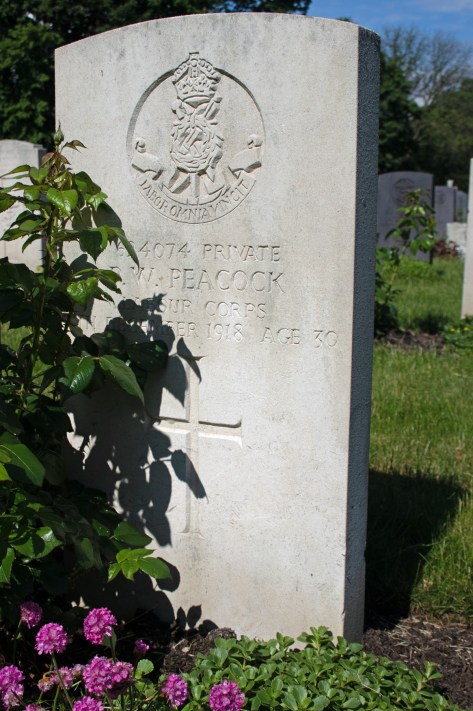
Private Percival Peacock

Private Percival Peacock

Percival William Peacock was born in early 1888, the son of Thomas and Louisa Peacock. Little information survives about Percival’s early life, other than that he was one of two children, and that, like his parents, he had been born in Gillingham, Kent. Thomas was a sexton and gravedigger, but Percival found work as a hairdresser.

The 1911 census shows him as head of the household in a cottage in the village of Stone, near Dartford; he was living there with his cousin James and his family.

On 21st April 1913, now living in Kensal Green, North London, Percival married Clara Milton, a labourer’s daughter from just a few doors up.

War was now imminent, but again there is limited information about Percival’s involvement. He did enlist, joining the Labour Corps as a Private, but this seems to have been later in the war. He appears to have served on home soil, although there is nothing to confirm this either way.

The next concrete evidence for Percival is the Army Register of Soldiers’ Effects. This confirms that he passed away on 5th December 1918 at the Paddington Military Hospital in London. No cause of death is provided, and the beneficiary given is his father, Thomas. Private Peacock was just 30 years old.

Percival William Peacock was laid to rest in the Grange Road Cemetery in Gillingham, Kent. Hs is commemorated in the nearby Woodlands Cemetery.


Tragedy was not far from the Peacocks’ life. Clara’s mother, Bessie, had passed away just a couple of weeks before Percival. Clara herself died on 5th March 1919, three months after her husband.


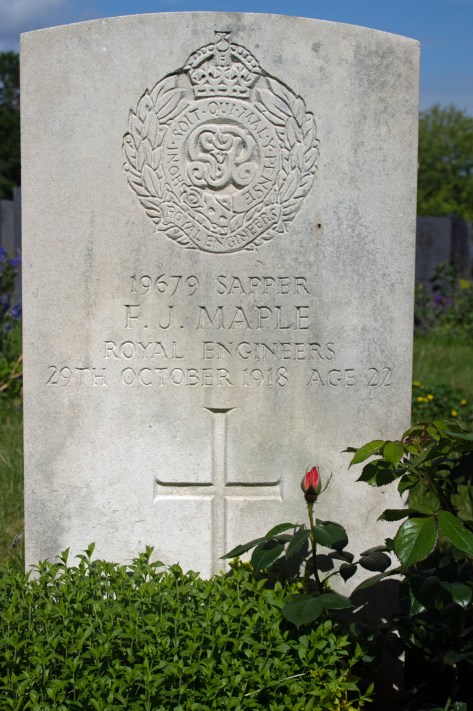
Sapper Frederick Maple

Sapper Frederick Maple

Frederick John Maple was born in 1896, the middle of three children to Royal Engineers Company Serjeant Major Frederick Maple and his wife Amelia. Frederick Jr was born in Brompton, Gillingham, Kent, but it’s interesting to note that the 1901 census gives Amelia’s place of birth as Canada, while Frederick Sr’s is not known.

Frederick Jr lost his father in 1904, and his mother five years later. At the age of just 13, he was an orphan, and this may have spurred him into finding a career. The next census – taken in 1911 – lists him as a Bugler in the Royal Engineers, barracked within walking distance of where he had grown up.

By the time war had broken out – and having come of age – the now Private Maple was assigned to the 15th Field Company. The regiment fought in a number of the key skirmishes of the war, including the Battles of Neuve Chapelle, the Somme, Loos, Ypres and Arras. Frederick went to France in March 1915, although it is not possible to confirm how or if he was involved in these battles. He was awarded the Victory and British Medals and the 1915 Star for his efforts.

Sadly, the next available document for Frederick is the Army Register of Soldiers’ Effects. This confirms that he was admitted to the 2nd London General Hospital in Chelsea, and that he passed away on 29th October 1918. Again, there is no evidence of the cause of his passing, so he may have fallen ill, or been wounded. Either way, Private Maple was just 22 years old when he died.

Frederick John Maple was laid to rest in the Grange Road Cemetery in Gillingham. When this was subsequently turned into a public park, he was commemorated in the neighbouring Woodlands Cemetery.


Private James Hayden

Private James Hayden

James Hope Hayden was born in Shorncliffe Military Camp in 1875, the son of Mary Anne Hayden. The youngest of five children, James’ father appears to have died when he was just a toddler; there are no records for him, and Mary Anne – who preferred to caller herself Annie – was listed a a widow by the time of the 1881 census.

The document confirms that Annie was lodging in a house near the Naval Dockyard in Chatham, working as a seamstress. She was living there with her landlady Anne Roberts and her five children, John, William, Annie, Charles and James, who seems to have gone by the name of Mathew.

By the time of the nest census, Annie had moved and was lodging in another house in the same road. She was still employed as a seamstress, and was sharing the rooms with her two youngest children and her brother, William.

The 1901 census finds Annie living in an adjacent road to her previous houses. Head of the household this time, she was working as a laundress. Her brother William was also living there – he was listed as an army pensioner. Mathew is the only one of her children still living with her; he had, by this time, found employment as a labourer in the dockyard.

Moving forward another ten years, and the family have moved one street over. Annie, at 69 years old, remained the head of the household, while Mathew is living there with his wife and three children.

Mathew’s wife is listed as Florence, but there is no record of their wedding, other than the census document which confirms they have been marred for ten years. Mathew is listed as an ex-soldier although again, there is no longer any documentation to confirm this.

From this point, Mathew’s/James’ life goes a bit hazy. The next available record is his army pension document. This confirms that he was a Private in the Royal Marine Light Infantry, under the name James Hope Hayden. By this time, he and Florence had had seven children, although it seems to suggest that they were not actually married.

Sadly, it also confirms that Private Hayden had passed away on 1st May 1917, having been suffering from pneumonia, contracted whilst on active service. He was 42 years old.

Mathew was laid to rest in the Grange Road Cemetery in Gillingham, Kent, under the name James. The cemetery has since been turned into a public park, and he is commemorated in the nearby Woodlands Cemetery.


Chief Stoker John Seager

Chief Stoker John Seager

John Edward Seager was born in Gillingham, Kent, in March 1869. One of eight children, his parents were labourer William Seager and his wife Maria (who was known by her middle name, Elizabeth).

John was keen to have adventure in his life, and the local Naval Dockyard in Chatham gave him that opportunity. on 23rd April 1887, he enlisted in the Royal Navy for the standard twelve years’ service. During that time, he served on six different ships, begging his career as a Stoker and rising through the ranks to become a Leading Stoker at the end of his time.

In April 1899, John re-enlisted and was given the rank of Chief Stoker. After completing his initial training at the on-shore establishment HMS Pembroke, he was assigned to HMS Cossack. Over the next ten years, he served on five more ships, before being moved over the Royal Naval Reserve in 1909.

During this time, John had gotten married. Emmeline Ada Driver was also born in Gillingham, and had found work as a nurse in the Surrey County Asylum. The couple married on 8th August 1903 in New Brompton, and set up home in a cottage close to the centre of Gillingham, close to their families and within walking distance of the dockyard.

When war broke out, John was called back into active service. He spent a year on board HMS Wildfire and five months on HMS Attentive. Most of his time, however, was spent at HMS Pembroke in Chatham. It was while he was here in January 1918 that he was admitted to hospital with pneumonia and tuberculosis. Sadly, Chief Stoker Seager was to succumb to these conditions; he died on 1st February 1918 at the age of 49 years old.

John Edward Seager was laid to rest in the Grange Road Cemetery in Gillingham, Kent. He is commemorated in the Woodlands Cemetery, which replaced this now park.


Serjeant Albert Romain

Serjeant Albert Romain

Albert William Romain was born in Gillingham, Kent, at the start of 1888, the middle of three children to Henry and Florence. Henry was a Sergeant in the Royal Engineers and is seemed inevitable that his son would follow suit.

Henry died in 1896, and was buried in the Grange Road Cemetery, Gillingham (now a public park). The 1901 census recorded Albert as a pupil at the Duke of York’s Royal Military Asylum in Chelsea. This was, in fact, a school for the children of soldiers, and it is likely that Albert was sent there to be educated when his father died.

The Royal Engineers obviously proved too great a lure for the young Albert. While full details of his service are not available, he had definitely enlisted early on, and was listed as a Lance Corporal in the Tempe barracks in Bloemfontein, South Africa in the 1911 census.

When war broke out, he was called back to Europe, as was on the Western Front by November 1914. Little further information on Albert is available – during the conflict he was assigned to D Company of the Royal Engineers, but the end of the war, he had become a Sergeant in the 1st Reserve Battalion.

In November 1918, back on UK soil, he was admitted to the Fort Pitt Military Hospital in Chatham, Kent. His condition is unclear, but sadly it was to be one to which he would succumb. Sergeant Romain died on 8th November 1918; he was just 30 years old.

Albert William Romain was laid to rest with his father in the Grange Road Cemetery. He is commemorated in the Woodlands Cemetery in his home town of Gillingham, Kent.