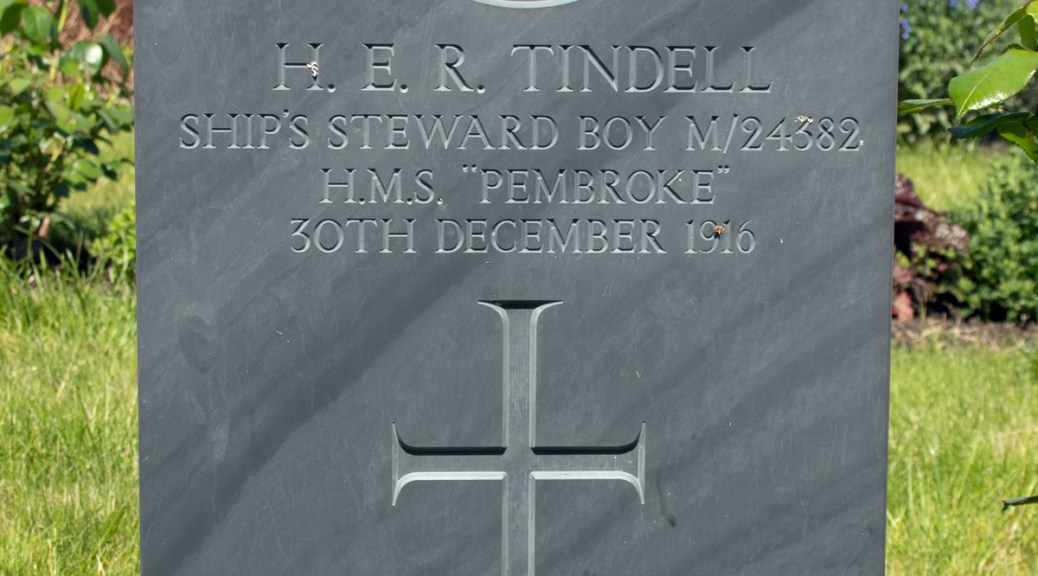
Harold Edward Richard Tindell was born in Sidcup, Kent, on 15th January 1898. The middle of three children, his parents were travelling salesman Lawrence Tindell, and his wife, Alice.
There is little concrete information available about Harold’s life: his family do not appear in the 1911 census, and it is only on his enlistment papers that we get a picture of the young man he had become. He joined the Royal Navy on 28th November 1916, signing up as a Ship’s Steward Assistant.
The document suggests that he had transferred over from the Royal Naval Volunteer Reserve, giving up his job as a clerk to fully serve his country. His papers show that he was 5ft 4.5ins (1.64m) tall, with brown hair, grey eyes and a fresh complexion.
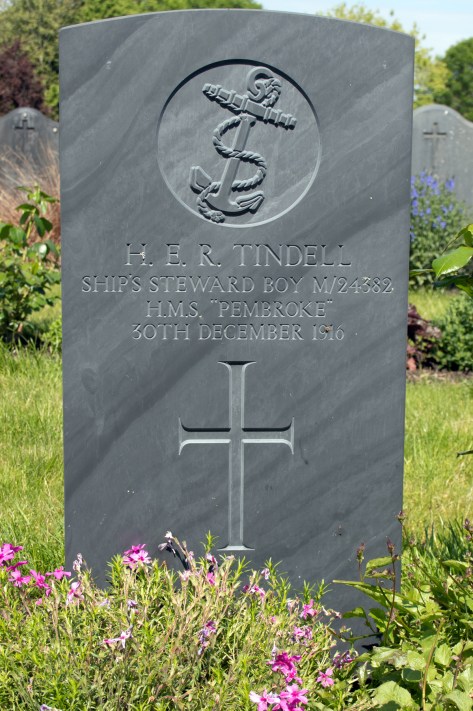
Ship’s Steward Assistant Tindell was sent to HMS Pembroke – the Royal Naval Dockyard in Chatham, Kent – for his training. Tragically, however, his time there was to be brief. He contracted cerebrospinal meningitis, dying from the condition on 30th December 1916: he was eighteen years of age, and had been in the Royal Navy for just 32 days.
Harold Edward Richard Tindell was laid to rest in the military section of Woodlands Cemetery, Gillingham, Kent, not far from the base he had so briefly called home.
Harold’s headstone gives his rank as Ship’s Steward Boy: however, his service papers and the Commonwealth War Graves Commission both confirm the role as Ship’s Steward Assistant.
George Grove Bailey was born towards the end of 1873, in the Hampshire town of Lymington. He was the second of two children to John and Emma Bailey. John was a butler, but when Emma died when their youngest boy was just two years old, he seems to have changed career. The 1881 census found the family living at 45 High Street, Lymington, not far from the school and the Church of St Thomas the Apostle.
While he had the support of domestic servant Mary Ann, John was still young and, in 1884, he married again. His new bride was Sarah Woodman, and the couple would go on to have a daughter, Edith, two years later.
George falls off the radar at this point, and it is only from a newspaper report of his funeral in June 1918 that we are able to fill in some of the details:
The funeral took place on Monday afternoon of Sergt. George Bailey, youngest son of Mr John Bailey, of Highfield, Lymington, who passed away in the military hospital at Brighton, following a short illness. The deceased, who was 45 years of age, and was recently married, served in the South African War, and joined up at the commencement of the present war, being for some twelve months in the Fusiliers at the front. He was wounded, and since his return to this country has been acting as sergt.-instructor.
[Hampshire Advertiser: Saturday 15th June 1918]
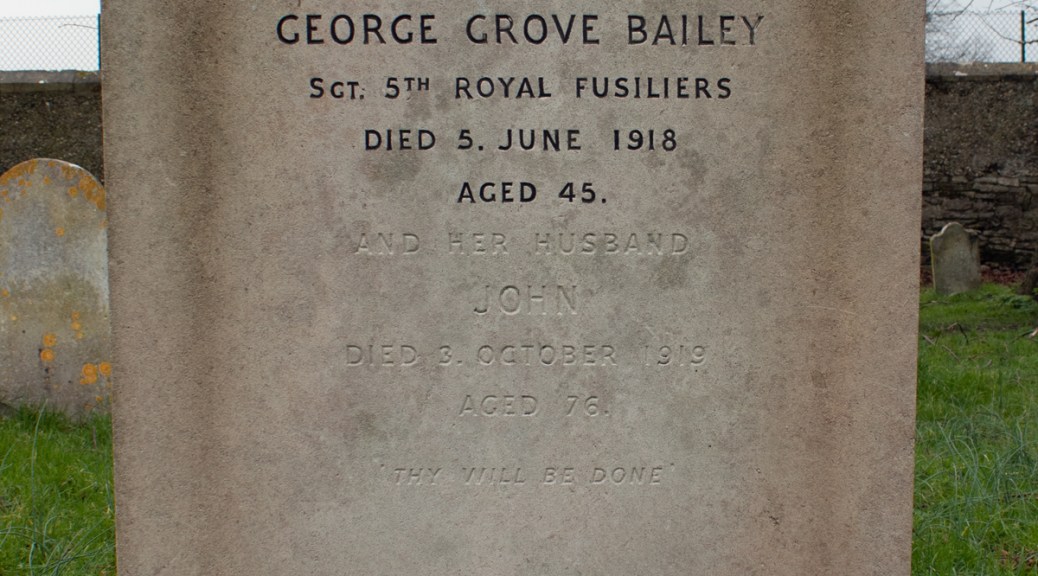
George’s new wife was Winifred Mary Bailey, but there is little additional information about her. His regiment – the 5th Battalion of the Royal Fusiliers – was based on home soil, and would not have been the unit with which he had served on the Western Front. It’s not possible, therefore, to determine where he fought, or how he was wounded.
George Grove Bailey was buried in the family plot in the graveyard of St Thomas’ Church, Lymington, not far from where his father’s shop had been. John, who had been working as a poor rate collector, died a year after his son, and was laid to rest alongside his wife and youngest child.
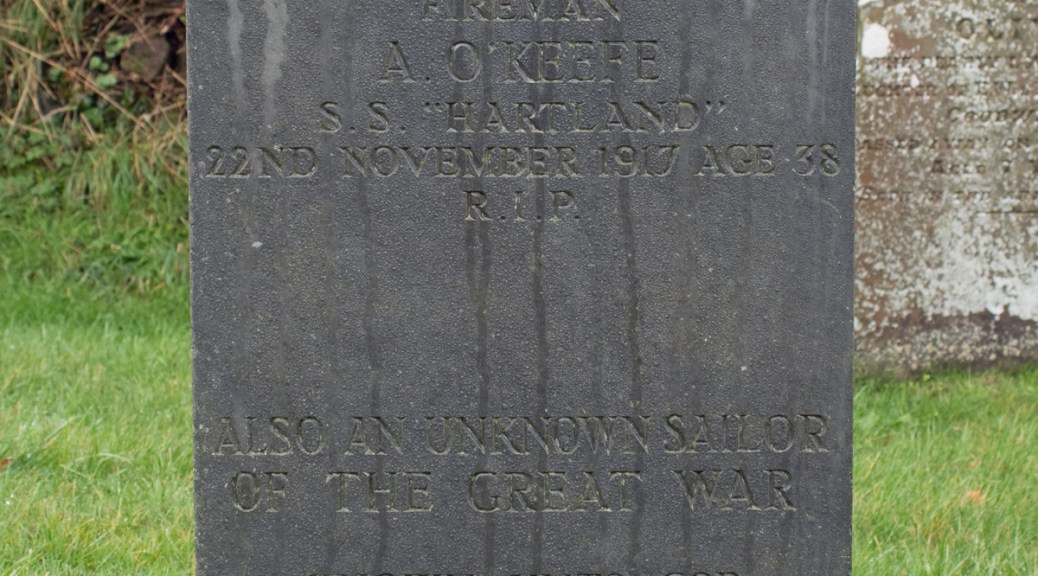
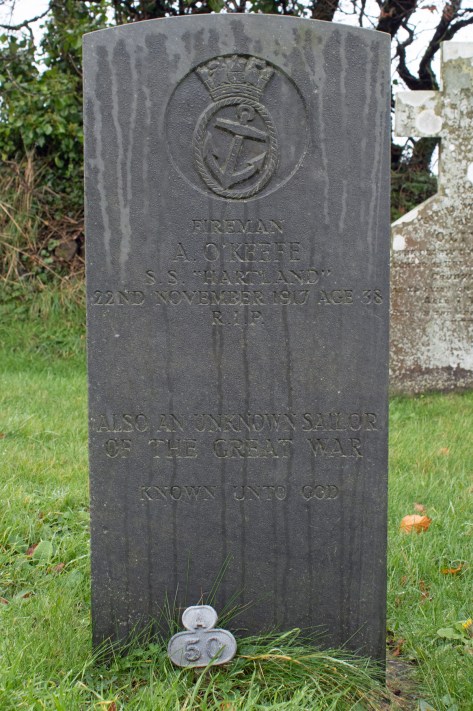
O’KEEFE Fireman Arthur. SS “Hartland.” 22nd Nov., 1917. Age 38. Son of John and Mary O’Keefe of Cork.
The search for information about Arthur O’Keefe has proved a challenging one. He does not appear with his parents on any census records, and there is precious little documentation about his life.
Arthur found work as a Fireman in the Mercantile Marine, and served on board at least four ships. In the autumn of 1917, he was based out of Glasgow, Scotland, and was attached to the SS Hartland. She had been requisitioned by the Admiralty, and was put to use transporting wheat from India.
On 22nd November the Hartland was travelling from Glasgow to Barry, South Wales, when she was hit by a torpedo from the submarine U-97, 21 miles south west of Bardsey Island. The ship was damaged, and two of the crew – Fireman O’Keefe and Fireman Thomas McGaw – were killed.
An American destroyer, the USS Conyngham, was at the head of the Hartland’s convoy, and managed to rescue the remaining 28 members of the crew, taking them to Holyhead. The Hartland was towed to Fishguard Harbour and refloated.
Arthur O’Keefe was 38 years of age when he was killed. He was laid to rest in Llanwnda Cemetery, not far from Fishguard, Pembrokeshire.
Arthur’s headstone notes that he was buried with an unknown sailor of the Great War. There is no indication who this might have been, but there are no records of his colleague Thomas McGaw being laid to rest. Given both men died in the same incident, and their bodies were transported to Fishguard with their ship, it seems possible that they may have been buried together.
Charles Archibald Walters was born in 1896, and was one of nine children to Arthur and Minnie. Arthur was a painter in the shipyards, and the 1901 census found the family living in a small cottage at 29 Cambrian Terrace in Neyland, Pembrokeshire.
By 1911, Charles had finished his schooling, and had found labouring work on a local farm. He was still living at home, however, and the family has moved to 46 Cambrian Road, overlooking the shipyard where Arthur still worked, and the Westward Pill and Cleddau Ddu rivers beyond.
When war came to Europe, Charles was called upon to play his part. Details of his military service are sketchy, but it is clear that he enlisted in the Royal Garrison Artillery, and was assigned to the Pembrokeshire Territorial Force.
Gunner Walters survived the war, but was suffering from nephritis. He was medically discharged from the army on 12th May 1919, and returned to the family home.
By this point Arthur had moved the family to Goodwick, near Fishguard, by this point, as he had taken up a job in the town as a painter for Great Western Railways.
Charles’ condition would ultimately get the better of him. He passed away on 4th April 1920: he was just 24 years of age.
Charles Archibald Walters was laid to rest in Llanwnda Cemetery, not far from where his family now lived.
The 1921 census found that two of Charles’ brother were also working for Great Western Railways, Frederick as a porter, and William as a boiler sealer in their engineering works (presumably the same place as Arthur).
Minnie died the following year, Arthur passing in 1924. Both were buried with their son, Charles, and they are remembered on his Commonwealth War Grave.
James Barrington was born in Westminster, Middlesex, on 1st June 1890. One of twelve children, his parents were Alfred and Hetty Barrington. Alfred worked in a soap factory, and the family seemed to move around: the 1891 census found them living in rooms at 3 Charles Buildings, St Martin-in-the Fields, while a decade later there were at 6 Lyric Place in Kennington, Surrey.
With so many mouths to feed, Alfred and Hetty were keen to get their children to work. The 1911 census found James working as a cowman on a farm in Mathry, Pembrokeshire, which must have come as a huge culture shock.
James soon settled in, however, and, on 9th November 1912, he married Elizabeth Thomas, the daughter of a labourer from nearby. The couple had a daughter, Hilda, who was born the following February.
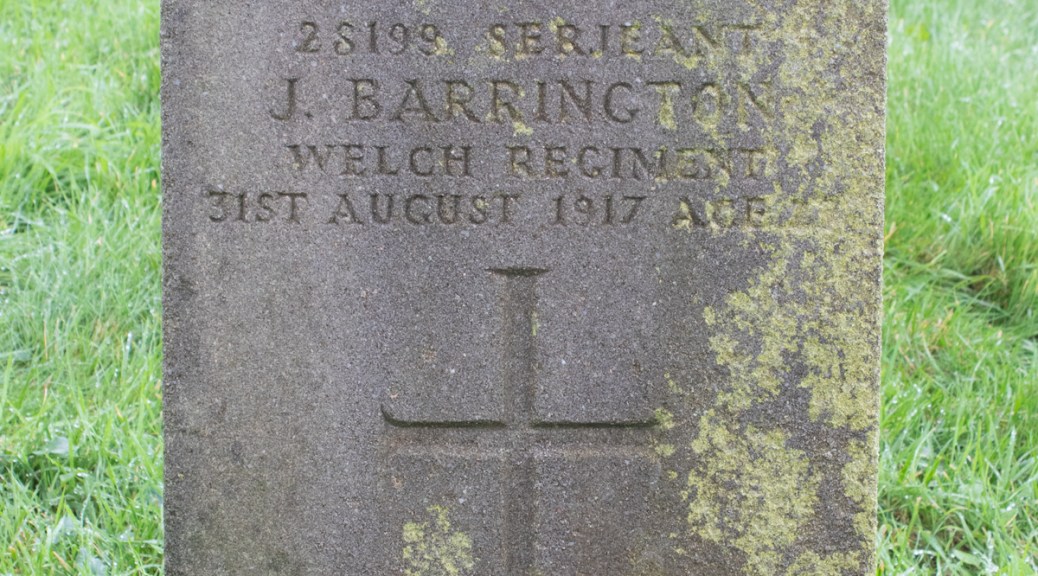
When war broke out, James was called upon to play his part. There is little concrete information about his service, but he was assigned to the Welch Regiment, as was attached to the 18th (Service) Battalion (2nd Glamorgan). He had attained the rank of Sergeant by the summer of 1917.
Sergeant Barrington’s unit fought in some of the key battles of the early stages of the conflict, including the Battle of the Ancre in 1916, and the German retreat to the Hindenburg Line the following spring. It was during fighting on the Western Front that summer, though, that he was wounded, and medically evacuated to Britain for treatment.
James was admitted to a hospital in London, but his wounds would prove too severe: he passed away on 31st August 1917, at the age of 27 years old.
The body of James Barrington was taken back to Wales for burial. He was laid to rest in Mathry Church Cemetery, not far from where his widow still lived.
Inquests have been held by Mr PB Ingoldby, County Coroner, on the bodies of Sergt. S Pickett, aged 36, and Sergt. A Martin, aged 29, whose deaths occurred recently as the result of an explosion in the New Forest.
The evidence showed that Sergt. Martin was killed. Sergt. Pickett was found insensible from shock, and died five hours later in hospital. In both cases the verdict was that death took place accidentally, and that no blame was attached to anybody.
[Hampshire Independent: Saturday 3rd March 1917]
The life of Sergeant A Martin is a challenge to piece together. While no service papers remain, the few documents that are available don’t provide enough information to unpick the his details.
His entry in the Army Register of Soldiers’ Effects confirms his name as Alfred Albert Martin, and that he served in the 3rd Battalion of the Hampshire Regiment. The document also gives his beneficiary as his mother, Philaidah.
Sergeant Martin’s pension ledger card gives his mother’s name as Louisa Martin, of 64 Bedford Street, Kingstone Road, Portsmouth. It also provides details of a brother, Sergeant Arthur Theodore of the Devonshire Regiment, who also died during the conflict.
The newspaper report suggests Alfred would have been born in around 1888, but there is no definite evidence of him, Philaidah/Louisa or Arthur in census records from 1891 to 1911.
Alfred’s Medal Roll Index Card confirms that he served in the Balkans, and arrived there on 25th April 1915. It gives his rank only as Sergeant, which would suggest that he may have had some military background before the First World War.
Sadly, there are too many pieces to the jigsaw of Sergeant Martin’s life missing to be able to build a better picture. Killed by an accident, he was laid to rest in Lyndhurst Cemetery, not far from where he died.
Arthur William Read was born on 5th February 1886 in Lyndhurst, Hampshire. The fourth of nine children, he was one of five sons to James and Mary Read. James a builder’s labourer-turned-yardman, although his son wasn’t to follow in his father’s footsteps.
Instead, Arthur rook on work as a baker’s boy, but this was not enough for him. He sought a career at sea and, on 10th April 1901, he took a job in the Royal Navy. Given the rank of Boy 2nd Class because of his age, he was sent to HMS St Vincent, the shore-based training establishment in Devonport, Devon. Over the next eighteen months he learnt the tools of his trade, and was promoted to Boy 1st Class after just ten months.
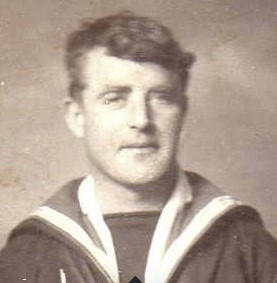
On 5th February 1904, Arthur turned 18, and came of age. Now able to formally enlist in the Royal Navy, he took that opportunity, and was given the rank of Ordinary Seaman. His service papers show that he was 5ft 5ins (1.65m) tall, with light brown hair, blue eyes and a fresh complexion.
At this point, Ordinary Seaman Read was serving on board the battleship HMS Irresistible. She would be his home for two years and, just a couple of weeks before changing vessels, he was promoted to Able Seaman.
Arthur would serve up to and during the First World War. He was assigned to a total of seven ships after the Irresistible, returning to what would become his home port, HMS Victory in Portsmouth, Hampshire, in between voyages. His character was regularly noted as being very good, while his ability was repeatedly found to be superior. By 1st October 1915, with war raging across Europe, he was promoted again, to the rank of Leading Seaman.
Away from his seafaring, Arthur had found love. In the last quarter of 1909 he married Alice Philpott. Sadly, details about her have been lost to time, but the couple would go on to have two children – Ivy and Gladys.
When war came to Europe, Arthur’s younger brother Harry stepped up to serve. He enlisted in the Middlesex Regiment, and was assigned to the 12th Battalion. Private Read was caught up in fighting on the Western Front, and was killed in action on 25th April 1916. He is buried in Bronfay Farm Military Cemetery, in Bray-sur-Somme, Picardie.
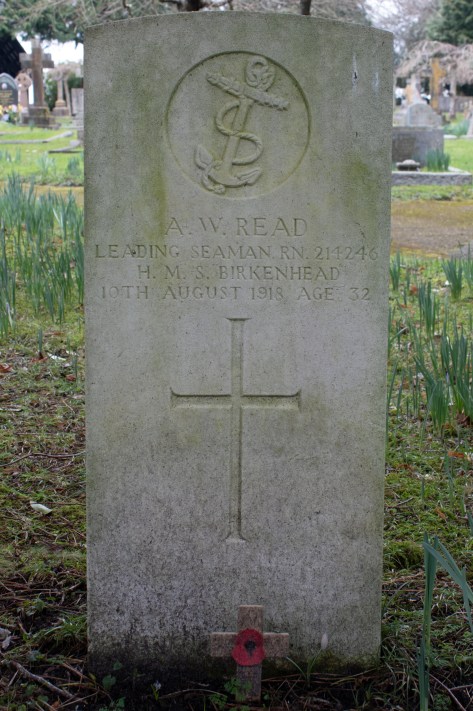
Leading Seaman Read, meanwhile, was continuing his naval career. From November 1916 he was assigned to the light cruiser HMS Birkenhead. Used to patrol the North Sea, she had come away from the Battle of Jutland unscathed.
As the war entered its closing months, Arthur’s health was becoming impacted. Suffering from diabetes, he was admitted to the Royal Naval Hospital in Edinburgh in summer of 1918. The condition was to better him, however, and he passed away on 10th August: he was 31 years of age.
The body of Arthur William Read was taken back to Hampshire for burial. He was laid to rest in Lyndhurst Cemetery.
After her husband’s death, Alice was left to raise two children under 5 years old. Unable to do this without support, on 8th July 1920, she married Jack White. A Chief Petty Officer in the Royal Navy, it is unclear whether his path had ever crosser her late husband’s. The following year’s census found her and her two daughters living in a house on Clarence Road in Lyndhurst: her husband was away at sea.
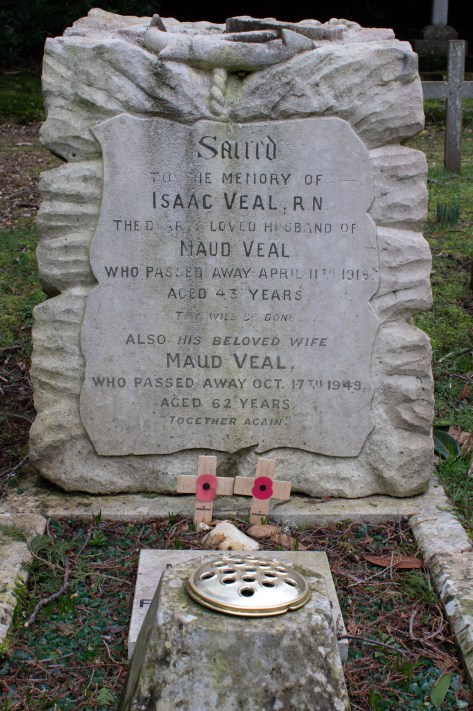
Isaac Veal was born on 18th November 1874, the seventh of eight children to Joseph and Frances Veal. When he was born, his parents were the publicans at the Waterloo Arms in Lyndhurst, Hampshire, and this is the town in which they would raise their family.
Frances died in 1890, and by the following year’s census, Joseph had stepped back from being a landlord, he was living with three of his children on a farm to the north of the town centre. Now employed as a domestic gardener, Isaac was working with him.
Isaac sought bigger and better things, however, and, on 21st December 1891, he enlisted in the Royal Navy. Intriguingly, though, he gave his date of birth as 10th July 1875. Below the age to formally sign up, he was given the rank of Boy 2nd Class, and was sent to HMS St Vincent in Devonport, Devon, for training. He remained on board for the next two years, rising to Boy 1st Class in March 1893.
On 26th August 1893, Isaac was promoted to Ordinary Seaman: this would normally mark a boy’s coming of age, but the date doesn’t match Isaac’s given date of birth, or his actual one. It is likely, therefore, that his true age had become known.
Ordinary Seaman Veal’s service documents confirm that he was 5ft 6ins (1.68m) tall, with auburn hair, brown eyes and a fair complexion. He signed up for a period of twelve years and, during that time, he would serve on a total of eleven ships. Isaac travelled the world, returning to HMS Victory, the Royal Naval Dockyard in Portsmouth, Hampshire, in between voyages.
On 11th March 1895, Isaac was promoted to the rank of Able Seaman, and his annual reviews generally marked him of very good character. From April 1901 he was assigned to the battleship HMS Revenge, and she would remain his home for more than four years. During his time assigned to her his contract came to an end and he immediately re-enlisted.
On 18th October 1909, Isaac married Ethel Maud Astridge, a caretaker’s daughter from Basingstoke, Hampshire. When they wed, Ethel – who was better known by her middle name – was working as a housemaid for a miller in North Stoneham. The couple would go on to have three children – Beatrice, Mary and Florence – and while her husband was away at sea, Ethel lived in their cottage on Queen’s Road in Lyndhurst.
Back at sea, Able Seaman Veal would continue to travel the world. During the second term of his contract with the navy, he was assigned to a further dozen ships. In August 1912, Isaac was assigned to HMS Dolphin, the shore base in Gosport, Hampshire, which was the home of the Royal Navy Submarine Service. Over the next five years he would split his time between Dolphin and HMS Maidstone. The submarine depot ship, which operated out of Harwich, Essex, would be his home for the majority of the First World War. Able Seaman Veal’s commitment to the navy was being recognised, as was his ability, which was recorded as superior in each of his annual reviews from 1911 onwards.
As the conflict entered its closing months, Isaac’s health was becoming impacted. In the spring of 1918, he was admitted to the sick quarters in Shotley – just across the river from Harwich – suffering from pernicious anaemia and rheumyalgia. The combination of conditions would prove fatal: Isaac passed away on 11th April 1918, at the age of 43 years old.
The body of Isaac Veal was taken back to Hampshire for burial. He was laid to rest in Lyndhurst Cemetery, just a few minutes’ walk from his family home. Conveyed to the cemetery in a motor ambulance van, he funeral was supported by a firing party from the local Bombing School Camp, tributes including “a token of respect from the men of the 8th and 9th Submarine Flotillas.” [Hampshire Advertiser – Saturday 20 April 1918]
After the death of her husband, Maud remained living in Myrtle Cottage, the family’s home for the rest of her life. The 1921 census recorded her as being an apartment House Keeper, while the 1939 Register noted that both she and her daughter Florence, were carrying out unpaid domestic duties.
This latter document identifies three boarders to Myrtle Cottage, including Maud’s younger sister Thirza.
Ethel Maud Veal died on 17th October 1949, at the age of 62. She was buried in the family plot in Lyndhurst Cemetery, reunited with her husband Isaac after more than 30 years.
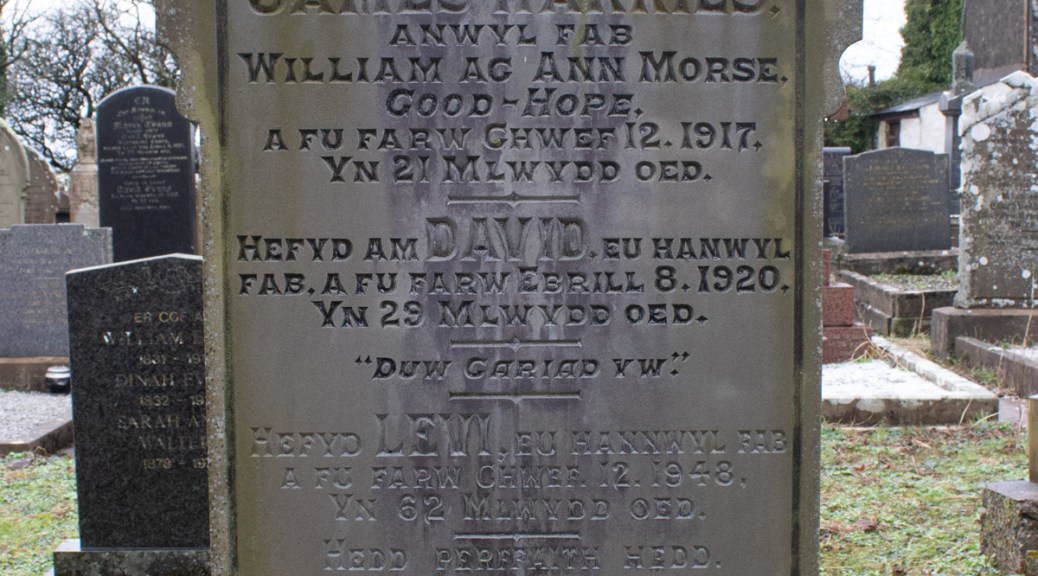
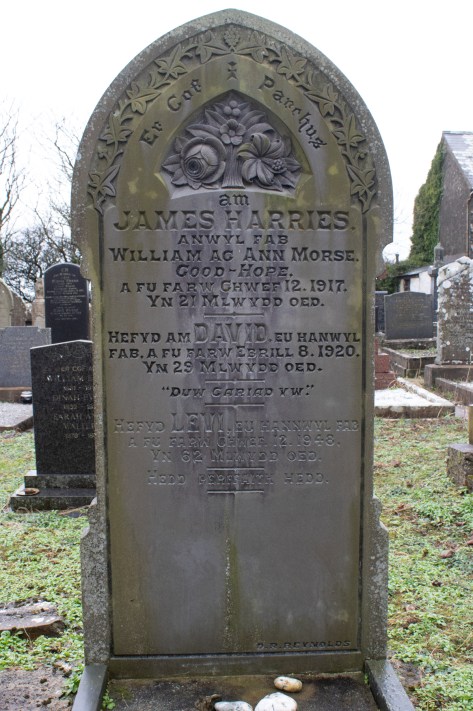
James Harries Morse was born in the autumn of 1895 in Llanwnda, Pembrokeshire. One of eleven children, his parents were agricultural labourer William Morse and his wife, Ann.
James’ schooling was completed early, and he was soon found work to keep him occupied. The 1911 census recorded him as being a cattle boy for the James family, living in on a farm not far from his family home.
When war broke out, James was keen to play his part. Details of his military service have been lost to time, but it is clear that he enlisted as a Private in the Welch Regiment, and was assigned to the 3rd (Reserve) Battalion. It’s not possible to identify where or for how long he served, and the only other documents available relate to his passing.
James Harries Morse died of disease on 12th February 1917: he was just 21 years of age. His body was taken back to Pembrokeshire for burial, and he was laid to rest in the family plot in Pencaer (Harmony) Baptist Burial Ground, not far from his parents’ home.
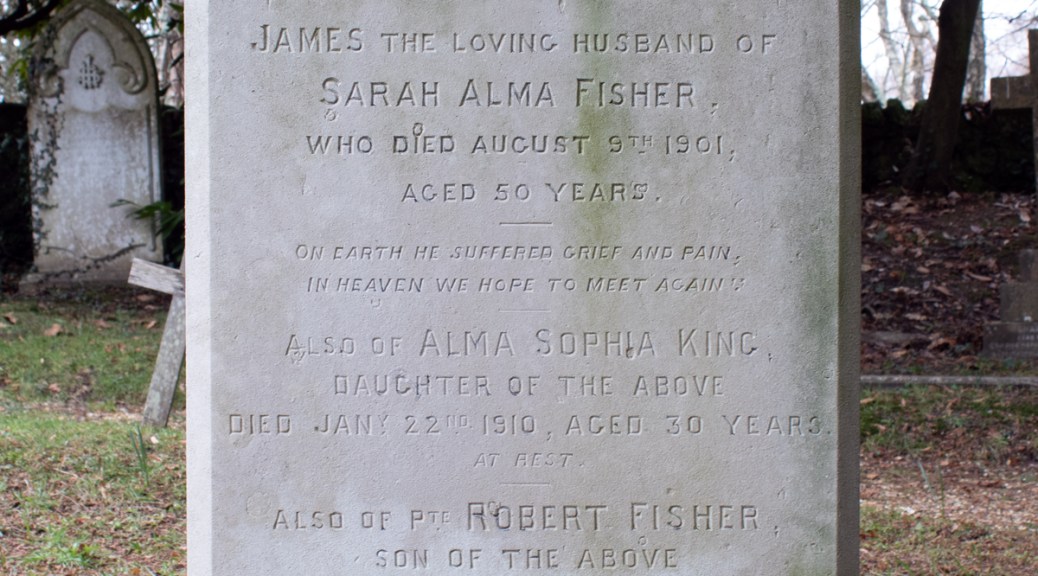
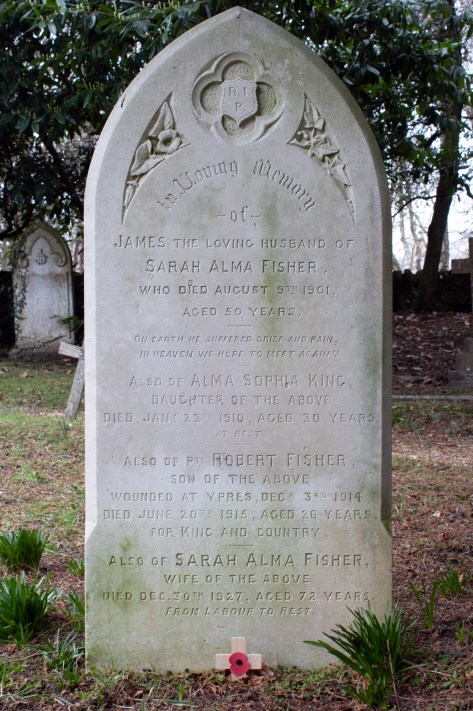
Robert Fisher was born on 12th September 1888 in Lyndhurst, Hampshire. He was the sixth of eight children to James and Sarah Fisher. James was a coachman, and the family lived on Pike’s Hill, to the north of the town centre.
James died in 1901, and Robert remained at home to support his mother and two younger sisters. The 1911 census found the family living in the same four-roomed cottage on Pike’s Hill: Robert was employed as a mail driver, while his sister Kathleen worked as a domestic servant. The family also had a lodger, William Penny, to help bring in some extra money.
When war broke out, Robert stepped up to play his part. His service documentation has been lost, but it is clear that he enlisted in the opening weeks of the conflict, and was assigned to the 1st Battalion of the Hampshire Regiment. As proof of a quick turnaround for these new recruits, Private Fisher found himself in France by mid-November 1914.
Fighting on the Western Front near Armentières, Private Fisher was wounded on 3rd December 1914. He was medically evacuated to Britain for treatment, and admitted to Netley Hospital near Southampton, Hampshire. He had been “struck in no less than seven places by shrapnel.” [Hampshire Independent: Saturday 3rd July 1915]
Eventually well enough to return home, by June 1915, Robert’s health had deteriorated. He contracted meningitis, and was admitted to the Isolation Hospital back in Southampton. The condition would ultimately prove fatal and Private Fisher passed away on 20th June 1915: he was 26 years of age.
Robert Fisher was laid to rest in the family plot in Lyndhurst Cemetery, alongside his father, and not far from where his grieving mother still lived.







 Death and Service