


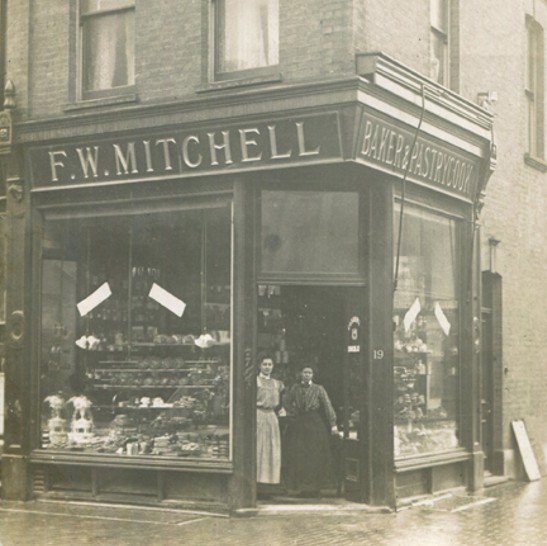
Ernest Henry Mitchell was born in the autumn of 1889 in Worthing, West Sussex. The second of five children, he was the eldest son of Frederick and Rhoda Mitchell. Frederick was a baker and confectioner, and the family lived in and around the town centre. The 1891 census found them at 29 West Buildings; ten years later they were living at 7 Clifton Road; the 1911 census recorded the family at 62 Chapel Road.
By this point, FW Mitchell’s was a well known bakery, and would remain so through to the 1960s. The Chapel Road shop was bombed during the Second World War, and the family moved the business to North Road.
The 1911 census showed what the bakery has become. Frederick and Rhoda were running the business, while their three sons – Ernest, Reginald and Frederick Jr – were also involved. Their eldest daughter, Rhoda Jr, was an elementary school teacher, while their youngest child, Edgar, was still at school. The Chapel Road property was a bustling affair: the Mitchells employed four live-in servants: Emily Lyon, Annie Dannage, and Mabel Swan as shop assistants, and Edith Blunden as a domestic.
Away from work, Ernest showed other talents. “He was possessed of musical inclinations, and was at one time a member of the Choir of the Congregational Church, as well as of the Choral Society.” [Worthing Gazette: Wednesday 31st October 1917]
In January 1913, Ernest married Constance Banwell. She was the eldest daughter of nurseryman Henry Banwell and his wife, Ellen, and lived on Christchurch Road, not far from the Mitchells’ shop.
When war broke out, Ernest stepped up to serve his country. His service records show that, while he enlisted on 9th December 1915, he was not formally mobilised until March 1917. As a Trooper, he was assigned to the Household Battalion, and, after a brief period of training, he soon found himself in the thick of things.
The Household Battalion fought at Arras in the spring of 1917, but it was at Passchendaele that Ernest’s war was to come to an end. Wounded in the leg on 6th October – just three months after arriving in France – he was medically evacuated to Britain for treatment. Admitted to No. 2 War Hospital in Birmingham, he initially recuperated, but pneumonia took over and Trooper Mitchell succumbed. He passed away on 26th October 1917, at the age of 28 years old.
The body was removed from Birmingham, arriving in Worthing at midnight on Monday; and the internment took place at the Cemetery yesterday afternoon [20th October]. Among those who attended the ceremony were two soldier brothers of the deceased – RA Mitchell, who is in the Royal Flying Corps; and FE Mitchell, of the Middlesex Regiment. Still another brother is serving his Country in a Military capacity. This is Fred Mitchell, formally Organist of the Congregational Church, who is in the Army Service Corps, and was unable to be present yesterday, for he is now in Hospital in Wiltshire.
[Worthing Gazette: Wednesday 31th October 1917]
Ultimately, Ernest Henry Mitchell would be the only one of his siblings to pay the ultimate price while serving his country. He was laid to rest in the family plot in Broadwater Cemetery, on the then outskirts of the home town.
Ernest’s headstone also pays tribute to Alan Frederick Gill, who died in April 1925. This was his sister Rhoda’s child, who died at just four-and-a-half years old.







 Death and Service