Tag Archives: wounded

Corporal George Collins

Corporal George Collins

The funeral of Corporal GH Collins, of the Royal Engineers, who died at Devonport at the age of 46, took place at Tiverton, where his mother and stepfather and sister reside. Corporal Collins’s wife and two children are at present in India. He had been in the army since 1899, and served in the South African War, for which he received the Queen’s and King’s medals with four clasps. He went to India in 1902, where he remained until the outbreak of the present war, when he came to France with his regiment. Corporal Collins was wounded, losing two fingers. He afterwards contracted fever, from which he died. The funeral was accorded military honours.

[Exeter and Plymouth Gazette – Monday 29 October 1917]

George Henry Collins was born in West Anstey, Devon, and was the son of George and Harriett Collins. There is little additional information about his early life available, and his was not an uncommon name in the area at the time.

George married Stella Euphrasia Constance O’Leary on 11th October 1911. At the time he was stationed in Myanmar, and the couple exchanged vows in the town of Maymyo, to the west of Mandalay. They would go on to have two children: Mary was born in August 1912, with Gertrude arriving the following November.

When the First World War broke out, it seems that Corporal Collins initially joined the Devonshire Regiment, but soon transferred to the Royal Engineers. Documentation suggests that he was assigned to the Special Brigade Depot at Saltash, Cornwall. However, this may have been the unit he was nominally allocated to when arrived in Britain for treatment to his injuries.

Frustratingly, there is little additional information available about George’s life. He died on 21st October 1917 was laid to rest in Tiverton Cemetery.


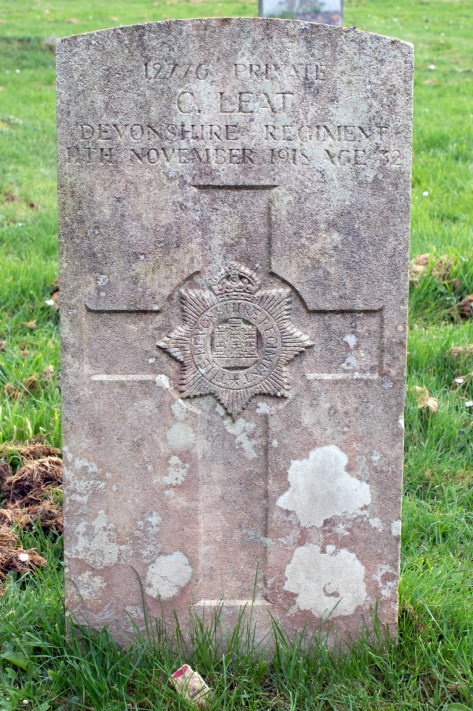
Private Charles Leat

Private Charles Leat

Charles Leat was born at the start of 1888 in Tiverton, Devon. One of thirteen children, his parents were Sidney and Ann Leat. Sidney worked as a lace maker, and the family lived in a crowded cottage on St Andrew Street to the south of the town centre.

When Charles left school, he found work as a grocer’s errand boy. Sidney died in 1897, Ann had to take on lace work herself. The house was too small for the growing family, and so the 1901 census found Charles and his brother Arthur living with his maternal aunt, Mary.

Things had moved on as the new century progressed. By 1911, Charles had moved to South Wales, and was living with his older brother, James, and his family in Glamorgan. James was a house painter, but his sibling had taken on work as a railway porter, and the family lived in terraced house at 57 Tydfil Street, Barry.

When war hit Europe, Charles seemed keen to play his part. Sadly, full details of his military service have been lost to time, but it is clear that he initially enlisted in the opening weeks of the conflict. Joining the Devonshire Regiment, he was assigned to the 11th Battalion.

A later newspaper report suggests that he “had been through most of the fighting on the Western Front… [and] was seriously wounded in 1915.” [Western Times – Friday 15 November 1918] It was after he had recuperated that Private Leat was reassigned to the regiment’s Labour Corps.

By the summer of 1918, Private Leat was serving on Salisbury Plain, Wiltshire. While here, he fell ill, and was eventually admitted to the Amesbury Military Hospital. His condition, pneumonia, was to prove too severe for his body to take, however, and he passed away from the condition on 11th November 1918, Armistice Day. He was 30 years of age.

Charles Leat’s body was taken back to Devon for burial. He was laid to rest in Tiverton Cemetery, not far from where his family still lived.


Private Gilbert Smyth

Private Gilbert Smyth

Gilbert Rowland Locke Smyth was born in the summer of 1897, and was the oldest of three children to Charles and Elizabeth. Charles was a postman and bootmaker and both he and his wife came from North Molton in Devon. The 1901 found the young family taking rooms in Dobbs Cottage on East Street, midway between two pubs: the Poltimore Arms and the Miner’s Arms.

Gilbert – who was better known as Roy – found work as a clerk she he finished his schooling. By the time war broke out, he was had moved to East Sheen, Surrey, and was employed by the civil service. He was keen to play his part, and enlisted in the army on 10th December 1915.

Initially assigned to the Suffolk Regiment, Private Smyth’s service records give an insight into the young man he had become. At eighteen years of age, he was 5ft 8.5ins (1.74m) tall, and weighed 112lbs (50.8kg). While he had worn spectacles for a couple of years, he was noted as being of fair physical development. The document confirms that he had a mole on the top of his right arm.

Roy was not formally mobilised until October 1916. After four months’ training on home soil, his unit, the 14th Battalion, was sent to France. Private Smyth remained overseas for nearly a year, during which time he transferred to the 12th Battalion of the York & Lancashire Regiment.

At the end of July 1918 Roy was caught up in a German gas attack, and this would have a long-term effect on his health, particularly his eyesight. He returned to Britain on 30th November 1918, and, after a couple more months spent in France, he was formally discharged from the army on medical grounds on 5th April 1919.

The deepest sympathy is extended to Mr and Mrs C Smyth in the loss of their eldest son, Roy… Deceased, who was employed in London in the Civil Service, was taken ill with pneumonia, and died before his father could arrive.

[Exeter and Plymouth Gazette: Friday 6th August 1920]

Gilbert Rowland Locke Smyth died on 3rd August 1920: he was 22 years of age. He was brought back to Devon for burial, and was laid to rest in All Saints’ Churchyard in his home village of North Molton.


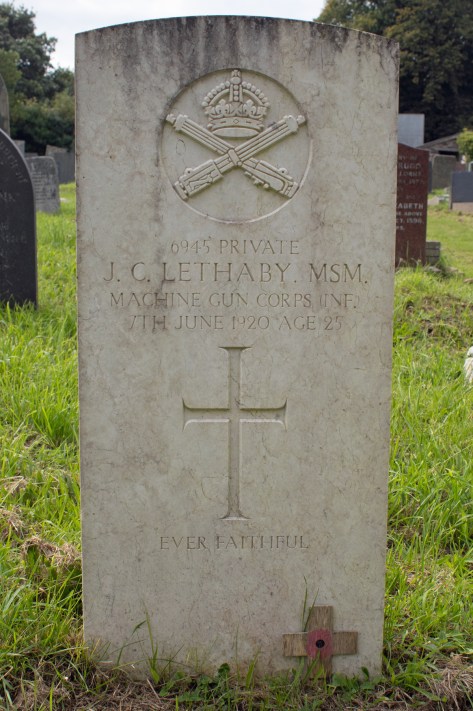
Private John Lethaby

Private John Lethaby

The news of the death of ex-Gunner JC Lethaby, who passed away early on Monday morning last. was received… with deep regret. On the outbreak of war he was only 16 years old, but when the call came for volunteers, he put his age to 19 and enlisted. He proved his worth on the battlefields of Flanders and after being wounded, was gassed, his work as a first class machine gunner calling him into much danger. He recovered from his injuries to some extent, but after demobilisation, his health broke down and he gradually sank. His pain and suffering during the past months were borne with much patience. Last week he earnestly begged to be removed to his home… and he was brought by motor car.. on Sunday afternoon, but he passed away the next morning. He leaves a wife and child to mourn their loss, and sympathy is expressed with them as also with his mother, father, brothers and sisters… Always of a cheerful disposition deceased had a host of friends, especially among the young men of the parish. He was awarded the Meritorious Service Medal and was entitled to the 1915-1915 Bronze Star.

[Tiverton Gazette (Mid-Devon Gazette): Tuesday 15th June 1920]

Despite the John Charles Lethaby’s obituary, there is little additional information about his early life. He does not appear on the 1901 or 1911 census returns, and there is no obvious sign of a birth or marriage certificate.

The Commonwealth War Graves Commission gives his wife’s name as Clara, and a later military record suggests that she moved to Hitchin, Hertfordshire, after her husband’s death. The 1921 census noted that she was living with her parents, Arthur and Eliza King, and had her daughter, Ada, with her.

The newspaper report suggests that John was born in 1898, which would have made him 22 when he died on 7th June 1920. His headstone gives his age as 25, which would fit in with the obituary commenting that he had added three years to his age in order to enlist. He appears to have joined the 3rd Battalion of the Devonshire Regiment, before transferring across to the Machine Gun Corps.

John Charles Lethaby was discharged from army on medical grounds on 19th April 1919. He died of pulmonary tuberculosis just over a year later, and was laid to rest in All Saints’ Churchyard, North Molton, Devon.


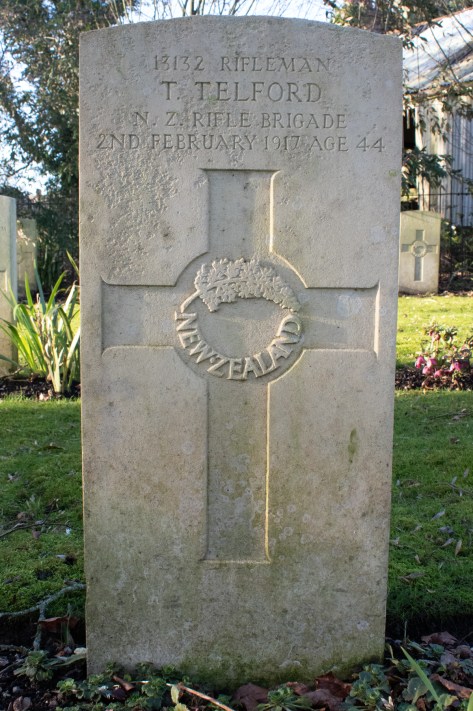
Rifleman Thomas Telford

Rifleman Thomas Telford

Thomas Telford was born in Bacchus Marsh, Victoria, Australia, on 31st July 1873. The fifth of eleven children, his parents were James and Mary Telford.

There is little additional information about Thomas’ early life. By the time war broke out, he had moved to New Zealand, and was working as a bushman, based out of Whanganui on the south coast of North Island.

Thomas enlisted on 18th January 1916, and would be assigned to the New Zealand Rifle Brigade. His service records show that, at 42 years of age, he was 5ft 5ins (1.65m) tall, and weighed 149lbs (67.6kg). A Roman Catholic, he had iron grey hair, blue eyes and fair hair.

Rifleman Telford’s unit left New Zealand in the spring of 1916. After five weeks in Egypt, he arrived on British soil on 7th August, marching from Southampton, Hampshire, to the Sling Camp in Wiltshire.

By 20th August, Thomas was in France, fighting on the front line. He was injured less than three weeks later and, after initial treatment in France, he was medically evacuated to Britain at the end of September.

Rifleman Telford spent time convalescing in a military home in Hornchurch, Essex, before being transferred to the ANZAC base in Codford, Wiltshire. That winter he contracted pneumonia, and he was admitted to the No. 3 New Zealand General Hospital on the outskirts of the village.

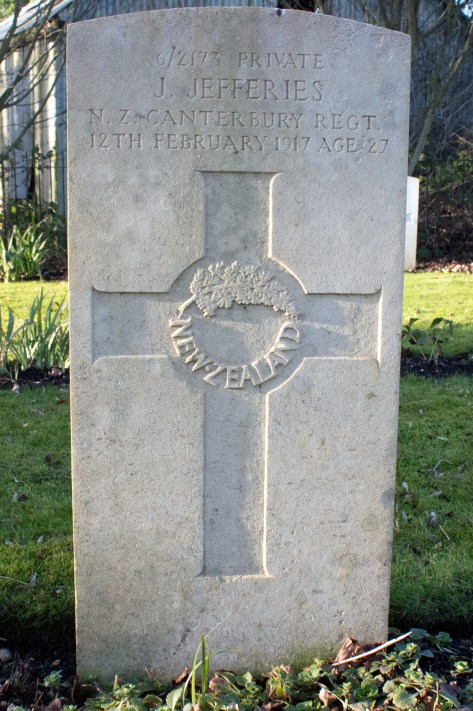
Sadly, the lung condition was to prove the better of Thomas. He passed away on 2nd February 1917, at the age of 43 years old.

Thousands of miles from home, Thomas Telford was laid to rest in the graveyard extension to St Mary’s Church in Codford, not far from where he had breathed his last.


Private James McLeod

Private James McLeod

James McLeod was born on 15th April 1893 in Dunedin, New Zealand. There is little further information about his early life, although the Commonwealth War Graves Commission give his father’s name as Samuel, and his service records note his next-of-kin as his brother, George McLeod.

James was employed by A&T Watt as a French polisher. However, he gave that up on 25th January 1915, when he enlisted in the New Zealand Expeditionary Force. His service records show that he was 5ft 8.5ins (1.74m) tall, and weighed 166lbs (75.3kg). He was recorded a having fair hair, blue eyes and a fair complexion.

Private McLeod was assigned to the New Zealand Otago Regiment, and undertook his initial training on home soil. He evidently showed some promise as, on 1st May, he was promoted to Lance Corporal. Six weeks later his unit was heading for Europe, and by the summer James was in Egypt.

On 20th August 1915, Private McLeod was admitted to the New Zealand and Australian Convalescent Hospital in Mena with a gun shot wound to his finger. He remained there for three weeks, returning to his unit in time for them to leave for the Dardanelles on 7th November 1915.

What happened to James over the next couple of months is uncertain. Certainly he was on the Greek island of Moudros by 18th November and in the Dardanelles on 7th December 1915. Just 20 days later he was back in Alexandria, and he would remain there for the next few months. There is, however, nothing in his medical record to suggest that his return to Egypt was on health reasons.

On 6th April 1916, Private McLeod was on the move again, this time to France. He was wounded again on 14th July 1916, and medically evacuated to Britain for treatment. Details of this injury are not clear, but he was admitted to the 2nd London General Hospital in Chelsea, Middlesex. After a month recuperating, James was released from hospital and sent to camp in Hornchurch, Essex. At this point he was also demoted to Private, although, again, the reason is unclear: it may have been a personal choice, or the reversion may have been connected to his injuries.

In September 1916, Private McLeod was transferred to the ANZAC Camp on the outskirts of Codford, Wiltshire. That winter he contracted pleurisy, and he was admitted to the No. 3 New Zealand Hospital, which was connected to the camp, on Christmas Day. His condition worsened, and James passed away from pneumonia on 28th December 1916. He was just 23 years of age.

Thousands of miles from home, James McLeod was laid to rest alongside his fellow soldiers in the extension to the graveyard of St Mary’s Church, Codford.


Lieutenant Charles Vanstone

Lieutenant Charles Vanstone

Charles Douglas Howard Vanstone was born in Paignton, Devon, on 27th October 1888. The fourth of seven children, he was the second son to Frederick and Charlotte Vanstone. Frederick was an architect’s surveyor and civil engineer, and the family lived comfortably in the seaside town.

The 1891 census found them living at Sorrento, a villa on Esplanade Road, overlooking the sea. By the time of the next census, they had moved to Torbay Park, and lived in a 12-room property. The family’s three sons all followed in their father’s trade, and, according to the 1911 return, four of the Vanstones were recorded as being civil engineer architects and surveyors.

When war came to Europe, Charles stepped up to play his part. He received a commission in August 1915 and, as a Second Lieutenant, was assigned to the Rifle Brigade. Attached to the 15th (Reserve) Battalion, the records suggest that he was in France by 23rd March 1916.

Lieutenant Vanstone seems to have been part of a Trench Mortar unit at the Somme. Wounded during the battle, he was medically evacuated to Britain for treatment. Admitted to the Reading War Hospital in Berkshire, his injuries were to prove too severe. Charles passed away on 7th February 1917: he was 28 years of age.

Charles Douglas Howard Vanstone’s body was brought back to Devon for burial. He was laid to rest in his home town’s sweeping cemetery.


Charles’ death was the third loss for the Vanstone family in as many years. His older sister, Constance, had died in 1914, while his younger brother, Stanley, a Lieutenant in the 20th Royal Fusiliers, died of wounds he received on the Western Front in October 1915. Just 25 years of age, he is buried in Merville Communal Cemetery, France.


Private George Whiteway

Private George Whiteway

George William John Whiteway was born in Paignton, Devon, on 4th February 1893. The youngest of three children, and the only son, his parents were William and Sarah Whiteway.

William was a journeyman painter, and from at least when his son was born, the family lived in a small terraced house, 9 Tower Road, on the outskirts of the town centre.

By the time of the 1911 census, George had completed his schooling, and was working as an apprentice painter. It is unclear whether this was under his father’s tutelage, as he gave his employment as verger and caretaker of the local parish church.

When war broke out, George stepped up to play his part. He enlisted in Torquay on 1st December 1915, and his service records note that he was of good physical development, stood 5ft 6.25ins (1.68m), and weighed 126lbs (57.2kg). He was also recorded as having light brown hair, brown eyes and a fair complexion.

Initially assigned to the Duke of Cornwall’s Light Infantry, Private Whiteway was transferred to the London Regiment and attached to the 3rd/21st Battalion. By the summer of 1916 George had transferred to the 1st/21st (County of London) Battalion, also known as the First Surrey Rifles. On 15th June his unit was sent to France, and he soon found himself in fighting on the Somme.

Private Whiteway’s time in France was to be a brief one. Caught up in the Battle of Flers-Courcelette, he was wounded in the back and neck, and, after initial treatment on site, he was medically evacuated to Britain.

It is unclear where George was first admitted, but by February 1917, he was being tended to in the Voluntary Aid Detachment Hospital in his home town, Paignton. He remained there for a couple of month, before being released back to duty.

Private Whiteway’s time fighting was over. He was transferred to the 619th Home Service Employment Company of the Labour Corps, and would spend the next year in and around Winchester, Hampshire. It is evident, however, that George’s health had been impacted. By March 1918 he was in hospital again, this time close to his army base. Suffering from a combination of peritonitis and tuberculosis, the contagious nature of the latter condition would lead to his dismissal from military service, and he was formally stood down on 29th April 1918.

At this point, George’s trail goes cold. It seems likely that he returned home, as his death was recorded in Totnes, Devon. He breathed his last on 25th August 1918: he was 25 years of age.

George William John Whiteway was laid to rest in Paignton Cemetery, a short walk from his family home.


Guardsman Frederick Madge

Guardsman Frederick Madge

Frederick Walter Smith Madge was born on 29th April 1886 and was the youngest of three children to Walter and Elizabeth. Walter was a painter from Paignton, and it was in the Devon town that the family was raised.

When Frederick finished his schooling, he found employment as a errand boy. By the 1901 census, the family were living on Princes Street, and his older sisters were both working as domestic servants. The next census found Frederick as the only one of the Madge siblings still living at home: he was also now working a a painter, presumably assisting his father.

Early in 1913, Frederick married Sarah Bishop. Sadly, there is little information about her, but her father’s name was Nicholas, and she was living in Newton Abbot, Devon, at the time of the wedding, which took place in nearby Wolborough.

When war broke out, Frederick stepped up to play his part. His service records are long gone, but it is clear that he had enlisted before March 1917, and had joined the prestigious Grenadier Guards. Guardsman Madge definitely saw service overseas, and his unit was heavily involved in some of the key battles on the Western Front.

It was during this fighting, possibly at the Battle of Polygon Wood, that Frederick was injured. He was medically evacuated to Britain for treatment, and admitted to the Kitchener Military Hospital in Brighton, Sussex.

The funeral took place, at Paignton, on Wednesday, Rev. AR Fuller officiating, of [Guardsman] FWS Madge, 31, Grenadier Guards, who died on October 6th in hospital at Brighton, following an amputation of the leg. Deceased, who was well known in Paignton, was a member of the town Fire Brigade, and highly respected.

[Western Times: Tuesday 16th October 1917]

Frederick Walter Smith Madge was laid to rest in Paignton’s sweeping cemetery.


Able Seaman Arthur Crisp

Able Seaman Arthur Crisp

Arthur Edward Crisp was born in 16th March 1899 in the Norfolk village of South Creake. The youngest of six children, his parents were blacksmith Henry Crisp and his wife, Sarah.

When war broke out across Europe, young Arthur had already had some experience of seamanship, and was keen to play his part. He joined the Royal Navy on 7th April 1915 and, given his age, he was assigned the rank of Boy 2nd Class. Initially sent to HMS Powerful, he was trained there for three months, rising to the rank of Boy 1st Class.

On 26th July 1915, Arthur was assigned to the battlecruiser HMS New Zealand, and would remain on board for the next two years. During this time, he came of age, and was formally inducted into the Royal Navy as an Ordinary Seaman. His service records show that he was 5ft 5ins (1.65m) tall, with brown hair, grey eyes and a fresh complexion.

His stint on New Zealand also exposed him to naval warfare, as she was heavily involved in the Battle of Jutland in May 1916. Ordinary Seaman Crisp came through, however, and remained part of the battlecruiser’s crew for a further year.

After a short time on shore, where he was based at HMS Victory, the Royal Naval Dockyard in Portsmouth, Hampshire, Arthur’s next posting was on board HMS Wallington. A former trawler, she had been converted to a boom defence vessel, she protected the dockyard in Grimsby. In November 1917, while based in the Lincolnshire town, Arthur was promoted again, rising to Able Seaman.

The following March, Arthur moved again, and was assigned to HMS Attentive, the shore base for the Dover Patrol. He would not remain there for long, however, and was admitted to the Royal Naval Hospital in Chatham, Kent. He passed away on 17th March 1918, from an intriguing combination of gunshot wounds to his chest and pneumonia. He had turned 19 years old the day before.

The body of Arthur Edward Crisp was taken to nearby Gillingham for burial. He was laid to rest in the military section of the town’s Woodlands Cemetery.


Able Seaman Arthur Crisp
(from findagrave.com)