Category Archives: story

Private Albert Harvey

Private Albert Harvey

Albert James Harvey was born on 23rd May 1894 in the Gloucestershire village of Warmley. One of eleven children, his parents were James and Alice Harvey. James was a bootmaker, and most of Albert’s siblings followed him into shoemaking, but Albert bucked the trend, and found work with a baker when he left school.

He wanted bigger and better things, however, and so, on 26th April 1911, he enlisted in the Royal Marine Light Infantry. His service records record that Private Harvey was 5ft 5.5ins (1.66m) tall, with blue eyes, auburn hair and a fresh complexion. It also suggests that he added a year to his age, to ensure that he was accepted for duty.

After initially enlisting in Deal, Kent, Albert was sent to Plymouth, Devon, where he served for most of 1912. On 18th November that year, he was assigned to the dreadnought battleship HMS Conqueror, on which he was to serve for the nearly five years.

It was during his time on board Conqueror that Albert married Ethel Brewer. The daughter of a pressman, the couple exchanged vows at St Barnabas Church in their shared home village, Warmley.

Private Harvey remained serving throughout the war and, in April 1918, he was involved in the Zeebrugge Raid. This was an attempt by the Royal Navy to block the Belgian port by sinking obsolete ships in the canal entrance. During the operation, more than 200 men were killed and over 300 – including Albert – were wounded.

Private Harvey was medically evacuated to England for treatment, but his injuries were to prove too severe. He passed away in a hospital in Plymouth on 28th June 1918. He was just 24 years old.

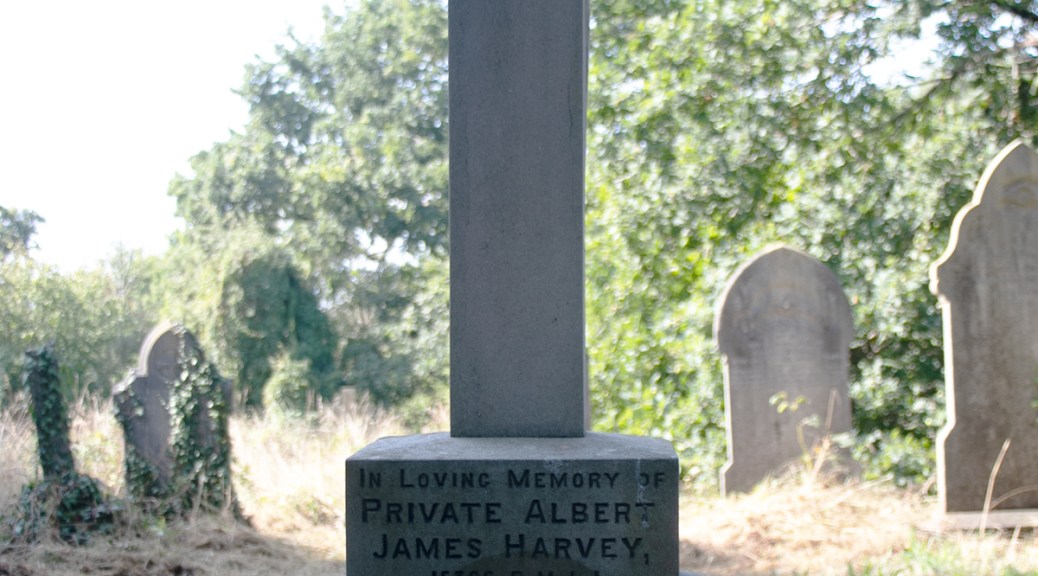
Albert James Harvey was brought back to Gloucestershire for burial. He was laid to rest in the graveyard of St Barnabas’ Church, where he has been both baptised and married.
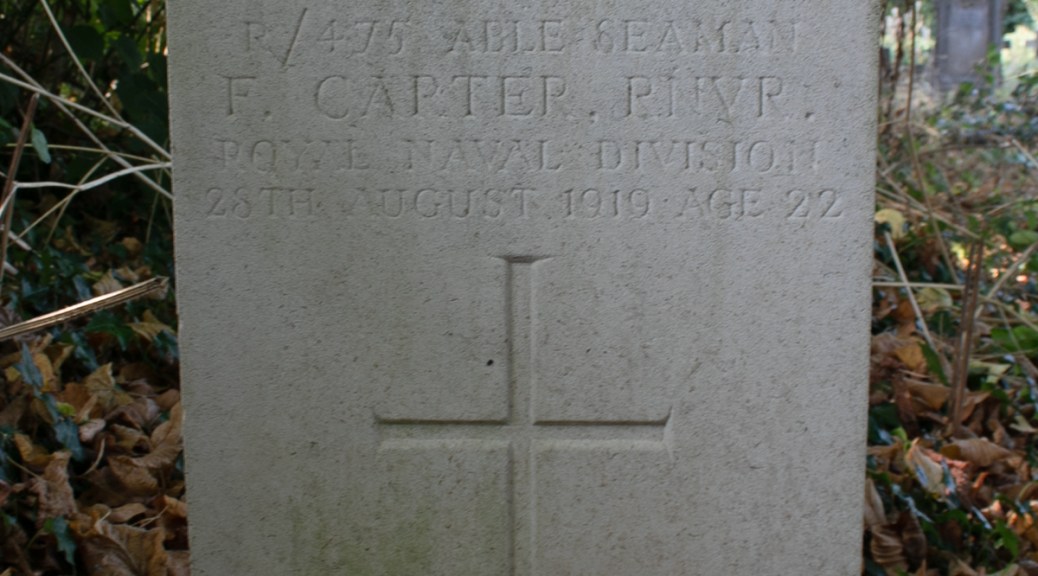
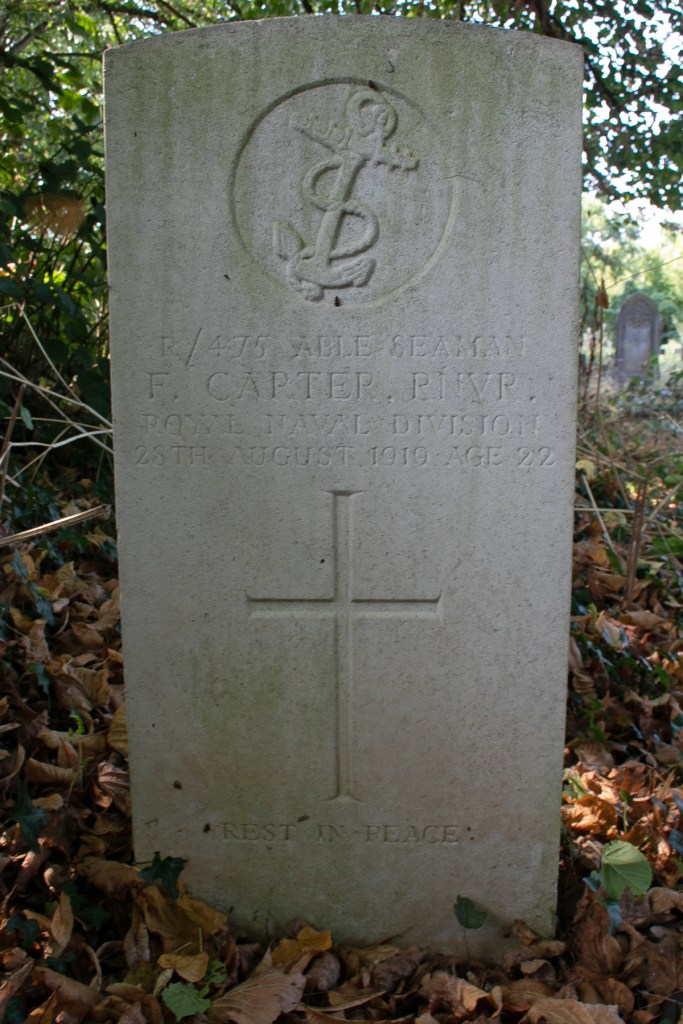
Able Seaman Frederick Carter

Able Seaman Frederick Carter

Frederick Carter was born in the autumn of 1896 in the village of Wick, Gloucestershire, midway between Bristol and Bath. He was one of nine children to farm labourer John and his wife, Charlotte.

Sadly, there is little concrete documentation on Frederick’s life. When he left school, he found work in the local shoe trade, as his older siblings had done before him.

At some point he enlisted in the Royal Naval Voluntary Reserve, although, again, exact details on this are scarce. This particular branch of the Royal Navy was there for people with no specific sailing or sea-faring experience behind him, although Frederick must have been dedicated to his duty as he had risen to the rank of Able Seaman.

What is clear is that he survived the war, but was invalided out of service, having contracted pulmonary tuberculosis. He returned to Warmley, Gloucestershire, where his parents were now living. Sadly, this was to be his last home, as well, as he passed away from the condition on 28th August 1919, at the age of just 22 years old.

Frederick Carter was laid to rest in the graveyard of St Barnabas Church, in Warmley, Gloucestershire.


Gunner George Curtis

Gunner George Curtis

George Henry Curtis was born in Oldland, near Bristol, in around 1887. His parents were George and Frances (Fanny) Curtis, and he was one of their four children.

There is little direct information about George’s life: his was a common name in the Gloucestershire area, and so it is difficult to identify if some documents are related to him nor not.

The first piece of concrete evidence for him is his marriage certificate. He wed Elizabeth May Henly on 7th November 1914. She was the daughter of an engineer, while George gave his trade as a tobacco operator (possibly making cigars and cigarettes). The wedding took place at St Anne’s Church in Oldland, local to bother bride and groom.

When war broke out, George stepped up to play his part and enlisted in the Royal Garrison Artillery as a Gunner. He did not see action overseas, but was awarded both the Victory and British Medals for his service.

Gunner Curtis’ adult life is hard to piece together. All that can be confirmed is that he passed away on 9th July 1921, at the age of 32 years old.

George Henry Curtis was laid to rest in the graveyard of the church in which he had been christened and married, St Anne’s in his home village, Oldland.


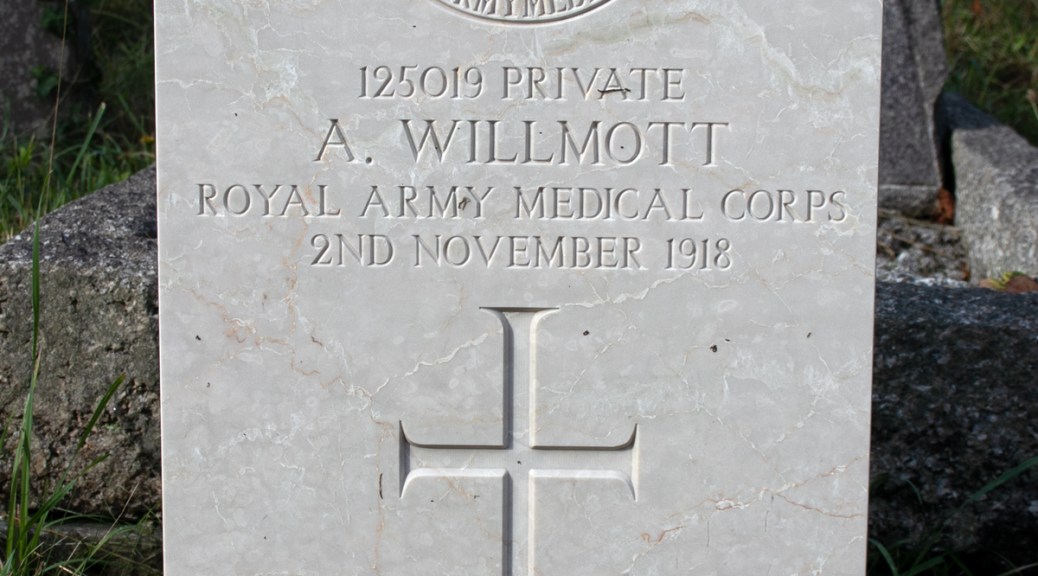
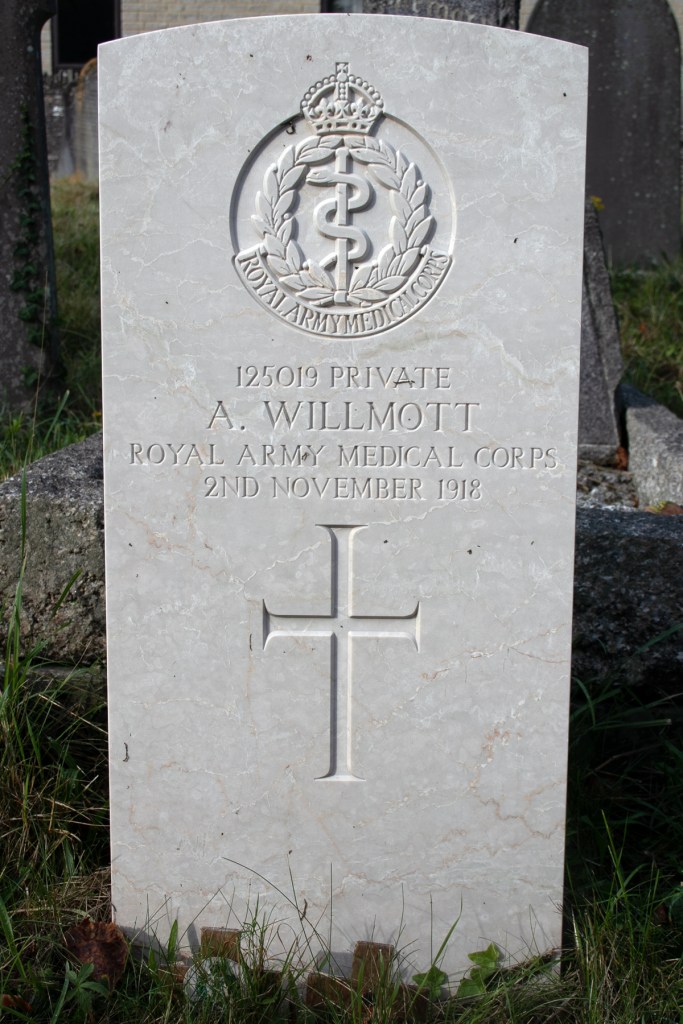
Private Alec Willmott

Private Alec Willmott

Alec William Willmott was born in 1886 and was one of six children to Henry and Ellen Willmott. Henry was a farm labourer from Oldland in Gloucestershire, and this is where the family were raised.

When he left school, Alec found work making shoes and boots at a local factory – this was work most of the Willmott children went into. On 24th April 1916, he married Elsie Frost in the local church. The couple set up home in Keynsham, and went on to have a son, Cecil, who was born in August 1917.

Alec played his part during the war. Full service details are not available, but it is clear that he had enlisted in the Royal Army Medical Corps by the spring of 1918. There is no confirmation of whether Private Willmott served at home or overseas, but, by October 1918, he had been admitted to the 2nd London General Hospital in Chelsea, suffering from a combination of influenza and pneumonia.

Sadly, these conditions put a strong pressure on his heart: Private Willmott passed away from cardiac failure on 2nd November 1918, at the age of just 32 years old.

Alec William Willmott was brought back to Gloucestershire for burial. He was laid to rest in the graveyard of St Anne’s Church in his home village, Oldland.


Private Frank Mayo

Private Frank Mayo

Francis James Stephen Mayo was born on 24th November 1894 in Oldland, a small Gloucestershire village near Bristol. One of eight children, his parents were collier Samuel Mayo and his wife, Diana.

Frank, as he was known, sought a life of adventure from the start. In July 1911, not content with life as a farm labourer, he enlisted in the Royal Navy as a Boy 2nd Class. His service records show that he was 5ft 5ins (1.65m) tall, had light hair, blue eyes and a fair complexion.

Sent to the training ship HMS Impregnable, Boy 2nd Class Mayo’s time there was short. When Samuel found out what his son had done, he paid £10 (the equivalent of around £1250 in today’s money) for his discharge.

Frank went back to farm work, but, with storm clouds brewing on European shores, his time was to come again. On 8th September 1914, just a month after war was declared, he enlisted. His service records show that he had gained an inch (2.5cm) in height since his attempt to join the Royal Navy.

Again, Frank’s attempt to escape what he presumably felt to be a humdrum life were thwarted. His service records confirm that he was discharged on medical grounds because he was deemed not likely to become an efficient sailor.

On Christmas Day 1915, Frank married Martha Sweet, the daughter of a chimney sweep. The couple settled down in Keynsham, not far from either of their families, and had a son, Henry. Frank, by this time, seemed to have given in to the inevitable, and looking for a regular wage, began working at one of the local collieries.

Frank still had a dream to fulfil, though, and with no end to the war in sight, he again enlisted, joining the Training Reserve in June 1917. His records show that he had gained another inch in height, and has a number of tattoos on his right forearm. His records this time show that he had a slight heart problem, and was also suffering from a touch of rheumatism.

Private Mayo was assigned to the 440th Company of the Labour Corps, and seemed, at last, to be fulfilling the role he had wanted to be doing for the last six years. As time went on, however, his health seems to have been failing him and, in the summer of 1918, he contracted pulmonary tuberculosis. He passed away from the condition on 30th August 1918, while at camp, aged just 23 years of age.

Brought back to Gloucestershire for burial, Francis James Stephen Mayo – or Frank – was laid to rest in the graveyard of St Anne’s Church in his home village of Oldland.


Corporal Ernest Jenkins

Corporal Ernest Jenkins

Ernest Gilbert Jenkins was born on 4th April 1888, the tenth of eleven children to Eli and Julia Jenkins. Eli was a dairyman from Dorset, but the family were born an raised in Marksbury, a village in Somerset. When Eli passed away in 1910, he was laid to rest in the nearby town of Keynsham, and this is where Julia and the family moved.

Ernest tried to make his mark by finding a career in the army and enlisted in the Royal Field Artillery on 22nd June 1908. He gave his trade as a electrician for the National Telephone Company and his records noted that he stood 5ft 7ins (1.70m) tall, with good vision and good physical development.

The 1911 census records the widowed Julia and five of her children living on Charlton Road, Keynsham, in a 12-roomed house, with a domestic servant and three visitors. While not noted as such, it would seem that Julia was running a boarding house, but without any further details, this is impossible to confirm.

Ernest may have completed his initial term of service by this point and he was recorded as living with his mother and working as a salesman of cattle feed. Bombardier Jenkins’ military records show uninterrupted service from 1908 to 1917, so it is likely that, at the time of the 1911 census, he was, in fact, on reserve.

When war broke out in 1914, Ernest was called back into duty. By March 1915, he found himself in France, having been promoted to Acting Corporal. He served on the Western Front until June 1916, when he was sent back home.

Corporal Jenkins seems to have been suffering with his health and, in July 1916 was admitted to hospital with pyrexia (fever). Medically evacuated to England for treatment, a heart murmur was also identified, and after treatment, he was relieved of active duty and placed on reserve in January 1917. The heart condition continued, however, and by the end of the year, he was medically discharged from the army.

At this point, Ernest’s trail goes cold. He returned to Bristol and is noted in the 1919 edition of Kelly’s Directory, as living back in Charlton Road with Julia.

The next record for Ernest confirms his passing. He died on 25th July 1919 in a nursing home in Bristol. He was just 31 years of age.

Ernest Gilbert Jenkins was laid to rest in the family plot in Keynsham Cemetery. When Julia passed away in 1929, at the age of 78, she was buried there as well, finally reunited with her husband and son.


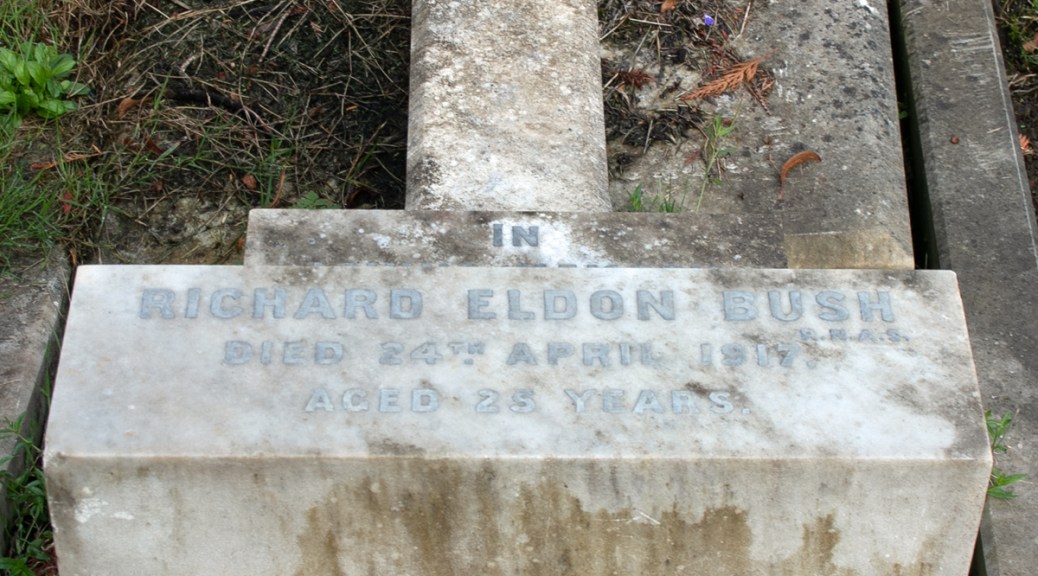
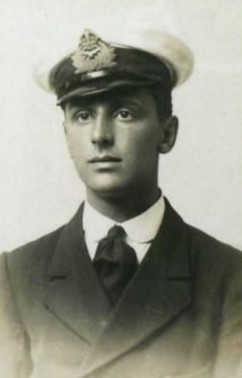
Flight Lieutenant Richard Bush

Flight Lieutenant Richard Bush

Richard Eldon Bush was born on 16th June 1891 in Keynsham, Somerset. The second of four children (all of whom were boys), his parents were Philip and Maria Bush. Philip was a solicitor, and with that status came opportunity for his children.

The 1911 census recorded the Bush family living in Keynsham with two servants – cook Clara Jones and parlour maid Laura Day. The two older boys – Richard and his older brother, Whittington, were both listed as Cambridge undergraduates, while his two young brothers were boarding at a private school in Repton, Yorkshire.

Richard had aspirations for a good life. In March 1914, he set sail for a life in Canada, looking to take up architecture in the colony. His time overseas wasn’t to be long, though, and, when war broke out in Europe, he returned home.

Full details of Richard’s military service are not available, but he joined the Royal Naval Air Service and, on 20th August 1915, he gained his wings. Richard rose to the rank of Flight Lieutenant, but tragedy was ahead.

On 24th April 1917, he was piloting a scout seaplane around the harbour in Fishguard, Pembrokeshire.

[He] failed to clear some overhead wires, and the seaplane swerved against the cliff with considerable violence, smashing the machine, which the petrol set alight, and crashed to the earth. When liberated from the blazing machine Lieutenant Bush rolled and extinguished his burning clothes.

Somerset Guardian and Radstock Observer: Friday 27th April 1917

Sadly, Flight Lieutenant Bush’s injuries proved too severe. He passed away a couple of days later, on 24th April 1917, at the age of 25 years old.

Brought back to Somerset for burial, Richard Eldon Bush was laid to rest in the cemetery of his home town, Keynsham.


Flight Lieutenant Richard Bush
(from astreetnearyou.org)

The same newspaper report noted that Richard’s brother Graham was an officer in the Royal Flying Corps. He had also been badly injured in a flying accident, but was, according to the report, “flying again now.


Private Robert Cantle

Private Robert Cantle

Robert Cantle’s life is one of hope and of tragedy. There is very little documentation on him, but what there is gives a hint to his life.

The 1911 census recorded him a living on Temple Street in Keynsham, Somerset. The head of the household was 86 year old John Cantle, a retired platelayer for Great Western Railway. His wife, Mary, was 22 years his junior, and they shared the house with their son, stationary cutter Ernest, his wife, Elsie, and their daughter, Madge. Robert was noted as being John and Mary’s adopted son. His age was given as 13, but his place of birth is ‘unknown’.

When war broke out, Robert joined the Wiltshire Regiment. Private Cantle set off for camp in Wiltshire in August 1917, and had been there for just two days when tragedy struck.

There were heavy thunderstorms in the Warminster district on Thursday, and while men of a unit of the Wiltshire Regiment were on the parade ground, three of them were struck by lightning. Pte. Robert Cantle, aged 19 years, whose home is at Keynsham, was killed on the spot, and the other two, Pte. Rowe and Pts Murgatroyd, were severely injured…

Sergeant Major HJ Bennett, of the Wilts Regiment, stated [at the inquest] the deceased lad had only just joined them. About 3pm on Thursday a squad was on the parade ground, when the signal was given to dismiss, as a storm was approaching. Immediately after there was a flash and a crash and it seemed to stagger everybody on the parade ground. Witness was brought to his knees, and when he recovered himself he saw three men, who of whom were struggling, on the ground. Private Cantle was found to be dead, and the other men recovered after being attended by a doctor. The squad consisted of recruits, and none of them were carrying arms.

Major Stocker, medical officer, said the crown of deceased’s cap was ripped off, and the body was burned from head to foot.

The jury returned a verdict of “Death from the effects of lightning.”

Somerset Standard: Friday 17th August 1917

Robert Cantle’s body was brought back to Keynsham for burial: he was laid to rest in the town’s cemetery.


Sapper Albert Headington

Sapper Albert Headington

Albert Edward Headington was born on 5th December 1876 in Keynsham, near Bristol, in Somerset. The ninth of eleven children, his parents were Joseph and Jemima Headington. Joseph was a stonemason and, while he seems not to have had his father’s talents, Albert worked with the same material, becoming a bricklayer’s labourer when he left school.

On 29th May 1899, Albert married Ellen Gray. She was a mason’s daughter from Semley in Wiltshire, and it seems that he was either working there or had some connection with the family through his father’s work. The couple settled down in Keynsham, and went on to have two children, Harold, who was born in 1900, and Edith, who was born in 1912.

By the time of the 1911 census, the family had settled in a small house in the middle of Keynsham. Albert had, by this point, found other employment, and was working for Great Western Railways as a packer.

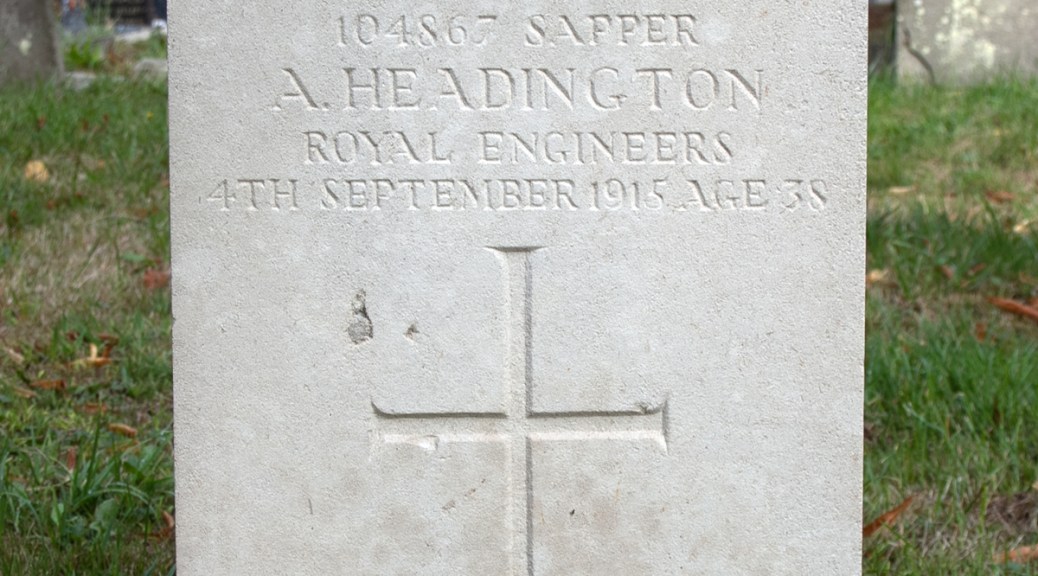
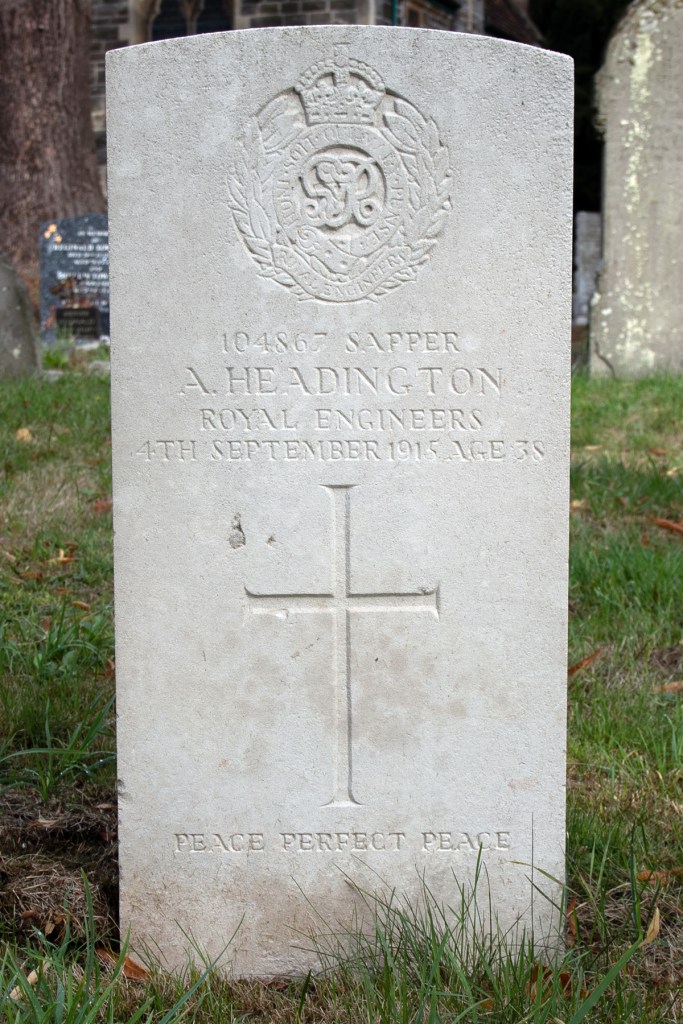
When war broke out, Albert stepped up to play his part. He enlisted on 22nd June 1915, joining the Royal Engineers as a Sapper. Sent for initial training in Chatham, Kent, he returned home on leave at the end of August. Tragically, he had fallen ill by this point, and died at home on 4th September 1915, having contracted cerebrospinal meningitis. He was 38 years of age.

Albert Edward Headington was laid to rest in the quiet cemetery of his home town of Keynsham.


Ellen went on to live a full life. She and Edith emigrated to Canada in 1921, following Harold, who had made the same move a year earlier. They all settled in the town of Welland, Ontario, not far from Niagara Falls.

Both of Albert and Ellen’s children married and had children of their own. Ellen never remarried, and passed away on 4th November 1956, at the age of 80 years old. She was laid to rest in the Holy Trinity Anglican Cemetery in Welland.


Private George Garrett

Private George Garrett

George Garrett was born in early 1895 in Abbotskerswell, Devon. He was the oldest of five children to George and Annie Garrett. George Sr was a labourer and the family seemed to travel with his work: his and Annie’s younger children were born in Aldershot, Plymouth and London.

When he left school, George Jr found work as an errand boy – the family were back in Devon by this point. War was on the horizon, however, and he would feel compelled to play his part. Full details of his service are not available, but it is known that he enlisted in the Devonshire Regiment, and was assigned to the 2nd Battalion.

Private Garrett arrived in France in December 1915, and was soon entrenched on the Western Front. Hi battalion was caught up in the Battle of the Somme and George was badly injured, having received a gunshot wound to his spine.

Medically evacuated to Britain, his wounds proved too severe for him to return to duty, and he was discharged from the army on 28th December 1916. It is not clear whether he returned home, but it seems likely that he remained in hospital in Exeter. He would never recover from his injuries. He passed away at the hospital on 18th April 1917, at the age of 22 years old.

George Garrett was laid to rest in the graveyard of St Andrew’s Church in Ipplepen, Devon, where his family were, at that point, living.