Category Archives: unknown

Air Mechanic Walter Naish

Air Mechanic Walter Naish

Walter Matthias Naish was born in the autumn of 1896, and was one of of five children to agricultural labourer Matthias Naish and his wife, Sarah Ann. Born in Lovington, near Castle Cary, Somerset, this is where the family is recorded as living for the 1901 and 1911 censuses.

When he left school, Walter found work as a cabinet maker; war was on the horizon, however, and he enlisted on 28th February 1916. He was immediately put on reserve, however, and was only mobilised in January 1917, when he was assigned to the Royal Flying Corps as an Air Mechanic.

Tragically, Walter’s military career was not to be a long one. He was admitted to the Connaught Hospital in Aldershot with conditions unknown, and passed away on 3rd March 1917, just 51 days after leaving home. He was just 20 years old.

Walter Matthias Naish’s body was brought back to Somerset for burial. He lies at rest in the Castle Cary Cemetery, not far from his home.


Private Cuthbert Collard

Private Cuthbert Collard

Cuthbert William George Collard was born in the spring of 1899, one of nine children to William and Eliza Collard. William was an agricultural labourer from North Newton in Somerset, and this is where he and Eliza raised their family. While probably helping his father out as a child, Cuthbert found work at the local blacksmith’s when he left school.

Cuthbert was barely fifteen when war broke out in Europe, and so had to wait until April 1917 before he was of age to enlist. He joined the Devonshire Regiment, and his service records show that he was 5ft 2ins (1.57m) tall, had black hair, brown eyes and a pale complexion.

Assigned to the 4th (Reserve) Battalion, Private Collard served his time on home soil. While full details are not available, it appears that he contracted tuberculosis during his training. This was serious enough for treatment in a sanatorium to be recommended, and he was medically discharged from military service because of the lung condition on 9th January 1918. He had been in the army for just 280 days.

At this point, Cuthbert’s trail goes cold. Whether he was admitted for medical treatment is unclear, but it appears that he returned to North Newton. He passed away on 19th June 1919 at the family home, aged just 20 years old.

Cuthbert William George Collard was laid to rest in the graveyard of the village church, St Peter’s.


Lieutenant Cecil Pearse

Lieutenant Cecil Pearse

Cecil George Lunell Pearse was born in the spring of 1883, one of seven children to George and Elizabeth Pearse. George was a schoolmaster from Devon, who moved the family to Weston-super-Mare in Somerset in the the 1870s to take up a post at the National School in the centre of the town.

Cecil and at least two of his siblings also went on to become teachers. By the time of the 1911 census, he was living in Plumstead, South East London, with his brother and sister-in-law, and teaching locally.

War was about to descend on Europe, and it is at this point that Cecil’s trail begins to go cold. He enlisted in the Royal Field Artillery, serving as part of the 8th London Howitzer Brigade. During his time, he rose to the rank of Lieutenant, and it seems that he remained part of the Territorial Force, but there is little more information available about his time in the army.

Nor is there much detail around Lieutenant Pearse’s death. He passed away on 20th October 1918, at the age of 35 years old, through causes unrecorded.

Cecil George Lunell Pearse was laid to rest in the Milton Road Cemetery in Weston-super-Mare, the town of his birth.


Major Stafford Douglas

Major Stafford Douglas

Stafford Edmund Douglas was born on 4th January 1863, the second of four children to Stephen and Mary Douglas. Stafford came from a military family, his father having been a Captain in the Royal Navy. This led to a lot of travelling and, having been born in Donaghadee, County Down, he then moved to South Wales.

By the 1880s, when Stephen and Mary had set up home in Portsmouth, Stafford had started to carve out a career for himself, and was a Lieutenant in the Argyll and Sutherland Highlanders, based at Edinburgh Castle.

Over the coming years, Lieutenant Douglas, who stood 5ft 8.5ins (1.74m) tall and also spoke French, travelled the world, serving in South Africa, Ceylon (Sri Lanka) and Hong Kong. By 1894 he had made Captain, and he finally retired in 1903, after nineteen years’ service.

On 29th April that year, at the age of 40, Stafford married Mary Louisa Harris. She was the daughter of an army colonel, and the couple wed in St George’s Church, Hanover Square, London. The couple set up home in Exeter, Devon, and went on to have two children – Violet and Stafford Jr.

At this point, Stafford’s trail goes cold. When war broke out in 1914, he was called back into duty, working as a Railway Transport Officer in Norwich. He continued in this role until 1919, before being stood down and returning home.

Stafford Edmund Douglas passed away on 15th February 1920, at the age of 57 years old, although no cause of death is immediately apparent. He was laid to rest in the Milton Road Cemetery in Weston-super-Mare, presumably where his family were, by this time, residing.


Private John Payne

Private John Payne

John Spencer Payne’s life is a bit of a challenge to piece together, as there is little documentation available. He was born in 1894 in the village of Overton-on-Dee, near Wrexham and was one of two children to Charles and Elizabeth Payne. John was christened in Tenby, Pembrokeshire, at which point, his father’s trade was ‘gentleman’.

The next available document for John is the 1911 census. This records him as living in Weston-super-Mare, Somerset, where he was working as a bank clerk. He was living in Severn Road, to the south of the town centre, with his now-widowed mother, his older sister and his maternal aunt.

War came to Europe in 1914, and, while there is limited information about John’s service, it is clear that he had enlisted by September 1915. He joined the Royal Gloucestershire Hussars as a Private and was assigned to the 2nd/1st Battalion.

The battalion was a second-line unit, that remained in England until late in the war, when it transferred to Ireland. By the spring of 1916, it had become a cyclist unit although, with no other documentation for Private Payne, it is impossible to determine how or when he served.

Sadly, too, the only other document about Private Payne’s life is the confirmation of his death. He passed away at home on 10th February 1916, although the cause of his death is not recorded. He was just 22 years old.

John Spencer Payne was laid to rest in the Milton Road Cemetery in Weston-super-Mare.


Private John Payne
(from findagrave.com)

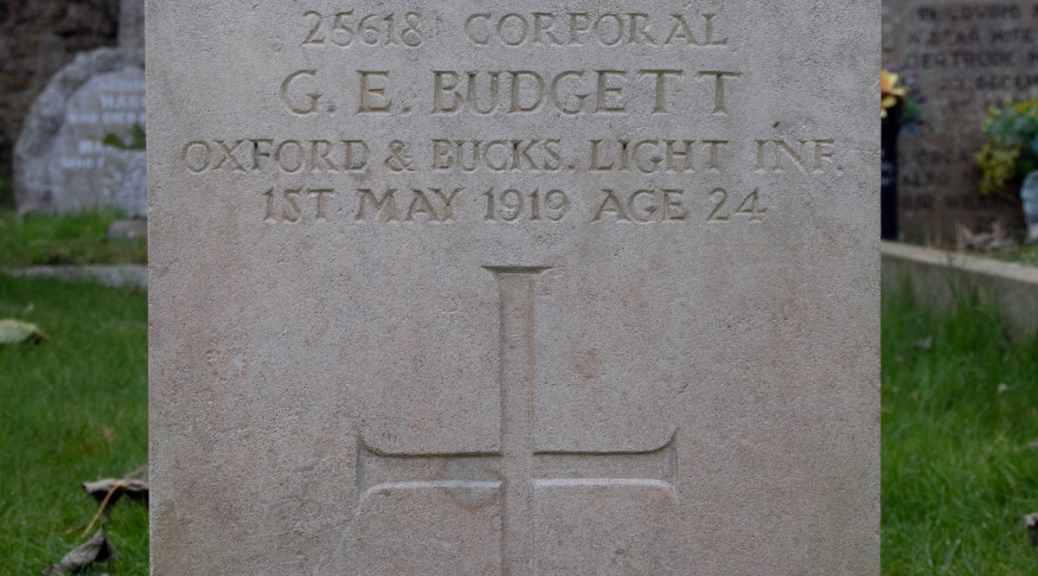
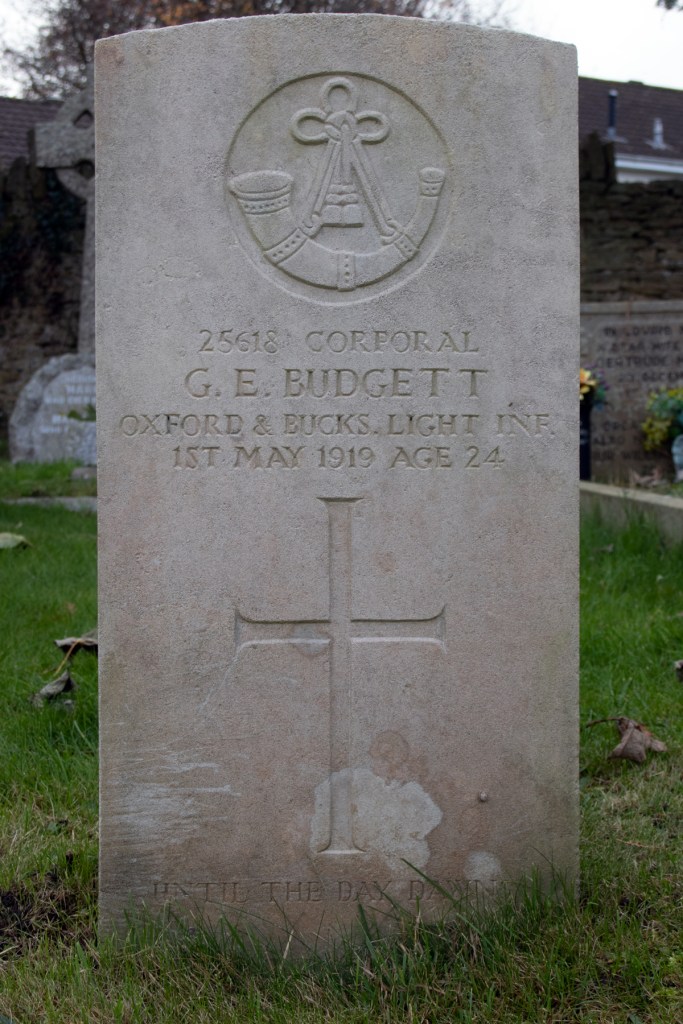
Corporal George Budgett

Corporal George Budgett

George Edgar Budgett was born in Frome, Somerset in the autumn of 1894, and was one of ten children to Joseph and Annie Budgett. Joseph was a labourer on the roads, but Annie and their eight daughters all went into the town’s silk weaving industry. When they left school, George and his older brother Frederick both found labouring work – Frederick at a bell foundry, George in the silkworks.

Conflict was coming to Europe and, within weeks of the war being declared, George enlisted. He was assigned to the Oxfordshire & Buckinghamshire Light Infantry as a Private and his service records show that he stood 5ft 5ins (1.65m) tall, weighed 114lbs (51.7kg), had dark brown hair and brown eyes.

Private Budgett initially served on home soil, but by May 1915 he was sent to France as part of the British Expeditionary Force, receiving a promotion to Corporal in the process. He had been on the front line for a little over a month when he was wounded at Ypres. He received a shrapnel wound to his left hand and had to have his little finger amputated in the camp hospital. He was then medically evacuated back to England for further treatment and recovery.

George was admitted to the City of London War Hospital in Epsom, and needed a further operation, this time the amputation of the third finger. His health recovered, but the injury to his hand resulted in him being medically discharged from the army on 25th August 1916.

Sadly, at this point Corporal Budgett’s trail goes cold. He passed away at home, through causes unrecorded, on 1st May 1919. He was just 24 years of age.

George Edgar Budgett was laid to rest in the graveyard of Holy Trinity Church in his home town of Frome, Somerset.


George’s brother Frederick – Joseph and Annie’s only other son – also fought in the First World War. He was assigned to the 14th Battalion of the Gloucester Regiment, and was missing in action, presumed dead on 4th April 1918 – possibly during the Battle of the Avre. He was commemorated at the Pozières Memorial in northern France.


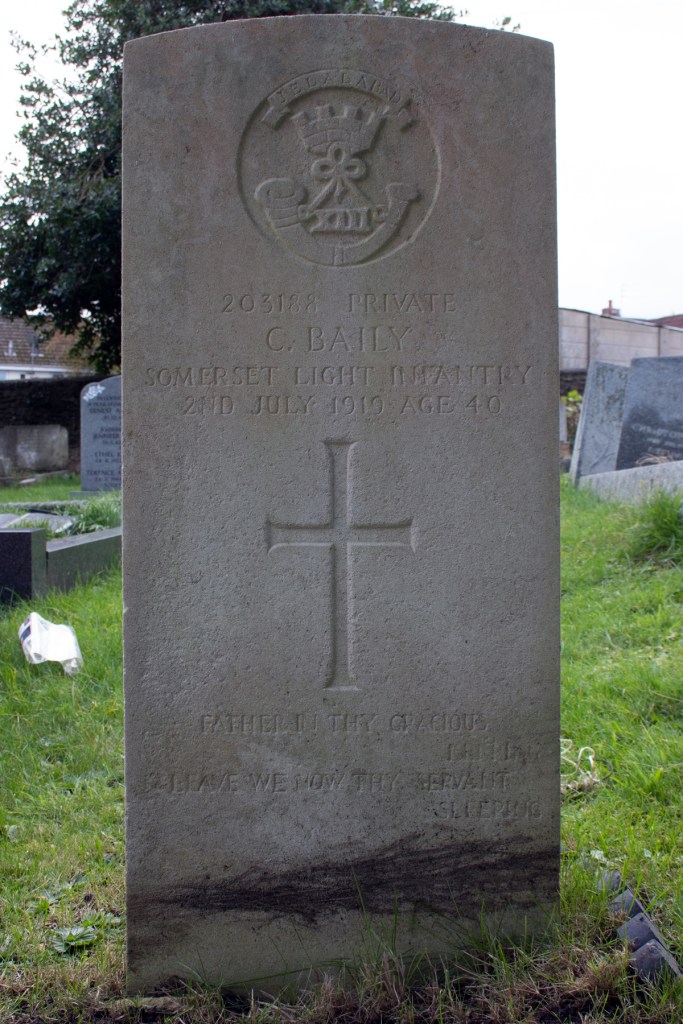
Private Charles Baily

Charles Baily

Charles Baily was born in Frome, Somerset, in March 1879; he was the middle of three children to Charles and Sarah Baily. Charles Sr was a plasterer, and the family were raised in a small cottage to the south of the town centre.

When Charles Jr left school, he found work as a carpenter and, on 17th March 1902, he married local woman Fanny Howell. Her father was a carter and she had not long returned from South Wales, where she had found employment as a parlour maid. Charles and Fanny set up home just three doors down from his parents, and went on to have five children.

War was coming to Europe, but the details of most of Charles’ military service are lost. He enlisted as a Private in the Somerset Light Infantry, and was assigned to B Company of the 1st/4th Battalion. The troop was sent to Bombay in the autumn of 1914; it then moved to Basra in the spring of 1916, remaining in Mesopotamia for the remainder of the conflict. Sadly, it’s not possible to know how much of this travel Private Baily undertook himself.

Charles survived the war, and was demobbed soon after the Armistice. He returned home, but his time back with his family was to be short: Private Baily died at home through causes lost to time on 2nd July 1919. He was 40 years old.

Charles Baily was laid to rest in the graveyard of Holy Trinity Church in his home town of Frome.


One sad aside to the story is that Charles and Fanny’s oldest child, daughter Frances Baily, had passed away in the summer of 1917. The cause of her passing is also lost to history, but she was just 16 years old when she died.


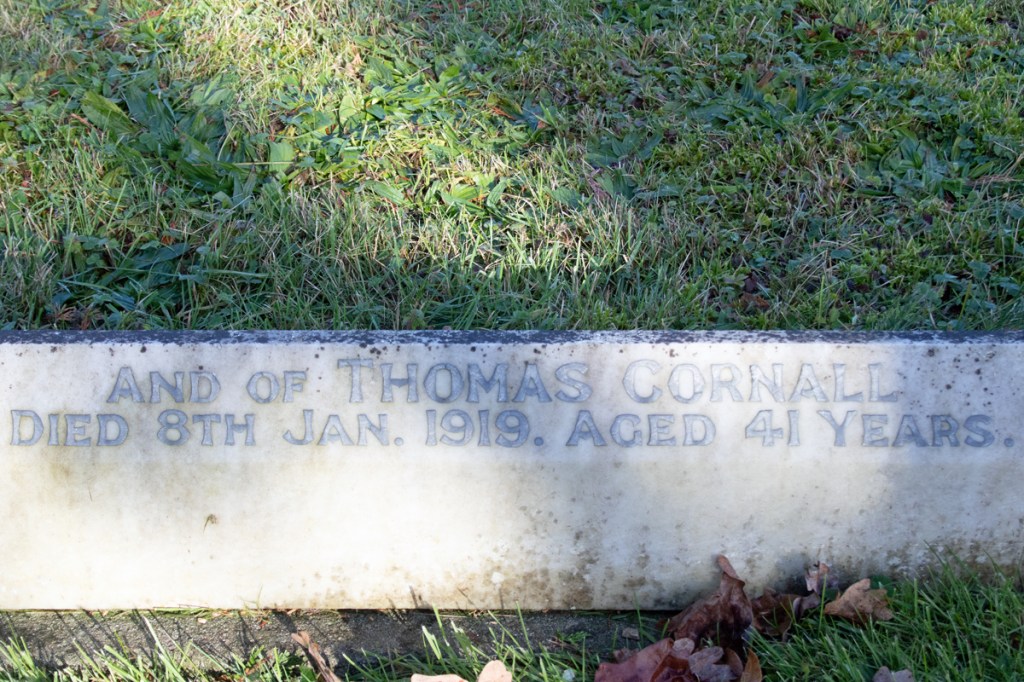
Private Thomas Cornall

Private Thomas Cornall

Thomas Cornall was born in Kingsteignton, Devon, early in 1879 and was the oldest of seven children to Thomas and Elizabeth Cornall. Thomas Sr was a clay cutter and, while the family were all raised in Kingsteignton, Thomas Jr appears to have been more wayward, and was farmed out to local relatives over time.

The 1881 census shows Thomas living with his parents; ten years later he was living with his maternal grandmother; in 1901 he was boarding with Elizabeth’s brother, John Withycombe, in Devonport; the 1911 census recorded him living with his sister and her family in the village of Chudleigh.

Thomas took on labouring jobs. He worked as a dockworker in Devonport, and a haulier in Chudleigh. War was coming to Europe, however, and Thomas was pulled in a different direction.

Full details of his military career are not available, but it is clear that he enlisted in the Somerset Light Infantry early on in the conflict. Whether Private Cornall saw active service overseas is lost to time, but he soon transferred over to the 696th Agricultural Company of the Labour Corps.

Thomas’ maternal uncle – John Withycombe – who had had lived with in 1901, had become manager of the Lion Hotel in Chudleigh and when he died in 1913, he left his wife, Bertha, with a son to raise and a business to run. At the end of 1916, Thomas and Bertha married in nearby Newton Abbot and took on the running of the Lion Hotel together.

Private Cornall was still serving at this point, and continued his work in the Labour Corps through until the end of the war. His trail at this point goes cold; all that is known is that he died at home on 8th January 1919, at the age of 40 years old.

Thomas Cornall was laid to rest in Chudleigh Cemetery. The family plot included John and Bertha, when she passed away in 1954.


Private Frederick Down

Private Frederick Down

Frederick Francis Down is one of those servicemen whose life is destined to remain lost to time. Born in Chudleigh, Devon, most of the information available about his life comes from one document – his naval service record.

The document gives his date of birth as 15th November 1897 and confirms that he enlisted on 23rd November 1914. Frederick was 5ft 2ins (1.57m) tall, had a fresh complexion, brown eyes and dark brown hair.

Frederick signed up as a Private in the Royal Marine Light Infantry, and, at the time of joining up, had been working as a butcher’s boy, living in Fore Street in the village of his birth.

Private Down served at the regiment’s depot in Deal, Kent. But he was only there for a short time: he was invalided out of the service – for reasons unrecorded – on 9th June 1915.

At this point, Frederick Francis Down’s trail goes cold once again. His gravestone confirms that he died on 11th April 1916, at the age of just 18 years old. He was laid to rest in Chudleigh Cemetery.


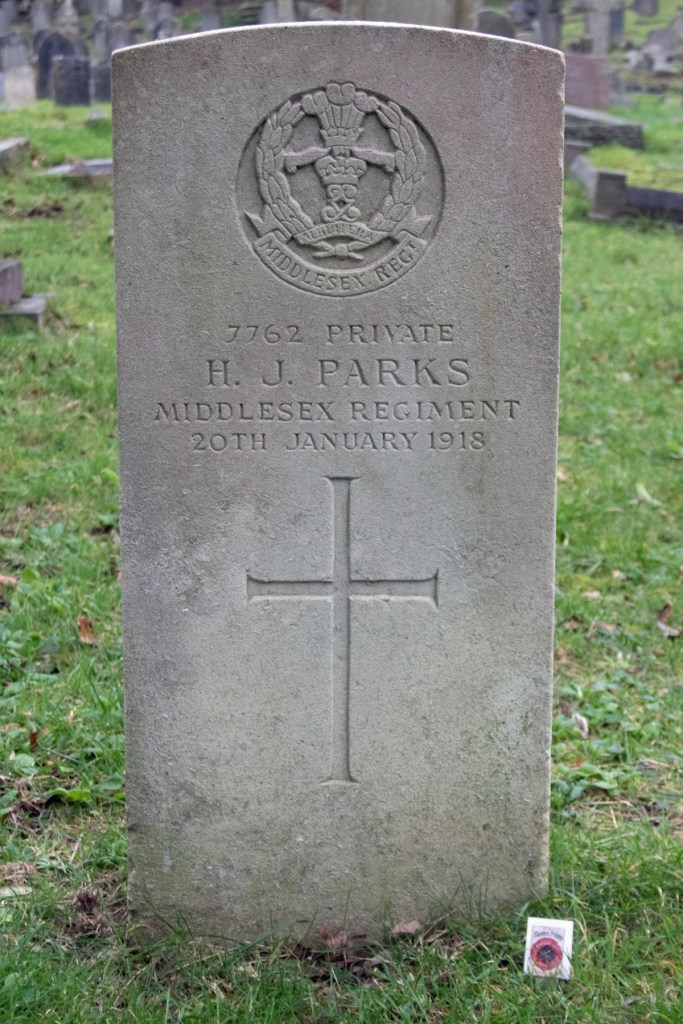
Private Hector Parks

Private Hector Parks

Hector Joseph Parks was born in the spring of 1885, the youngest of five children to William Jacob and Mary Ann Parks. William was a ship’s steward who, when Mary died in 1895, remarried, giving Hector a further two half-siblings.

With William employed at sea, Hector spent a lot of time with his paternal grandparents and, in fact, both the 1891 and 1901 censuses recorded him as living in East London with them. That later document shows that Hector had left school, and was working as a carman for a delivery company.

The next available record for Hector comes thirteen years later, when it is evident that he was among the first to volunteer for war service. He enlisted in the Middlesex Regiment and, while full details of his army career are not available, he soon found himself in the thick of things, arriving in France on 14th August 1914.

Private Parks’ battalion – the 4th – was caught up in skirmishes from the outset of war, fighting at Le Cateau, Marne, Aisne and Hooge. Over the next few years, the Middlesex Regiment found itself at The Somme and Ypres and, while it is not possible to place Hector directly in these conflicts, it seems likely that he would have been involved in a lot of them.

In January 1918, Private Parks was back on home soil, having been admitted to the Auxiliary Hospital at Ashcombe House in Weston-super-Mare, Somerset. Sadly, the cause of his return to England is lost to time, but he was to succumb, passing away on 20th January 1918, at the age of 32 years old.

Hector Joseph Parks was laid to rest in Somerset – he is buried in the Milton Road Cemetery in Weston-super-Mare.