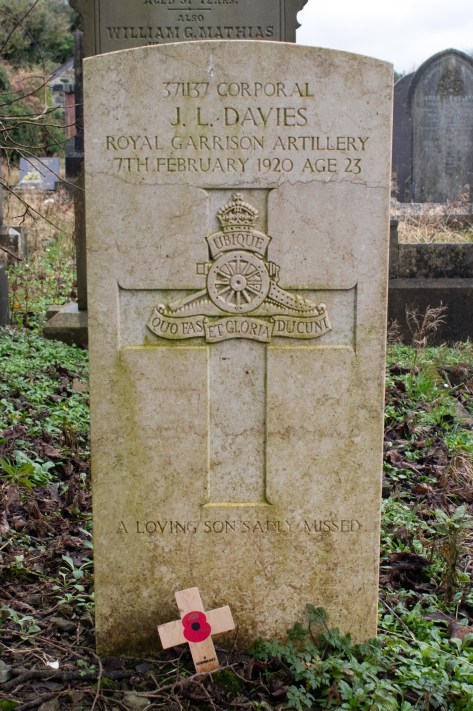
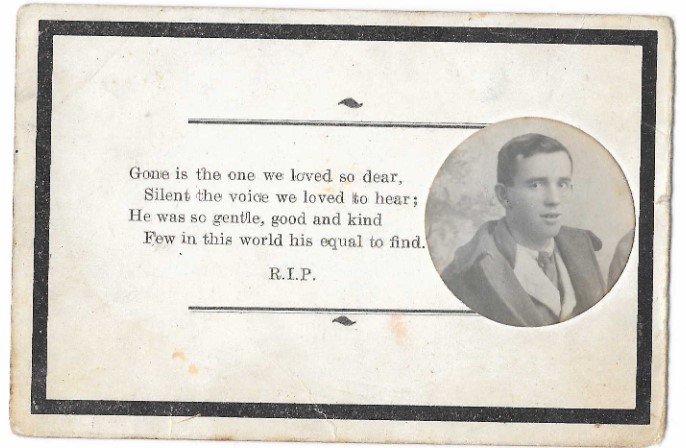
James Lloyd Davies was born in Dyffryn, Llanwnda, Pembrokeshire, early in 1897. One of six children, his parents were Hugh and Margaret Davies. Hugh was a farm worker, but when he died in 1907, Margaret was left to raise the family on her own.
The 1911 census found the family living in a 4-roomed house on Cross Street. Margaret had found work as a charwoman, while James was employed as a butcher’s errand boy. His three younger siblings were still at school.
When war broke out, James stepped up to play his part. He enlisted in the Royal Garrison Artillery, but from here on in his trail goes cold. All that can be confirmed is that he had risen to the rank of Corporal by the end of the conflict.
James Lloyd Davies returned home after the war, and passed away on 7th February 1920. He was 23 years of age. He was laid to rest in the Hermon Baptist Burial Ground in Fishguard, Pembrokeshire.
James was only accepted for commemoration as war dead in 2012. It was at this point that the Commonwealth War Graves Commission erected a headstone in his honour.
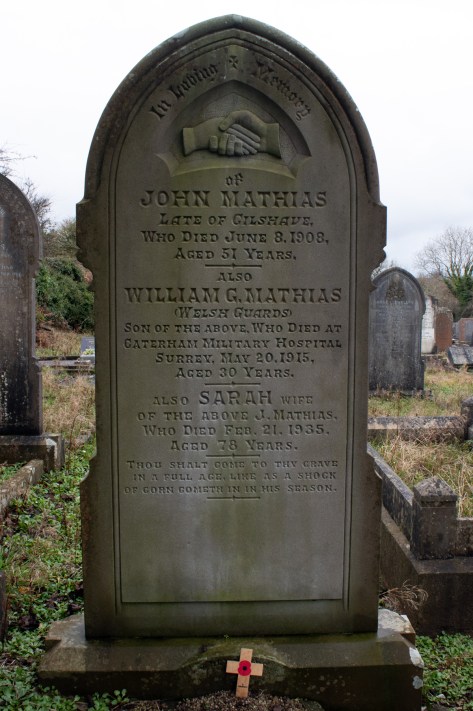
William George Mathias was born in the Pembrokeshire village of Littleston early in 1885. The oldest of five children, his parents were John and Sarah Mathias. John was a farm worker, but when he finished his schooling William found work as a rabbit trapper. This meant a move from home, and the 1901 census found him as a servant for the Evans family, in nearby Mathry.
Agricultural work was not employment that William wanted to dedicate his life to, and he soon found a new opportunity. He took a job as a police constable in Glamorganshire. There is little information about this part of his life, but the 1911 census recorded him as being one of 26 police officers boarding in the village of Gilfach Goch. Interestingly the census includes the annotation “The above are police quartered at the Ogmore Arms, Gilfach Goch, temporarily during the coal strike.”
The Miner’s Strike of 1910/11 resulted in the temporary closure of South Wales mines. Police were shipped in, but this only resulted in riots breaking out. In November 1910 disorder broke out in Tonypandy, Pontypridd and Gilfach Goch, amongst other locations. Nearly 80 police and more than 500 civilians were injured, although the exact number of miners wounded is unclear, as many refused to seek medical treatment for fear of being singled out.
As the strike moved into 1911, the army was called in, with four detachments of the Somerset Light Infantry being called into Penygraig, Llwynpia, Clydach Vale and Gilfach Goch. Stones were thrown by the rioters, and a number of William’s police colleagues were injured: thirteen of the Gilfach miners were arrested and prosecuted for their involvement in the unrest.
The decision to send troops in was contentious, and anger became directed at the then Home Secretary, Winston Churchill, for the decisions he took. Ultimately, the miners were defeated, their calls for better living conditions and higher wages went unanswered.
William continued in the police force until war broke out. His time in the army is lost to history, but it is clear that he enlisted in the Welsh Guards as a Private. Sent to Caterham, Surrey, for his training, his time serving King and Country was not to be a lengthy one. In May 1915 he was admitted to a military hospital, though the cause is not clear. He passed away on 20th May 1915: he was 30 years of age.
The body of William George Mathias was taken back to Pembrokeshire for burial. He was laid to rest in Fishguard’s Hernon Baptist Burial Ground.
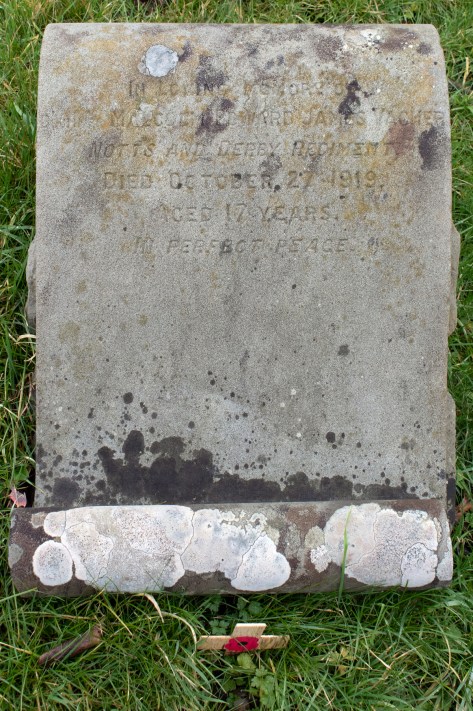
Born at the start of 1902, Malcolm Edward James Vacher was the younger of two children to James and Alice Vacher. James was a domestic coachman and both he and Alice were born in Milton Abbas, Dorset. By the time Malcolm was born, the family had relocated to the village of Mortimer, Berkshire.
Alice died when her youngest was just five, and James moved the family to the village of Kelstern in Lincolnshire, possibly for work. Sadly, James passed away in 1916, leaving Malcolm and his older sister, Gladys, as orphans.
By this point war was raging across Europe, and it seems that Malcolm looked to the army as a new family. He enlisted in the Sherwood Foresters (Notts and Derby Regiment), although his service papers have been lost to time.
It is unclear how or where Drummer Vacher served. He survived the war, however, and by the autumn of 1919, found himself on furlough in Wiltshire. His death certificate records that died on 26th October, from a combination of appendicitis and heart failure. Just 17 years of age, his sister was by his side when he passed.
Malcolm Edward James Vacher was laid to rest in St John’s Churchyard, Warminster. The Grave Registration Form notes that the headstone was paid for by his uncle.
By this point, Gladys had lost her parents and her brother. Twenty-one years of age when her sibling died, she nonetheless found the resilience to carry on.
The 1921 census recorded Gladys living at 1 Corporation Street, Kidderminster. Boarding with Jane Smith, she was working as garage assistant for the motorcycle department of the Castle Motor Co Ltd on Vicar Street.
In the spring of 1925, Gladys married radio engineer and dealer George Whitford. By the time of the 1939 Register, the couple were living at 81 New Road, Kidderminster. Gladys was helping her husband with the business, and was recorded as being a radio dealer and travel agent.
Gladys Whitford, née Vacher, passed away in the spring of 1960. An obituary outlined the life she had forged for herself after losing her brother:
Mrs Gladys Mary Whitford, who has died at her home in New Road, Kidderminster, aged 63, had conducted one of the oldest travel agencies in the Midlands for 30 years. The firm, founded by her husband’s grandfather in 1856, arranged emigration for many families seeking a new life in the Commonwealth.
Mrs Whitford joined the Women’s Legion in 1916 and was one of the first motor-cycle despatch riders attached to the Royal Army Service Corps. She was a member of the Kidderminster Chamber of Commerce and of the committee of the Kidderminster Retail Traders’ Association. She is survived by her husband, Mr George Whitford, a radio and television dealer.
[Birmingham Daily Post – Tuesday 12 January 1960]
My thanks go to Peter Calver and the members of the Lost Cousins website for their help in filling in details of Gladys’ life after the loss of her family.
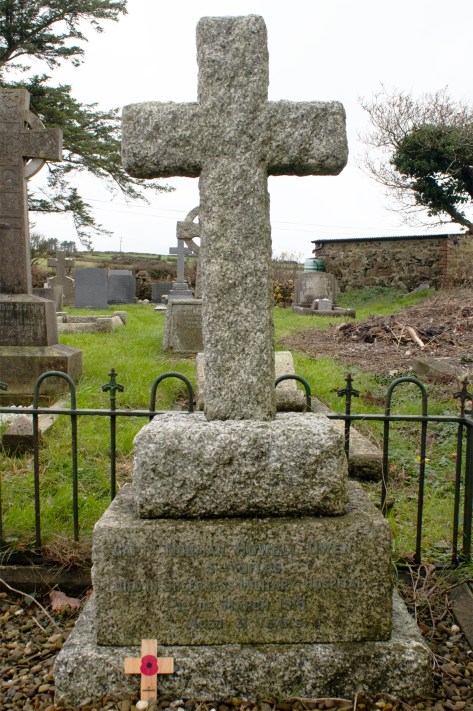
Norman Howell Owen was born in the spring of 1888, and was the third of four children – all boys – to John and Elizabeth. John was a surgeon from Pembroke Dock, Pembrokeshire, but the family were raised in Fishguard, where his practice was based.
Norman was an educated young man and, in 1906, attended the Sir Isaac Pitman & Son Phonetic Institute in Bath Somerset. He was studying shorthand, passing an examination in the subject after just three months. He passed an entrance exam for the National and Provincial Bank the following year, and, by the time of the 1911 census, he was working in the Fishguard branch and living back with his parents.
When war came to Europe, Norman was called upon to play his part. Full details of his service have been lost to time, but what remains paints an interesting picture of his time in the army. He appears to have enlisted in the King’s Liverpool Regiment as a Private, before transferring to the Labour Corps, then the Army Ordnance Corps.
By 1918 the Pembrokeshire Voters List noted Norman and two of his brothers as absentee voters – serving in the army, so not at home. Norman is recorded as being a Captain in the Army Service Corps, having received a commission on 8th February 1915. His older brother John is recorded as being a Captain in the Royal Army Medical Corps, while his younger brother, Lionel, was a Captain in the Royal Field Artillery.
The mystery of Norman continued: he survived the conflict, but by February 1919 had been admitted to the Broadway Military Hospital in Sheerness, Kent. He passed away on 1st March, the cause of his passing not readily available. Captain Owen was 31 years of age.
The body of Norman Howell Owen was taken back to Pembrokeshire for burial. He was laid to rest in Fishguard Church Cemetery.
Norman died intestate: his family went through probate, and his effects – totalling £1003 8s 10d (approximately £67,000 today) were left to his father.
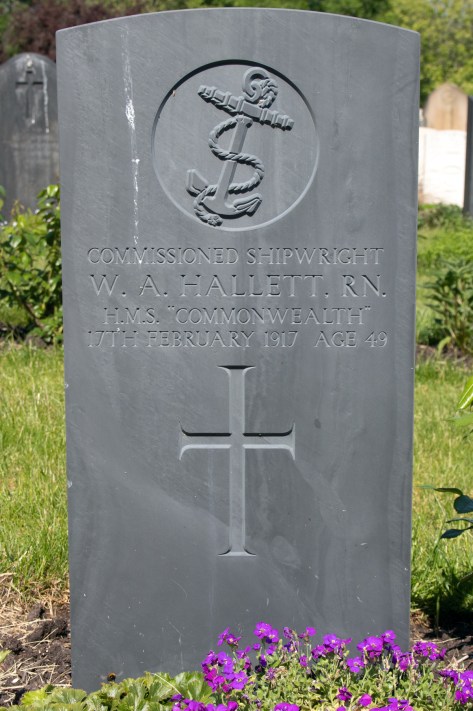
William Amos Hallett was born on 2nd March 1867 in Pimlico, Middlesex. The oldest of six children, his parents were Charles and Rosa Hallett. Charles was a police inspector and, by the time of the 1871 census, the family has moved to Sheerness in Kent, where he worked.
In the summer of 1893, William married Emily Nokes. By this point he had been working for the Royal Navy for four years, initially as a Shipwright, then as a Leading Shipwright. His service records show that he was 5ft 8ins (1.73m) tall, with light brown hair, blue eyes and a fresh complexion.
Based out of HMS Pembroke, the Royal Naval Dockyard in Chatham, Kent, by June 1900 William had served on HMS Urgent, HMS Sphinx. Most of his time, however, had been spent between his Chatham base and its Sheerness counterpart, HMS Wildfire.
In November 1901 William was promoted to the rank of Carpenter. Over the next decade he served on eight vessels, and his service record for that time give an insight into his character. He was regularly commended for his hard-working and zealous nature: “[he] gets through more work in his time than any carpenter I’ve been shipmates with… He is excellent in every way.” His ability did not go unnoticed, another report noting his “special knowledge [in] geometrical drawing.”
In the summer of 1910, his superior, Captain Morgan, noted that Carpenter Hallett “worked well and zealously and has got a good deal of work done under somewhat difficult circumstances and with a small staff…” He was recommended for advancement, and it seemed that a promotion was in the offing.
By the time war broke out, William was a Commissioned Shipwright. Details of his service are harder to trace, but by the end of 1916, he was assigned to the battleship HMS Commonwealth. The next record notes his passing:
HALLETT – On 17th February, at RN Hospital, Chatham, Chief Carpenter RN William Amos Hallett, aged 49 years, eldest son of the late Mr Charles Hallett, of Sheerness.
[Sheerness Guardian and East Kent Advertiser: Saturday 24th February 1917]
There is no further information about William Amos Hallett’s passing. He was laid to rest in the military section of Woodlands Cemetery, Gillingham, Kent, not far from HMS Pembroke, the dockyard he had for so long called home.
Harold Frederic Chandler was born on 8th April 1886, and was the only child to Frederic and Rhoda. Frederic was a newspaper publisher, and the family lived in North London. The 1891 census found the Chandlers living at 1 Parolles Road, Islington; ten years later they were at 14 West View on Highgate Hill.
Those census returns included family members as part of the household. By the time of the 1911 census, however, when the were living in a substantial house at 22 Hillside Gardens, Highgate, there were no other family members with them, although they did have a boarder – banker’s clerk Alfred Schleicher – and domestic servant Esther Tebbutt living with them.
By this point, Harold was 24 years of age, and was employed as an architect’s assistant. War was coming, however, and he was called upon to play his part.
Full details of Harold’s service have been lost to time, but it is clear that he enlisted in the Royal Engineers as a Sapper, likely using the skills he had learnt in his civilian life.
The only documentation confirms Harold’s passing. Discharged from the army on 29th October 1919, he died just over a year later. He breathed his last on 17th December 1920, at the age of 34 years old. His death was registered in Edmonton, Essex, so it seems likely that he was there in some sort of convalescent capacity.
The body of Harold Frederic Chandler was taken back to Middlesex for burial, and he was laid to rest in Highgate Cemetery.
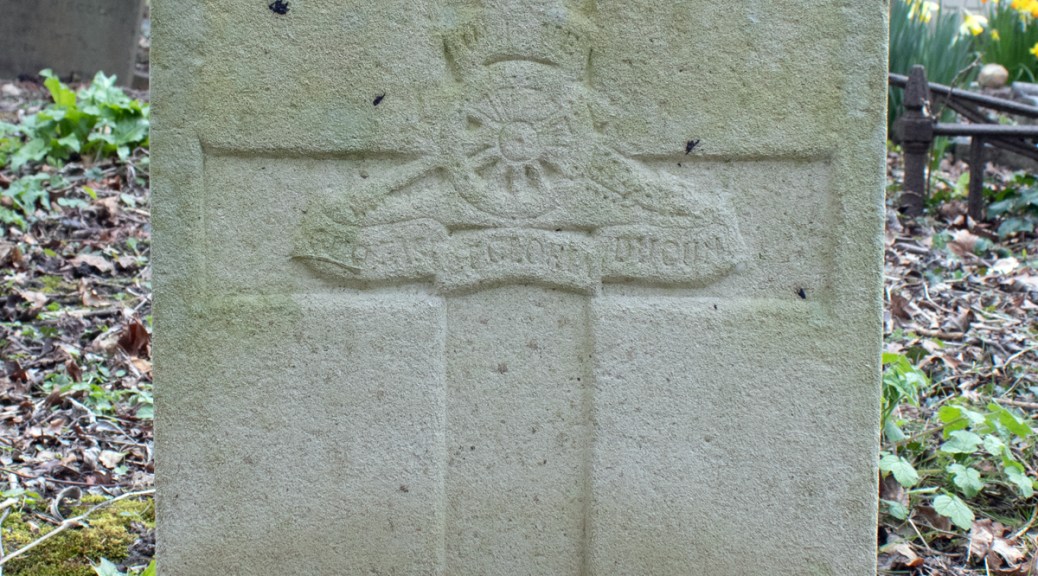
In the depths of Highgate Cemetery, Middlesex, is the weathered grave of Driver EA Lord, of the Royal Horse Artillery, who died on 8th May 1921. Little concrete information is available about him, and a lot of the young man’s life is destined to remain lost to time.
A few military documents shed some light on the man. His name was Ernest Arthur Lord, and he was 26 when he died in Manor House Hospital, Golders Green, Middlesex.
A pension for his widow was refused, because the couple married after he was discharged from the army. There is a marriage certificate for an Ernest Lord and Beatrice Moore on Christmas Day 1920. The couple wed in Charleston Parish Church, Salford, Lancashire: Ernest was noted as being a clerk, and Beatrice a tailoress. However, this is more of an interesting footnote: there is nothing to directly connect this Ernest Lord to the burial in Highgate.
Driver Lord’s entry on the Medal Roll Index confirms that his unit was sent to France on 26th December 1915. Where he served, and for how long, however, is unclear.
Much of Ernest Arthur Lord’s life is sadly untraceable: a life and a history lost to the Great War.
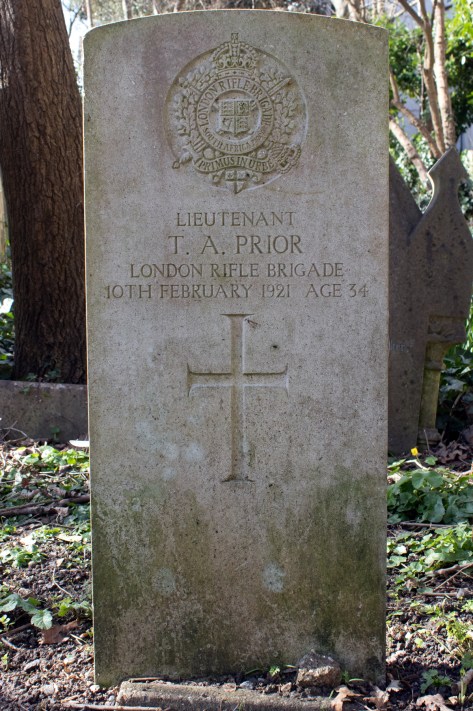
Thomas Ashley Prior was born in Islington, Middlesex, at the start of 1886. The third of seven children, he was the only son to Thomas and Ellen Prior. Thomas Sr was a colonial produce broker agent and, at the time of the 1891 census, the family were living in rooms at 115 Sussex Road.
Over the following years, the family lived together, but moved homes. By 1901 they were living at 1 Blythwood Road, Islington; ten years later they had set up home at 10 Oakfield Road, Stroud Green. By this point Thomas Sr was listed as being a rubber broker. Four of the children were employed in respectable trades: Thomas Jr as a bullion refiner’s clerk, his older sisters as a paper merchant’s clerk and a saleswoman for the court dressmaker. The youngest employed sibling, 22 year old Margaret, was also a clerk, for an estate agent. The family had a live in servant, Alice Charles, supporting them.
War rose its ugly head in 1914, and Thomas Jr stepped up to play his part. He was already a volunteer in army and, as a later military history confirms, he threw himself into a more permanent role:
PRIOR, THOMAS ASHLEY. Enlisted 1909. Served continuously and went to France with 1st Batt. Nov. 1914-May 1915 (wounded). 2nd Lieut. 28/9/15. Served in France again with 1st Batt. March-June 1916 and Nov. 1916-June 1918. Lieut. 1917. Sports. Member of Brighton March and Marathon Teams. Died 1921.
[The History of The London Rifle Brigade 1859-1919]
Thomas’ regiment – the London Rifle Brigade – was actually the 5th Battalion of the London Regiment. Based on his unit’s time abroad, it is likely what Thomas was wounded at Ypres – possibly during the Battle of St Julien. On his return to the front, he would have fought at Arras and Ypres in 1917, and at the Somme (Arras) the following year.
Lieutenant Prior’s return to Britain is not documented. HIs mother, Ellen, had died in 1912, and his father followed in 1918. The London City Directory for 1920 recorded him as living at 8 Oakfield Road, a double-fronted Victorian terrace within sight of Finsbury Park.
Thomas Ashley Prior died on 10th February 1921. Just 34 years of age, the cause of his passing is not clear. He was laid to rest in Highgate Cemetery, not far from his last recorded address.
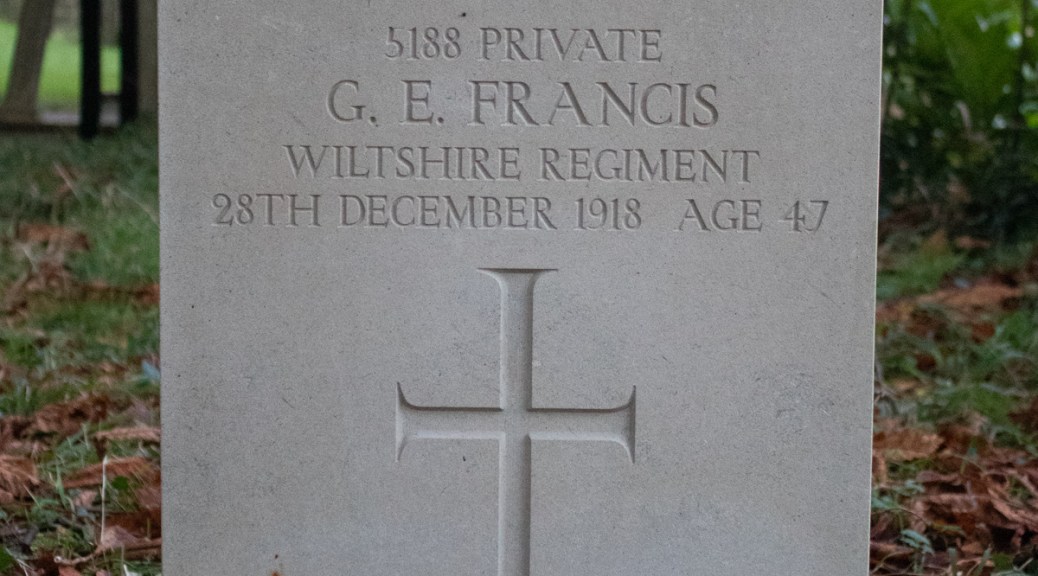
George Edward Francis was born at the end of 1871 in the Wiltshire village of Alvediston. The youngest of six children, his parents were Eli and Mary Francis. Eli was an agricultural labourer, and this was the line of work that George would also follow.
Eli died in 1885, and Mary moved in her daughter Elizabeth’s family, and the 1891 census noted that George and his older brother Samuel were also living there. George, now 19 years of age, was employed as a farm labourer.
On 11th July 1906, George married Alice Shirley. A year older than her new husband their wedding certificate notes that she was also born in Alvediston, but that her father wasn’t known. The couple settled in a house in Tollard Royal, a few miles south of their home village.
George stepped up to serve his country when war was declared. Full details of his time in the army are unclear, but he had definitely enlisted by the summer of 1918. He was initially assigned to the Wiltshire Regiment, but was later transferred to the 651st Agricultural Company of the Labour Corps.
The only other record for Private Francis’ time in the army, is a document relating to his passing. This confirms that he died on 28th December 1918 in camp at Norton Bavant, to the east of Warminster, Wiltshire: he was 47 years of age.
It seems likely that Alice was unable to cover the cost of bringing her husband’s body back to Tollard Royal for burial. Instead, George Edward Francis was laid to rest in the graveyard of All Saints’ Church in Norton Bavant.
Thomas Lockyer Dicker was born at the start of 1890 in Tiverton, Devon. One of six children, his parents were Thomas and Mary Dicker. Thomas Sr was a cab driver, and the family lived at 4 Back Lane in the town.
Thomas Jr’s later life is a challenge to pin down. He doesn’t appear on the 1911 census, and his service records have been lost to time. It is clear that he had enlisted before October 1919 – and, in all likelihood, while the war was being fought. Assigned to the Royal Field Artillery, he worked as a driver, and again it is possible that he served overseas at some point.
Thomas Lockyer Dicker died at the Queen Alexandra Hospital in Cosham, Hampshire, on 12th April 1920, although the cause of his passing is unclear. He was 30 years of age. His body was taken back to Devon for burial, and he was laid to rest in Tiverton Cemetery, not far from the family home.













 Death and Service