Category Archives: Devon

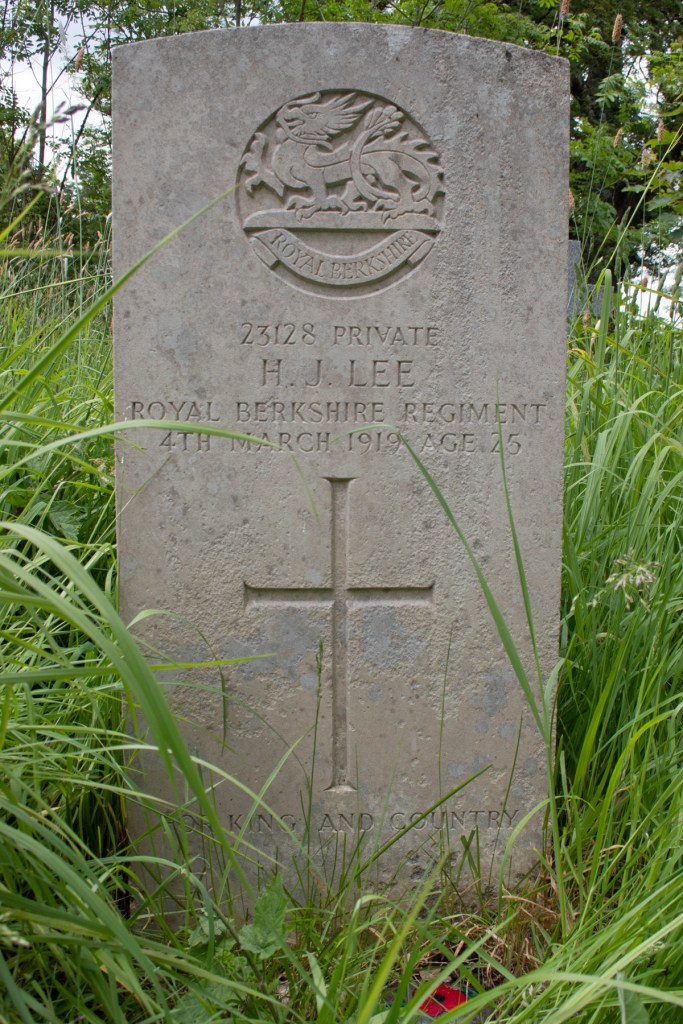
Private Herbert Lee

Private Herbert Lee

Herbert Jack Lee was born in the autumn of 1893 and was one of twelve children. His parents were Devon-born John Lee and his wife, Emily, who came from Churchstanton, Somerset, and it was here that the young family were raised. John was a bootmaker-turned-innkeeper, and the Lees lived in the village’s Rising Sun Inn.

By the time of the 1911 census, John had returned to boot-making once more. Herbert, meanwhile, had found work as a domestic gardener, bringing in a second wage to a household that included his parents and two younger siblings.

When war came to Europe, Herbert – who was better known by his middle name – stepped up to serve his King and Country. Little of his service documentation remains, but a contemporary newspaper report outlined his time in the army:

[Jack] joined the service in January, 1916, and was posted to the Wilts Regiment. He was subsequently transferred to the Royal Berks, and with them proceeded to France, returning to England suffering from trench feet at Easter, 1917. He was then posted to the Devon Regiment, and put into an Agricultural Company, and employed at Offwell, near Honiton.

Taunton Courier and Western Advertiser: Wednesday 12th March 1919

Private Lee’s health had suffered badly during the winter of 1916/17 and, in the spring of 1919, he came down with a severe bout of influenza. His body was too weakened to recover, and he passed away on 4th March 1919, aged just 25 years old.

Herbert Jack Lee was brought back to Somerset for burial. He was laid to rest in the peaceful graveyard of St Paul’s Church, in his home village of Churchstanton.


Interestingly, in the same edition of the Taunton Courier and Western Advertiser that had reported on Herbert’s funeral, was a report on the state of the Lee’s former home, the Rising Sun Inn.

…some of the rooms were very damp through water having come in… [and] was not fit to live in. The house had been very well conducted by the present tenant [Frank Gill], but… trade… had gone down by four-fifths since the war..

Taunton Courier and Western Advertiser: Wednesday 12th March 1919

Frank Gill was applying to the Licensing Board to avoid paying taxes for the year, given the drop in clientele and the number of other public houses in the area to support any customers. His case was referred on.

Sapper John Gage

Sapper John Gage

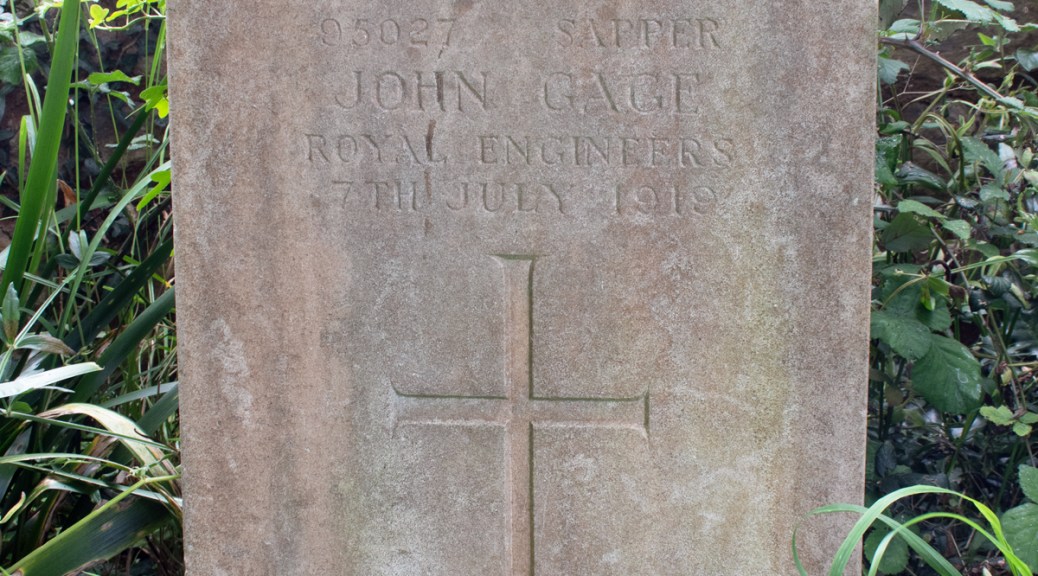
The life of John Gage seems destined to remain a mystery. His grave lies in a quiet corner of St Andrew’s Churchyard in West Hatch, Somerset. The Commonwealth War Graves Commission registration reads:

GAGE, Spr. John, 95027. “G” Depot Coy. Royal Engineers. 7th July 1919. Son of John Gage; husband of Lucy Gage, of Canal Cottage, Wrantage, Taunton. Born at Axminster, Devon.

There is no date of birth for John, and, while there is a possible census return for 1891, with a John Gage Sr and Jr living in the Axminster area, in isolation it is not concrete enough to connect to the man lying in St Andrew’s Churchyard.

The Army Register of Soldiers’ Effects confirms Lucy as John’s widow, but again no marriage documents remain to give a date for the nuptials or ages for the bride and groom. The document does confirm that Sapper Gage had been serving in the Royal Engineers for more than six months at the time of his passing, and that he died in a military hospital in Taunton.

There are no contemporary newspapers that report on John’s passing, which would indicate that is was nothing out of the ordinary, or connected directly to the war – through injury, for example. This might suggest, therefore, that John passed away though illness, although this cannot be confirmed either way.

Sapper John Gage’s life is set to be lost to time, therefore. He lies in the graveyard of St Andrew’s Church in West Hatch. Nearby is another grave, that of Lucy Gage, who died in 1942.


Private Thomas Parsons

Private Thomas Parsons

Thomas Alfred Parsons was born in the summer of 1885 in Twerton, Somerset. One of six children, his parents were railway engine driver William Parsons and his wife, Mary. When Thomas finished his schooling, he found work at a labourer at a mineral water supplier, something he continued doing through to the outbreak of war.

On 27th May 1912, Thomas married Lily Howell, a labourer’s daughter, the couple tying the knot in Twerton parish church. They were living in Charlton Buildings, next to the river and now student accommodation for Bath’s universities. Lily had had a son, in November 1905: young Ronald was either Thomas’, or he was accepted as his own.

When war came to Europe, Thomas stepped up to play his part. He enlisted on 11th December 1915, although he was not formally mobilised until six months later. Private Parsons initially joined the Devonshire Regiment, but by early 1917, he became attached to the 169th Labour Corps.

Sent to France in February that year, Private Parsons only remained overseas for a matter of six months. By early September Thomas had fallen ill, contracting a combination of bronchitis and phthisis (or tuberculosis). Medically evacuated back to Britain, he was admitted to a hospital in Plymouth, Devon, but grew weaker until, on 2nd October 1917, he passed away. He was 32 years of age.

The body of Thomas Alfred Parsons was taken back to Somerset for burial. He was laid to rest in Twerton Cemetery, not far from his widow’s home.


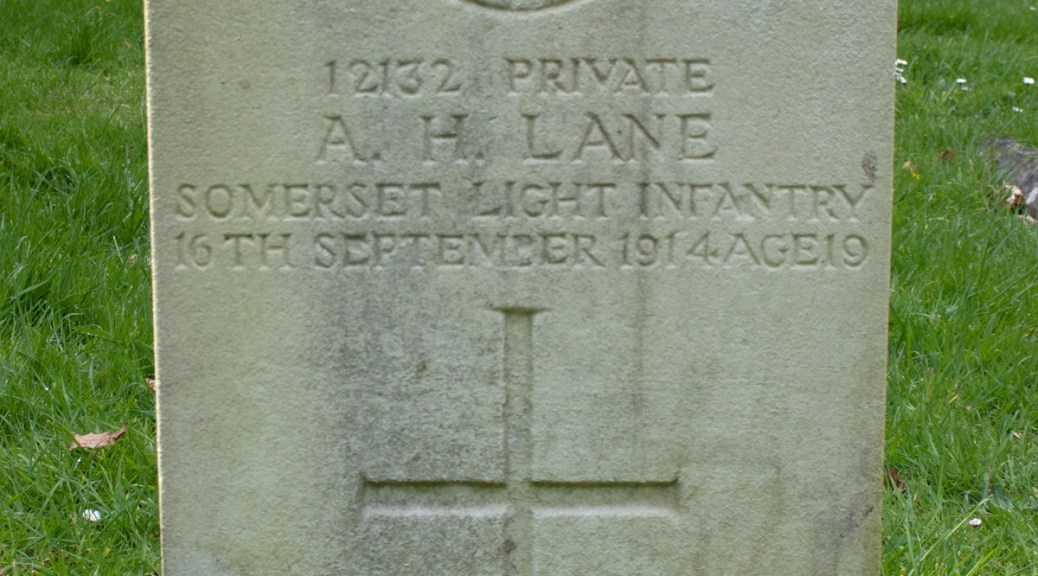
Private Arthur Lane

Private Arthur Lane

Arthur Henry Lane was born in the summer of 1895, the third of eight children to Henry and Ada Lane. The family were initially born and raised in Templecombe, Somerset, before moving to Bath in the early 1900s.

Henry was employed as an engine driver for Great Western Railways and, after initially finding work as a jobbing gardener, Arthur moved in with relatives in Highbridge in 1911. He found work as an engine cleaner for the Somerset and Dorset Joint Railway Company, and was there for nearly three years.

When war broke out, Arthur was one of the first to enlist. He joined the 3rd Battalion of the Somerset Light Infantry at the barracks in Taunton. Private Lane was then sent to Devon for further training, but he quickly fell ill.

Admitted to Devonport Hospital with appendicitis, he suffered complications following the operation, dying just five days later. He was only 19 years of age, and had been in the army for less than a month.

Arthur Henry Lane’s body was brought back to Somerset for burial. He was laid to rest in Bath’s Twerton Cemetery.


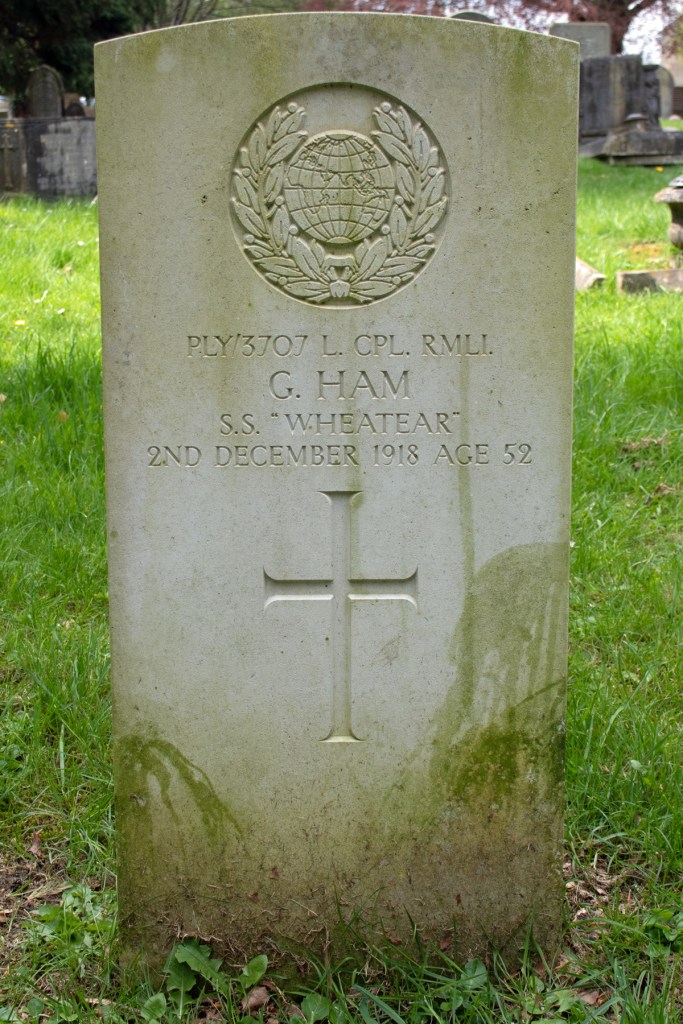
Lance Corporal George Ham

Lance Corporal George Ham

George Ham was born on 19th December 1867 in Twerton, Somerset. His parents were George and Emily Ham, and he was the oldest of their nine children. George Sr was a mason, and initially his first born followed suit, but he was pulled towards something bigger and better and, on 19th January 1886, he enlisted in the Royal Marine Light Infantry.

George’s service records note that he was 5ft 6ins (1.68m) tall, with brown hair, grey eyes and a fresh complexion. He was initially sent to the barracks at Walmer in Kent, and it was from here that Private Ham began a 21 year career in the Royal Marines. Over that time, he served on seven separate ships, and, between voyages, he was based in barracks in Plymouth, Devon. Both his character and ability were consistently noted as being very good.

Private Ham’s career took him around the world and, in 1887, he found himself on the gunboat HMS Banterer, on which he served for three years. His tour of duty included a period of time in Galway, Ireland, and it was here that he met Mary Ann Goode. On 5th July 1889, the couple married in city’s St Nicholas’ Church. The church’s records suggest that the couple went on to have four children – Frederick George; Emily, who died just after her first birthday; Albert; and Katherine.

George’s records from this point become a little disjointed. In October 1890, he returned to his Plymouth base, and the following year’s census recorded him as living in the East Stonehouse Barracks, although his marital status was noted as single.

The next census, in 1901, presents a different picture. George and Mary were, by this time, living in family barracks in East Stonehouse, with two children, (Frederick) George and Albert. Katherine, the couple’s youngest child, was born the following year.

In January 1907, after more than two decades’ service, George was stood down from active service in the Royal Marines. He was placed on reserve status, and took up work as a mason once more. At this point, however, the family seemed to have hit more troubled times, underlined by four separate 1911 census documents.

George, who was 44 by this point, was recorded as being an inmate in the Bath Union Workhouse and Infirmary in Lyncombe, Somerset. Mary and Katherine, meanwhile, were in two rooms in a house in Stonehouse, Devon. Frederick, who was now better known as George, had followed his father into military service, and was a Private in the Royal Marine Light Infantry, serving on HMS Colossus. Albert, who was 13 years old, was one of 946 students boarding at the Royal Hospital School for Sons of Seamen in Greenwich, London.

George spent nine years in the reserves, and, in 1914, was called up again for war service, this time as a Lance Corporal. According to a contemporary newspaper:

[He was] engaged on naval patrol work against submarines off the Canadian coast and elsewhere, and was in charge of a gun on an armed merchant ship. Once the boat he was on was torpedoed, and on another occasion he had a long running fight with a submarine in the Irish Channel. The ship, however, reached Portrush (Ireland), and the inhabitants gave Lance-Corporal Ham a testimonial, and he was also rewarded in other ways, the Cardiff owners of the vessel recognising his skill and gallantry.

Bath Chronicle and Weekly Gazette: Saturday 7th December 1918

Tragedy was to strike in the end, however, and George was to meet a sad end to a distinguished career.

While at Cork [George] fell, either from a boat or the dock, and sustained an injury to the side of his head. It did not appear very serious, and it is understood that he made a trip to Cardiff and back to Londonderry, [where] he became so seriously ill as to necessitate his going to a military hospital in Londonderry. Hemorrhage [sic] of the brain set in, and he died on Monday [2nd December 1918] before his brother, Mr Albert Ham, who had been telegraphed for, could reach him.

Bath Chronicle and Weekly Gazette: Saturday 7th December 1918

Lance Corporal George Ham was days short of his 51st birthday when he died. His body was brought back to Somerset for burial, and he was laid to rest in Twerton Cemetery. The newspaper report give no indication as to whether Mary or their children were in attendance and, in fact, does not mention his wife and family at all.


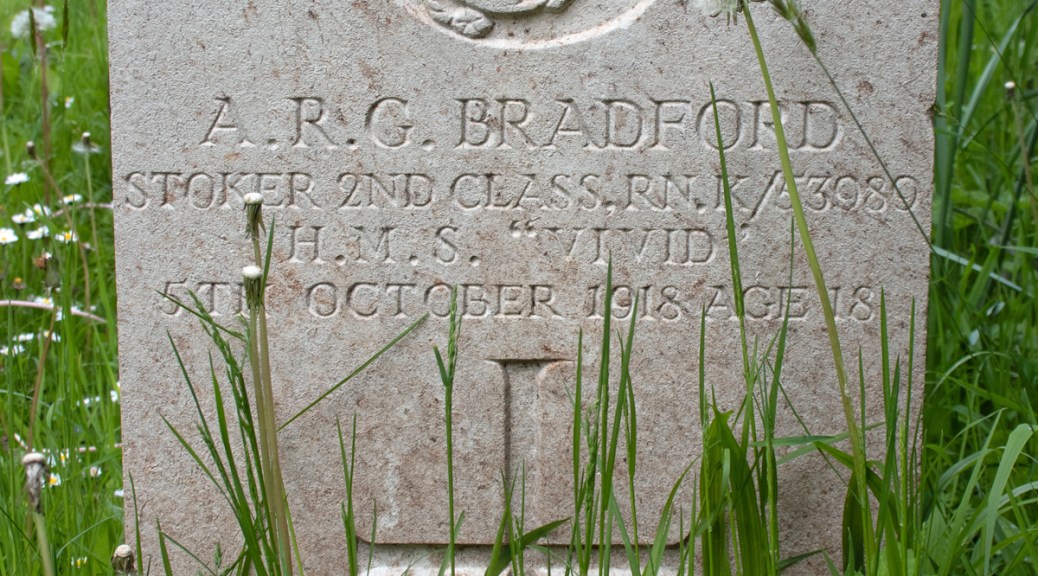
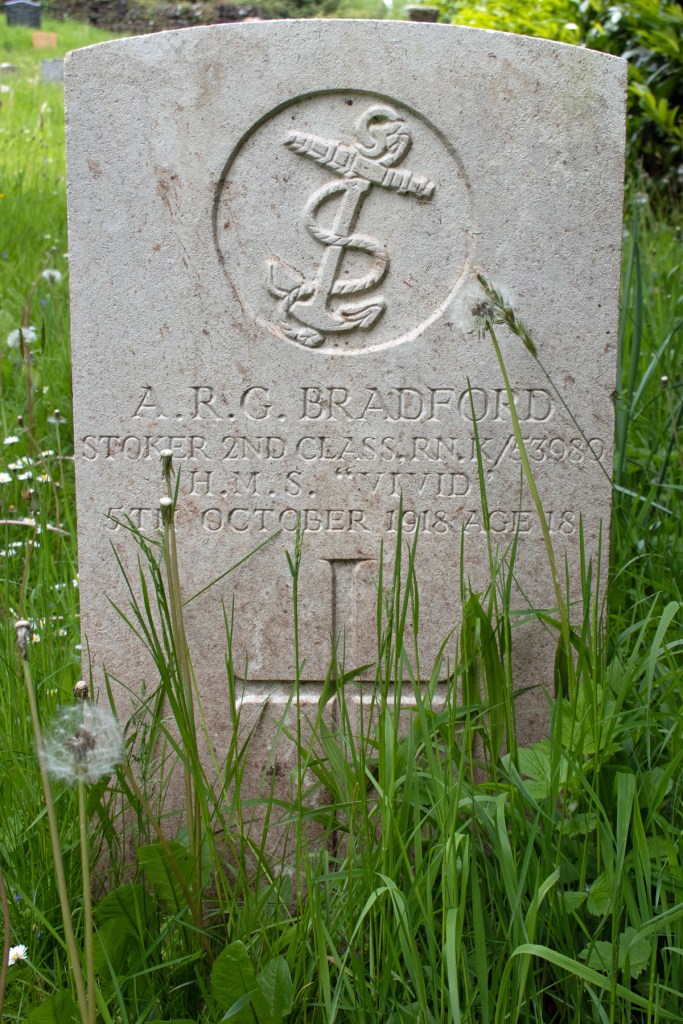
Stoker 2nd Class Arthur Bradford

Stoker 2nd Class Arthur Bradford

Arthur Redvers George Bradford was born in the Somerset village of Winscombe on 16th September 1900. He was second of six children to George Bradford, who was a postman, and his wife, Louisa.

When he finished his schooling, Arthur found work as a carter. War was raging across Europe by this point, however, and he was evidently keen not to miss out on the excitement. On 18th September 1918, just two days after his 18th birthday, he enlisted in the Royal Navy.

Stoker 2nd Class Bradford was noted as being 5ft 3.5ins (1.61m) tall, with brown hair, grey eyes and a fresh complexion. He was sent to HMS Vivid, the Royal Naval Dockyard in Devonport, for training, but his time there was to be tragically short.

Cramped barracks prove to be the perfect breeding ground for illness, and in early October 1918, influenza and pneumonia were rife. Around a dozen of Stoker Bradford’s colleagues died from the diseases in the time he was at the base, and, on 5th October 1918, he too was to succumb to them. He was just eighteen years old, and had been in the Royal Navy for just 17 days.

The body of Arthur Redvers George Bradford was brought back to Somerset for burial. He was laid to rest in the quiet graveyard of St James the Great Church in his home village of Winscombe.


Stoker 1st Class Phillip Clemett

Stoker 1st Class Phillip Clemett

Phillip George Clemett was born on 5th December 1891, one of eight children to Albert and Mary Jane Clemett. Albert was a carpenter from Devon, Mary Jane came from Somerset, but by the time Phillip was born, the family had moved to Fulham in Middlesex.

The 1911 census records the family as having moved back to Somerset. Mary Jane had been born in the village of Huntspill, and it was here that the Clemetts returned. Albert was now working as a farmer, so it is possible that they had moved to work on the family farm.

Labouring was not a job to satisfy Phillip, though, and he sought a career on the high seas. On 3rd February 1913, he enlisted in the Royal Navy as a Stoker 2nd Class. His service records show that he was 5ft 4ins (1.63m) tall, with brown hair, brown eyes and a fresh complexion.

Stoker Clemett’s was initially sent to HMS Vivid, the Royal Naval Dockyard in Plymouth, Devon. Here he received a few months’ training, before being given his first posting, on board the battleship HMS Indefatigable. He remained on board for the next fifteen months, gaining a promotion to Stoker 1st Class in the process.

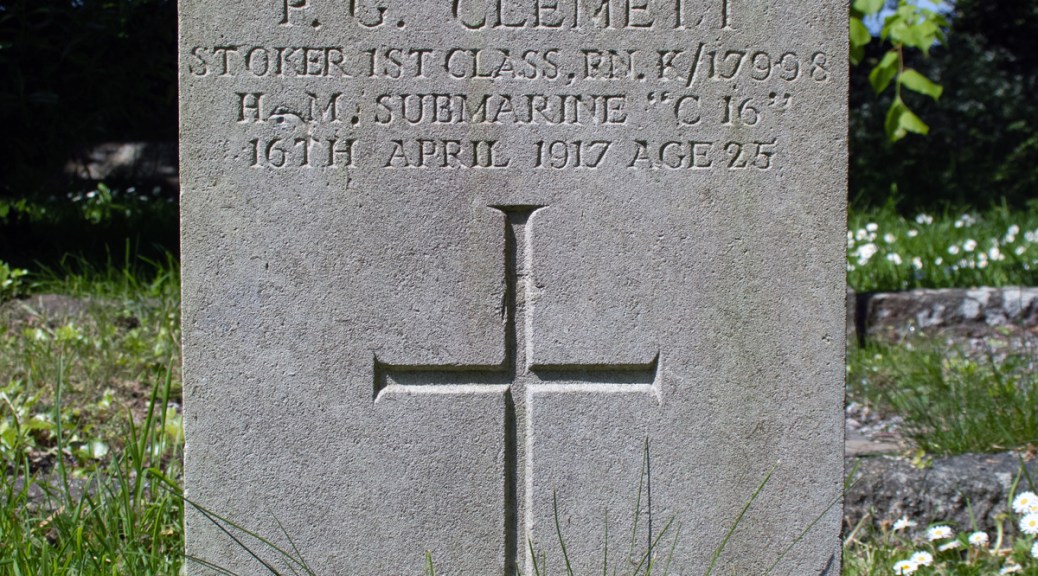
Over the next couple of years, Phillip served on a couple more vessels, but on 11th February 1917 he was assigned to the submarine HMS C16. Stoker Clemetts was on board for a couple of months, as she was patrolling off the Essex coast. On 16th April 1917, the C16 was accidentally rammed by the destroyer HMS Melampus. She sank to the bottom and a couple of attempts were made for the crew to escape, but they became trapped and all perished, including Stoker 1st Class Clemetts. He was 25 years of age.

Contemporary newspaper reports give little detail about the accident – stating simply that Phillip ‘perished at sea’ [Western Daily Press – Tuesday 01 May 1917] His service documents are equally cagy about the incident, confirming jus that he ‘lost his life on duty.’ The records, however, show that on each of his five annual reviews, his character was noted as ‘very good’, while his ability was ‘superior’.

When the submarine was salvaged, Phillip George Clemett’s body was brought back to Somerset for burial. He was laid to rest in the peaceful graveyard of St Peter’s Church in Huntspill.


Gunner Valentine Wilkinson

Gunner Valentine Wilkinson

Valentine Burnett Wilkinson was born early in 1889 in Combe Down, Somerset. One of eight children, his parents were Harry and Eliza Wilkinson, Harry was from nearby Bath and worked as a gardener, and this is the trade into which Valentine also went when he finished school.

In the spring of 1913, Valentine married Florence Moody. She was the daughter of a stone mason and, at the time of the 1911 census, she was employed as a live-in sewing maid at Monkton Combe Junior School.

Gardening seems to have been a footstep to something bigger for Valentine, and he soon found other employment, as a police constable. He and Florence moved to Street, near Glastonbury, and this is where they were living when war broke out.

Keen to play his part, Valentine enlisted in the Royal Garrison Artillery on 11th December 1915. He was placed on reserve, possibly because of his occupation, and was not formally mobilised until the end of June 1917, just six weeks after Florence had given birth to their first and only child, Joan.

Gunner Wilkinson’s service records note that he was 5ft 11ins (1.8m) tall, and had a scar on his right wrist. He spent five months training, split between No. 3 Depot in Plymouth, Devon, 473 Siege Battery and No. 1 Reinforcing Depot in Bexhill-on-Sea, Sussex. On 3rd November 1917, however, he was sent to France, and was attached to the 234th Siege Battery.

Gunner Wilkinson’s time overseas was to be brief, however. He was caught up in a gas attack in December, and evacuated back to Britain for treatment. His health was now impacted and, during the summer of 1918, he was admitted to hospital having contracted pleurisy. After two months in hospital, Valentine was sent to the Military Convalescent Hospital in Ashton-in-Makerfield, near Wigan.

The war was in its closing stages by this point, and in November 1918 Gunner Wilkinson resumed some of his duties, albeit on home soil. His health was still suffering, and he contracted tuberculosis on the lung and throat. He was formally discharged from the army on 27th February 1919, no longer physically fit to serve.

Valentine returned home to Somerset, and it was here, on 1st April 1919, that his body finally succumbed to the lung conditions that had dogged him for nearly eighteen months. He was just 30 years of age.

Valentine Burnett Wilkinson was laid to rest in the quiet graveyard of St Michael’s Church in the parish of his childhood home, Monkton Combe.


Yeoman of Signals Alfred Collins

Yeoman of Signals Alfred Collins

Alfred Henry Collins was born on 22nd August 1886, in the Gloucestershire village of Wotton-under-Edge. One of five children, his parents were cowman and farm labourer Samuel George Collins and his wife, Jane. Samuel’s work took the family south, and by the time of the 1901 census, the Collinses had settled in Whitchurch, near Bristol.

When Alfred finished his schooling, he also found employment labouring on a farm, but he was drawn to a more reliable career and a life at sea. On 9th March 1903, Alfred enlisted in the Royal Navy. His service records show the young man he was becoming. He was 5ft 4ins tall, with brown hair, brown eyes and a fresh complexion.

Alfred was still underage in the navy’s eyes, and so he was given the rank of Boy 2nd Class. He was assigned to HMS Northampton, a training ship, and must have shown some promise, as within three months he had been promoted.

In June 1903, Boy 1st Class Collins was assigned to HMS Victory, the Royal Naval Dockyard in Portsmouth, Hampshire, and his trajectory was still upwards. When he turned seventeen on 22nd August, Alfred was formally enrolled in the Royal Navy, and was given the rank of Ordinary Seaman. However, his training in Portsmouth continued, and by November he had become a Signalman.

In December 1903 he was posted to the cruiser HMS Isis and, over the next decade he served on ten different ships, returning to HMS Vivid, the Royal Naval Dockyard in Devonport, in between voyages. During this time he was promoted to Leading Signalman, and his annual reviews showed him as having a very good character and a superior ability.

With war now brewing across Europe, the role of the navy intensified. When conflict was declared, Leading Signalman Collins was serving on board the cruiser HMS Pomone and, after nine months back at HMS Vivid, possibly in a training role, Alfred was assigned to the newly-refitted battleship HMS Bellerophon, on board which he would serve for more than two years.

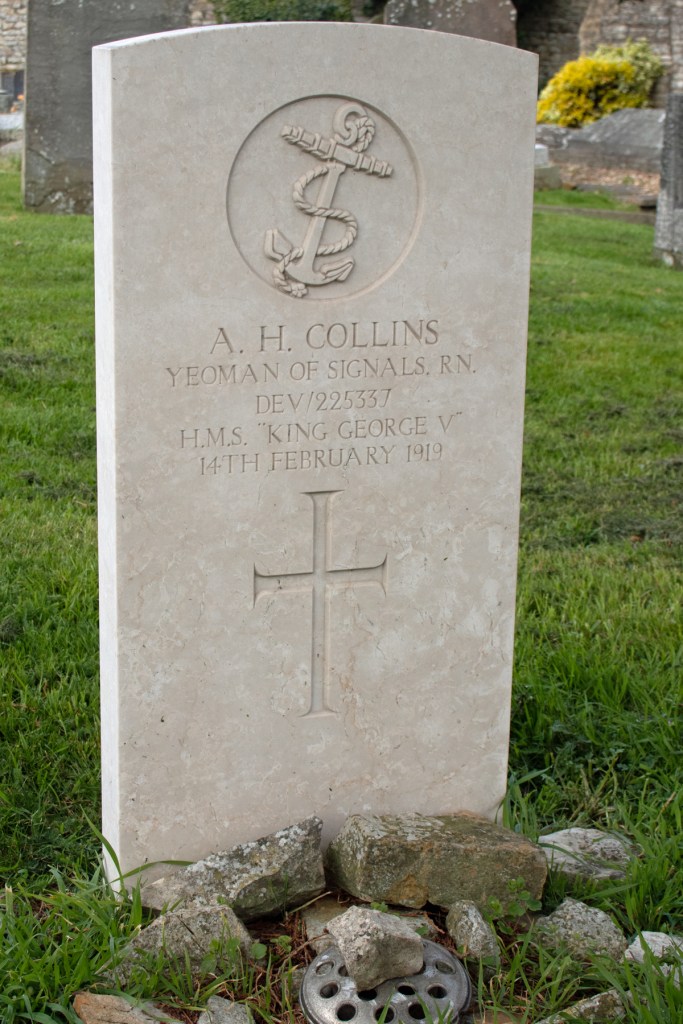
Bellerophon served at the Battle of Jutland, and remained patrolling the southern part of the North Sea for the rest of the war. In July 1917, Alfred was promoted again, to Yeoman of the Signals, and transferred to HMS King George. He remained in the North Sea, but his new ship was there to protect the convoys transporting good between the UK and Norway, so he was based in Scotland.

Yeoman of the Signals Collins survived the war, but in February 1919 he was admitted to the Royal Naval Hospital in Granton, near Edinburgh, suffering from pneumonia. Sadly, the condition was to get the better of him and he died on 14th February 1919, at the age of 32 years old. He had served for just short of sixteen years.

The body of Alfred Henry Collins was brought back to Somerset for burial. He was laid to rest in the graveyard of St Nicholas’ Church in Whitchurch.


Stoker 1st Class Francis Doel

Stoker 1st Class Francis Doel

Francis Benjamin John Doel was born in Glastonbury, Somerset, on 26th August 1897. The oldest of five children, his parents were Frederick and Alice Doel. Frederick was a mason’s labourer and, by the time of the 1911 census, the family had set up home in the village of Berkley, on the outskirts of Frome. Intriguingly, the census clearly gives Francis’ middle name as Crossman, although no other record confirms this.

When war broke out, Francis had left school, and was employed as a labourer in a brass foundry. By the start of 1916, however, he stepped up to serve his King and Country, and enlisted in the Royal Navy. His service records give his height as 5ft 3.5ins (1.61m) and note that he had brown hair, grey eyes and a fresh complexion.

Francis was assigned the role of Stoker 2nd Class, and was sent to HMS Vivid – the Royal Naval Dockyard in Devonport – for training. Within a matter of weeks, he was given his first posting, on board the cruiser HMS Dublin, although he only remained there for a month.

After having returned to HMS Vivid for a few weeks, Francis was assigned to another cruiser, HMS Essex. He appears to have been good at his job, and in November 1916 was promoted to Stoker 1st Class.

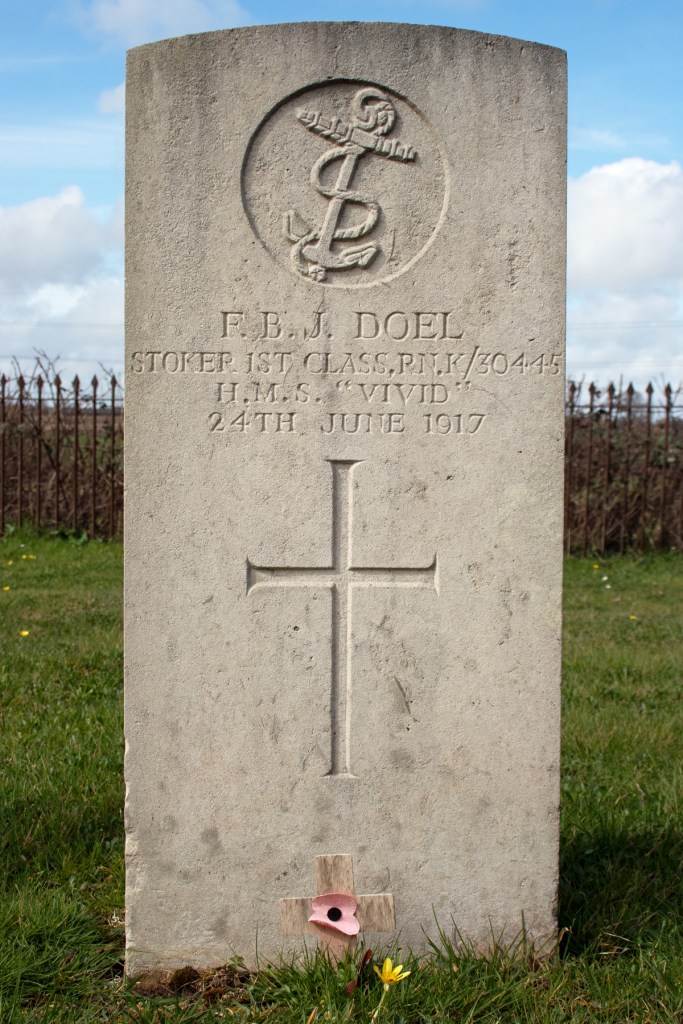
Stoker Doel returned to HMS Vivid in May 1917, preparing for his Leading Stoker exams. They were not to be, however, as on 24th June, he died, having ‘accidentally drowned’. No further information is available on his death, and the newspaper report of his funeral only notes that he “…met his death on Sunday week. His body was landed from his vessel, and was brought home for burial…” [Somerset Standard: Friday 6th July 1917]. He was just 19 years of age.

Francis Benjamin John Doel was brought back to Berkley for burial. He was laid to rest in the village’s church cemetery.