Joseph William Cutting was born on 10th September 1897 in Stratford, Essex. The middle of three children, his parents were Alfred and Clara. Alfred was a stoker in a carpenter’s workshop, but when he completed his schooling, his son found work as a clerk.
When war broke out, Joseph stepped up to play his part. He enlisted in the Royal Navy on 22nd September 1915, joining as an Officer’s Steward 3rd Class. His service records show that he was 5ft 8ins (1.72m) tall, with dark brown hair, blue eyes and a fresh complexion. He was also noted as having a scar in the middle of his forehead.
Officer’s Steward Cutting was based at HMS Pembroke, the Royal Naval Dockyard in Chatham, Kent, and would continue in his role for the next two and a half years. His annual review recorded a very good character, and moderate to satisfactory ability, which may be why he did not rise above his junior rank.
In the summer of 1918, Joseph was admitted to the Royal Naval Hospital in Chatham, suffering from tuberculosis. The lung condition was to prove his undoing, and he succumbed to it on 16th July 1918. He was just 20 years of age.
Joseph William Cutting was laid to rest in the naval section of Woodlands Cemetery in Gillingham, Kent, not far from the base he had called home for so long.
Bernard Arthur de Plumley Smyth was born in Erith, Kent, on 16th September 1897. The second of four children – all of them boys – his parents were Reginald and Emily Smyth.
Bernard’s early life was a delicate one, and he spent at least some time at Great Ormond’s Street Hospital in Camden, London. His weakened health was such that he was baptised at the hospital’s local church – St George the Martyr – on 11th February 1900.
It is intriguing to see Reginald Smyth’s life develop over the years. His son’s baptism record gives his line of work as labourer, but by the following year’s census, he had moved the family to Ifield, West Sussex, where he was noted as living on his own means. Moving forward another decade, and the family had moved again, settling in a 9-roomed villa in Burgess Hill. Reginald was now listed as being a nurseryman and the family of six were sharing their home with boarder Horatio Jacoby, who was living by private means.
Bernard was still a schoolboy at this point. His health had seeming recovered over the years, and he was ready to make his mark on the world. On 6th March 1913, he enlisted as a Boy 2nd Class in the Royal Navy. His service records show that he was 5ft 3ins (1.59m) tall, with brown hair, brown eyes and a fresh complexion.
Boy Smyth was initially sent to HMS Ganges, the shore-based establishment in Suffolk, for his training. He remined there for six months, and was promoted to Boy 1st Class for his work.
On 26th September 1913, Bernard was given his first posting, on board the cruiser HMS Grafton. He remained on board for nine months, before returning to shore – this time to the Royal Naval Dockyard in Chatham, Kent – for the summer.
In August 1914, war was declared and by the end of that month, Boy 1st Class Smyth was given his second assignment, aboard the battleship HMS Formidable. She was a key vessel in the Channel Fleet, her role part of a convoy patrolling the seas of the southern coast of Britain.
Early on the morning of 1st January 1915, while off the Dorset coast, the battleship was torpedoed by a German submarine. Other ships in her convoy came to her aid, but it would prove fruitless. After a couple of hours – and another torpedo strike – she sank, taking more than 540 officer and crew – including Boy 1st Class Smyth – were lost. He was just 17 years of age.
We regret to record that a former scholar of the London Road Council Schools, Burgess Hill, lost his life through the disaster which came to HMS Formidable on January 1st. This was Bernard Arthur de Plumley Smith, the second son of Mr and Mrs Smyth, of Edward cottage, Brook Road, Prittlewell, Southend-on-Sea, late of Elgin Villa, Crescent Road, Burgess Hill. He was 17 years of age, and a first-class boy on board the ship. He bore the reputation of being smart, steady ad industrious, and was well known in Burgess Hill…
[Mid Sussex Times: Tuesday 12th January 1915]
Bernard Arthur de Plumley Smith was laid to rest in a communal grave in Lyme Regis Cemetery, in the hills above the Dorset town where he had been brought ashore following his ship’s sinking.
William Feldon was born on 16th October 1878, the middle of three children – and the only son – to William and Jessie Feldon. William Sr was a carpenter from Highgate, Middlesex, but it was south of the Thames, in Lambeth, Surrey, that the family were raised.
When he finished his schooling, William Jr found work as a general labourer. He was drawn to bigger and better things, however, and a life at sea was to catch his eye. In June 1894, he enlisted in the Royal Navy as a Boy 2nd Class. His service records noted that he was 5ft 2ins (1.57m) tall, with brown hair, brown eyes and a fresh complexion.
By the time William had completed his initial training, he had been promoted to Boy 1st Class. He was then moved to HMS Pembroke, the Royal Naval Dockyard in Chatham, Kent.
By October 1895, he was given his first posting, on board the torpedo cruiser HMS Archer, and he would remain assigned to her for the next two years. During this time, William came of age and was formally inducted into the Royal Navy, and was given the rank of Ordinary Seaman. His commitment to the service was pretty clear, and, within seven months he had been promoted again, to Able Seaman.
After a short spell back at Pembroke, William was assigned to HMS Wildfire, another shore establishment just along the coast in Sheerness. He remained there for nine months, during which time he was promoted again, to the rank of Leading Seaman.
In May 1899, William was moved to another posting, on board the gunboat HMS Partridge. This assignment provide him with the route to further promotion: he remained on board until July 1901, having risen to Petty Office 2nd Class on 1st July 1899 and Petty Officer 1st Class on 23rd September 1900.
Over the remainder of his initial term of service, William served on six further vessels. The sea was in his blood by this point, and when his contracted ended on 15th October 1908, he re-enlisted without any hesitation.
Away from the Navy, William fell in love. On 23rd October 1909, he married Ada Plumpton, who was 25 years old, and who lived in Battersea, Surrey. The couple exchanged vows at St Faith’s Church in Southwark, but settled down in the village of Dovercourt, Essex. They went on to have two children, Doris, who was born in 1910, and Elsie, who came along the following year.
Back at sea, Petty Officer Feldon was assigned to the cruiser HMS Boadicea. He spent two years on board, before moving to another cruiser, HMS Blonde, for another two years. In between voyages, William returned to the Royal Naval Dockyard in Chatham.
On 13th January 1914, Petty Officer Feldon was posted to the battleship HMS Formidable, part of the Channel Fleet patrolling the seas of the southern coast of Britain.
Early on the morning of 1st January 1915, while off the Dorset coast, she was torpedoed by the German submarine U-24. Other ships in her convoy came to help, but after a couple of hours – and another torpedo strike – the damage was too great and she sank. 120 members of the crew were saved, but more than 540 officer and crew – including Petty Officer Feldon – were lost. He was 36 years of age.
William Feldon’s body was one of those recovered and identified. He was laid to rest in a communal grave in Lyme Regis Cemetery, in the hills above the Dorset town where he had been brought ashore.
Horace Frank Bernthall was born in Clapton, Middlesex, on 19th February 1893. One of twelve children, his parents were Henry and Ellen. Henry was a general labourer, and this is work into which his sons followed.
By the time of the 1911 census, the Bernthall family were living on Folly Lane in Walthamstow, Essex. Henry and Ellen were sharing three rooms with six of their children – of which Horace was the eldest. The census return confirms that, of their twelve children, four had died by this point. Three of the family were working – Henry, Horace and another sibling, 16 year old Arthur.
Horace set his sights on bigger and better things, and on 30th August 1912, he enlisted in the Royal Navy. He took up the role of Stoker 2nd Class, his records confirming that he was 5ft 5ins (1.65m) tall, with brown hair, grey eyes and a fresh complexion.
Stoker Bernthall was initially sent to HMS Pembroke, the Royal Naval Dockyard in Chatham, Kent, for his training. He remained there for the next five months, before being assigned to the pre-dreadnought battleship HMS Formidable. She was to remain his home for the nest two years, and was where he gained promotion to Stoker 1st Class in August 1913.
HMS Formidable was attached to the Channel Fleet, primarily guarding the waters separating Britain from France. Early on the morning of 1st January 1915, while off the Dorset coast, she was torpedoed by the German submarine U-24. Other ships in her convoy came to help, but after a couple of hours – and another torpedo strike – the damage was too great and she sank. 120 members of the crew were saved, but more than 540 officer and crew – including Stoker 1st Class Bernthall – were lost. He was just 21 years of age.
Horace Frank Bernthall’s body was one of those recovered and identified. He was laid to rest in a communal grave in Lyme Regis Cemetery, in the hills above the Dorset town where he had been brought ashore.
The spelling of the family surname varies across the documents that cover Horace’s life – Bernthal, and Burnthall being two other suggestions – but I have gone with Bernthall, as that is what is recorded on his baptism record.
Harold Stanley Randall was born in Taunton, Somerset, in the autumn of 1898. One of twins, his parents were Joseph and Elizabeth Randall. Joseph was a carpenter, and when Elizabeth died in 1900, he was left with nine children to raise on his own. This led to Harold being raised Joseph’s brother and sister-in-law, George and Caroline, and he is noted as living with them in Bath, Somerset, in the 1901 and 1911 censuses.
There is little direct evidence of Harold’s life: at the time of the 1911 census he was still at school, so it is not clear what employment he took up once his education came to an end. When war broke out, he played his part, and had enlisted in the Gloucestershire Regiment by the summer of 1918.
Private Randall was attached to the 17th Battalion, a territorial force based in Essex. By the end of the war, Harold was billeted in St Osyth, and it was here that he fell ill. Details of his condition are lost to time, but his health was impacted enough for him to be admitted to the general hospital in Colchester.
Harold Stanley Randall’s illness was to get the better of him. He passed away on 7th December 1918, aged just 20 years old. His body was brought back to Somerset for burial, and he was laid to rest in Bath’s sweeping Locksbrook Cemetery. His next of kin was noted as his aunt Caroline, who had raised him from a toddler.
Walter Soper Mitchell was born in the summer of 1878 in Newton Abbot, Devon. The fourth of nine children, his parents were Frederick and Mary. Frederick was a house painter and handyman, and records seem to suggest that he took the family to where the work was. The 1881 census found the family living in Chelsea, West London, and it seems that they stayed in London until 1890.
By the time of the 1891 census, the Mitchells were back in Devon, living at 10 Orchard Terrace in Paignton. Frederick was now working as a plumber, while Walter’s older siblings – brothers Frederick Jr, William and Alfred – were variously employed as a sailor, a painter and a plumber.
Walter, who was 12 years old by this point, was nearing the end of his schooling. When he left, he followed the family trade, and as soon employed as a house painter. The 1901 census found him as the oldest sibling still to be living with Frederick and Mary, although his circumstances were about to change.
In September 1903, Walter married Emily Jeffery. She was a couple of years younger than her new spouse, but, sadly, there is little information about her parents. The 1891 census found her living with her grandparents, while the 1901 return noted her boarding with her aunt and uncle.
Walter and Emily went on to have three children. By the time of the 1911 census, the family were living at 25 Norton Terrace in Paignton, Walter being employed as a house painter by this point.
War came to Europe in the summer of 1914, and Walter was called upon to play his part. Full details of his military service have been lost in the mists of time, but from what remains it is clear that he enlisted in the Royal Army Ordnance Corps at some point after July 1915. He was attached to the 67th Coy., but it is unclear whether he saw any action overseas.
Private Mitchell’s time in the army was not to be a lengthy one. He seems to have been based in Essex, and a later record confirms that he contracted bronchitis and anaemia. This would prove to be his undoing: he passed away in Colchester on 17th February 1916, aged 36 years old.
The body of Walter Soper Mitchell was brought back to Devon for burial. He was laid to rest in what would become the family plot in the sweeping Paignton Cemetery.
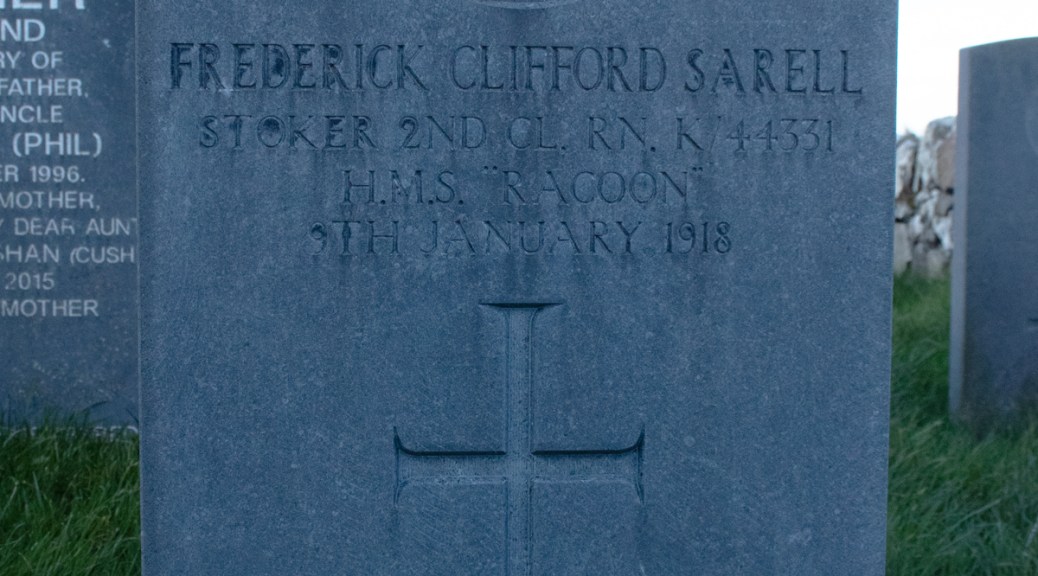
Frederick Clifford Sarell was born on 6th July 1899, one of six children to James and Theresa. James was a general labourer from East London, and the family were born and brought up in West Ham, Essex.
The Sarell family were beset by tragedy: Frederick’s oldest brother, James, died in 1903, at the age of 23, while James Sr passed away three years later. By the time of the 1911 census, Theresa was raising her five remaining children in a small house in Fife Road, Canning Town, with her oldest three children bringing in some money to support the family,
In 1913, another of Frederick’s brothers, George, passed away, and the following year his oldest sister, Theresa Jr, also died. By the summer of 1917, with war raging across Europe, Frederick stepped up to play his part. It is unclear whether his motives were to support his mother, or because he was conscripted, but either way he enlisted in the Royal Navy.
Frederick had been working as a dock labourer when he signed up. He Employed as a Stoker 2nd Class, his naval records show that he was 5ft 6.5ins (1.69m) tall, with brown hair, grey eyes and a fresh complexion. He was noted as having a scar on his right knee, a distinguishing mark that would tragically help to identify his body before the year was out.
Stoker Sarell was initially sent to HMS Pembroke, the Royal Naval Dockyard in Chatham, Kent, for his training. On 10th October 1917, he was given his first posting, on board the destroyer HMS Racoon, which patrolled the seas between Ireland and Scotland.
Frederick was on board when, on 9th January 1918, the Racoon struck rocks off the coast of Northern Ireland in heavy seas and blizzard conditions. All of the crew – more than 90 men – were lost. Stoker 2nd Class Sarell was just eighteen years old when he died: he had been in the Royal Navy for less than six months.
The body of Frederick Clifford Sarell washed ashore near Ballintoy, County Antrim. He was laid to rest in the graveyard of the village’s church next to two other crew members, Ordinary Seaman Frank Green and Ship’s Cook Walter Griffin.
Frank Ernest Green was born in Stratford, Essex on 14th November 1889. One of nine children, his parents were printer’s compositor John Green and his wife, Susan. The family were raised in Leytonstone and, by the time of the 1911 census, they were living in a house in Elsham Road.
Frank found work as a clerk for a financial company when he finished his schooling. On 31st August 1912, he married sailor’s daughter Charlotte Greenland, who was four years his senior. The couple settled in Gibbon Road, Peckham, Surrey, where Frank continued his work.
When war broke out, Frank was called upon to play his part. On 3rd January 1917, he enlisted in the Royal Navy for the duration of the war. His service records show that he was 5ft 6.5ins (1.69m) tall, with brown hair, blue eyes and a fresh complexion.
Ordinary Seaman Green was initially sent to HMS Pembroke, the Royal Naval Dockyard in Chatham, Kent, for training. He spent short periods of time on two ships before being assigned to HMS Racoon, a Beagle-class destroyer,
Initially patrolling the Mediterranean, by the time Frank joined the crew the Racoon she was part of the Second Destroyer Flotilla, based from Northern Ireland. In January 1918, she struck harsh weather:
HMS Racoon, Lieut. George LM Napier RN, in command, struck some rocks off the north coast of Ireland at about 2am on the 9th [January], and subsequently foundered with all hands.
Nine of the crew had been left behind at her last port of call, and these are the sole survivors.
Seventeen bodies have been picked up by patrol craft, and are being buried at Rath Mullan. Five more bodies have been washed ashore, and are being buried locally.
All the next of kin have been informed.
Exeter and Plymouth Gazette – Monday 14 January 1918
Ordinary Seaman Frank Ernest Green was one of those to be washed ashore. He was just 28 years of age. He was laid to rest in the peaceful and picturesque graveyard of Ballintoy Church, County Antrim, not far from where he had come to land. He was buried next to two other crew members, Ship’s Cook Walter Griffin and Stoker 2nd Class Frederick Sarell.
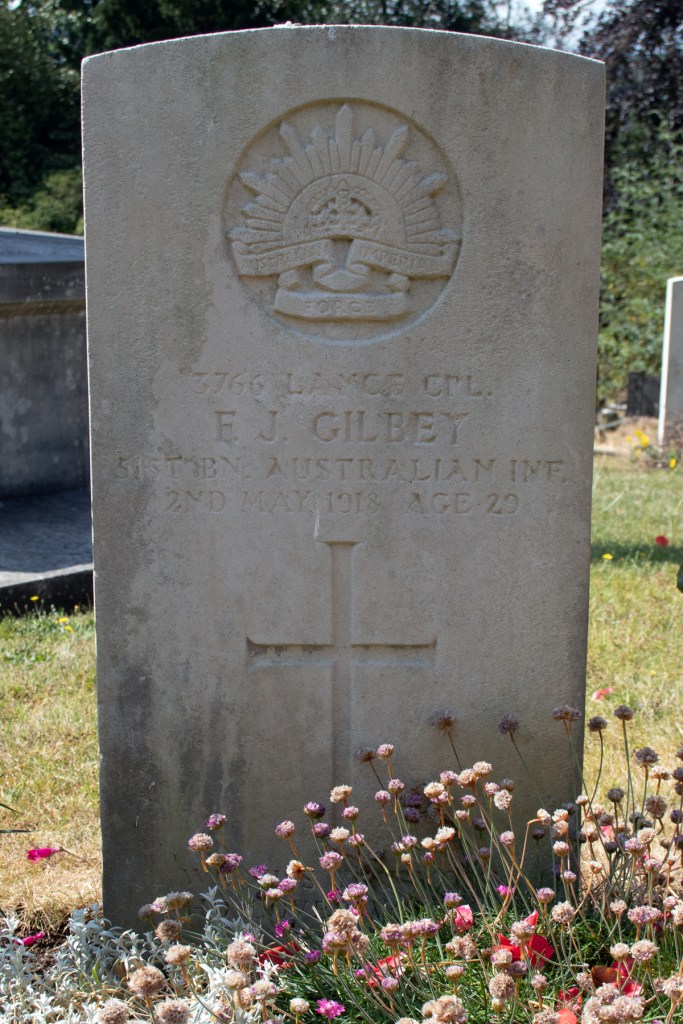
Frederick James Gilbey was born on 1st September 1888 in Walthamstow, Essex. The oldest of nine children, his parents were Alfred and Emily. Alfred was a general labourer, and the family initially lived on Chingford Road, before moving to an end-of-terrace house at 41 MacDonald Road.
On 28th August 1910, Frederick married Katherine Heathorn. Little more information is available about her, although the young couple’s marriage seemed to be the start of something bigger: the newlyweds emigrated shortly afterwards, arriving in Fremantle, Australia, in October 1910. Frederick’s immigration records noted that he was employed as a salesman, while Katherine was working as a dressmaker.
The couple settled into their new life well. The 1916 Electoral Records found the family living at 20 Oswald Street in the leafy Victoria Park suburb of Fremantle. Frederick was now working as a tram conductor, while Katherine was busy raising their two children, Leslie and Arthur.
By this point, Europe was two years into a bloody conflict. Frederick’s younger brother William, a Private in the Royal Fusiliers, had been killed at Gallipoli in August 1915, and it would seem that he also felt pulled to serve his King and Empire.
On 12th September 1916, Frederick enlisted in the Australian Imperial Force. His service documents note that he was 5ft 6.5ins (1.69m) tall and weighed 140lbs (63.5kg). Private Gilbey had auburn hair, blue eyes and a fresh complexion.
After initial training, he left Fremantle for the two-month journey back to Britain. Assigned to the 13th Training Battalion, his unit was based in Codford, Wiltshire. In November 1917, Frederick attended the 15th Rifle Course at the School of Musketry in Tidworth, where he qualified as 1st Class, with a fair working knowledge of the Lewis Gun.
The following February, Private Gilbey was transferred to the 51st Battalion of the Australian Infantry, and sent with his unit to France. On 20th April, days before the Battle of Villers Bretonneux, he was promoted to Lance Corporal.
The battle, however, was to prove to be his last. Wounded in the right thigh by gun shot, he was medically evacuated to Britain, and admitted to Bath War Hospital, Somerset, for treatment. His wounds were too severe, however: Private Gilbey passed away on 2nd May 1918, at the age of 29 years old.
With his widow and children on the other side of the globe, Frederick James Gilbey was laid to rest in the military section of Bath’s Locksbrook Cemetery.
John Phippen Dyer was born in the spring of 1896, and was the oldest of four children. His parents, John and Fanny Dyer, were from Somerset and it was in the town of Highbridge that they raised their family.
John Sr worked as a coach body maker for the railways, and his eldest boy joined him as an apprentice when he finished his schooling. When war broke out, however, John Jr was keen to be seen to be playing his part.
John Jr enlisted in Taunton on 15th November 1915, joining the Wessex Division of the Royal Engineers. His service records confirm that he was 5ft 7.5ins (1.71m) tall and of god physical development. He was sent off to Essex for training, but came down with influenza the following January.
Sapper Dyer was admitted to hospital in Great Bentley, spending a fortnight there. He was released back to his unit, but his health continued to suffer. He had had bouts of rheumatism going back to 1911, and, by the spring of 1916, this had recurred, and was recorded as possible rheumatic appendicitis.
John’s condition led to him being declared permanently unfit for was service: he was discharged from the army on 30th March 1916, having served for just four-and-a-half months.
John Jr returned to Somerset, but at this point his trail goes cold. The next record for him is that of his passing, on 26th May 1919. He was just 23 years of age.
John Phippen Dyer was lair to rest in the cemetery of his home town, Highbridge, Somerset.