Category Archives: Kent

Stoker Anthony Eames

Stoker Anthony Eames

Anthony Eames was born on 29th October 1876 in the village of Newhall, Derbyshire. He was one of four children to James and Mary Eames, although Mary passed away in 1880, not long after Anthony’s younger brother was born. James remarried, and he and his new wife (and possibly his late wife’s sister), Theresa Barlow went on to have twelve children of their own.

James was a coal miner, and while Anthony initially followed in his father’s footsteps, he sought bigger and better things. In September 1896, just short of his twentieth birthday, he joined the Royal Navy as a Stoker 2nd Class. His service records show that he was 5ft 3.5ins (1.61m) tall, had brown hair, grey eyes and a fresh complexion. The document also noted that he had tattoos on both of his arms.

Stoker Eames’ initial posting was at HMS Victory, the Royal Naval Dockyard in Portsmouth, Hampshire. He spend a year there, honing his skill, before being assigned to HMS Powerful in September 1897. Three months later, he was transferred to the cruiser HMS Alacrity and, over the remainder of his twelve years’ service, he worked on eight further vessels, rising to the rank of Stoker 1st Class in the process.

It was during this time that Anthony met and married Frances Pelley, a young woman from Portsmouth. The couple went on to have three children and, when Stoker Eames was stood down from active service at the end of his contract in 1908, the family moved to Sheffield. Anthony found employment in the mines again and the family settled in to a small terraced house in the then village of Darnall.

The sea continued to call to Anthony, though, and, on 8th March 1912, he re-enlisted. For the next couple of years he was based at HMS Victory, but when war broke out he was transferred to the battleship HMS Bulwark.

Stoker Eames was on board Bulwark when, on the morning of 26th November 1914, an explosion ripped through the ship, tearing it apart and sinking it. In all 741 souls were lost, Anthony amongst them. He was 38 years of age.

The majority of those who died in the explosion aboard HMS Bulwark were buried in a mass grave in Woodland Cemetery, Gillingham, Kent. Anthony Eames’s body, however, had been identified, and so he was laid to rest in a marked grave in the cemetery.

Leading Stoker Ernest Brown

Leading Stoker Ernest Brown

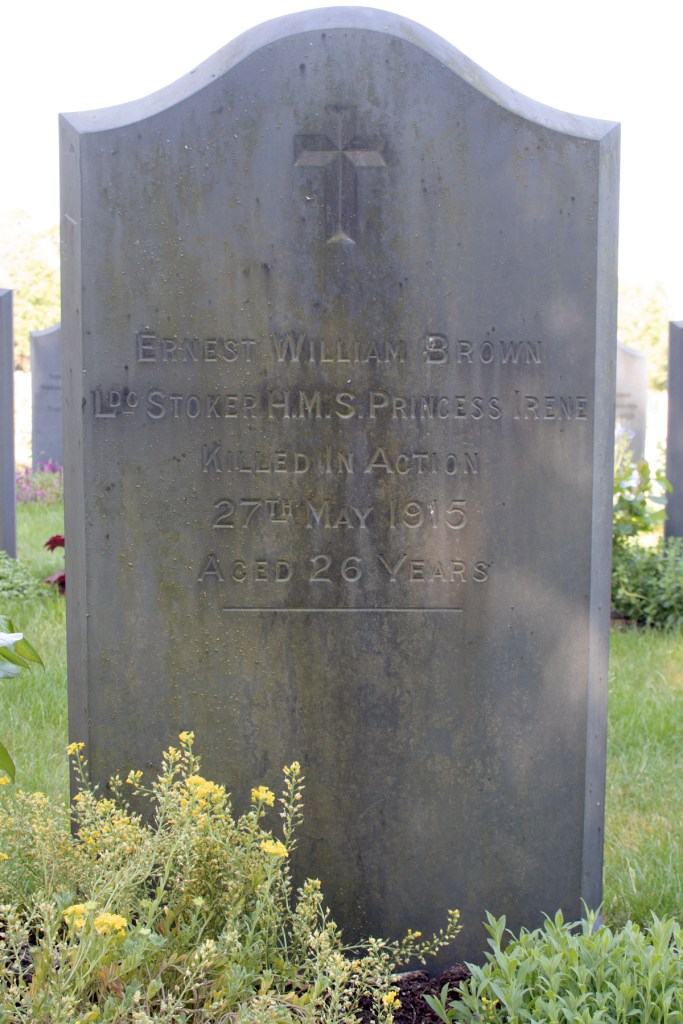
Ernest William Brown was born on 5th April 1889 in Halstead, Essex. One of twelve children, his parents were carpenter Edward and silk weaver Elizabeth Brown.

Ernest initially found work as an errand boy, then as a house painter. He wanted bigger and better things, however, and the Royal Navy offered him that opportunity. He enlisted as a Stoker 2nd Class on 12th March 1908 for a period of twelve years’ service.

Ernest’s early service records are lost to time, but he received a promotion to Stoker 1st Class on 12th March 1909, exactly a year after a joined up. At this point he was assigned to the dreadnought battleship HMS Russell, on board which he served until August 1912.

After a short period at HMS Pembroke, the Royal Naval Dockyard in Chatham, Kent, Stoker 1st Class Brown was transferred to the Apollo-class cruiser HMS Iphigenia. She was to be his home for the next two-and-a-half years, during which time he was promoted again, this time to Leading Stoker.

Returning to HMS Pembroke in March 1915, this was to be his shore base for the next couple of months. On 27th May, Leading Stoker Brown was helping out on the steamer Princess Irene. Tragically, while on board an explosion ripped through the ship, while moored off Sheerness, Kent and he was one of the 352 souls killed. He was just 26 years of age.

Ernest William Brown was laid to rest in the Woodlands Cemetery in Gillingham, Kent. His body having been identified, he was given his own grave, unlike those who were buried in a mass grave nearby.


Officers’ Steward Peter Galea

Officers’ Steward Peter Galea

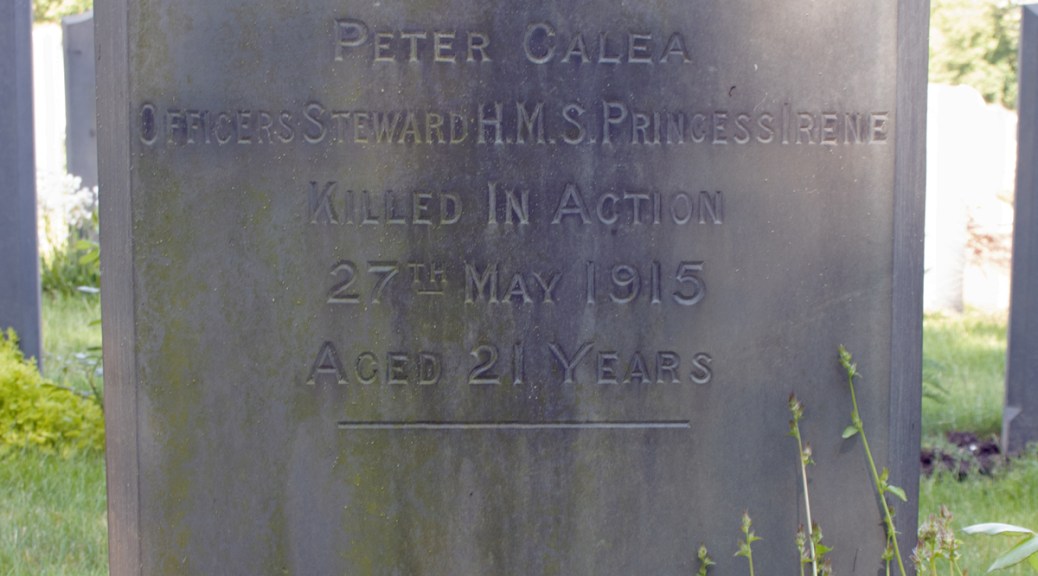
Peter Galea was born in the Maltese town of Senglea on 25th August 1893. His mother’s name was Carmela, but there is little further concrete information about his early life.

What is clear is that Peter found employment by enlisting in the Royal Navy. He joined up on 2nd January 1912 as an Officer’s Steward 3rd Class. His service records show that he was 5ft 9.5ins (1.66m) tall, had brown eyes, black hair and a dark complexion.

Officer’s Steward Galea’s first assignment was on board the dreadnought battleship HMS Orion. He was to spend more than three years on board, although his continuous service was interrupted by three days spent in the cells in May 1913: unfortunately his misdemeanour is not recorded.

In February 1914, Peter was transferred to the Apollo-class cruiser HMS Thetis. She was to be his home for the next year, during which time war was declared across Europe. In March 1915, Officer’s Steward Galea was assigned to another ship, the ocean liner Princess Irene.

Tragically, Peter was on board when, on 27th May 1915, an explosion ripped through the ship, while moored off Sheerness, Kent and he was one of the 352 souls killed. He was just 21 years of age.

Peter Galea was laid to rest in the Woodlands Cemetery in Gillingham, Kent. His body having been identified, he was given his own grave, unlike those who were buried in a mass grave nearby.


Fireman John Donoghue

Fireman John Donoghue

In the naval section of the Woodlands Cemetery in Gillingham, Kent, stands a headstone to a John Donoghue. The stone states that he was a Fireman on board HMS Princess Irene and that he was killed in action on 27th May 1915. He was 25 years of age.

Further research confirms that he was part of the Mercantile Marine Reserve, but there are no records to confirm his service at sea. While John was born in around 1890, with no confirmation of his place of birth, or the names of his parents, it is impossible to narrow down any further details for him.

Records of the Princess Irene’s crew do not include a John Donoghue, although this does not necessarily mean that he was not serving on board, only that records no longer exist. The fact that he was granted an individual headstone, rather than being commemorated in the mass grave that is also situated in the Woodlands Cemetery suggests that his body was able to be identified.

Sadly, however, Fireman John Donoghue’s life is destined to be lost to time, his legacy to be one of the 352 souls lost during the explosion and sinking of the ship on board which he served.


Private Lot Hayward

Private Lot Hayward

Lot Hayward was born in November 1897 in the Somerset village of West Coker. The seventh of eight children, his parents were Walter and Elizabeth Hayward. Walter was a twine maker at a local factory, but when Lot left school – and after Elizabeth died in 1908 – he found work as a farm labourer.

Lot was seeking bigger and better things in life, however, and on 18th August 1913, he enlisted in the Royal Marine Light Infantry. His service records confirm that he was 5ft 6ins (1.67m) tall, had light brown hair, brown eyes and a pale complexion. It also confirms that he lied about his age – giving his year of birth as 1895 in order to be accepted for service.

Private Hayward joined up at the recruitment depot in Deal, Kent, and, after training there, he was sent to Plymouth in Devon, arriving there in June 1914. Over the next couple of years, he moved between Devon and HMS Victory, the Royal Navy Dockyard in Portsmouth, Hampshire.

When war was declared, Lot also served overseas, fighting at Antwerp, Alexandria and in Turkey. While there in the summer of 1916, he fell ill, contracting pulmonary tuberculosis. He returned to Plymouth, and was admitted to the Royal Naval Hospital in the city.

His lung condition meant that Private Hayward could no longer perform his duties as a soldier. He was medically discharged from the navy on 10th June 1916.

Lot returned home, but his condition grew steadily worse. He eventually succumbed to it, passing away on 18th November 1917, at the tender age of just 20.

Lot Hayward was laid to rest in the graveyard of St Martin’s Church in his home village of West Coker. Reunited with his mother, Lot’s father, Walter, was also laid to rest in the family plot when he passed away in 1920.


Guardsman John Boucher

Guardsman John Boucher

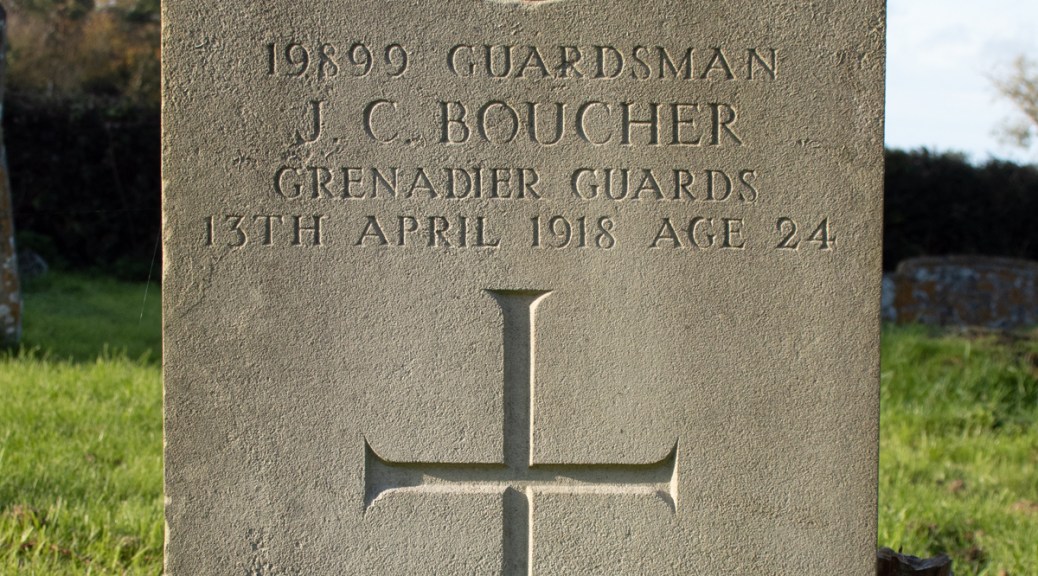
John Charles Boucher was born in East Coker, Somerset, in the spring of 1894. The youngest of five children, he was the son of Charles and Ann Boucher. Charles worked on the railways as a plate layer, while John found work in a local textile factory as a yarn dyer when he left school. He was a sporty young man, and became a prominent member of the nearby Stoford Football Club.

Ann died in 1914 and, when war was declared, John was keen to play his part. He had enlisted in the Grenadier Guards by the summer of 1917 and was assigned to the 5th Battalion. Full details of Guardsman Boucher’s military service are lost to time, but it is clear that he served abroad, and was wounded twice in the fighting.

John was based at Guards barracks in Kensington, London. It was here that he met Elsie Louise Vaughan, who was the daughter of a local insurance agent. The couple married at the Holy Trinity Church in Paddington on 28th June 1917.

Guardsman Boucher was soon sent to the Western Front again, however, and, in the spring of 1918, he was caught up in the Battles of the Lys. Wounded for a third time, he was medically evacuated to Britain, and admitted to the Military Hospital in Sidcup, Kent. Sadly, it was to be third time unlucky for John: his wounds proved too severe, and he died of his injuries on 13th April 1918. He was just 24 years of age.

John Charles Boucher was brought back to Somerset for burial. He was laid to rest in the cemetery of his home village, East Coker.


Tragically, just three weeks after John’s death, Elsie gave birth to their first, and only, child, a son she named after his father. She went on to marry again in the spring of 1919, to a John Bellamy. The couple would go on to have a child of their own – a daughter called Iris – the following year. John Jr died in 1972, and Elsie followed five years later, at the age of 83 years old.


Corporal de Courcy Raymond

Corporal de Courcy Raymond

de Courcy William Raymond was born in the summer of 1883 in the Somerset village of West Camel. He was one of six children to carpenter George Raymond and his wife, Anne. de Courcy – whose name may have had family connections – followed his father into carpentry and, by the time of the 1911 census, the family had moved to nearby South Barrow, where George had been born.

When war came to Europe, de Courcy was keen to play his part. Sadly, full details of his military service no longer survive, but what can be determined is that he had enlisted by March 1915, joining the North Somerset Yeomanry.

Private Raymond was assigned to the 2nd/1st Battalion, which was a second-line troop, and remained on home soil, moving from Somerset to Wiltshire to Kent by the autumn of 1915. He was evidently good at his job as he was soon promoted to the rank of Corporal for his efforts.

It was while he was based in Kent that de Courcy fell ill. He contracted pneumonia, and was admitted to a military hospital in Canterbury. Sadly, the condition was to prove too much, and he passed away from the condition on 9th October 1915. He was 32 years of age.

The body of de Courcy William Raymond was brought back to Somerset for burial. He was laid to rest in the family plot in the graveyard of St Peter’s Church in South Barrow.


Rifleman William Locke

Rifleman William Locke

William Thomas Locke was born at the start of 1900 in the Kent village of Eccles. His parents were Thomas and Annie Locke, although it seems that he was orphaned early on. The 1901 census recorded him as living with his grandparents John and Mary Locke. Their daughter Annie is also recorded as living at the property, although there is nothing to confirm whether she was William’s mother or an aunt.

By the time of the 1911 census John Locke had died. Mary was living in the same house, with two of her sons – Frederick and Alfred – and her grandchildren, William and his cousin Gladys. Both of William’s uncles were labourers in the local cement works, and it seems likely that this would be work that he would have followed them into once he had completed school.

William’s trail goes cold at this point, although he would have been too young to join up at the outbreak of the First World War. Records confirm that he had enlisted by March 1918, and it seems likely that he would have done so as soon as he came of age.

Rifleman Locke joined the 5th Battalion of the King’s (Liverpool Regiment), but this is the only detail of his military service that can be confirmed. The next record for him confirms that he passed away on 5th October 1918, having been admitted to hospital in Oswestry, Shropshire, suffering from intestinal problems. He was just 18 years old when he passed.

William Thomas Locke’s body was brought back to Kent for burial. He was laid to rest in the graveyard of St Peter & St Paul’s Church in Aylesford, the parish church for his home village of Eccles.

The specific location of William’s grave is not known, although it is likely that he was laid to rest near his grandfather. Instead, he is commemorated on a joint headstone in the First World War section of the graveyard. William’s grandmother passed away the following year, and records confirm that his next of kin was noted as his aunt, Mary Ann Longley.


Private Charles Grigsby

Private Charles Grigsby

Charles Grigsby was born in Boughton Monchelsea, a village to the south of Maidstone, Kent, in the summer of 1878. His parents were farm labourer William Grigsby and his wife, Elizabeth, and he was one of four children. Charles’ mother passed away when he was just three years old, and William married again – to another Elizabeth. They had six children – half-siblings to Charles.

Charles falls off the radar for a few years – his First World War service records suggest that he had enlisted with the East Kent Regiment, and so may have been serving abroad at the time of the 1891 and 1901 censuses.

In 1904 he was back in Kent, however, where he married Henrietta Harpum. The daughter of a soldier, Henrietta had been born in Shoeburyness, Essex, but the family had moved to Frindsbury, Kent, not long afterwards.

The 1911 census found the Grigsbys living in the village of Eccles, near Aylesford. Charles was working as a blacksmith’s striker at the local cement works, and they had their Henrietta’s nephew, George, living with them at the time the record was taken.

When war was declared, Charles stepped up again to play his part. He enlisted on 24th August 1914, and was assigned to the Queen’s Own (Royal West Kent Regiment). Private Grigsby’s service records confirm that he was 5ft 6.5ins (1.69m) tall, and weighed 129lbs (58.5kg). He had brown hair, blue eyes and tattoos on both arms.

Tragically, Henrietta died not long after her husband joined up, although the exact date and cause of her passing is lost to time. Assigned to the 6th (Service) Battalion, Charles was, by this time, based in Hythe, on the Kent coast.

Private Grigsby’s time back in the army was to be a short one, however. He was admitted to Shorncliffe Military Hospital in January 1915, suffering from bronchial pneumonia, and is was this lung condition that was to take his life just weeks later. He passed away on 22nd February 1915, at the age of 35 years old.

Charles Grigsby was brought back to Aylesford by his siblings. He was laid to rest in the graveyard of St Peter & St Paul’s Churchyard. It is likely that he was buried alongside Henrietta, although the exact location of his grave is not longer known. Instead, he is commemorated on a joint headstone in the First World War section of the graveyard.


Lance Corporal Ernest Green

Lance Corporal Ernest Green

Ernest Green was born on 31st March 1881 – four days before that year’s census – in the Kent village of Aylesford. The middle of eleven children, his parent were William and Sarah Green. William was a labourer in the local clay works, and this is employment that Ernest and his brothers also entered into.

On 10th December 1904, Ernest married Emily Chapman. She was the daughter of another labourer, and the couple went on to have seven children, the oldest of whom was born in May 1905.

The family set up home in Aylesford, not far from Ernest’s parents, and life would have been set, had it not been for the intervention of the First World War.

Ernest enlisted early on, joining The Buffs (East Kent Regiment) in December 1914. His service records confirm that he was 33 years old when he enlisted, and stood 5ft 4ins (1.63m) tall. Sadly, Private Green’s service records are a little sketchy, and it is unclear whether he ever saw action overseas, although it is likely that he did at some point.

Private Green transferred to the Machine Gun Corps in February 1916, and then moved again – to the Labour Corps – in the summer of 1918. He joined the 426th Agricultural Coy, and was based in Canterbury.

Working outside through the summer and autumn, it seems that Ernest’s health may have begun to suffer and he was admitted to the Canterbury Military Hospital in December 1918, having contracted influenza. Sadly, the lung condition was to prove his undoing: Private Green passed away at the facility on 20th December 1918. He was 37 years of age.

Ernest Green was brought back to Aylesford for burial. He was laid to rest in the graveyard of St Peter & St Paul’s Church, although the exact location of his grave is not longer known. Instead, he is commemorated on a joint headstone in the First World War section of the graveyard.