James Ward Jones was born on 17th August 1871 in the Denbighshire town of Llangollen. He was the oldest of eleven children to William and Anne Jones. William was a bricklayer’s labourer, and James followed suit when he finished school.
On 30th April 1898, James married fisherman’s daughter Mary Jones. The couple set up home in Llangollen and went on to have ten children.
When war came to Europe, James stepped up to play his part for King and Country. Sadly, little detail of his military service remains available. but it is clear that he enlisted in the Royal Welch Fusiliers and, as a Private, he was assigned to the 47th Provisional Battalion. The troop was based on home soil, and James found himself sent to Norfolk for his war work.
It is unlikely that Private Jones was in camp for long. On Christmas Day 1915 he collapsed having had a seizure, and passed away. He was 44 years of age.
James Ward Jones’ body was brought back to Wales for burial. He was laid to rest in the graveyard of St John’s Church in his home town of Llangollen.
Mary was left with ten children to bring up on her own. She married again, to a Jack Evans, in the autumn of 1916. The couple had two children of their own. Mary passed away in December 1935, aged just 58 years old.
Victor Frank Langdon was born in the autumn of 1897, the only child to Francis and Martha Langdon. Frank was a carter and cowman from Clatworthy in Devon, but it was in Bradford-on-Tone in neighbouring Somerset that Victor was raised.
Victor was 16 years old when war was declared, but he was still keen to play his part. While full details of his military service are not available, he initially enlisted in the Hampshire Yeomanry, before transferring across to the 15th (Service) Battalion of the Hampshire Regiment in 1917.
Records suggest that Private Langdon served as part of a territorial force and, by the summer of 1918, was based in Norfolk. It was here that he fell ill, and, while in the camp hospital on 15th June 1918, he passed away. Details of his condition are lost to time, but it was noted as “disease”. He was just 21 years of age.
Victor Frank Langdon was brought back to Somerset for burial. He lies at rest in the graveyard of St Giles’ Church, in his home town of Bradford-on-Tone.
Edward Francis Wakeford was born in Rottingdean, near Brighton, Sussex, in February 1881. He was the younger of two children to curate William Wakeford and his wife, Eliza.
The family home was always a busy one; the 1881 census records one visitor, four boarders and a servant. Ten years later, confirms one boarder and two servants.
By 1901, William had taken up a post in St Peter’s Church, Henfield. This seems to have been a step up: helping look after the family and a visitor were four servants – a gardener, a cook, a housemaid and a kitchenmaid.
In March 1907, Edward married Annie West Thornton; she was the daughter of a well-to-do family – the census records show that her father, William West Thornton, lived by private means, while Annie was sent to Surrey to attend a boarding school.
Edward and Annie couple set up home on the Sussex coast, and, when William passed away in 1912, were soon also living by private means. They went on to have three children: two girls, Olive and Iris, and a boy, who they named William after both of their fathers.
War was coming to Europe by this point. While full details of Edwards military service are not available, he appears to have given a commission in the Royal Sussex Regiment. Initially serving as a Lieutenant, but October 1914, he was promoted to Captain.
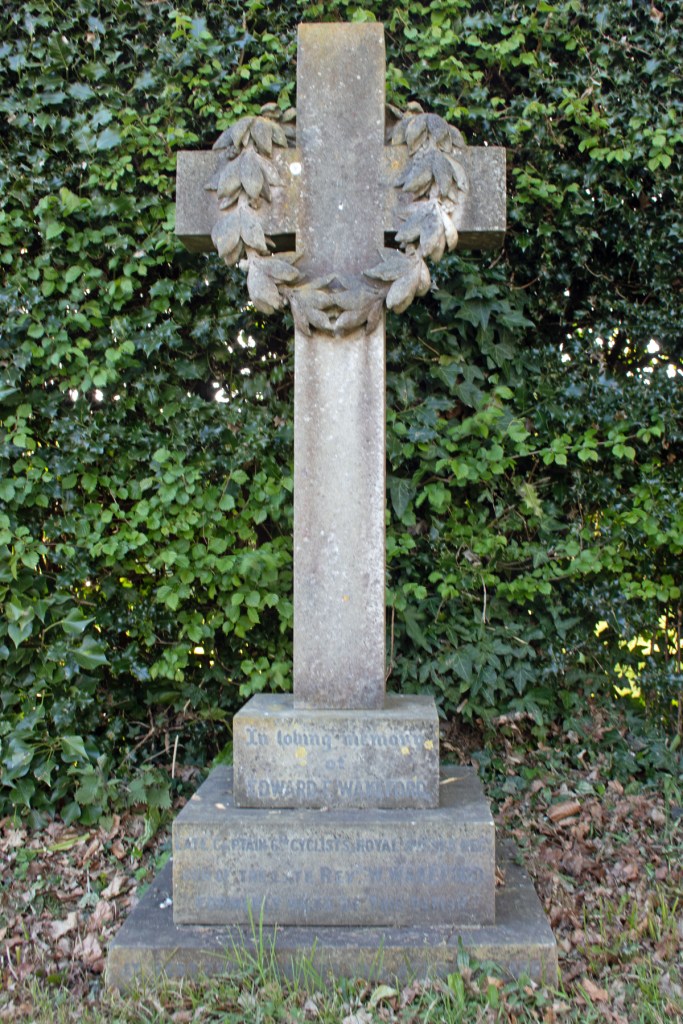
Edward was assigned to the 6th (Cyclist) Battalion, and served in East Anglia. It seems that he fell ill while there, and was admitted to the Norfolk and Norwich Military Hospital, suffering with appendicitis. Sadly the condition proved too much, and Captain Wakeford passed away following the operation. He died on 23rd February 1915, not long after his 34th birthday.
Edward Francis Wakeford’s body was brought back to Sussex. He was laid to rest in Henfield Cemetery, not far from the church where his father had served for so long.
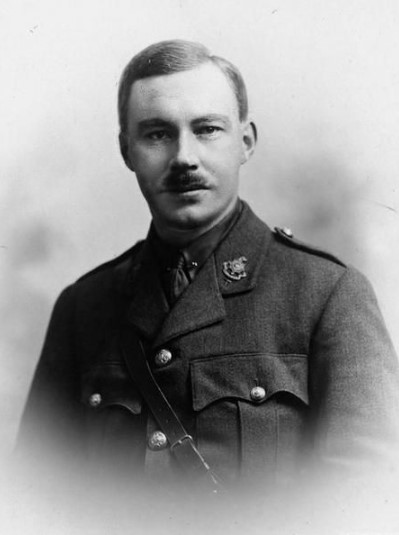
Captain Edward Wakeford (from findagrave.com)
The now widowed Annie wed again, marrying Reverend John Gurney in October 1917. Tragedy was to strike again, though, when she passed away just a year later, on 20th October 1918. She was laid to rest Henfield Cemetery, in the plot next to her late husband, Edward.
John Gurney went on to live a full live. He never married again, and settled in Buxted, near Uckfield. He passed away in November 1956, at the age of 76 years old. He was also laid to rest in Henfield Cemetery, where he was buried in the same plot as Annie.
Edward and Annie’s children also went on to have full lives, despite the early loss of their parents.
Olive never married, and passed away in Nottingham in 1986, aged 78 years old.
Iris married in Liverpool in 1934, and went on to have two children. When the marriage failed in the 1940s, she got wed again in 1949. She passed away in Cheltenham in 1965, at the age of 54.
William got married in 1940, at which point he was serving as a Lieutenant in the 1st King’s Shropshire Light Infantry. He saw action in Italy towards the end of the war, and was awarded a Military Cross for his service. When peace came to Europe again, he and his wife settled into a normal life, before emigrating to Australia. William passed away in May 1967, at the age of 54 years old.
Harry Barker is one of those people whose lives are likely to remain lost to time as very little information remains that can be directly connected to him.
The only document that can be directly attributed to him is his Royal Navy service record. This confirms Harry’s date and place of birth as 5th January 1896 in West Dereham, Norfolk and confirms that he was a farm labourer before enlisting.
Census records confirm that, in 1901 there was a Harry Barker living in that village. He was residing with his grandparents – Robert and Elisabeth Barker – their son, Cornelius, and five more of their grandchildren.
One of the Barkers’ grandsons, Sidney, appears next to a Harry Barker on the 1911 census. Both were inmates at the Downham Union Workhouse, as does a Cornelius Barker. It seems likely, therefore, that the three are connected, and that this is the Harry Barker who appears on the service records five years later.
Harry’s records show that he enlisted in the Royal Navy as a Stoker 2nd Class on 27th October 1916. He was 5ft 8ins (1.73m) tall, had brown hair, brown eyes and a fresh complexion.
Stoker Barker was initially stationed at HMS Pembroke, the Royal Naval Dockyard in Chatham, Kent. After six months he received his first ocean-going post, aboard the dreadnought battleship HMS Hibernia. He spent five months on board, before returning to Chatham.
He was billeted in the Drill Hall, which had been set up with temporary accommodation during 1917, when the barracks themselves became overcrowded.
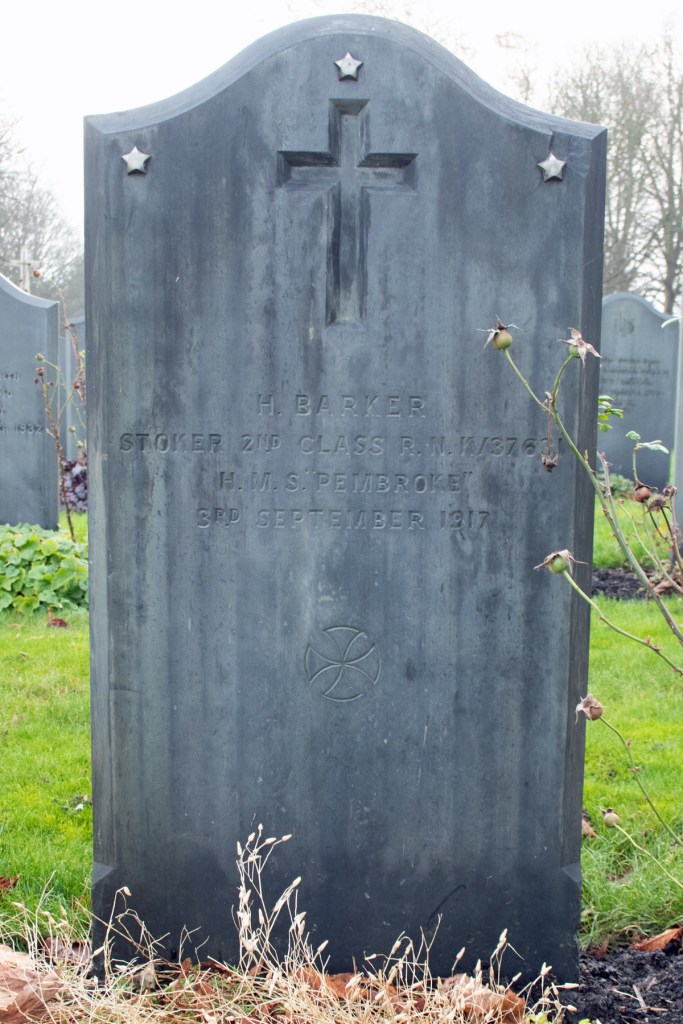
On the 3rd September 1917, the German Air Force carried out one of its first night-time air raids on England: Chatham was heavily bombed and the Drill Hall received a direct hit. Stoker Barker was amongst those killed instantly. He was just 20 years of age.
Harry Barker was laid to rest, along with the other victims of the Chatham Air Raid, in the Woodlands Cemetery, Gillingham.
Stafford Edmund Douglas was born on 4th January 1863, the second of four children to Stephen and Mary Douglas. Stafford came from a military family, his father having been a Captain in the Royal Navy. This led to a lot of travelling and, having been born in Donaghadee, County Down, he then moved to South Wales.
By the 1880s, when Stephen and Mary had set up home in Portsmouth, Stafford had started to carve out a career for himself, and was a Lieutenant in the Argyll and Sutherland Highlanders, based at Edinburgh Castle.
Over the coming years, Lieutenant Douglas, who stood 5ft 8.5ins (1.74m) tall and also spoke French, travelled the world, serving in South Africa, Ceylon (Sri Lanka) and Hong Kong. By 1894 he had made Captain, and he finally retired in 1903, after nineteen years’ service.
On 29th April that year, at the age of 40, Stafford married Mary Louisa Harris. She was the daughter of an army colonel, and the couple wed in St George’s Church, Hanover Square, London. The couple set up home in Exeter, Devon, and went on to have two children – Violet and Stafford Jr.
At this point, Stafford’s trail goes cold. When war broke out in 1914, he was called back into duty, working as a Railway Transport Officer in Norwich. He continued in this role until 1919, before being stood down and returning home.
Stafford Edmund Douglas passed away on 15th February 1920, at the age of 57 years old, although no cause of death is immediately apparent. He was laid to rest in the Milton Road Cemetery in Weston-super-Mare, presumably where his family were, by this time, residing.
Norman Stanley Allard was born on 3rd December 1892 in the village of Corsley, Wiltshire, halfway between Frome and Warminster. The younger of two children, his parents were Benjamin and Mercy Allard. Benjamin was a farmer who passed away when his son was only 14 years old. Mercy, who was born in Frome, moved the family back to her home town and Norman found work as a clerk at a printing firm in the area.
War came to Europe and, in December 1915, Norman was called up. There is little specific information about his military service, although his records show that he was 5ft 9ins (1.75m) tall and had varicocele – enlarged veins in his scrotum – listed as Distinctive Marks.
Initially assigned to the King’s Royal Rifles, Private Allard spent the first year of his service on home soil. He was eventually dispatched to France in March 1917, serving there for a year. On 22nd March 1918, he was wounded in a gas attack, and medically evacuated back to England.
He was called back into service, and assigned to the 9th Battalion of the Northamptonshire Regiment. He remained on home soil, working as part of the Labour Corps in Cley-next-the-Sea in Norfolk. Sadly, however, it seems that his injuries were to prove too much, and the now Corporal Allard was discharged from military service after just three months.
At this point, Norman’s trail goes cold. He returned home, and passed away there on 13th March 1919. He was just 26 years of age.
Norman Stanley Allard was laid to rest in the graveyard of Holy Trinity Church. This became a family grave, and his mother and sister were also buried there when they passed in 1924 and 1940.
Herbert William Hare Marshall was born in Ambala, India, on 19th August 1890. His father – Herbert Seymour Marshall – was a Colonel in the army, and was serving in India with his wife, Charlotte, when their children – Charlotte (known as Jessie) and Herbert Jr – were born.
The family were back in England by 1898, and had set up home in the Somerset seaside town of Weston-super-Mare. When Herbert Sr passed away that year, Charlotte was set up on a widow’s pension, and this allowed her to send her son to St Peter’s, a private boarding school in the town.
When her son’s schooling was complete, Charlotte took the family off to Canada. They settled in British Colombia, in Revelstoke, a mountain town halfway between Calgary and Vancouver. Here, Herbert found work as a bank clerk, but war came to Europe, and he felt a need to do his bit for King and Country.
Herbert enlisted in the Canadian Expeditionary Force (CEF) in November 1914; his service papers record him as being 5ft 8ins (1.73m) tall, 148lbs (67kg) in weight. He had black eyes, brown hair and a dark complexion – something that he may well have inherited through his mother’s genes.
Shipped to England, by August 1915, Private Marshall had been discharged from the CEF as part of a transfer to the New Army – also known as Kitchener’s Army, the volunteer British Army raised as a direct result of the outbreak of war.
Detailed information about Herbert’s military service is lacking, although it seems that he joined the 17th Battalion of the West Yorkshire Regiment, one of the regiments heavily involved during the Battle of the Somme.
By October 1916, however, the now Lieutenant Marshall had made another move, this time joining the Royal Flying Corps. On the afternoon of 26th August 1917, he was an observer on a flight at Marham, in Norfolk. The pilot, a Lieutenant Challington, was banking the aircraft, when it dived and crashed, killing both men. Lieutenant Marshall had turned 27 years old the week before.
Herbert William Hare Marshall’s body was brought back to his adopted home of Weston-super-Mare. He lies at rest alongside his father in the town’s Milton Road Cemetery.
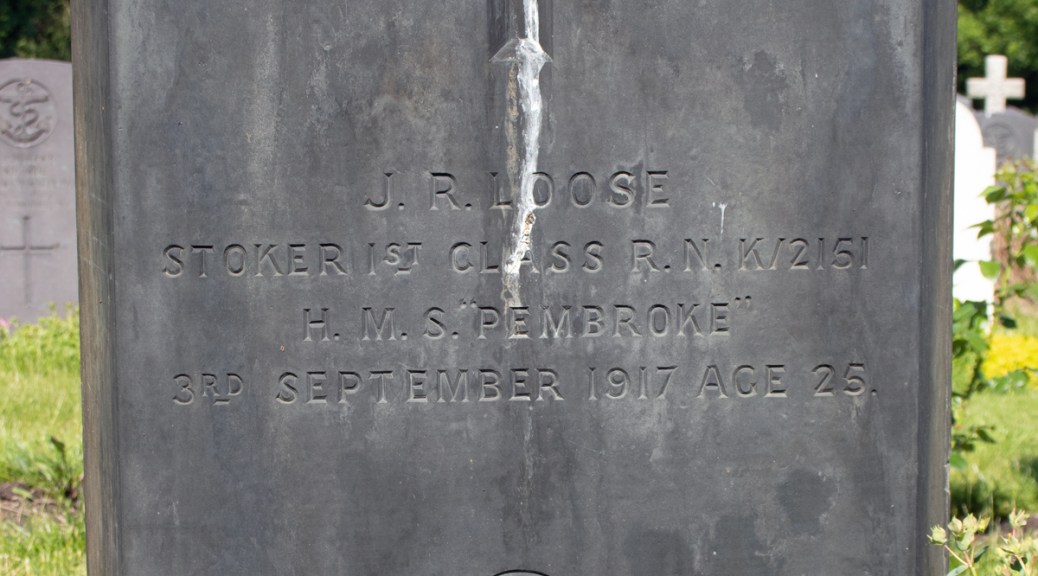
John Robert Loose was born on 3rd March 1891 in the village of Brancaster on the North Norfolk coast. One of seven children his parents were John and Agnes Loose.
John Loose Sr was a fisherman, as were most of the family’s neighbours and the sea was definitely in his oldest son’s blood. Within days of his eighteenth birthday, he had enlisted in the Royal Navy for a 12 year term. His service records show that he was 5ft 9ins (1.75m) tall, with light brown hair, blue eyes and a fresh complexion.
Stoker 2nd Class Loose’s first assignment was on board HMS Acheron and, over the next year he learnt his trade on board her, HMS Vindictive and HMS Hawke. In June 1910, he was serving on HMS Inflexible, and received a promotion to Stoker 1st Class.
In the lead up to the outbreak of the First World War, John served on five further vessels. In between ocean assignments he was based on board HMS Pembroke, the shore-based establishment based at the Royal Naval Dockyard in Chatham, Kent.
While he seemed diligent and hard working, Stoker Loose was not without his flaws, and had a couple of run-ins with authority. In June 1912 he was detained for 90 days for absence, drunkenness and for striking a Leading Seaman. Eighteen months later he was imprisoned for a further 28 days for being absent beyond his allotted leave.
When hostilities commenced, Stoker Loose was serving on board HMS Bacchante, an armoured cruiser that was part of the Royal Navy’s Mediterranean fleet. He spent a total of eighteen months on board, returning to Chatham in February 1916.
A further lengthy posting followed, as he was assigned to HMS Calliope, a light cruiser that served in the North Sea, and which was involved in the Battle of Jutland later that spring. Again, Stoker Loose’s record was not without blemish: he spend a week in the brig, although there is no confirmation of his misdemeanour this time around.
By August 1917, John was back on dry land in Kent. HMS Pembroke was a busy place that summer, and, with its barracks having reached capacity, Chatham Drill Hall was used as temporary accommodation. This is where John found himself billeted.
The German Air Force, by this point was trying to minimise the losses it was suffering during raids it carried out in daytime. Instead, it trialled night flights and, on 3rd September 1917, Chatham found itself in their flight path. The Drill Hall Stoker Loose was sleeping in received a direct hit, and he was killed. He was just 26 years old.
The 98 victims of the Chatham Air Raid were laid to rest in Woodlands Cemetery, Gillingham, walking distance from the Drill Hall where John Robert Loose had been living.
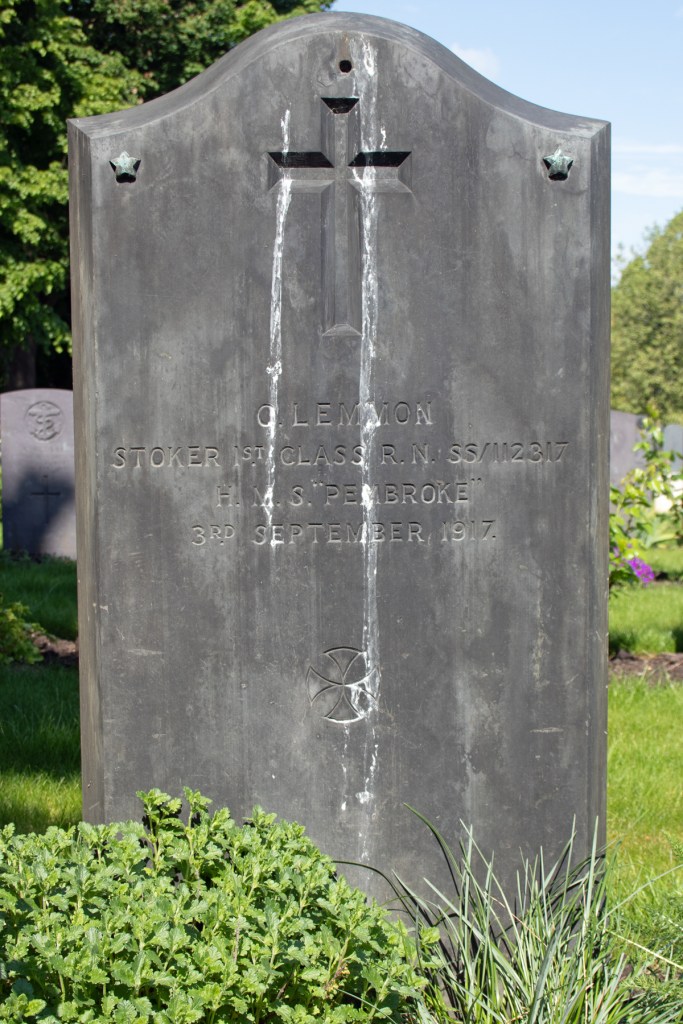
Charles Lemmon was born in Norwich, Norfolk on 12th July 1892. He was one of ten children and the son of bricklayer Henry Lemmon and his wife Sophia.
When Charles left school, he found work as an errand boy; by the time of the 1911 census, he had moved to Cambridge. He was living with John Buol, a Swiss confectioner and pastry chef who had set up a restaurant in the centre of the city, opposite King’s College.
The move from Norfolk to Cambridgeshire must has ignited a yearning for travel, however. Within a year, Charles had enlisted in the Royal Navy, and was taken on as a Stoker 2nd Class. His naval records show that he stood at 5ft 2ins (1.57m) tall, had brown hair, grey eyes and a fair complexion. It was also noted that he had a scar on his left leg.
Stoker Lemmon was set to see the world. After his initial training at HMS Pembroke – the Royal Naval Dockyard in Chatham, Kent – he was assigned to HMS Berwick, an armoured cruiser that sailed between England and the Americas.
The following year, Charles was reassigned to HMS Swiftsure, and received a promotion to Stoker 1st Class. He returned to HMS Pembroke in May 1916, and, after a couple of months on land, boarded HMS Titania, a submarine depot ship that had recently seen action in the Battle of Jutland.
Stoker Lemmon spent just under a year on the Titania, before again returning to Chatham in the spring of 1917. HMS Pembroke was a crowded place that summer, Charles was billeted in temporary accommodation in the dockyard’s Drill Hall.
On 3rd September, the German Air Force was trialling night raids on English locations; Chatham found itself in the line of fire. The Drill Hall received a direct hit, and Stoker 1st Class Lemmon was killed, along with close to 100 other servicemen resting there. He was just 25 years of age.
The servicemen who lost their lives in the Chatham Air Raid, including Charles Lemmon, were laid to rest in the Woodlands Cemetery in nearby Gillingham.
Roland William John Mayes was born on 29th September 1895 in the Norfolk village of Fundenhall. He was the seventh of ten children to Herbert and Anna Mayes, and was the first son. Herbert was a carpenter, and this was a trade his son was to follow him into, finding work at a local piano factory.
By 1914, war was looming, and Roland wanted to put his skills to good use. He enlisted in the Royal Navy on 11th March 1914, joining a carpenter’s crew at HMS Pembroke, the Royal Naval Dockyard in Chatham, Kent. Roland’s service records show that he stood at 5ft 7ins (1.7m) tall, had brown hair, grey eyes and a sallow complexion.
Crewman Mayes’ first sea-bound assignment was aboard HMS Patrol; she was a cruiser that provided defence for the east coast of England. The vessel was badly damaged during the German bombardment of Hartlepool in December that year; Roland remained on board for more than three years.
In August 1917, Crewman Mayes returned to Chatham. HMS Pembroke was a crowded place that summer, additional accommodation was made available in the dockyard’s Drill Hall, and this is where Roland was billeted.
On the night of the 3rd September, the German Air Force was trialling night raids on English locations; Chatham found itself in the direct line of fire. The Drill Hall received a direct hit, and Carpenter’s Crewman Mayes was killed, along with close to 100 other servicemen resting there. He was just 21 years of age.
Along with 97 other victims of the Chatham Air Raid, Roland William John Mayes was laid to rest three days later in the Woodlands Cemetery in nearby Gillingham.












 Death and Service