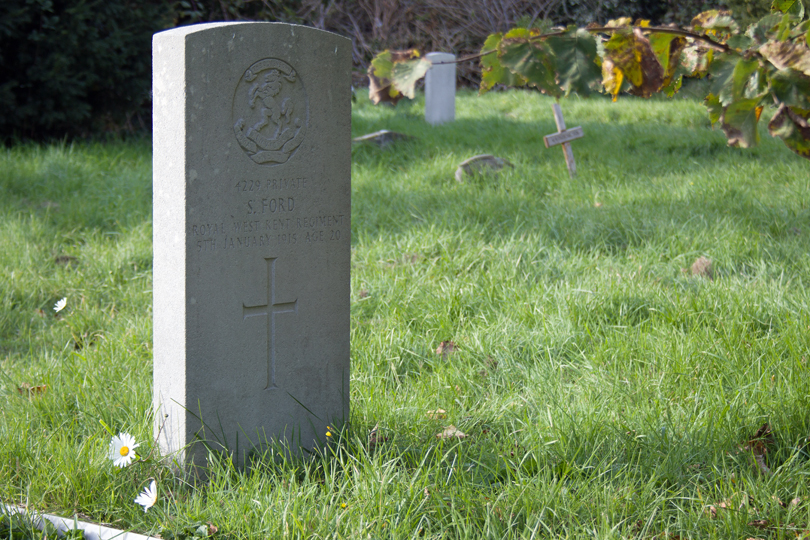
Fred Ford was born in the Wiltshire town of Mere in 1877. One of eight children to John and Charlotte, his father was an agricultural labourer from the village.
When he left school, Fred initially found work as an errand boy; he soon moved into labouring and, by the time of the 1901 census, was employed as a bricklayer.
In 1904, Fred married Florence Phillips; she was the daughter of an agricultural labour from Somerset. Fred, by this time, had found work as a coal miner in the county, and the young couple set up home in the village of Babington, near Frome. They went on to have four children.
Conflict was on the horizon and, while full details of his military service are not available, it’s clear that he enlisted as soon as he was able to, almost as was was declared. Gunner Ford joined the Royal Field Artillery, and was assigned to the 108th Brigade of the regiment’s Ammunition Corps.
Initially based in Taunton, Fred was soon moved to Portsmouth and then Worthing, and it was here, in the first winter of the war, that he contracted influenza and pneumonia. Admitted to St Cecil’s Red Cross Military Hospital in the Sussex town, sadly the condition proved too much for him. He passed away on 8th February 1915, tragically hours before Florence arrived from Somerset. Gunner Ford was just 37 years old.
Finances not enabling her to transport his remains back home, Florence Ford laid Fred’s body to rest in Broadwater Cemetery in Worthing, the town where he died.
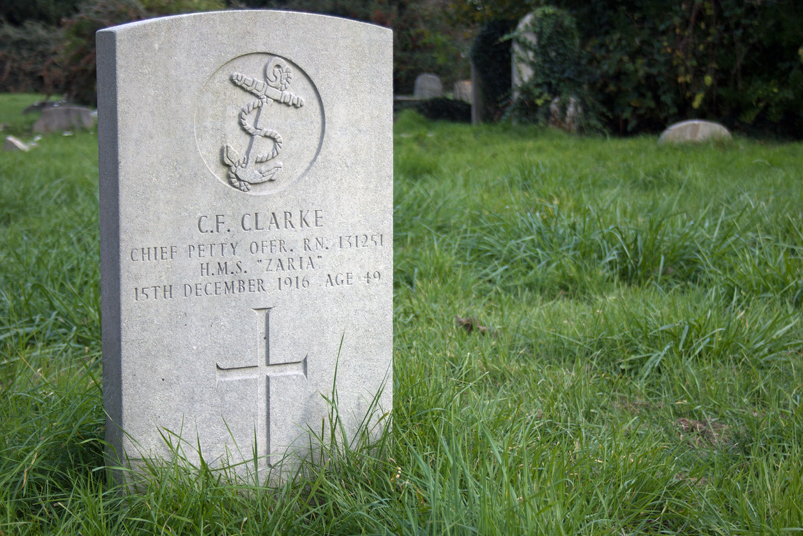
Charles Frederick Clarke was born on the 14th April 1869 to James and Jane Clarke. James was born in Suffolk, but moved to London, where he found work as a watchman (guarding the city streets at night). Jane was from Essex, and the couple went on to have five children, of whom Charles was the middle child.
Charles was set on a life of adventure, joining the Royal Navy in 1887, for a period of twelve years. During this time, he served on eleven vessels, working his way up through the ranks from Boy to Ordinary Seaman to Able Seaman, Leading Seaman and eventually Petty Officer.
In October 1895, he married Lydia Rogers, a sailor’s daughter from Portsmouth. The couple would go on to have nine children, eventually settling in Sussex.
When his naval service ended in 1899, Charles enlisted again. Within six years, he had achieved the rank of Chief Petty Officer, and in March 1909, after 22 years’ service, retired from active duty. He was obviously well respected, however, and was selected to serve on the staff of the Royal Naval Recruiting Office in Portsmouth. His service records suggest that he resigned from this role on 14th April 1914.
It seems that Chief Petty Office Clarke took on a role on the vessel HMS Zaria. This was a ship that was requisitioned by the Royal Navy, which acted as a patrol ship, guarding the coastal waters around the UK. While details are scant, Charles certainly served on board for a couple of years, and he died on board, from causes undisclosed, on 16th December 1916, at the age of 47 years old.
Brought back to West Sussex, Charles Frederick Clarke was laid to rest in the Broadwater Cemetery in Worthing. This was where Lydia was now living; she was buried in the same grave, when she passed away eight years after her husband.
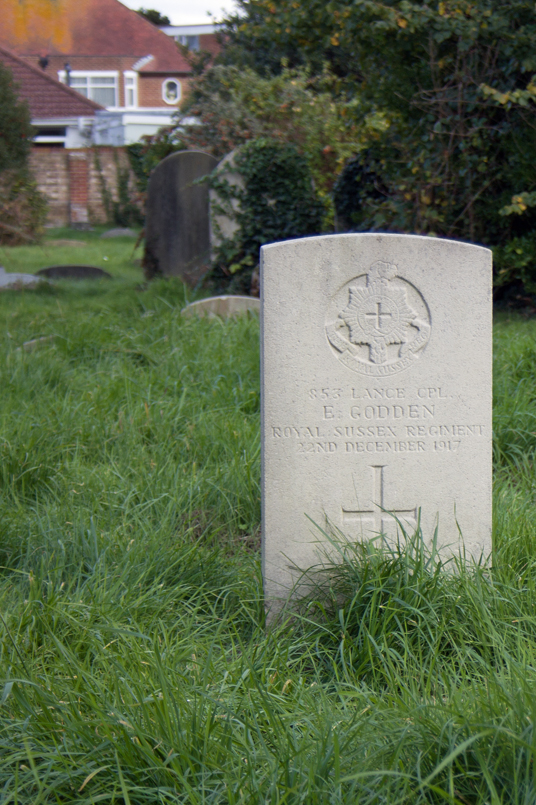
Edgar Godden was born in the summer of 1892, one of eight children to John and Alice Godden. John came from Littlehampton, and Alice from Worthing, and this is where they raised their family.
John was a bricklayer, and it was this trade that Edgar went into when he left school. War was coming to Europe, however, and, within weeks of the conflict breaking out, he had volunteered his services.
Edgar joined the Royal Sussex Regiment, and was assigned to the 7th (Service) Battalion. Details of his military service are a little sketchy, but a newspaper article, written after his death, gives a hint about what happened to him.
Mr Edgar Godden… who was twenty-five years of age and leave a widow and a little child, enlisted on the 1st September 1914, and was wounded in the arm in September of the following year. In October 1916 he was blown up and buried by an enemy mine. Last February he was taken out of the trenches and sent to a hospital in France, and last April he came home to England and had an arm amputated. Since his discharge from the Seventh Royal Sussex Regiment, he had been a member of the staff of the Post Office, and was known as “The One-armed Postman”.
Worthing Gazette: Wednesday 10th January 1918.
In the autumn of 1916, and recovering from his injuries Lance Corporal Godden married Emily Owers. They lived with John and Alice, but I have been unable to find details of the child mentioned in the newspaper report.
It seems that his injuries had left Edgar in a weakened state, and, after a ‘short and painful illness’ [Worthing Gazette: 2nd January 1918], he passed away on 22nd December 1917. He was just 25 years of age.
Edgar Godden was laid to rest, finally at peace, in the Broadwater Cemetery in his home town of Worthing, West Sussex.
The newspaper report above gave a little more information about a couple of Edgar’s siblings.
Mr & Mrs [John] Godden had one son killed in action in November 1916; and still another – the eldest – is now in France, as a member of the Royal Engineers.
Worthing Gazette: Wednesday 10th January 1918
Edgar’s oldest brother – also called John – survived the war, but it was his younger brother, Charles, who was killed in action.
A Corporal in the 11th Battalion of the Royal Sussex Regiment, Charles was caught up in the Battle of the Somme. It was while fighting in the Battle of the Ancre on 13th November 1916, that he was killed. He is remembered at the Thiepval Memorial in Northern France, and is also commemorated on Edgar’s own headstone.
One last aside to Edgar’s story is his address in the last few years of his life. John and Alice were living in Worthing, specifically at a house called “Chiswick” in Tarring Road, to the west of the town.
Coincidentally, when researching another soldier, Private Ernest Parsons, this turns out to be the address where he also died, just ten months later on 4th October 1918. There is no apparent other link between the two men.
Ernest Charles Parsons was born in 1881, and was one of six children to bricklayer Robert Parsons and his wife Mary Ann. Robert was a labourer and bricklayer from Watford, while Mary Ann was born in Arundel, West Sussex. The couple moved to where his work was, having their first children in Hertfordshire and Sussex They finally settled in London, which was where Ernest was born.
Where he first left school, Ernest worked as a painter, but soon found a career as a postman., something he would continue to do through to the outbreak of war.
Ernest married Frances Olive Eynott on 28th February 1904; they went on to have a daughter, Doris, the following year. It seems, however, that their marriage was destined to be a short one; Frances passed away within a couple of years.
With a daughter to raise and a living to earn, Ernest married again. Elizabeth Kate Dew was born in Fulham in 1883, and the couple married in the spring of 1907. Again, however, their happiness was to be short; Elizabeth died eighteen months later.
Widowed twice, and with Doris now a toddler, Ernest moved back in with his parents in Chiswick. He continued his work as a postman, but alongside this had been an active volunteer in the London Regiment (Post Office Rifles) since early 1908.
Rifleman Parsons’ initial year’s service was extended and extended and, by the time of the outbreak of the First World War, had been serving for some six years.
By 1914, Ernest had found love for a third time, and married Lilian Frances Cromie on 25th March that year. With war imminent, his time was take up more with military duties; while part of the territorial force, Rifleman Parsons had been officially mobilised.
The sudden intermingling of men from different parts of the country in small, packed training camps made the perfect environment for illness and disease to circulate. Ernest had initially contracted bronchitis while on service in 1912; this had dogged him intermittently oved the next few years until, in March 1915, it was serious enough for the Medical Examination Board to declare him unfit for military service.
Ernest moved his family to Worthing, in West Sussex, presumably as the air was fresher there than in the bustling capital. He may also had had family in the area, as his mother had been born just up the road in Arundel. Sadly, though, it seems that his health was not to recover sufficiently, and he passed away on 4th October 1918, at the age of 37.
Ernest Charles Parsons was buried in the Broadwater Cemetery in the town, not far from where his widow and daughter were then living.
Coincidentally, when researching another soldier, Lance Corporal Edgar Godden, this turns out to be the address where he also died, just ten months earlier on 22nd December 1917. There is no apparent other link between the two men.
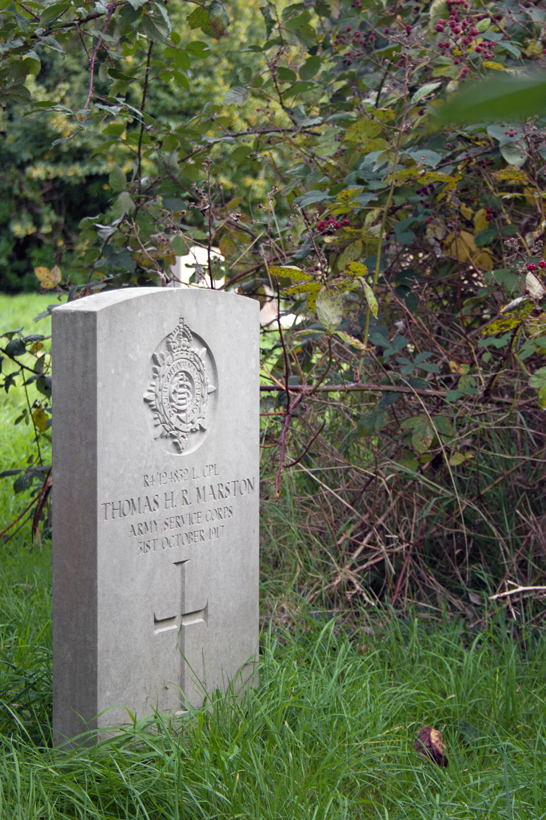
Thomas Henry Robert Marston was born on 12th February 1876, the son of Frederick and Elizabeth Marston. Frederick was a police constable who raised his family in the Paddington area of London.
Sadly, details of Thomas’ early life are tantalisingly scarce. He was not baptised until October 1881, on the same day as his brother, Frederick, who was four years younger.
Thomas seems to have had a sense of adventure; his Commonwealth War Graves Commission records confirm that he served in the South African Campaign – this would put him out of the country during the 1890s, and reinforce why documentation for that time is missing.
The next confirmed information for Thomas is his marriage record. He wed Bessie Ponder by banns in August 1909. The ceremony was at Christ Church in Marylebone, and the couple went on to have two children, Doris, born in 1911, and Hettie, born in 1912.
By the time of the 1911 census, with his military service by now complete, Thomas and Bessie were living on the Caledonian Road in Islington. Still childless at this point (although Bessie was undoubtedly pregnant), Thomas was working as a butcher.
The census gives their address as 54 Wallace Buildings, a Victorian tenement block, and the couple lived in two rooms. Their neighbours at No. 53 were fellow butcher Ralph Bonest, his wife Isabel and their three children, who also all lived in two rooms. On the other side newlywed cab driver William Barnes, lived with his wife Florence and her sister. The Barnes’ had the luxury of No. 55 being a three-roomed flat.
When the Great War broke out, it seems evident that the 38 year old Thomas was either re-mobilised or voluntarily re-enlisted. While the dates are not certain, he had joined the Army Service Corps by March 1917 and was assigned to the Remount Depot at Romsey in Hampshire. This section of the regiment was involved in the provision of horses and mules to other parts of the army.
No further details of Lance Corporal Marston’s military career remain. Sadly, the next record of his life confirm his death. He was admitted to the Hursley Camp Hospital with rupture of viscera (possibly an aneurysm), but died from his injury on 31st October 1917. He was 41 years old.
At some point after the 1911 census, the family had moved to Worthing in West Sussex. The body of Thomas Henry Robert Marston was brought back home, and he was laid to rest in the Broadwater Cemetery in the town.
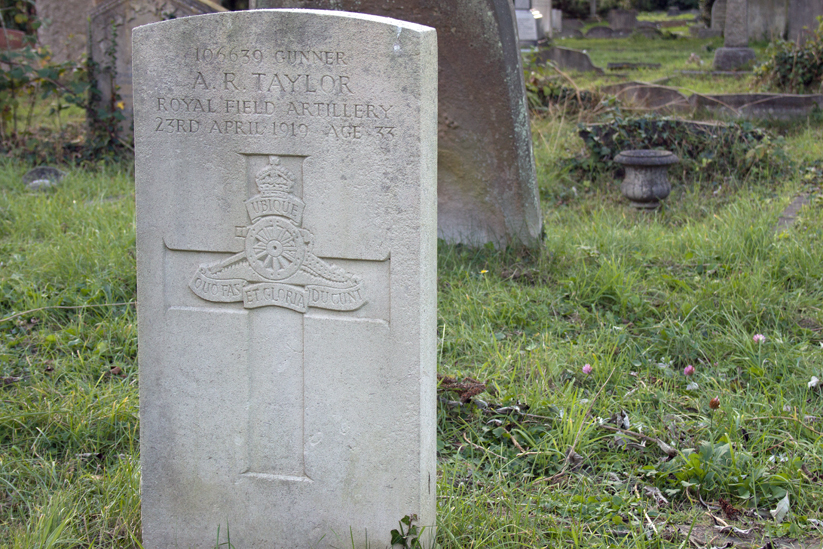
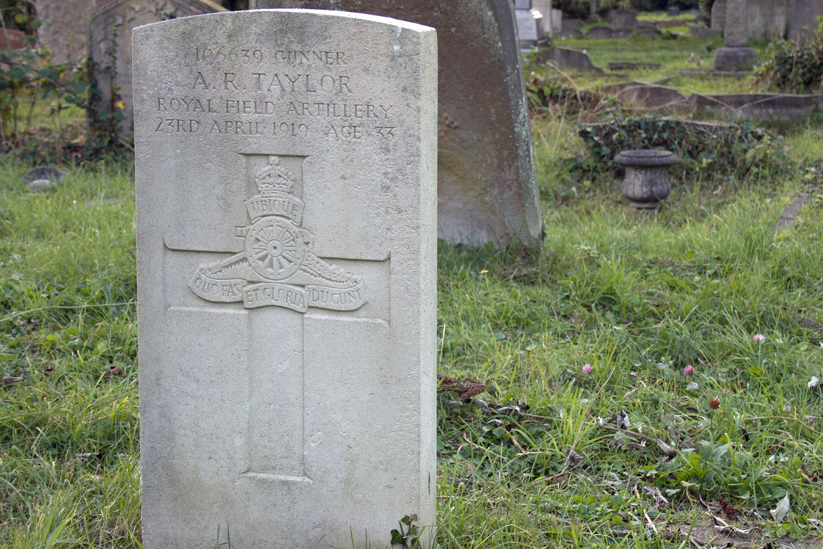
Alfred R Taylor was born in Portsmouth, Hampshire, in 1886, and was one of six children to James and Agnes Taylor. James was a jobbing gardener, who had been born near Chichester in West Sussex.
Agnes had been born in Tarring, near Worthing, and strong connections to her home town seemed to remain. In the 1891 census, Alfred was boarding with his aunt – Agnes’ sister – in Worthing and, ten years later, both of his parents and all of his siblings were also living there.
By 1911, Alfred was working as a nursery gardener – given his father’s work, this is not surprising, and, at the time, the coastal slopes of the South Downs were filled with orchards, farms and nursery greenhouses.
Tantalisingly, there is not a lot more documentation relating to Alfred’s life. When war broke out, he enlisted in the Royal Field Artillery as a Gunner. He joined up in October 1915 and was sent to the Balkans and, as a result of his service, was awarded the Victory and British Medals and the 1915 Star.
Back home on leave, Gunner Taylor married Ellen Mary Sayers at the start of 1918. She was a plumber’s daughter from Worthing, and this was where she and Alfred married.
When the Armistice was declared, Alfred was transferred to the Labour Corps, as part of the Army Reserve force. He passed away on 23rd April 1919, and, while there are no details of his death, it is likely that he fell victim to one of the lung conditions impacting the returning troops at the time. He was just 33 years of age when he died.
Alfred R Taylor was laid to rest in the Broadwater Cemetery in Worthing, not far from where his widow lived.
There are some further details about Ellen Taylor. She and Alfred did not have any children, and she never married again. She passed away in the spring of 1968 in her home town, at the age of 88 years old.
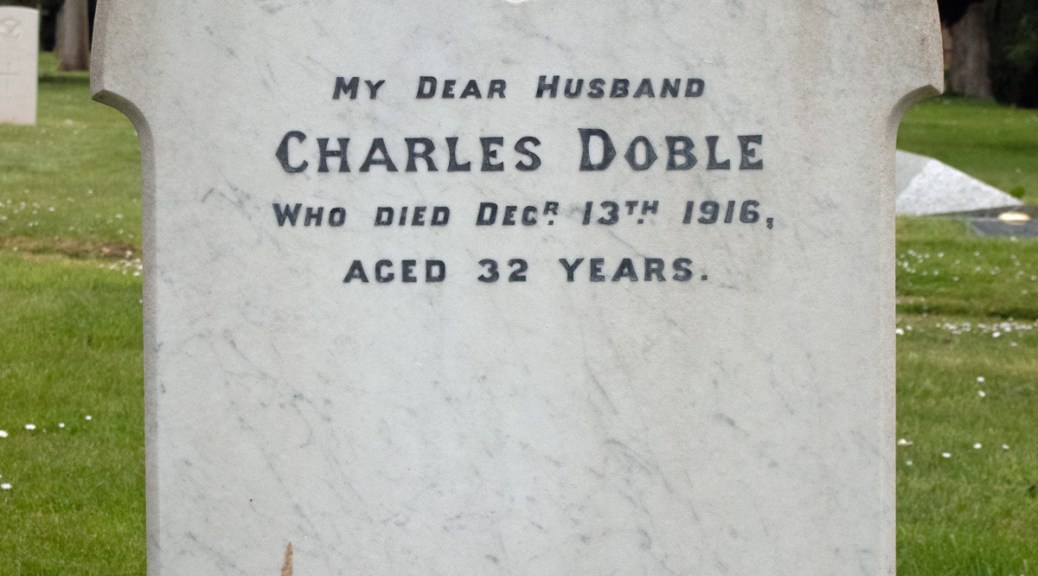
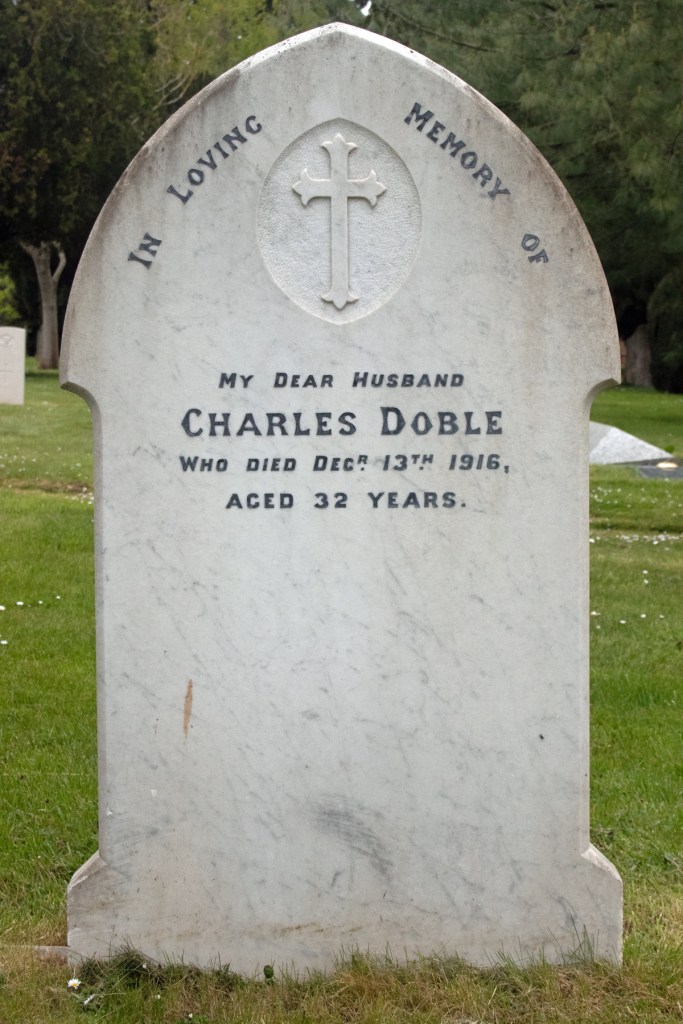
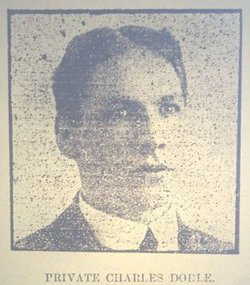
Charles Doble – also known as Charlie – was born 12th September 1884, the second of seven children to James and Mary Ann Doble from Dunkeswell in Devon. James was a carpenter, but on leaving school, Charles initially found work as an errand boy, before becoming employed as a porter at the Taunton and Somerset Hospital.
The 1911 census found Charles in the village of Cotford St Luke, working as an attendant at the Somerset and Bath Asylum. Housing more than 800 patients at the time, it is reasonable to assume that his duties would have been wide and varied.
Details of Charles’ military service are scarce. He enlisted in the Hertfordshire Regiment as a Private in April 1916, but soon transferred over to the 13th Battalion of the Royal Sussex Regiment.
In the spring of that year, Charles married Ethel Willmott; presumably this was before he was sent abroad, because he soon found himself on the Western Front.
His battalion was caught up in the Battle of the Boar’s Head, during with the Royal Sussex Regiment succeeded in capturing a section of the German front line trench and second line trench, before being pushed back because of mounting casualties and a lack of ammunition.
It seems likely that Private Doble was one of those injured on what became known as The Day Sussex Died, as he was evacuated back to England for treatment. Admitted to a military hospital in Stourbridge, sadly his wounds proved too much for Charles to bear; he passed away on 13th December 1916, at the age of 32 years old.
Charles Doble’s body was brought back to Taunton, and he was buried in the St James’ Cemetery in the town.
Ernest Frederick Hawkins was born in Street, Somerset, in 1884. He was the youngest of six children to Charles Hawkins and his wife Elizabeth. Both of Ernest’s parents were shoemakers in the Clark’s Factory in the town, and this was the trade Elizabeth continued in after her husband’s death in 1887.
Ernest’s life has some mysteries about it and there is a sense that he spent time trying to escape from something. In August 1904, he enlisted in the army, joining the Scottish Rifles (also known as the Cameronians). He did this under an assumed name, preferring to be called James Fisher.
“James” gave his next of kin as his parents, listing them as George and Annie in South Acton (even though these were not his actual parents’ names, and that his father had passed away 17 years previously).
His enlistment papers give an interesting insight into the young man. He was listed as 22 years old, 5ft 4ins (1.62m) tall, with brown eyes, black hair and a sallow complexion. His arms were adorned with a number of tattoos, including Buffalo Bill on his upper right arm and a ship surrounded by flags on his upper left.
Private Fisher served for a year on home soil, before being shipped out to India. He returned to the UK in October 1907, and transferred to the Army Reserve.
Ernest returned to Somerset, and it was here that he met Sarah Jane Manning. The couple married in a registry office in Bristol, and went on to have two children, Hubert and Iris.
War broke out, and Private Fisher was remobilised. By August 1914 he was promoted to Lance Corporal, and sent to France as part of the British Expeditionary Force. Here he became caught up in a number of the key battles of the conflict.
On 24th July 1916, during the British attacks on High Wood at the Somme, he was wounded in the right arm, and invalided back to England for treatment. Admitted to the War Hospital in Guildford, Surrey, it was confirmed that he had received a gun-shot wound to his right arm, which had resulted in a compound fracture of the humerus, radius and ulna. Sadly for Ernest, the only option was a full amputation of his right arm.
After some time to recover, Ernest was transferred to the Pavilion Military Hospital in Brighton where he was fitted for an artificial limb. He spent three months in the Brighton facility, before being moved to the Queen Mary’s Convalescent Home in Roehampton to recuperate. He was eventually discharged – from the hospital and the army – on 10th March 1917, and returned to his wife and family in Somerset.
There is little further documented information about Ernest. He and Sarah went on to have a further child – Leslie – in 1917. Sadly, where Ernest had been a toddler when his father had died, Leslie was consigned to be a babe-in-arms when Ernest passed away.
Ernest Frederick Hawkins – also known as James Fisher – died in Swindon on 2nd July 1918, at the age of 34. He lies at rest in St Mary’s Cemetery in his adopted home town of Taunton, Somerset.
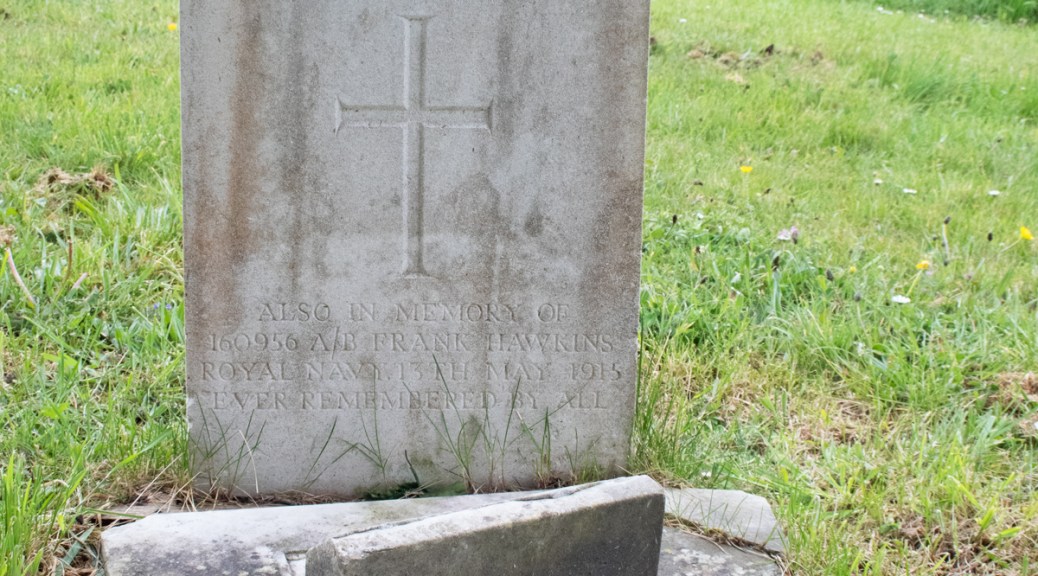
Ernest’s gravestone also commemorates his brother Frank Hawkins. Frank was nine years older than Ernest, and, like his younger brother, had decided that the military life was for him.
Frank enlisted in the Royal Navy in November 1894 and was assigned a Boy 2nd Class on HMS Impregnable – the training ship based in Chatham, Kent. Over the period of his twelve years’ service, Frank rose through the ranks to Able Seaman. When his term was up, he joined the Royal Fleet Reserve for a further five years.
When war came, Able Seaman Hawkins was immediately called back into action. He was assigned to HMS Goliath, serving off German East Africa and the Dardanelles. On the night of the 12th May 1915, the ship was guarding the water off Gallipoli, when it was struck by three Ottoman torpedoes. The resulting explosions caused the ship to sink quickly, and 570 souls – out of a total complement of 750 crew – were lost.
Able Seaman Hawkins was one of those lost, and was subsequently commemorated on his brother’s gravestone.
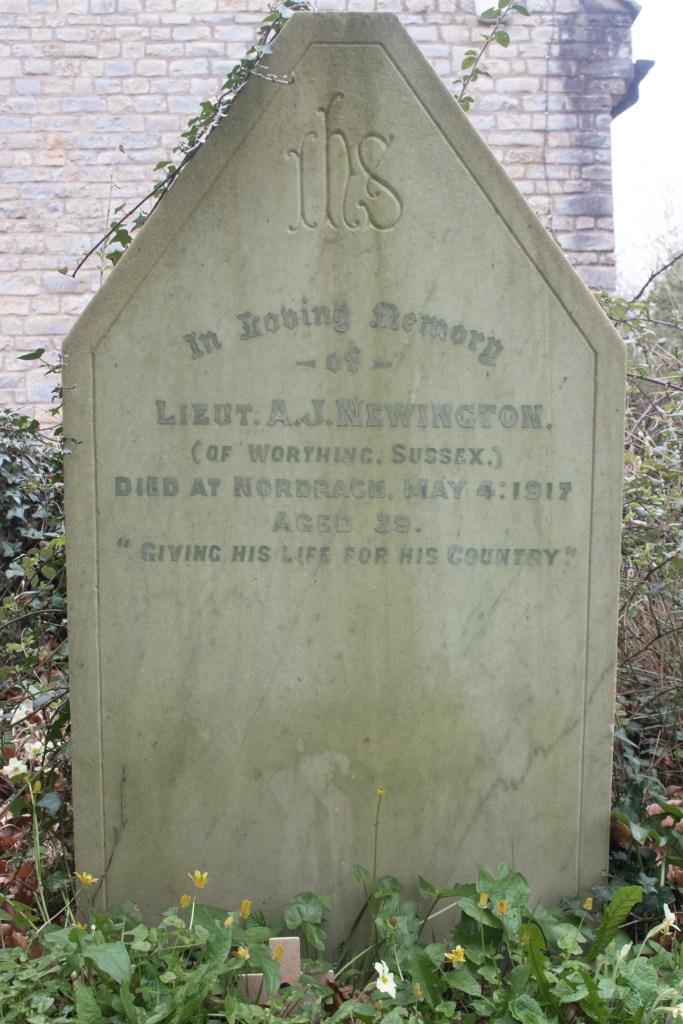
Alfred John Newington was born in 1878. The oldest of four children to Alfred and Minna Newington, Alfred Sr was a hosier, and the family lived in Brighton, Sussex.
Alfred Sr passed away in 1899, and by this time, his eldest son had followed his trade, becoming a gentleman’s outfitter. By the time of the 1911 census, he was the only one of the siblings still living at home, and was supporting Minna financially and in the family business along the coast in Worthing.
As with his early life, details of Alfred’s military service are a little scarce. However, a newspaper report of his passing gives more detail.
DEATH OF LIEUTENANT NEWINGTON
We learn with regret that Lieutenant Alfred J Newington died at Nordrath [sic], Blagdon, Somerset, on Friday. He was the eldest son of the late Mr Alfred Newington and of Mrs Newington, of Somerset Villa, Richmond Road.
The death of Mr Newington Sr took place after an illness of a long duration, in July 1899, after he had been in business her for about sixteen years. He came hither from Brighton, and established himself as an outfitter at the corner of Warwick Street at the premises now occupied by Messrs. Kinch Brothers.
During his residence here, Mr AJ Newington, who assisted his father in the business, had an exciting experience in the summer of 1896. He and Mr Frederick Barnwell and a friend names Wadham went towards Lancing on a fishing expedition and the boat was capsized, and Mr Barnwell was drowned, whilst Mr Newington and Mr Wadham were in the water for an hour and a half, eventually reaching the shore in an exhausted condition.
In February 1897, Mr Newington went to South Africa, and when War broke out he became a trooper in the South Africa Light Horse. He was subsequently awarded the silver medal with six bars, bearing the names of Belmont, Laing’s Nek, the Relief of Ladysmith, Orange Free State, Tugela Heights and Cape Colony.
When he came back to England, Mr Newington returned to the business and was a member of the Somerset Yeomanry, in which he advanced to the rank of Sergeant Major. His health failed about eight years ago, and he undertook a trip to the Baltic.
During the present War, he joined the Army Service Corps, and was attached to the Indian Cavalry Division in France, and it is only within a comparatively brief period that he was on leave at Worthing. His relatives will receive the sympathy of a wide circle of friends in the loss they have now sustained.
Worthing Gazette: Wednesday 9th May 1917
Second Lieutenant Newington had actually been admitted to the Nordrach Sanatorium near Blagdon in Somerset. This was a hospital that specialised in the treatment of tuberculosis, so it is safe to assume that this is the condition that affected him. He passed away on 4th May 1917, at the age of 39 years old.
Alfred John Newington wasn’t taken back to Worthing for burial. Instead, he lies at rest in the quiet churchyard of St Bartholomew’s in the village of Ubley, near Blagdon, in Somerset.
Clifford Charles Tucker was born in 1896, one of five children to John and Ellen Tucker. John was a shoemaker in the Somerset village of Othery, while Clifford became a farm labourer when he left school.
There is little documented of Clifford’s life, and what I have been able to identify about his military career has come from a newspaper article.
Much regret is felt in Othery at the new of the death of Clifford Tucker, one of the young fellows who volunteered for the service of their King and Country. Deceased, who was only 18 years of age… enlisted in the Royal Artillery about six weeks ago and was stationed at Brighton.
He was taken ill with pneumonia and died, his father arriving in time to see him before he breathed his last.
Taunton Courier and Western Advertiser: Wednesday 17th March 1915.
Gunner Tucker passed away on 28th February 1915, aged just 18 years old.
He lies at rest in the cemetery of his home village of Othery.