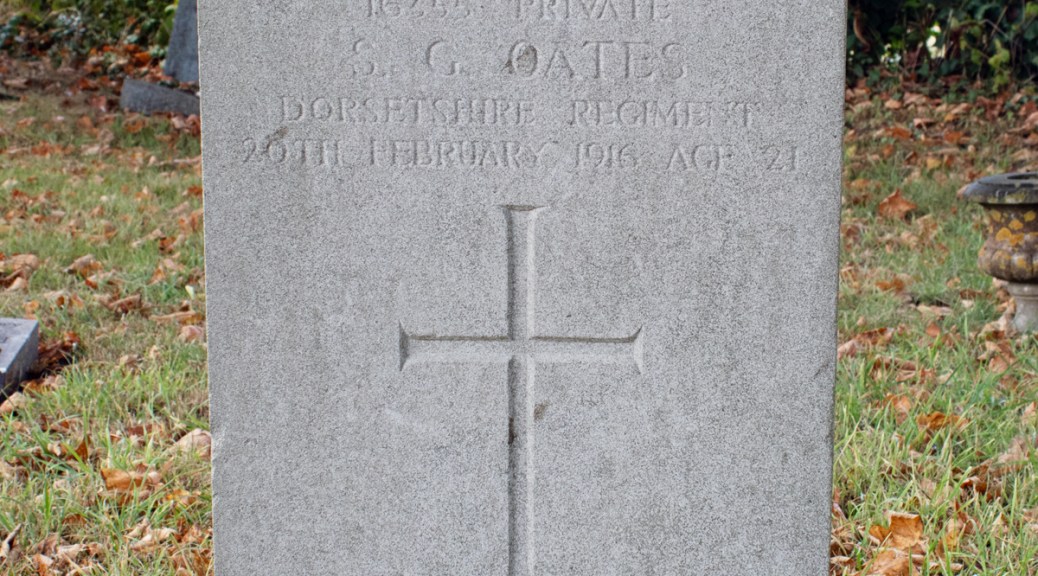
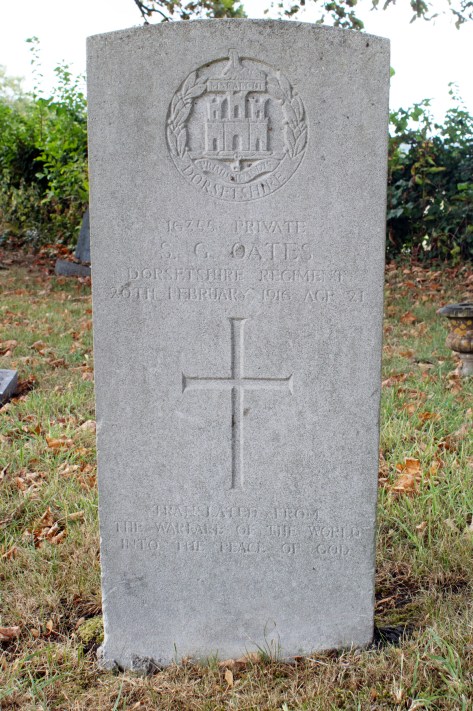
Sidney George Oates was born in the spring of 1895, and was the oldest of three children – all boys – to John and Eliza Oates. John was a general labourer from Parkstone, Dorset, but it was in the village of Odcombe in Somerset that the family were born and raised.
Eliza died in 1899, and John was left to raise three young children on his own. He re-married, to a Lucy Moores, but the a split of the family followed the wedding. Sidney’s younger brothers stayed with their father and his new wife, while Sidney himself was looked after by his maternal grandparents. Job and Elizabeth Green lived in Buckhorn Weston, a village to the west of Gillingham, Dorset.
When he finished his schooling, Sidney was apprenticed to a carpenter. War was on the horizon, however, and he soon stepped up to play his part. As with many others, his service papers have been lost to time, but it is clear that he had enlisted in the Dorsetshire Regiment no earlier than August 1915.
Private Oates was assigned to the 7th (Reserve) Battalion and sent to a training camp near Wool, Dorset. While there, however, he caught pneumonia, and was admitted to a military hospital in the village. The condition was to prove fatal: he passed away on 20th February 1916, aged just 21 years old.
The body of Sidney George Oates was taken back to Buckhorn Weston for burial. He was laid to rest in the village’s cemetery.
Sidney’s younger brother Edward also served in the First World War. A Pioneer in the Royal Engineers, he was killed in action in northern France on 12th April 1917. He was buried in Mory Abbey Military Cemetery to the north of Bapaume.
John MacDonald Ayre was born in Hemel Hempstead, Hertfordshire, in 1891. His father – also John MacDonald Ayre – had been born in Edinburgh, but had moved south to take up a job as a passenger clerk for the railways. He had met his wife, Rosa, there, and they had married in 1890. John Jr was their eldest child, and they would go on to have five more although, tragically, only three survived childhood.
John Jr also found employment with the railway company when he finished his schooling. The 1911 census found him working as a goods clerk, and he was living with his family at 16 Bridge Road in Hemel Hempstead town centre.
On 8th September 1915, John Jr married Mabel Langdon. She was a postman’s daughter from Westbury, Wiltshire, and, at the time of the 1911 census, she was working as an under-housemaid for Edward Innes, a barrister in her future husband’s home town. The couple married in Westbury Parish Church.
When war broke out, John Jr was called upon to play his part. Little information is available about his time in the army, but is it clear that he had enlisted by the end of 1916, and had joined the Royal Engineers as a Sapper. His background made him ideal for the regiment’s Railway Operating Division.
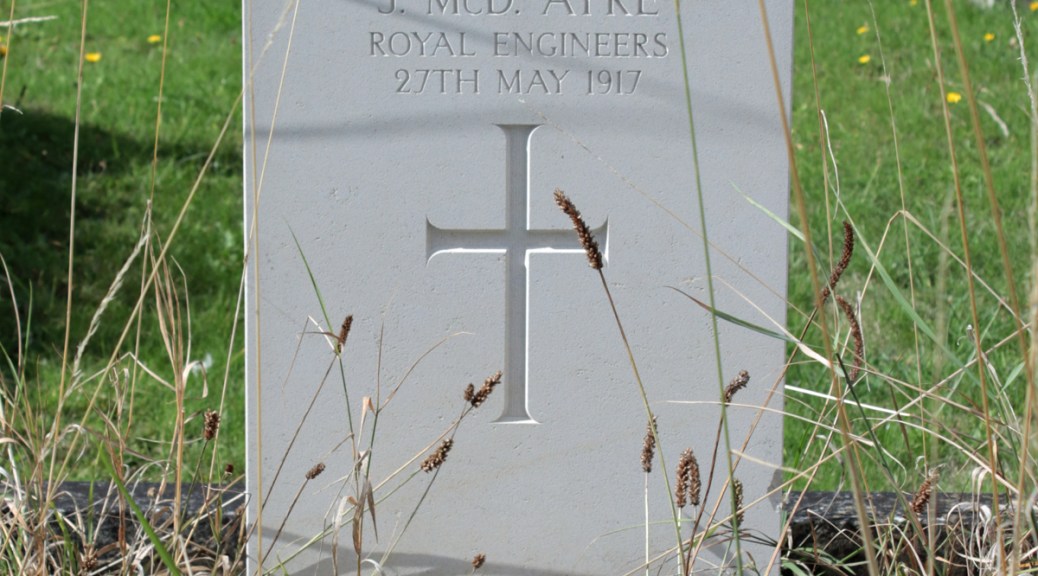
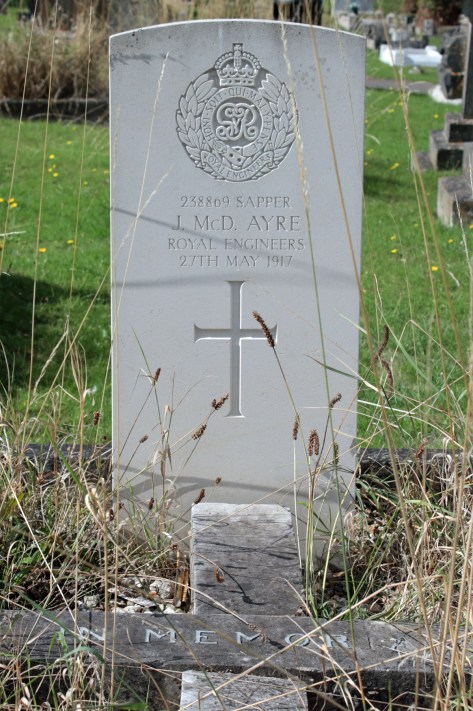
There is no evidence that Sapper Ayre spent any time overseas, and, by the spring of 1917, he was based in Shropshire. He had been unwell and was admitted to a military hospital in Shrewsbury, suffering from tuberculosis. The condition was to get the better of him, and he passed away on 27th May, at the age of 26 years old.
The body of John MacDonald Ayre was taken back to Wiltshire for burial. He was laid to rest in Westbury Cemetery.
Tragically, Mabel was pregnant when her husband died. She gave birth to their son, who she named John, on 14th July 1917.
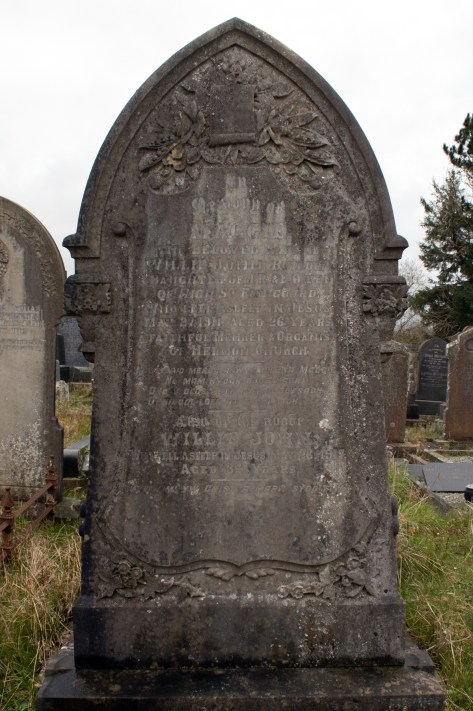
In the Hermon Baptist Burial Ground in Fishguard, Pembrokeshire is a headstone dedicated to Maggie and Willie John. The inscription reads: “In memory of Maggie, the beloved wife of Willie John, builder. Daughter of JR & E Owen of High Street Fishguard, who fell asleep in Jesus May 27, 1911, aged 26 years. A faithful member & organist of Hermon Church… Also of the above Willie John, who fell asleep in Jesus May 26, 1917, age 34 years.”
The early life of Willie – or William – John is a challenge to piece together. He and Maggie – Margaret – married in Hermon Chapel on 30th March 1907, and went on to have a son, Owen, who was born in May 1908.
Willie was employed as a builder and mason, and, after Maggie’s death, sought work wherever he could find it. When war broke out, he was living at 16 Bryn Bedw, Blaengarw, Glamorganshire, although it is unclear whether Owen was with him as well.
Willie’s trade made him an ideal candidate for the Royal Engineers, and he was assigned to the 38th Signal Company when he enlisted on 6th March 1915. Sapper John’s service records show that , he was 5ft 6ins (1.68m) tall, with black hair, dark eyes and a sallow complexion.
Sapper John was sent to Biggleswade, Bedfordshire, for his training, and it was while there that things took a downturn. On 17th September he had a standard inoculation against typhoid, and from there on in felt unwell. Over the following days and weeks he became anaemic and had bouts of giddiness and pains in the back. His medical report notes that he was breathless on waking, and when he walked more than a few hundred yards.
Over the next few months Willie’s condition was monitored, but his condition did not improve. Ultimately he was medically discharged from the army on 10th May 1916, as he was no longer fit enough to serve.
At this point, Willie John’s trail goes cold. He seems to have returned to Pembrokeshire, and it was here, on 26th May 1917, that he passed away. He was reunited with Maggie in the Fishguard burial ground.
Percy Townley Rawlings was born on 22nd September 1887 in Clapham, Surrey. Details of his early life are sketchy, and most of the information comes from second hand accounts. His baptism record gives his parents as Edward and Lizzie Rawlings. Edward was listed as being a gentleman, but there is no record of the family on the 1891, or 1901 census returns.
He was educated at Westminster School and Cambridge University, where he obtained honours in the Mechanical Sciences Tripos.
In 1910 he went to Woolwich Arsenal as [an] advanced workshop student, and in the following year he obtained a Commission in the Royal Engineers…
In 1912 he entered the Public Works Department of the Sudan Government, and during 1913-14 acted as engineer to the Egyptian Irrigation Service on the construction of the Blue Nile Dam.
On the outbreak of the War he was sent to France [as a Lieutenant in the Royal Engineers], in the 2nd Field Co., being transferred in the following year to the [Royal Naval Volunteer Reserve], for engineering duties with the [Royal Naval Air Service].
In 1917 he flew to Constantinople in a Handley-Page machine, and bombed the Goeben, for which he received the DSC.
[1921 Institution of Mechanical Engineers: Obituaries]
By the end of the conflict, Percy had been promoted to Captain. After the Armistice he remained involved in the Royal Air Force, and was involved in testing the rapidly changing technology of flight.
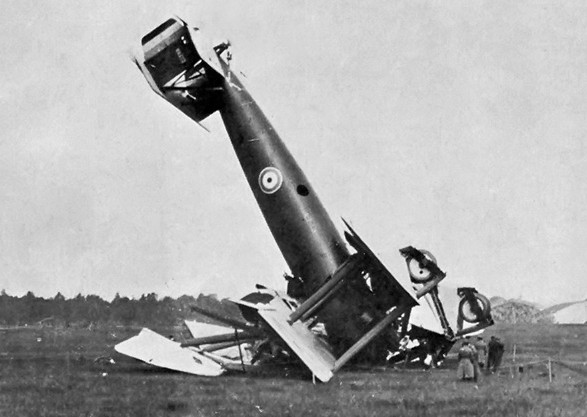
A Tarrant triplane, constructed at the Royal Aircraft Factory, Farnborough, was wrecked on a trial flight on Monday. The machine, which had six engines, each developing 500 horse power, after running along the ground toppled forward and seemed to bury itself in the earth. One of the pilots… Captain Rawlings, has died, and the other, Capt. Dunn, is in a very grave condition.
[Waterford Standard: Wednesday 28th May 1919]
Captain Percy Rawlings’ Tarrant triplane after the crash
Captain Dunn also died in the crash, which happened on 26th May 1919. Percy was 31 years of age when he died.
A close friend, Henry Edmunds, wrote to the Flight Magazine to express his sympathy at the loss:
As a boy, Rawlings was always interested in scientific matters, particularly photography and motors..
He was manly, open, and frank, fearless and honest, of an enquiring mind, and fond of experimenting. I remember his pre-heating paraffin vapour electrically, as a fuel for explosive engines…
It was at my house at Brighton that Rawlings met Mr. W. G. Tarrant, who was spending the week-end with me. Rawlings had just returned from the famous flight in the Handley Page to Constantinople, where he bombed the ‘Goeben.’ I remember his describing vividly his impressions of that memorable journey. If I recollect correctly, he motored down to Folkestone somewhat rapidly. He told me he believed the police were on the look-out for him for exceeding the speed-limit; but he went from Folkestone by air, proceeding to Naples. It was delightful to hear him recount that remarkable voyage. Their fears lest they should not be able to cross some of the high mountain ranges with the heavy load they were carrying, and where, had anything happened, they would have been out of the reach of all human aid. How he availed himself of a special camera for photographing portions of his trip, the results of which he feared it might be unwise to disclose at that time, so he brought the negatives back with him, and I believe they wore kept personally until after the War.
He and Mr. Tarrant were mutually attracted to each other, and discussed with much seriousness the construction of a new type of bombing-plane, which eventuated in the great Tarrant machine. Rawlings joined Tarrant shortly afterwards, and devoted all his energies to carrying on the work of design and construction. On several occasions he came down to see me, and related his experiences. He was full of confidence as to the future of his work; and invited me to take my first flight with him.
Townley Rawlings was a gallant gentleman. Those whom the gods love are taken early.
[Flight Magazine: 29th May 1919]
The speeding incident is an interesting anecdote, another similar incident recorded in a separate newspaper report:
Chauffeur Summoned for Fast Driving
Capt. Rawlings, who was killed in the Tarrant triplane accident, should have appeared as a witness yesterday in the Kingston court.
His chauffeur, Arthur B Cogger, of West Byfleet, summoned for exceeding the limit, was driving Captain Rawlings to Farnborough on Saturday, before the accident.
He said the captain told him he wanted to get along as quickly as possible as he was going to test an aeroplane. He had intended to come to court.
The summons was dismissed.
[Dublin Daily Express: Saturday 31st May 1919]
Percy Townley Rawlings was laid to rest in Highgate Cemetery, possibly close to where he or his family had been living.
Harold Frederic Chandler was born on 8th April 1886, and was the only child to Frederic and Rhoda. Frederic was a newspaper publisher, and the family lived in North London. The 1891 census found the Chandlers living at 1 Parolles Road, Islington; ten years later they were at 14 West View on Highgate Hill.
Those census returns included family members as part of the household. By the time of the 1911 census, however, when the were living in a substantial house at 22 Hillside Gardens, Highgate, there were no other family members with them, although they did have a boarder – banker’s clerk Alfred Schleicher – and domestic servant Esther Tebbutt living with them.
By this point, Harold was 24 years of age, and was employed as an architect’s assistant. War was coming, however, and he was called upon to play his part.
Full details of Harold’s service have been lost to time, but it is clear that he enlisted in the Royal Engineers as a Sapper, likely using the skills he had learnt in his civilian life.
The only documentation confirms Harold’s passing. Discharged from the army on 29th October 1919, he died just over a year later. He breathed his last on 17th December 1920, at the age of 34 years old. His death was registered in Edmonton, Essex, so it seems likely that he was there in some sort of convalescent capacity.
The body of Harold Frederic Chandler was taken back to Middlesex for burial, and he was laid to rest in Highgate Cemetery.
Gwyn Lewis Thomas was born in Llanrhian, Pembrokeshire, in 1894, and was the youngest of five children to George and Jane Thomas. George was a farmer, and by the time of the 1911 census, his son had been sent to work with another farmer, William Miles, in Mathry, four miles to the east.
When war broke out, Gwyn stepped up to serve his country. He enlisted in the Royal Engineers as a Sapper and, while little information about his service, it is clear that he was sent to France on 23rd August 1915. By the end of the conflict, he had achieved the rank of Corporal, and when the Armistice was declared, he returned home to Wales.
The only other documents connected to Corporal Thomas are those relating to his passing. He died from disease on 2nd March 1920, at the age of 25 years old. His death was registered in Haverfordwest, Pembrokeshire, which would suggest that he either passed there, or that that was the registry office to his home.
Gwyn Lewis Thomas was laid to rest in Mathry Congregational Chapelyard in Rehoboth, midway between his parents’ farm and that of his former employer. His headstone is inscribed with the words Bu farw o effaith y Rhyfel Mawrth (He died from the effects of the Great War).
The funeral of Corporal GH Collins, of the Royal Engineers, who died at Devonport at the age of 46, took place at Tiverton, where his mother and stepfather and sister reside. Corporal Collins’s wife and two children are at present in India. He had been in the army since 1899, and served in the South African War, for which he received the Queen’s and King’s medals with four clasps. He went to India in 1902, where he remained until the outbreak of the present war, when he came to France with his regiment. Corporal Collins was wounded, losing two fingers. He afterwards contracted fever, from which he died. The funeral was accorded military honours.
[Exeter and Plymouth Gazette – Monday 29 October 1917]
George Henry Collins was born in West Anstey, Devon, and was the son of George and Harriett Collins. There is little additional information about his early life available, and his was not an uncommon name in the area at the time.
George married Stella Euphrasia Constance O’Leary on 11th October 1911. At the time he was stationed in Myanmar, and the couple exchanged vows in the town of Maymyo, to the west of Mandalay. They would go on to have two children: Mary was born in August 1912, with Gertrude arriving the following November.
When the First World War broke out, it seems that Corporal Collins initially joined the Devonshire Regiment, but soon transferred to the Royal Engineers. Documentation suggests that he was assigned to the Special Brigade Depot at Saltash, Cornwall. However, this may have been the unit he was nominally allocated to when arrived in Britain for treatment to his injuries.
Frustratingly, there is little additional information available about George’s life. He died on 21st October 1917 was laid to rest in Tiverton Cemetery.
Joseph Frederick Yeoman was born on 28th December 1880, the sixth of eight children to John and Eliza. John was a brewer’s drayman from Harbertonford in Devon, but it was on the coast in Paignton that the Yeoman family were born and raised.
When he finished school, Joseph found work as a mason’s apprentice. The 1901 census found the family of seven living in a small terrace cottage on Hill Park Terrace, to the south of Paignton town centre, with all but Eliza bringing in a wage.
In 1906, Joseph married Lydia Gill. She was the daughter of a general labourer from Chudleigh, Devon, who was working as a domestic servant for an architectural surveyor and his wife. The couple went on to have two children – Joseph Jr, who was born the following year, and Lilian, who was born in 1910, but who died when just a babe-in-arms.
The 1911 census found Joseph and Lydia living at 20 Nuneham Terrace, Joseph Jr is missing from the document, and it seems likely that, with his sister’s death, he had been taken in by another relative to allow his grieving parents some space.
When war broke out, Joseph stepped up to play his part. Full details of his military service have been lost to time, and a clear chronology is a challenge to piece together. Lydia passed away in January 1915, but it is not clear whether Joseph had enlisted by this point. His entry in the Army Register of Soldiers’ Effects confirms that he had joined up by September 1915 at the latest, and that he was in the Royal Engineers.
Sapper Yeoman was assigned to the 1st/3rd (Wessex) Field Company. It is unclear from his records whether he served overseas, but by the spring of 1916, he was in Kent.
The news will be received with deep regret of the death of Sapper JF Yeoman… which took place on Sunday from enteric fever at Nackington Hospital, Canterbury. Deseased was in the employ of Mr WF Pearce before joining up, and frequently assisted the old Rugby Football Club.
South Devon Weekly Express: Friday 10th March 1916
Joseph Frederick Yeoman was 35 years of age when he died on 5th March. His body was brought back to Devon for burial, and he was laid to rest in Paignton Cemetery.
Joseph Yeoman Jr was just nine years old when his father, and had lost both of his parents within a space of just over a year. Emma Augusta Gill, possibly Lydia’s sister-in-law, was given guardianship of him, and he moved to East Brent, Somerset, for a new life.
Walter Sargeant Abbott Woodward was born in Bath, Somerset, in the summer of 1896. The oldest of four children, his parents were Henry and Louisa. Henry Woodward was a painter and decorator, but when Walter completed his schooling, he found work as a telegraph messenger for the Genera Post Office.
The 1911 census recorded the family – Walter, his parents and his three siblings – living in a 3-roomed apartment at 5 Beauford Square, close to the city centre. Within a year, Walter had been promoted within the GPO, and was given the role of Assistant Postman.
War came to Europe and Walter was called upon to play his part. On 10th December 1915 he enlisted in the army, and was assigned to the Royal Engineers as a Sapper. His records show that he was still employed by the GPO at this point, and was working as a Lineman, so it seems that his skills were appropriate for the regiment to which he was assigned.
Sapper Woodward’s service documents confirm that he was 5ft 10ins (1.78m) in height, and that he was not formally mobilised until April 1916. After a couple of months’ training, he was sent to France and he remained on the Western Front for just over a year.
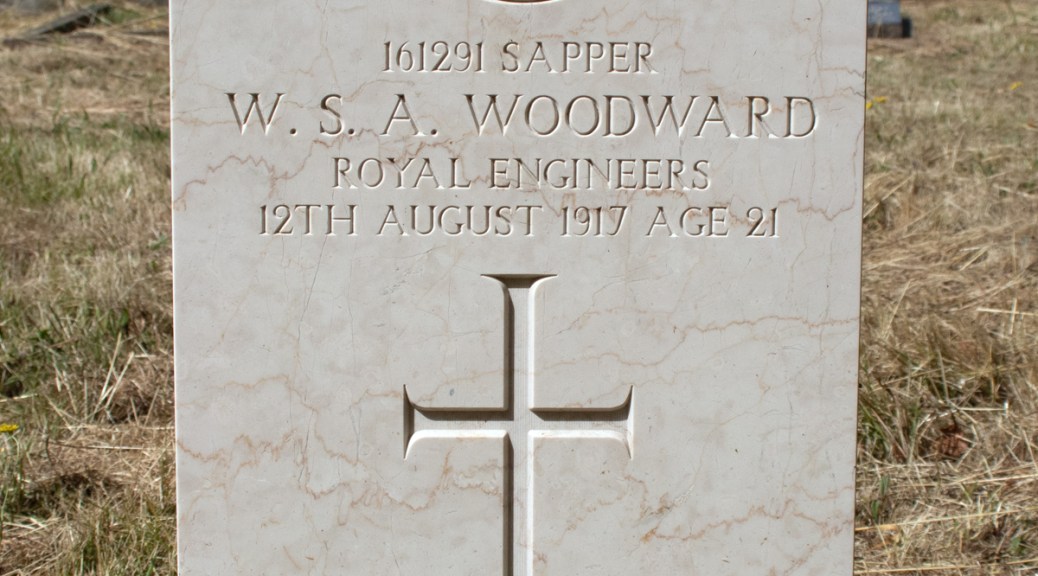
On 3rd July 1917, Sapper Woodward was posted back to England. It seems that he was en route for the Signal Depot in Fenny Stratford, Buckinghamshire, when he became ill. Admitted to the Queen’s Canadian Hospital in Shornecliffe, Kent, he was suffering from gastritis. This would ultimately take his young life: he passed away on 12th August, aged just 21 years old.
The body of Walter Sargeant Abbott Woodward was taken back to Somerset for burial. He was laid to rest in the city’s Locksbrook Cemetery.
Wilfred Clarence Ansfield was born in the spring of 1899, and was the youngest of eleven children to Frederick and Frances Ashfield. Frederick was an innkeeper from West Tarring in Sussex, and the family were living in the public house he ran – possible the Vine Brewery on the Hight Street.
Frederick died at the start of 1904, and by the time of the next census, taken seven years later, Frances had moved the family to Salvington. They settled at 1 Beaconsfield Terrace, with six of the Ansfield children sharing the home with their mother. Three of Wilfred’s brothers were employed as gardeners – possibly at one of the many nurseries in the area – while he was still at school.
When war came to Europe, Wilfred was keen to serve his King and Country. Full service details have been lost to time, but it is clear that he enlisted in the Royal Engineers and, as a Pioneer, was assigned to the 3rd Provisional Company (later renamed the 642nd (London) Field Company). This was a territorial force, and it is unlikely that Wilfred saw any action overseas.
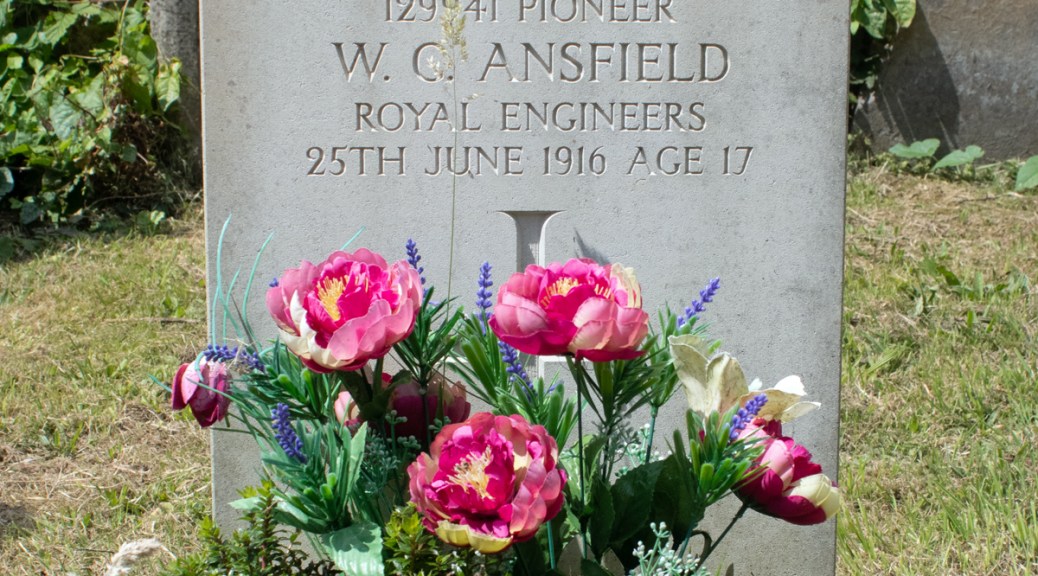
The only other document that can definitely connected to Pioneer Ansfield is the record of who his pension was assigned to. This confirmed Frances’ name and address, but also gives the cause of her son’s death, noted as ‘acute paralysis’. This could have been as a result of a tetanus infection, but nothing remains to confirm either way. Wilfred died on 25th June 1916: he was just 17 years of age.
Wilfred Clarence Ansfield was laid to rest in the graveyard of St Andrew’s Church in West Tarring, He was buried alongside Frederick, father and son reunited after twelve years.








 Death and Service