Albert John Richomme was born on 13th June 1885 and was one of eight children to Charles and Marie Richomme. Both were from France, but had moved to Jersey in the Channel Islands before Albert’s oldest sibling, Charles, was born. The couple farmed land near Grouville, the children helping out as they became old enough.
On 28th September 1904, Albert married Linda Rouland at St Thomas’ Roman Catholic Church. The couple set up home in Trinity, and went on to have six children. The 1911 census recorded Albert as being a jobbing gardener, with the family living in the four-roomed Sunny Side Cottage.
When war came to Europe, Albert stepped up to play his part. Initially enlisting in the Royal Jersey Militia, his unit was absorbed into the 7th (Reserve) Battalion of the Royal Irish Rifles. By the end of 1915, he found himself in France.
Full details of Private Richomme’s service are lost to time, but is seems that he was caught up in a gas attack and, after being medically evacuated to Britain to recuperate, he was transferred to the Labour Corps.
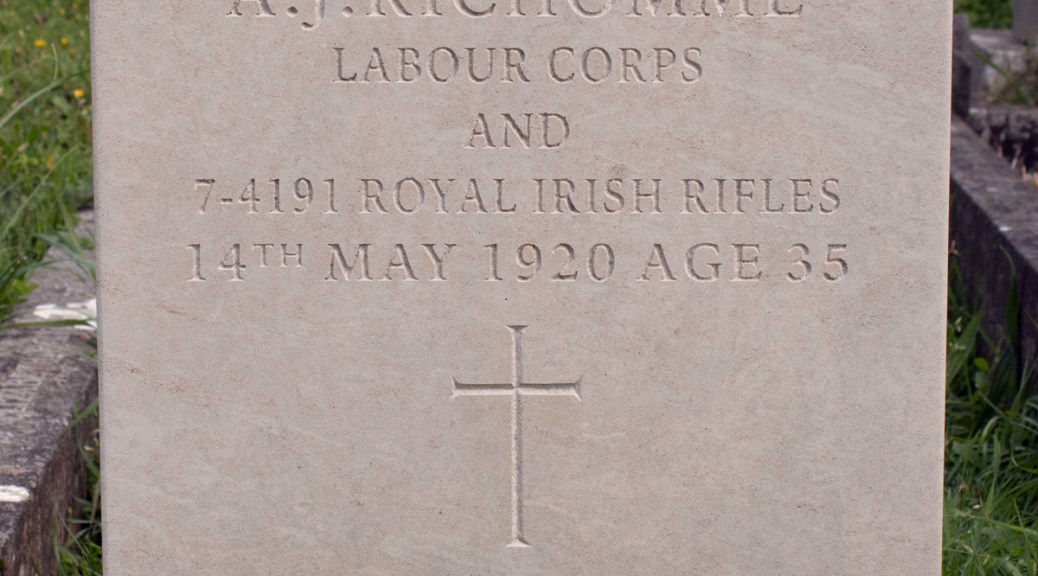
At this point, Private Richomme’s trail goes cold. He survived the war and returned home, but passed away from pneumonia on 14th May 1920, just short of his 35th birthday.
Albert John Richomme was laid to rest in the peaceful grounds of La Croix Cemetery in Grouville.
While meeting the appropriate criteria for his burial site to be granted a Commonwealth War Grave, Albert is not recognised by the Commission.
Joseph Marie Louis Gionta was born on 7th January 1897 in St Ouen, Jersey. He was the oldest of three children to Matthieu and Marie Gionta. Marie has been married before, and so her two children – Joseph’s older stepbrothers – made up the household.
Shoemaker Matthieu passed away when Joseph was just a teenager. By the time of the 1911 census, Marie was living in two rooms in St Ouen’s, supported by her five children. She was working as a charwoman, while her two children from her first marriage were farm labourers, bringing in three probably meagre wages to the family home.
When war broke out, Joseph stepped up to play his part. Initially enlisting in the Royal Jersey Militia, his unit was absorbed by the 7th (Service) Battalion of the Royal Irish Rifles shortly after he joined up. Rifleman Gionta’s service records confirm he was 5ft 3.5ins (1.61m) tall, and that he was 19 years old when he enlisted.
Joseph’s battalion served in France from December 1915, and he spent the next ten months overseas. In October 1916, he returned to the UK, and was transferred to the regiment’s 4th (Extra Reserve) Battalion, serving in Ireland.
Towards the end of 1917, Rifleman Gionta became unwell, contracting tuberculosis. This led to his medical discharge from the army on 29th January 1918, and he returned to the Channel Islands. At this point, his trail goes cold, and it is not until the autumn of 1920 that he resurfaces.
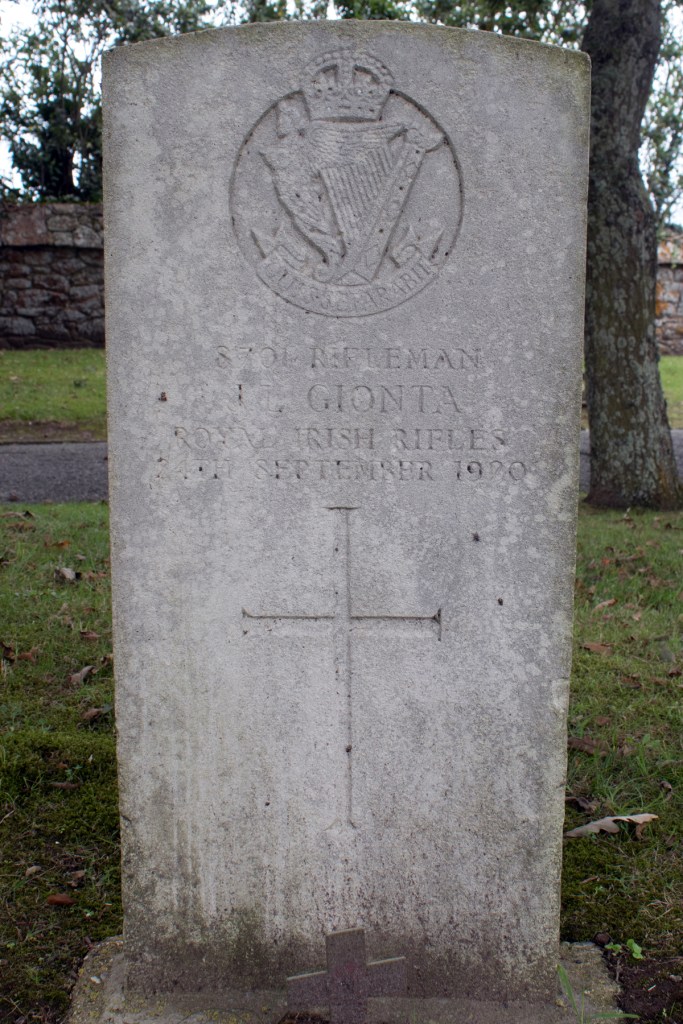
Joseph Marie Louis Gionta passed away on 24th September 1920: he was 23 years of age. A cause of death is unclear, although the likelihood is that it was related to the lung condition that he picked up while on active duty. He was laid to rest in the peaceful St Ouen’s Churchyard in Jersey.
David Orr was born in Ballymena, County Antrim, in 1897, one of five children to William and Annie Orr. William was employed as a railway porter but, when Annie died in the early 1900s, he took on work as a dealer.
By the time of the 1911 census, David, who was now 13 years old, had taken a job as a message boy. War was coming to Europe, however, and he felt it his duty to serve his King and Country.
David joined the Royal Irish Rifles, and was attached to the 18th Battalion. He “was one of the first in [the] district to join the Ulster Division when it was formed in September 1914, and began his training at Cleggan Camp. He was subsequently transferred with his regiment to Clandeboye, where he completed his training…” [Ballymena Weekly Telegraph: Saturday 26th February 1916]
Rifleman Orr’s unit arrived in France on 5th October 1915, but was only overseas for a matter of months.
While serving in the trenches, he was stricken by illness, and was eventually sent back to England and underwent treatment in the 4th London General Hospital, Denmark Hill, and at the Wallace Field Convalescent Home, Croydon. His condition improved somewhat, and he was afterwards transferred to Victoria Barracks, Belfast; but the improvement was, unfortunately, only of a temporary nature…
Ballymena Weekly Telegraph: Saturday 26th February 1916
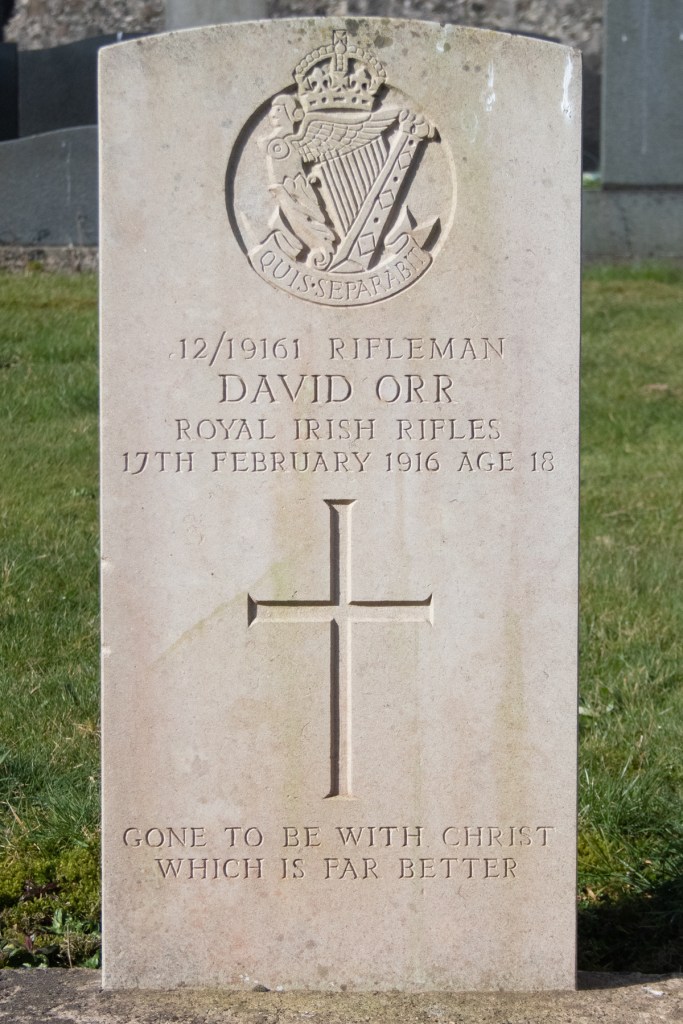
David Orr passed away on 17th February 1916: he was 18 years of age. He was laid to rest in Ballymena New Cemetery, not far from where his family still lived.
Rifleman David Orr (from britishnewspaperarchive.co.uk)
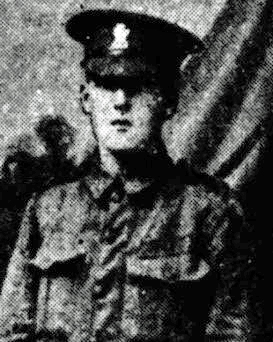
John Bowden was born in Slaght, Ballymena, County Antrim, in 1896. The third of four children, he was one of three sons to David and Margaret. David was a railway labourer, and by the time of the 1911 census, the family had four wages coming in. John, at 15, was working as a solicitor’s clerk, while his older brothers were both employed, one as a baker, the other as an engine cleaner.
On Saturday afternoon last there were laid to rest in the Ballymena New Cemetery the mortal remains of Lance-Corporal John Bowden, of the Royal Irish Rifles, whose lamented demise from scarlet fever took place at Newtownards Camp… to the intense regret of his commanding officers and comrades, with all of whom he was on the most intimate and friendly terms.
The deceased was a bright, intelligent young man, of a rather retiring disposition but by his unassuming personality, combined with a cheery and lovable disposition, he gained for himself hosts of friends wherever he went.
He served his apprenticeship to the law in the office of Mr John Owens, solicitor… where he was held in the very highest esteem by his employer and fellow clerks. Indeed he was on happy relations with all the law clerks and young men in the town, all of whom deeply deplore his demise.
He was for a considerable length of time a staunch and loyal member of Slatt LOL No. 475, and… [at] Ballymena District Orange Lodge very sympathetic allusions were made to his untimely death, and the District Secretary (Br. Hugh Ballentine) was instructed to forward a letter of sympathy and condolence to the bereaved parents and other relatives in this season of their affliction.
The deceased was a most enthusiastic member of the No. C Company Ulster Volunteers (Harryville Branch) and here is may be remarked that out of a hundred of a membership there at the present time thirty-nine members in Lord Kitchener’s army, together with eight reserve men at the front, which educed the company by almost fifty per cent…
Shortly after the outbreak of hostilities the deceased very gallantly volunteered for active service and was accepted, being attached to the 12th Battalion Royal Irish Rifles… He was most attentive to his drill instructions, courteous and obliging to his officers, and a true comrade in every sense of the term.
Ballymena Observer: Friday 9th April 1915
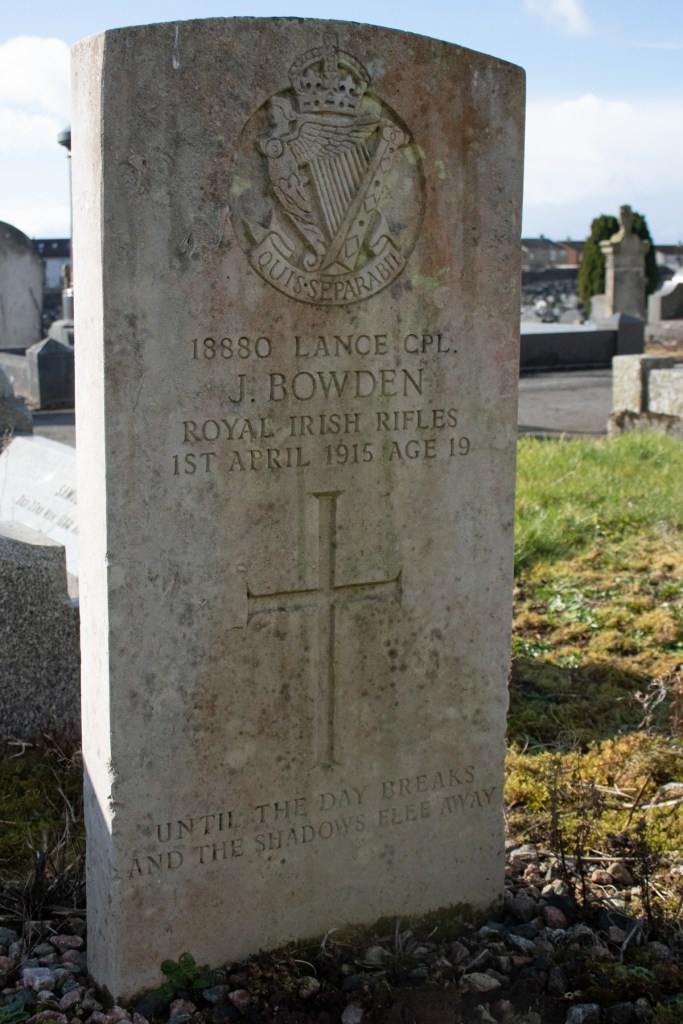
Much of John’s service records are lost to time. His commitment to duty was underlined by his promotion to the role of Lance Corporal within months of enlisting.
John Bowden passed away from scarlet fever at Newtownards Camp on 1st April 1915. He was just 19 years of age. He was laid to rest in Ballymena New Cemetery, the newspaper report going on to outline the outpouring of grief at what would have been one of the town’s first military funerals of the war:
The tremendous crowds which formed in the funeral procession at the several squares and crossings en route to the cemetery testified to the respect in which the deceased was held by all who knew him.
The footpaths were lined and thronged with people all along the entire way, and as the funeral passed through the town business was suspended for the time being…
On arriving at the Cemetery the place was absolutely packed with spectators, all anxious to witness the carrying out of the obsequies… the scene was truly most pathetic, whilst to add to the sorrow and sympathy manifested on the face of everyone, the wailing and sobbing of deceased’s little sister as the remains were lowered into the grave were heartrending.
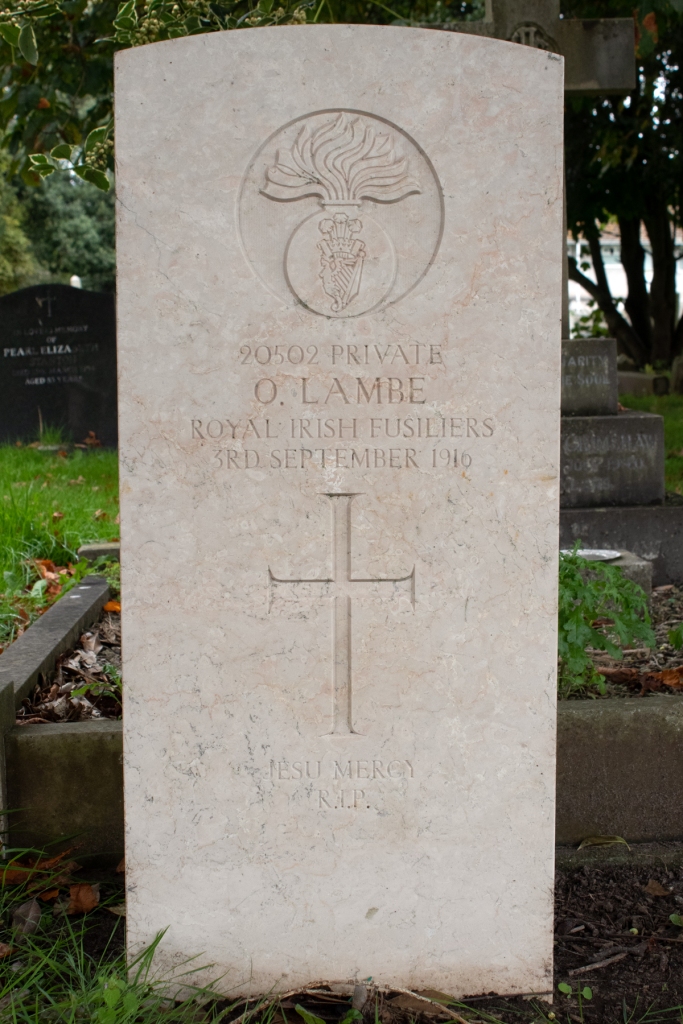
Owen Lambe was born in Drogheda, Co. Louth, Ireland, in November 1873. There is little information about his early life, but later documentation confirms that he was the son of John and Ellen Lambe, and that he had three brothers and one sister.
When Owen finished his schooling, he found work as a baker. He was also volunteering as a soldier in the 6th Battalion of the Royal Irish Rifles at the time, however, and this sparked a career move for him. On 7th May 1890, he formally enlisted: his medical report shows that he was 5ft 4ins (1.63m) tall, and weighed 128lbs (58kg). He was noted as having brown hair, grey eyes and a dark complexion.
Over the twelve years of his contract, Private Lambe saw a fair bit of the world. After eighteen months on home soil, he was sent to Malta, where he remained until November 1894. His battalion was then moved to India, where they remained for more than three years.
With seven years’ service under his belt, Owen returned to Britain. Put on reserve status, he was recalled to active duty in October 1899, as hostilities broke out in South Africa. He served in the Second Boer War for nearly three years, until, in July 1902, he returned home once more. By this point, he had completed his contract, and formally stepped down from the army on 31st August.
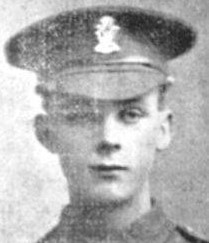
Owen’s trail goes cold at this point, and it is only possible to pick up details from later documents relating to his death. These confirm that he had re-enlisted by the spring of 1916, and that he joined the 8th (Service) Battalion of the Royal Irish Fusiliers. Based on his previous army experience, Private Lambe would have been sent to the Western Front fairly readily, and his battalion was certainly involved in the fighting at the Battle of the Somme.
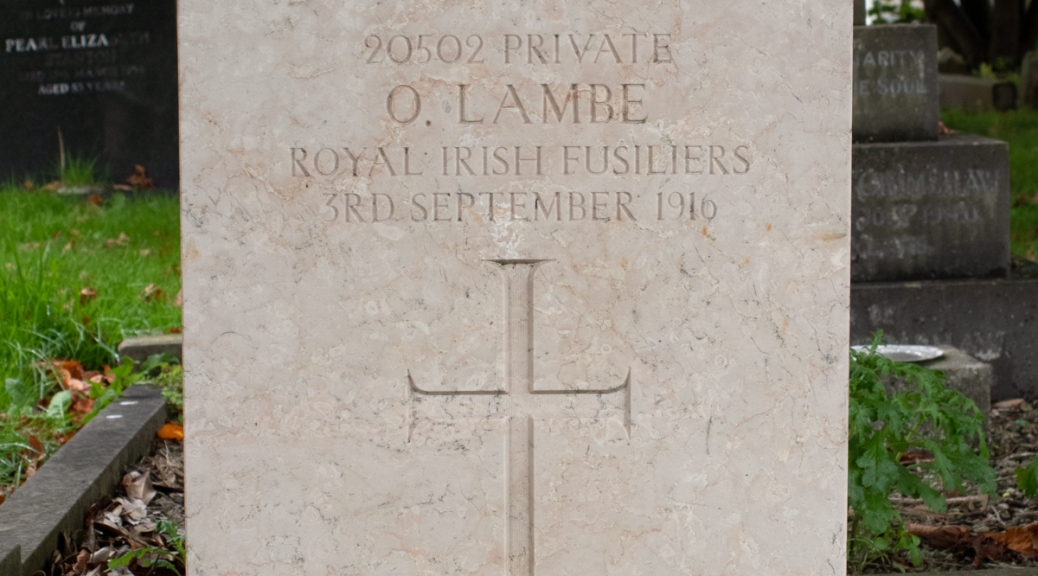
It was here, on the front line, that Owen was injured. Again, details are sketchy, but he received gun shot wounds severe enough for him to me medically evacuated to Britain for treatment. He was taken to Somerset and admitted to the Volunteer Aid Detachment Hospital in Burnham-on-Sea for treatment. Private Lambe’s wounds were to prove too severe, however: he passed away from his injuries on 3rd September 1916, at the age of 42 years old.
Owen Lambe was laid to rest in the Roman Catholic section of Burnham Cemetery. His headstone was paid for by the local Catholic church.
Frederick William Reid was born in January 1876 in Liverpool, Lancashire. Little information is available for his early life, and his trail only really becomes traceable when he joined the Royal Irish Regiment at the age of 16 years old.
Frederick’s service records confirm that his mother was called Elizabeth, who lived in Bedminster, near Bristol. He was already volunteering for the regiment when he enlisted, and was working as a musician when he joined up. His papers confirm that he was 5ft 4ins (1.63m) tall, and weighed 112lbs (60.8kg). He had brown hair, hazel eyes and a fresh complexion.
Frederick was given the rank of Drummer when he joined up and was attached to the Royal Irish Regiment’s 3rd Depot. He spent more than seven years on home soil, rising to the rank of Corporal in May 1898. The following January he reverted to the rank of Private at his own request, but his superiors obviously saw something in him, and he was supported in a new role – Lance Corporal – just a month later.
In October 1899, however, Frederick’s life was to take a new turn, when he was sent to India with his troop.
Corporal Reid was based in Lahore, and had found the life that he was seeking. Over the next forty months, he successfully took on a variety of clerical roles. He was promoted to Lance Sergeant in October 1901 and given oversight of the Officers’ Room.
In March 1903, Frederick returned to Britain. With the move came a further promotion, to the rank of full Sergeant, again, overseeing the Officer’s Room. He seems to have been based in Gloucestershire by this point, as, on 18th November 1903, he married Isabella Jane Parke at a Registry Office in Bristol. There is no further record for the young couple, however, so the new Mrs Reid is destined to remain a mystery.
Frederick was destined to return to India, and in January 1905, that is exactly what he did. His regiment returned to Lahore, and he was given the role of Clerk Steward at one of the Lawrence Memorial Asylum. The name is misleading, as the asylums were a series of four military-style boarding schools across India. Sergeant Reid’s records do not confirm which of the four he was attached to, but it would have been Sanawar, Mount Abu, Lovedale or Ghora Gali.
Given his military background, it seems that the role of clerk was something Frederick settled into quite happily. He was recalled back to army service in November 1909, and, within seven months, he requested a discharge from the army. This was granted, as he had, by this point, completed more than eighteen years’ service.
Frederick remained in India, however, and on 28th September 1913, he married Elizabeth Marshall in Lahore. They had two children, Florence, who was born in Quetta on 2nd September 1914, and Lily, who was born on 1st January 1916 in Lahore.
War had come to the world by this point, and in spite of his age – he was 39 by now – Frederick felt it only right to step up and play his part again. On 28th October 1914, he enlisted again, and was assigned to the 1st Battalion of the Duke of Wellington’s (West Riding Regiment). His new medical noted that he was 5ft 7ins (1.7m) tall, and weighed in at 9st (57.2kg). His complexion was recorded as pale, while he had a number of tattoos on his left forearm: the crossed swords, harp and crown of the Royal Irish Regiment, along with the initials VR.
While part of the West Riding Regiment, Sergeant Reid was attached to the 3rd Mule Corps of the Indian Supply & Transport Corps. He was involved in arranging provisions for the various battalions who needed them.
By March 1916, his battalion had been sent to Salonika, and it was here that Frederick contracted tuberculosis. Medically evacuated to Britain, he was admitted to the Southwark Military Hospital. He was confirmed as no longer being medically fit for army service and was discharged on 16th August 1916. His medical report noted that he “is anxious to have sanatorium treatment, but is not an insured man, owing to having been stationed in India.”
On his discharge, Frederick moved to Weston-super-Mare, Somerset, which is where his mother was by now living. His wife and children also came to live in England and, the family settled in Pawlett, near Bridgwater.
After leaving the army, Frederick’s trail goes cold. The next confirmation of his life is that of his passing. He died on 12th October 1919, presumably from his lung condition. He was 43 years of age.
Frederick William Reid, who had been born in Liverpool, who had had two separate careers in the army, and who had lived and married in India, was laid to rest in the peaceful graveyard of St John the Baptist’s Church in Pawlett, Somerset.
Walter Samuel Radford was born in the summer of 1899, the oldest of eight children to William and Florence Radford. William was a farm labourer from Churchstanton, Somerset, but by the time Walter was born, the family had moved to Chedzoy, near Bridgwater.
Chedzoy was also where William’s parents lived, and the two families’ cottages were just three doors apart. Oddly, even though he was the oldest child, Walter was raised by his grandparents, Frank and Anna, and is recorded as living with them in both the 1901 and 1911 censuses.
Walter was just 15 years old when war came to Europe, and so was too young to enlist. He bided his time, though, and had joined up by the summer of 1918. He was assigned to the 1st Battalion of the Royal Irish Rifles, and was sent to the Western Front in the closing months of the conflict.
Caught up in the final advance in Flanders, Rifleman Radford was injured, possibly during the action of Ooteghem. He was medically evacuated to Britain for treatment, but died of his injuries while admitted to a hospital in London. He passed away on 26th November 1918, aged just 19 years old.
Walter Samuel Radford was brought back to Somerset for burial. He was laid to rest in the peaceful graveyard of St Mary’s Church in Chedzoy.
Interestingly, while Walter’s pension ledger gave his father, William, as the recipient, the Army Register of Soldiers’ Effects noted his grandmother, Anna, as the recipient of his belongings.
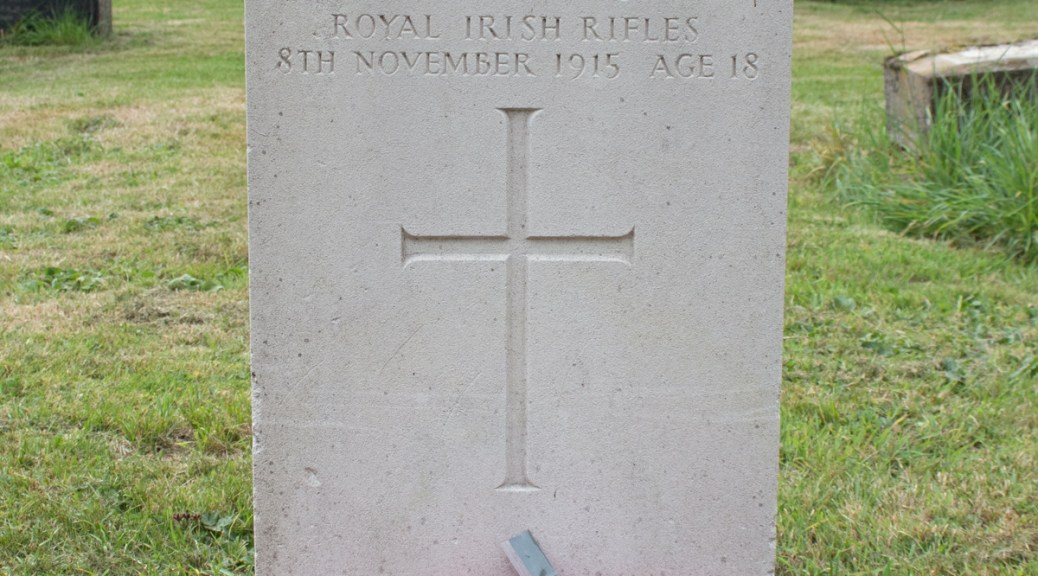
Much of Joseph Collins’ life is destined to remain a mystery. He was born in Northern Ireland on 8th November 1897, and was the son of William and Minnie Collins, who lived near Lurgan, in Armargh.
When war broke out, Joseph enlisted, joining the 16th (Service) Battalion – the 2nd County Down Pioneers – of the Royal Irish Rifles. Formed in Lurgan, the regiment moved from Northern Ireland to Seaford in East Sussex in July 1915. By that October, Rifleman Collins found himself on the Front Line in Northern France.
Joseph was invalided on 26th October, and medically evacuated to Britain for treatment. Admitted to the Brynkinalt Hospital in Chirk, Denbighshire, he was operated on, but this was to prove insufficient, and he passed away from his injuries on 8th November 1915 – his eighteenth birthday.
Rifleman Collins was well thought of in his regiment, as the comments in the Lurgan Mail [Saturday 20th November 1915] confirmed. Captain HF Sheppard, who commanded Joseph’s Company, noted “I need hardly say I was shocked, as I thought when he left us that the operation necessary for his complaint was certain to prove successful. I had always been attracted by his cheerful temperament, and I was always keenly interested in him as he was one of the first to join my Company.“
Lieutenant E Somerfield noted that Joseph “was a great favourite with the rest of his platoon, and a boy I had great regard for. I can assure you we all feel his loss very keenly.“
The most touching comments, however, come from one of Joseph’s colleagues, Rifleman R McKeown: “I am sending you these few lines to let you know I got a letter today which Joe wrote before he died. The nurse found it in his locker and sent it on to me I am sending you a copy of it and the nurse’s letter. I was never so badly struck in my life as when I heard of his death, for his could not have grieved me more has it been my own brother. The day he went away I never got bidding him good-bye, for the morning he went on the sick list I was on parade, and when I came in he was away. The boys in the platoon and company he was in were all greatly grieved at hearing about his death. You have my sincerest sympathy in your trouble. I don’t know how I am ever going to go home – if I ever do – without him. He was like a brother to me.“
Unable to bring their son back to Ireland, William and Minnie had to be content with the fact that their son was given a military funeral in the town where he died. Joseph Collins was laid to rest in the graveyard of St Mary’s Church in Chirk.
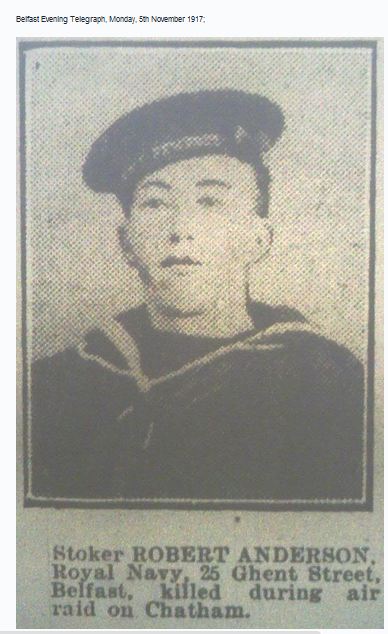
Robert Anderson was born on 4th September 1889, one of ten children – of whom tragically only three survived – to James and Emily Anderson. James was a storekeeper from Belfast, who had moved his family to Preston, Lancashire, but who had subsequently moved them back to Northern Ireland after Robert had been born.
In 1911, while working as a town labourer, Robert had met and married Rebecca Barkley; the couple went on to have to children, Mary and Agnes.
War was coming to Europe, however, and Robert was keen to play his part. He enlisted in the 3rd Battalion of the Royal Irish Rifles and, according to a subsequent newspaper report, saw action at Mons and the Marne early in the conflict.
The Belfast Evening Telegraph reported that “He completed his time, and instead of re-enlisting in the Army, he joined the Navy.” [Thursday 4th October 1917] Given that Robert enlisted in the Royal Navy in the autumn of 1915, this raises the question of how he left the army at the height of the conflict, particularly given that the same report suggests that he had come through the major battles “unscathed“.
Either way, Private Anderson made the move to Stoker 2nd Class on 10th November 1915. He record show that he stood 5ft 5.5ins (1.66m) tall, had fair hair, brown eyes and a fresh complexion. On his arms he sported a number of tattoos; a lady, crossed flags and a ship on his right, and his initials on the left.
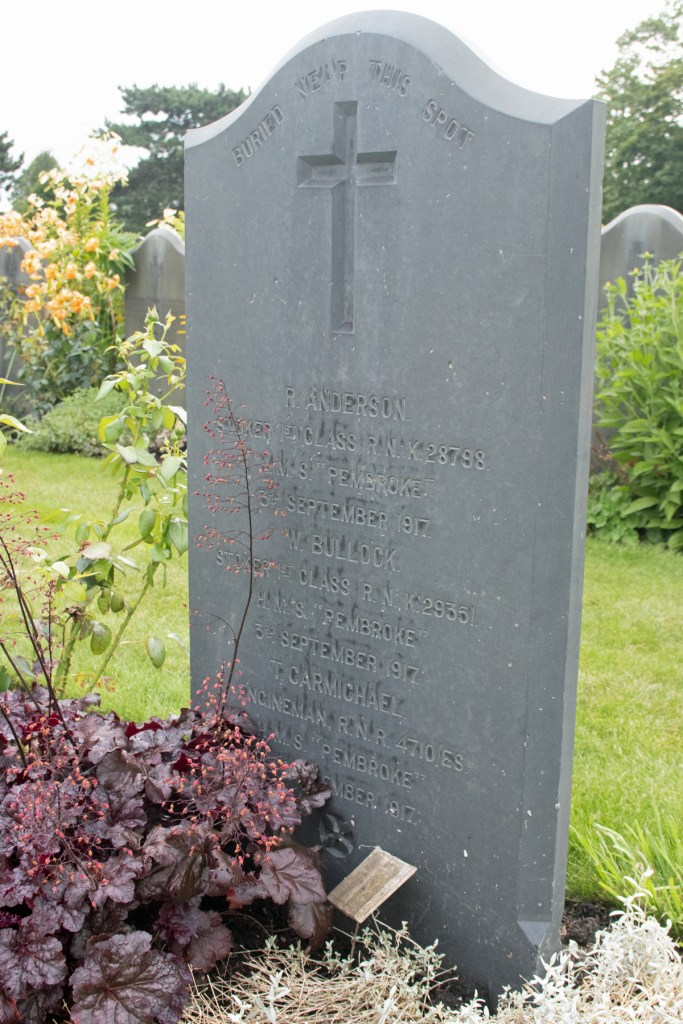
Robert’s first posting was HMS Pembroke, the Royal Naval Dockyard at Chatham, Kent, where he received a couple of months’ training. He was then assigned to HMS Egremont, also known as Fort St Angelo in Birgu, Malta, where he spent a couple of months. Stoker Anderson then returned to England, serving at HMS Victory, the Royal Naval Dockyard in Portsmouth, and gaining a promotion to Stoker 1st Class in the process.
By August 1917, he had returned to HMS Pembroke. The Dockyard was particularly busy that summer, and the large number of extra servicemen meant that Robert was billeted in temporary accommodation in Chatham Drill Hall.
On the 3rd September 1917, the first night air raid carried out by the German Air Force bombarded the town, and scored a direct hit on the Drill Hall; Stoker 1st Class Anderson was among those killed instantly. He was a day short of his 28th birthday.
Robert Anderson was laid to rest, along with the other victims of the Chatham Air Raid, in the Woodlands Cemetery, Gillingham.
Stoker 1st Class Robert Anderson (from findagrave.com)
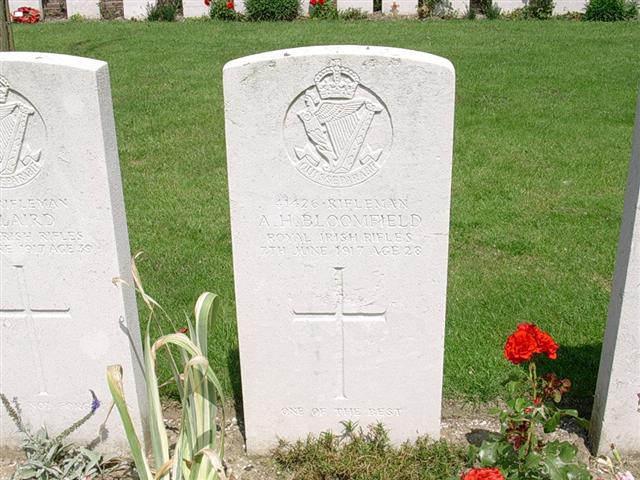
Arthur Henry Bloomfield was born on 19th December 1888, the youngest of six children. His parents, agricultural labourer and carter William and his wife Mary, raised the family in the small Norfolk village of East Harling, which was about halfway between the larger towns of Thetford and Diss.
Arthur married Rose Howlett in November 1911; the couple had two children – Margaret and Frederick – who became siblings for Rose’s daughter, Violet.
While Arthur’s military records are scarce, it is evident that he enlisted in the 9th Battalion of the Royal Irish Rifles. Private Bloomfield’s troop fought at a number of the key skirmishes on the Western Front, including the devastating (for the battalion) Battle of Albert in 1916.
A year later, the 8th and 9th Battalions were caught up in the Battle of Messines and it was here that Private Bloomfield met his fate. His pension records show that he was killed in action on 7th June 1917. He was 28 years old.
Arthur Henry Bloomfield lies at rest in the Lone Tree Military Cemetery in Mesen, West Flanders, Belgium.
Interestingly, Arthur’s pension records only cite his beneficiaries as Rose, Margaret and Frederick. This may go further in confirming that Violet was not his daughter.
Arthur Henry Bloomfield was my great great uncle.
Photo courtesy of Commonwealth War Graves Commission.









 Death and Service