Category Archives: Royal Naval Volunteer Reserve

Lieutenant Frederick Hill

Lieutenant Frederick Hill

Frederick Charles Hill was born on 13th June 1882 in the Devon village of Marldon. One of seven children, his parents were William and Elizabeth Hill. William was a carpenter, and the 1891 census found the family living or boarding at the Royal Oak Inn.

When he finished his schooling, Frederick found work as a gardener. However, he sought a bigger and better life and, on 21st April 1897, he joined the Royal Navy. His service record suggests that he lied about his age to do so, giving his year of birth as 1881,

Frederick was below the age to formally enlist in the navy, and was given the rank of Boy 2nd Class. He was sent to HMS Impregnable, the training base in Devonport, Devon, spending the next eighteen months there. Promoted to Boy 1st Class in February 1898, he was given his first posting, on board HMS Agincourt, later that year.

In the autumn of 1898, Frederick was assigned to the cruiser HMS Leander. The following summer, and based on the date of birth he had previously provided, he came of age, and was formally inducted into the Royal Navy. His service records show that he was 5ft 2ins (1.57m) tall, with red hair, grey eyes and a fresh complexion. Hs was also noted as having a scar on his forehead.

The now Ordinary Seaman Hill remained on board HMS Leander for more than two years. He proved a worthwhile member of crew, and was promoted to Able Seaman in May 1900. He left Leander in January 1901, and was billeted at HMS Vivid, the Royal Naval Dockyard in Plymouth, Devon, which would become his base when not at sea.

Frederick’s contract was for twelve years, and during that time he would serve on four vessels. His dedication to the navy was evident by his promotions – he made Leading Seaman in October 1904, Petty Officer 2nd Class in October 1906, and Petty Officer 1st Class in March 1911. When his term of service ended, he immediately re-enlisted, and, at his annual reviews, was regularly noted for his very good character and superior ability. His career kept going from strength to strength, and, in 1914, he was promoted to Chief Petty Officer.

He was sent to Antwerp in September [1914] with the Royal Naval Division, and in 1916 went to the Dardanelles, there gaining his commission for bravery. After the evacuation he was sent to France and won the MC in the Ancre drive in 1916. In February 1918 he was sent for six months’ rest to England. Lieut. Hill volunteered to go to France again in November the same year, and contracted heart disease, from which he died. He returned to England early in June [1919], and, being on sick leave, went to Paignton Hospital, where his death occurred.

[Brixham Western Guardian: Thursday 7th August 1919]

Frederick Charles Hill was 37 years of age when he died on 2nd August 1919. His body was laid to rest in the family plot in St John the Baptist’s Church, Marldon.


Frederick’s headstone records his rank as Lieutenant Commander. However, Commonwealth War Grave Commission documents suggest his rank was Lieutenant.


Captain Percy Rawlings

Captain Percy Rawlings

Percy Townley Rawlings was born on 22nd September 1887 in Clapham, Surrey. Details of his early life are sketchy, and most of the information comes from second hand accounts. His baptism record gives his parents as Edward and Lizzie Rawlings. Edward was listed as being a gentleman, but there is no record of the family on the 1891, or 1901 census returns.

He was educated at Westminster School and Cambridge University, where he obtained honours in the Mechanical Sciences Tripos.

In 1910 he went to Woolwich Arsenal as [an] advanced workshop student, and in the following year he obtained a Commission in the Royal Engineers…

In 1912 he entered the Public Works Department of the Sudan Government, and during 1913-14 acted as engineer to the Egyptian Irrigation Service on the construction of the Blue Nile Dam.

On the outbreak of the War he was sent to France [as a Lieutenant in the Royal Engineers], in the 2nd Field Co., being transferred in the following year to the [Royal Naval Volunteer Reserve], for engineering duties with the [Royal Naval Air Service].

In 1917 he flew to Constantinople in a Handley-Page machine, and bombed the Goeben, for which he received the DSC.

[1921 Institution of Mechanical Engineers: Obituaries]

By the end of the conflict, Percy had been promoted to Captain. After the Armistice he remained involved in the Royal Air Force, and was involved in testing the rapidly changing technology of flight.

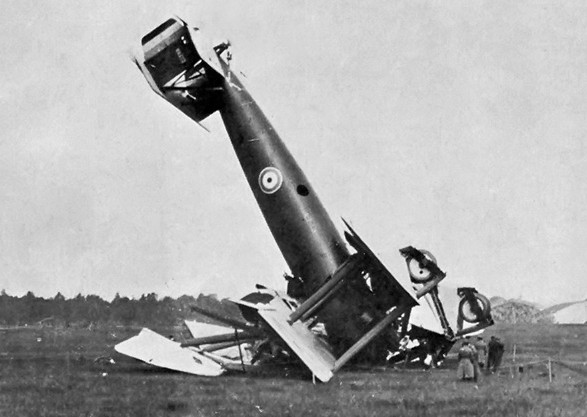
A Tarrant triplane, constructed at the Royal Aircraft Factory, Farnborough, was wrecked on a trial flight on Monday. The machine, which had six engines, each developing 500 horse power, after running along the ground toppled forward and seemed to bury itself in the earth. One of the pilots… Captain Rawlings, has died, and the other, Capt. Dunn, is in a very grave condition.

[Waterford Standard: Wednesday 28th May 1919]

Captain Percy Rawlings’ Tarrant triplane after the crash

Captain Dunn also died in the crash, which happened on 26th May 1919. Percy was 31 years of age when he died.

A close friend, Henry Edmunds, wrote to the Flight Magazine to express his sympathy at the loss:

As a boy, Rawlings was always interested in scientific matters, particularly photography and motors..

He was manly, open, and frank, fearless and honest, of an enquiring mind, and fond of experimenting. I remember his pre-heating paraffin vapour electrically, as a fuel for explosive engines…

It was at my house at Brighton that Rawlings met Mr. W. G. Tarrant, who was spending the week-end with me. Rawlings had just returned from the famous flight in the Handley Page to Constantinople, where he bombed the ‘Goeben.’ I remember his describing vividly his impressions of that memorable journey. If I recollect correctly, he motored down to Folkestone somewhat rapidly. He told me he believed the police were on the look-out for him for exceeding the speed-limit; but he went from Folkestone by air, proceeding to Naples. It was delightful to hear him recount that remarkable voyage. Their fears lest they should not be able to cross some of the high mountain ranges with the heavy load they were carrying, and where, had anything happened, they would have been out of the reach of all human aid. How he availed himself of a special camera for photographing portions of his trip, the results of which he feared it might be unwise to disclose at that time, so he brought the negatives back with him, and I believe they wore kept personally until after the War.

He and Mr. Tarrant were mutually attracted to each other, and discussed with much seriousness the construction of a new type of bombing-plane, which eventuated in the great Tarrant machine. Rawlings joined Tarrant shortly afterwards, and devoted all his energies to carrying on the work of design and construction. On several occasions he came down to see me, and related his experiences. He was full of confidence as to the future of his work; and invited me to take my first flight with him.

Townley Rawlings was a gallant gentleman. Those whom the gods love are taken early.

[Flight Magazine: 29th May 1919]

The speeding incident is an interesting anecdote, another similar incident recorded in a separate newspaper report:

Chauffeur Summoned for Fast Driving

Capt. Rawlings, who was killed in the Tarrant triplane accident, should have appeared as a witness yesterday in the Kingston court.

His chauffeur, Arthur B Cogger, of West Byfleet, summoned for exceeding the limit, was driving Captain Rawlings to Farnborough on Saturday, before the accident.

He said the captain told him he wanted to get along as quickly as possible as he was going to test an aeroplane. He had intended to come to court.

The summons was dismissed.

[Dublin Daily Express: Saturday 31st May 1919]

Percy Townley Rawlings was laid to rest in Highgate Cemetery, possibly close to where he or his family had been living.


Ship’s Steward Assistant Harold Tindell

Ship’s Steward Assistant Harold Tindell

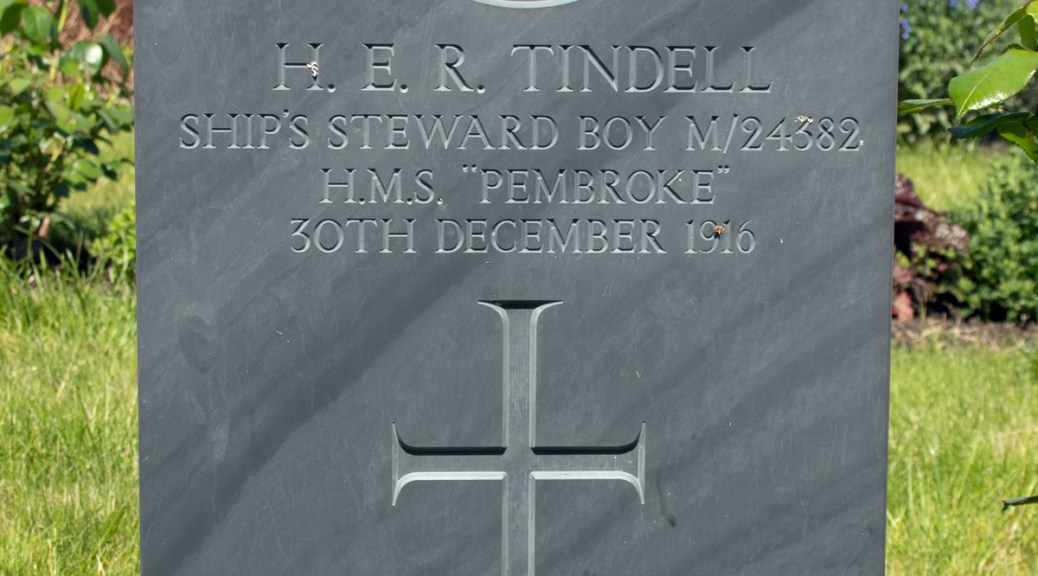
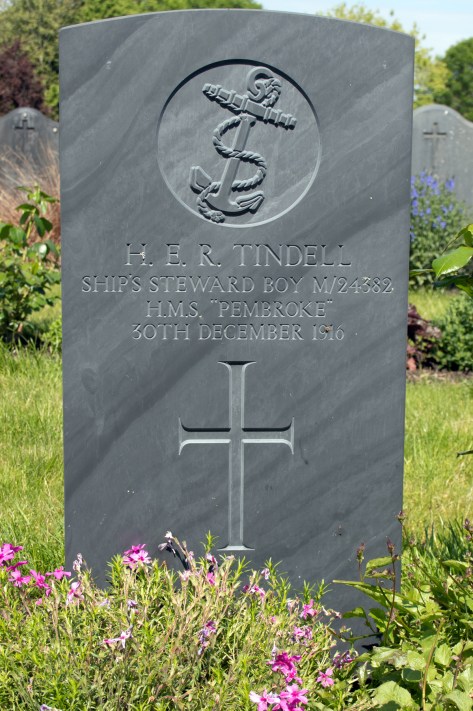
Harold Edward Richard Tindell was born in Sidcup, Kent, on 15th January 1898. The middle of three children, his parents were travelling salesman Lawrence Tindell, and his wife, Alice.

There is little concrete information available about Harold’s life: his family do not appear in the 1911 census, and it is only on his enlistment papers that we get a picture of the young man he had become. He joined the Royal Navy on 28th November 1916, signing up as a Ship’s Steward Assistant.

The document suggests that he had transferred over from the Royal Naval Volunteer Reserve, giving up his job as a clerk to fully serve his country. His papers show that he was 5ft 4.5ins (1.64m) tall, with brown hair, grey eyes and a fresh complexion.

Ship’s Steward Assistant Tindell was sent to HMS Pembroke – the Royal Naval Dockyard in Chatham, Kent – for his training. Tragically, however, his time there was to be brief. He contracted cerebrospinal meningitis, dying from the condition on 30th December 1916: he was eighteen years of age, and had been in the Royal Navy for just 32 days.

Harold Edward Richard Tindell was laid to rest in the military section of Woodlands Cemetery, Gillingham, Kent, not far from the base he had so briefly called home.


Harold’s headstone gives his rank as Ship’s Steward Boy: however, his service papers and the Commonwealth War Graves Commission both confirm the role as Ship’s Steward Assistant.


Leading Seaman Frederick Tillier

Leading Seaman Frederick Tillier

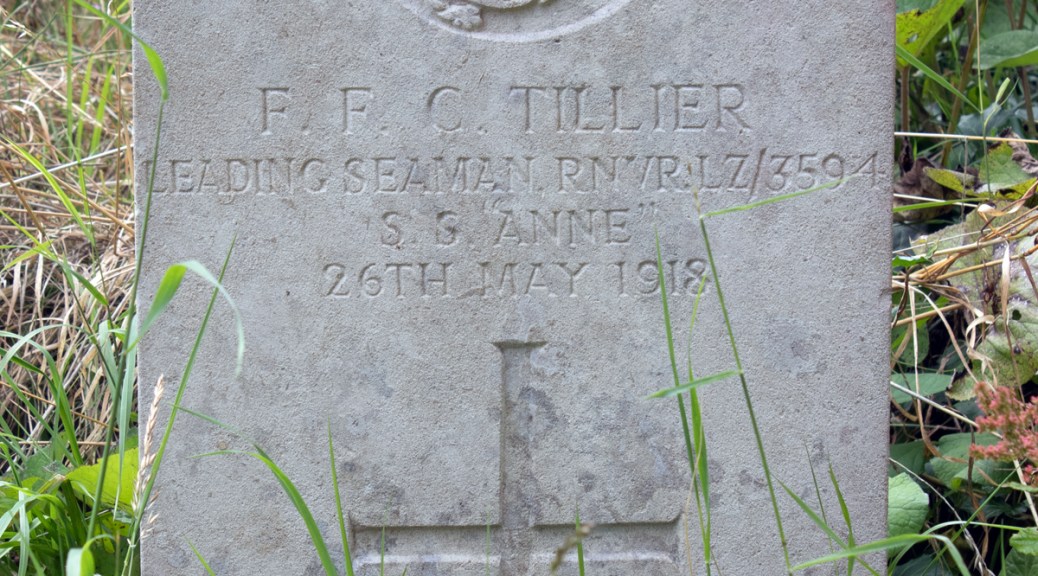
Frederick Francis Charles Vizzard was born on 12th December 1894 in Ottershaw, Surrey. The younger of two children, his parents were nurseryman Frederick Vizzard and his wife, Frances.

Details of Frederick Jr’s life are a challenge to unpick. Frederick Sr had died in 1909, and is seems that from this point on, he used his mother’s maiden name, Tillier, as his own. He found work as a labourer, and this is what he was doing when war broke out.

By this point Frederick had moved to Reading, Berkshire, and he was living in a small terraced house at 12 Highgrove Street. He enlisted in the Royal Naval Division on 18th October 1915, and was mobilised six months later.

Frederick’s records show that he was 5ft 7.5ins (1.71m) tall, with brown hair and grey eyes. He joined as an Able Seaman, which would suggest some previous experience, although there are no records to confirm this.

Able Seaman Tillier’s time in the navy seems to have been spent on shore. He was initially sent to Portsmouth, Hampshire, where he served on HMS Victory and HMS Excellent. On 19th December 1916, Frederick was reassigned to the Royal Naval Volunteer Reserve as a Leading Seaman, and sent to HMS President, the unit’s shore base near Tower Bridge in London.

Frederick would remain attached to HMS President for the next couple of years. The next entry on his service papers states that he was admitted to the Cottage Hospital in Dartmouth, Devon, as he was very seriously injured. What those injuries were, and how he received them is unclear, but Leading Seaman Tillier would succumb to them on 26th May 1918. He was 23 years of age.

Frederick Frances Charles Tillier was laid to rest in the graveyard of St Clement’s Church in Dartmouth.


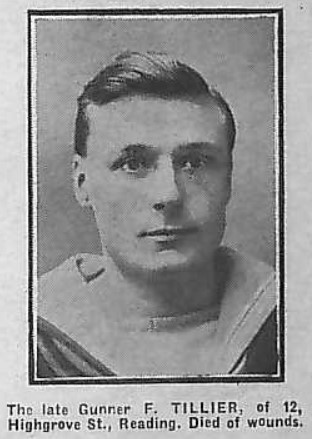
Leading Seaman Tillier
(from ancestery.co.uk)

Able Seaman Christopher Spratt

Able Seaman Christopher Spratt

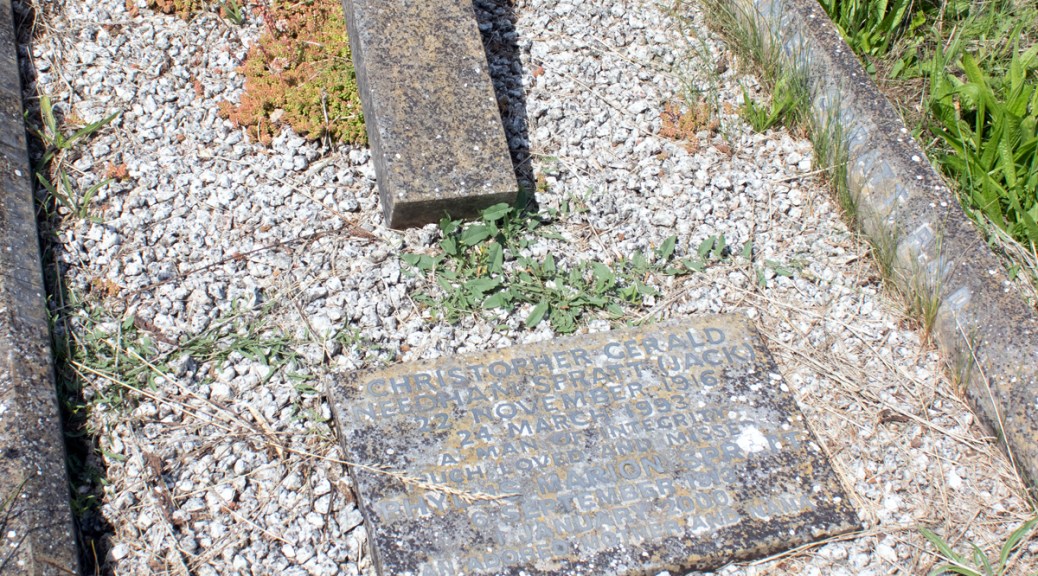
Christopher Templar Spratt was born on 23rd August 1889 in Streatham, Surrey. The youngest of three children, his parents were James and Elizabeth. James was an electrician by trade, and the 1891 census recorded the family as living at 58 Limes Road, between Selhurst and West Croydon.

The Spratts seem to have been a divided family. By the time of the 1901 census, James appears to have emigrated to Australia, presumably to earn money in the burgeoning country. Elizabeth and their younger two children were visiting Worthing, West Sussex.

At this point, and the decision seems to have been made for them to move to Sussex permanently, as the 1911 census found her and Christopher living at 87 Westcourt Road, Worthing. Elizabeth was noted as living on her own means; Christopher was working as a solicitor’s clerk, and they had a boarder, governess Nettie Buckler, to help bring in some additional money.

In January 1912, Christopher married Edith Green, a dressmaker from just along the coast in Goring-by-Sea. The couple moved in with Elizabeth, and went on to have two children: Florence, who was born that June; and Christopher Jr, who was born in November 1916.

By this point, war was raging across Europe, and Christopher stepped up to serve his King and Country. He had enlisted the Royal Naval Volunteer Reserve on 9th December 1915, but was not formally mobilised until the following June. Given the rank of Ordinary Seaman, Christopher’s service records note that he was 5ft 9ins (1.75m) tall, with dark brown hair, grey eyes and a fair complexion. He was also noted as having a mole on his left thigh.

Christopher was assigned to the Nelson Battalion of the Royal Naval Division, and sent to Dorset for training. While details of his service as more haphazard than usual, it seems that he served time overseas, and was promoted to Able Seaman on 1st October 1916. He became unwell in February 1917, as was admitted to the 18th General Hospital in Dannes-Camiers, on the French coast.

Suffering from cellulitis, Able Seaman Spratt was medically evacuated to Britain for treatment, and ended up as a patient in the 2nd Western General Hospital in Manchester. The condition was to prove fatal: he passed away on 12th February 1917, at the age of 27 years old.

The body of Christopher Templar Spratt was brought back to Sussex for burial. He was laid to rest in the churchyard of St Mary’s in Goring-by-Sea.


Elizabeth went on to re-marry and, by the time of the 1921 census, was living in East Preston, Sussex, with her new husband, Edward Neal, Christopher Jr and her new daughter, Enid. There is no evidence of Elizabeth’s older daughter, Christopher, although there is a Florence Spratt recorded as a patient in White Oak Schools (Homes for Ophthalmic Children) in Swanley, Kent.

Christopher Jr went on to marry Phyllis Bennett in the autumn of 1946. They remained in the Worthing area until his death in March 1993: he was laid to rest alongside the father he would not have remembered, in St Mary’s Churchyard. When Phyllis died seven years later, she was buried alongside her husband and father-in-law.


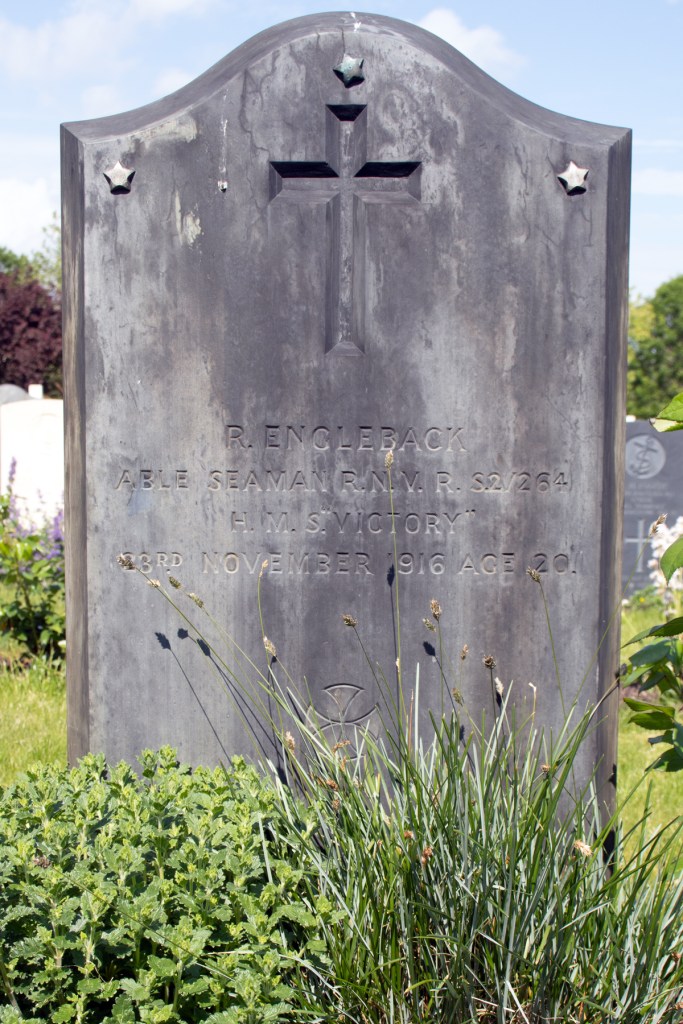
Able Seaman Russell Engleback

Able Seaman Russell Engleback

The life of Russell Engleback seems destined to remain lost in the mists of time and the only concrete information for him relate to his military service.

Ordinary Seaman Engleback joined the Royal Naval Volunteer Service on 3rd July 1914, just weeks before the declaration of war. His records confirm his date of birth – 11th August 1896 – and his occupation, which was a printer. He was 5ft 5ins (1.64m) tall, and had dark brown hair, brown eyes and a dark complexion.

Russell was sent to HMS Victory – the Royal Naval Dockyard in Portsmouth, Hampshire – for training, before being assigned to the battleship HMS Commonwealth in October. He remained on board for the next two years, rising to the rank of Able Seaman during this time.

Able Seaman Engleback returned to HMS Victory in August 1916, but may have moved to another naval base, HMS Pembroke in Chatham soon afterwards. Certainly he was at the Kent dockyard when he fell ill in November, as he was admitted to the Royal Naval Hospital around this time.

Russell was suffering from nephritis – kidney disease – by this point, and it was a condition that was to ultimately kill him. He passed away on 23rd November 1916, while still admitted in hospital: he was just 20 years of age.

Russell Engleback was laid to rest in Woodlands Cemetery, Gillingham, not far from the Chatham dockyard. His pension records give Fred and Amelia Tiffin – Russell’s Sussex-based mother and stepfather – as his next-of-kin.


Ordinary Seaman Walter Nipper

Ordinary Seaman Walter Nipper

Walter Henry Nipper was born on 21st September 1900 in Bleadon, Somerset. The oldest of four children, his parents were Gilfred and Rose Nipper. Gilfred was an agricultural labourer turned butcher and poultry dealer, and, by the time of the 1911 census, he had set up a retail business in the middle of the village.

Walter turned to farm work when he finished his schooling, but with war raging across Europe, he seems to have been one of the young men desperate not to miss out on the action. On 16th September 1918, just five days before he turned 18, Walter enlisted in the Royal Naval Volunteer Reserve. His service records confirm that he stood just 5ft 1.5ins (1.56m) tall, had black hair, hazel eyes and a fresh complexion. The document also noted that he had a scar on the back of his right hand.

Ordinary Seaman Nipper was sent to HMS Victory VI, the shore-based training vessel in Crystal Palace, Surrey, for his induction. It is likely that, when he left Somerset for the capital, that was the last time his parents saw him. Billeted in cramp barracks, with young men from across the country, Walter fell ill: he passed away on 10th October, just 24 days after joining up. He was barely 18 years of age.

Walter Henry Nipper’s body was brought back to Somerset for burial. He was laid to rest in the tranquil graveyard of St Peter and St Paul’s Church in his home village.


Ordinary Seaman Bertie Clark

Ordinary Seaman Bertie Clark

Bertie Baden Clark was born on 5th August 1900 in the hamlet of Dunball, near Puriton in Somerset. The third of seven children, his parents were quarry and cement works labourer George Clark and his wife, Bessie.

When war came to Europe, George stepped up to play his part. Despite being 44 years old, he enlisted in the Royal Army Service Corps on 4th November 1915 and, within a year, was in France. He remained posted at the No. 4 Remount Depot until October 1918.

“On the morning of the 1st October 1918, I left the 26th Squadron 4 Base Remount Depot riding a horse and leading one to exercise about a mile & half from the Squadron while proceeding by the side of the railway line my horse was frightened by the whistle of a railway engine & ran away with me throwing me to the road and stepping on my right ankle.”

Private Clark was initially treated at the No. 2 Canadian General Hospital, but was soon invalided back to Britain and placed on furlough until being formally demobbed from the army early in 1919.

Bertie, meanwhile, could see the excitement of the war passing him by. Determine to play is part before it was too late, he gave up his job as a labourer on 13th July 1918 and enlisted in the Royal Naval Volunteer Reserve.

Given the rank of Ordinary Seaman, his service records confirm that he was 5ft 6in (1.68m) tall (1in, or 2.5cm, taller than his father), with dark brown hair, grey eyes and a fresh complexion. He was noted as having a scar on his right knee.

Bertie was sent to HMS Victory, the Royal Naval Dockyard in Portsmouth, Hampshire, for training. Tragically, this was to be his only posting. He was admitted to the dockyard hospital early in October, suffering from double pneumonia and influenza. The condition was to take his life, and he passed away on 10th October 1918, at the age of just 18 years old.

Bertie Baden Clark’s body was brought back to Somerset for burial. He was laid to rest in the quiet graveyard of St Michael’s Church in Puriton, the funeral attended by his family, including his recently returned father, George.


Ordinary Seaman Herbert Fry

Ordinary Seaman Herbert Fry

Herbert Austin Fry was born on 30th January 1889 in the Somerset village of Moorlinch. He was the fifth of ten children and his parents were Joseph and Ellen Fry. Joseph was a farmer, and by the time Herbert was just two years old, the family had moved to Sutton Farm, in nearby Sutton Mallet.

The whole family chipped in to play their part on the farm, and, even before he finished his schooling, this was something that Herbert was also destined to do.

When war came to Europe, Herbert was keen to play his part. He enlisted in the Royal Naval Volunteer Reserve on 7th September 1916 as an Ordinary Seaman. His service records give a hint as to the young man he had become: he was 5ft 11ins (1.8m) tall, with sandy hair, blue eyes and a fair complexion.

Ordinary Seaman Fry was initially sent to HMS Victory – the Royal Naval Dockyard in Portsmouth, Hampshire – for training. Over the next year, he was given two sea-going postings, before returning to HMS President in London in September 1917.

On 31st October, Herbert boarded SS Dunrobin, a merchant ship. Having sailed to Almeria in Spain, she was returning to Britain, with a cargo of iron ore and grapes. On 24th November 1917, while 49 miles (79km) south-west of The Lizard in Cornwall, the Dunrobin was torpedoed by a German submarine. She sunk, and 31 lives – including that of Ordinary Seaman Fry – were lost. Herbert was 28 years of age.

Herbert Austin Fry’s body was recovered and brought back to Somerset for burial. He was laid to rest in the peaceful Sutton Mallet Churchyard.


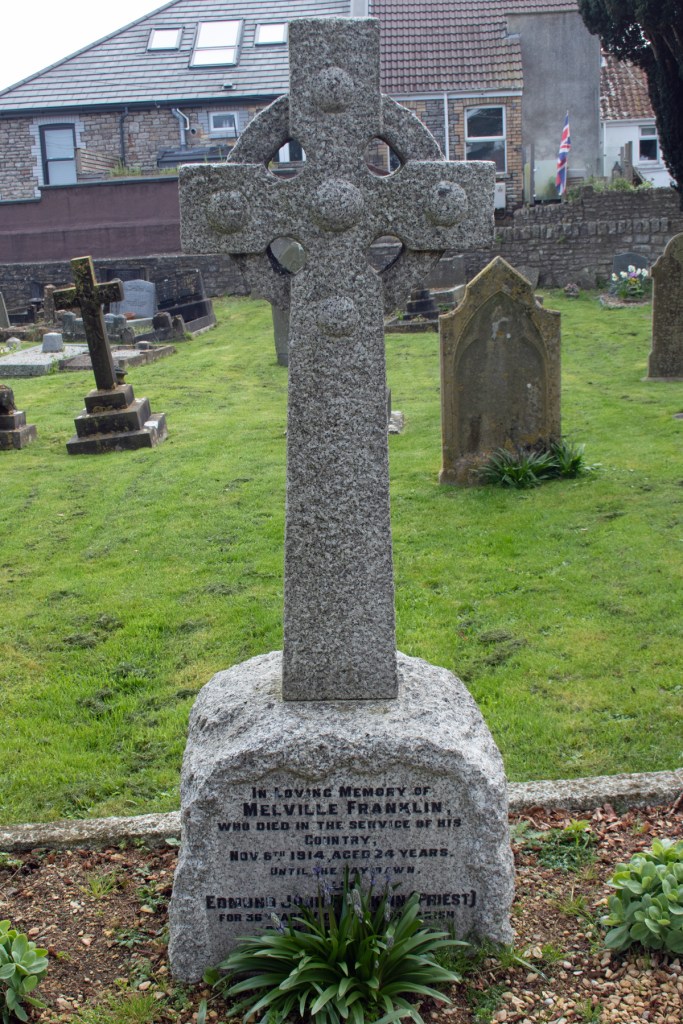
Able Seaman Melville Franklin

Able Seaman Melville Franklin

Melville Franklin was born on 25th November 1890, the youngest of seven children to Edmund and Alice Franklin. Edmund had been born in Birmingham, and had taken up holy orders. He and Alice married in the UK, but their first born, a boy called Victor, had been born in Australia, while their second child, another son called Harold, had been born a year later in Birmingham.

By the late 1880s, Reverend Franklin had taken up the post of vicar of St Nicholas’ Church in Whitchurch, near Bristol, and the family moved there. Unsurprisingly, the parish record for both Melville and his older sister Elsie, both of whom had been born in the village, shows they were baptised in the church by their father.

The Franklin children’s upbringing stood them in good stead in life. The 1901 census found that Victor and Harold had both found work as clerks – Victor for a timber merchant, and Harold for an oil cake merchant – while the following census, in 1911, recorded that another brother, Percival, was a motor expert for an insurance company. Melville, aged 20 by this point, had also found employment as a clerk, his employer being a wine merchant.

Melville wanted to expand his horizons further and, on 25th February 1911, he joined the Royal Naval Volunteer Reserve. His service records are sparse, but they confirm that he was 6ft 1ins (1.85m) tall, had fair hair, grey eyes and a fresh complexion.

Melville was formally mobilised on 22nd August 1914. At this early point in the war, there was a surplus of more than 20,000 men from the Royal Naval Volunteer Reserve, and the powers that be recognised that this was enough to form three brigades of land troops – one of Marines and two Naval.

Able Seaman Franklin was assigned to the Collingwood Battalion of the Royal Naval Division, and appears to have found himself heading to Belgium via Dunkirk by the late summer.

In the general rush to get men to the front line, more than three quarters of the troops went without even the most basic of equipment – packs, mess tins, water bottles.

The Division had no artillery, field ambulances or other support. Melville’s brigade was provided with old rifles, which they were given just three days before embarking for Europe.

Able Seaman Franklin landed in Antwerp shortly before the German invasion, and in the retreat, more than 1500 troops were captured and interned in the Netherlands. Melville, it would seem, was one of those who managed to escape back to England.

This was only to be a very temporary reprieve for Able Seaman Franklin, however. He had returned to Bristol, but had contracted enteric fever, also known as typhoid. This was to get the better of him, and he succumbed to it on 6th November 1914. He was weeks away from his 24th birthday.

Melville Franklin was laid to rest in the graveyard of St Nicholas’ Church, Whitchurch, in a funeral likely to have been presided over by his father, Edmund.