Category Archives: Leading Seaman

Leading Seaman Dan Pierson

Leading Seaman Dan Pierson

Dan Pierson was born in Liss, Hampshire, on 14th February 1884. One of eleven children, he was the third of four sons to Daniel and Annie Pierson. Daniel was an agricultural labourer, but his son wanted a more guaranteed career and, on 21st February 1901, he joined the Royal Navy.

Having only just turned 17, Dan was too young to formally enlist, and so was given the rank of Boy 2nd Class. He would spend the next year on training ships – HMS Northampton and HMS Calliope – and was also billeted at HMS Victory, the Royal Naval Dockyard in Portsmouth, Hampshire. Just two months after joining, he was promoted to Boy 1st Class and, when he came of age in February 1902, he was fully enrolled into the navy, and given the rank of Ordinary Seaman.

Dan was assigned to the gunboat HMS Redbreast by this point, and his service records show the young man he had become. He was 5ft 6ins (1.68m) tall, with dark brown hair, grey eyes and a fresh complexion. He also had two tattoos: one of a woman on his right arm, and another of a swallow on his left.

Ordinary Seaman Pierson’s contract was for twelve years and, over that time, he served on board eight different vessels. His annual reviews commented on his very good character and his superior ability, both of which backed up his progression through the ranks. On 11th June 1903, towards the end of his three years aboard Redbreast, he was promoted to Able Seaman, and on 1st December 1913, just a couple of months before the end of his initial term of service, he rose to Leading Seaman.

By this point, Dan had married. His new wife, Edith, was a railway worker’s daughter from Harting in Sussex. She was working as a housemaid for Reverend John Leake and his wife Helena at the time of their wedding.

When his contract came to an end, Leading Seaman Pierson immediately renewed it. His papers show that he had grown to 5ft 9.5ins (1.77m) in height but that he had been injured in the intervening years: it was noted that the little toe of his right foot was missing, and that he had a scar on his left leg.

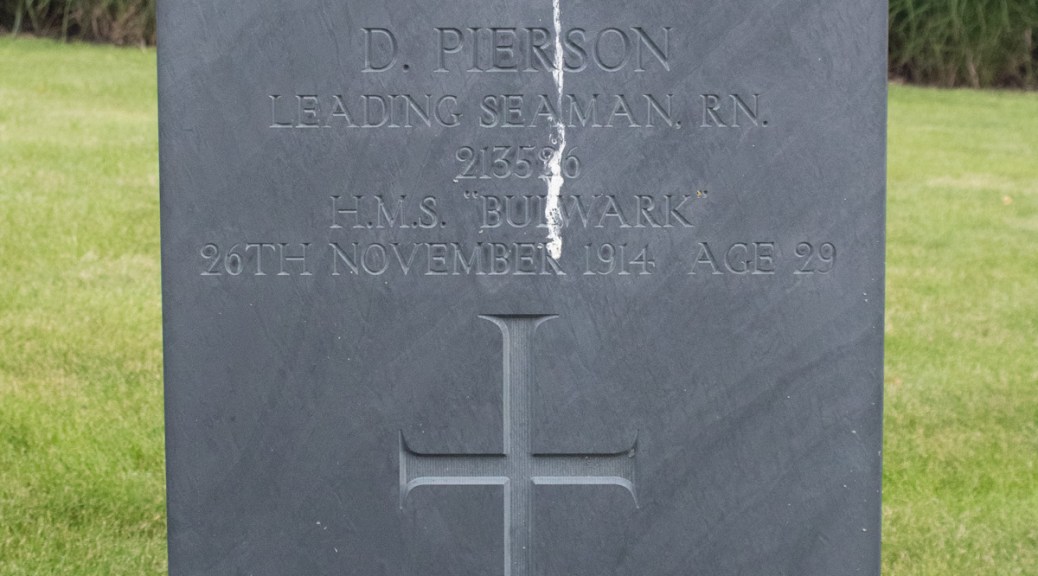
By the time war broke out, Leading Stoker Pierson was assigned to the pre-dreadnought battleship HMS Bulwark. During the summer of 1914, she was one of the Channel fleet used to protect ships transporting troops across to France. He was on board Bulwark when, on the morning of 26th November 1914, an explosion ripped through the ship while it was moored near Sheerness, Kent, tearing it apart and sinking it. In all 741 souls were lost, Dan amongst them. He was 30 years of age.

Dan Pierson’s body was recovered and identified. He was laid to rest in Woodlands Cemetery, Gillingham, Kent, not far from Chatham Dockyard.


Edith’s brother Ernest Pay was also serving in the Royal Navy. Attached to HMS Bulwark as well, Leading Stoker Pay was also killed in the explosion: he was 28 years of age. Tragically for Edith and her parents, Ernest’s body was never recovered. His loss is commemorated on the Portsmouth Naval Memorial in Hampshire.


Lieutenant Frederick Hill

Lieutenant Frederick Hill

Frederick Charles Hill was born on 13th June 1882 in the Devon village of Marldon. One of seven children, his parents were William and Elizabeth Hill. William was a carpenter, and the 1891 census found the family living or boarding at the Royal Oak Inn.

When he finished his schooling, Frederick found work as a gardener. However, he sought a bigger and better life and, on 21st April 1897, he joined the Royal Navy. His service record suggests that he lied about his age to do so, giving his year of birth as 1881,

Frederick was below the age to formally enlist in the navy, and was given the rank of Boy 2nd Class. He was sent to HMS Impregnable, the training base in Devonport, Devon, spending the next eighteen months there. Promoted to Boy 1st Class in February 1898, he was given his first posting, on board HMS Agincourt, later that year.

In the autumn of 1898, Frederick was assigned to the cruiser HMS Leander. The following summer, and based on the date of birth he had previously provided, he came of age, and was formally inducted into the Royal Navy. His service records show that he was 5ft 2ins (1.57m) tall, with red hair, grey eyes and a fresh complexion. Hs was also noted as having a scar on his forehead.

The now Ordinary Seaman Hill remained on board HMS Leander for more than two years. He proved a worthwhile member of crew, and was promoted to Able Seaman in May 1900. He left Leander in January 1901, and was billeted at HMS Vivid, the Royal Naval Dockyard in Plymouth, Devon, which would become his base when not at sea.

Frederick’s contract was for twelve years, and during that time he would serve on four vessels. His dedication to the navy was evident by his promotions – he made Leading Seaman in October 1904, Petty Officer 2nd Class in October 1906, and Petty Officer 1st Class in March 1911. When his term of service ended, he immediately re-enlisted, and, at his annual reviews, was regularly noted for his very good character and superior ability. His career kept going from strength to strength, and, in 1914, he was promoted to Chief Petty Officer.

He was sent to Antwerp in September [1914] with the Royal Naval Division, and in 1916 went to the Dardanelles, there gaining his commission for bravery. After the evacuation he was sent to France and won the MC in the Ancre drive in 1916. In February 1918 he was sent for six months’ rest to England. Lieut. Hill volunteered to go to France again in November the same year, and contracted heart disease, from which he died. He returned to England early in June [1919], and, being on sick leave, went to Paignton Hospital, where his death occurred.

[Brixham Western Guardian: Thursday 7th August 1919]

Frederick Charles Hill was 37 years of age when he died on 2nd August 1919. His body was laid to rest in the family plot in St John the Baptist’s Church, Marldon.


Frederick’s headstone records his rank as Lieutenant Commander. However, Commonwealth War Grave Commission documents suggest his rank was Lieutenant.


Leading Seaman William Coombes

Leading Seaman William Coombes

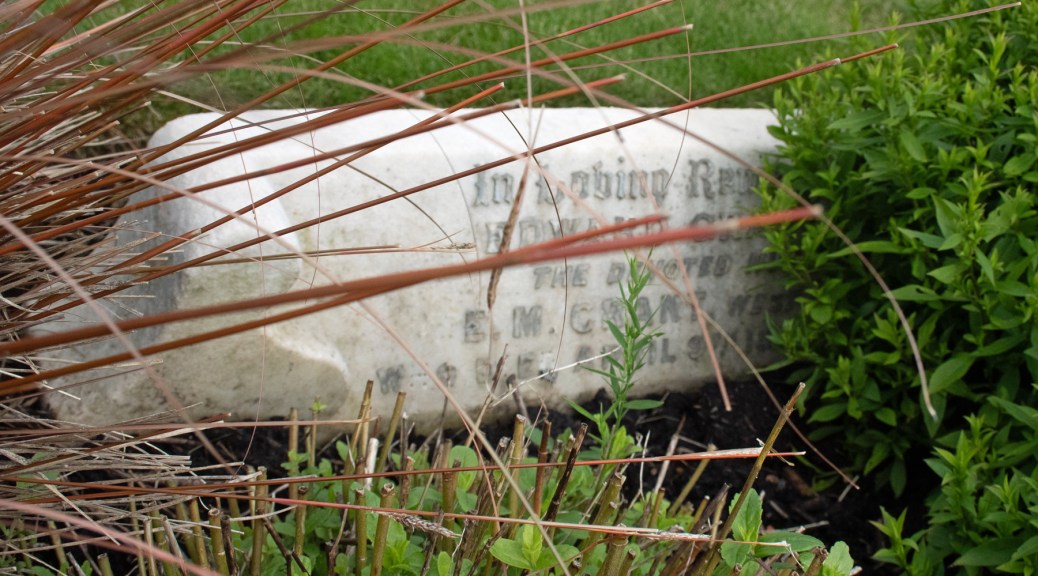
William Henry Marsh was born on 6th September 1879 in Whitstable, Kent. An only child, his parents were William and Maria Marsh, and, based on the census records, his early life seemed to have lacked some stability.

The 1881 census recorded William and his mother living on Beach Walk in the town. Marias was recorded as being a mariner’s wife. By 1891, William and his father was living with Maria’s sister and son. Still a mariner, with his son also working as a seaman, William Sr was listed as being a widower.

A decade on, and William Jr’s life had taken a different turn and the 1901 census listed him living on Whitstable High Street. Working as a labourer in the harbour, he is recorded as having a wife, Julia, and a two-year-old son, also William. Sadly, there is no further information about either of them.

The next document for William Jr is his First World War service papers. It shows that he enlisted on 10th March 1915, his previous time at sea making him an ideal candidate for the Royal Naval Reserve. His is noted as being 5ft 7ins (1.7m) tall, with blue eyes and a fresh complexion. He also had a tattoo of clasped hands on his right forearm. The most interesting thing about this document, however, is the fact that William had chosen to go by the surname of Coombes.

Given the rank of Leading Seaman, William would spend the next couple of years serving mainly on shore, at bases in London and Devonport. By the spring of 1918, while attached to the SS Eastville, he was admitted to the Royal Naval Dockyard in Chatham, Kent. Suffering from anaemia and malaria, the conditions would take his life. He died on 19th March 1918, at the age of 38 years old.

The body of William Henry Coombes was laid to rest in the naval section of Woodlands Cemetery, Gillingham, Kent, not far from the dockyard he would have known.


William’s will left £114 (around £8200) to his widow Julia, who was by now living in Leeds, Yorkshire. At his request, however his war pension, however, was given to his aunt, Mrs Rose Rout, of Hull, Yorkshire.


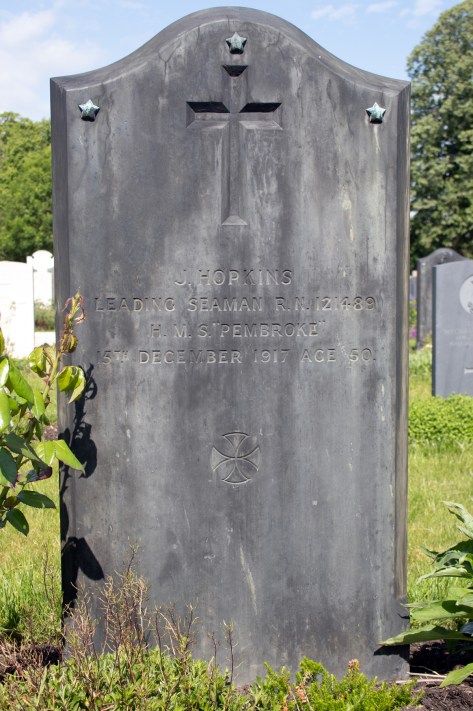
Leading Seaman Joseph Hopkins

Leading Seaman Joseph Hopkins

Joseph Hopkins was born in Ramsgate, Kent, on 27th May 1867. The third of seven children, his parents were commissioned sailor George Hopkins and his wife, Agnes.

Given his father’s job, Joseph seemed destined for a life at sea himself and, on 30th November 1882, he joined the Royal Navy as a Boy 2nd Class. Over the next couple of years, he learnt the tools of his trade, starting on the training ships HMS St Vincent and HMS Hector. During this time, he was promoted to Boy 1st Class.

On 1st January 1885, Joseph was assigned to the ironclad ship HMS Repulse. He remained on board for six months, during which time he came of age. Now an Ordinary Seaman, his service papers show that he was just 5ft 1in (1.55m) tall, with black hair, grey eyes and a pale complexion. He was also noted as having a scar on the left of his forehead.

Ordinary Seaman Hopkins’ contract was for ten years and over that decade he sailed the world, serving on eight ships. Less than a year after formally enlisting, he was promoted to Able Seaman, but his time in the navy was not without its problems.

Able Seaman Hopkins spent four separate periods of time – totalling 49 days – in the brig between 1886 and 1895. Details of his most of his offences have been lost to time. Given the last instance was an expired shore leave which also landed him with a find of £3 10s (around £580 today), it seems likely that he was a repeat offender.

When Able Seaman Hopkins’ contract expired, he immediately re-enlisted. He served for another ten year and, apart from one further bout in the cells in 1898, his record was incident free. In the summer of 1905, after more than two decades in the Royal Navy, he was formally stood down to reserve status.

Joseph’s trail goes cold for a while and it is only in the 1911 census that we pick him up again. At this point he was living with his younger brother in Kilburn, Middlesex, where he was employed as a warehouseman.

When war broke out, Joseph was called upon to play his part once more. He took up the rank of Able Seaman once again, but remained shore-based, serving at HMS Pembroke, the Royal Naval Dockyard in Chatham, Kent. He would spend the next three years at the dockyard, rising to Leading Seaman in March 1917.

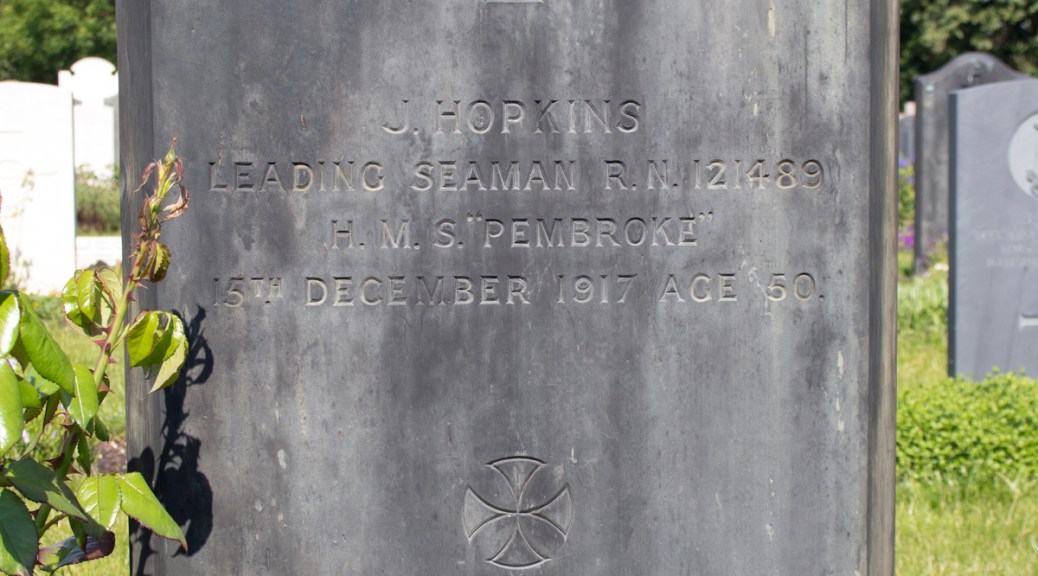
By this point, however, Joseph’s health was beginning to decline. In December 1917 he was admitted to Chatham’s Royal Naval Hospital following a cerebral haemorrhage, but the condition would prove fatal. He passed away on 15th December, at the age of 50 years old.

The body of Joseph Hopkins was taken to Woodlands Cemetery in Gillingham, Kent, and he was laid to rest, not far from the base he had called home for so long.


Leading Seaman Henry Hudson

Leading Seaman Henry Hudson

Henry John Gerrard Hudson was born in Whitechapel, Middlesex, on 11th November 1873. The fourth of seven children – and one of five boys – his parents were John and Emma Hudson. John was a paper stainer, and the family were raised in rooms at 62 Fern Street, Tower Hamlets.

Money was seemingly tight, and Henry sought an escape. On 5th January 1889 he enlisted in the Royal Navy, and was sent to the Devon school ship, HMS Impregnable, for his training. As he was below the age to full enrol, he was given the rank of Boy 2nd Class.

Over the next couple of years, Henry learnt the tools of his trade. He spent a year training at HMS Ganges, the shore establishment near Ipswich, Suffolk, and rose to the rank of Boy 1st Class. On 20th November 1890, he was given his first sea-faring assignment, aboard HMS Ruby, and she would remain his home for the next eighteen months.

During his time with Ruby, Henry came of age. His service records show that he was 5ft 5ins (1.65m) tall with light brown hair, brown eyes and a fair complexion. He was also noted as having a number of abscess scars under his left arm.

The now Ordinary Seaman Hudson definitely showed signs of promise as, after just three months, he was promoted to Able Seaman, a rank he would hold for the next five years. During that time, he served on four further ships, including the torpedo boat depot ship HMS Vulcan.

On 1st June 1897, Henry was promoted to Leading Seaman, although he reverted to his previous role just nine months later, at his own request. In October 1898 he transferred to HMS Caesar and, presumably with further support, he was promoted to Leading Seaman again in August 1899.

By May 1902, Henry’s initial term of service came to an end, and he was stood down to reserve status.

In January 1907 Henry married Alice Martin. She was a carpenter’s daughter, and the couple were living on Grosvenor Terrace in Newington, Middlesex, when the exchanged vows. They would go on to have three children.

The 1911 census found the Hudsons living in Weymouth, Dorset. Henry, by this point, was working as a motor boat driver, and the family had a small cottage on South View Road, not far from the town centre. The document shows how they had travelled to where Henry’s work took them: their first child, Nancy, had been born in Walworth, Surrey, in 1908, while her sister, Gladys, was born in nearby Camberwell the following year.

The next couple of years provided a big upheaval for the Hudsons and, by the spring of 1914 the family had moved to Rugby, Warwickshire. There seems to be no family connection to the area on either Henry or Alice’s side. It can only be assumed, therefore, that an opportunity of work arose.

In June 1914, Alice gave birth to the couple’s third son, John. Just two months later, war was declared, and Henry was called back into service. Taking up his previous role, Leading Seaman was to spend the next few years on land. Initially sent to HMS Victory, the Royal Naval Dockyard in Portsmouth, Hampshire. From there he moved to a base in Gorleston, Norfolk, and would remain there until the autumn of 1916.

Leading Seaman Hudson spent six month at HMS President in London, before moving to the Royal Naval Dockyard in Chatham, Kent, also known as HMS Pembroke. By this point – the spring of 1917 – his health was suffering and, that May, he was admitted to the town’s Royal Naval Hospital, suffering from tuberculosis.

The condition was to prove too severe for Henry: he passed away from a combination of the lung condition and a gastric ulcer on 20th May 1917. Henry was 43 years of age.

Alice was still living in Warwickshire at this point. Her husband, Henry John Gerrard Hudson, was therefore laid to rest in the naval section of Woodlands Cemetery, Gillingham, Kent.


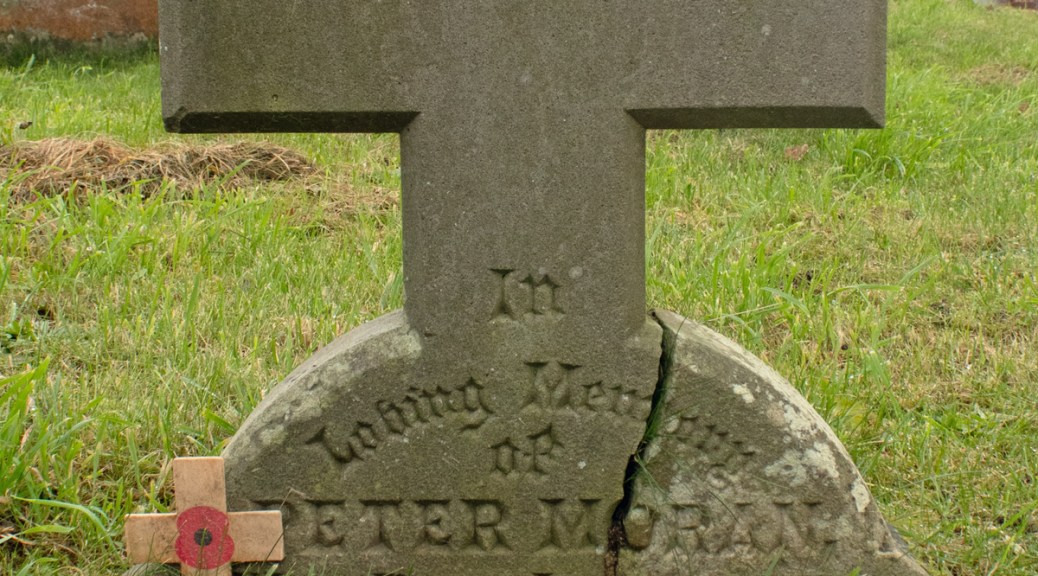
Leading Boatman Peter Moran

Leading Boatman Peter Moran

Peter Moran was born in Kilmeena, County Mayo, Ireland, on 29th January 1876. Details of his early life are hard to track down, but when he finished his schooling, he wound work as a fisherman.

By 19th August 1891, Peter sought to make a more permanent career of the sea. He signed up to the Royal Navy, and was sent to HMS Impregnable, the shore base in Devonport, Devon, for his training. Being just 15 years of age, he was too young to formally enlist, and was given the rank of Boy 2nd Class.

Over the next few years, Peter learnt the tools of his trade. On 2nd July 1892 he was promoted to Boy 1st Class, and the following February he was given his first sea-faring assignment, on board the battleship HMS Neptune. By March 1893 Boy Moran found himself serving on board HMS Daphne, a screw sloop which would become his home for the next three years.

During his time aboard Daphne, Peter came of age, and was given the rank of Ordinary Seaman. His service records show that he was 5ft 4ins (1.63m) tall, with light hair, grey-blue eyes and a fresh complexion. Within eighteen months he had proved his mettle, and was promoted to Able Seaman.

Over the next decade, Peter would serve on eight vessels. By the time the term of his contract came to an end in September 1903, he had been promoted twice – to Leading Seaman, then to Petty Officer 2nd Class.

Peter renewed his contract, but seems to have chosen a new career path. On 2nd October 1903 he moved to HM Coastguard and, as a Boatman, was assigned to Pendeen Cove, Cornwall.

Love blossomed for Peter, and he married a woman called Caroline in the next few years. There is little further information about her, but the couple would go on to have three children – Mary in 1908, Florence in 1911 and Thomas in 1913.

Boatman Moran would spend twelve years with the coastguard, moving to St Ives, Cornwall, in September 1908, and Fishguard, Pembrokeshire, in March 1914. By this point he had been promoted to Leading Boatman, and was set on a new life in Wales. Sadly, the new life was not to be: on 2nd June 1915 he passed away from pneumonia. He was 39 years of age.

The body of Peter Moran was laid to rest in Fishguard Cemetery: a life at sea, and forging homes in three countries at an end.


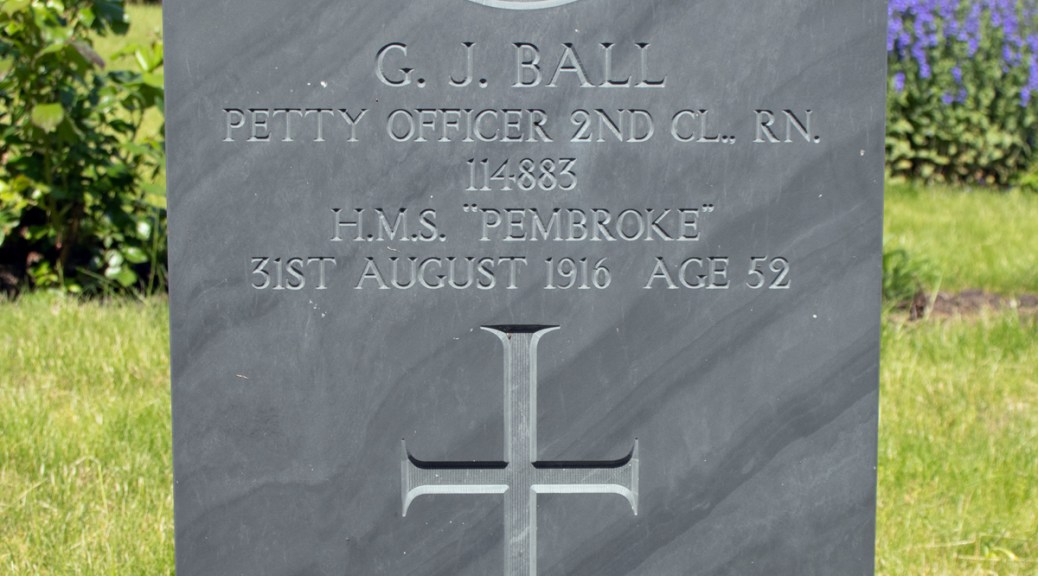
Petty Officer 2nd Class George Ball

Petty Officer 2nd Class George Ball

The early life of George John Ball is a challenge to piece together.

His naval records confirm that he was born in Bedminster, Somerset, on 11th October 1865. There are census records that link his name to parents coal miner Luke Ball and his wife, Ann, but these cannot be confirmed.

George’s papers show that he found work as a butcher when he finished his schooling. He was set on a life at sea, however, and, on 25th November 1880, he joined the Royal Navy. Given the rank of Boy 2nd Class, he was sent to the training base HMS Impregnable for his induction. The Devon establishment would remain his home for the next two years, and, during this time, he rose to the rank of Boy 1st Class.

On 10th October 1882, George was given his first sea-faring assignment, on board the armoured cruiser HMS Northampton. He stayed with her for the next two years, during which time he came of age. Now formally inducted to the Royal Navy, he was promoted to Ordinary Seaman. His service records from the time give an indication as to the man he had become. Short of stature, he was just 5ft 1.5ins (1.56m) tall, and had light brown hair, hazel eyes and a fresh complexion.

Ordinary Seaman Ball signed up for a ten-year contract. Over that time, he would serve on a total of eight vessels, rising to the rank of Able Seaman in January 1889. George’s slate was not completely clean, however, and his record notes three serious demeanours in that time.

In the spring of 1888 George spent 27 days in Canterbury Gaol for ‘breaking out of [the] ship’ he was then serving on, HMS Duncan. He was sent to the brig for a further fourteen days in January 1892 for an undisclosed crime.

Able Seaman Ball was also fined £3 10s (£575 in today’s money) for staying away beyond his allotted shore leave. His papers note an absence of seventeen weeks from 10th October 1893, and this time would have been added to the end of his contract.

George re-enlisted on 9th February 1894, and his service record noted that he had grown half and inch (1.3cm) since he enlisted. He had also had a number of tattoos in that time, including an anchor on his right arm and a bracelet and sailor on his left.

Over the next decade, Able Seaman Ball continued his steady progression through the ranks. He would serve on seven ships, returning to what had become his shore base – HMS Victory, the Royal Naval Dockyard in Chatham, Kent – in between assignments. In October 1897, George was promoted to Leading Seaman: by the following July he was given the rank of Petty Officer 2nd Class.

On 29th April 1904, after more than twenty years in service, George was formally stood down to reserve status. The next document for him – the 1911 census – gives an insight into his life away from the sea. By this point, George was living in a small terraced house at 234 Luton Road, Chatham, Kent.

The document confirms he had been married for fourteen years, to a woman called Sarah. The couple had a daughter – six-year-old Doris – and Sarah’s son from a previous marriage, Albert, was also living with them. George had not distanced himself too far from the sea, however. He was employed as a Ship’s Canteen Manager, a position his stepson also held.

When war came to Europe, George was called upon to play his part once more. Taking up the rank of Petty Officer 2nd Class again, he would be based at HMS Pembroke – Chatham Dockyard – and he remained in service for the next two years.

In August 1916, George was admitted to the Royal Naval Hospital in Chatham, with a combination of pychtis and a stricture. The conditions were to prove fatal: he breathed his last on 31st August 1916, at the age of 50 years old.

George John Ball was laid to rest in the military section of Woodlands Cemetery, Gillingham, Kent, not far from the dockyard that had been his home for many years.


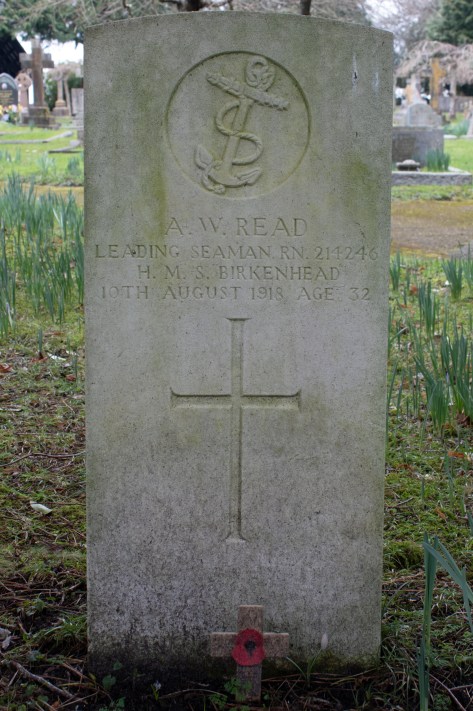
Leading Seaman Arthur Read

Leading Seaman Arthur Read

Arthur William Read was born on 5th February 1886 in Lyndhurst, Hampshire. The fourth of nine children, he was one of five sons to James and Mary Read. James a builder’s labourer-turned-yardman, although his son wasn’t to follow in his father’s footsteps.

Instead, Arthur rook on work as a baker’s boy, but this was not enough for him. He sought a career at sea and, on 10th April 1901, he took a job in the Royal Navy. Given the rank of Boy 2nd Class because of his age, he was sent to HMS St Vincent, the shore-based training establishment in Devonport, Devon. Over the next eighteen months he learnt the tools of his trade, and was promoted to Boy 1st Class after just ten months.

On 5th February 1904, Arthur turned 18, and came of age. Now able to formally enlist in the Royal Navy, he took that opportunity, and was given the rank of Ordinary Seaman. His service papers show that he was 5ft 5ins (1.65m) tall, with light brown hair, blue eyes and a fresh complexion.

At this point, Ordinary Seaman Read was serving on board the battleship HMS Irresistible. She would be his home for two years and, just a couple of weeks before changing vessels, he was promoted to Able Seaman.

Arthur would serve up to and during the First World War. He was assigned to a total of seven ships after the Irresistible, returning to what would become his home port, HMS Victory in Portsmouth, Hampshire, in between voyages. His character was regularly noted as being very good, while his ability was repeatedly found to be superior. By 1st October 1915, with war raging across Europe, he was promoted again, to the rank of Leading Seaman.

Away from his seafaring, Arthur had found love. In the last quarter of 1909 he married Alice Philpott. Sadly, details about her have been lost to time, but the couple would go on to have two children – Ivy and Gladys.

When war came to Europe, Arthur’s younger brother Harry stepped up to serve. He enlisted in the Middlesex Regiment, and was assigned to the 12th Battalion. Private Read was caught up in fighting on the Western Front, and was killed in action on 25th April 1916. He is buried in Bronfay Farm Military Cemetery, in Bray-sur-Somme, Picardie.

Leading Seaman Read, meanwhile, was continuing his naval career. From November 1916 he was assigned to the light cruiser HMS Birkenhead. Used to patrol the North Sea, she had come away from the Battle of Jutland unscathed.

As the war entered its closing months, Arthur’s health was becoming impacted. Suffering from diabetes, he was admitted to the Royal Naval Hospital in Edinburgh in summer of 1918. The condition was to better him, however, and he passed away on 10th August: he was 31 years of age.

The body of Arthur William Read was taken back to Hampshire for burial. He was laid to rest in Lyndhurst Cemetery.


After her husband’s death, Alice was left to raise two children under 5 years old. Unable to do this without support, on 8th July 1920, she married Jack White. A Chief Petty Officer in the Royal Navy, it is unclear whether his path had ever crosser her late husband’s. The following year’s census found her and her two daughters living in a house on Clarence Road in Lyndhurst: her husband was away at sea.


Leading Seaman Arthur Read
(from ancestry.co.uk)

Petty Officer 1st Class Frederick Morgan

Petty Officer 1st Class Frederick Morgan

Frederick Morgan was born on 15th July 1871, the oldest of four children to Samuel and Selina. Samuel was a miner from Bristol, Gloucestershire, but it was in the Staffordshire town of Tipton that he and local girl Selina married and raised their family. The 1881 census found the Morgans living at 17 Brewery Street, to the south of the town centre.

Frederick was not destined to follow in his father’s footsteps, however, and had his sights set on a life at sea, rather than in the depths of a coal mine. On 23rd November 1896 he joined the Royal Navy, and was sent to HMS Impregnable, the training base in Devonport, Devon, for his induction.

Being too young to formally enlist, Frederick was given the rank of Boy 2nd Class. Over the next three years, he learnt the tools of his trade, and served at three further bases: HMS Lion, HMS Penelope and HMS Raleigh. During this time, he was promoted to Boy 1st Class and, on 15th July 1889, when he turned 18, he was formally inducted into the Royal Navy.

Ordinary Seaman Morgan’s service records show that he was just 5ft 2.5ins (1.59m) tall. He had light brown hair, blue eyes and a fair complexion. He also had a tattoo by this point, of a dancing sailor on the inside of his right arm.

Frederick remained at HMS Raleigh for the next couple of years, and was promoted to Able Seaman on 1st July 1891. From the autumn, however, his sea-going life really took hold. Over the next ten years, he served on five ships, and was to be based at HMS Vivid, the Royal Naval Dockyard in Devonport, in between voyages. His dedication to the service was recognised – his annual reviews regularly noted his character as very good, and he rose through the ranks to Leading Seaman in May 1898, Petty Officer 2nd Class that October, and Petty Officer 1st Class in January 1901.

Away from work, Frederick’s love life was blossoming. In the autumn of 1893 he married Zipporah Elizabeth Beatrice Griffiths. Better known as Beatrice, she was the daughter of waterman Thomas Griffiths and his wife, Zipporah. The family came from Dartmouth, and this is likely where the young couple got to know each other. They married in St Clement’s Church, Dartmouth, and went on to have two children, George and Kathleen.

On 15th July 1901, Petty Officer Morgan’s initial contract with the Royal Navy came to an end. He renewed it straight away, and would spend the next decade sailing the world. Again Frederick was based at HMS Vivid in between voyages. On 11th July 1911, after 21 years in service, he was formally stood down to reserve status, and he returned to shore.

Frederick’s trail goes cold over the next couple of years, but when war broke out, he was called into service once more. Petty Officer Morgan would serve on the depot ships HMS Leander and Cyclops, which served out of Scapa Flow. He also spent time at HMS Gunner, the naval base to the north of Edinburgh. By March 1919, with the Armistice signed, he found himself based back in Devon.

At the Royal Naval Hospital, Plymouth, on Saturday, an inquest was held relative to the death of Fredk Morgan, 47, a naval pensioner, who died suddenly in the train on Thursday last.

Wm. Griffiths, inspector, GWR, at Millbay, said that PO Morgan was removed from the 6.20 train from Saltash on Thursday, apparently in a fit. He was laid on a seat, and a doctor who was about to travel on another train pronounced life extinct.

Charles Evans Jenkins, surgeon-lieutenant at the Naval Hospital said death was due to fatty degeneration of the heart.

The Coroner, who expressed his sympathy with the widow, declared that death was due to natural causes.

[Western Times: Tuesday 1st April 1919]

Frederick Morgan died of a heart attack on 27th Match 1919. He was laid to rest in the graveyard of St Clement’s Churchyard, Dartmouth, where he and Beatrice had been married.


Leading Seaman Frederick Tillier

Leading Seaman Frederick Tillier

Frederick Francis Charles Vizzard was born on 12th December 1894 in Ottershaw, Surrey. The younger of two children, his parents were nurseryman Frederick Vizzard and his wife, Frances.

Details of Frederick Jr’s life are a challenge to unpick. Frederick Sr had died in 1909, and is seems that from this point on, he used his mother’s maiden name, Tillier, as his own. He found work as a labourer, and this is what he was doing when war broke out.

By this point Frederick had moved to Reading, Berkshire, and he was living in a small terraced house at 12 Highgrove Street. He enlisted in the Royal Naval Division on 18th October 1915, and was mobilised six months later.

Frederick’s records show that he was 5ft 7.5ins (1.71m) tall, with brown hair and grey eyes. He joined as an Able Seaman, which would suggest some previous experience, although there are no records to confirm this.

Able Seaman Tillier’s time in the navy seems to have been spent on shore. He was initially sent to Portsmouth, Hampshire, where he served on HMS Victory and HMS Excellent. On 19th December 1916, Frederick was reassigned to the Royal Naval Volunteer Reserve as a Leading Seaman, and sent to HMS President, the unit’s shore base near Tower Bridge in London.

Frederick would remain attached to HMS President for the next couple of years. The next entry on his service papers states that he was admitted to the Cottage Hospital in Dartmouth, Devon, as he was very seriously injured. What those injuries were, and how he received them is unclear, but Leading Seaman Tillier would succumb to them on 26th May 1918. He was 23 years of age.

Frederick Frances Charles Tillier was laid to rest in the graveyard of St Clement’s Church in Dartmouth.


Leading Seaman Tillier
(from ancestery.co.uk)