Category Archives: Private

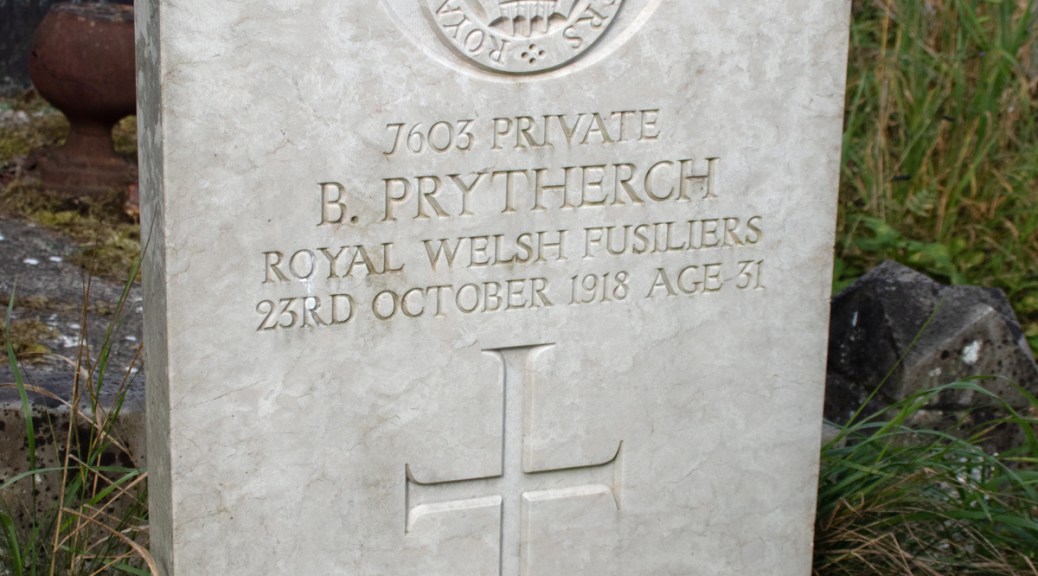
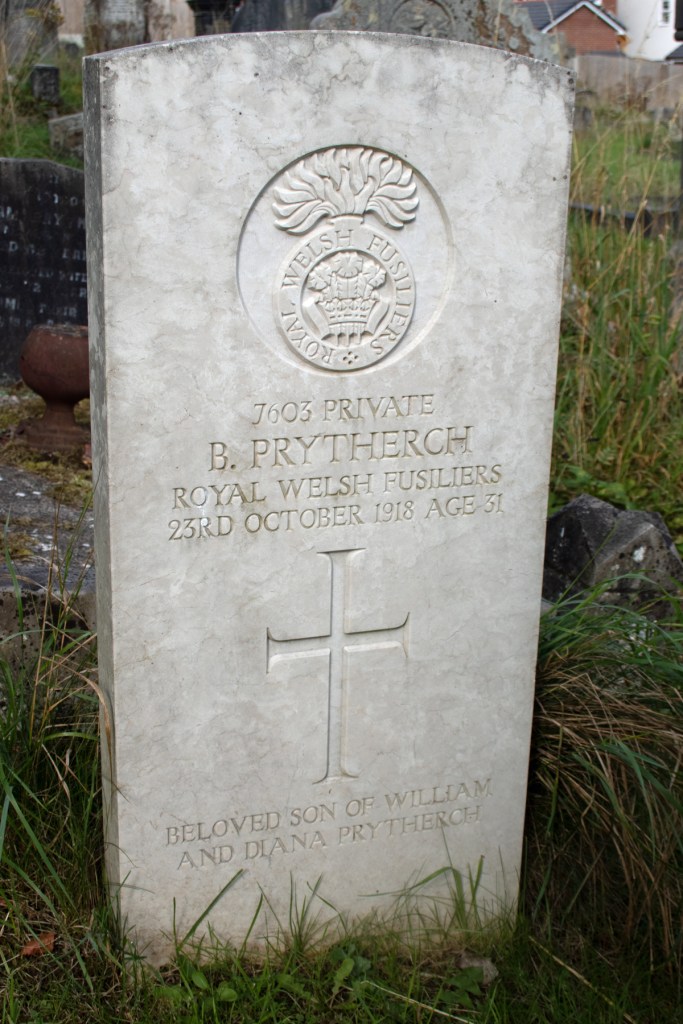
Private Benjamin Prytherch

Private Benjamin Prytherch

Benjamin Prytherch was born in the summer of 1887 in Cefn Mawr, to the east of Llangollen, Denbighshire. One of eight children, his parents were local blacksmith William and his wife, Diana. The family moved around a little while young Benjamin was growing up, but by 1901 had settled in Llangollen itself.

By the time of the 1901 census, Benjamin was the only one of the Prytherch siblings to still be living with his parents and was employed as a cabinet maker.

When war broke out, Benjamin was quick to enlist. He joined the Royal Welch Fusiliers and was assigned to the 1/4th (Denbighshire) Battalion. His service records show that he was 5ft 3.75ins (1.62m) tall and of good physical development.

While his battalion was part of the regiment’s Territorial Force, by February 1915, Private Prytherch found himself in France. He was caught up in the fighting almost immediately, and was injured during an explosion in a trench in May that year.

Sent to the No. 3 British General Hospital at Le Tréport in Normandy, Private Prytherch remained there for a little over a month to recover. However, when he returned to the front line, his health was impacted and he was unable to perform his duties without his breathing becoming affected. Further assessment revealed a heart murmur and he was sent back to Britain in July 1915.

Benjamin’s condition did not improve, and by October 1916, he was medically discharged as a direct result of the injuries he had sustained in the trench blast.

At this point, Benjamin’s trail goes cold. He returned home, but it is unclear whether he was able to work again. All that can be confirmed is that by October 1918 he had contracted pulmonary tuberculosis. He died on the 23rd of that month in the town of Corwen, ten miles to the west of Llangollen. He may have been in respite care of some sort, as his parents were still living in Llangollen itself. He was just 31 years of age when he passed away.

Benjamin Prytherch was brought back to Llangollen for burial: he was laid to rest in what became the family plot in the town’s Fron Cemetery.
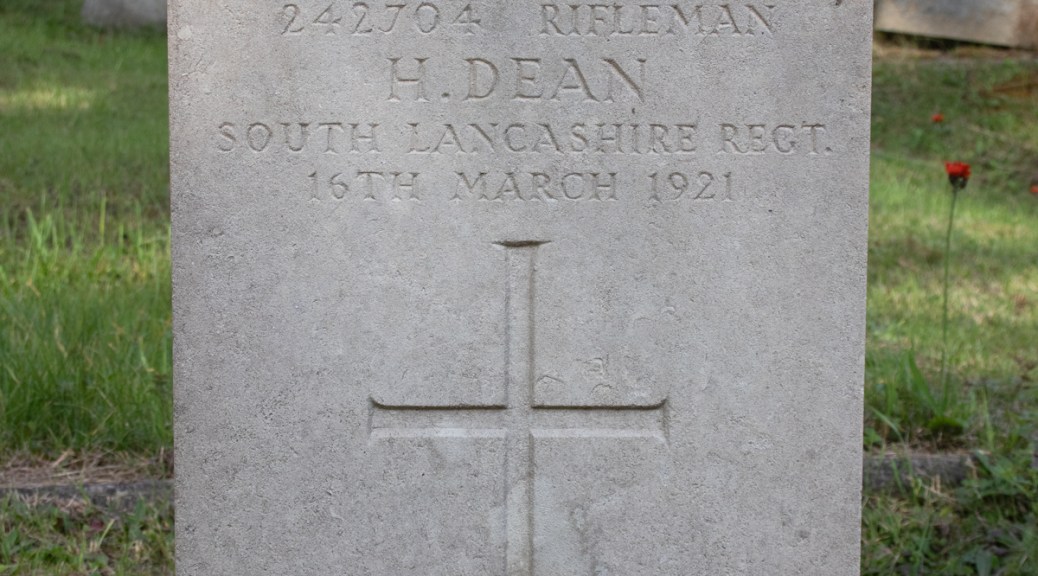
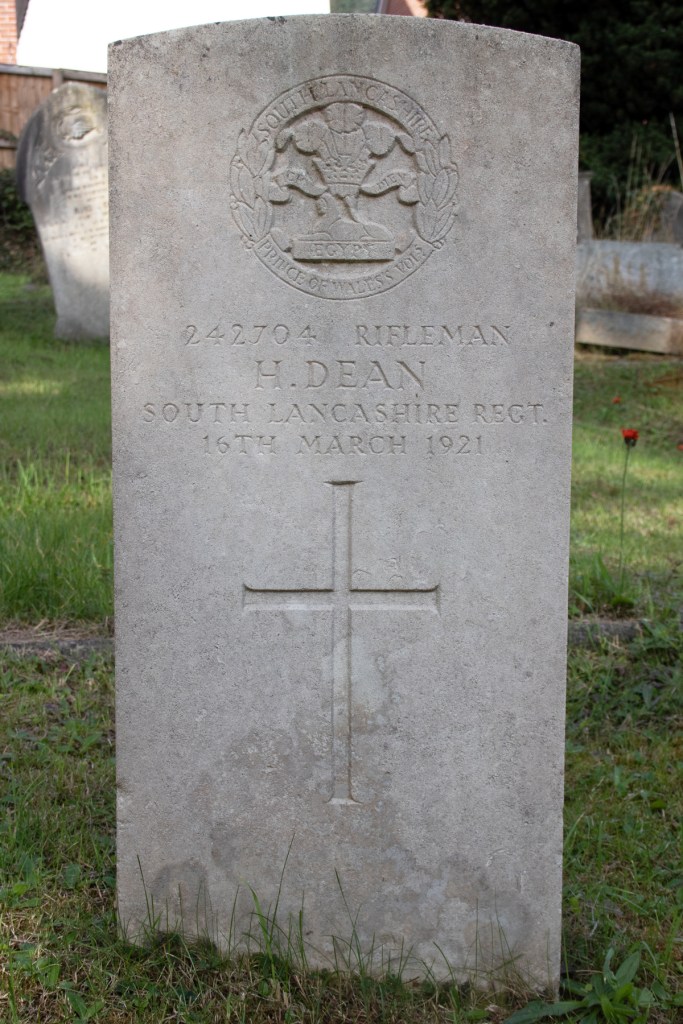
Rifleman Harold Dean

Rifleman Harold Dean

Harold Dean was born in the spring of 1888 in Llangollen, Denbighshire. One of four children to John and Sarah Dean, his father was a waiter at the Hand Hotel in the town until his death in 1905. When Harold left school, he was taken on by the hotel, and, by the time of the 1911 census, was recorded as working as a billiard marker.

War was coming to Europe by this point and, on 24th October 1916, Harold enlisted. He joined the South Lancashire Regiment (also known as The Prince of Wales’s Volunteers) and was assigned to the 2nd/5th Battalion.

After an initial few months’ training, Private Dean was sent to France, and was soon ensconced on the Western Front. Caught up in the fighting, he received a gun shot wound to his left wrist on 7th June 1917 and, after some initial treatment in a camp hospital, he was evacuated to Britain for full recuperation.

Harold remained on home soil for the remainder of the year, He contracted tuberculosis that winter and was medically discharged from the army because of it on 5th December 1917.

At this point, Harold’s trail goes cold. He returned to Llangollen, and remained there after his mother passed away in 1919. It appears that his lung condition continued to dog him, however, and this was probably the cause of his untimely passing. He died on 16th March 1921, at the age of 33 years old.

Harold Dean was laid to rest in Fron Cemetery, in his home town of Llangollen.


Private Joseph Roe

Private Joseph Roe

Joseph Leonard Roe was born on 16th February 1892 in Totnes, Devon. The older of two children, his parents were Francis and Mary Roe. Mary died in 1898, when Joseph was only six years old, leaving Francis, who was a traveller for a wholesale grocer, to raise his sons. Tragically, he also passed away in 1902, and it seems that Joseph and his brother were left in the care of their paternal grandmother.

Hope was to come out of adversity – the 1911 census recorded Joseph as boarding in a school in Tiverton, while his brother, who was called Francis, found work as a clerk at a chartered accountant. He was living with his grandmother Mary and aunt Marian in Weston-super-Mare, Somerset.

Joseph followed in his father’s footsteps, finding work as a chemist’s merchant, and this took him travelling across the country. When war broke out, he was living in Wallasey, Merseyside, and it was from here that, on 28th August 1914, he was to enlist.

Joseph’s service records show that he was 5ft 11ins (1.80m) tall, was of good physical development and had good vision. He was accepted for enlistment into The King’s (Liverpool Regiment), and was assigned to the 10th (Scottish) Battalion.

After a coupe of months’ training, Private Roe set sail for France, arriving in Le Havre on 1st November 1914. His time overseas, however, was to be cut short, however, when he contracted a combination of myalgia, bronchitis and diarrhoea. He was medically evacuated back to Britain on 30th November, and given time to recover.

Private Roe remained on home soil for the remainder of his time in the army. However, he continued to suffer with his health. In the spring of 1916, he contracted tuberculosis and was at his grandmother’s home when he passed away on 4th April. He was just 24 years of age.

Joseph Leonard Roe was laid to rest in Totnes Cemetery, buried in the family grave, and reunited with his parents at last.


Francis, meanwhile, had also played an active part on the First World War. He joined the 2nd Battalion of the South Lancashire Regiment and fought on the Western Front.

While at Etaples, he was wounded, and succumbed to his injuries on 7th January 1916, aged just 21 years old. Second Lieutenant Francis Roe was buried at Etaples Military Cemetery in Northern France.

His sacrifice is also commemorated on the family monument in Totnes Cemetery.


Private William King

Private William King

William Samuel King was born in the summer of 1880, and was one of four children to Richard and Elizabeth King. Richard was a railway worker from Totnes, Devon, and this is where the family were born and raised.

When he left school, William found work as a house painter, and this is a job he continued to do through to the outbreak of the Great War. On 8th June 1908 he married Minnie Edmunds: the couple went on to have a son, Leslie, who was born in 1912. William and Minnie had, by this point, moved to Swansea, West Glamorgan, presumably as work was more plentiful here than in their Devon home. His work as a decorator seems to have been recognised, and he was admitted to the National Association Partnership, Swansea South.

On 1st December 1915, William enlisted and his service records show that he was 5ft 2ins (1.57m) tall. While it is clear that he spent his time on home soil, his service seems a bit disjointed.

Private King wasn’t formally mobilised until September 1916, when he was assigned to the 2nd/2nd Battalion of the Monmouthshire Regiment. In December he was transferred to the Royal West Kent Regiment before returned to his original battalion in February 1917. A month later, he moved to the Bedfordshire Regiment, before moving to the Middlesex Regiment a few weeks later. This also seems to have been a temporary move as, three weeks later, he was assigned to the 337th Works Company of the Labour Corps (although this was still part of the Middlesex Regiment).

The potential reason behind Private King’s haphazard service seemed to become a little clearer when, in September 1917, he was referred to Fort Pitt Hospital in Rochester, Kent. He was noted as being “very talkative, noisy [and] in a state of mental disease… he has… exalted and grandiose ideas and is difficult to restrain.” His mental health was obviously suffering, and he was discharged from military service in December 1917.

William returned home, although it was not to be for long. He passed away on 13th April 1918, at the age of 37 years old. While no cause of death is evident, it seems likely to have been connected to his ‘mania’, which had been exacerbated by his army service.

William Samuel King was laid to rest in Totnes Cemetery, not far from his parental home.


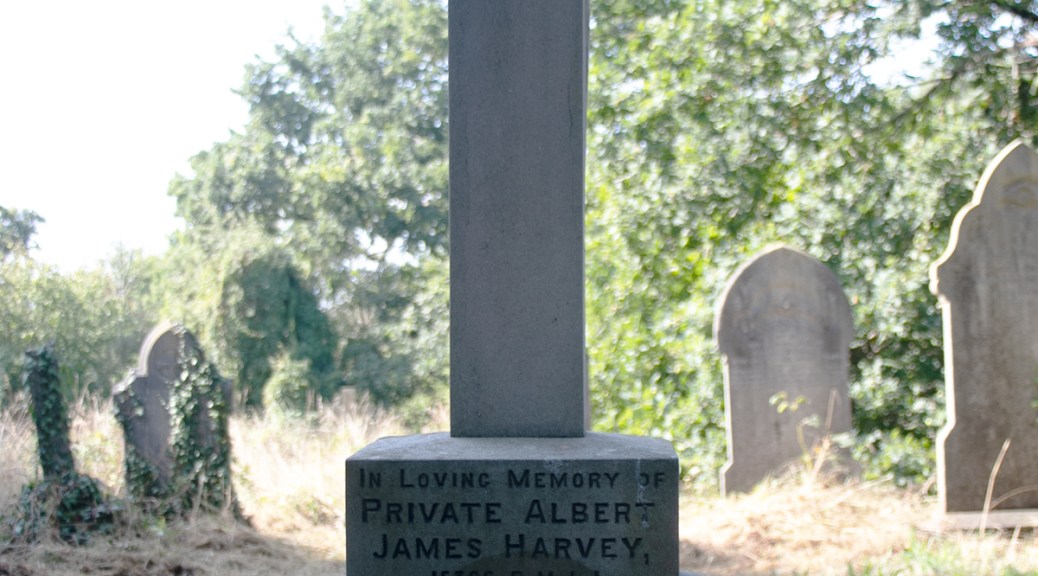
Private Albert Harvey

Private Albert Harvey

Albert James Harvey was born on 23rd May 1894 in the Gloucestershire village of Warmley. One of eleven children, his parents were James and Alice Harvey. James was a bootmaker, and most of Albert’s siblings followed him into shoemaking, but Albert bucked the trend, and found work with a baker when he left school.

He wanted bigger and better things, however, and so, on 26th April 1911, he enlisted in the Royal Marine Light Infantry. His service records record that Private Harvey was 5ft 5.5ins (1.66m) tall, with blue eyes, auburn hair and a fresh complexion. It also suggests that he added a year to his age, to ensure that he was accepted for duty.

After initially enlisting in Deal, Kent, Albert was sent to Plymouth, Devon, where he served for most of 1912. On 18th November that year, he was assigned to the dreadnought battleship HMS Conqueror, on which he was to serve for the nearly five years.

It was during his time on board Conqueror that Albert married Ethel Brewer. The daughter of a pressman, the couple exchanged vows at St Barnabas Church in their shared home village, Warmley.

Private Harvey remained serving throughout the war and, in April 1918, he was involved in the Zeebrugge Raid. This was an attempt by the Royal Navy to block the Belgian port by sinking obsolete ships in the canal entrance. During the operation, more than 200 men were killed and over 300 – including Albert – were wounded.

Private Harvey was medically evacuated to England for treatment, but his injuries were to prove too severe. He passed away in a hospital in Plymouth on 28th June 1918. He was just 24 years old.

Albert James Harvey was brought back to Gloucestershire for burial. He was laid to rest in the graveyard of St Barnabas’ Church, where he has been both baptised and married.


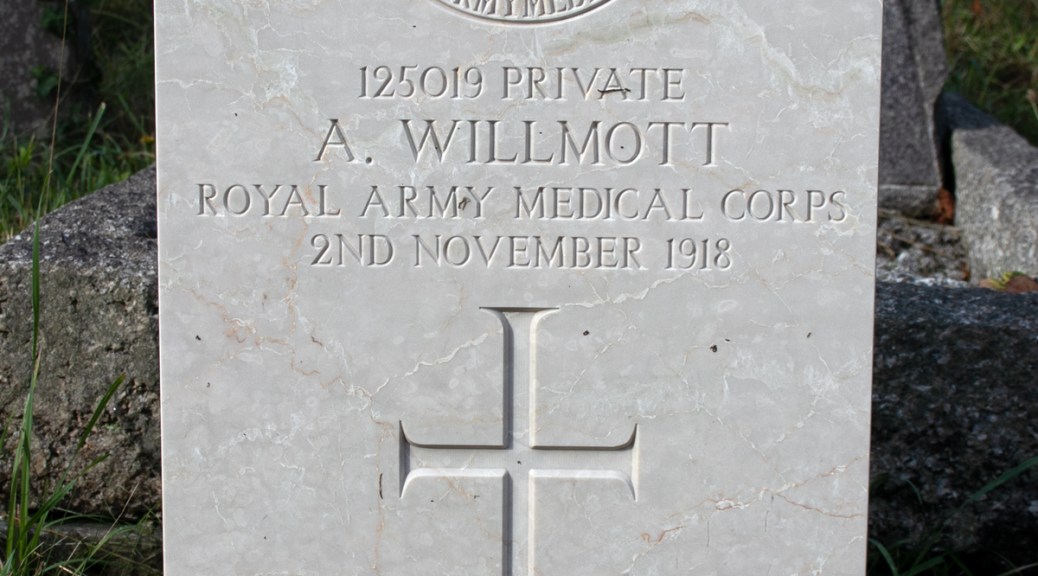
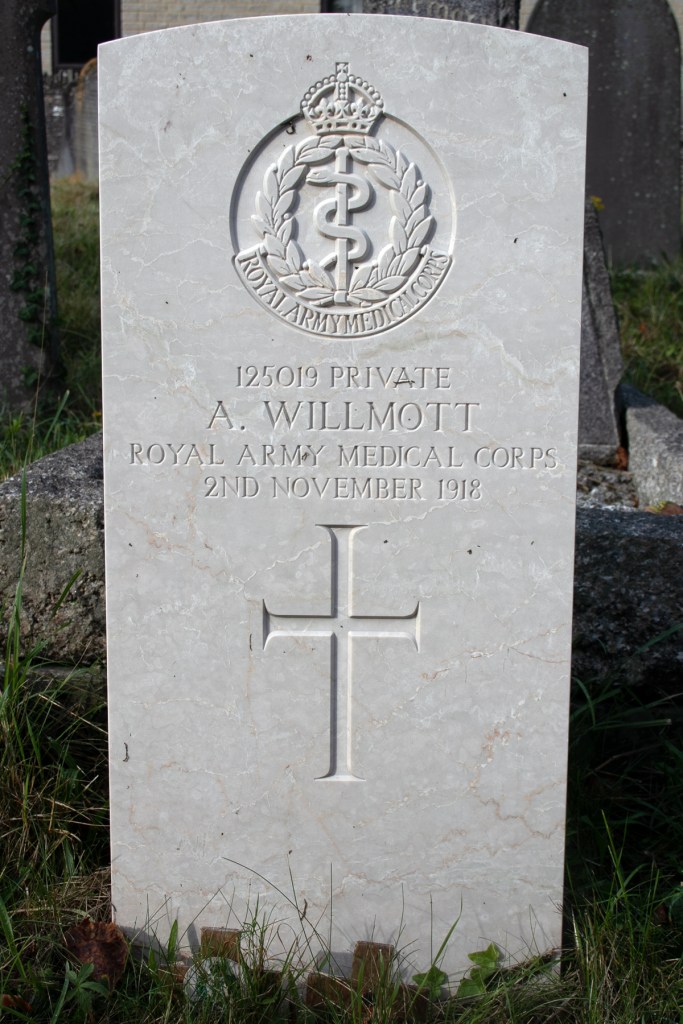
Private Alec Willmott

Private Alec Willmott

Alec William Willmott was born in 1886 and was one of six children to Henry and Ellen Willmott. Henry was a farm labourer from Oldland in Gloucestershire, and this is where the family were raised.

When he left school, Alec found work making shoes and boots at a local factory – this was work most of the Willmott children went into. On 24th April 1916, he married Elsie Frost in the local church. The couple set up home in Keynsham, and went on to have a son, Cecil, who was born in August 1917.

Alec played his part during the war. Full service details are not available, but it is clear that he had enlisted in the Royal Army Medical Corps by the spring of 1918. There is no confirmation of whether Private Willmott served at home or overseas, but, by October 1918, he had been admitted to the 2nd London General Hospital in Chelsea, suffering from a combination of influenza and pneumonia.

Sadly, these conditions put a strong pressure on his heart: Private Willmott passed away from cardiac failure on 2nd November 1918, at the age of just 32 years old.

Alec William Willmott was brought back to Gloucestershire for burial. He was laid to rest in the graveyard of St Anne’s Church in his home village, Oldland.


Private Frank Mayo

Private Frank Mayo

Francis James Stephen Mayo was born on 24th November 1894 in Oldland, a small Gloucestershire village near Bristol. One of eight children, his parents were collier Samuel Mayo and his wife, Diana.

Frank, as he was known, sought a life of adventure from the start. In July 1911, not content with life as a farm labourer, he enlisted in the Royal Navy as a Boy 2nd Class. His service records show that he was 5ft 5ins (1.65m) tall, had light hair, blue eyes and a fair complexion.

Sent to the training ship HMS Impregnable, Boy 2nd Class Mayo’s time there was short. When Samuel found out what his son had done, he paid £10 (the equivalent of around £1250 in today’s money) for his discharge.

Frank went back to farm work, but, with storm clouds brewing on European shores, his time was to come again. On 8th September 1914, just a month after war was declared, he enlisted. His service records show that he had gained an inch (2.5cm) in height since his attempt to join the Royal Navy.

Again, Frank’s attempt to escape what he presumably felt to be a humdrum life were thwarted. His service records confirm that he was discharged on medical grounds because he was deemed not likely to become an efficient sailor.

On Christmas Day 1915, Frank married Martha Sweet, the daughter of a chimney sweep. The couple settled down in Keynsham, not far from either of their families, and had a son, Henry. Frank, by this time, seemed to have given in to the inevitable, and looking for a regular wage, began working at one of the local collieries.

Frank still had a dream to fulfil, though, and with no end to the war in sight, he again enlisted, joining the Training Reserve in June 1917. His records show that he had gained another inch in height, and has a number of tattoos on his right forearm. His records this time show that he had a slight heart problem, and was also suffering from a touch of rheumatism.

Private Mayo was assigned to the 440th Company of the Labour Corps, and seemed, at last, to be fulfilling the role he had wanted to be doing for the last six years. As time went on, however, his health seems to have been failing him and, in the summer of 1918, he contracted pulmonary tuberculosis. He passed away from the condition on 30th August 1918, while at camp, aged just 23 years of age.

Brought back to Gloucestershire for burial, Francis James Stephen Mayo – or Frank – was laid to rest in the graveyard of St Anne’s Church in his home village of Oldland.


Private Robert Cantle

Private Robert Cantle

Robert Cantle’s life is one of hope and of tragedy. There is very little documentation on him, but what there is gives a hint to his life.

The 1911 census recorded him a living on Temple Street in Keynsham, Somerset. The head of the household was 86 year old John Cantle, a retired platelayer for Great Western Railway. His wife, Mary, was 22 years his junior, and they shared the house with their son, stationary cutter Ernest, his wife, Elsie, and their daughter, Madge. Robert was noted as being John and Mary’s adopted son. His age was given as 13, but his place of birth is ‘unknown’.

When war broke out, Robert joined the Wiltshire Regiment. Private Cantle set off for camp in Wiltshire in August 1917, and had been there for just two days when tragedy struck.

There were heavy thunderstorms in the Warminster district on Thursday, and while men of a unit of the Wiltshire Regiment were on the parade ground, three of them were struck by lightning. Pte. Robert Cantle, aged 19 years, whose home is at Keynsham, was killed on the spot, and the other two, Pte. Rowe and Pts Murgatroyd, were severely injured…

Sergeant Major HJ Bennett, of the Wilts Regiment, stated [at the inquest] the deceased lad had only just joined them. About 3pm on Thursday a squad was on the parade ground, when the signal was given to dismiss, as a storm was approaching. Immediately after there was a flash and a crash and it seemed to stagger everybody on the parade ground. Witness was brought to his knees, and when he recovered himself he saw three men, who of whom were struggling, on the ground. Private Cantle was found to be dead, and the other men recovered after being attended by a doctor. The squad consisted of recruits, and none of them were carrying arms.

Major Stocker, medical officer, said the crown of deceased’s cap was ripped off, and the body was burned from head to foot.

The jury returned a verdict of “Death from the effects of lightning.”

Somerset Standard: Friday 17th August 1917

Robert Cantle’s body was brought back to Keynsham for burial: he was laid to rest in the town’s cemetery.


Private George Garrett

Private George Garrett

George Garrett was born in early 1895 in Abbotskerswell, Devon. He was the oldest of five children to George and Annie Garrett. George Sr was a labourer and the family seemed to travel with his work: his and Annie’s younger children were born in Aldershot, Plymouth and London.

When he left school, George Jr found work as an errand boy – the family were back in Devon by this point. War was on the horizon, however, and he would feel compelled to play his part. Full details of his service are not available, but it is known that he enlisted in the Devonshire Regiment, and was assigned to the 2nd Battalion.

Private Garrett arrived in France in December 1915, and was soon entrenched on the Western Front. Hi battalion was caught up in the Battle of the Somme and George was badly injured, having received a gunshot wound to his spine.

Medically evacuated to Britain, his wounds proved too severe for him to return to duty, and he was discharged from the army on 28th December 1916. It is not clear whether he returned home, but it seems likely that he remained in hospital in Exeter. He would never recover from his injuries. He passed away at the hospital on 18th April 1917, at the age of 22 years old.

George Garrett was laid to rest in the graveyard of St Andrew’s Church in Ipplepen, Devon, where his family were, at that point, living.


Private Leonard Luscombe

Private Leonard Luscombe

Leonard Luscombe was born in the spring of 1894 in the Devon village of Ipplepen. He was the fourth of five children to William and Bertha Luscombe, bakers and grocers in the village.

When he left school, Leonard found work as a clerk in a bank, but it is clear he was after bigger and better things. On 27th August 1912 he enlisted in the Royal 1st Devon Yeomanry as a Private. His service records show that he was 5ft 5ins (1.65m) tall, had good vision and was of good physical development.

Private Luscombe was sent to Salisbury Plain in Wiltshire for his training, but then returned to Devon at a base near Bovey Tracey, where he remained when war broke out in 1914. That autumn, he contracted tuberculosis, and it was to prove severe enough for him to be medically discharged from the army in February 1915.

Leonard returned to his life in Ipplepen, but his lung complaint was to dog him for the next few years. He finally succumbed to the condition on 26th October 1918, at the age of just 24 years old.

Leonard Luscombe, whose “cheerful hopefulness and intelligence gained him much popular sympathy” [Western Times: Saturday 2nd November 1918], was laid to rest in the family grave in St Andrew’s Churchyard in his home village.